
Hot Water Circulator Pump Market Size and Share
Market Overview
| Study Period | 2022 - 2032 |
|---|---|
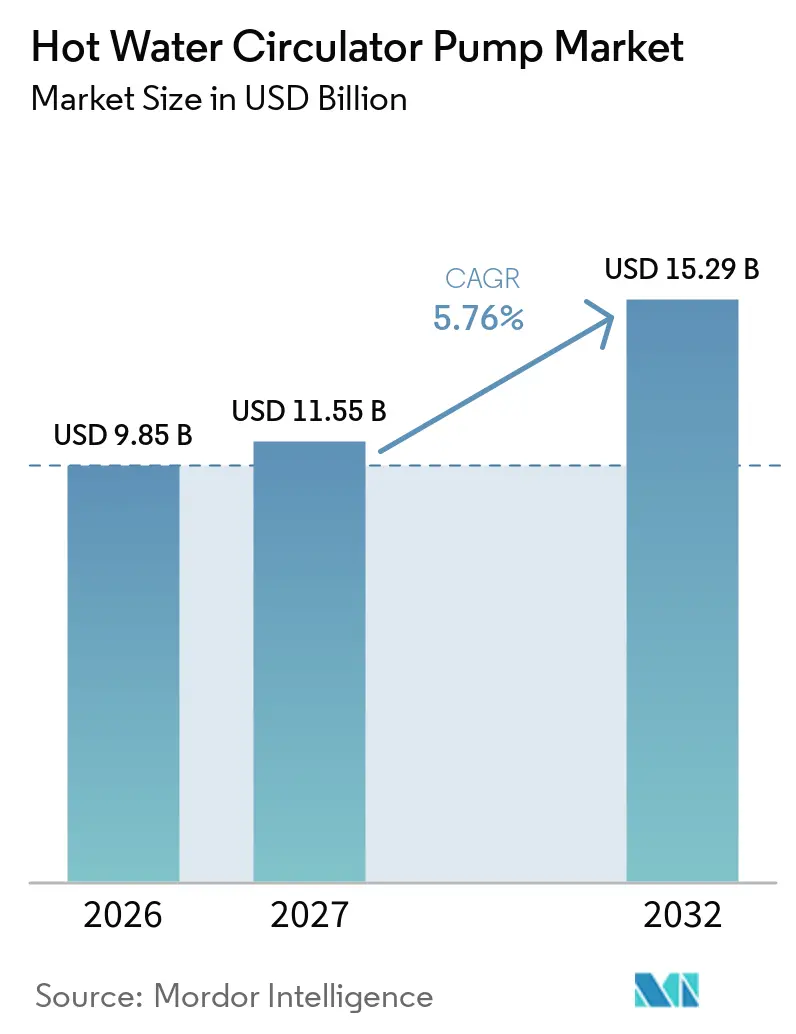
| Market Size (2027) | USD 11.55 Billion |
| Market Size (2032) | USD 15.29 Billion |
| Growth Rate (2027 - 2032) | 5.76 % |
| Fastest Growing Market | Asia-Pacific |
| Largest Market | Europe |
| Market Concentration | Medium |
Major Players *Disclaimer: Major Players sorted in no particular order Image © Mordor Intelligence. Reuse requires attribution under CC BY 4.0. | |
Hot Water Circulator Pump Market Analysis by Mordor Intelligence
The hot water circulator pump market size is projected to be USD 9.85 billion in 2026, USD 11.55 billion in 2027, and reach USD 15.29 billion by 2032, growing at a CAGR of 5.76% from 2027 to 2032. The U.S. efficiency rule creates a defined replacement deadline because pumps made or imported after May 22, 2028 must meet a Circulator Energy Index of 1.00 or lower, while 66% of U.S. shipments did not meet that level when the rule was published.[1] Energy rules in the United States and Europe are moving purchasing toward electronically commutated motors and controls that perform efficiently at different loads.[2] Hygiene rules also favor products that can maintain suitable loop temperatures and support thermal disinfection in commercial and multifamily buildings. New construction remains important, but regulatory replacement demand provides a separate source of sales when housing activity is uneven. The Hot Water Circulator Pump Market therefore favors suppliers that combine compliant products, established distribution, and building-control connectivity.
Key Report Takeaways
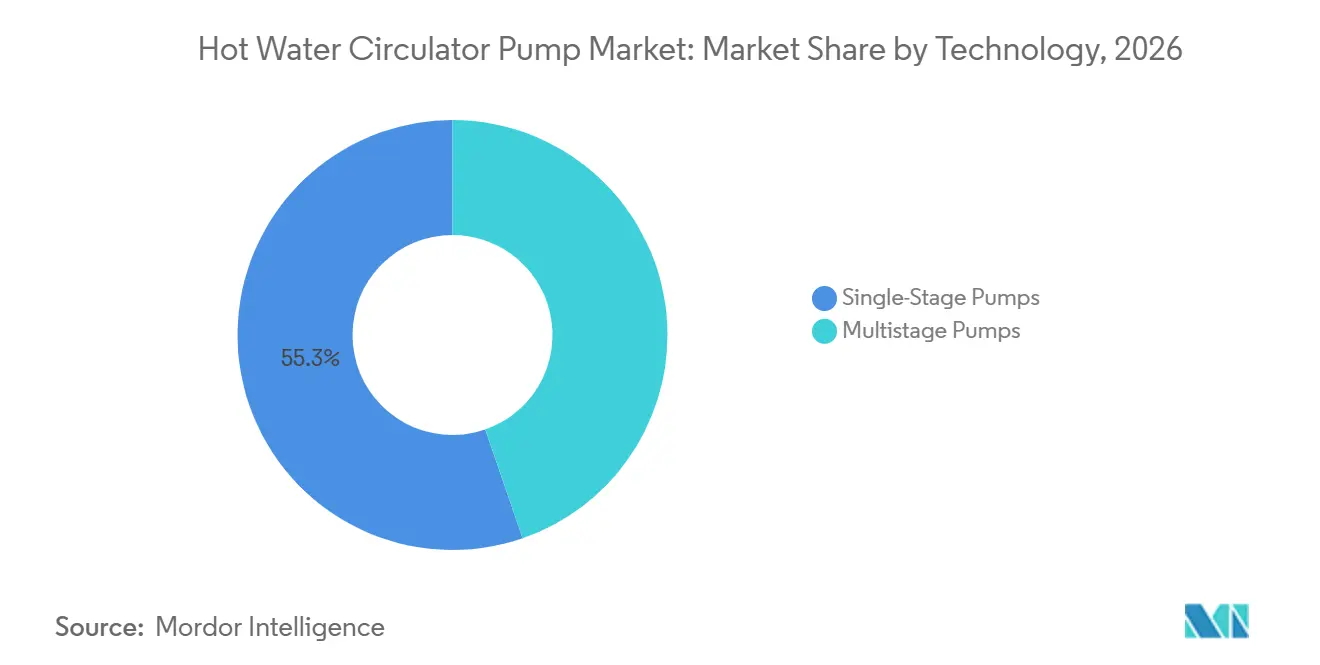
- By technology, single-stage pumps held 55.3% of the hot water circulator pump market share in 2026, while multistage pumps are forecast to grow at a CAGR of 5.9% through 2032.
- By material type, stainless steel held 48.1% of the hot water circulator pump market share in 2026 and is forecast to grow at a CAGR of 5.8% through 2032.
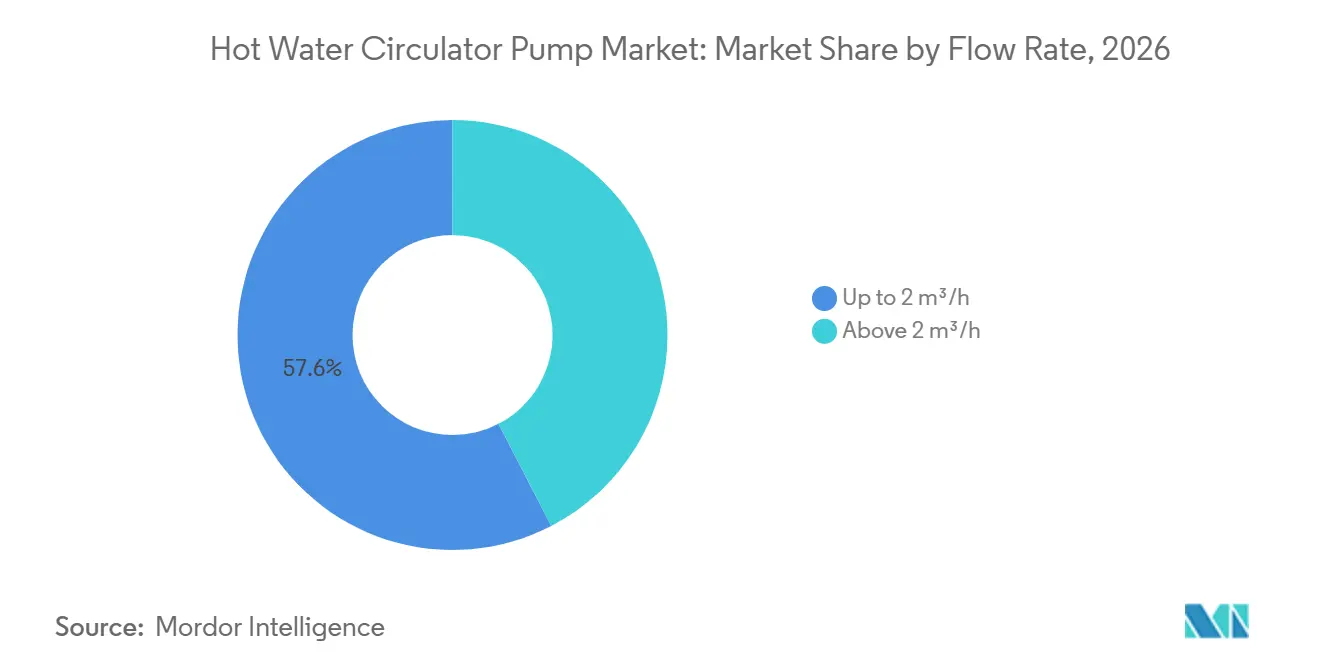
- By flow rate, the up to 2 m³/h segment held 57.6% of revenue in 2026 and is forecast to grow at a CAGR of 6.1% through 2032.
- By pump type, centrifugal pumps held 68.2% of revenue in 2026, while magnetic drive pumps are forecast to grow at a CAGR of 6.3% through 2032.
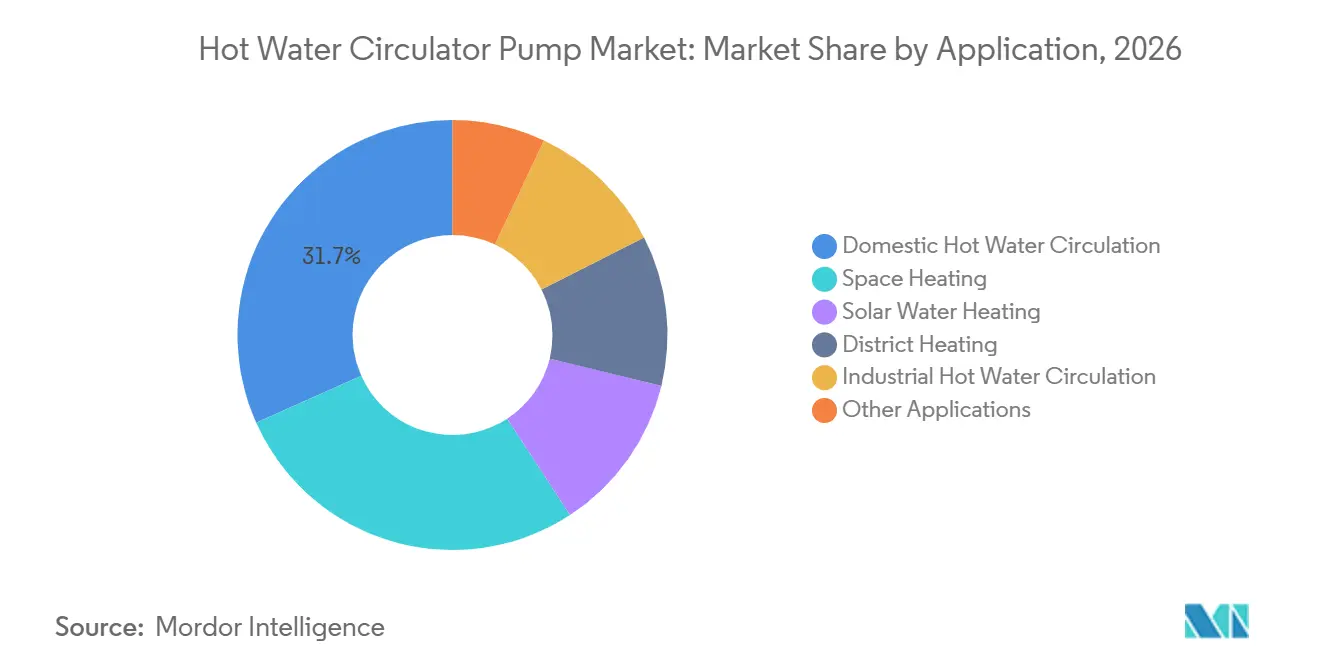
- By application, domestic hot water circulation held 31.7% of revenue in 2026, while solar water heating is forecast to grow at a CAGR of 6.2% through 2032.
- By end user, residential held 52.8% of revenue in 2026, while industrial is forecast to grow at a 7.1% CAGR through 2032. This reflects the interaction between energy performance, water safety, and the need to replace equipment in existing buildings.
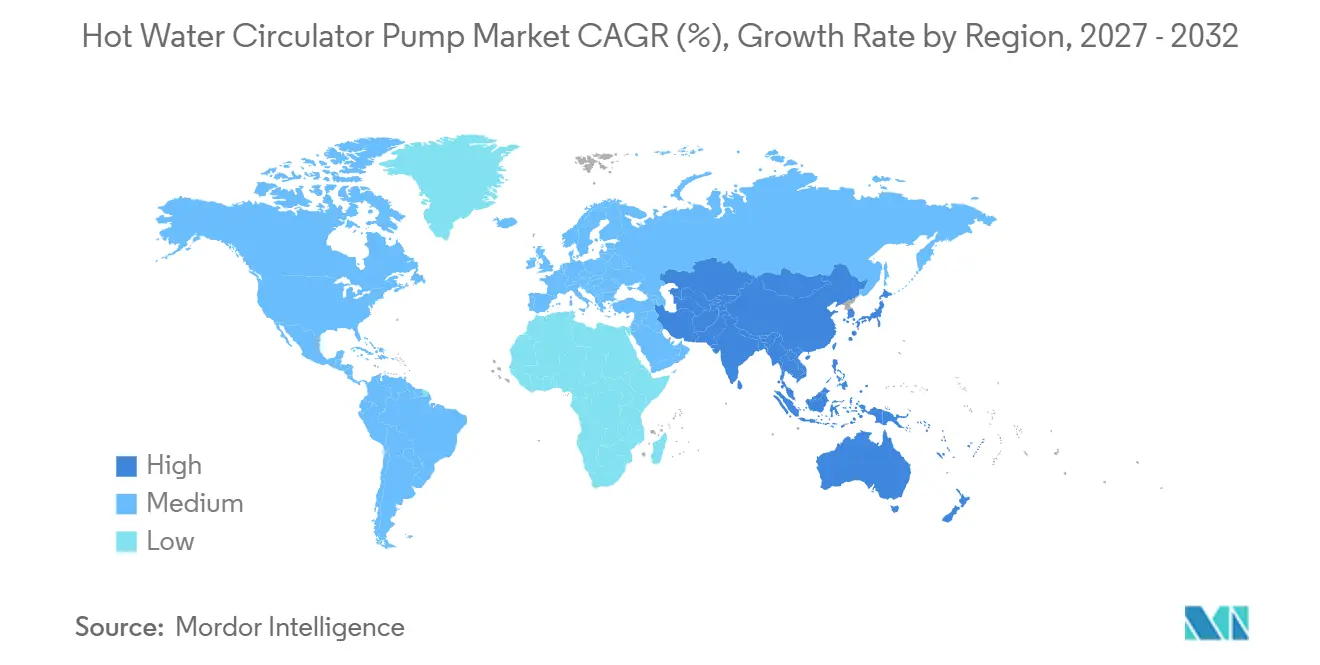
- By geography, Europe accounted for 47.3% of revenue in 2026, while Asia-Pacific is forecast to grow at a CAGR of 8.5% through 2032.
Note: Market numbers in this report are based on Mordor Intelligence's proprietary estimation framework, which combines nine months of actuals with Q4 projections for base year 2026.
Market Trends and Insights
Drivers Impact Analysis of Hot Water Circulator Pump Market*
| Driver | (~) % Impact on CAGR Forecast | Geographic Relevance | Impact Timeline |
|---|---|---|---|
| Energy-Efficiency Standards and Building-Decarbonization Retrofits | +1.3% | Global, with intensity in North America, EU, and Australia | Medium term (2-4 years) |
| Demand for Lower Hot-Water Wait Times and Water Conservation | +0.6% | North America and EU, with spillover to GCC and Australia | Short term (≤ 2 years) |
| Residential and Multifamily Construction | +0.7% | APAC core, with spillover to MEA | Long term (≥ 4 years) |
| Smart Controls, ECM Motors and Building-Management Integration | +1.0% | Global, with early gains in Germany, Netherlands, and South Korea | Medium term (2-4 years) |
| Heat-Pump Water-Heater and Renewable-Heating Deployment | +0.9% | Europe and North America, with emerging demand in Japan and Australia | Medium term (2-4 years) |
| Domestic-Hot-Water Hygiene and Thermal-Disinfection Requirements | +0.5% | EU, with spillover to GCC and ANZ | Short term (≤ 2 years) |
| Source: Mordor Intelligence | |||
Energy-Efficiency Standards and Building-Decarbonization Retrofits
The Hot Water Circulator Pump Market is being reshaped by efficiency requirements that assess performance beyond a pump’s rated load. The U.S. Department of Energy (DOE) rule measures performance at 25%, 50%, 75%, and 100% of best efficiency point, which places greater importance on part-load operation. This approach makes conventional single-phase induction motors less suitable where efficiency falls at reduced loads. It directs U.S. products toward electronically commutated (EC) motor designs before the May 2028 compliance date. Europe has similar direction through Ecodesign rules that set an energy efficiency index (EEI) ceiling of 0.23 for covered glandless circulators. The two frameworks encourage globally aligned product platforms and favor manufacturers that can fund redesign programs across both regions. The compliance change affects product planning, distributor inventory, installation practice, and the timing of customer replacement decisions. A pump that meets a nameplate requirement but performs poorly at lower loads can no longer be treated as equivalent under the DOE method. Suppliers must therefore consider the full operating range when matching motors and hydraulic designs. Larger manufacturers can spread engineering costs across more product families, whereas smaller suppliers may face a narrower path to compliant portfolios.
Smart Controls, ECM Motors and Building-Management Integration
Smart control features are expanding the role of the Hot Water Circulator Pump Market beyond the basic pump unit. Wilo’s Stratos MAXO-Z uses Bluetooth, Modbus RTU, and BACnet MS/TP for building-system connection, with a stated EEI of 0.17 to 0.19. These interfaces support commissioning, operating data exchange, and ongoing system management, which gives owners a way to document pump operation and connect equipment decisions to broader building controls. California’s proposed 2028 Title 24 measure would require variable-speed or demand-flow controls for covered nonresidential service hot-water systems. Armstrong’s The Brain digital mixing center also provides Modbus RTU and BACnet MS/TP connections with remote monitoring through SAGE software. These capabilities make connectivity a product-selection factor in larger commercial systems. Connected pump functions are relevant because the equipment is increasingly specified within a wider building system rather than purchased only as a replacement part. Bluetooth can simplify local data exchange, while Modbus RTU and BACnet MS/TP allow a connection to established building control architectures. Remote monitoring can provide operating records for facilities teams. These features are most relevant where owners need consistent control of water temperature, energy use, and system performance across larger properties.
Heat-Pump Water-Heater and Renewable-Heating Deployment
Heat pump water heaters create demand for circulation equipment that can respond to a narrower operating temperature range. The systems achieve their highest coefficient of performance at storage temperatures of 48°C to 55°C, while hygiene practices require suitable return-loop temperatures. That combination increases the value of speed control and temperature-aware operation. The IEA expects global heat pump sales to recover and more than double under its STEPS scenario. This broadens equipment demand beyond the traditional boiler-replacement cycle. The Hot Water Circulator Pump Market can benefit where installers specify circulation hardware alongside heat pump water-heater systems. The equipment relationship is practical rather than simply a broader heating trend. Storage temperature, return-loop temperature, flow control, and hygiene requirements must work together in a heat pump water-heater installation. A simple on-and-off circulator offers less control over these conditions. The transition supports premium Electronically Commutated (EC) motor products where the system needs to maintain a stable temperature range without undermining the heat pump’s operating performance.
Domestic-Hot-Water Hygiene and Thermal-Disinfection Requirements
Legionella controls are extending hot-water circulation requirements beyond specialist healthcare settings. CEN/TR 16355 describes circulation-loop temperatures of at least 55°C and disinfection cycles at 70°C for 5 to 20 minutes at each draw-off point. These conditions require equipment that can sustain higher operating temperatures and respond to disinfection cycles. Poor loop balancing can create cooler areas that increase hygiene risk and raise the need for related balancing components. This supports demand for controlled circulators and matching system equipment. Temperature control is especially important because cold sections of a poorly balanced loop can undermine the purpose of a disinfection program. The pump, valves, sensors, and commissioning process need to function together. This creates demand for products with embedded detection and control functions. It also raises the importance of technical support for installers and facilities managers responsible for maintaining hot-water systems in occupied buildings.
Restraints Impact Analysis of Hot Water Circulator Pump Market*
| Restraint | (~) % Impact on CAGR Forecast | Geographic Relevance | Impact Timeline |
|---|---|---|---|
| Retrofit Installation Complexity and Dedicated Return-Line Requirements | -0.9% | Global, with intensity in North America and Central/Eastern Europe | Short term (≤ 2 years) |
| High Upfront Cost and Contractor Skill Constraints | -0.7% | APAC, South America, MEA | Medium term (2–4 years) |
| Flow-Accelerated Corrosion, Scaling and Poor System Commissioning | -0.6% | Global, with intensity in MEA, South Asia, and aging infrastructure in Central/Eastern Europe | Medium term (2–4 years) |
| Low Consumer Awareness and Commodity Price Competition | -0.5% | APAC emerging markets (India, Vietnam, Indonesia), South America, MEA | Long term (≥ 4 years) |
| Source: Mordor Intelligence | |||
Retrofit Installation Complexity and Dedicated Return-Line Requirements
Retrofit work limits adoption where older buildings lack a dedicated return pipe. Conventional recirculation requires that line, so new piping can add cost and disruption in older homes and low-rise multifamily properties. A crossover-pump approach can use cold-water lines, but it can reduce performance and complicate commissioning. Existing piping may also have corrosion at elbows and header intersections, which raises the difficulty of modification.[3] Weak retrofit design can leave scaling, galvanic corrosion, and uneven loop temperatures. The Hot Water Circulator Pump Market also faces a training challenge where installers have limited experience with variable-speed pumps and digital controls. The constraint is particularly relevant in older buildings because the physical arrangement of pipework cannot be changed as easily as an individual pump. New routes can disturb finished walls and occupied spaces. Crossover approaches may avoid some construction work, but they do not remove every operational tradeoff. The effect is strongest where owners must weigh water, energy, disruption, equipment cost, and the condition of aging pipes before authorizing a retrofit.
High Upfront Cost and Contractor Skill Constraints
High-efficiency products can cost 2 to 3 times more than standard induction-motor alternatives. The gap can delay voluntary upgrades in price-sensitive parts of Asia-Pacific and South America. Product benefits can be lost when pumps are incorrectly sized or commissioned. This is a particular issue in India, Vietnam, and Indonesia, where qualified hydronic-system engineers are less widely available. Limited awareness of energy losses from hot-water wait times also weakens the case for voluntary replacement. Price pressure in distributor channels can further constrain suppliers that do not have strong premium product positions The price difference is more difficult to overcome when customers focus on the initial purchase rather than the full operating life of the equipment. Installation quality also shapes the customer experience after purchase. Incorrect sizing can prevent expected efficiency gains, and weak commissioning can leave temperature or flow problems unresolved. This makes training, product selection support, and distributor capability important parts of the adoption process in rapidly developing markets.
*Our forecasts treat driver/restraint impacts as directional, not additive. The impact forecasts reflect baseline growth, mix effects, and variable interactions.
Hot Water Circulator Pump Market Segment Analysis
By Technology:
Electronically Commutated Motor (ECM) Transition Reshapes Single-Stage DominanceSingle-Stage Pumps captured 55.3% of technology revenue in 2026. Their broad compatibility supports use in domestic hot-water and space-heating loops. Many residential loops have moderate head requirements, which supports their continued use. Cost and straightforward service also remain important in replacement purchases. The segment benefits from the size of the existing residential installed base.
Multi-Stage Pumps are forecast to grow at 5.9% CAGR through 2032. District-heating substations, large hotel loops, and industrial systems need the higher differential pressures provided by multi-impeller designs. The U.S. Department of Energy (DOE) standard will divide the single-stage category between compliant ECM products and older induction-motor models. Legacy products may leave U.S. distribution as the May 2028 deadline approaches. The Hot Water Circulator Pump Market size for compliant commercial platforms can grow as suppliers redesign products around efficiency rules. In practice, this requires manufacturers to match motor selection, hydraulics, controls, and after-sales support more closely than in earlier product cycles. It also makes product availability and installer familiarity important during the shift from conventional designs. The technical change does not remove the need for simple, serviceable products in routine residential work. It changes the motor and control features that suppliers must incorporate within familiar pump formats. Multistage designs retain a separate role when systems need greater pressure. The result is a technology mix in which the installed base sustains single-stage volume while larger projects support multistage growth.

By Material Type:
Stainless Steel Benefits from Hygiene and Corrosion RequirementsStainless Steel held 48.1% of material revenue in 2026. Its position reflects demand for products compatible with periodic high-temperature hygiene cycles. Repeated heating can affect less durable materials in demanding service conditions. Bronze remained important in older mixed-metal piping systems because of its machinability and low iron-contamination risk. Cast Iron is losing relevance where corrosion, weight, and scale accumulation are material concerns.
Stainless Steel is forecast to grow at 5.8% CAGR through 2032. Pharmaceutical and food-processing systems require nonreactive wetted surfaces that can support clean-in-place processes. Grundfos introduced the COMFORT XL in 2026 with stainless construction and compatibility with both 140 mm and 150 mm legacy port-to-port dimensions.[4] This configuration can reduce the need for pipe changes during replacement. Its material position reflects hygiene requirements and retrofit practicality. This favors designs that can address both water quality needs and the physical constraints of aging buildings. The replacement case is therefore stronger when a supplier can provide a compatible product without requiring extensive site modification. Material choice also influences service life, maintenance expectations, and customer acceptance in systems that undergo repeated high-temperature operation. Stainless steel is relevant where water-contact surfaces must be robust and compatible with hygiene procedures. Bronze retains value in installed systems with older materials, while Cast Iron faces more limitations in modern loop designs. Manufacturers can use connection compatibility and durable materials together to ease replacement decisions.
By Flow Rate:
Small-Circuit Pumps Drive Regulatory Replacement DemandThe Up to 2 m³/h category held 57.6% of revenue in 2026. Single-family and small multifamily loops commonly operate within this range. The category has a large replacement base linked to the age of installed housing stock, and that base can sustain demand even when the pace of newly built housing changes from one period to another. This provides recurring demand that is less tied to new construction. Compact pumps also suit the service needs of smaller domestic systems.
Up to 2 m³/h is forecast to grow at 6.1% CAGR through 2032. The U.S. Department of Energy (DOE) and European requirements will concentrate replacement demand in the small residential pump range. Pumps above 2 m³/h continue to serve commercial and district-heating applications with longer loops and higher heat loads. California’s proposed controls measure can reinforce demand for electronic control at smaller scales in covered nonresidential systems. The Hot Water Circulator Pump Market share of smaller pumps reflects a high-volume residential replacement cycle. The high installed base means that a small improvement in replacement compliance can affect a large number of routine service purchases. Manufacturers are thus likely to prioritize compact Electronically Commutated (EC) motor products that fit established residential system layouts. Smaller pumps are common because most residential systems do not require the capacity of commercial or district-heating installations. Their volume position is therefore linked to ordinary maintenance and replacement activity in housing stock. Larger flow classes remain important for facilities with more branches, longer loops, or higher loads. The different flow ranges require suppliers to serve both high-volume routine replacements and lower-volume engineered applications.
By Pump Type:
Centrifugal Products Lead While Magnetic Drive ExpandsCentrifugal pumps accounted for 68.2% of pump-type revenue in 2026. Their efficiency curves align with the flow and head needs of closed-loop hot-water systems. Manufacturers and service providers are familiar with the design. Spare parts are available across many regions. Electronically Commutated (EC) motor integration can also be added without a fundamental pump-body redesign.
Magnetic Drive Pumps are forecast to grow at 6.3% CAGR through 2032. Their sealed construction addresses leakage and contamination concerns in pharmaceutical, semiconductor, and food-processing hot-water applications. Positive Displacement Pumps remain relevant where dosing precision or fluid viscosity is more important than efficiency. In-line and vertical multistage products serve compact or higher-pressure HVAC applications. The Hot Water Circulator Pump Market has a specialty opportunity where process requirements make conventional mechanical seals less suitable. The contrast between broad centrifugal demand and specialized magnetic drive demand leaves room for both high-volume standard platforms and higher-value products for controlled industrial environments. Product choice depends on the required operating conditions rather than a single universal design. Centrifugal products benefit from a broad service ecosystem and standard operating fit across closed-loop systems. Magnetic drive products address a narrower group of installations, but their value proposition is clear where containment is essential. Positive displacement and other designs remain useful for specific operating needs. This keeps the category diverse even though centrifugal pumps have the strongest revenue position.
By Application:
Domestic Circulation Leads While Solar Heating AdvancesDomestic Hot Water Circulation held 31.7% of application revenue in 2026. Centralized hot-water systems in European and North American residential and hospitality buildings support this position. Space heating and district heating also remain important applications. European investment in lower-carbon urban heating networks supports district-heating demand. Domestic systems continue to provide the broadest installed base for replacement activity.
Solar Water Heating is forecast to grow at 6.2% CAGR through 2032. Solar primary-circuit pumps handle glycol-water mixtures and may operate at temperatures approaching 120°C. They also need protection against cavitation and overheating during periods of high solar input and low water draw. These requirements favor suppliers with relevant application capabilities. EU rules exempt solar primary-circuit circulators from the covered EEI requirements, reducing a potential cost barrier. The different operating conditions show why application knowledge matters, particularly where temperature, fluid properties, and intermittent demand create installation risks. Suppliers that support installation and commissioning can reduce those risks for system owners. Application requirements vary materially between routine domestic circulation and solar thermal systems. Domestic installations emphasize reliable delivery and replacement compatibility. Solar installations require a pump capable of handling high temperature, glycol-water fluid, and changing solar conditions. District heating and space-heating installations bring their own system requirements, which keeps application expertise relevant to product selection.
By End User:
Residential Volume Supports Industrial Premium GrowthResidential held 52.8% of end-user revenue in 2026. Global housing stock creates a large and recurring replacement base. Electronically Commutated (EC)-motor replacements can carry higher selling prices than the induction-motor products they replace. Commercial buyers in hospitality, healthcare, and institutions face water-safety and building-management requirements. Those needs can raise system values above typical residential specifications.
Industrial is forecast to grow at 7.1% CAGR through 2032. Pharmaceutical sterilization, food and beverage production, and district-energy projects require more demanding process-heat equipment. These systems can require high-alloy stainless steel or magnetic drive configurations for sustained higher-temperature operation. The International Energy Agency (IEA) identifies industrial heat as a priority for electrification in key scenarios. The Hot Water Circulator Pump Market can therefore see stronger value per unit in industrial projects than in standard residential replacements. Residential replacements remain sensitive to installation simplicity, while industrial buyers focus more on operating reliability and system specification. This distinction supports different product and service approaches across the main customer groups. Residential buyers are supported by the large installed base, but they often prioritize cost, installation ease, and simple service. Commercial buyers place more weight on water safety practices and building-system integration. Industrial buyers need designs suited to continuous and demanding process conditions. These differences explain why the largest customer base and the fastest-growth customer base are not the same.
Geography Analysis
Europe Hot Water Circulator Pump Market
Europe led with 47.3% of global revenue in 2026. The region combines older building stock, efficiency regulations, and extensive district-heating infrastructure. The Hot Water Circulator Pump Market share in Europe reflects these connected sources of demand. Covered EU glandless circulators must meet an Energy Efficiency Index (EEI) ceiling of 0.23. Germany supports heating optimization through hydraulic-balancing requirements.
North America Hot Water Circulator Pump Market
In North America, an established replacement base and multifamily construction support demand. The May 2028 Department of Energy (DOE) compliance date is a major short-term catalyst because 66% of U.S. shipments did not meet the new standard when it was published. This requires manufacturers and distributors to transition their product ranges. Canadian retrofit incentives extend the replacement opportunity. Mexico adds hospitality and commercial demand, while western U.S. water-conservation rules support interest in reducing hot-water wait times, shifting recirculation from a discretionary convenience feature toward a water-management consideration, especially where building owners seek to reduce the time spent waiting for hot water at the point of use. The Circulator Efficiency Index (CEI) transition also creates an incentive for distributors to manage stock carefully as the deadline approaches. Manufacturers with compliant products already available can help contractors avoid a last-minute product change. This favors established supply relationships in a region where replacement demand is already significant.
The Americas, EMEA and APAC Hot Water Circulator Pump Market
Asia-Pacific is forecast to grow at 8.5% CAGR through 2032. Construction, solar thermal deployment, manufacturing development, and heat pump water-heater programs support demand across a range of building and industrial applications. Construction activity, solar thermal deployment, and industrial development support the regional outlook, with India, Vietnam, and Indonesia contributing building and process-heat demand across several customer categories. China continues to add building space with centralized hot-water systems and building electrification policies. Vietnam, Indonesia, and Thailand are adding industrial demand through manufacturing investment. Australia and South Korea support heat pump water heaters through incentive programs. Saudi Arabia and the UAE also support higher-specification systems in hospitality and mixed-use projects, while Brazil, South Africa, Chile, and Morocco remain accessible longer-term entry points. Regional demand differs because building stock, local codes, heating systems, and project activity are not uniform. Suppliers need a product portfolio that can meet local installation practices while maintaining consistent compliance performance. Europe’s regulation-led replacement activity differs from North America’s pending CEI transition and Asia-Pacific’s combination of construction, solar thermal systems, and industrial expansion. These regional patterns affect the types of pumps, materials, and control features that customers specify. They also affect channel strategy, because replacement-led demand and project-led demand require different sales and service approaches. A global supplier must respond to both without treating all regional markets as identical.
Competitive Landscape
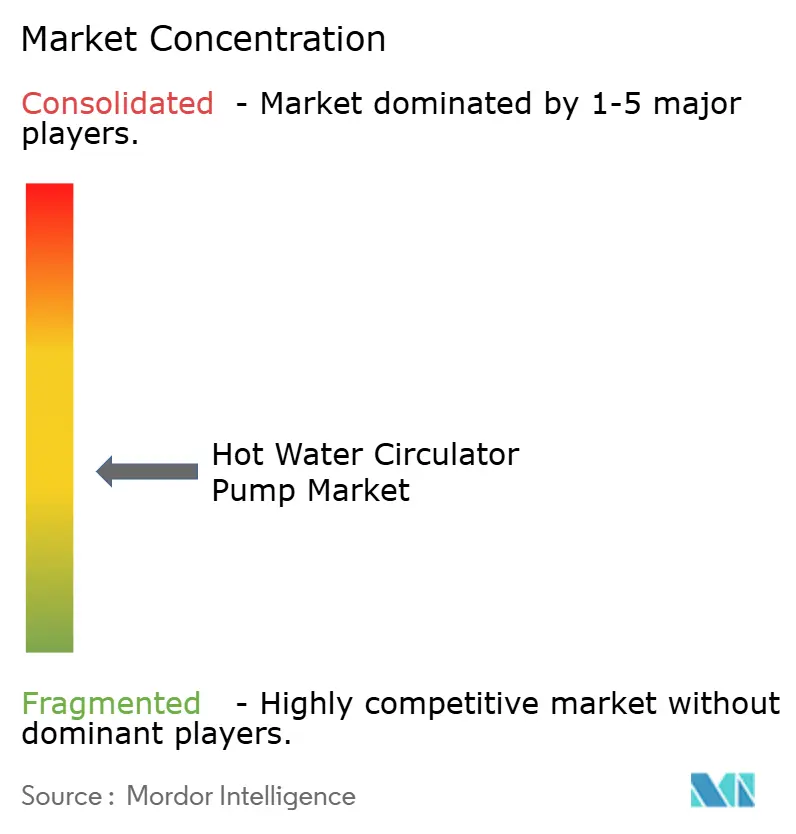
The Hot Water Circulator Pump Market is moderately concentrated around Grundfos, Wilo SE, Xylem, and KSB. These suppliers compete through product efficiency, controls, system integration, and established service networks. Grundfos has a strong position in residential and commercial applications through its COMFORT and ALPHA platform families. Wilo competes in larger buildings and district heating through the Stratos MAXO-Z and Stratos GIGA2.0-I. The latter uses an IE5-class Electronically Commutated (EC) motor in premium commercial HVAC applications. The competitive emphasis has shifted from basic hardware pricing toward connected products that integrate with building-management systems. This approach helps leading manufacturers differentiate products that would otherwise compete mainly on pump-body price and basic hydraulic performance. It also increases the importance of communication standards, commissioning support, and the ability to work within the control systems used by commercial building owners. These capabilities complement rather than replace the need for efficient motors, durable materials, and reliable service support.
Grundfos displayed its ALPHA HWR hot-water recirculation pump and expanded E-pump portfolio at AHR Expo 2026. The COMFORT XL provides 140 mm and 150 mm connection compatibility for multifamily replacement work. KSB commissioned 40 Etaline and Etabloc pumps with PumpMeter devices at the Überseeinsel district energy center in Bremen during April 2025. These examples show that product development and engineered project delivery remain important competitive tools. A replacement product can compete on compatibility and ease of installation, while a district-energy project can require engineering capability, monitoring devices, and coordination with a wider system design. The range of buyer needs allows suppliers to differentiate through both standardized product families and specialized project expertise. Companies that can serve both pathways have broader options as demand changes across regions and applications.
Armstrong Fluid Technology, ITT Inc., Taco Comfort Solutions, DAB Pumps, and Calpeda address application-specific or regional opportunities. Armstrong offers its digital mixing center for commercial and healthcare hot-water loops, with RS-485 building-system integration and SAGE remote monitoring. Companies with products that meet both U.S. Circulator Energy Index (CEI) and EU Energy Efficiency Index (EEI) rules can reduce the need for region-specific redesign. Digital controls can help suppliers remain involved after the initial equipment sale through monitoring and service. Demand-controlled systems for buildings without dedicated return lines are an unresolved technical opportunity. Predictive maintenance is also relevant in industrial hot-water loops where uptime is important. The competitive position of each supplier also depends on the ability to provide technical support to distributors, installers, and project engineers. This can matter when products require electronic setup, hydraulic balancing, or connection to a building management system. Competition also depends on the ability to meet performance rules before compliance deadlines and to make those products available through established channels. Product platforms that connect to building systems can support a longer relationship with owners after installation. At the same time, specialized suppliers can remain competitive where a particular application or local service capability is important. The market is not defined by one product approach, although compliance and control features are increasingly central.
Hot Water Circulator Pump Industry Leaders
-
Grundfos
-
Wilo SE
-
Xylem Inc.
-
Taco Comfort Solutions
-
KSB SE & Co. KGaA
- *Disclaimer: Major Players sorted in no particular order
Hot Water Circulator Pump Market Companies Covered in this Report
- A. O. Smith Corporation
- Armstrong Fluid Technology
- Bell & Gossett
- Calpeda S.p.A.
- CNP Pumps India Pvt. Ltd.
- DAB Pumps
- Danfoss A/S
- Ebara Corporation
- Ebara Pumps Europe S.p.A.
- Flowserve Corporation
- Grundfos
- ITT Inc.
- Kirloskar Brothers Limited
- KSB SE & Co. KGaA
- NIBE Industrier AB
- Pentair plc
- Rheem Manufacturing Company
- Stiebel Eltron GmbH & Co. KG
- Sulzer Ltd
- Taco Comfort Solutions
- Wilo SE
- Xylem Inc.
Recent Industry Developments in Hot Water Circulator Pump Market
- August 2026: Xylem Inc. agreed to acquire the Cornell Pump and Roper Pump businesses from Indicor for USD 1.46 billion, significantly expanding its position in engineered pumping applications beyond traditional municipal water infrastructure. The acquisition adds specialized pump technologies for slurry transport, solids handling, self-priming operation, and high suction-lift applications, strengthening Xylem's presence in mining, construction, agriculture, food processing, energy, and industrial process markets.
- February 2026: Grundfos used AHR Expo 2026 to introduce an expanded range of electronically controlled E-pumps for commercial HVAC and hydronic applications. The expanded platform incorporates IE5 motor technology, adaptive speed control, integrated sensors, cloud connectivity, and predictive maintenance functions to reduce energy consumption and simplify system management.
- June 2025: Taco Comfort Solutions updated its SmartPlus® hot water recirculation system with adjustable runtime controls and a 72-hour memory backup. The demand-based system automatically learns household hot-water usage patterns and operates only when needed, reducing electrical consumption by up to 94% compared with conventional continuously operating recirculation systems.
- April 2025: KSB SE commissioned 40 Etaline and Etabloc pumps equipped with PumpMeter monitoring technology at the new Überseeinsel district energy centre in Bremen, Germany, a project developed by STADT.ENERGIE.SPEICHER GmbH. The EUR 19 million facility integrates a 5 MW river-water heat pump, thermal storage systems, power-to-heat units, and combined heating and cooling networks to provide low-carbon energy for approximately 650 residential units and commercial buildings.
Global Hot Water Circulator Pump Market Report Scope
A hot water circulator pump is a mechanical device that continuously circulates hot water through a building's plumbing system, ensuring heated water is immediately available at any tap or fixture. Keeping hot water moving between the water heater and points of use prevents water from cooling in the pipes when not in use. This continuous loop eliminates the need to run the tap while waiting for hot water, reducing domestic water waste and improving energy efficiency.
The global hot water circulator pump market is segmented by technology (single-stage pumps and multistage pumps), material type (stainless steel, bronze, cast iron, and other material types), flow rate (up to 2 m³/h and above 2 m³/h), pump type (centrifugal pumps, positive displacement pumps, magnetic drive pumps, and other pump types), application (domestic hot water circulation, space heating, solar water heating, district heating, industrial hot water circulation, and other applications), and end user (residential, commercial, and industrial). The report also covers market size and forecasts for the global hot water circulator pump market across 28 countries in key regions. For each segment, market sizing and forecasts are provided on the basis of value (USD).
Segmentation Overview
| Single-Stage Pumps |
| Multistage Pumps |
| Stainless Steel |
| Bronze |
| Cast Iron |
| Other Material Types |
| Up to 2 m³/h |
| Above 2 m³/h |
| Centrifugal Pumps |
| Positive Displacement Pumps |
| Magnetic Drive Pumps |
| Other Pump Types |
| Domestic Hot Water Circulation |
| Space Heating |
| Solar Water Heating |
| District Heating |
| Industrial Hot Water Circulation |
| Other Applications |
| Residential |
| Commercial |
| Industrial |
| North America | United States |
| Canada | |
| Mexico | |
| Rest of North America | |
| South America | Brazil |
| Argentina | |
| Chile | |
| Rest of South America | |
| Europe | Germany |
| France | |
| Italy | |
| Spain | |
| United Kingdom | |
| Poland | |
| Russia | |
| Rest of Europe | |
| Asia-Pacific | China |
| India | |
| Japan | |
| South Korea | |
| Australia | |
| Indonesia | |
| Vietnam | |
| Thailand | |
| Rest of Asia-Pacific | |
| Middle East | Saudi Arabia |
| United Arab Emirates | |
| Turkey | |
| Jordan | |
| Rest of Middle East | |
| Africa | South Africa |
| Egypt | |
| Morocco | |
| Rest of Africa |
| By Technology | Single-Stage Pumps | |
| Multistage Pumps | ||
| By Material Type | Stainless Steel | |
| Bronze | ||
| Cast Iron | ||
| Other Material Types | ||
| By Flow Rate | Up to 2 m³/h | |
| Above 2 m³/h | ||
| By Pump Type | Centrifugal Pumps | |
| Positive Displacement Pumps | ||
| Magnetic Drive Pumps | ||
| Other Pump Types | ||
| By Application | Domestic Hot Water Circulation | |
| Space Heating | ||
| Solar Water Heating | ||
| District Heating | ||
| Industrial Hot Water Circulation | ||
| Other Applications | ||
| By End User | Residential | |
| Commercial | ||
| Industrial | ||
| By Geography | North America | United States |
| Canada | ||
| Mexico | ||
| Rest of North America | ||
| South America | Brazil | |
| Argentina | ||
| Chile | ||
| Rest of South America | ||
| Europe | Germany | |
| France | ||
| Italy | ||
| Spain | ||
| United Kingdom | ||
| Poland | ||
| Russia | ||
| Rest of Europe | ||
| Asia-Pacific | China | |
| India | ||
| Japan | ||
| South Korea | ||
| Australia | ||
| Indonesia | ||
| Vietnam | ||
| Thailand | ||
| Rest of Asia-Pacific | ||
| Middle East | Saudi Arabia | |
| United Arab Emirates | ||
| Turkey | ||
| Jordan | ||
| Rest of Middle East | ||
| Africa | South Africa | |
| Egypt | ||
| Morocco | ||
| Rest of Africa | ||
Key Questions Answered in the Report
What is the projected value of the hot water circulator pump market by 2032?
The market is projected to reach USD 15.29 billion by 2032, growing at a CAGR of 5.76% from 2027. Demand is supported by efficiency-driven replacements, EC motor products with connectivity features, and system requirements linked to hot-water hygiene and thermal disinfection.
Which pump technology leads hot-water circulation revenue?
Single-stage pumps accounted for 55.3% of technology revenue in 2026. Their broad compatibility with domestic hot-water and space-heating loops, combined with ease of serviceability and a large residential installed base, supports their dominant position.
Which material is most widely used in hot-water circulator pumps?
Stainless steel accounted for 48.1% of material revenue in 2026 and is forecast to grow at a CAGR of 5.8%. It is preferred in applications requiring resistance to repeated high-temperature hygiene cycles and nonreactive wetted surfaces.
Which region is growing fastest for hot-water circulator pumps?
Asia-Pacific is forecast to grow at a CAGR of 8.5% through 2032. Construction activity, solar thermal deployment, manufacturing expansion, and heat pump water-heater programs are driving demand across a range of building and industrial applications.
Which end user is expected to grow fastest?
Industrial end users are forecast to grow at a CAGR of 7.1% through 2032, supported by process-heat requirements and electrification initiatives. Pharmaceutical sterilization, food and beverage production, and district-energy projects require more specialized circulation equipment.