
Heated Tobacco Products Market Size and Share
Market Overview
| Study Period | 2021 - 2031 |
|---|---|
| Market Size (2026) | USD 58.53 Billion |
| Market Size (2031) | USD 118.39 Billion |
| Growth Rate (2026 - 2031) | 15.13 % |
| Fastest Growing Market | Europe |
| Largest Market | Asia-Pacific |
| Market Concentration | High |
Major Players *Disclaimer: Major Players sorted in no particular order Image © Mordor Intelligence. Reuse requires attribution under CC BY 4.0. | |
Heated Tobacco Products Market Analysis by Mordor Intelligence
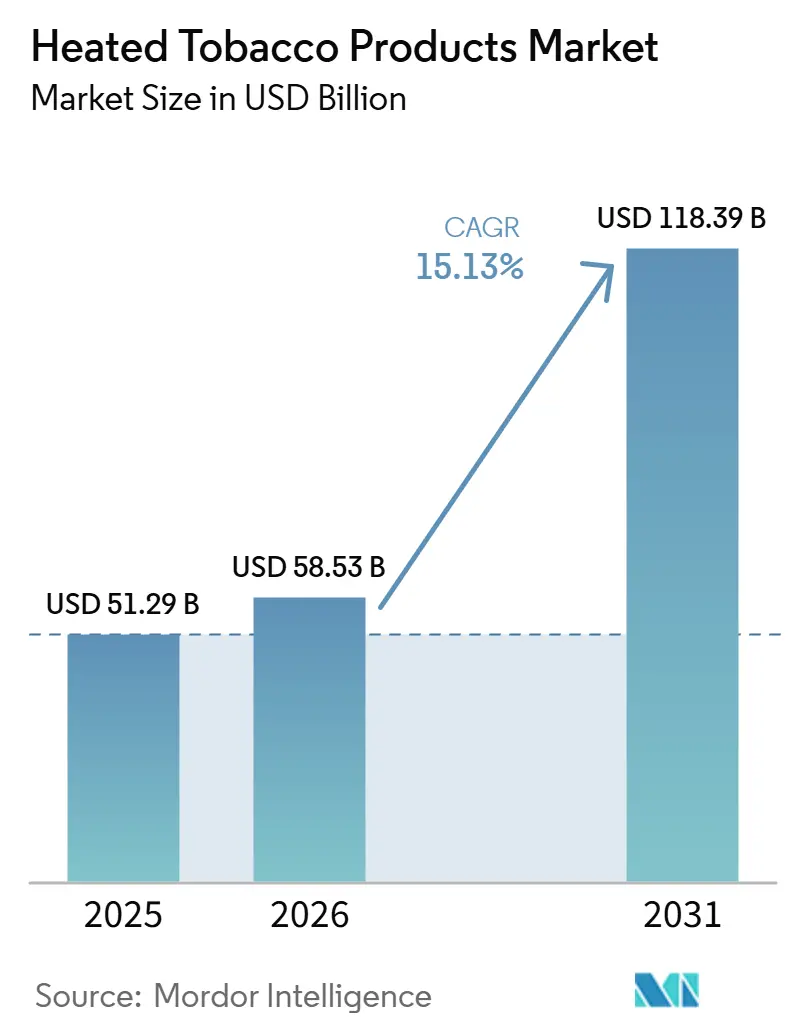
The heated tobacco products market size is expected to grow from USD 51.29 billion in 2025 to USD 58.53 billion in 2026 and reach USD 118.39 billion by 2031, registering a CAGR of 15.13% during 2026-2031. The market is expanding even as global tobacco use declines, as some smokers are shifting from combustible products to device-based alternatives instead of quitting nicotine use. Adult tobacco use prevalence fell from 26.2% in 2010 to 19.5% in 2024, while the number of tobacco users declined to 1.2 billion in 2024. Faster product launches, wider regulatory recognition of reduced-exposure claims, and strong retail networks of major tobacco companies are supporting growth. The projected 2026 value of USD 58.5 billion shows early acceleration, driven by premium devices, refill sales, and direct-to-consumer reorder models. Large incumbents remain well positioned because approvals, patents, and device ecosystems are difficult to replicate. PMI is expected to report more than 43 million legal-age users of smoke-free products by the end of 2025. EU flavor limits, country-specific reviews, and vaping competition may affect regional product mix, but they are unlikely to slow the market’s long-term growth path.
Key Report Takeaways
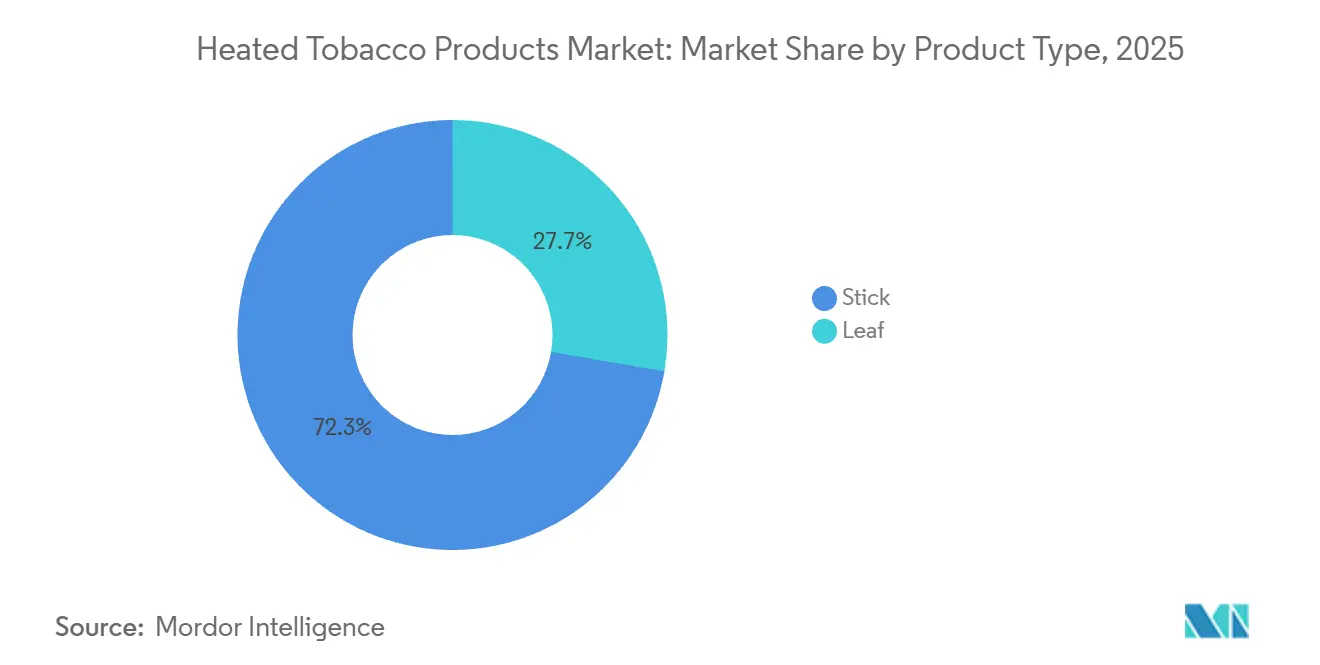
- By product type, stick products held 72.3% of revenue in 2025, while leaf products are projected to grow at a 16.7% CAGR through 2031.
- By category, regular products accounted for 63.1% of revenue in 2025, while flavored products are forecast to expand at a 17.2% CAGR through 2031.
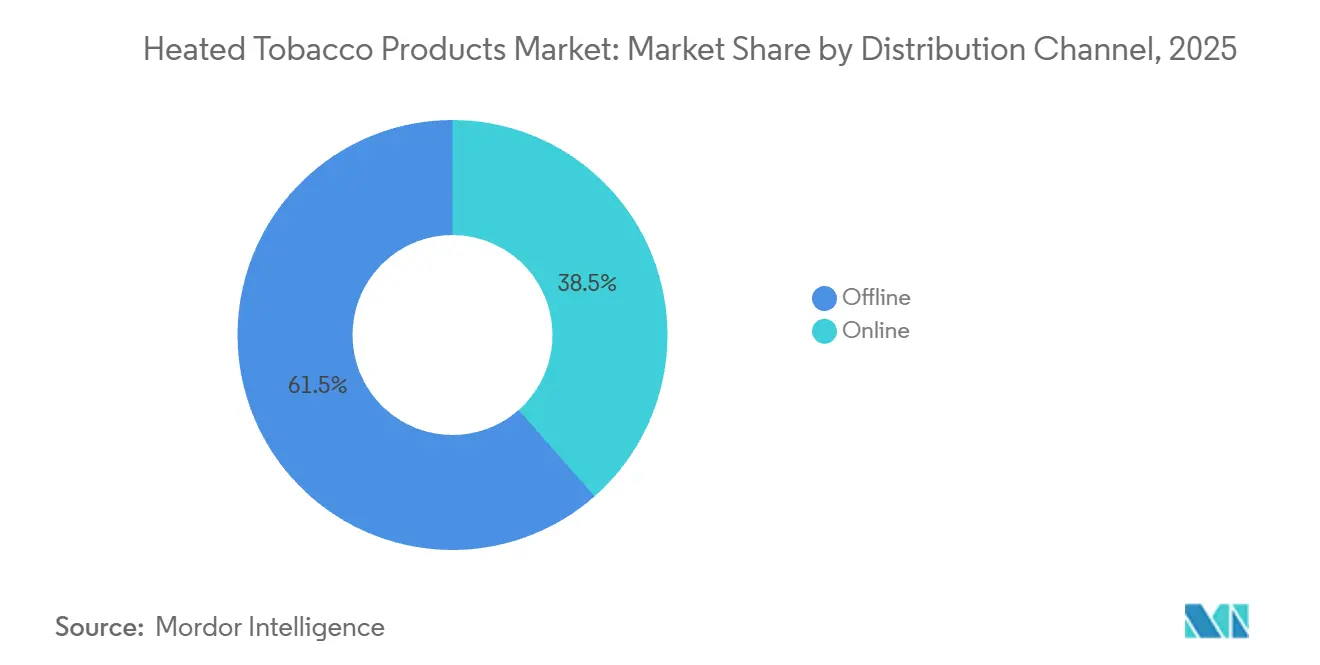
- By distribution channel, offline sales represented 61.5% of revenue in 2025, while online sales are expected to grow at a 16.4% CAGR through 2031.
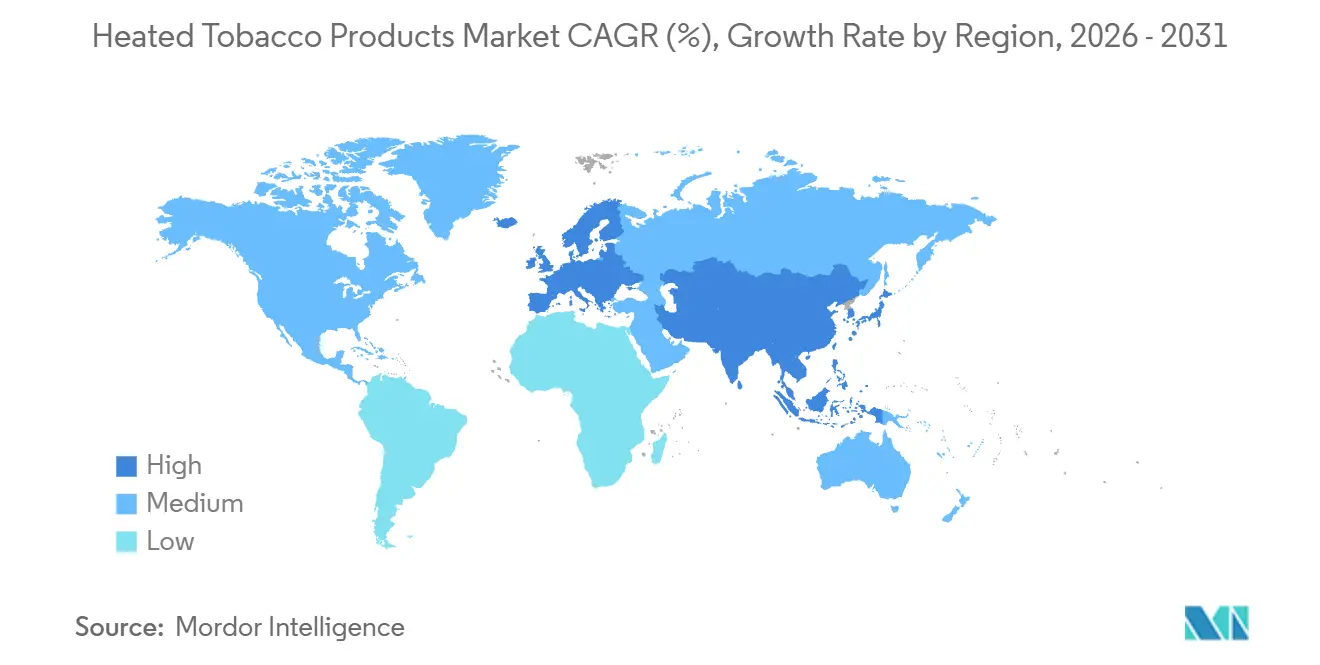
- By geography, Asia-Pacific held 45.6% of the heated tobacco products market in 2025, while Europe is projected to record the fastest regional CAGR at 15.9% through 2031.
Note: Market size and forecast figures in this report are generated using Mordor Intelligence’s proprietary estimation framework, updated with the latest available data and insights as of January 2026.
Market Trends and Insights
Drivers Impact Analysis of Heated Tobacco Products Market*
| Drivers | (~) % Impact on CAGR Forecast | Geographic Relevance | Impact Timeline |
|---|---|---|---|
| Rising Demand for Reduced-Risk Alternatives | +4.5% | Global, concentrated in Asia-Pacific, Western Europe, and North America | Long term (≥ 4 years) |
| Decline in Cigarette Consumption | +3.2% | Global, most pronounced in the Americas and Europe, with spillover to Asia-Pacific | Long term (≥ 4 years) |
| Product Innovation and Launches | +2.8% | Global, concentrated in Japan, EU-5, and South Korea | Medium term (2-4 years) |
| Marketing and Promotional Campaigns | +1.5% | Global, particularly strong in Asia-Pacific and Eastern Europe | Short term (≤ 2 years) |
| Expansion of Premium Tobacco Portfolios | +1.3% | Japan, Italy, South Korea, and Germany | Medium term (2-4 years) |
| Preference for Less Lingering Odor and Smoke | +1.1% | Urban Asia-Pacific, Germany, Italy, and early gains in Gulf states | Medium term (2-4 years) |
| Source: Mordor Intelligence | |||
Rising Demand for Reduced-Risk Alternatives
The strongest structural driver in the heated tobacco products market is the shift toward alternatives that adult smokers view as lower risk than combustible cigarettes. This shift may gain formal support in April 2026, when the US FDA is expected to review Modified Risk Tobacco Product orders for five IQOS products. The FDA has stated that switching completely from cigarettes to IQOS reduces exposure to harmful chemicals, adding regulatory credibility. A 2025 actual-use study in Czechia may show lower cigarette consumption and continued use after self-purchase, indicating sustained demand. As evidence-based regulation expands, companies with clinical data, regulatory expertise, and product dossiers may gain an advantage. PMI’s USD 16 billion-plus investment in smoke-free R&D since 2008 highlights the high entry barrier.
Decline in Cigarette Consumption
The heated tobacco products market is benefiting from the continued decline in combustible cigarette consumption across major regions, supported by stricter regulations, higher taxes, and changing consumer preferences. A 2025 peer-reviewed study is expected to show that global cigarette stick sales declined by 11.6% between 2008 and 2022, with steeper drops in the Americas and Europe. The WHO’s 2025 tobacco trends report is expected to show adult tobacco use prevalence falling from 26.2% in 2010 to 19.5% in 2024, while users declined from 1.32 billion to 1.2 billion[1]. This trend supports the market, as many users shift to heated formats instead of quitting nicotine immediately. Japan reflects this shift, with cigarette sales falling after IQOS expanded nationally and heated tobacco products expected to account for 50% of tobacco user activity by 2025.
Product Innovation and Launches
Technology upgrades are expected to broaden the appeal of the heated tobacco products market beyond existing brand switching. BAT’s glo Hilo, launched in Japan in September 2025, Poland in October 2025, and Italy in November 2025, is expected to offer a two-piece design, faster heating, an integrated display, and a tobacco-free consumable range called Rivo, positioning BAT in the premium tier. PMI expands IQOS ILUMA, its blade-free induction-heating platform, to 55 markets in 2025, reducing maintenance issues and improving device consistency. Japan Tobacco expects heated tobacco unit volume growth of 38.6% in FY2025 and plans to invest JPY 800 billion, or USD 5.3 billion, in Ploom expansion between 2026 and 2028. These moves show that major players continue to view the market as a long-cycle growth category. Device improvements can support repeat consumable purchases, strengthen recurring revenue, and reinforce user retention and premium pricing.
Expansion of Premium Tobacco Portfolios
The heated tobacco products market is being supported by a shift toward higher-value product portfolios across large tobacco groups. PMI reported USD 16.9 billion in smoke-free net revenue in 2025, equal to 41.5% of total revenue, with smoke-free products accounting for nearly 43% of its gross profit. In 27 markets, PMI's smoke-free products contributed more than 50% of full-year net revenue, and 8 markets crossed the 75% threshold, indicating that premium device-led formats have moved beyond early adoption in several countries. Italy illustrates this trend, as non-combustion products grew from 4% of the tobacco and inhalation products market in 2019 to 18% in 2024. PMI responded by launching BONDS by IQOS in Italy in 2026 to reach adult smokers who had been harder to convert. BAT's 50% trial-to-conversion rate for glo Hilo in launch markets further confirms that premium positioning appeals to users seeking device differentiation over basic switching options. The heated tobacco products market is therefore increasingly a contest over premium share and recurring margins, not just user entry into the category.
Restraints Impact Analysis of Heated Tobacco Products Market*
| Restraint | (~) % Impact on CAGR Forecast | Geographic Relevance | Impact Timeline |
|---|---|---|---|
| Stringent Regulatory Frameworks | -1.8% | EU-27, Japan regulatory review underway, and emerging-market consideration | Long term (≥ 4 years) |
| Competition from Vaping Products | -1.4% | Global, most acute in the UK, U.S., and Southeast Asia | Medium term (2-4 years) |
| High Dependence on Device Ecosystems | -0.9% | Japan, South Korea, and Western Europe | Medium term (2-4 years) |
| Concerns Over Aerosol Exposure and Emissions | -0.7% | North America, the EU, and Australia | Long term (≥ 4 years) |
| Source: Mordor Intelligence | |||
Stringent Regulatory Frameworks
Regulation is the most significant structural constraint on the heated tobacco products market, particularly where flavor policies are tightening. Commission Delegated Directive 2022/2100 extended the flavored tobacco ban to heated tobacco products across the EU, with Poland implementing the restriction in January 2025[2]. The Advocate General of the European Court of Justice further supported the European Commission's position in the same month. PMI identified the EU flavor ban as a headwind, contributing to a moderation in full-year 2025 heated tobacco unit in-market sales growth to 10.5%. Compliance obligations, including warnings, disclosures, and marketing restrictions, are increasing fixed costs, favoring larger companies with established regulatory teams and compliance systems. Japan's Ministry of Health, Labour and Welfare is reviewing the category in 2026, which is significant as Japan remains the single largest national market for heated tobacco products. Regulatory impact is more visible in product mix and launch planning, with regular and menthol variants gaining relative weight in more restricted countries.
Competition from Vaping Products
Vaping products and heated tobacco products compete for the same adult smokers seeking alternatives to combustible cigarettes. E-cigarettes typically offer lower device costs and a wider flavor range, making them easier to try. BAT's FY2025 results reflect this competition, with Vuse revenue growing 17.3% in the UK while glo heated tobacco revenue declined 0.7% globally. Despite this, heated tobacco products hold a key regulatory advantage: IQOS is the only product in the United States with FDA MRTP authorization for reduced-exposure communication, a distinction vaping brands do not currently have. This gives heated tobacco products a stronger position in Japan, South Korea, and parts of Central and Eastern Europe, while vaping leads in the UK, the United States, and parts of Southeast Asia. The outcome is not category displacement but a regional split in device preferences within the broader alternative tobacco market.
*Our forecasts treat driver/restraint impacts as directional, not additive. The impact forecasts reflect baseline growth, mix effects, and variable interactions.
Heated Tobacco Products Market Segment Analysis
By Product Type:
Stick Format Drives Recurring Revenue While Leaf Remains the Faster-Growing NicheStick products held 72.3% of the heated tobacco products market share in 2025, making them the primary revenue base and core of recurring consumable demand. The format follows a simple model: consumers buy a device once and return repeatedly for branded consumables, creating high attachment rates. PMI's IQOS system, through HEETS and TEREA sticks, leads this approach with 76% of global heated tobacco unit volume in 2025. KT&G's lil Able 2.0 Plus showed how device upgrades drive consumable sales, with stick volumes running 40% above prior-year levels through Q3 2025. PMI's blade-free IQOS ILUMA rollout across 55 markets by end-2025 further reduced maintenance issues, lowering customer churn within the stick ecosystem.
Leaf products held a smaller share in 2025, but their market size is projected to grow at a 16.7% CAGR through 2031. The format appeals to consumers who prefer a tobacco experience closer to traditional use, giving it relevance in specialty retail and premium markets. The main challenge is technical: variable-form tobacco heats unevenly and creates more residue than standardized sticks. However, ongoing patent activity around chamber and heating solutions points to continued development, which could establish a distinct premium segment if a major manufacturer successfully scales the format.
By Category:
Regular Products Provide Stability While Flavored Products Drive Faster Growth Outside the EURegular products accounted for 63.1% of revenue in 2025, driven by users in Japan, South Korea, and Central Europe who switched from combustibles for familiarity. In Japan, standard tobacco and menthol variants form the main volume base, supporting the stable segment of the heated tobacco products market. These products also carry the least reformulation risk, as they remain permissible across the EU following the extension of flavor restrictions to heated tobacco products, making them the most predictable revenue stream through the forecast period.
Flavored products are forecast to grow at 17.2% through 2031, making them the fastest-growing category where regulations permit wider flavor options. A 2025 Czechia study found that fruit-flavored variants such as watermelon and berry were popular among participants, with flavor variety supporting the shift away from combustible cigarettes. As a result, growth in flavored heated tobacco products is moving from the EU toward Asia-Pacific, the Middle East, and South America. Global companies are now offering restricted tobacco and menthol ranges for Europe while maintaining broader flavor portfolios for less regulated markets, creating a clear regional divide in the heated tobacco products market.
By Distribution Channel:
Offline Stores Lead Device Conversion While Online Channels Improve Reorder EconomicsOffline retail accounted for 61.5% of revenue in 2025, driven by its role in first-time device trials and assisted conversions. New users typically need product comparisons, device explanations, and guided purchases before heated tobacco becomes part of their routine, making physical retail essential to the category. In Japan, convenience stores account for more than 60% of heated tobacco sales, highlighting how physical retail drives both category access and repeat purchasing. BAT's launch of glo Hilo through selective premium offline distribution in Japan, Poland, and Italy confirms that brands still use physical retail to build positioning before scaling distribution.
Online sales are projected to grow at a 16.4% CAGR through 2031, making them the fastest-growing distribution channel in the heated tobacco products market. Subscription-style consumable delivery reduces reorder friction, particularly for users who already own a compatible device. Online channels also extend reach in markets with limited specialty stores, including South Asia, the Middle East and Africa, and South America. By 2031, the gap between offline and online is expected to narrow, but offline retail will remain central to device adoption given its role in guiding new users through the category.
Geography Analysis
APAC Heated Tobacco Products Market
Asia-Pacific accounted for 45.6% of the heated tobacco products market size in 2025, keeping the region at the center of both commercial scale and product development. Japan remains the largest single national market, with its shift away from combustibles providing the clearest adoption pattern for the category. In South Korea, KT&G's lil platform held 46% of the domestic market in 2025 while PMI's IQOS held 45%, reflecting close competition in one of the most advanced markets globally. KT&G's lil Able 2.0 Plus, featuring multi-stick compatibility, pause functions, and faster charging, helped dedicated stick sales rise 40% year-over-year through Q3 2025. China remains largely closed to multinational expansion due to domestic distribution controls, while ASEAN markets and India offer underpenetrated growth potential as regulation continues to develop.
Europe Heated Tobacco Products Market
Europe is the fastest-growing region, with a projected CAGR of 15.9% through 2031. PMI reported that IQOS heated tobacco unit sales in Europe grew 8.6% in full-year 2025, accelerating to 10.3% in Q4, with IQOS capturing 12% of total nicotine offtake. Italy leads the region, with heated tobacco sticks valued at EUR 4.4 billion (USD 4.9 billion) in 2025. Growing competition from BAT and Imperial Brands' Pulze in Italy and Greece signals that the European market is moving beyond a single-brand dynamic.
The Americas and MEA Heated Tobacco Products Market
North America, South America, and the Middle East and Africa are at different stages of adoption. In North America, the commercial launch of IQOS in Austin in March 2025 and the April 2026 FDA MRTP reauthorization have strengthened the category's foundation. JT Group's October 2024 acquisition of Vector Group added U.S. manufacturing and distribution capabilities, supporting future commercialization of Ploom and Marlboro-branded heated tobacco sticks. South America remains limited, as Brazil still prohibits heated tobacco product sales. In the Middle East and Africa, adoption is early but growing, with KT&G's July 2026 MoU with Khyber Tobacco Company in Pakistan marking an early step into adjacent markets.
Competitive Landscape
The heated tobacco products market is highly concentrated, with a small group of multinational tobacco companies controlling most of the global market through proprietary devices, consumable systems, and established distribution networks. PMI leads the market, with IQOS holding 76% to 77% of global heated tobacco unit volume from 2025 into Q1 2026 and more than 43 million legal-age users of its smoke-free products in 2025, backed by more than USD 16 billion in cumulative smoke-free R&D spending since 2008. IQOS is the only heated tobacco product with FDA MRTP authorization in the United States, and its large installed base generates recurring stick purchases, creating a strong embedded revenue layer. British American Tobacco, Japan Tobacco International, and KT&G remain the nearest challengers, each competing based on its own portfolio and geographic strengths.
BAT launched glo Hilo, a premium two-piece device co-developed with SMOORE's Metex platform, in Japan, Poland, and Italy during late 2025. It achieved a 50% trial-to-conversion rate, 3.9% volume share in Poland, and 1.4% in Japan, showing that premium differentiation can still attract consumers in a market dominated by IQOS. PMI responded by broadening the IQOS ILUMA range and introducing BONDS by IQOS in Italy, targeting both established premium users and more resistant adult smokers. Device architecture, price tier, and rollout speed are increasingly important competitive factors.
Growth opportunities remain in value tiers, ultra-premium segments, and underpenetrated regions such as South Asia, the Middle East and Africa, and Latin America, where brand loyalties are not yet firmly established. The leaf format remains underdeveloped among major brands, offering room for differentiation if heating consistency and residue control improve. JT Group's USD 2.4 billion acquisition of Vector Group in October 2024 confirmed that large tobacco companies continue using combustible cash flow to fund international expansion in the heated tobacco products market.
Heated Tobacco Products Industry Leaders
-
Philip Morris International Inc.
-
British American Tobacco p.l.c.
-
Japan Tobacco Inc.
-
KT&G Corporation
-
Imperial Brands plc
- *Disclaimer: Major Players sorted in no particular order

Heated Tobacco Products Market Companies Covered in this Report
- Philip Morris International Inc.
- British American Tobacco p.l.c.
- Japan Tobacco Inc.
- KT&G Corporation
- Imperial Brands plc
- Altria Group, Inc.
- China National Tobacco Corporation
- PAX Labs, Inc.
- Vapor Tobacco Manufacturing LLC
- Shenzhen Yukan Technology Co., Ltd.
- SMOORE International Holdings Limited
- ALD Group Limited
- Buddy Technology Development Co., Ltd.
- CFU Group
- Kamry Technology Co., Ltd.
- Joecig Technology Co., Ltd.
- Lambda Smoke Inc.
- ISMODJO Technology Co., Ltd.
- Xomok Technology Co., Ltd.
- Shenzhen Kanger Technology Co., Ltd.
Recent Industry Developments in Heated Tobacco Products Market
- July 2026: Khyber Tobacco Company (KHTC) signed an MoU with South Korea's KT&G Corporation for a royalty licensing arrangement for the Pine Passion Sky cigarette brand in Pakistan. The agreement marks KT&G's first formal distribution relationship in South Asia's tobacco market, an early step in building the commercial infrastructure that could support future NGP (heated tobacco) product introductions in the region.
- November 2025: BAT commercially launched glo Hilo in Italy, its first premium, two-piece HTP device co-developed with SMOORE International, following sequential launches in Japan and Poland. Glo Hilo reached 3.9% volume share in Poland and 1.4% in Japan within its initial post-launch period, with a trial-to-conversion rate of 50%
- March 2025: PMI launched IQOS commercially in Austin, Texas following a consumer engagement pilot initiated in October 2024, representing the formal reentry of IQOS into U.S. retail distribution and an early test for a broader national expansion strategy.
Global Heated Tobacco Products Market Report Scope
Segmentation Overview
| Stick |
| Leaf |
| Regular |
| Flavored |
| Offline |
| Online |
| North America | United States |
| Canada | |
| Mexico | |
| Rest of North America | |
| Europe | Germany |
| United Kingdom | |
| Italy | |
| France | |
| Spain | |
| Netherlands | |
| Rest of Europe | |
| Asia-Pacific | China |
| India | |
| Japan | |
| Australia | |
| Rest of Asia-Pacific | |
| South America | |
| Middle East and Africa |
| By Product Type | Stick | |
| Leaf | ||
| By Category | Regular | |
| Flavored | ||
| By Distribution Channel | Offline | |
| Online | ||
| By Geography | North America | United States |
| Canada | ||
| Mexico | ||
| Rest of North America | ||
| Europe | Germany | |
| United Kingdom | ||
| Italy | ||
| France | ||
| Spain | ||
| Netherlands | ||
| Rest of Europe | ||
| Asia-Pacific | China | |
| India | ||
| Japan | ||
| Australia | ||
| Rest of Asia-Pacific | ||
| South America | ||
| Middle East and Africa | ||
Key Questions Answered in the Report
What is the projected value of the heated tobacco products sector by 2031?
The heated tobacco products market is projected to reach USD 118.39 billion by 2031, up from USD 58.53 billion in 2026, at a 15.13% CAGR over 2026-2031.
Which region leads heated tobacco product demand today?
Asia-Pacific led with 45.6% of global revenue in 2025, supported by Japan’s large installed base and South Korea’s active competitive environment.
Which product format generates the most revenue in heated tobacco products?
Stick products led with 72.3% of revenue in 2025 because device ownership drives repeat purchases of compatible consumables.
Which category is growing the fastest in heated tobacco products?
Flavored products are expected to post the fastest growth at a 17.2% CAGR through 2031, mainly in markets that do not follow the EU’s flavor-restriction model.