
Gear Motor Market Size and Share
Market Overview
| Study Period | 2022 - 2032 |
|---|---|
| Market Size (2027) | USD 36.68 Billion |
| Market Size (2032) | USD 45.81 Billion |
| Fastest Growing Market | North America |
| Largest Market | Asia-Pacific |
| Market Concentration | Medium |
Major Players *Disclaimer: Major Players sorted in no particular order Image © Mordor Intelligence. Reuse requires attribution under CC BY 4.0. | |
Gear Motor Market Analysis by Mordor Intelligence
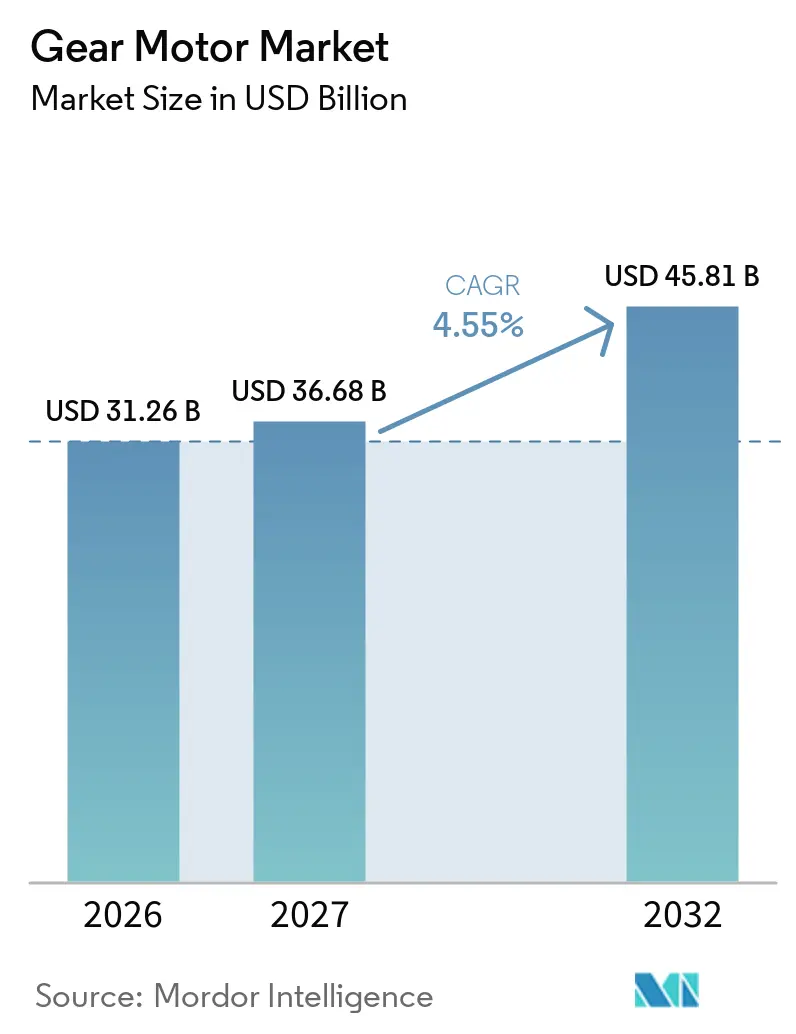
The global gear motor market size is projected to expand from USD 31.26 billion in 2026 and USD 36.68 billion in 2027 to USD 45.81 billion by 2032, at a CAGR of 4.55% between 2027 and 2032. Growing factory automation is increasing demand for compact, precise, and durable motion systems across material handling, packaging, and process operations. Energy-efficiency requirements are directing replacement spending toward higher-efficiency motors and integrated drive systems. Wind energy projects and automated fulfillment centers are supporting demand for high-torque and high-cycle equipment. Asia-Pacific remained the largest regional market in 2026, while North America is expected to grow at a faster rate through 2032. Competition is centered on application engineering, efficiency compliance, product integration, and service support rather than on a single standardized product design.
Key Report Takeaways
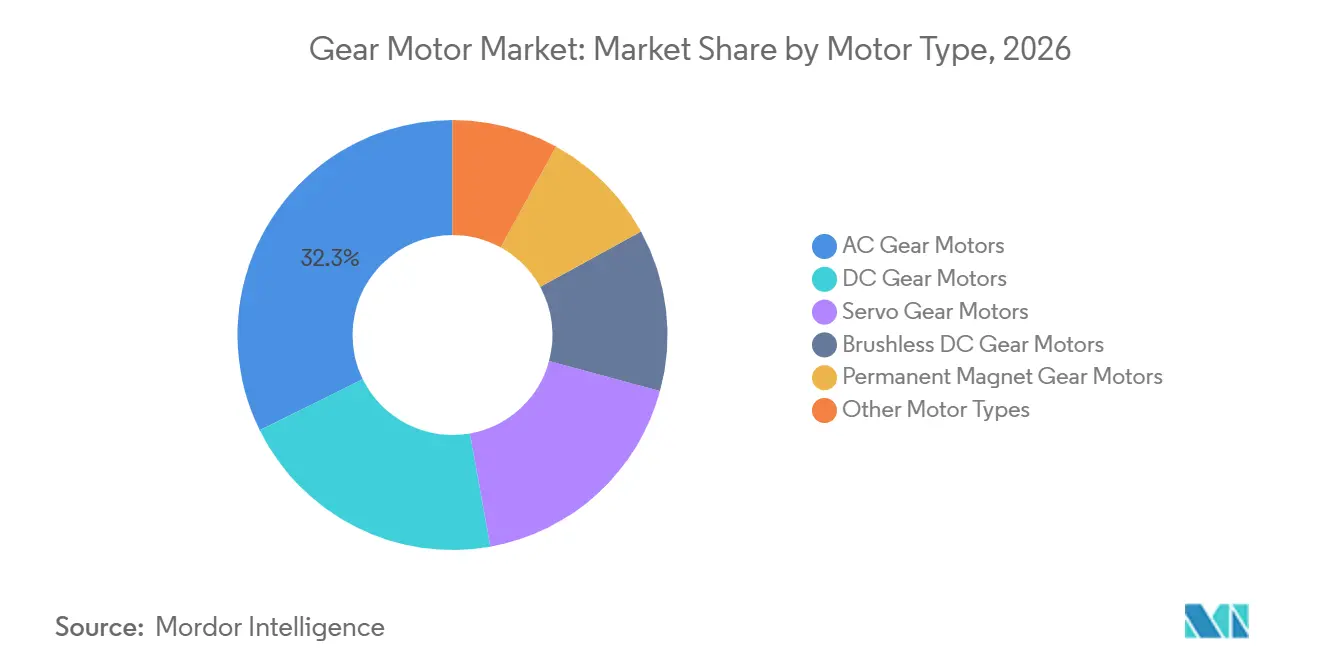
- By motor type, AC gear motors held 32.3% of the gear motor market share in 2026, while servo gear motors are forecast to grow at a 6.1% CAGR through 2032.
- By rated power, units up to 7.5 kW accounted for 51.6% of the gear motor market size in 2026, while units above 75 kW are projected to grow at a 5.7% CAGR through 2032.
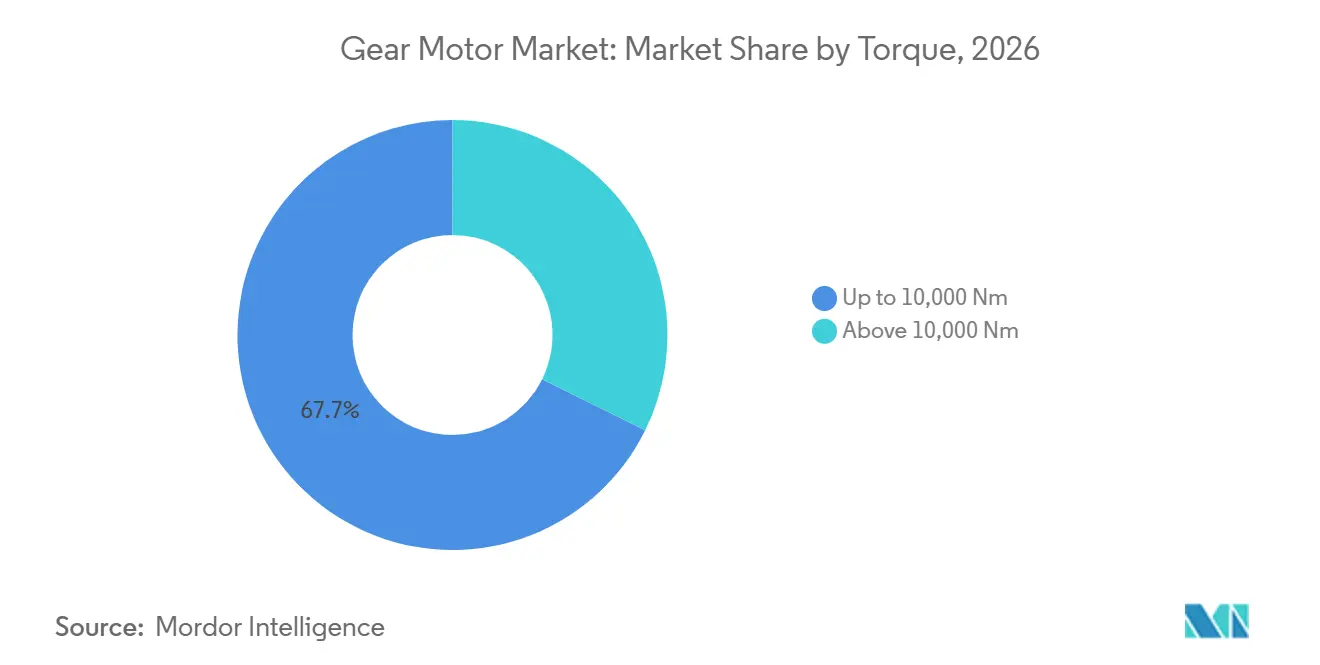
- By torque, units up to 10,000 Nm held 67.7% of revenue in 2026, while units above 10,000 Nm are projected to grow at a 5.6% CAGR through 2032.
- By application, conveyors accounted for 25.6% of revenue in 2026, while robotics and automation are forecast to grow at a 6.7% CAGR through 2032.
- By end-use industry, manufacturing and industrial machinery held 24.4% of revenue in 2026 and is projected to grow at a 6.2% CAGR through 2032.
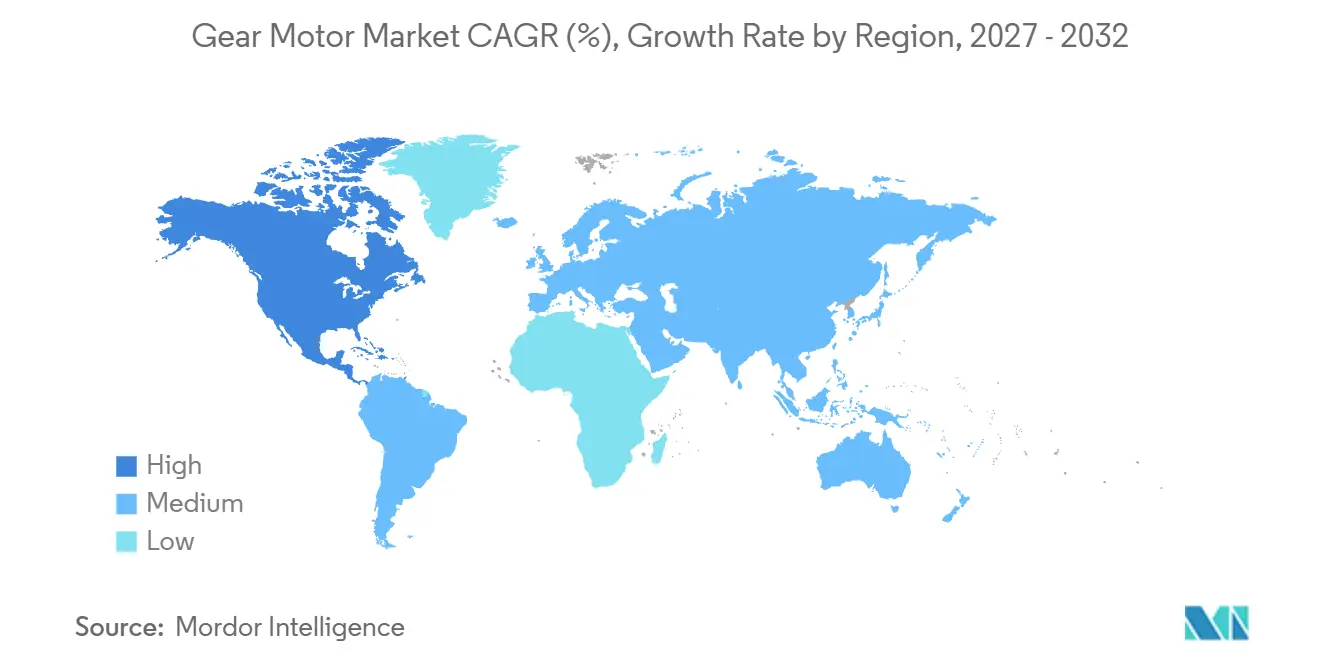
- By geography, Asia-Pacific held 39.5% of revenue in 2026, while North America is forecast to grow at a 5.8% CAGR through 2032.
Note: Market numbers in this report are based on Mordor Intelligence's proprietary estimation framework, which combines nine months of actuals with Q4 projections for base year 2026.
Market Trends and Insights
Drivers Impact Analysis of Gear Motor Market*
| Driver | (~) % Impact on CAGR Forecast | Geographic Relevance | Impact Timeline |
|---|---|---|---|
| Industrial Automation and Robotics Adoption | +1.1% | Global, led by Asia-Pacific and North America | Medium term (2-4 years) |
| E-Commerce Warehousing and Conveyor Automation | +0.7% | North America, Europe, and Asia-Pacific logistics corridors | Short term (≤ 2 years) |
| Wind-Power and Renewable-Energy Installations | +0.6% | Asia-Pacific, Europe, and North America | Long term (≥ 4 years) |
| Energy-Efficiency Upgrades and IE-Class Compliance | +0.8% | Global, with leading phase-ins in the EU, North America, and India | Medium term (2-4 years) |
| Modular High-Torque Drives for Space-Constrained Equipment | +0.4% | Global, concentrated in Asia-Pacific manufacturing and EU OEMs | Medium term (2-4 years) |
| Retrofit Demand from Motor-Driven-System Electrification | +0.5% | Global, with early traction in North America and the EU | Long term (≥ 4 years) |
| Source: Mordor Intelligence | |||
Industrial Automation and Robotics Adoption
The gear motor market is benefiting from the continued growth of factory automation and robotics. The International Federation of Robotics recorded 542,000 industrial robot installations worldwide in 2024, marking the fourth consecutive year above 500,000 installations.[1] Preliminary International Federation of Robotics data indicated that installations rose 15% to 621,000 units in 2025.[2] Gear motor assemblies support joint actuation and motion control in articulated robots and mobile systems. Food processing and warehousing applications require compact, low-backlash servo and planetary configurations for handling and positioning tasks. This trend supports servo and brushless DC suppliers, even as AC gear motors remain important in high-volume industrial applications.
E-Commerce Warehousing and Conveyor Automation
Automated warehousing is generating new demand for conveyor, storage, sorting, and shuttle equipment across the gear motor market. Fulfillment systems require multiple drive points for conveyor movement, sorting, and container handling. Automated storage and retrieval layouts can increase the number of gear motor locations within a facility compared to older pick-and-pack layouts. In September 2026, Exotec and GXO Logistics deployed a 127-robot Skypod system for Guess at the Venlo facility in the Netherlands, including 200 meters of conveyor network. Such facilities favor compact drives capable of repeated operation within limited floor space. Demand is linked to both conveyor length and the additional automation equipment surrounding it.
Wind-Power and Renewable-Energy Installations
Renewable energy installations are supporting demand for specialized high-torque drives in the gear motor market. The International Energy Agency projects that cumulative onshore wind capacity additions will increase 45% between 2025 and 2030. Yaw, pitch, and nacelle-positioning systems use geared components in many turbine designs. Direct-drive turbines reduce gearbox use in some offshore applications, but do not eliminate demand for all geared motion systems within wind installations. Onshore capacity growth creates sustained demand for associated positioning and handling equipment. Mining, ports, and bulk-material handling systems also share many high-torque drive requirements with renewable energy projects.
Energy-Efficiency Upgrades and IE-Class Compliance
Efficiency regulations are supporting replacement activity across the gear motor market. The EU Ecodesign Regulation established requirements for electric motors and variable-speed drives, including IE4 requirements for specified three-phase motor ranges.[3] These requirements make motor efficiency a more visible purchasing criterion for operators and OEMs. Integrated motor and gearbox systems stand to benefit, as a compliant upgrade may involve replacing more than one component. A United States Department of Energy requirement scheduled for June 2027 is encouraging earlier planning for compliant motor purchases. The resulting demand favors suppliers that can offer motors, controls, inverters, and gearbox designs in a tested, integrated package.
Restraints Impact Analysis of Gear Motor Market*
| Restraint | (~) % Impact on CAGR Forecast | Geographic Relevance | Impact Timeline |
|---|---|---|---|
| High Acquisition and Maintenance Cost | -0.5% | Global, particularly in SME-dense markets in Asia-Pacific and South America | Short term (≤ 2 years) |
| Steel, Copper and Rare-Earth Input-Cost Volatility | -0.6% | Global, with cross-regional exposure from upstream concentration in China | Medium term (2-4 years) |
| Application-Specific Compliance and Testing Burden | -0.3% | EU and North America, with effects on export-focused Asia-Pacific manufacturers | Medium term (2-4 years) |
| Gearbox Losses and Lubrication Constraints in Variable-Load Duty | -0.3% | Global, especially food processing and pharmaceutical clean-room settings | Long term (≥ 4 years) |
| Source: Mordor Intelligence | |||
High Acquisition and Maintenance Cost
Higher acquisition and maintenance costs can slow replacement decisions in the gear motor market. Transitioning from IE3-equivalent to IE4 systems carries a 15% to 30% upfront cost premium. Smaller manufacturers may find it difficult to absorb this cost within short capital-budget cycles. Integrated systems can also require lubrication management, encoder calibration, and firmware support beyond routine electrical maintenance. Platform standardization may create additional switching costs through interface requirements, inverter compatibility, and spare-parts inventories. These conditions can extend equipment replacement cycles in food, beverage, and general manufacturing applications.
Steel, Copper and Rare-Earth Input-Cost Volatility
Input-cost volatility remains a material constraint for the gear motor market. The International Energy Agency confirmed that base-metal prices rose by one-third between January 2025 and April 2026, while copper smelter benchmark fees fell to USD 0 per tonne in 2026. Copper is a significant cost input for three-phase motors, and changes in its price directly affect production economics. China's export-licensing requirements for seven heavy rare-earth elements have also affected permanent-magnet supply chains. The International Monetary Fund reported that European prices for heavy rare earths reached five times Chinese domestic prices following these controls. This price gap may favor vertically integrated or China-based producers in servo and brushless DC applications, while compliance and variable-load requirements continue to add testing and maintenance burdens elsewhere.
*Our forecasts treat driver/restraint impacts as directional, not additive. The impact forecasts reflect baseline growth, mix effects, and variable interactions.
Gear Motor Market Segment Analysis
By Motor Type:
AC Drives Retain Volume While Servo Systems Gain GroundAC gear motors held 32.3% of the gear motor market share in 2026, making them the largest motor-type category. Their position reflects compatibility with standard three-phase industrial power systems and broad use in conveyors, pumps, and mixers. The segment also benefits from a cost advantage in bulk process applications. DC gear motors serve battery-powered mobile equipment and older fixed-speed installations where variable-frequency-drive upgrades are less practical. Brushless DC and permanent-magnet models support compact applications where power density is more important than maximum torque. These categories include collaborative-robot joints and packaging pick-and-place equipment.
Servo gear motors are forecast to grow at a 6.1% CAGR from 2027 to 2032. Demand comes from food processing, pharmaceutical packaging, and semiconductor handling lines that require accurate motion control and repeatable positioning, which supports low-backlash and compact designs. The gear motor market is therefore moving toward a broader mix of motion-control products rather than away from AC systems altogether. Integrated designs reduce the assembly work required from OEMs. Suppliers must balance output, control accuracy, available installation space, and maintenance needs when addressing these applications, making product choice more application-specific than in conventional conveyor or pumping installations. In August 2026, NORD DRIVESYSTEMS launched NORDAC FUSION, combining selected motor options and a decentralized frequency inverter in a compact unit for conveyor, AGV, and packaging applications.[4]

By Rated Power:
Smaller Units Lead Installed Demand While High-Power Units Grow FasterUnits rated up to 7.5 kW accounted for 51.6% of the gear motor market size in 2026. This share reflects the large installed base of light-duty conveyors, packaging lines, and material-handling equipment. E-commerce, food processing, and discrete manufacturing use many smaller drives across individual processes. The 7.5 kW to 75 kW range serves a wide set of manufacturing and HVAC applications. Pump and fan retrofit programs also support mid-range demand where efficiency upgrades are required. The smaller power range remains central because equipment fleets often use several low-power units rather than a few large drives.
Units above 75 kW are expected to grow at a 5.7% CAGR from 2027 to 2032. Wind-turbine yaw systems, port cranes, mining equipment, and bulk conveyors are important applications for this range. In these settings, torque density and reliable operation through long duty cycles can carry more weight than initial unit cost. The high-power category also aligns with equipment investment in energy, mining, and logistics infrastructure. Buyers often evaluate these products as part of a wider mechanical system rather than as standalone components, placing greater importance on fit, service access, and operating reliability after installation. In August 2026, NORD DRIVESYSTEMS reported expanded MAXXDRIVE availability for mining and bulk-material handling, with output torques from 6,800 to 282,000 Nm and power from 1.5 to 6,000 kW.[5] This platform illustrates why specialized high-power equipment remains relevant to the gear motor market despite its smaller volume base.
By Torque:
Broad Mid-Range Demand Supports Volume and Very High Torque Adds GrowthUnits rated up to 10,000 Nm held 67.7% of revenue in 2026. Material handling, packaging, agricultural machinery, and light industrial automation support this large installed base. These applications need dependable drives across a wide range of standard operating conditions, and the category includes many systems replaced through normal maintenance cycles. Its leading share indicates that the gear motor market remains closely tied to common industrial equipment rather than only to large infrastructure projects. Product availability and service support are therefore important purchasing factors for this torque range.
Units above 10,000 Nm are forecast to grow at a 5.6% CAGR from 2027 to 2032. Mining, bulk-material handling, offshore crane systems, and large-format wind-turbine positioning systems drive this demand. The electrification of mine conveyors and port equipment can require torque ratings previously associated with hydraulic equipment. Higher-torque systems also require more application-specific engineering and certification, which favors suppliers with experience in heavy-duty drive design and field support. Equipment failure can interrupt a larger operating system, increasing the value placed on tested products and accessible service. Project requirements also vary by load profile, installation environment, and required operating life. The growth of this category adds a higher-value layer to the gear motor market while smaller and mid-range units continue to represent the larger revenue base.
By Application:
Conveyors Provide the Revenue Base and Robotics Raises Precision DemandConveyors accounted for 25.6% of revenue in 2026, making them the largest application within the gear motor market. They are used across manufacturing, mining, food processing, and fulfillment operations, and require many drive units across transport, sorting, and transfer points. This installed base creates both replacement demand and demand for new equipment. Material-handling equipment, pumps, packaging machinery, and mixers and agitators form the next group of major applications, with demand depending on process investment, plant upgrades, and the operating needs of individual end users.
Robotics and automation are expected to grow at a 6.7% CAGR from 2027 to 2032. Articulated robots, autonomous mobile robots, and gantry systems are expanding into food, electronics, and e-commerce operations. These systems require compact designs with precise motion control, increasing demand for servo, planetary, and brushless DC configurations. System builders must select components that match space constraints, positioning requirements, and expected operating cycles, making control performance and product integration important alongside traditional torque and output considerations. Fans and blowers, hoists and cranes, and extruders continue to contribute to demand that tracks activity in their respective end markets. The application mix is widening, but conveyor systems remain an important foundation for the gear motor market.
By End-Use Industry:
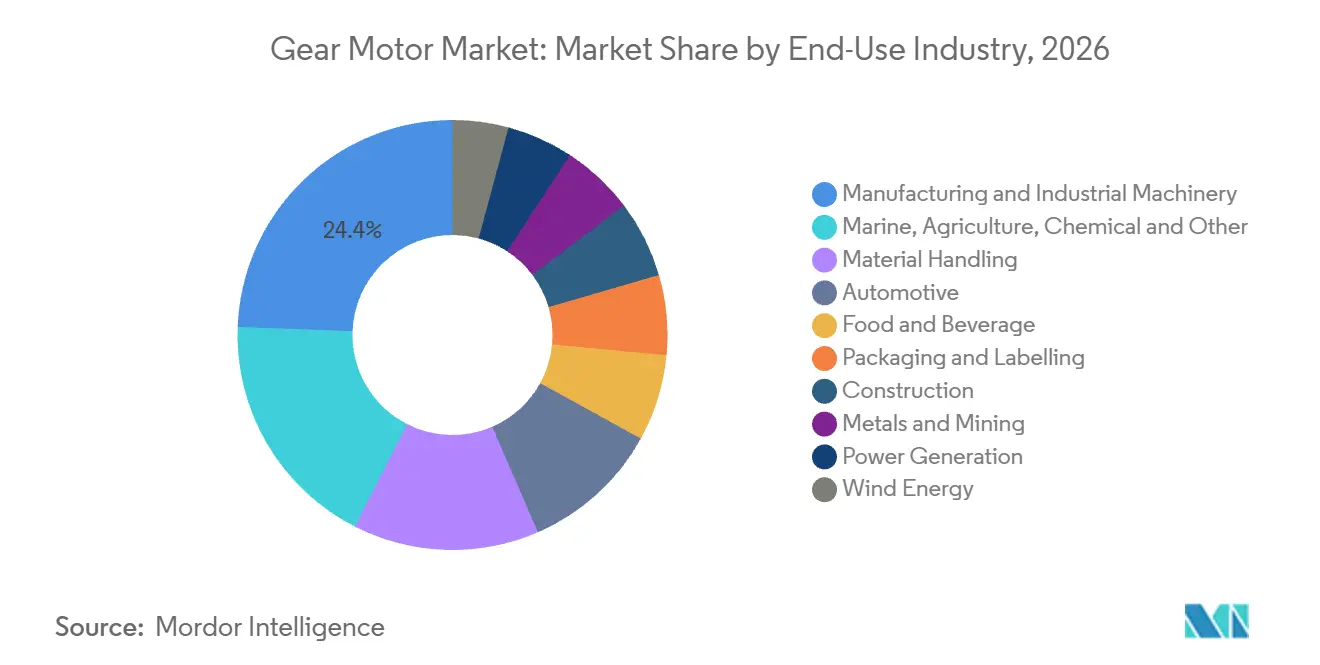
Manufacturing Combines the Largest Revenue Base With the Fastest GrowthManufacturing and industrial machinery accounted for 24.4% of revenue in 2026 and is also expected to grow at a 6.2% CAGR from 2027 to 2032. This combined position reflects the large number of motion applications within production lines, machine tools, packaging systems, and material-handling equipment. Manufacturers require both standard drives and specialized units for different processes. Automation spending can increase the use of precision products, while routine equipment replacement maintains demand for conventional designs. The gear motor market, therefore, depends heavily on the direction of global manufacturing investment.
Material handling is the second-largest end-use area, supported by capital spending on warehousing and port equipment. Automotive remains an important end-use in assembly and body-in-white operations, though its relative growth is moderated by the shift from transfer-line equipment toward flexible robotic cells. Food and beverage, packaging and labeling, and chemical and petrochemical operations provide recurring replacement demand, which can help stabilize the gear motor market during periods of weaker capital spending. Their operating environments create distinct requirements for cleaning, process continuity, and compatible equipment layouts, requiring suppliers to maintain broad product coverage and the ability to adapt products to end-use conditions. Power generation and mining add demand for heavier-duty products where performance, certification, and uptime are the primary considerations.
Geography Analysis
APAC Gear Motor Market
Asia-Pacific held 39.5% of revenue in 2026. China's manufacturing base and the region's strong position in industrial robotics supported this share. Asia accounted for 74% of worldwide industrial robot installations in 2024, and China represented 54% of global installations. India recorded 9,100 robot installations in 2024, a national record. India's motor-labeling requirements beginning in the third quarter of 2026 also support compliance-driven replacement activity. Vietnam, Indonesia, and Thailand are becoming more important manufacturing locations, which extends gear motor market demand for factory automation equipment across the region.
North America Gear Motor Market
North America is forecast to grow at a 5.8% CAGR from 2027 to 2032. The United States recorded 38,000 industrial robot installations in 2025, an 11% increase according to preliminary IFR data. Food, warehousing, and non-automotive general industry were significant contributors to this recovery. The planned June 2027 United States efficiency requirement is encouraging earlier procurement planning in 2026. Reshoring in semiconductor, pharmaceutical, and consumer-goods manufacturing supports demand for servo gear motors. These end uses strengthen the gear motor market because they require both control accuracy and dependable plant operation.
EMEA and South America Gear Motor Market
Europe remains defined by drive-system engineering and energy regulation. Germany hosts SEW-EURODRIVE, NORD DRIVESYSTEMS, Lenze, and Bosch Rexroth, giving the region a strong manufacturing and design base. EU motor-efficiency rules support replacement activity across regulated motor ranges. South America, the Middle East, and Africa represent smaller regional bases for the gear motor market. Brazil's automation activity, renewable-energy programs in Chile and Morocco, and Saudi Arabia's manufacturing plans support demand in these areas. Diversification from commodity extraction toward industrial production could extend equipment demand as local manufacturing activity develops.
Competitive Landscape
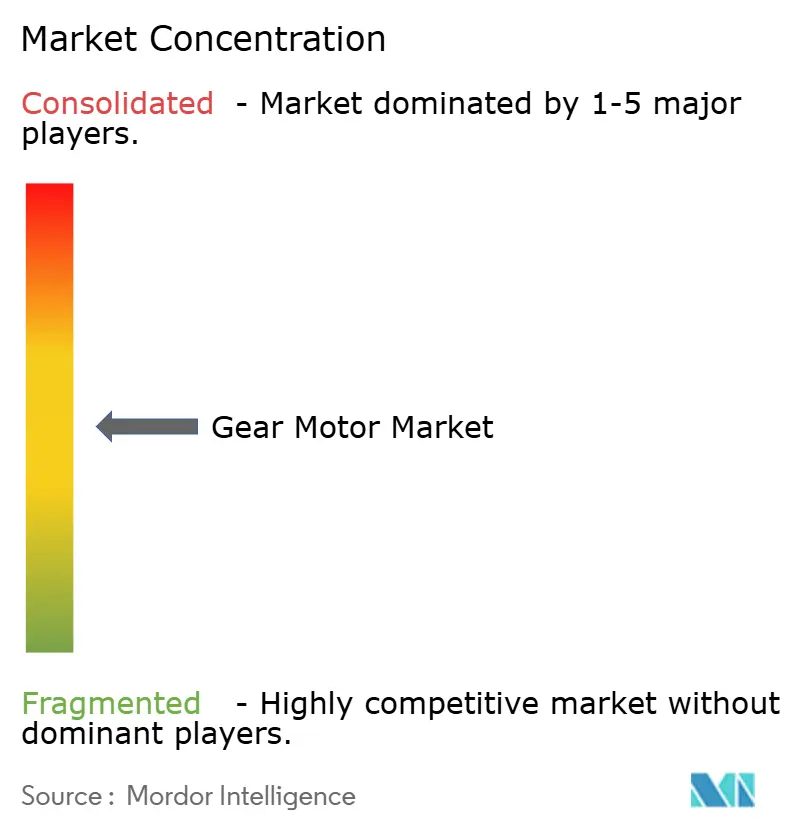
The gear motor market is moderately fragmented, with no single manufacturer holding a dominant position across motor types, power ranges, and applications. SEW-EURODRIVE, NORD DRIVESYSTEMS, Bonfiglioli, and Lenze hold strong positions in precision and energy-efficient products. Nidec, Sumitomo Heavy Industries, Nabtesco, and Jiangsu Guomao compete through scale in AC and worm gear motor categories while expanding their capabilities in servo and planetary systems. Regal Rexnord and Emerson Electric have established positions in North America through application engineering and installed-base relationships. The differing product requirements of food, mining, HVAC, manufacturing, and logistics prevent a single product architecture from serving the entire market. This supports a competitive structure based on specialized product and service capabilities across the gear motor market.
Suppliers are increasingly integrating motors, inverters, sensors, and connectivity features into complete drive systems. This approach reduces integration work for OEMs and supports monitoring functions at the plant level. NORD DRIVESYSTEMS introduced NORDAC FUSION in August 2026 with asynchronous and IE5+ permanent-magnet synchronous motor options paired with a decentralized NORDAC ON inverter. ABB introduced the SD200 SP4 severe-duty motor in September 2026 for operators preparing for the United States efficiency requirement. These launches indicate how efficiency compliance and integrated designs are becoming part of product positioning.
Opportunities remain in compact servo gear motors for collaborative robotics, high-torque certified drives for offshore wind and mining and monitored drives for food and pharmaceutical facilities. Bauer Gear Motor, Oriental Motor, and KEB Automation pursue selected niches rather than competing across every category. Hazardous-location requirements, including IECEx and ATEX certification, can create barriers in mining and other demanding applications. These requirements favor manufacturers with certified products and established engineering support. Lower-cost competitors may find these specialized segments harder to enter, as certification, testing, and application knowledge are important factors.
Gear Motor Industry Leaders
-
SEW-EURODRIVE GmbH & Co KG
-
NORD DRIVESYSTEMS
-
Sumitomo Heavy Industries, Ltd.
-
Flender GmbH
-
Bonfiglioli S.p.A.
- *Disclaimer: Major Players sorted in no particular order
Gear Motor Market Companies Covered in this Report
- ABB Ltd.
- Altra Industrial Motion Corp.
- Bauer Gear Motor GmbH
- Bonfiglioli S.p.A.
- Bosch Rexroth AG
- Dana Incorporated
- Emerson Electric Co.
- Flender GmbH
- Jiangsu Guomao Reducer Co., Ltd.
- KEB Automation KG
- Lenze SE
- Nabtesco Corporation
- Nidec Corporation
- NORD DRIVESYSTEMS
- Oriental Motor Co., Ltd.
- Regal Rexnord Corporation
- SEW-EURODRIVE GmbH & Co KG
- Shanthi Gears Limited
- Siemens AG
- Sumitomo Heavy Industries, Ltd.
- WEG S.A.
Recent Industry Developments in Gear Motor Market
- September 2026: ABB Ltd. introduced the SD200 SP4 severe-duty motor, expanding its industrial motor portfolio with 125 to 250 hp, 2-pole and 4-pole configurations that meet NEMA Premium 4 efficiency requirements (equivalent to IE4 efficiency). The motor was launched to help industrial users comply with the upcoming U.S. Department of Energy motor-efficiency regulations scheduled to take effect in June 2027.
- August 2026: NORD DRIVESYSTEMS expanded the market availability of its MAXXDRIVE industrial gear units for mining, bulk-material handling, conveying, and heavy-process applications. The portfolio offers output torques ranging from 6,800 Nm to 282,000 Nm and power ratings from 1.5 kW to 6,000 kW, available in both parallel-shaft helical and right-angle helical-bevel configurations.
- August 2026: NORD DRIVESYSTEMS launched NORDAC FUSION, an integrated drive solution combining a gearbox, motor, and decentralized frequency inverter within a compact unit. Available with both asynchronous motors and IE5+ permanent-magnet synchronous motors, the system covers 0.31 to 3.7 kW and is designed for conveyor systems, intralogistics, packaging equipment, and material-handling applications that require compact gear-motor solutions.
- March 2026: ABB India committed approximately USD 75 million toward manufacturing expansion for its Motion Business Area, more than double its 2025 investment. The expansion supports increased production of industrial motors, drives, and gear-drive solutions under a local-for-local manufacturing strategy, aimed at meeting growing demand across manufacturing, infrastructure, mining, and industrial automation sectors.
Global Gear Motor Market Report Scope
A gear motor is an integrated electromechanical device that combines an electric motor and a gearbox into a single compact unit to deliver controlled speed and high torque output. Gear motors reduce motor speed while increasing torque, making them suitable for power transmission and motion control applications. They are widely used in conveyors, material handling systems, industrial machinery, robotics, packaging equipment, pumps, and automation systems. Gear motors improve operational efficiency, provide precise speed control, and enable reliable performance in demanding industrial environments.
The global gear motor market is segmented by motor type, rated power, torque, application, end-use industry, and geography. By motor type, the market is segmented into AC gear motors, DC gear motors, servo gear motors, brushless DC gear motors, permanent magnet gear motors, and other motor types. By rated power, the market is segmented into up to 7.5 kW, 7.5 kW to 75 kW, and above 75 kW. By torque, the market is segmented into up to 10,000 Nm and above 10,000 Nm. By application, the market is segmented into conveyors, material handling equipment, pumps, mixers and agitators, packaging machinery, robotics and automation, hoists and cranes, fans and blowers, extruders, and other applications. By end-use industry, the market is segmented into manufacturing and industrial machinery, material handling, automotive, food and beverage, packaging and labelling, construction, metals and mining, power generation, wind energy, marine, agriculture, chemical and petrochemical, and other industries. The report also covers the market size and forecasts for the global gear motor market across 26 countries in key regions. For each segment, the market sizing and forecasts are provided on the basis of value (USD).
Segmentation Overview
| AC Gear Motors |
| DC Gear Motors |
| Servo Gear Motors |
| Brushless DC Gear Motors |
| Permanent Magnet Gear Motors |
| Other Motor Types |
| Up to 7.5 kW |
| 7.5 kW to 75 kW |
| Above 75 kW |
| Up to 10,000 Nm |
| Above 10,000 Nm |
| Conveyors |
| Material Handling Equipment |
| Pumps |
| Mixers and Agitators |
| Packaging Machinery |
| Robotics and Automation |
| Hoists and Cranes |
| Fans and Blowers |
| Extruders |
| Other Applications |
| Manufacturing and Industrial Machinery |
| Material Handling |
| Automotive |
| Food and Beverage |
| Packaging and Labelling |
| Construction |
| Metals and Mining |
| Power Generation |
| Wind Energy |
| Marine |
| Agriculture |
| Chemical and Petrochemical |
| Other Industries |
| North America | United States |
| Canada | |
| Mexico | |
| Europe | Germany |
| France | |
| Italy | |
| Spain | |
| United Kingdom | |
| Poland | |
| Russia | |
| Rest of Europe | |
| Asia-Pacific | China |
| India | |
| Japan | |
| South Korea | |
| Australia | |
| Indonesia | |
| Vietnam | |
| Thailand | |
| Rest of Asia-Pacific | |
| South America | Brazil |
| Argentina | |
| Chile | |
| Rest of South America | |
| Middle East and Africa | Saudi Arabia |
| United Arab Emirates | |
| Egypt | |
| South Africa | |
| Morocco | |
| Rest of Middle East and Africa |
| By Motor Type | AC Gear Motors | |
| DC Gear Motors | ||
| Servo Gear Motors | ||
| Brushless DC Gear Motors | ||
| Permanent Magnet Gear Motors | ||
| Other Motor Types | ||
| By Rated Power | Up to 7.5 kW | |
| 7.5 kW to 75 kW | ||
| Above 75 kW | ||
| By Torque | Up to 10,000 Nm | |
| Above 10,000 Nm | ||
| By Application | Conveyors | |
| Material Handling Equipment | ||
| Pumps | ||
| Mixers and Agitators | ||
| Packaging Machinery | ||
| Robotics and Automation | ||
| Hoists and Cranes | ||
| Fans and Blowers | ||
| Extruders | ||
| Other Applications | ||
| By End-Use Industry | Manufacturing and Industrial Machinery | |
| Material Handling | ||
| Automotive | ||
| Food and Beverage | ||
| Packaging and Labelling | ||
| Construction | ||
| Metals and Mining | ||
| Power Generation | ||
| Wind Energy | ||
| Marine | ||
| Agriculture | ||
| Chemical and Petrochemical | ||
| Other Industries | ||
| By Geography | North America | United States |
| Canada | ||
| Mexico | ||
| Europe | Germany | |
| France | ||
| Italy | ||
| Spain | ||
| United Kingdom | ||
| Poland | ||
| Russia | ||
| Rest of Europe | ||
| Asia-Pacific | China | |
| India | ||
| Japan | ||
| South Korea | ||
| Australia | ||
| Indonesia | ||
| Vietnam | ||
| Thailand | ||
| Rest of Asia-Pacific | ||
| South America | Brazil | |
| Argentina | ||
| Chile | ||
| Rest of South America | ||
| Middle East and Africa | Saudi Arabia | |
| United Arab Emirates | ||
| Egypt | ||
| South Africa | ||
| Morocco | ||
| Rest of Middle East and Africa | ||
Key Questions Answered in the Report
What is the projected growth rate for the gear motor market through 2032?
The gear motor market is forecast to grow at a 4.55% CAGR from 2027 to 2032, reaching USD 45.81 billion by 2032. Automation investments, energy-efficiency upgrades, wind energy projects, and fulfillment infrastructure development support this outlook.
Which motor type has the largest revenue share?
AC gear motors led all motor types with a 32.3% revenue share in 2026. This position reflects their compatibility with three-phase power systems and broad use in conveyors, pumps, and mixers across established industrial applications.
Why are servo gear motors growing faster than other motor types?
Servo gear motors are projected to grow at a 6.1% CAGR because robotics, packaging, food processing, and semiconductor handling applications require precise motion control. Their compact size, repeatable positioning, and low-backlash operation support adoption in these applications.
Which application segment is growing the fastest?
Robotics and automation are forecast to grow at a 6.7% CAGR through 2032. Conveyors remained the largest application segment in 2025 with a 25.6% revenue share, driven by broad use across production, logistics, mining, food processing, and fulfillment operations.
Which region is expected to grow the fastest?
North America is forecast to grow at a 5.8% CAGR through 2032, supported by automation investment, reshoring activity, and planned efficiency requirements. Asia-Pacific was the largest regional market in 2025, accounting for 39.5% of revenue.
What factors can limit the adoption of higher-efficiency systems?
Higher upfront costs, specialized maintenance requirements, copper and rare-earth price volatility, and regulatory compliance requirements can delay equipment replacement decisions. These conditions are particularly relevant where capital budgets are constrained and service resources are limited.