
Exploration and Production Software Market Size and Share
Market Overview
| Study Period | 2022 - 2032 |
|---|---|
| Market Size (2027) | USD 13.56 Billion |
| Market Size (2032) | USD 25.29 Billion |
| Growth Rate (2027 - 2032) | 13.27 % |
| Fastest Growing Market | Asia-Pacific |
| Largest Market | North America |
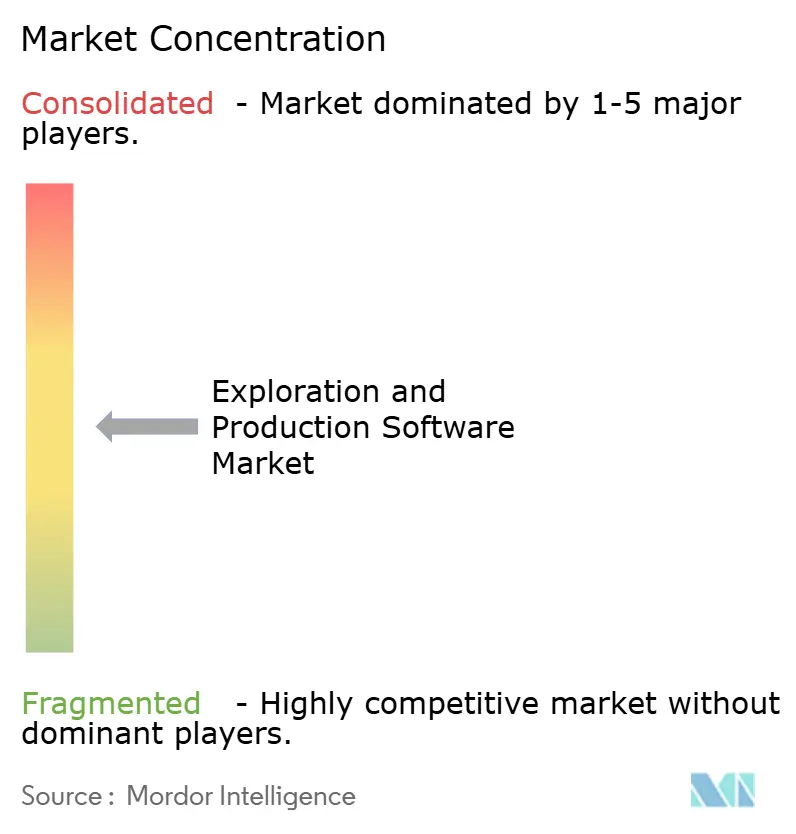
| Market Concentration | Medium |
Major Players *Disclaimer: Major Players sorted in no particular order Image © Mordor Intelligence. Reuse requires attribution under CC BY 4.0. | |
Exploration and Production Software Market Analysis by Mordor Intelligence
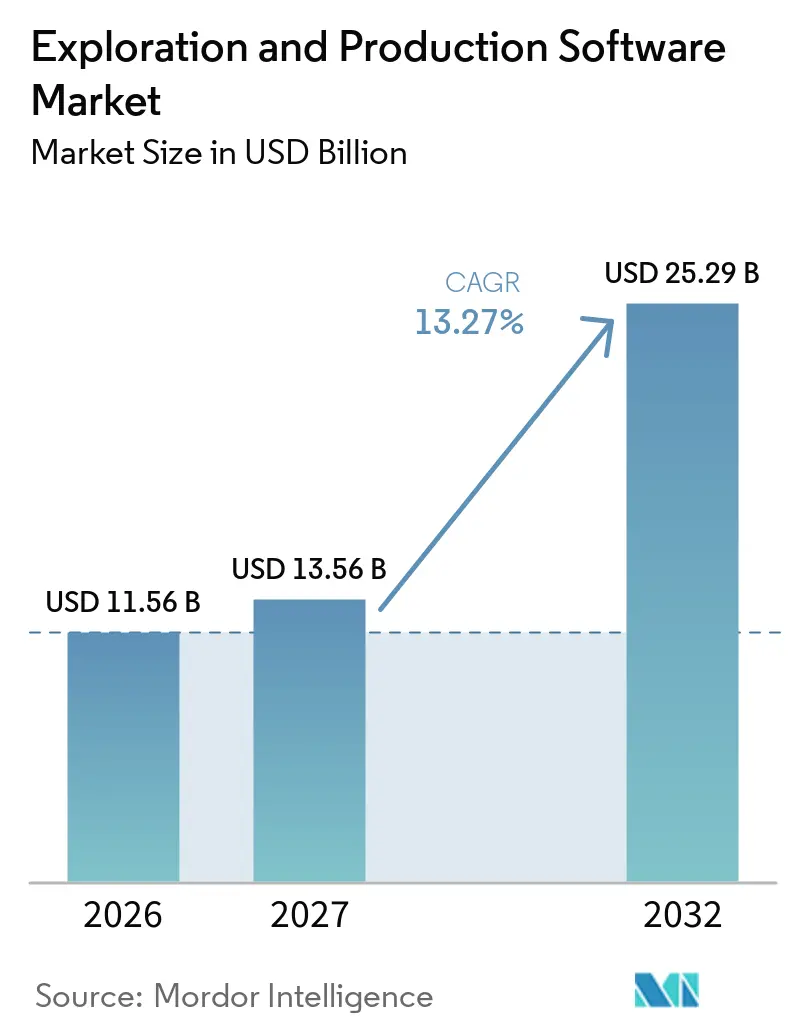
The exploration and production software market size is expected to increase from USD 11.56 billion in 2026 to USD 13.56 billion in 2027 and reach USD 25.29 billion by 2032, at a CAGR of 13.27% over 2027-2032. The market is shifting from isolated workflow tools toward connected data environments that link subsurface, drilling, and production decisions. Operators are prioritizing tools that shorten interpretation cycles, improve well placement, and identify equipment risks before they interrupt production. Cloud migration is widening access to computing capacity, although security, data residency, and legacy integration remain material adoption constraints. Platform providers are responding through acquisitions, marketplaces, and integrated offerings that combine data, analytics, and automation. These shifts are expanding the role of exploration and production software in mature-field optimization, offshore operations, and emerging carbon storage or geothermal applications.
Key Report Takeaways
- By software, seismic and subsurface software led with 29.3% revenue share in 2026, while drilling software is forecast to expand at a 13.9% CAGR through 2032.
- By deployment, on-premises systems held 56.7% revenue share in 2026, while cloud-based deployment is forecast to expand at a 14.5% CAGR through 2032.
- By operation, onshore operations held 64.1% revenue share in 2026, while offshore operations are forecast to expand at a 15.4% CAGR through 2032.
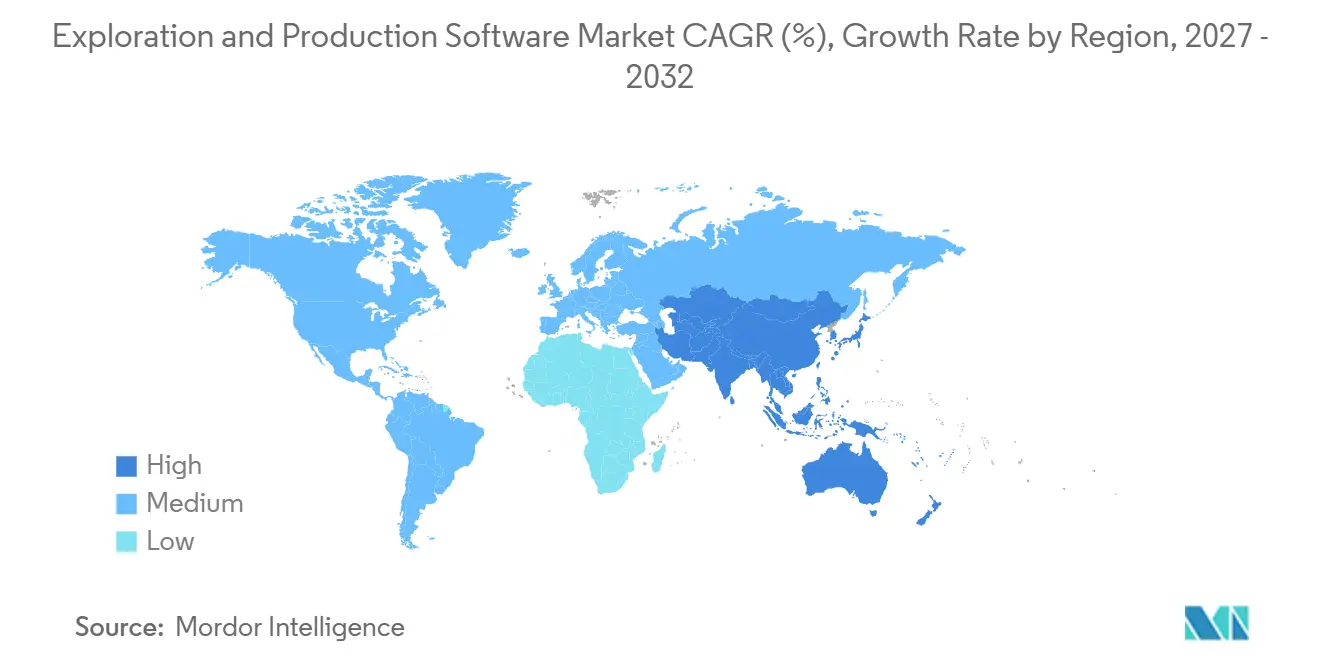
- By geography, North America held 39.7% revenue share in 2026, while Asia-Pacific is forecast to expand at a 15.6% CAGR through 2032.
Note: Market numbers in this report are based on Mordor Intelligence's proprietary estimation framework, which combines nine months of actuals with Q4 projections for base year 2026.
Market Trends and Insights
Drivers Impact Analysis of Exploration and Production Software Market*
| Driver | (~) % Impact on CAGR Forecast | Geographic Relevance | Impact Timeline |
|---|---|---|---|
| AI-Assisted Subsurface Interpretation and Reservoir Modeling | +3.0% | Global, led by North America and Asia-Pacific NOC programs | Short term (≤ 2 years) |
| Cloud-Native E&P Data and Workflow Migration | +2.5% | Global, concentrated in North America and Europe | Medium term (2-4 years) |
| Mature-Field Life Extension and Recovery Optimization | +2.0% | Global, led by North America, the Middle East, and North Sea basins | Long term (≥ 4 years) |
| Real-Time Production Surveillance and Predictive Maintenance | +1.8% | Global, with offshore activity in Asia-Pacific and the Middle East and Africa | Short term (≤ 2 years) |
| Autonomous Drilling and Well-Planning Workflows | +1.7% | North America, the North Sea, and Asia-Pacific offshore operations | Medium term (2-4 years) |
| Carbon Storage and Geothermal Repurposing of E&P Workflows | +1.0% | North America, Europe, and early Asia-Pacific adoption | Long term (≥ 4 years) |
| Source: Mordor Intelligence | |||
AI-Assisted Subsurface Interpretation, Reservoir Modeling, and Autonomous Drilling
AI-assisted interpretation is increasing the value of seismic, well-log, and reservoir data in the exploration and production software market. Physics-informed neural networks have delivered seismic characterization at speeds up to 200 times faster than conventional processing while retaining geological constraints.[1] Faster processing can reduce dependence on scarce senior geoscientists when operators maintain standardized data. China's China National Petroleum Corporation developed the Kunlun model with 300 billion language parameters, 44 billion vision parameters, and 800 billion multimodal parameters for seismic processing and well-log interpretation. Halliburton's DecisionSpace 365 Assisted Lithology Interpretation uses supervised learning to predict lithology from wireline logs across thousands of wells. Closed-loop drilling extends this approach from interpretation into well execution and supports the projected 13.9% CAGR for drilling software.
Cloud-Native E&P Data and Workflow Migration
Cloud migration is reshaping the exploration and production software market as operators increasingly require connected workflows rather than separate applications. Open standards can reduce application-specific data copies and make information available across drilling, subsurface, and production teams. TotalEnergies replaced fragmented exchange pipelines with automated OSDU ingestion workflows across its drilling-to-production portfolio. Petrobras adopted the VDS seismic format as its cloud-aligned standard, supporting a more consistent data architecture. Schlumberger Limited introduced its XD product range in 2026 for operators moving to OSDU-based environments. Data residency rules continue to favor hybrid designs that retain sensitive datasets locally while using cloud analytics.
Mature-Field Recovery, Production Surveillance, and Predictive Maintenance
Mature assets are expanding the addressable market for exploration and production software, as production decisions must improve without interrupting existing operations. Baker Hughes stated that nearly 80% of global oil and gas output is expected to come from mature assets by 2030.[2] This increases demand for workover planning, infill drilling analysis, enhanced recovery simulation, and surveillance tools. Schlumberger Limited reported that its OptiSite AI solution predicted 88% of equipment failures up to 21 days in advance during a Middle East deployment. Abu Dhabi National Oil Company deployed AiPSO across 8 fields in 2025 to process millions of real-time data points and support remote diagnostics. Continuous monitoring can help operators identify mechanical conditions linked to fugitive methane (CH4) emissions.
Carbon Storage and Geothermal Workflow Reuse
Existing subsurface software capabilities can be applied to carbon storage characterization, injection planning, and plume monitoring, providing a related opportunity for the exploration and production software market without requiring operators to abandon established geological and simulation workflows. Schlumberger Limited introduced its Sequestri carbon storage solutions in 2025. Research on legacy wells identified uses for screening carbon storage and geothermal potential in the United States. These applications are still developing, but they allow vendors to adapt reservoir and fracture knowledge to adjacent energy projects and create opportunities for specialized providers to build functions beyond hydrocarbon production.
Restraints Impact Analysis of Exploration and Production Software Market*
| Restraint | (~) % Impact on CAGR Forecast | Geographic Relevance | Impact Timeline |
|---|---|---|---|
| Cybersecurity, Data Sovereignty, and Operational Technology Risk | -1.3% | Global, especially North America, Europe, and Asia | Short term (≤ 2 years) |
| High Implementation Cost and Scarcity of Hybrid Domain Talent | -1.1% | Global, especially Asia-Pacific and the Middle East and Africa | Medium term (2-4 years) |
| Legacy-Data Interoperability and Workflow Disruption | -0.8% | Global, with higher exposure in mature basins | Long term (≥ 4 years) |
| Internal Development of Proprietary Digital Solutions by Large Operators | -0.6% | Large operators and national oil companies in Asia and the Middle East | Long term (≥ 4 years) |
| Source: Mordor Intelligence | |||
Cybersecurity, Data Sovereignty, and Operational Technology Risk
Greater connectivity exposes production environments to increased cybersecurity and operational technology risks. Dragos reported that 37% of oil and gas security findings involved malware-protection gaps and 29% involved inadequate IT and OT network segmentation.[3] A 2025 compromise of unmonitored cellular gateways in US upstream operations further highlighted these vulnerabilities. Operators may delay cloud-hosted production applications when they cannot demonstrate secure access, monitoring, and recovery procedures. ISA/IEC 62443 and TSA security requirements add configuration work for vendors and lengthen procurement reviews. Data sovereignty requirements similarly lead operators to favor certified hybrid environments over unrestricted data movement.
Implementation Costs, Legacy Integration, and In-House Digital Development
Implementation complexity can slow the exploration and production software market when subsurface, drilling, production, and enterprise systems do not share usable data. Connecting these systems requires professionals who understand both upstream workflows and data engineering. Legacy architectures can make migration disruptive when live production applications cannot tolerate downtime. Large operators may also develop proprietary digital tools where local operating knowledge is viewed as a strategic asset. Cloud deployment reduces infrastructure management needs, but does not eliminate the need for internal process ownership. Vendors that provide integration, training, and measurable field outcomes are better positioned to address this barrier.
*Our forecasts treat driver/restraint impacts as directional, not additive. The impact forecasts reflect baseline growth, mix effects, and variable interactions.
Exploration and Production Software Market Segment Analysis
By Software:
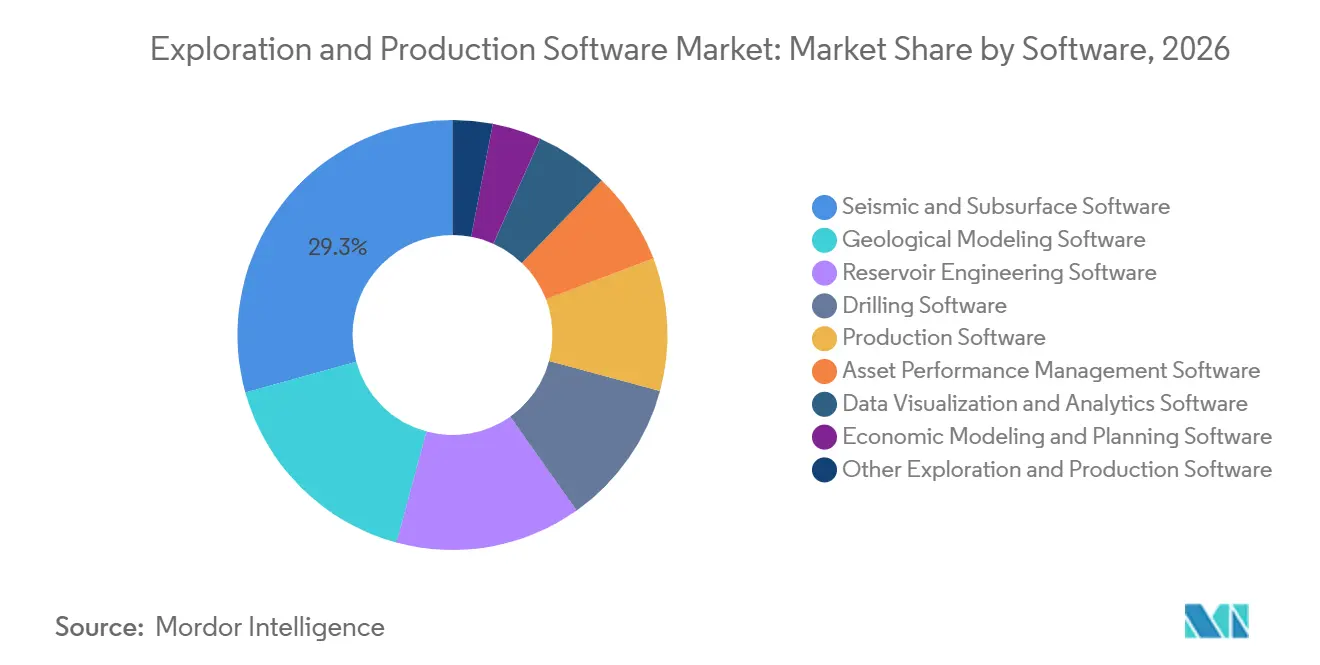
Seismic and Subsurface Software Anchors the Revenue BaseSeismic and subsurface software accounted for 29.3% of the exploration and production software market share in 2026. Its position reflects the need to process and interpret subsurface information before well planning begins. Geological modeling and reservoir engineering translate acquisition data into calibrated models that guide development decisions. Machine learning can improve property prediction for sweet-spot mapping when input data is consistent. Drilling software is projected to grow at a 13.9% CAGR through 2032 as operators adopt closed-loop automation. Production and asset performance applications extend digital workflows into operating fields.
The exploration and production software market also uses data visualization and economic modeling tools for portfolio decisions across conventional and unconventional assets. In April 2026, Schlumberger Limited announced an agreement to acquire S&P Global Energy's Kingdom, Petra, and Harmony portfolio. These tools were embedded in U.S. onshore workflows, illustrating the value of established user practices. The deal supports a shift toward integrated suites rather than separate point products. Faster seismic classification is encouraging further investment in AI-assisted interpretation pipelines. Specialist vendors can remain relevant where they offer deep capability in a focused workflow.

By Deployment:
Cloud Migration Reshapes an On-Premises-Heavy BaselineOn-premises systems held 56.7% of the exploration and production software market share in 2026. Many operators retain private data centers and legacy SCADA systems that are difficult to migrate without disrupting live workflows. Cloud-based deployment is forecast to record a 14.5% CAGR through 2032. The higher growth rate reflects demand for scalable computing in simulation, interpretation, and AI model training. Hybrid deployment offers a transition path by keeping latency-sensitive wellsite functions close to operations while allowing operators to use cloud resources for broader analytics and development work.
The exploration and production software market is likely to retain hybrid environments where local data control is mandatory. Schlumberger Limited's 2026 XD portfolio was designed for cloud-based advantages in subsurface workflows. Weatherford International's cloud migration of ForeSite and CygNet represents an example of legacy system repositioning. Operators still require reliable data contextualization before cloud tools can generate useful results, making implementation quality as important as infrastructure choice. Smaller vendors may find it harder to meet the compliance requirements of certified hybrid deployments.
By Operation:
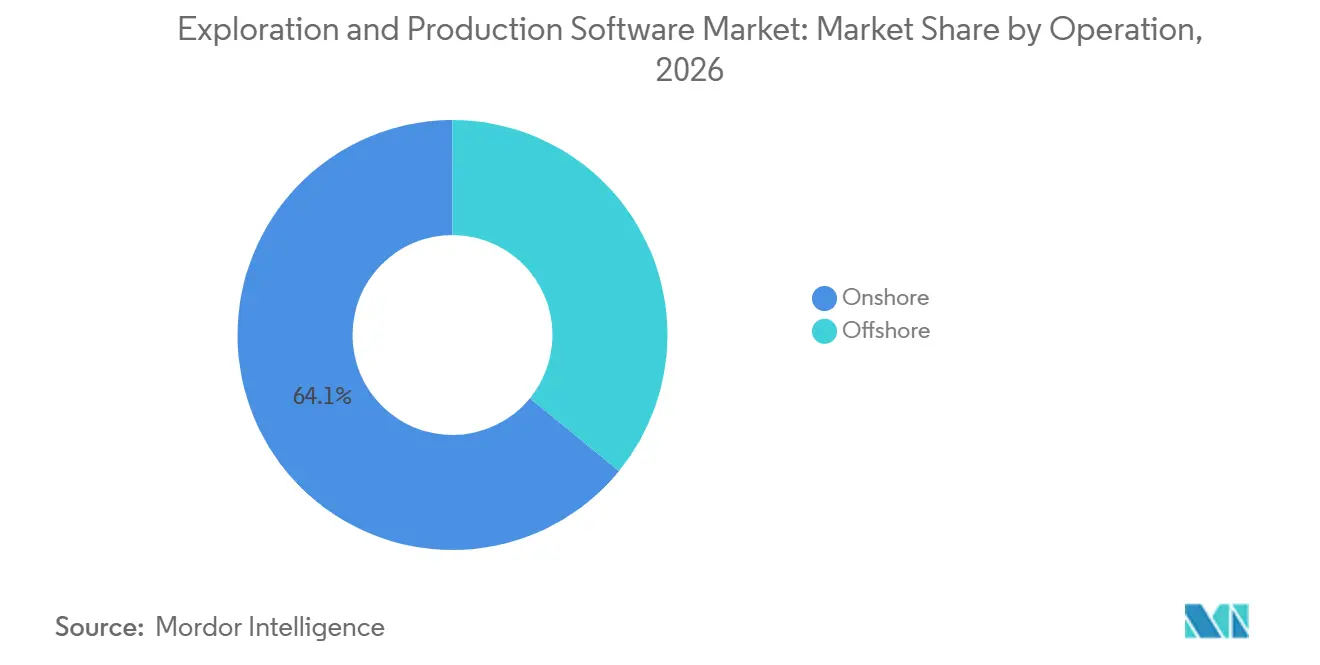
Offshore Digitalization Outpaces as Precision Economics Drive AdoptionOnshore operations accounted for 64.1% of the exploration and production software market in 2026. U.S. unconventional activity supports frequent use of drilling optimization, production analytics, and economic planning tools. Offshore operations are projected to grow at a 15.4% CAGR through 2032. Offshore interventions can cost substantially more than comparable onshore work, increasing the value of reliable surveillance and well planning tools. In 2026, Schlumberger Limited reported autonomous geosteering in offshore Malaysia that kept the wellbore within a 3 m reservoir margin, illustrating why offshore operators place a premium on precise execution.
Real-time data can help offshore teams diagnose well and facility issues faster across remote assets. Abu Dhabi National Oil Company's AiPSO deployment across 8 fields demonstrated how portfolio-scale monitoring can support remote production decisions. Large offshore seismic datasets also favor flexible computing and data management capacity. The exploration and production software market must still accommodate intermittent connectivity, offshore safety requirements, and strict operating procedures. These requirements favor providers that combine digital tools with practical upstream deployment experience, supporting demand for both specialized applications and broader integrated platforms.
Geography Analysis
North America accounted for 39.7% of total revenue in 2026. United States shale activity creates recurring demand for subsurface analytics, drilling engineering, and production optimization. Kingdom, Petra, and Harmony had established usage in United States onshore workflows before Schlumberger's announced acquisition.[4] This installed base can make workflow changes costly for operators. The exploration and production software market in North America also requires hybrid solutions, as cybersecurity and data protection concerns remain prominent.
Asia-Pacific is forecast to grow at a CAGR of 15.6% through 2032. Growth is driven by national oil company digital programs in China and India, as well as offshore activity in Malaysia, Vietnam, and Australia. China's state-owned companies are developing domestic alternatives, including the Kunlun model, HiSimPro reservoir simulation, and Sinopec's Fenghuo industrial AI agent. PETRONAS Carigali signed its third joint development agreement with IBM Malaysia and Tridiagonal.AI in July 2026 to advance TriCipta AI for surface equipment optimization. South America has a mixed demand base, with Petrobras pre-salt operations requiring advanced subsurface work while Guyana and Vaca Muerta add drilling-analysis demand.
The Middle East and Africa are shaped by national oil company programs focused on improving recovery from large producing fields. ADNOC's AiPSO deployment across 8 UAE fields established a regional reference point for remote diagnostics and AI-supported optimization. Saudi Arabia, Qatar, and the UAE favor on-premises and sovereign-cloud designs due to data-security requirements. These preferences create demand for vendors that can support hybrid OSDU environments on local infrastructure. Nigeria's deepwater Niger Delta adds offshore optimization potential, although infrastructure limitations reduce the pace of broader adoption.
Competitive Landscape
The exploration and production software market is moderately concentrated among large platform providers, while specialized workflow categories remain fragmented. Schlumberger, Halliburton Landmark, and Baker Hughes offer connected capabilities across subsurface work, well construction, and production operations. Competition increasingly depends on control of data environments, as automated workflows and AI training histories can raise switching costs. Schlumberger launched its Digital Marketplace in June 2026 with around 200 products from Schlumberger and more than 30 partners in its Delfi and Lumi environments. Marketplace models can strengthen vendor relationships with customers by integrating partner offerings into a shared workflow layer.
Halliburton acquired Sekal AS in April 2026, adding DrillTronics drilling-autonomy technology to its well-construction portfolio. Baker Hughes launched Kantori in January 2026 as a unified autonomous well construction solution integrating AI, physics-based models, and Corva analytics. Schlumberger's planned acquisition of the Kingdom, Petra, and Harmony portfolio is another example of suite expansion. These moves indicate that large providers are simultaneously adding technology and established user communities. The exploration and production software market therefore places greater value on integrated deployment than on isolated application features.
Carbon storage and geothermal workflows remain areas where established subsurface expertise can be extended. Schlumberger's Sequestri offering demonstrates the move into carbon storage solutions. Smaller companies can retain a role through specialized simulation, risk analysis, or workflow functions. Patent protection around automated planning and geosteering can also create barriers in drilling automation. The competitive structure of the exploration and production software market is concentrated in large enterprise platforms but fragmented across niche software categories. Vendors outside broader platform ecosystems face pressure where bundled data, analytics, and AI tools lower total deployment costs.
Exploration and Production Software Industry Leaders
-
SLB N.V.
-
Halliburton Company
-
Baker Hughes Company
-
Emerson Electric Co.
-
Viridien
- *Disclaimer: Major Players sorted in no particular order
Exploration and Production Software Market Companies Covered in this Report
- SLB N.V.
- Aspen Technology, Inc.
- AVEVA Group Limited
- Baker Hughes Company
- Viridien
- Computer Modelling Group Ltd.
- Emerson Electric Co.
- Enverus, Inc.
- ETL Solutions Limited
- Halliburton Company
- Ikon Science Limited
- KAPPA Engineering
- Kongsberg Digital AS
- Microsoft Corporation
- Paradigm B.V.
- Pason Systems Inc.
- Peloton Computer Enterprises Ltd.
- Petroleum Experts Limited
- Petrolink International Ltd.
- Quorum Business Solutions, Inc.
- Rock Flow Dynamics, Inc.
- S&P Global Inc.
Recent Industry Developments in Exploration and Production Software Market
- July 2026: PETRONAS Carigali signed its third Joint Development Agreement with IBM Malaysia and Tridiagonal.AI to expand the capabilities of the TriCipta AI platform into surface equipment optimization. The agreement builds on earlier deployments for basin screening and AI-based production surveillance, strengthening the use of AI-driven software across exploration and production workflows.
- June 2026: Schlumberger launched its Digital Marketplace, providing approximately 200 digital products, including AI agents, Tela AI skills, SaaS applications, and data connectors from more than 30 partners. The marketplace is integrated within the Delfi and Lumi environments, expanding access to exploration and production software tools covering exploration, reservoir management, drilling, and production optimization.
- April 2026: Schlumberger entered a definitive agreement to acquire the upstream software portfolio of S&P Global Energy, including Kingdom, Petra, and Harmony. These applications are used by approximately 110,000 users across 4,000 organizations in 113 countries and represent some of the most widely deployed geological modeling, interpretation, and reservoir engineering tools in the industry.
- January 2026: Baker Hughes introduced Kantori, an autonomous well-construction platform integrating AI, physics-based models, and Corva's real-time analytics. The software supports drilling planning, execution, monitoring, and optimization through a unified digital environment.
Global Exploration and Production Software Market Report Scope
Exploration and Production (E&P) software refers to a specialized suite of digital tools used by the oil and gas industry to locate, analyze, and extract hydrocarbon resources from beneath the Earth's surface. This software uses advanced algorithms to process seismic data, model geological formations, and simulate reservoir behavior, enabling engineers and geoscientists to evaluate the commercial viability of potential fields. By integrating data across the entire upstream lifecycle, it optimizes well drilling paths, improves production yields, and manages asset integrity while minimizing operational risks.
The Global Exploration and Production Software Market is segmented by software type into seismic and subsurface software, geological modeling software, reservoir engineering software, drilling software, production software, asset performance management software, data visualization and analytics software, economic modeling and planning software, and other exploration and production software. By deployment, the market is segmented into cloud-based, on-premises, and hybrid solutions. By operation, the market is segmented into onshore and offshore applications. The report also covers market size and forecasts for the global exploration and production software market across 26 countries in key regions. For each segment, market sizing and forecasts are provided on the basis of value (USD).
Segmentation Overview
| Seismic and Subsurface Software |
| Geological Modeling Software |
| Reservoir Engineering Software |
| Drilling Software |
| Production Software |
| Asset Performance Management Software |
| Data Visualization and Analytics Software |
| Economic Modeling and Planning Software |
| Other Exploration and Production Software |
| Cloud-Based |
| On-Premises |
| Hybrid |
| Onshore |
| Offshore |
| North America | United States |
| Canada | |
| Mexico | |
| Europe | Germany |
| France | |
| Italy | |
| Spain | |
| United Kingdom | |
| Norway | |
| Netherlands | |
| Denmark | |
| Russia | |
| Rest of Europe | |
| Asia-Pacific | China |
| India | |
| Japan | |
| South Korea | |
| Australia | |
| Malaysia | |
| Vietnam | |
| Thailand | |
| Rest of Asia-Pacific | |
| South America | Brazil |
| Argentina | |
| Chile | |
| Guyana | |
| Rest of South America | |
| Middle East and Africa | Saudi Arabia |
| United Arab Emirates | |
| Egypt | |
| South Africa | |
| Qatar | |
| Nigeria | |
| Rest of Middle East and Africa |
| By Software | Seismic and Subsurface Software | |
| Geological Modeling Software | ||
| Reservoir Engineering Software | ||
| Drilling Software | ||
| Production Software | ||
| Asset Performance Management Software | ||
| Data Visualization and Analytics Software | ||
| Economic Modeling and Planning Software | ||
| Other Exploration and Production Software | ||
| By Deployment | Cloud-Based | |
| On-Premises | ||
| Hybrid | ||
| By Operation | Onshore | |
| Offshore | ||
| By Geography | North America | United States |
| Canada | ||
| Mexico | ||
| Europe | Germany | |
| France | ||
| Italy | ||
| Spain | ||
| United Kingdom | ||
| Norway | ||
| Netherlands | ||
| Denmark | ||
| Russia | ||
| Rest of Europe | ||
| Asia-Pacific | China | |
| India | ||
| Japan | ||
| South Korea | ||
| Australia | ||
| Malaysia | ||
| Vietnam | ||
| Thailand | ||
| Rest of Asia-Pacific | ||
| South America | Brazil | |
| Argentina | ||
| Chile | ||
| Guyana | ||
| Rest of South America | ||
| Middle East and Africa | Saudi Arabia | |
| United Arab Emirates | ||
| Egypt | ||
| South Africa | ||
| Qatar | ||
| Nigeria | ||
| Rest of Middle East and Africa | ||
Key Questions Answered in the Report
What is the 2027 value of the exploration and production software market?
The exploration and production software market is estimated at USD 13.56 billion in 2027, and is forecast to reach USD 25.29 billion by 2032, at a CAGR of 13.27%.
Which software category held the largest revenue share in 2026?
Seismic and subsurface software held the largest revenue share at 29.3% in 2026. These tools support data processing and interpretation work conducted prior to well planning.
Which deployment model is growing fastest?
Cloud-based deployment is projected to grow at a CAGR of 14.5% through 2032. Within the exploration and production software market, cloud capacity is used for simulation, interpretation, and AI model development.
Why are offshore applications growing faster than onshore applications?
Offshore operations are forecast to grow at a CAGR of 15.4% through 2032. Higher downtime, intervention costs, and well-placement risks increase the value of accurate surveillance and planning tools.
Which region is expanding fastest?
Asia-Pacific is projected to grow at a CAGR of 15.6% through 2032. Growth in the exploration and production software market in this region is supported by national oil company programs and rising offshore activity.
What limits adoption of exploration and production software?
Key constraints include cybersecurity and data sovereignty requirements, high implementation costs, a shortage of hybrid skills, and disruption from legacy system integration. These factors can extend procurement timelines and slow deployment.