
Electric Vehicle Traction Motor Market Size and Share
Market Overview
| Study Period | 2022 - 2032 |
|---|---|
| Market Size (2027) | USD 27.09 Billion |
| Market Size (2032) | USD 106.65 Billion |
| Growth Rate (2027 - 2032) | 31.53 % |
| Fastest Growing Market | Asia-Pacific |
| Largest Market | Asia-Pacific |
| Market Concentration | Medium |
Major Players *Disclaimer: Major Players sorted in no particular order Image © Mordor Intelligence. Reuse requires attribution under CC BY 4.0. | |
Electric Vehicle Traction Motor Market Analysis by Mordor Intelligence
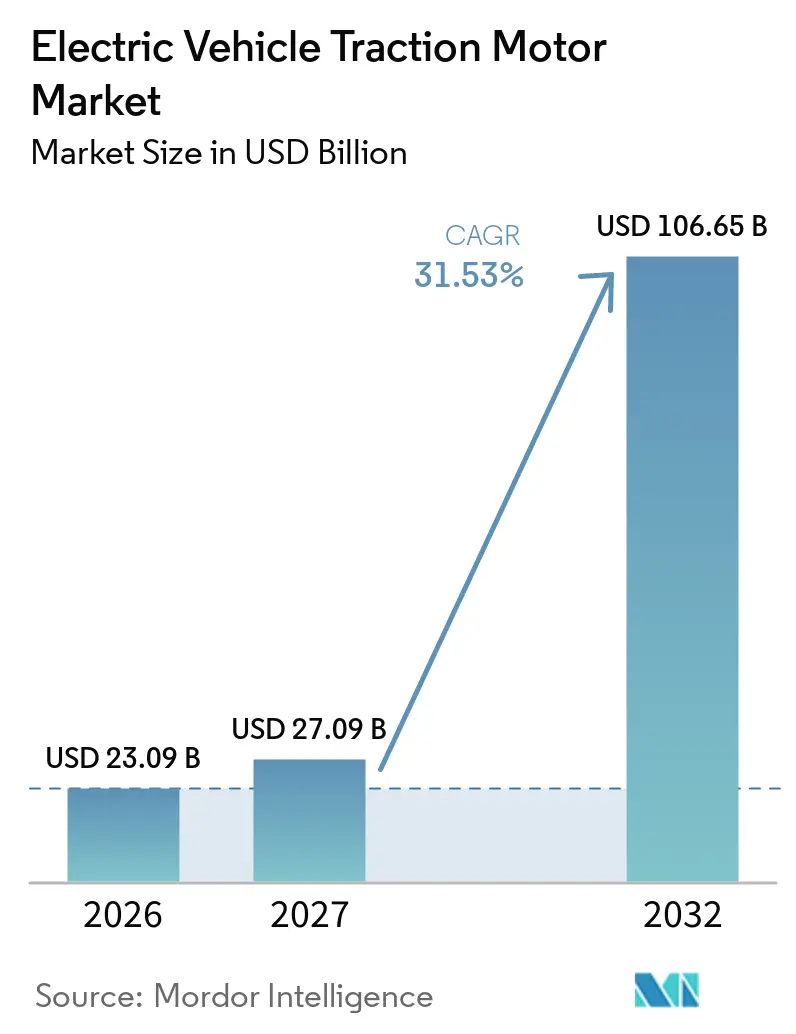
The global electric vehicle traction motor market size is projected to expand from USD 23.09 billion in 2026 and USD 27.09 billion in 2027 to USD 106.65 billion by 2032, at a CAGR of 31.53% between 2027 and 2032. Battery electric vehicle production in China, Europe, and North America continues to support demand for traction motors. Dual-motor and quad-motor all-wheel-drive layouts increase motor content per vehicle. Fleet emission regulations are making powertrain performance and component traceability more important in vehicle procurement. Original equipment manufacturers are bringing more drive-unit engineering in-house, which is narrowing the opportunity for independent suppliers in high-volume passenger vehicles. Integrated e-drive systems, high-voltage architectures, and localized supply chains are changing which suppliers can compete for new programs.
Key Report Takeaways
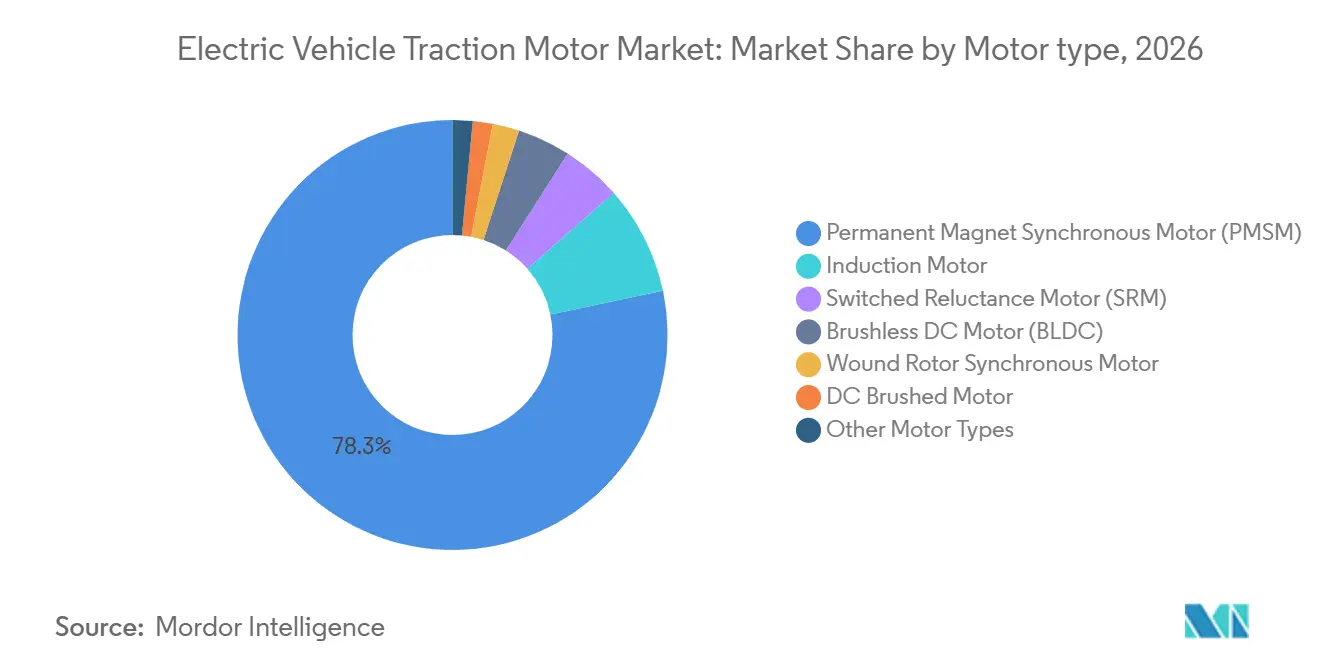
- By motor type, permanent magnet synchronous motors held 78.3% of the global electric vehicle traction motor market share in 2026, while switched reluctance motors are forecast to grow at a CAGR of 31.7% through 2032.
- By power rating, the 100-200 kW band held 38.5% of the global electric vehicle traction motor market share in 2026, while the above 400 kW band is forecast to expand at a CAGR of 31.9% through 2032.
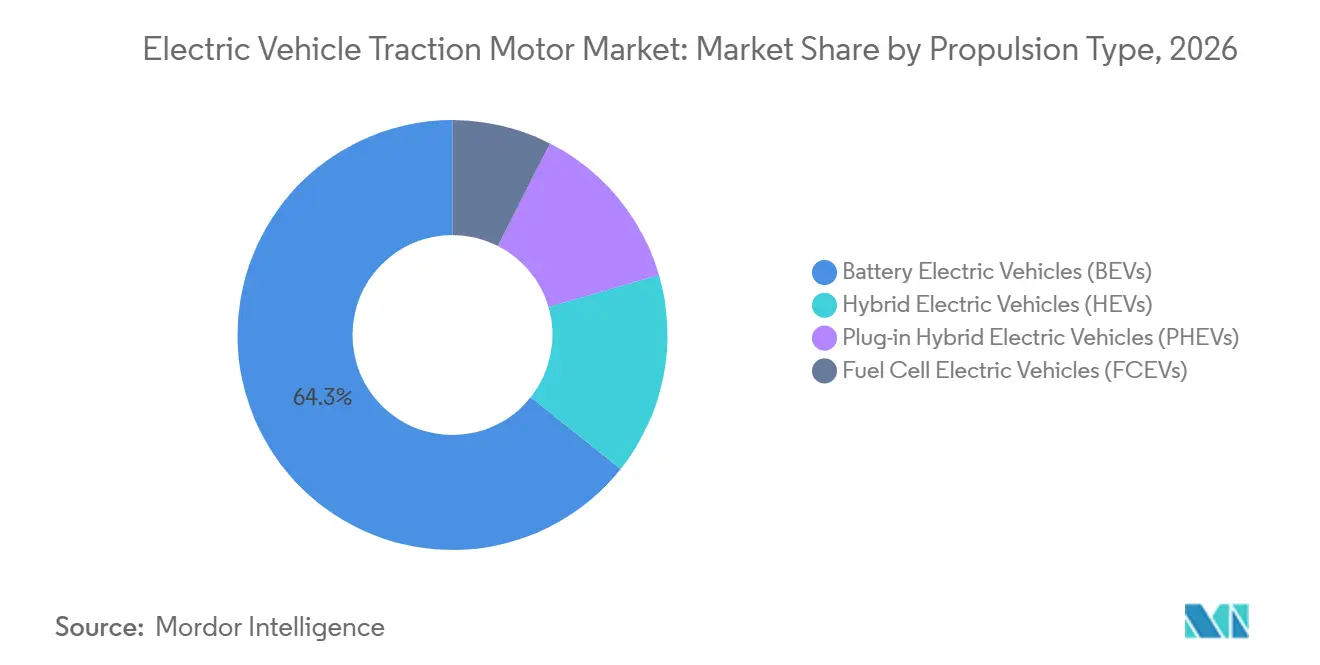
- By propulsion type, battery electric vehicles held 64.3% of the global electric vehicle traction motor market share in 2026, while plug-in hybrid electric vehicles are forecast to grow at a CAGR of 32.6% through 2032.
- By geography, Asia-Pacific held 52.7% of the global electric vehicle traction motor market share in 2026 and is forecast to grow at a CAGR of 32.1% through 2032.
Note: Market numbers in this report are based on Mordor Intelligence's proprietary estimation framework, which combines nine months of actuals with Q4 projections for base year 2026.
Market Trends and Insights
Drivers Impact Analysis of Electric Vehicle Traction Motor Market*
| Driver | (~) % Impact on CAGR Forecast | Geographic Relevance | Impact Timeline |
|---|---|---|---|
| Accelerating EV Production and Sales | +11.2% | Global | Short term (≤ 2 years) |
| Tightening Zero-Emission and Fleet-Regulation Targets | +5.4% | North America, Europe, China core, expanding to India and Southeast Asia | Medium term (2-4 years) |
| 800-Volt Platforms and Silicon-Carbide Inverter Adoption | +4% | Europe and China core, expanding globally | Short term (≤ 2 years) |
| Commercial Fleet Electrification and E-Axle Deployment | +3.6% | APAC, North America, Europe | Medium term (2-4 years) |
| OEM Localization and Vertical Integration of Drive Units | +2.4% | Global, concentrated in the United States, Germany, and China | Long term (≥ 4 years) |
| Rare-Earth Diversification Encouraging Alternative Motor Architectures | +2.1% | Global, with early gains in North America and Europe | Medium term (2-4 years) |
| Source: Mordor Intelligence | |||
Accelerating EV Production and Sales
Global passenger EV registrations reached record levels through 2025, and battery-electric vehicle production is expected to expand further in 2026. This increase supports direct demand across the global electric vehicle traction motor market. Battery-electric vehicles use 1 to 4 traction motors, depending on their drivetrain layout. The shift toward dual-motor and quad-motor all-wheel-drive vehicles raises motor content per vehicle beyond what registration growth alone indicates. Urban light commercial vehicles and medium-duty trucks require higher-power systems with broader integration requirements. The International Energy Agency stated that medium- and heavy-duty electric trucks can provide greater operational cost savings than light commercial vehicles, which supports fleet demand despite current vehicle price premiums.[1]
Tightening Zero-Emission and Fleet-Regulation Targets
Fleet emission requirements are making electrified powertrains more central to OEM planning in Europe, China, and North America. China's dual-credit approach links vehicle compliance to powertrain performance. Component traceability is also becoming an important procurement condition as regulations place greater attention on supply-chain provenance. POSCO INTERNATIONAL completed its Poland drive-motor-core plant in 2025 to supply 1.68 million units annually to Hyundai-Kia's European operations. The company is building a global network with a target capacity of 7.5 million units per year by 2030. This investment reflects how production localization now supports both supply security and regional compliance needs in the global electric vehicle traction motor market.
800-Volt Platforms and Silicon-Carbide Inverter Adoption
High-voltage platforms require stronger insulation, tighter coil geometry, and closer control of noise, vibration, and harshness. These requirements make motor and inverter design more interdependent. ROHM Semiconductor and Schaeffler began mass production of a silicon-carbide MOSFET inverter brick in September 2025 for a Chinese high-voltage vehicle platform. The inverter is designed for voltages above 800 V and root mean square currents up to 650 A. BMW began series production of its sixth-generation electric drive at Plant Steyr in August 2025 using an 800 V silicon-carbide architecture. BMW reported 40% lower energy loss, 20% lower cost, and 10% lower weight compared to the earlier generation.[2]
Commercial Fleet Electrification and E-Axle Deployment
Commercial vehicle electrification is moving from pilot programs to platform-level product specifications. E-axles combine a motor, power electronics, and gearbox within one assembly. MAHLE introduced its Contactless Transmitter motor in September 2025 for heavy commercial vehicle e-axles. The permanent-magnet-free unit delivers 370 kW peak output, more than 900 N·m of torque, and 95% VECTO-cycle efficiency. Accelera by Cummins introduced its 17Xe eAxle for class 7 to 8 trucks with 2,000 N·m of torque and support for 450 V to 900 V architectures. These systems can command 3 to 5 times the average selling price of comparable passenger-vehicle motor systems.
OEM Localization and Vertical Integration of Drive Units
OEMs are increasing in-house motor production to improve supply security, cost control, and intellectual-property protection. BMW committed more than EUR 1 billion to electric-drive development and production at Plant Steyr through 2030. The site employs around 1,000 people in sixth-generation e-drive assembly and produces variants for the Neue Klasse range. Volkswagen Group had produced 5 million electric drives globally by mid-2025. Its APP290 motor, rated from 85 kW to 166 kW, is planned for the Electric Urban Car Family. These programs reduce the addressable passenger-vehicle volume for independent suppliers, while preserving opportunities in commercial vehicles, premium systems, and regions that favor external sourcing.
Restraints Impact Analysis of Electric Vehicle Traction Motor Market*
| Restraint | (~) % Impact on CAGR Forecast | Geographic Relevance | Impact Timeline |
|---|---|---|---|
| Rare-Earth Magnet and Electrical-Steel Supply Volatility | -3.8% | Global, most acute in North America and Europe | Short term (≤ 2 years) |
| Thermal Management and NVH Engineering Complexity | -2.4% | Global | Medium term (2-4 years) |
| Charging and Grid Readiness Constraints for Commercial EVs | -1.9% | North America, Europe, emerging APAC markets | Long term (≥ 4 years) |
| High Qualification Costs and Long OEM Design-In Cycles | -1.6% | Global | Medium term (2-4 years) |
| Source: Mordor Intelligence | |||
Rare-Earth Magnet and Electrical-Steel Supply Volatility
According to the International Energy Agency, China accounted for 60% of mined rare-earth output, 91% of refined production, and 94% of sintered permanent magnets in 2024. This concentration exposes the global electric vehicle traction motor market to disruption in magnet and motor supply. In April 2025, China imposed export licensing requirements on 7 heavy rare-earth elements. These controls reduced magnet exports and contributed to automotive production slowdowns in Europe and North America. Further controls were announced in October 2025 and then suspended for one year in November 2025. The International Energy Agency identified automotive supply chains as a major area of exposure if wider controls are implemented.
Thermal Management and NVH Engineering Complexity
Higher-power motors operating on 800 V platforms create thermal loads that standard water-glycol cooling cannot always manage. Oil-immersion and combined cooling systems can address this issue, but they increase mass, cost, and design requirements. Motor noise becomes more noticeable when battery-electric powertrains remove internal-combustion-engine noise. Switched reluctance motors present additional noise, vibration, and harshness challenges, as torque ripple and radial-force variation require active control. The close relationship between cooling design and motor geometry raises entry barriers for suppliers without established validation capabilities in the global electric vehicle traction motor market. Compliance with rotating-machine and electric-vehicle safety standards can extend the certification timeline for each new motor variant.
*Our forecasts treat driver/restraint impacts as directional, not additive. The impact forecasts reflect baseline growth, mix effects, and variable interactions.
Electric Vehicle Traction Motor Market Segment Analysis
By Motor Type:
PMSM Leads While Supply Risk Changes the Technology MixPermanent Magnet Synchronous Motors accounted for 78.3% of the global electric vehicle traction motor market revenue in 2026. Their position is supported by high power density, peak system efficiency above 96%, and established hairpin-winding supply chains across Asia. China's new-energy-vehicle ecosystem has a strong PMSM base, linking rare-earth refining, magnet manufacturing, and motor assembly. This integrated chain supports lower system costs and high production volumes. Induction motors retain a role in durable commercial applications and cost-sensitive vehicle programs. BorgWarner won a February 2026 contract to supply an 800 V induction e-machine for REEV trucks and large SUVs, demonstrating that high-voltage induction designs remain relevant.[3]
Switched Reluctance Motors are forecast to record a 31.7% CAGR from 2027 to 2032, the fastest rate among motor types. Procurement teams are giving greater consideration to magnet-free designs following China's 2025 export controls. A 2026 IEEE study documented a 150 kW switched reluctance motor inverter that achieved 109.4 kW peak power at 9,000 rpm in a Cadillac LYRIQ. MAHLE's MCT motor offers 370 kW peak output and 95% VECTO efficiency without rare-earth materials. The U.S. Department of Energy is also applying AI-based optimization through its fiscal year 2026 MOTOR-AI program to reduce critical magnet use in permanent-magnet motors. These developments expand the technology options available to suppliers in the global electric vehicle traction motor market.

By Power Rating:
Higher-Output Systems Support Heavy-Duty Vehicle DemandThe 100 to 200 kW band held 38.5% of the global electric vehicle traction motor market in 2026. This range serves high-volume mid-segment passenger electric vehicles across many global model lines. LG Magna e-Powertrain's HP1015 platform provides up to 180 kW and supports both 400 V and 800 V systems. The unit delivers 96% peak efficiency and uses a hairpin-wound package for B- and C-segment battery electric vehicles and plug-in hybrid electric vehicles. Motors below 100 kW remain important for two-wheelers, three-wheelers, and urban electric vehicles, particularly in Asia-Pacific. The 200 to 400 kW range supports larger SUVs and performance passenger vehicles.
The above 400 kW category is forecast to grow at a 31.9% CAGR between 2027 and 2032. Heavy-duty trucks, high-performance multi-motor passenger vehicles, and fuel-cell drivetrains require high continuous power output. Accelera's 17Xe eAxle provides 2,000 Nm of torque and supports 450 V to 900 V systems for Class 7 to 8 trucks. Commercial heavy-duty motor systems carry higher average selling prices than passenger-vehicle equivalents. As a result, revenue growth in this segment of the global electric vehicle traction motor market can exceed unit volume growth. Emissions regulations for heavy vehicles in the EU, China, and North America support fleet purchasing plans for these systems.
By Propulsion Type:
BEV Volumes Provide the Base While PHEVs Grow FasterBattery electric vehicles held 64.3% of the global electric vehicle traction motor market by propulsion type in 2026, reflecting their role as the primary volume base for global electric-vehicle production. Hybrid electric vehicles retain a stable position in markets where charging infrastructure gaps and consumer range preferences support hybrid adoption. Japan and Southeast Asia are notable examples of this demand pattern. Fuel cell electric vehicles remain concentrated in heavy commercial applications where hydrogen logistics are more developed. Each propulsion type requires different motor configurations and integration approaches, supporting a broad supplier base across the global electric vehicle traction motor market.
Plug-in hybrid electric vehicles are forecast to expand at a 32.6% CAGR from 2027 to 2032. Commercial fleets and OEMs are adopting plug-in hybrid electric vehicle architectures in regions where charging networks are less mature. BorgWarner secured multiple P2 eMotor awards in China and South Korea in April 2026 for plug-in hybrid electric vehicle applications. These programs use S-winding technology paired with 1.5-liter and 2.0-liter turbocharged engines, with production scheduled to begin in phases from June 2026. Extended-range trucks and SUVs can use separate traction motors on each axle, increasing motor content per vehicle compared with mild hybrids and conventional plug-in hybrid electric vehicles.
Geography Analysis
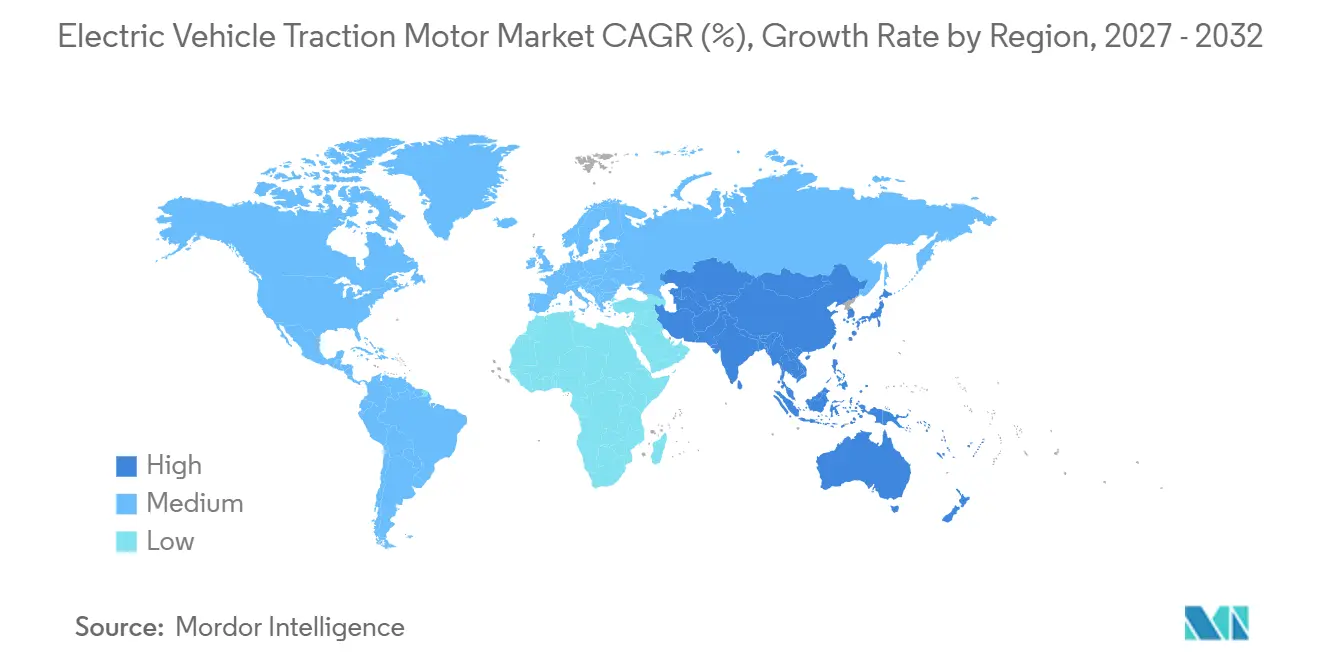
Asia-Pacific accounted for 52.7% of the global electric vehicle traction motor market share in 2026 and is forecast to grow at a 32.1% CAGR through 2032. China's scale in EV production and traction motor manufacturing is the principal regional factor. Its supply chain spans rare-earth refining, magnet production, electrical-steel processing, and motor assembly. China had an estimated annual traction-motor production capacity of 21 million units in 2025, compared with a global total of 38 million units. Japan and South Korea contribute advanced PMSM and hybrid-powertrain technology. Hyundai Mobis secured more than USD 9.2 billion in global OEM orders in 2025, exceeding its target by 23%.[4]
Europe is the second-largest regional revenue contributor to the global electric vehicle traction motor market. Binding fleet carbon dioxide (CO2) targets support vehicle electrification across the region. Germany remains central to motor production and consumption, as Volkswagen, BMW, and Mercedes-Benz are expanding electric-drive capabilities. Volkswagen had produced 5 million electric drives by mid-2025 and continues to scale internal capacity. Hyundai Mobis opened European facilities in Spain, Hungary, and Slovakia during the first half of 2026. Its Nováky facility in Slovakia has an annual capacity of 300,000 units, following a KRW 350 billion (USD 231 million) investment.
North America is expanding domestic traction-motor capacity through supplier commitments from BorgWarner, Magna International, and Nidec Corporation. BorgWarner's 2026 program awards indicate continued demand for integrated high-voltage drive modules in the region. South America, the Middle East, and Africa represent smaller contributors to the global electric vehicle traction motor market through 2031. Brazil's urban transport and delivery fleets support early commercial-electrification activity. The United Arab Emirates and Saudi Arabia are investing in EV infrastructure and manufacturing as part of broader economic-diversification plans. South Africa's mining and industrial operations provide additional commercial-EV applications, while Israel contributes motor-control and power-electronics expertise.
Competitive Landscape
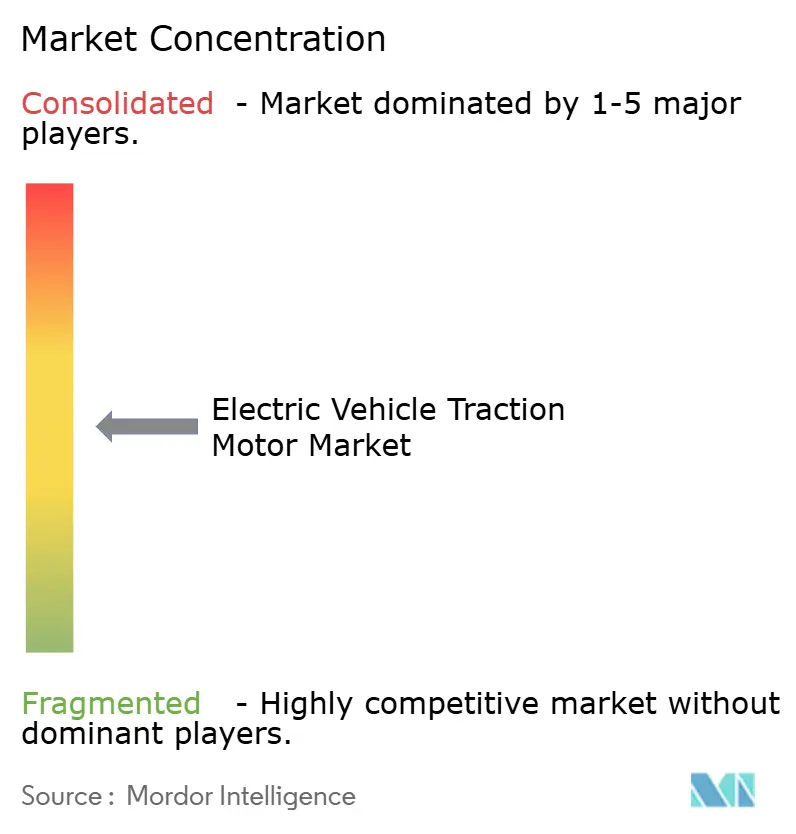
The global electric vehicle traction motor market is moderately consolidated at the integrated-system level. China-based active motor manufacturers increased from 23 in 2020 to 41 in 2025, increasing competitive pressure in mid-power passenger applications. BorgWarner secured a three-in-one coaxial integrated-drive-module award from a global OEM in August 2026. The company also secured three Asian OEM eMotor awards in April 2026 and an 800 V REEV truck contract in February 2026. These wins are based on system efficiency through GenIV silicon-carbide inverter technology and Viper D power-switch technology, rather than motor output alone.
Nidec Corporation is targeting a 40% to 45% global e-axle share by 2030 through a vertically integrated model covering more than 400 e-axle components. Its platform approach shortens derivative development time compared with the common 2 to 2.5-year development cycle. ZF Friedrichshafen confirmed in May 2026 that it will continue to develop and manufacture e-motors and inverters in-house. Its SELECT eDrive platform serves 150 to 300 kW applications at both 400 V and 800 V. Hyundai Mobis reached full capacity at its Slovakia PE-system plant in the first quarter of 2026. The company's non-affiliate order book reflects how Korean tier-1 suppliers are expanding their role in the global electric vehicle traction motor market.
Rare-earth-free commercial-vehicle motors above 200 kW remain an early competitive area. MAHLE's MCT launch in September 2026 is an example of a supplier addressing that need. Drive-unit repair and remanufacturing are also emerging as EV fleets mature and warranties expire. ZF Friedrichshafen introduced drive-unit bearing repair kits at Automechanika Frankfurt 2026, indicating a service opportunity for fleet operators. Schaeffler and CATL formed a partnership for battery-management systems and X-in-1 Intelligent PowerBox solutions. This work combines cell-level algorithms with automotive manufacturing capability and increases the importance of motor-system software in competitive positioning.
Electric Vehicle Traction Motor Industry Leaders
-
Nidec Corporation
-
BYD Company Limited
-
Robert Bosch GmbH
-
BorgWarner Inc.
-
Tesla, Inc.
- *Disclaimer: Major Players sorted in no particular order
Electric Vehicle Traction Motor Market Companies Covered in this Report
- ABB Ltd.
- AISIN Corporation
- BorgWarner Inc.
- Broad-Ocean Motor Co., Ltd.
- BYD Company Limited
- Continental AG
- Dana Incorporated
- DENSO Corporation
- GKN Automotive Limited
- Hitachi Astemo, Ltd.
- Hyundai Mobis Co., Ltd.
- Jing-Jin Electric Technologies Co., Ltd.
- LG Magna e-Powertrain Co., Ltd.
- Magna International Inc.
- MAHLE GmbH
- Marelli Holdings Co., Ltd.
- Mitsubishi Electric Corporation
- Nidec Corporation
- Robert Bosch GmbH
- Schaeffler AG
- Siemens AG
- Tesla, Inc.
- Valeo SE
- ZF Friedrichshafen AG
Recent Industry Developments in Electric Vehicle Traction Motor Market
- September 2026: MAHLE GmbH introduced its MCT (Magnet-free Contactless Transmitter) electric motor for heavy commercial vehicle e-axles at IAA Transportation 2026. The motor delivers 370 kW peak power, more than 900 Nm torque, and approximately 95% efficiency over the VECTO driving cycle, while eliminating up to 3 kg of rare-earth magnet material per vehicle compared with conventional permanent-magnet synchronous motors (PMSMs).
- August 2026: BorgWarner Inc. announced a new integrated drive module award from a global original equipment manufacturer, with production scheduled to begin in 2027. The system combines a next-generation electric motor, compact coaxial gearbox, and GenIV silicon-carbide inverter for electric vehicle platforms.
- August 2026: BMW Group commenced series production of its sixth-generation electric motors at Plant Steyr, Austria. The new drivetrain platform utilizes an 800 V architecture with silicon-carbide technology, delivering 40% lower energy losses, 20% lower costs, and 10% lower weight compared with the previous generation. BMW Group has committed more than EUR 1 billion to electric drive development and production at the facility through 2030.
- February 2026: BorgWarner Inc. secured a contract with a major North American original equipment manufacturer to supply an 800 V secondary integrated drive module and generator module for range-extended electric trucks and large sport utility vehicles. The system incorporates a dual-inverter architecture, and production is scheduled to commence in 2029.
Global Electric Vehicle Traction Motor Market Report Scope
Electric vehicle (EV) traction refers to the propulsion system and mechanisms used to drive an electric vehicle. Instead of an internal combustion engine, EV traction relies on a high-voltage traction battery pack that supplies electrical energy to one or more electric traction motors. These motors convert electrical energy into mechanical energy, generating instantaneous torque that is transferred directly to the wheels via a simplified transmission. The system also uses regenerative braking to capture kinetic energy during deceleration and return it to the battery, improving the vehicle's overall efficiency.
The global electric vehicle traction motor market is segmented by motor type into permanent magnet synchronous motor (PMSM), induction motor, switched reluctance motor (SRM), brushless DC motor (BLDC), wound rotor synchronous motor, DC brushed motor, and other motor types. By power rating, the market is segmented into less than 100 kW, 100-200 kW, 200-400 kW, and above 400 kW. By propulsion type, the market is segmented into battery electric vehicles (BEVs), hybrid electric vehicles (HEVs), plug-in hybrid electric vehicles (PHEVs), and fuel cell electric vehicles (FCEVs). The report also covers the market size and forecasts for the global electric vehicle traction motor market across 23 countries in key regions. For each segment, the market sizing and forecasts are provided on the basis of value (USD).
Segmentation Overview
| Permanent Magnet Synchronous Motor (PMSM) |
| Induction Motor |
| Switched Reluctance Motor (SRM) |
| Brushless DC Motor (BLDC) |
| Wound Rotor Synchronous Motor |
| DC Brushed Motor |
| Other Motor Types |
| Less Than 100 kW |
| 100–200 kW |
| 200–400 kW |
| Above 400 kW |
| Battery Electric Vehicles (BEVs) |
| Hybrid Electric Vehicles (HEVs) |
| Plug-in Hybrid Electric Vehicles (PHEVs) |
| Fuel Cell Electric Vehicles (FCEVs) |
| North America | United States |
| Canada | |
| Mexico | |
| Europe | Germany |
| France | |
| United Kingdom | |
| Italy | |
| Spain | |
| Netherlands | |
| Norway | |
| Sweden | |
| Rest of Europe |
| Asia-Pacific | China |
| Japan | |
| India | |
| South Korea | |
| Thailand | |
| Indonesia | |
| Rest of Asia-Pacific | |
| South America | Brazil |
| Argentina | |
| Rest of South America | |
| Middle East and Africa | United Arab Emirates |
| Saudi Arabia | |
| South Africa | |
| Israel | |
| Rest of Middle East and Africa |
| By Motor Type | Permanent Magnet Synchronous Motor (PMSM) | |
| Induction Motor | ||
| Switched Reluctance Motor (SRM) | ||
| Brushless DC Motor (BLDC) | ||
| Wound Rotor Synchronous Motor | ||
| DC Brushed Motor | ||
| Other Motor Types | ||
| By Power Rating | Less Than 100 kW | |
| 100–200 kW | ||
| 200–400 kW | ||
| Above 400 kW | ||
| By Propulsion Type | Battery Electric Vehicles (BEVs) | |
| Hybrid Electric Vehicles (HEVs) | ||
| Plug-in Hybrid Electric Vehicles (PHEVs) | ||
| Fuel Cell Electric Vehicles (FCEVs) | ||
| Geography | North America | United States |
| Canada | ||
| Mexico | ||
| Europe | Germany | |
| France | ||
| United Kingdom | ||
| Italy | ||
| Spain | ||
| Netherlands | ||
| Norway | ||
| Sweden | ||
| Rest of Europe | ||
| ` | Asia-Pacific | China |
| Japan | ||
| India | ||
| South Korea | ||
| Thailand | ||
| Indonesia | ||
| Rest of Asia-Pacific | ||
| South America | Brazil | |
| Argentina | ||
| Rest of South America | ||
| Middle East and Africa | United Arab Emirates | |
| Saudi Arabia | ||
| South Africa | ||
| Israel | ||
| Rest of Middle East and Africa | ||
Key Questions Answered in the Report
What is the expected growth rate for electric vehicle traction motors?
The global electric vehicle traction motor market is forecast to grow at a CAGR of 31.53% from 2027 to 2032 and reach USD 106.65 billion by 2032..
Which motor type leads electric vehicle traction motor revenue?
Permanent magnet synchronous motors held 78.3% of revenue in 2026, supported by their power density and established supply chains.
Which traction motor technology is growing fastest?
Switched reluctance motors are forecast to grow at a CAGR of 31.7% through 2032, as automakers evaluate magnet-free designs.
Which propulsion type generates the largest demand for traction motors?
Battery electric vehicles held 64.3% of revenue in 2026 and remain the primary volume base for electric powertrains.
Why are 800 V vehicle platforms important for traction motor suppliers?
They require co-design of motors and inverters, including stronger insulation, tighter coil geometry, and greater thermal control capability.
Which region leads demand for electric vehicle traction motors?
Asia-Pacific held 52.7% of revenue in 2026 and is forecast to grow at a CAGR of 32.1% through 2032.