
Distribution Substation Market Size and Share
Market Overview
| Study Period | 2022 - 2032 |
|---|---|
| Market Size (2027) | USD 120.28 Billion |
| Market Size (2032) | USD 149.95 Billion |
| Growth Rate (2027 - 2032) | 4.51 % |
| Fastest Growing Market | Asia-Pacific |
| Largest Market | Asia-Pacific |
| Market Concentration | Medium |
Major Players *Disclaimer: Major Players sorted in no particular order Image © Mordor Intelligence. Reuse requires attribution under CC BY 4.0. | |
Distribution Substation Market Analysis by Mordor Intelligence
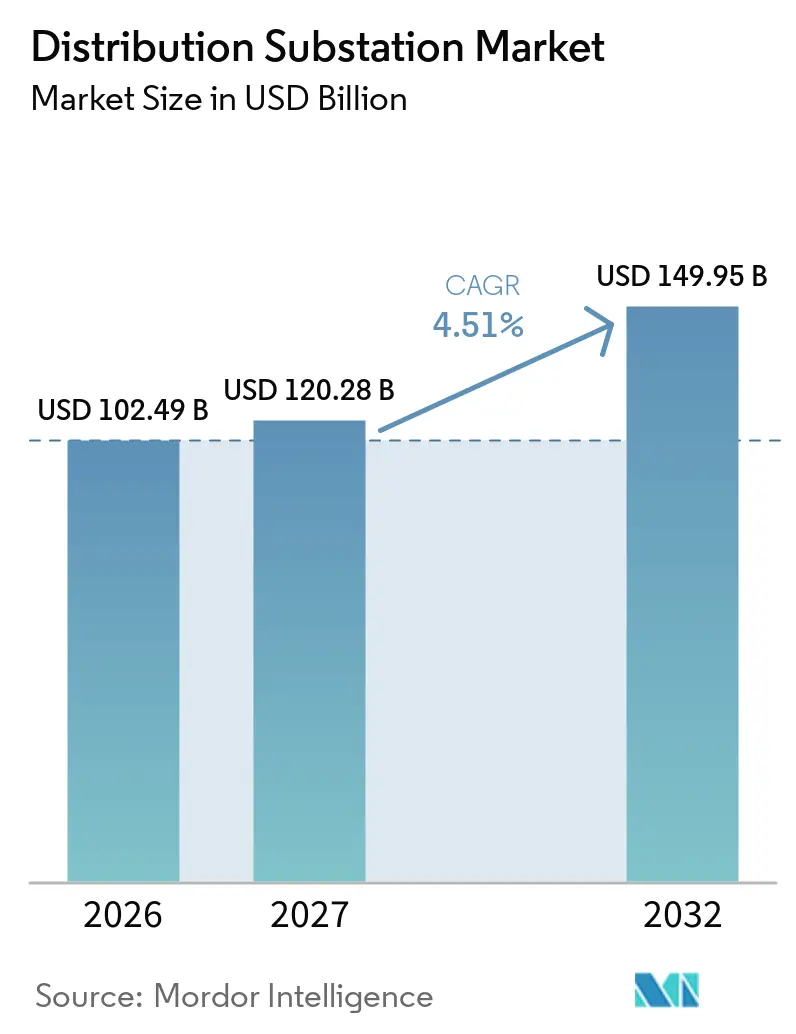
The distribution substation market size is expected to increase from USD 102.49 billion in 2026 to USD 120.28 billion in 2027 and reach USD 149.95 billion by 2032, at a CAGR of 4.51% over 2027-2032. Demand is supported by grid investment requirements, renewable energy connections, industrial electrification, and the replacement of aging network assets. The International Energy Agency stated that annual global grid investment needs to rise 50% by 2030 to avoid congestion and renewable curtailment. This is also reflected in connection queues, where more than 2,500 GW of renewable, large-load, and storage projects are awaiting grid connections. Suppliers are responding with compact equipment, SF6-free switchgear, automation systems, and modular designs that help utilities address land constraints and operating requirements. Procurement remains constrained by equipment availability, long approval processes, and the capital intensity of large projects.
Key Report Takeaways
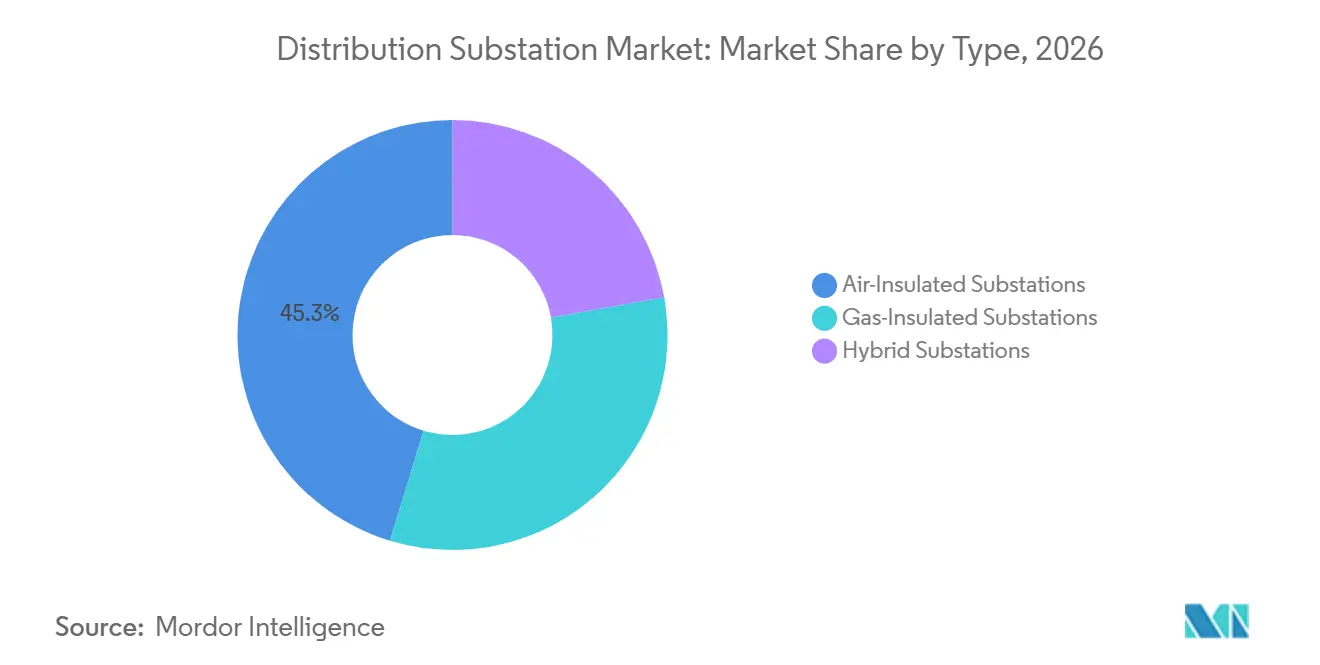
- By type, air-insulated substations held 45.3% share in 2026, while gas-insulated substations are forecast to grow at a 5.3% CAGR through 2032.
- By component, transformers held 36.4% share in 2026, while control and protection equipment is forecast to grow at a 4.8% CAGR through 2032.
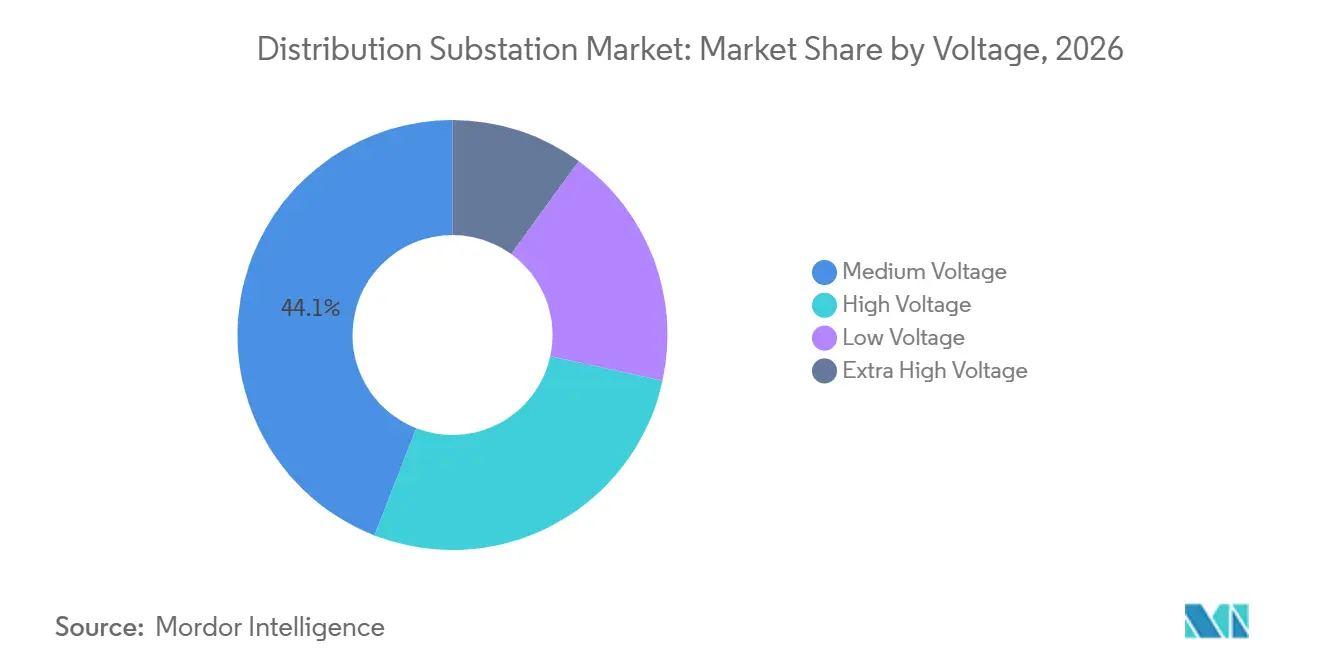
- By voltage, medium voltage held 44.1% share in 2026, while high voltage is forecast to grow at a 4.8% CAGR through 2032.
- By application, utility applications held 29.4% share in 2026, while industrial applications are forecast to grow at a 5.1% CAGR through 2032.
- By geography, Asia-Pacific held 38.7% share of the distribution substation market in 2026 and is forecast to grow at a 5.2% CAGR through 2032.
Note: Market numbers in this report are based on Mordor Intelligence's proprietary estimation framework, which combines nine months of actuals with Q4 projections for base year 2026.
Market Trends and Insights
Drivers Impact Analysis of Distribution Substation Market*
| Driver | (~) % Impact on CAGR Forecast | Geographic Relevance | Impact Timeline |
|---|---|---|---|
| Grid Modernization and Aging-Asset Replacement | +1.2% | Global, with concentration in North America, Europe, China, and India | Short term (≤ 2 years) |
| Renewable Energy and Distributed Energy Resource Integration | +1.0% | Global, led by Asia-Pacific, Europe, and North America | Medium term (2-4 years) |
| Rising Electricity Demand and Electrification of Industry and Transport | +0.8% | Global, with the highest velocity in North America and Asia-Pacific | Short term (≤ 2 years) |
| Smart-Grid Automation, Remote Monitoring, and Predictive Maintenance | +0.7% | Global, led by North America, Europe, and China | Medium term (2-4 years) |
| SF6-Free and Low-Emission Switchgear Transition | +0.4% | European Union-led, with spillover into Asia-Pacific and Middle East and Africa | Medium term (2-4 years) |
| Compact and Modular Substations for Space-Constrained Load Growth | +0.3% | Urban centers globally, particularly in Asia-Pacific and North America | Medium term (2-4 years) |
| Source: Mordor Intelligence | |||
Grid Modernization and Aging-Asset Replacement
Grid modernization is a primary demand driver for the distribution substation market, as utilities need to renew aging assets while adding capacity. The International Energy Agency reported that annual global grid investment needs to increase 50% by 2030 to avoid congestion and renewable curtailment. China's State Grid announced CNY 4 trillion in fixed-asset investment for 2026-2030, directing funding toward ultra-high-voltage transmission, distribution modernization, and smart substations. Distribution networks are expected to absorb 40%-45% of this investment program, supporting both equipment replacement and network expansion. Germany's E.ON SE raised its 2026-2030 capital program to EUR 48 billion, including EUR 40 billion for grid expansion and resilience. This spending pattern shortens replacement cycles as utilities bring forward work to meet interconnection and reliability requirements.
Renewable Energy and Distributed Energy Resource Integration
Renewable generation and distributed energy resources require additional connection capacity, creating direct procurement demand in the distribution substation market. According to the International Energy Agency, more than 2,500 GW of renewable, large-load, and storage projects were in grid connection queues. The agency indicated that connecting 450-700 GW of advanced-stage projects requires further grid equipment and network development. India's planned renewable deployment requires substantial substation capacity additions, while Power Grid Corporation of India Limited has committed major capital expenditure to transmission expansion. Offshore wind also requires large substations at coastal landing points, where compact gas-insulated switchgear configurations suit space and environmental conditions. These requirements extend from large transmission interfaces to distribution networks that must manage more variable local power flows.
Rising Electricity Demand and Electrification of Industry and Transport
Rising electricity use from industrial facilities, transport systems, and data centers is broadening demand in the distribution substation market. The Electric Power Research Institute projected that U.S. data center electricity use could reach 9%-17% of national electricity demand by 2030.[1] Large AI campuses require dedicated high-voltage grid connections, placing them in a similar infrastructure category as industrial utility customers. The International Energy Agency warned that grid constraints could delay nearly 20% of planned global data center projects. Electric vehicle manufacturing, metro rail, freight rail, and charging infrastructure are also increasing loads on medium- and high-voltage networks. These applications require protection systems capable of managing rapid load changes while maintaining reliable service.
Smart-Grid Automation, Remote Monitoring, and Predictive Maintenance
Digital systems are becoming a standard requirement for new and upgraded installations in the distribution substation market. IEC 61850-based automation supports communication between intelligent electronic devices and enables faster protection signaling than conventional hardwired approaches. Mitteldeutsche Netzgesellschaft Strom mbH allocated EUR 531 million for network expansion, digitalization, and resilience in 2026, including the deployment of 500 digital local-network stations and digital upgrades at 510 transformer stations.[2] Remote monitoring helps utilities improve maintenance planning and asset visibility across dispersed networks. Greater use of intelligent electronic devices also increases the value of control and protection equipment within an installation. This shift creates continuing requirements for software, communications, and equipment upgrades beyond the initial project completion.
Restraints Impact Analysis of Distribution Substation Market*
| Restraint | (~) % Impact on CAGR Forecast | Geographic Relevance | Impact Timeline |
|---|---|---|---|
| High Capital Intensity and Long Utility Procurement Cycles | -0.8% | Global, most acute in emerging markets | Medium term (2-4 years) |
| Permitting, Land Acquisition, and Environmental Clearance Delays | -0.6% | Global, particularly North America, Europe, and South Asia | Medium term (2-4 years) |
| Interoperability and Cybersecurity Exposure in Brownfield Retrofits | -0.5% | Global, particularly advanced economies with legacy infrastructure | Medium term (2-4 years) |
| Transformer, Switchgear, and Power-Electronics Supply Bottlenecks | -0.4% | Global | Short term (≤ 2 years) |
| Source: Mordor Intelligence | |||
High Capital Intensity and Long Utility Procurement Cycles
Large projects in the distribution substation market require investment decisions that often align with utility rate cases and regulatory recovery periods. A 110 kV GIS replacement can cost EUR 15 million to EUR 40 million, while transmission-interface facilities can exceed USD 100 million. Utilities must recover these costs through regulated asset-base mechanisms or approved tariffs, which can delay procurement after a project decision. In emerging markets, multilateral financing and public-private partnership arrangements can further lengthen the funding process. Transformer efficiency requirements and dielectric oil standards can add specification costs where environmental rules are becoming more stringent. Long procurement cycles can therefore defer project awards even when network need is established.
Permitting, Land Acquisition, and Environmental Clearance Delays
Permitting and land acquisition slow the pace at which the distribution substation market can convert planned investment into commissioned assets. The International Energy Agency stated that grid infrastructure can take 5 to 15 years to plan, permit, and complete, compared with 1 to 5 years for the renewable projects it connects.[3] Substation upgrades can require separate federal, state, and municipal approvals before construction begins. Dense urban areas create additional difficulty because even compact GIS projects may face prolonged land acquisition and legal processes. Older sites can require environmental remediation involving legacy SF6 equipment or polychlorinated biphenyl-contaminated oil before replacement. These constraints add cost and make project schedules less certain for utilities and equipment suppliers.
*Our forecasts treat driver/restraint impacts as directional, not additive. The impact forecasts reflect baseline growth, mix effects, and variable interactions.
Distribution Substation Market Segment Analysis
By Type:
GIS Adoption Accelerates as Insulation Mandates Reshape ProcurementAir-insulated substations held 45.3% share in 2026, as they remain cost-effective for greenfield sites with adequate land. Their installed base is supported by rural utility networks and emerging markets where footprint constraints are less severe. Gas-insulated substations are forecast to expand at a 5.3% CAGR between 2026 and 2032, the fastest rate among types. This segment of the distribution substation market benefits from compact layouts suited to constrained urban locations. Regulation (EU) 2024/573 restricts new SF6 medium-voltage switchgear up to 24 kV from January 2026, with requirements extending to higher voltage categories in later years. This regulation is shifting purchasing criteria toward SF6-free and lower-emission alternatives.
GIS demand within the distribution substation market is also supported by renewable energy connections and replacement work in locations where a large air-insulated footprint is impractical. ESB Networks outlined the staged requirements of the European F-Gas regulation, including restrictions at 52 kV from 2030 and at higher voltage levels during 2028 to 2032. GE Vernova's 2025 contract to modernize the Kühmoos cross-border grid hub in Germany replaced AIS with GIS and doubled capacity within a smaller footprint. Hybrid substations allow utilities to add GIS elements into existing AIS bays when full replacement is not feasible. This approach is relevant in land-constrained markets such as Japan and South Korea. The distribution substation industry is also moving toward non-SF6 gases and vacuum interruption as compliant technologies become more widely available. CIGRE issued guidance on non-SF6 gases and gas mixtures in substations in 2026.[4]

By Component:
Transformers Lead While Control Equipment Gains Value ShareTransformers held 36.4% share of the distribution substation market in 2026, reflecting their high value and central role in every substation configuration. They are essential to both asset replacement programs and new network capacity projects. Supply pressure has increased the importance of securing transformer manufacturing slots. Hitachi Energy and E.ON signed an agreement worth up to USD 700 million in July 2025 to deliver power and distribution transformers for the German grid. Switchgear remains another major component, as projects require isolation, protection, and switching capability. Control and protection equipment has the fastest projected CAGR at 4.8% through 2032, as utilities replace electromechanical relays with intelligent electronic devices.
Control equipment growth is driven by automation requirements, as new projects increasingly specify IEC 61850-compatible architectures. Demand for this equipment benefits from digital monitoring, SCADA integration, and protection upgrades that accompany broader modernization work. Batteries and UPS systems remain the smallest component category, but utilities use them to support resilience and substation-level energy storage. Other components include instrument transformers, surge arresters, and SCADA hardware, all of which benefit from digitalization projects. Hitachi Energy committed USD 300 million in August 2026 to expand transformer and component production in Hefei, China, including capacity for bushings and smart transformer components. Embedded sensors and monitoring features are bringing transformer equipment and control systems closer together in project specifications, increasing the importance of suppliers that can offer both equipment and digital capabilities.
By Voltage:
Medium Voltage Anchors Base, High Voltage Leads Forward GrowthMedium voltage held 44.1% share in 2026, supported by the large number of substations serving residential, commercial, and urban distribution networks. The segment is shaped by replacement of legacy equipment and continued additions to local distribution capacity. The first phase of the European F-Gas restrictions applies to switchgear up to 24 kV from January 2026. Utilities are replacing SF6-insulated ring-main units with vacuum or alternative-gas designs. This compliance requirement gives the medium voltage segment an important role in the transition to lower-emission switchgear, while its large installed base creates recurring upgrade opportunities for suppliers.
High voltage in the distribution substation market is forecast to record the fastest CAGR at 4.8% through 2032. High-voltage demand is supported by offshore wind landing facilities, cross-border interconnections, data centers, and energy-intensive industrial sites. Offshore wind connections can require 110 to 400 kV GIS at coastal locations. Large data centers similarly require dedicated high-voltage infrastructure where local network capacity is limited. Low voltage installations benefit from EV charging and smart-metering programs, although they remain more standardized than upper-voltage equipment. Extra high voltage remains concentrated in China's planned UHV DC projects, India's renewable energy corridors, and solar-linked projects in the Middle East, creating demand for large, specialized equipment rather than broad-based distribution installations.
By Application:
Industrial Demand Outpaces All Other End MarketsUtility applications held 29.4% share in 2026, as utilities operate the core distribution networks that require continuous renewal. Their demand is supported by established asset replacement programs and regulated investment frameworks in North America, Europe, China, and India. Commercial facilities such as offices, retail sites, hospitals, and mixed-use developments create steady demand for compact modular substations. Residential demand benefits from EV charging mandates and urban densification but remains highly price sensitive. Utilities also require control upgrades and resilience investments as distributed energy resources become more common, which maintains the utility segment's leading position in the distribution substation market.
Industrial applications in the distribution substation market are forecast to grow at a 5.1% CAGR through 2032, the highest rate among all applications. AI data centers, semiconductor facilities, and EV battery plants require reliable connections, high continuous-current transformers, and switchgear with very low fault tolerance. The Electric Power Research Institute projected that data centers could account for 9% to 17% of U.S. electricity demand by 2030. American Electric Power Ohio's signed data center pipeline reached 17.8 GW in early 2026, illustrating the scale of prospective industrial loads within one utility territory. The distribution substation industry serves these customers through dedicated facilities that integrate protection, automation, and compact site layouts. Industrial customers also place greater value on project delivery speed, as delays can affect the start of production or digital operations.
Geography Analysis
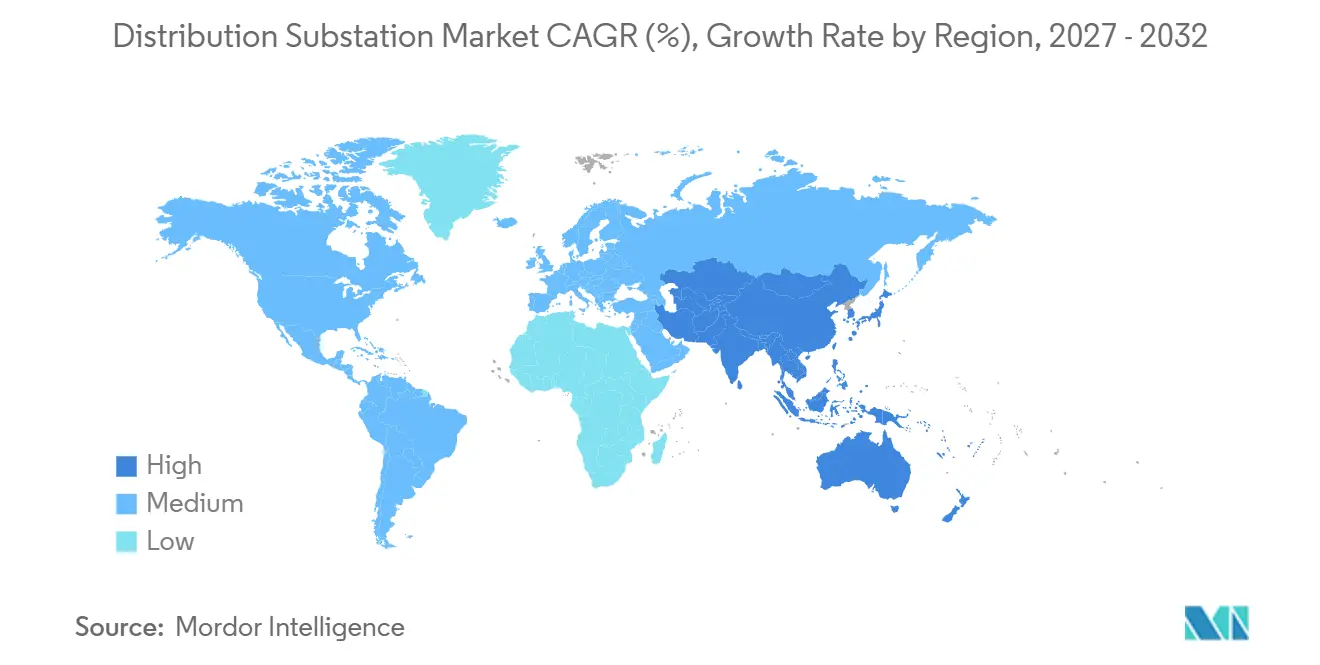
Asia-Pacific held a 38.7% share of the distribution substation market in 2026 and is forecast to grow at a 5.2% CAGR through 2032. China's State Grid announced CNY 4 trillion in fixed-asset investment for 2026-2030, covering ultra-high-voltage transmission, distribution modernization, and smart substations. Distribution systems are expected to receive 40%-45% of this program, supporting a large pipeline of local network projects. India requires significant additions in substation capacity to connect planned renewable generation. Japan requires substantial grid investment through 2040, and Toshiba Energy is expanding transmission and distribution manufacturing capacity through 2027. Vietnam, Indonesia, and Thailand also require new capacity for industrial zones and renewable connections.
Europe's distribution substation market is shaped by asset replacement, grid resilience requirements, and SF6 phase-out regulations. E.ON's EUR 48 billion investment program for 2026-2030 allocates EUR 40 billion to grid expansion and resilience. EWE received a EUR 700 million financing package backed by the European Investment Bank for 2,600 km of new underground lines and more than 1,100 substations in Lower Saxony. Regulation (EU) 2024/573 is a major procurement factor, as it phases out SF6 equipment across medium- and high-voltage categories. North America's distribution substation market is driven by aging infrastructure and growing electricity demand from data centers, electric vehicle manufacturing, and other industrial facilities. Demand in this region also depends on timely interconnection and permitting processes.
South America and Middle East and Africa represent smaller but notable segments of the distribution substation market. Brazil's renewable buildout in northeastern states supports demand for improved grid connections and related network equipment. Mexico's electricity network investment program allocated more than MXN 60.8 billion for energy infrastructure through 2028. Saudi Arabia and the UAE support demand through utility-scale solar integration and industrial electrification programs. South Africa, Morocco, and Egypt require network upgrades for industrial zones and renewable-linked green hydrogen corridors. These markets are at different stages of development, but each requires equipment capable of connecting new sources of load and generation. Opportunities in these markets are often tied to the delivery of specific infrastructure programs rather than broad replacement cycles.
Competitive Landscape
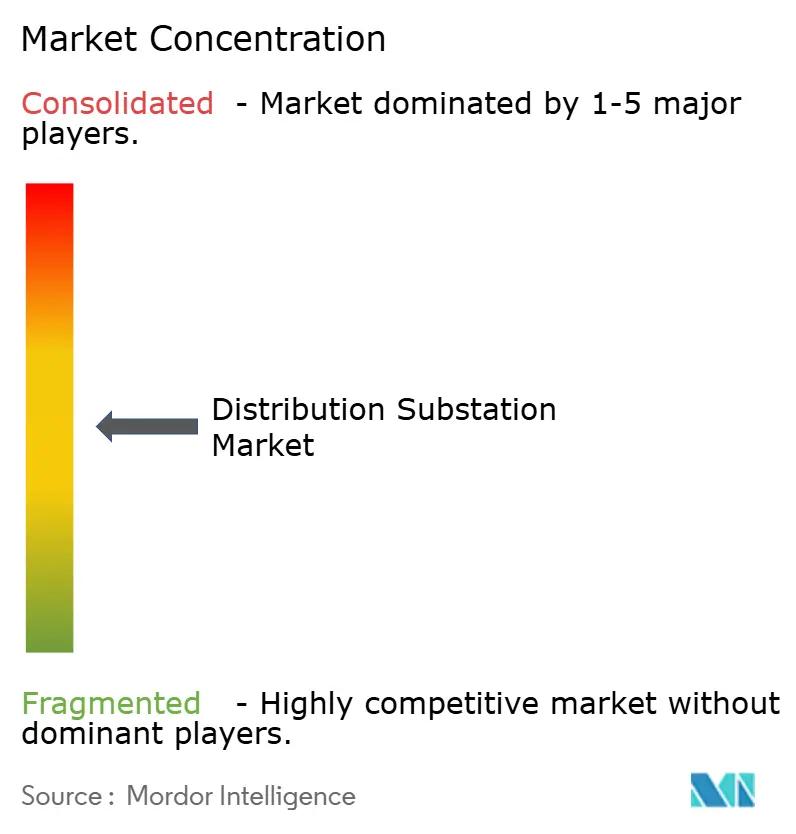
The distribution substation market is moderately concentrated at the upper tier, where ABB, Siemens Energy, Hitachi Energy, Schneider Electric, and GE Vernova compete for large-format, high-voltage, and turnkey contracts. These suppliers offer combinations of transformers, switchgear, control equipment, and digital systems. Chinese manufacturers such as TGOOD and NR Electric compete in medium-voltage, automation, and modular formats. Hyundai Electric also competes in equipment categories where price and local supply requirements influence contract awards. Suppliers in the distribution substation market differentiate through SF6-free technology, automation capabilities, and integrated project delivery. This structure favors firms with established installed bases, manufacturing scale, and utility relationships.
Hitachi Energy is expanding capacity across transformers, switchgear, substations, and digital capabilities as part of its USD 9 billion investment plan. In September 2026, the company announced a USD 528 million transformer facility in Mississippi to serve U.S. grid needs and data center growth. GE Vernova is advancing its SF6-free gas-insulated switchgear portfolio through planned deployment for Statnett and Equinor in Norway. In July 2026, GE Vernova secured contracts for 110 kV SF6-free gas-insulated switchgear substations in Berlin. These developments reflect how product development and manufacturing investment are being used to compete for replacement and expansion projects.
Turnkey delivery is an important competitive strategy in the distribution substation market, as it allows suppliers to combine equipment with design, automation, and long-term service. IEC 62443 and NERC CIP requirements raise cybersecurity and integration expectations for digital substation projects. Modular facilities are particularly relevant to renewable developers and data center operators that require faster deployment than custom-build schedules allow. TGOOD maintains an established prefabricated portfolio for this type of project. Smaller and specialist suppliers can compete where deployment speed or local content requirements are more important than a full global product range. The distribution substation market remains less concentrated in medium-voltage and modular niches than in large high-voltage turnkey projects.
Distribution Substation Industry Leaders
-
Hitachi Energy Ltd.
-
Siemens Energy AG
-
ABB Ltd.
-
Schneider Electric SE
-
GE Vernova Inc.
- *Disclaimer: Major Players sorted in no particular order
Distribution Substation Market Companies Covered in this Report
- ABB Ltd.
- Siemens Energy AG
- Schneider Electric SE
- Hitachi Energy Ltd.
- GE Vernova Inc.
- Eaton Corporation plc
- Mitsubishi Electric Corporation
- Toshiba Energy Systems & Solutions Corporation
- Rockwell Automation, Inc.
- Honeywell International Inc.
- Cisco Systems, Inc.
- Emerson Electric Co.
- Schweitzer Engineering Laboratories, Inc.
- Larsen & Toubro Limited
- CG Power and Industrial Solutions Limited
- Hyundai Electric & Energy Systems Co., Ltd.
- WEG S.A.
- NR Electric Co., Ltd.
- Arteche Lantegi Elkartea, S.A.
- Efacec Power Solutions, S.A.
- TGOOD Global Ltd.
Recent Industry Developments in Distribution Substation Market
- September 2026: Hitachi Energy announced a USD 528 million transformer manufacturing facility in Mississippi, its largest US investment to date. The plant will produce large power transformers and grid equipment to support transmission and distribution infrastructure, complementing the company's previously announced Virginia transformer facility.
- August 2026: Hitachi Energy committed USD 300 million to expand manufacturing capacity in Hefei, China, covering transformer bushings, smart transformer components, and grid infrastructure equipment. The project is part of the company's broader global investment strategy to address increasing demand for substations and distribution networks.
- July 2026: GE Vernova secured contracts from Stromnetz Berlin to design, deliver, and install two 110 kV gas-insulated substations (GIS) in Wittenau and Neukölln. The substations will use the company's g³ GRiDEA SF6-free technology, reducing greenhouse gas emissions while supporting urban electricity demand growth.
- January 2026: State Grid Corporation of China announced CNY 4 trillion in fixed-asset investments for 2026 to 2030 to support ultra-high-voltage transmission, smart substations, distribution automation, and grid modernization. The program represents one of the largest utility-led investments in substation infrastructure globally.
Global Distribution Substation Market Report Scope
A distribution substation is an electrical facility within the power grid that delivers electricity to consumers. It serves as the final major voltage transition point, stepping down high-voltage electricity received from transmission lines to lower voltage levels suitable for local distribution. Equipped with transformers, circuit breakers, and monitoring equipment, it isolates grid faults, regulates voltage, and distributes power across multiple feeder lines that supply residential, commercial, and industrial areas.
The global distribution substation market is segmented by type into gas-insulated substations, air-insulated substations, and hybrid substations. By component, the market is segmented into transformers, switchgear, control and protection equipment, batteries and UPS, and other components. By voltage, the market is segmented into low voltage, medium voltage, high voltage, and extra high voltage. By application, the market is segmented into residential, commercial, industrial, and utility sectors. The report also covers the market size and forecasts for the global distribution substation market across 26 countries in key regions. For each segment, the market sizing and forecasts have been provided on the basis of value (USD).
Segmentation Overview
| Gas-Insulated Substations |
| Air-Insulated Substations |
| Hybrid Substations |
| Transformers |
| Switchgear |
| Control and Protection Equipment |
| Batteries and UPS |
| Other Components |
| Low Voltage |
| Medium Voltage |
| High Voltage |
| Extra High Voltage |
| Residential |
| Commercial |
| Industrial |
| Utility |
| North America | United States |
| Canada | |
| Mexico | |
| Europe | Germany |
| France | |
| Italy | |
| Spain | |
| United Kingdom | |
| Poland | |
| Russia | |
| Rest of Europe | |
| Asia-Pacific | China |
| India | |
| Japan | |
| South Korea | |
| Australia | |
| Indonesia | |
| Vietnam | |
| Thailand | |
| Rest of Asia-Pacific | |
| South America | Brazil |
| Argentina | |
| Chile | |
| Rest of South America | |
| Middle East and Africa | Saudi Arabia |
| United Arab Emirates | |
| Egypt | |
| South Africa | |
| Morocco | |
| Rest of Middle East and Africa |
| By Type | Gas-Insulated Substations | |
| Air-Insulated Substations | ||
| Hybrid Substations | ||
| By Component | Transformers | |
| Switchgear | ||
| Control and Protection Equipment | ||
| Batteries and UPS | ||
| Other Components | ||
| By Voltage | Low Voltage | |
| Medium Voltage | ||
| High Voltage | ||
| Extra High Voltage | ||
| By Application | Residential | |
| Commercial | ||
| Industrial | ||
| Utility | ||
| By Geography | North America | United States |
| Canada | ||
| Mexico | ||
| Europe | Germany | |
| France | ||
| Italy | ||
| Spain | ||
| United Kingdom | ||
| Poland | ||
| Russia | ||
| Rest of Europe | ||
| Asia-Pacific | China | |
| India | ||
| Japan | ||
| South Korea | ||
| Australia | ||
| Indonesia | ||
| Vietnam | ||
| Thailand | ||
| Rest of Asia-Pacific | ||
| South America | Brazil | |
| Argentina | ||
| Chile | ||
| Rest of South America | ||
| Middle East and Africa | Saudi Arabia | |
| United Arab Emirates | ||
| Egypt | ||
| South Africa | ||
| Morocco | ||
| Rest of Middle East and Africa | ||
Key Questions Answered in the Report
What is the projected size of the distribution substation market by 2032?
The distribution substation market is forecast to reach USD 149.95 billion by 2032, growing at a CAGR of 4.51% from 2027.
Which substation type is growing fastest?
Gas-insulated substations are forecast to grow at a CAGR of 5.3% through 2032, driven by compact design requirements and SF6 restrictions.
Why are utilities investing in new substations?
Utilities are replacing aging assets, integrating renewable generation, and responding to higher electricity demand from the transport and industrial sectors.
Which component has the highest growth outlook?
Control and protection equipment is forecast to grow at a CAGR of 4.8% through 2032, driven by increasing adoption of automation and intelligent electronic devices.
Which region leads global demand?
Asia-Pacific held a 38.7% share of the distribution substation market in 2026 and is forecast to grow at a CAGR of 5.2% through 2032.
What limits project delivery?
Capital requirements, long procurement cycles, equipment shortages, and permitting delays can slow project execution.