
Discount Retail Market Size and Share
Market Overview
| Study Period | 2022 - 2032 |
|---|---|
| Market Size (2027) | USD 825.35 Billion |
| Market Size (2032) | USD 997.78 Billion |
| Growth Rate (2027 - 2032) | 3.87 % |
| Fastest Growing Market | Asia-Pacific |
| Largest Market | Europe |
| Market Concentration | Low |
Major Players *Disclaimer: Major Players sorted in no particular order Image © Mordor Intelligence. Reuse requires attribution under CC BY 4.0. | |
Discount Retail Market Analysis by Mordor Intelligence
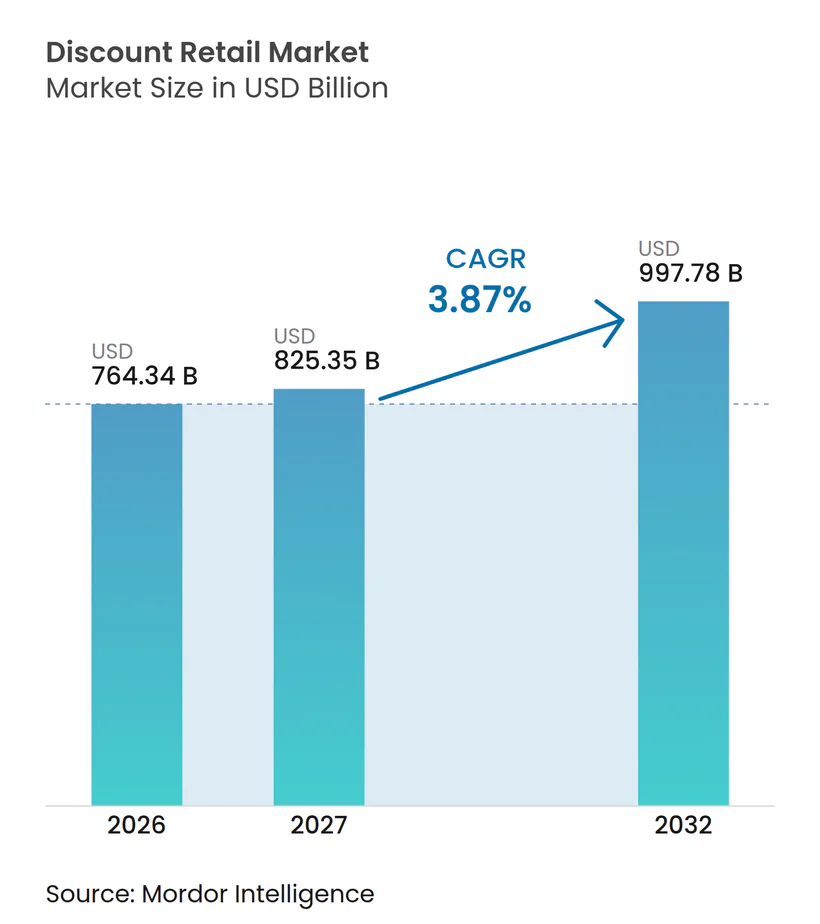
The global discount retail market size was valued at USD 764.34 billion in 2026 and is estimated to grow from USD 825.35 billion in 2027 to reach USD 997.78 billion by 2032, at a CAGR of 3.87% during the forecast period (2027-2032). The global discount retail market benefits from focused assortments, expanded private-label offerings, and disciplined cost structures. Store expansion remains important, as retailers serve rural, suburban, and urban catchments through different store formats and sizes. Digital ordering and loyalty programs are increasingly relevant when they improve convenience without compromising the value proposition. The market remains fragmented, allowing established local operators to defend their positions while larger chains expand selectively.
Key Report Takeaways
- By store format, Hard Discount Stores accounted for 43.32% of the global discount retail market share in 2026, while Online Discount Retailers are projected to grow at a 4.46% CAGR through 2032.
- By product category, Food and Grocery accounted for 46.75% of the global discount retail market share in 2026 and is projected to grow at a 4.95% CAGR through 2032.
- By business model, Private Label-Led Retail accounted for 52.35% of the global discount retail market share in 2026, while Omnichannel Value Retail is projected to grow at a 5.24% CAGR through 2032.
- By geography, Europe accounted for 33.94% of the global discount retail market share in 2026, while Asia-Pacific is projected to grow at a 5.63% CAGR through 2032.
Note: Market numbers in this report are based on Mordor Intelligence's proprietary estimation framework, which combines nine months of actuals with Q4 projections for base year 2026.
Market Trends and Insights
Drivers Impact Analysis of Discount Retail Market*
| Driver | (~) % Impact on CAGR Forecast | Geographic Relevance | Impact Timeline |
|---|---|---|---|
| Household Trade-Down and Persistent Value-Seeking | +1.2% | Global, most acute in North America and Europe | Short term (≤ 2 years) |
| Private Label Expansion and Everyday-Low-Price Models | +0.8% | Europe, with spillover to North America and Asia-Pacific | Medium term (2-4 years) |
| Discount Store Network Expansion in Underserved Catchments | +0.6% | Asia-Pacific, the Middle East and Africa, and South America | Long term (≥ 4 years) |
| Omnichannel Value Retail and Digital Customer Engagement | +0.5% | North America, Asia-Pacific, and Europe | Medium term (2-4 years) |
| Retailer Access to Excess Inventory and Flexible Sourcing | +0.4% | Global, with supply concentrated in North America and Europe | Medium term (2-4 years) |
| Retail Media and Loyalty Monetization | +0.3% | North America, Europe, and Australia | Medium term (2-4 years) |
| Source: Mordor Intelligence | |||
Household Trade-Down and Persistent Value-Seeking
Household trade-down continues to support the global discount retail market as consumers prioritize essential-product spending. This trend extends beyond low-income shoppers, as more households compare prices and switch stores. Product quality and reliable availability are as important as low shelf prices. Discount retailers can retain customers when private-label products consistently meet routine household needs at affordable price points. Retailers that rely only on temporary promotions are at a disadvantage as consumers increasingly expect everyday value.
Private Label Expansion and Everyday-Low-Price Models
Private-label expansion supports discount retailing by increasing retailers’ control over pricing, product assortments, and differentiation. In the United States, private-label dollar sales rose 4.4% in the first half of 2025, compared with 1.1% growth for national brands. Private-label unit sales increased 0.4%, while national-brand unit sales declined 0.6%[1]. Dollar General planned to launch about 100 private-brand products in the first quarter of 2025, expanding its owned-brand assortment. Private labels enable discount retailers to offer value and reduce direct price comparisons with national brands.
Discount Store Network Expansion in Underserved Catchments
Store network expansion remains a durable growth driver for the global discount retail market, as smaller-format stores can serve areas with limited retail options. Dollar General opened 589 new stores in fiscal 2025, including 581 in the United States, and stated that many locations serve rural communities[2]. ALDI United States planned to open more than 180 stores across 31 states in 2026 under its USD 9 billion investment program. Action’s net sales rose 16.1% to EUR 16 billion (USD 18.82 billion) in 2025, supported by 384 new stores and 21.6 million weekly customers, strengthening its European discount retail presence. Disciplined location selection can help new stores strengthen purchasing scale and reduce consumer travel times.
Omnichannel Value Retail and Digital Customer Engagement
Omnichannel capabilities can expand the global discount retail market by improving access to value assortments. In fiscal 2025, Dollar General included delivery and digital channels in its customer engagement strategy. Digital tools enable retailers to communicate store-specific offers, manage loyalty benefits, and direct customers to nearby locations. However, the operating model remains challenging because delivery costs can exceed margins on low-priced baskets. Retailers must integrate online ordering with store networks and local fulfillment rather than rely solely on centralized e-commerce operations.
Restraints Impact Analysis of Discount Retail Market*
| Restraint | (~) % Impact on CAGR Forecast | Geographic Relevance | Impact Timeline |
|---|---|---|---|
| Margin Compression from Price Competition and Cost Inflation | -0.8% | Global, most acute in Europe and North America | Short term (≤ 2 years) |
| Online Price Transparency and Low-Cost E-Commerce Substitution | -0.5% | North America, Asia-Pacific, and Europe | Medium term (2-4 years) |
| Rising Labor, Rent, Energy, and Store-Fit-Out Costs | -0.7% | North America and Europe | Short term (≤ 2 years) |
| Shrink, Organized Retail Crime, and Assortment Volatility | -0.4% | Global | Medium term (2-4 years) |
| Source: Mordor Intelligence | |||
Margin Compression from Price Competition and Cost Inflation
Margin compression restrains the global discount retail market because low-price positioning leaves limited flexibility to absorb cost increases. Discount retailers must manage freight, product, labor, energy, and rent costs while maintaining competitive prices. Private-label products, supply chain efficiency, and operational discipline can partly offset these pressures. However, intense price competition can limit the gains from higher store traffic. As a result, retailers with efficient sourcing systems perform better than those with inflexible cost structures.
Online Price Transparency and Low-Cost E-Commerce Substitution
Online price transparency restrains the global discount retail market by allowing shoppers to compare prices across retailers quickly. Digital marketplaces intensify competition by offering low-cost goods without the overhead of extensive physical store networks. This pressure is most evident in general merchandise, seasonal products, and discretionary categories. Discount retailers can respond by maintaining competitive pricing, clearly communicating product value, and ensuring immediate in-store availability. Reliable return policies and convenient shopping experiences can further differentiate their offerings.
*Our forecasts treat driver/restraint impacts as directional, not additive. The impact forecasts reflect baseline growth, mix effects, and variable interactions.
Consumer Behavior Analysis
Household spending patterns across major economies show how essential purchases compete with discretionary budgets. In the European Union, inflation-adjusted household consumption expenditure rose 1.5% in 2024. Food and non-alcoholic beverage spending increased 1.2%, while clothing and footwear spending fell 0.6%. In the United States, average household expenditure rose 1.8% in 2024, below the 2.9% inflation rate, indicating lower real spending. These trends create opportunities for discount retailers in essential and selected discretionary categories but do not confirm a shift to discount stores.
Category priorities vary across markets. In the United States, food represented 12.9% of household spending in 2024, while apparel and services accounted for 2.5%. Despite differing periods and definitions, both datasets highlight essential purchases. Discount retailers can tailor assortments, pack sizes, and seasonal ranges to local spending patterns.
Retail Performance Intelligence
Dollar General’s average annual sales per sq. ft. rose from USD 263 in fiscal 2024 to USD 270 in fiscal 2025. Fourth-quarter comparable sales increased 4.3%, driven by 2.6% higher customer traffic and 1.7% growth in average transaction value. Action generated EUR 16 billion (USD 18.82 billion) in net sales in 2025, with 4.9% like-for-like sales growth and EUR 2.37 billion (USD 2.78 billion) in operating Earnings. These metrics measure existing-store performance and operating profitability.
Long-term leases create fixed obligations that store sales must support. Dollar General reported USD 1.99 billion in operating lease costs and USD 410 million in variable lease costs for fiscal 2025. Its weighted-average remaining operating lease term was 9.1 years as of January 30, 2026. Lidl GB announced more than GBP 600 million (USD 809.47 million) in investment, including over 50 new stores planned for the following 12 months. Disciplined site selection, lease negotiations, and refurbishment decisions help protect store-level returns.
Discount Retail Market Segment Analysis
By Store Format:
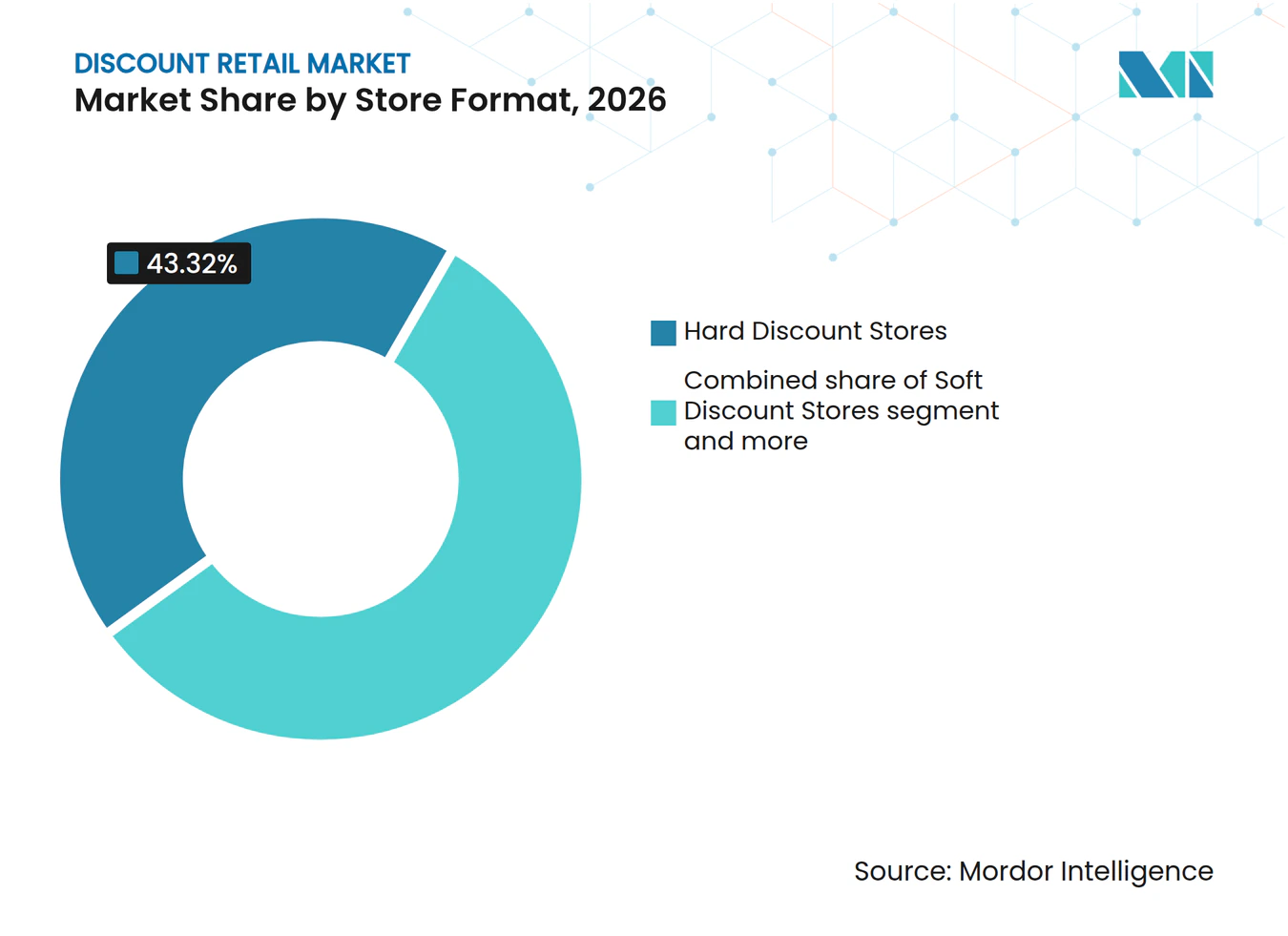
Hard Discount Leads While Online Formats ExpandHard Discount Stores accounted for 43.32% of the global discount retail market in 2026, making them the largest format. They rely on focused assortments, private labels, direct sourcing, and efficient operations. Lidl continues to expand in Europe, including the United Kingdom. Dense networks strengthen purchasing leverage and support routine grocery and household purchases. Online Discount Retailers are forecast to grow at a 4.46% CAGR through 2032, supported by search visibility, value communication, and efficient delivery or pickup. However, they face price comparison and delivery-cost pressures, while physical stores remain relevant for immediate access and the absence of delivery fees.
Soft Discount Stores combine recognized brands, promotions, and value pricing. Dollar and Variety Stores serve North American smaller towns and neighborhoods, while Discount Superstores support larger shopping trips. Convenience Discount Stores are expanding in transit and dense locations. Off-Price Stores and Warehouse Clubs attract consumers through branded bargains, bulk buying, and changing assortments. Tailored store sizes and assortments can improve productivity across catchments.



By Product Category:
Food and Grocery Provides the Core Demand BaseFood and Grocery accounted for 46.75% of the global discount retail market in 2026 and is forecast to grow at a 4.95% CAGR through 2032. Frequent household purchases and budget-conscious spending support demand. Dependable availability, freshness, and private-label ranges at lower price points drive repeat traffic, making groceries a stable market foundation.
Apparel and Footwear remain important, particularly in Eastern Europe and Central Asia. LPP’s Sinsay banner opened its 2,000th store in 2025 and continued international expansion[3]. Seasonal demand and changing preferences require rapid replenishment and attractive basic ranges. Affordable apparel complements grocery and household purchases in multi-category discount stores.
Household and Personal Care products support recurring basket value, while Health and Beauty products can improve margins at accessible prices. Consumer Electronics and Accessories face online price competition and short product cycles. Seasonal and General Merchandise drive discovery but carry higher inventory risk. Category mix depends on income levels, store format, and selling space. Food and Grocery remains the structural anchor, while flexible non-food assortments increase basket value and address local and seasonal demand.
By Business Model:
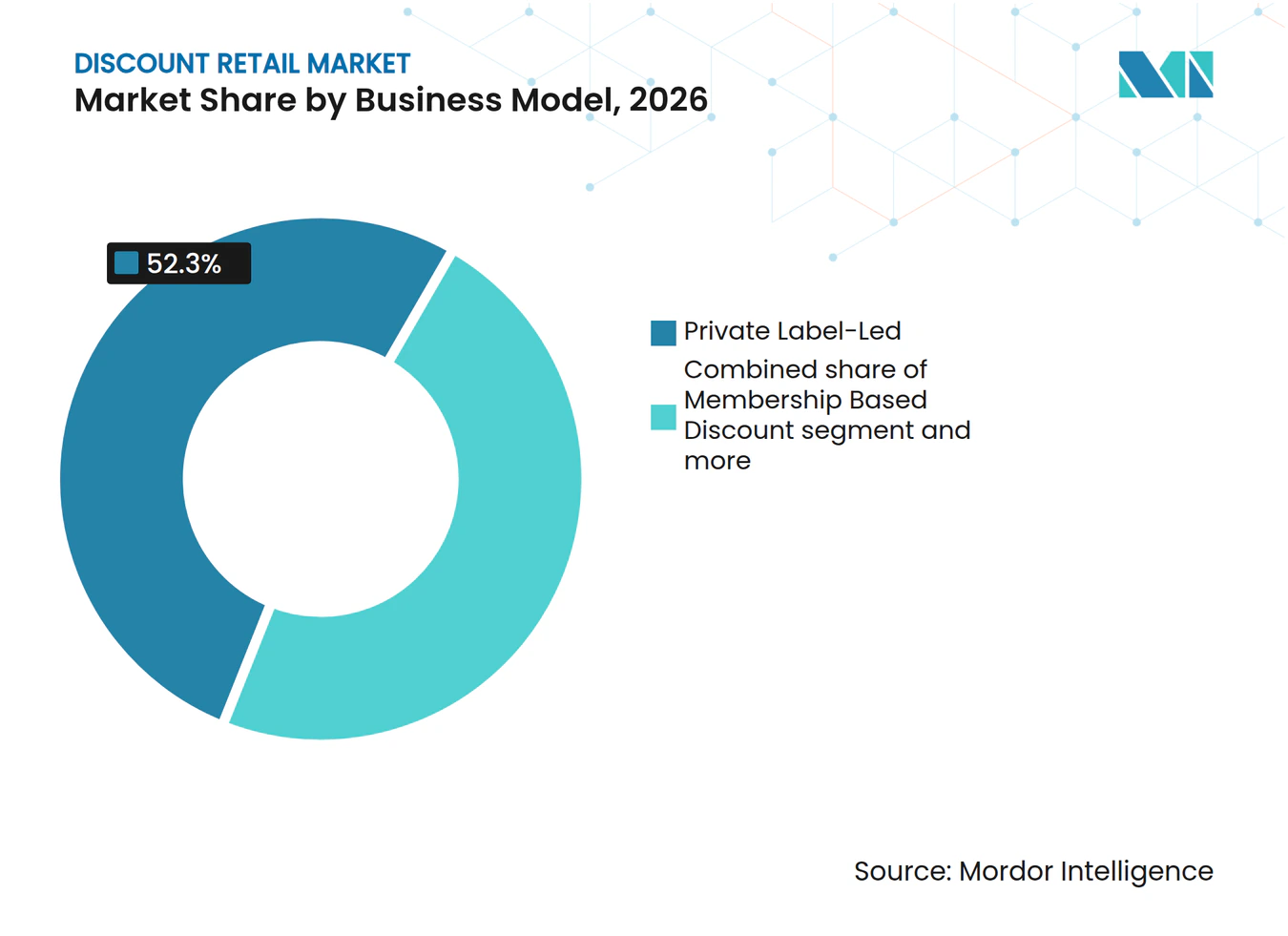
Private Labels Retain the Largest PositionPrivate Label-Led Retail accounted for 52.35% of global sales in 2026. It gives retailers control over product specifications, shelf placement, and pricing. Private-label unit sales rose 0.4% in the first half of 2025, while national-brand sales fell 0.6%, supporting investment in product development and supplier partnerships. Off-price retailers selectively purchase excess, discontinued, and seasonal inventory. TJX’s opportunistic strategy relies on an extensive vendor network. Membership-based discount models encourage repeat purchases through fees, loyalty programs, and bulk pack sizes, although appeal varies by household size, income, and storage capacity.
Omnichannel Value Retail is forecast to grow at a 5.24% CAGR through 2032, integrating stores, digital offers, online ordering, loyalty programs, and local fulfillment. Private-label models align quality, price, and assortment; off-price formats offer branded discovery; membership models emphasize retention; and omnichannel models prioritize convenience. The suitable model depends on product mix, consumer behavior, and cost structure.

Geography Analysis
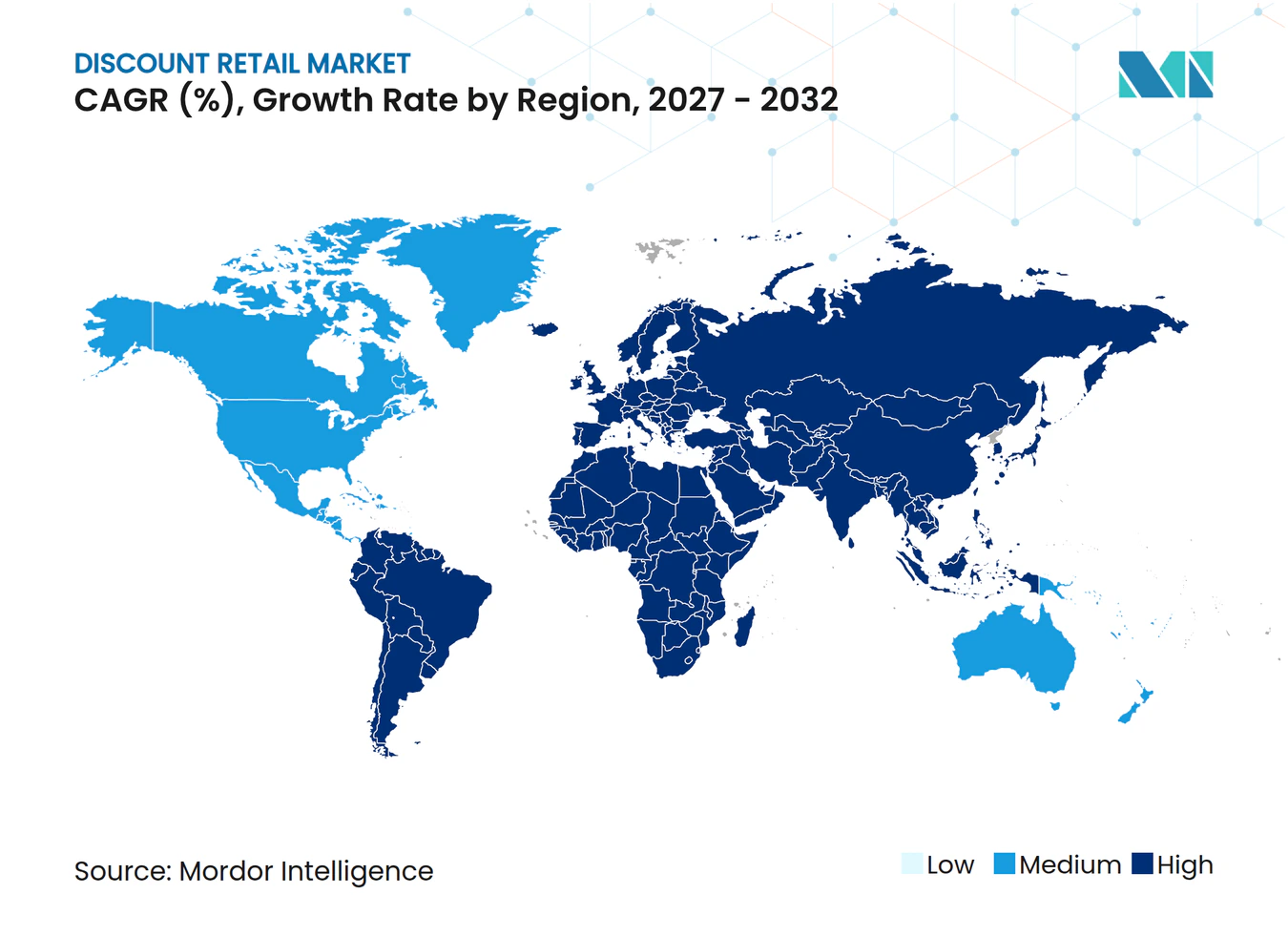
Europe accounted for 33.94% of the global discount retail market in 2026, supported by established hard-discount networks, mature store bases, and familiarity with private-label products. ALDI and Lidl continue investing in stores and distribution. Competition for sites and improved assortments require operational efficiency. Asia-Pacific is projected to grow at a 5.63% CAGR through 2032, the highest regional rate. Growth varies across cities, smaller urban areas, and emerging corridors. China is important as physical discount formats and digital value channels develop. Dollarama acquired The Reject Shop in Australia in July 2025. Retailers require localized assortments and supply chains. Dollar stores, food discount chains, and off-price retailers anchor North America. South America offers opportunities in proximity formats and value groceries, subject to sourcing and price conditions. In the Middle East and Africa, discount retailers are expanding into cities and secondary locations. BIM had 933 stores in Morocco after adding 144 in 2025[4]. Expansion requires local compliance, supply-chain planning, and neighborhood-specific formats.
Retail Supply and Development Intelligence
The global discount retail market includes compact convenience-oriented outlets and larger value-focused stores, with footprints determined by product mix and catchment size. As of January 30, 2026, Dollar General operated 20,893 stores, averaging approximately 7,500 sq. ft. of selling space; nearly 80% were in towns with populations of 20,000 or fewer. Action ended 2025 with 3,302 stores across 14 countries. These networks reflect localized small-box convenience and standardized non-food discount models.
Store density improves customer access and purchasing scale, while efficient layouts and distribution coverage help control costs. In 2026, ALDI United States planned more than 180 new stores, targeting nearly 2,800 locations by the end of 2026, with three new distribution centers planned for 2027 to 2029. Dollar General’s fiscal 2026 plan included about 450 new United States stores, 10 in Mexico, and 4,270 remodels or relocations. Action is planned for at least 400 stores and entry into Croatia and Slovenia. Execution depends on site economics, staffing, distribution capacity, and sales productivity.
Competitive Landscape
Market Concentration
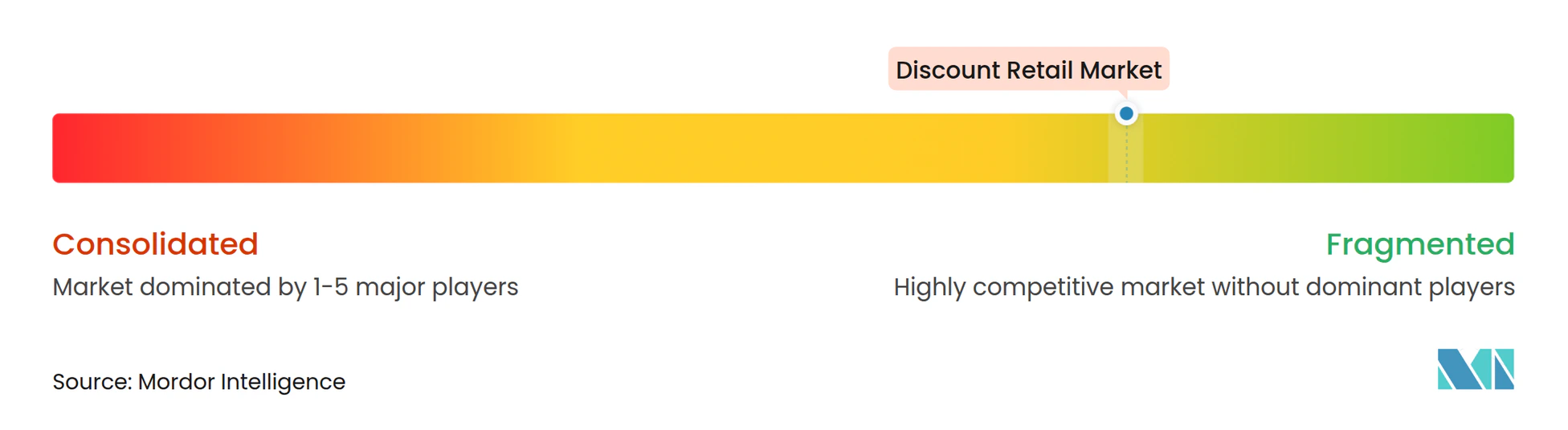
The global discount retail market is fragmented, with the top five operators accounting for an estimated 27.40% of global sales in 2026. Competition differs across regional grocery, dollar, off-price, and variety retail formats, with no single operator dominating all major regions. European discounters continue to expand while maintaining value-driven operating models. Action reported EUR 16 billion (USD 18.82 billion) in net sales in 2025 and planned to open at least 400 stores in 2026. ALDI United States has announced plans to open more than 180 new stores in 2026. In North America, Dollar General plans to open approximately 450 stores in the United States and 10 stores in Mexico in 2026, alongside extensive store remodeling initiatives. Dollar Tree is expanding its multi-price assortment to increase product choice and support basket growth. Competitive advantage depends on cost control, private-label strength, store density, sourcing efficiency, and consistent execution. Retailers must sustain store productivity and customer value as they expand.
Discount Retail Industry Leaders
-
Lidl Stiftung & Co. KG
-
Aldi Einkauf SE & Co. oHG
-
Dollar General Corporation
-
Mercadona, S.A.
-
X5 Retail Group N.V.
- *Disclaimer: Major Players sorted in no particular order
Discount Retail Market Companies Covered in this Report
- Dollar General Corporation
- Dollar Tree, Inc.
- Aldi Einkauf SE & Co. oHG
- Lidl Stiftung & Co. KG
- Walmart Inc.
- The TJX Companies, Inc.
- Ross Stores, Inc.
- Burlington Stores, Inc.
- Five Below, Inc.
- Ollie's Bargain Outlet, Inc.
- Grocery Outlet Holding Corp.
- Action Nederland Holding B.V.
- Jerónimo Martins, SGPS, S.A.
- X5 Retail Group N.V.
- Pepco Group N.V.
- Schwarz Group
- REWE Group
- Mercadona, S.A.
- Eurospin Italia S.p.A.
- Pan Pacific International Holdings Corporation
- Miniso Group Holding Limited
- Salling Group A/S
- Colruyt Group N.V.
- Loblaw Companies Limited
Recent Industry Developments in Discount Retail Market
- July 2026: Modella Capital completed its acquisition of Dealz Poland from Pepco Group, taking control of a discount retail network comprising more than 340 stores across Poland.
- February 2026: Schwarz Group received conditional approval from Romania’s Competition Council to acquire a majority stake in La Cocoș, expanding its presence in Romania’s supermarket sector.
- January 2026: ALDI United States announced plans to open more than 180 stores across 31 states in 2026, supporting its USD 9 billion investment program through 2028.
- December 2025: Mr Price Group agreed to acquire NKD Group GmbH, adding 2,108 stores across seven Central and Eastern European countries to its retail network. The acquisition was completed in March 2026.
Global Discount Retail Market Report Scope
The global discount retail market report analyzes discount-focused retail formats offering products at competitive prices across food, grocery, apparel, household goods, personal care, and general merchandise categories worldwide. The market is segmented by store format (Hard Discount Stores, Soft Discount Stores, Dollar and Variety Stores, Discount Superstores, Convenience Discount Stores, Online Discount Retailers, and Others), product category, business model, and geography. The study examines key drivers, including household trade-down, private-label expansion, store-network growth, omnichannel value retail, flexible sourcing, and loyalty monetization, alongside restraints such as margin compression, e-commerce competition, rising operating costs, retail shrink, and assortment volatility. It evaluates store networks, expansion pipelines, sales performance, occupancy costs, consumer purchasing preferences, channel choices, and spending patterns. The report provides market size and growth forecasts, competitive landscape analysis, market concentration and share assessments, strategic developments, and profiles of leading retailers. It also explores opportunities in private-label assortments, underserved catchments, digital price discovery, omnichannel fulfillment, and excess-inventory sourcing. Market estimates and forecasts are presented in value (USD) across all covered segments.
Segmentation Overview
Key Questions Answered in the Report
What is the value of the discount retail sector in 2026?
The global discount retail market was valued at USD 764.34 billion in 2026 and is forecast to reach USD 997.78 billion by 2032, growing at a 3.87% CAGR from 2027 to 2032.
Which store format has the largest share of discount retail sales?
Hard Discount Stores hold 43.32% of sales in 2026, supported by focused assortments, private labels, and efficient operations.
Which product category is growing fastest in discount retail?
Food and Grocery is forecast to grow at a 4.95% CAGR through 2032 and account for 46.75% of 2026 sales.
Why are private labels important for value retailers?
U.S. Private-label sales rose 4.46% in the first half of 2025, helping retailers control assortment and support everyday value.
Which region offers the strongest growth outlook for discount retail?
Asia-Pacific is forecast to grow at a 5.63% CAGR through 2032, the fastest regional rate in the report.
How concentrated is the global discount retail sector?
The global discount retail market remains fragmented, with the top five operators accounting for a combined 27.40% of the market in 2026.