
Data Center Substation Market Size and Share
Market Overview
| Study Period | 2022 - 2032 |
|---|---|
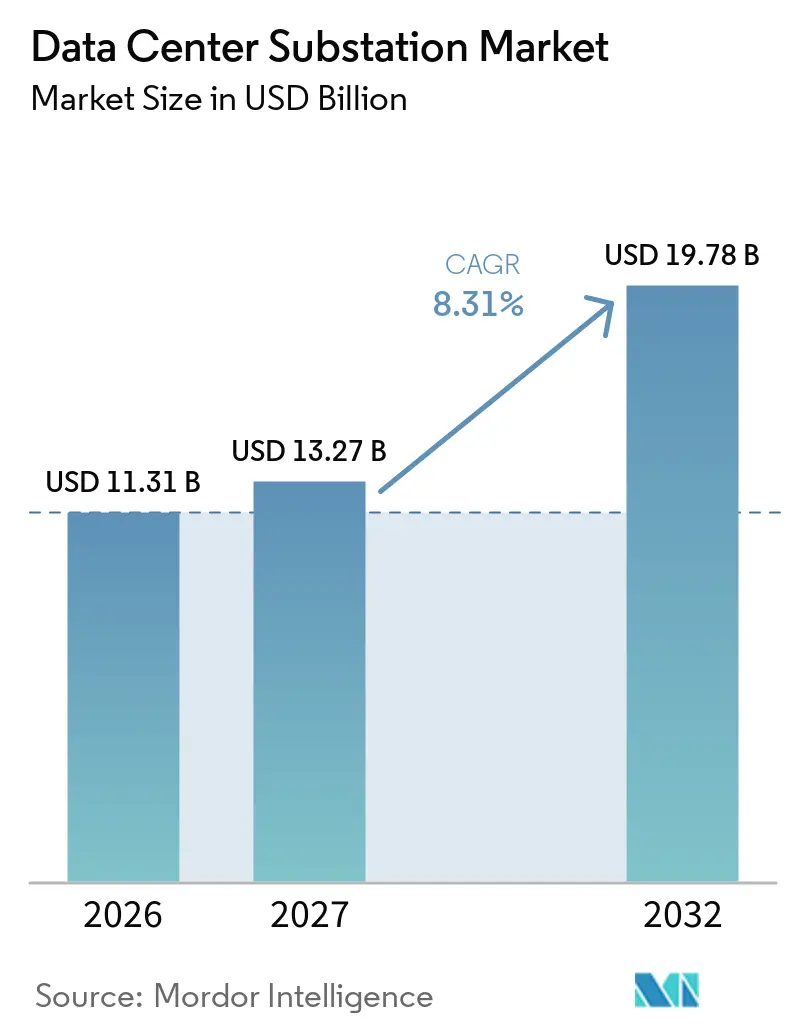
| Market Size (2027) | USD 13.27 Billion |
| Market Size (2032) | USD 19.78 Billion |
| Growth Rate (2027 - 2032) | 8.31 % |
| Fastest Growing Market | Asia-Pacific |
| Largest Market | North America |
| Market Concentration | Medium |
Major Players *Disclaimer: Major Players sorted in no particular order Image © Mordor Intelligence. Reuse requires attribution under CC BY 4.0. | |
Data Center Substation Market Analysis by Mordor Intelligence
The global data center substation market size is expected to increase from USD 11.31 billion in 2026 to USD 13.27 billion in 2027 and reach USD 19.78 billion by 2032, at a CAGR of 8.31% over 2027-2032. AI training campuses are directing more capital toward high-voltage power infrastructure as their electricity requirements are rising faster than those of most other demand categories. According to the International Energy Agency, global data center electricity consumption is expected to increase from 415 TWh in 2024 to 945 TWh by 2030, reflecting annual growth of 15%. This demand is shifting the role of a substation from a campus connection point to a critical component of delivery schedules for new digital infrastructure. Long equipment lead times and grid connection queues are encouraging operators to secure supply earlier and consider generation, storage, and modular designs. The data center substation market is therefore shaped by both higher power requirements and the practical ability to obtain grid access and equipment on time.
Key Report Takeaways
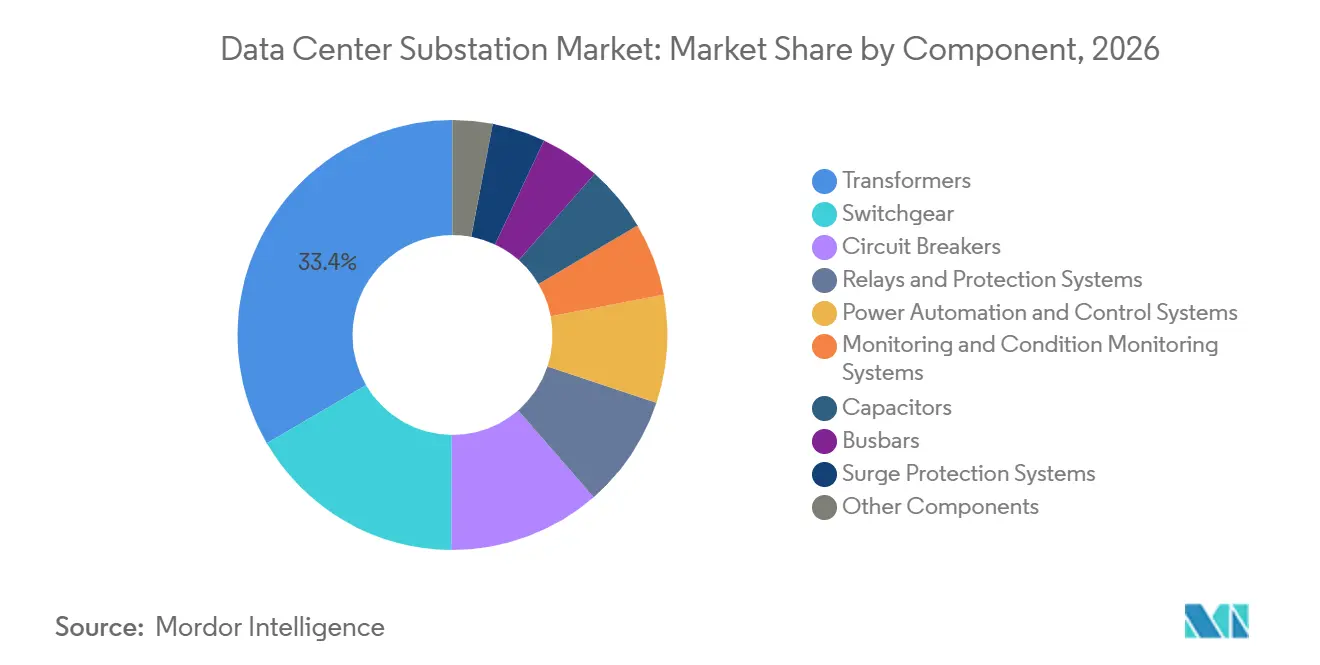
- By component, transformers led with 33.4% of revenue in 2026, while switchgear is forecast to grow at a 9.1% CAGR through 2032.
- By voltage, above 500 kV held 42.1% of revenue in 2026 and is forecast to expand at an 8.4% CAGR through 2032.
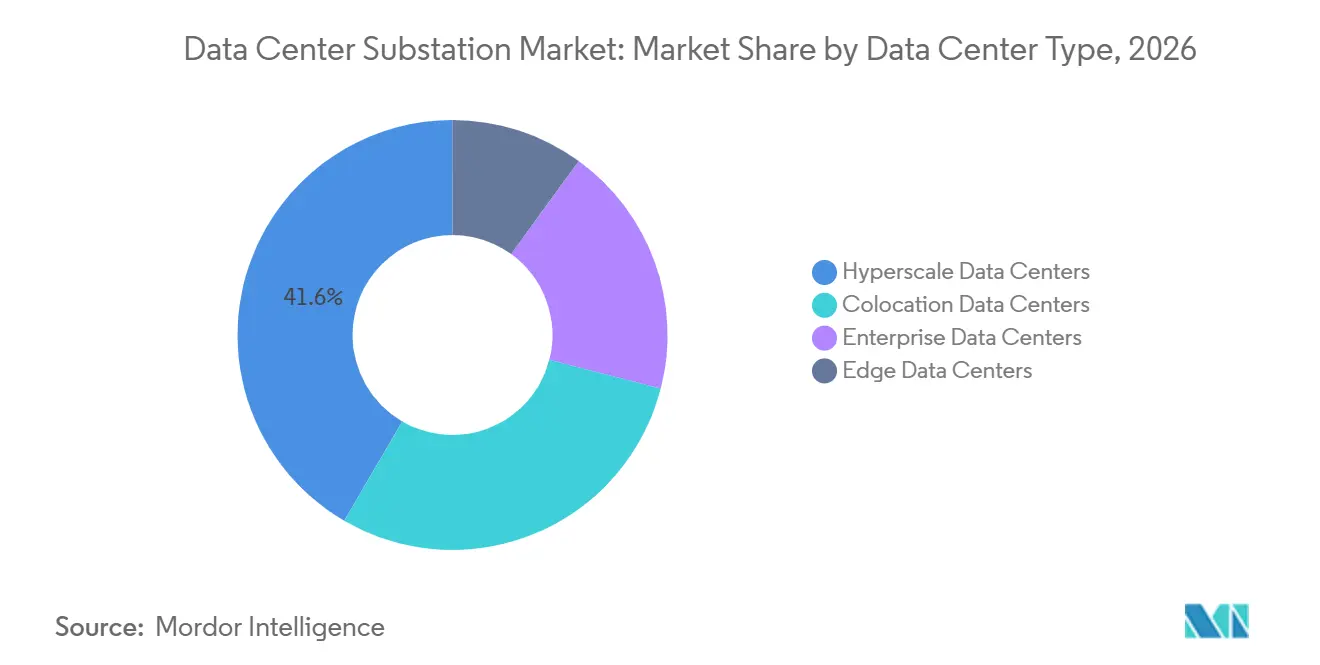
- By data center type, hyperscale facilities accounted for 41.6% of revenue in 2026 and are forecast to grow at a 9.3% CAGR through 2032.
- By geography, North America held 38.5% of revenue in 2026, while Asia-Pacific is forecast to grow at a 10.4% CAGR through 2032.
Note: Market numbers in this report are based on Mordor Intelligence's proprietary estimation framework, which combines nine months of actuals with Q4 projections for base year 2026.
Market Trends and Insights
Drivers Impact Analysis of Data Center Substation Market*
| Driver | (~) % Impact on CAGR Forecast | Geographic Relevance | Impact Timeline |
|---|---|---|---|
| Hyperscale and AI Data Center Load Expansion | +2.8% | Global, led by North America and Asia-Pacific | Short term (≤ 2 years) |
| Cloud, Colocation and Edge Capacity Growth | +1.5% | Global, with Asia-Pacific core and North America spillover | Medium term (2-4 years) |
| Grid Modernization and Replacement of Aging Substations | +0.9% | North America and Europe | Medium term (2-4 years) |
| Demand for High-Availability, Redundant Power Infrastructure | +0.8% | Global | Short term (≤ 2 years) |
| Digital and Modular Substation Deployment | +0.6% | North America, Europe, and Asia-Pacific core | Medium term (2-4 years) |
| Renewable Integration and Energy Storage at Data Center Sites | +0.5% | North America, Europe, and Southeast Asia | Long term (≥ 4 years) |
| Source: Mordor Intelligence | |||
Hyperscale and AI Data Center Load Expansion Driving Transmission-Grade Power Connections
AI workloads are increasing demand for transmission-grade connections in the data center substation market. The IEA expects electricity use from AI-driven accelerated servers to grow at 30% annually in its base case. These servers account for nearly half of the net increase in worldwide data center electricity consumption through 2030.[1] Campuses once designed around 20 MW to 50 MW connections are now being planned for 200 MW to 500 MW, requiring dedicated 110 kV or 220 kV substations and, in some cases, direct 500 kV interconnections. This increase in scale places substation delivery ahead of many other construction items in the project sequence.
Larger facilities raise demand for equipment capable of operating at higher fault levels and managing larger transformer banks. They also place greater emphasis on early utility coordination, land selection, and equipment ordering. Growth in the data center substation market is tied to campus development, though project pace remains dependent on grid availability. These requirements make transmission-grade connections a planning consideration early in campus development and make substation delivery an important factor alongside the broader construction schedule.
Cloud, Colocation and Edge Capacity Growth Creating Distributed Demand Across Voltage Tiers
Cloud adoption, colocation expansion, and edge deployment are creating demand across several voltage tiers in the data center substation market. According to the supplied industry assessments, colocation operators upgraded existing substations to support higher rack density in 46% of newly expanded facilities between 2024 and 2025. Edge sites use compact medium-voltage switchgear and smaller transformers across distributed locations. This combination broadens demand beyond large hyperscale installations and creates opportunities for regional suppliers offering products designed for shorter lead times and more standardized configurations.
According to PV Magazine, U.S. developers were planning 56 GW of on-site generation capacity in early 2026, equal to 30% of planned data center builds. Pure DC and AVK deployed Europe's first 110 MW data center microgrid in Dublin during 2026, combining battery storage with future grid integration. This arrangement increases demand for switchgear, controls, and integrated power systems. Colocation and edge electrical systems differ from hyperscale systems in that they typically require smaller transformers, faster delivery, and greater product standardization. Reliability requirements continue to support investment in redundant power infrastructure across these locations.
Digital and Modular Substation Deployment Compressing Project Timelines
Digital and modular equipment is becoming more relevant to the data center substation market due to its potential to shorten installation schedules. ABB states that its digital substations use IEC 61850 fiber communications in place of point-to-point copper wiring, which can reduce wiring by up to 80% and cut installation time by as much as half. Factory-built e-house and skid-mounted systems also allow substation work to proceed in parallel with data hall construction, reducing the sequential dependencies that can extend site-built projects by 6 to 12 months.
In June 2026, TGOOD Electric introduced its AI PowerHouse in Qingdao as a modular high-voltage AC/DC power system for AI data centers. The company states that the platform can deliver substations in 5 months, compared with 12 to 18 months for conventional high-voltage substations, and can provide 800 VDC server feeds. Digital systems can also supply continuous equipment-health data to support predictive maintenance and load management. These capabilities are relevant where operators require high availability and greater visibility into transformer and switchgear condition. The data center substation market also benefits from grid modernization and infrastructure replacement, particularly in North America and Europe, where existing infrastructure must accommodate larger load requests.
Renewable Integration and Energy Storage Expanding Substation Scope and Complexity
Co-located generation is changing the technical scope of the data center substation market. Substations serving these sites must manage bidirectional power flows, battery dispatch signals, and power quality under variable renewable input. In June 2026, Google began construction of the Meitner Energy Center in Texas, a campus combining more than 1 GW of wind, solar, battery storage, and gas-fired generation. This type of design requires controls capable of coordinating multiple power sources rather than a single utility supply.
A 2026 study published in ACS Energy Letters found that combined battery and hydrogen systems can help control cost escalation at off-grid hyperscale AI campuses, with batteries addressing daily variation and hydrogen providing seasonal storage.[2] Such configurations require more complex control, protection, switching, and monitoring systems than grid-only facilities. On-site generation planning also supports demand for surge protection and automation equipment. These requirements increase the scope of substation systems where developers adopt hybrid power arrangements.
Restraints Impact Analysis of Data Center Substation Market*
| Restraint | (~) % Impact on CAGR Forecast | Geographic Relevance | Impact Timeline |
|---|---|---|---|
| Grid Interconnection Queues and Regional Transmission Congestion | -1.4% | North America and Europe | Short term (≤ 2 years) |
| Power Transformer and High-Voltage Equipment Lead-Time Backlogs | -1.2% | Global | Short term (≤ 2 years) |
| High Upfront Capital and Site-Specific Engineering Complexity | -0.6% | Emerging markets and Asia-Pacific secondary cities | Medium term (2-4 years) |
| AI Load Variability and Power-Quality Management Requirements | -0.5% | Global | Long term (≥ 4 years) |
| Source: Mordor Intelligence | |||
Grid Interconnection Queues and Regional Transmission Congestion Delaying Energization
Grid interconnection queues are limiting the data center substation market because an available substation does not guarantee timely energization. Lawrence Berkeley National Laboratory recorded more than 8,200 projects representing over 2,060 GW in U.S. interconnection queues at the end of 2025. The laboratory found that the median period from request to commercial operation exceeded 5 years for projects built in 2025. Long timelines can lead operators to select secondary markets or plan on-site generation, redirecting project spending away from congested urban corridors.
PJM's 2025 to 2026 capacity auction cost consumers USD 14.7 billion, compared with USD 2.2 billion in the previous year. The clearing price increased from USD 28.92 to USD 269.92 per MW-day, partly because transmission planning limited the delivery of lower-cost generation to demand centers. The Federal Energy Regulatory Commission issued 6 show cause orders on June 18, 2026, for PJM, MISO, SPP, CAISO, ISO New England, and NYISO, asking the operators to justify or revise large-load interconnection rules. The regulatory response may improve future connection processes, but it does not remove near-term congestion.
Power Transformer and High-Voltage Equipment Lead-Time Backlogs Constraining Project Execution
Power transformer shortages are constraining project execution across the data center substation market. Large power transformer lead times reached 128 weeks in the second quarter of 2025, 144 weeks for generator step-up units, and more than 160 weeks for substation-class transformers by the first quarter of 2026. As a result, equipment must be ordered early in the project cycle. High-voltage equipment backlogs also expose projects to rising costs and delivery risk, a constraint that is most acute for projects that finalize equipment specifications only after investment approval.
Transformer prices rose 77% since 2019, while demand for substation power transformers increased 116% and generator step-up demand increased 274%. Only 30 to 35 facilities globally manufacture high-capacity large power transformers. Grain-oriented electrical steel supply adds a further constraint, with 5 companies controlling annual capacity of 3.5 million to 4 million tons. These supply limitations can defer energization for 2026 construction plans. Deferred projects retain future equipment demand, but they can weaken short-term revenue recognition in the data center substation market.
*Our forecasts treat driver/restraint impacts as directional, not additive. The impact forecasts reflect baseline growth, mix effects, and variable interactions.
Data Center Substation Market Segment Analysis
By Component:
Transformers Lead While Switchgear Gains GroundTransformers held 33.4% of the data center substation market share in the component category in 2026. Large AI campuses commonly specify transformer banks rated from 150 MVA to 300 MVA. Individual units can handle loads from 10 MW to more than 100 MW, supporting high average selling prices. Annual value for a large unit is placed at USD 500,000 or more. Tier 1 OEM order windows for 2028 commissioning were effectively closed, underscoring the importance of early procurement.
Switchgear is the fastest-growing component and is expected to expand at a 9.1% CAGR through 2032. Demand is supported by more interconnect bays on larger campuses. The European Union ban on SF6 in new medium-voltage switchgear up to 24 kV took effect in January 2026, increasing demand for SF6-free vacuum or g3 alternatives. GE Vernova's Wittenau and Neukölln projects in Berlin use GRiDEA g3 SF6-free switchgear, reducing global-warming potential by 99% compared with SF6.[3] Circuit breakers, relays, surge protection, automation systems, capacitors, busbars, and condition monitoring also support redundancy, power quality, and predictive maintenance across the data center substation market.

By Voltage:
Above 500 kV Supports Transmission-Level Campus ConnectionsAbove 500 kV accounted for 42.1% of the data center substation market size in 2026 and is projected to grow at an 8.4% CAGR through 2032. This voltage tier supports campuses requiring hundreds of megawatts without relying on congested distribution networks. Oracle's Stargate Phase 1 project in the United States, targeting 200 MW, reflects the scale at which transmission-level connections become economical. The 220 kV to 500 kV range serves mid-scale hyperscale projects and large colocation sites, suitable for facilities with 50 MW to 150 MW needs where 500 kV infrastructure is not immediately available.
The 110 kV to 220 kV range supports large enterprise and colocation campuses. The 33 kV to 110 kV range is more applicable to edge and smaller enterprise sites with lower redundancy requirements. As hyperscale operators adopt 500 kV and higher connections, utilities treat them more like large industrial customers with dedicated substation needs. FERC's 2026 actions reflect the need for tariff provisions for large loads, rather than incremental residential or commercial demand. IEEE Standard 1547 and NERC computational-load guidance are relevant to protection, relay, and automation specifications at these voltage levels.
By Data Center Type:
Hyperscale Extends Its Lead While Edge Retains a Distinct ProfileHyperscale facilities held 41.6% of the data center substation market share in 2026 and are forecast to grow at a 9.3% CAGR through 2032, making this segment both the largest and the fastest-growing data center type. The International Energy Agency states that hyperscale facilities, colocation providers, and server-farm operators account for most data center electricity-demand growth through 2030, with AI workloads accounting for nearly half of the net consumption increase. A 200 MW to 500 MW campus requires fault-duty and transformer capacity once associated with industrial parks or small city grids.
ABB expanded its partnership with Applied Digital in 2025 to provide electrical architecture for 300 MW to 400 MW campuses. Colocation remains the second-largest category, with existing sites selectively upgrading substations for liquid-cooled AI racks. Enterprise facilities are consolidating workloads into cloud and colocation environments, while sensitive and sovereign workloads continue to require dedicated redundancy. Edge sites remain the smallest category, using compact, rapidly deployable medium-voltage switchgear and smaller transformers. Bitkom found that cloud infrastructure accounted for 49% of German data center capacity in 2025, compared with 45% in the previous year.[4]
Geography Analysis
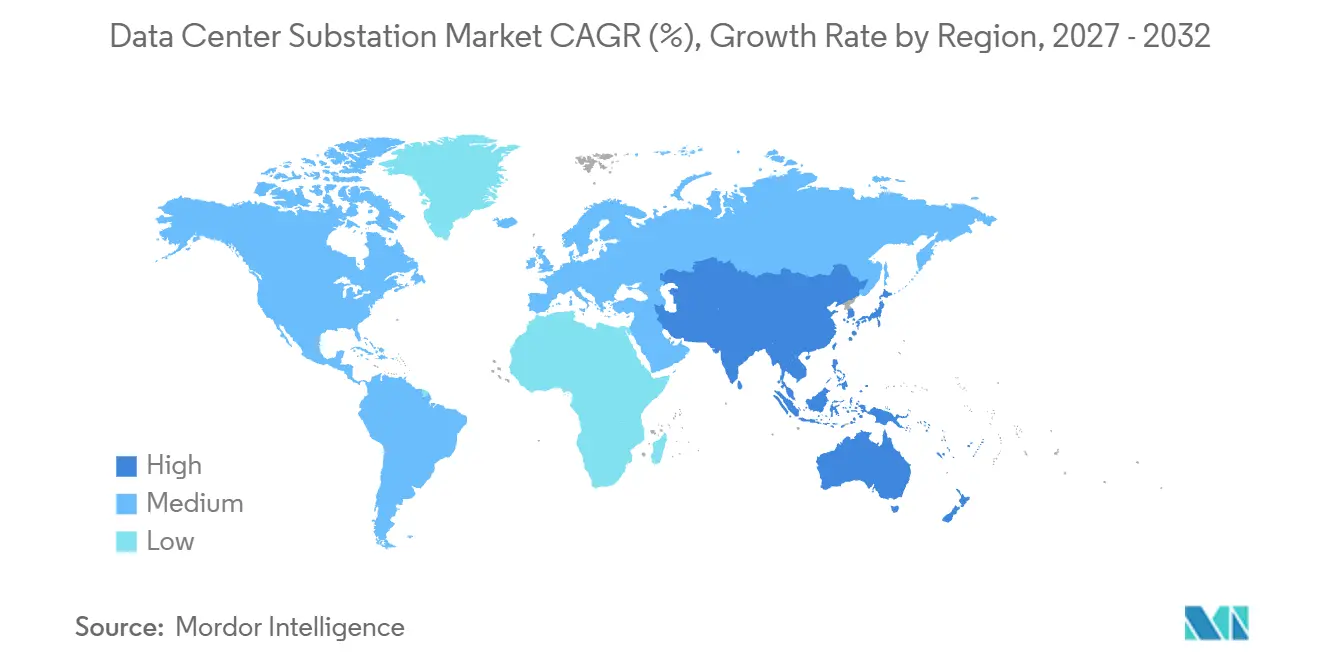
North America held 38.5% of the data center substation market in 2026. The region benefits from major hyperscale operators and a concentration of facilities in Northern Virginia, Dallas, and Chicago, which places sustained pressure on domestic substation supply chains. Hitachi Energy began a USD 457 million expansion of its South Boston, Virginia campus in June 2026. The project is intended to become the nation's largest large-power-transformer production site, create 825 jobs, and begin operations in 2029. Canada offers operators grid access and renewable power purchase agreements outside the congested US northeast, while Mexico is emerging as a nearshore location for hyperscale facilities.
Asia-Pacific is forecast to expand at a 10.4% CAGR through 2032, the fastest regional growth rate in the data center substation market. China, India, Japan, South Korea, Australia, and Southeast Asia all contribute to new capacity additions. TGOOD Electric's 2026 AI PowerHouse launch demonstrates how Chinese suppliers are targeting shorter time-to-power schedules. Japan's eight major power utilities announced plans in July 2026 to expand transmission infrastructure at 30 locations to accommodate accelerating data center construction. India's CG Power received an INR 900 crore transformer export order from Tallgrass Integrated Logistics in January 2026. Southeast Asia is attracting global hyperscalers, and NTT Global Data Centers and Fuji Electric began a 115 kV GIS substation project in Chonburi, Thailand, in June 2026.
In Europe, the data center substation market is supported by key markets including Germany, the United Kingdom, France, Poland, and Spain. Germany recorded a 9% increase in data center capacity to 2,980 MW in 2025, with capacity expected to exceed 3,000 MW in early 2026 and approach 5,000 MW by 2030. Hitachi Energy received a July 2026 contract for a dedicated 110 kV connection for Kauri CAB Digital Infrastructure's Frankfurt campus. In South America, Brazil is an emerging market where Siemens Energy signed a BRL 100 million contract for a 300 MW GIS substation and two 150 MVA transformers in Campinas. The Middle East and Africa are led by Saudi Arabia and the UAE, where sovereign AI programs are driving demand for 220 kV and higher infrastructure.
Competitive Landscape
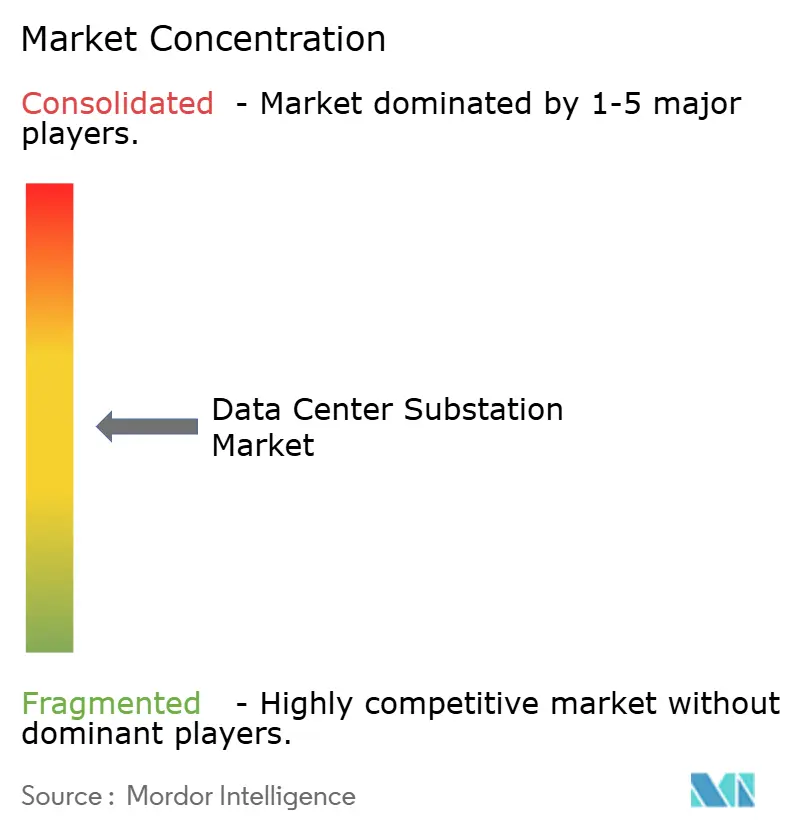
The data center substation market is moderately consolidated among global suppliers but fragmented at the mid-tier level. ABB, Hitachi Energy, Siemens Energy, GE Vernova, Schneider Electric, and Mitsubishi Electric lead in high-voltage and complex project scopes. Their multi-year order backlogs provide pricing leverage on large transformer and grid-connection work, favoring suppliers that can offer integrated systems and secure manufacturing capacity. Regional and national suppliers compete within specific voltage tiers and geographic markets, particularly where local-content procurement requirements apply. This structure combines concentrated capability for the most complex projects with broader competition in standardized applications.
Capacity expansion is a central response among suppliers in the data center substation market. Hitachi Energy began work on its South Boston facility in June 2026, while Virginia Transformer began a 50% expansion of its Rincon, Georgia site in April 2026 and announced a new plant in Muscle Shoals, Alabama, in May 2026. Eaton announced a USD 50 million campus in Henrico County, Virginia, in December 2025, with production expected in 2027. These investments indicate that suppliers expect supply shortages to persist long enough to support multi-year manufacturing commitments.
Systems integration represents another competitive approach in the data center substation market. ABB deployed its HiPerGuard medium-voltage UPS at Ark Data Centres in the United Kingdom, with 25 MVA of installed capacity, and expanded its work with Applied Digital's North Dakota campuses. Schneider Electric launched standardized prefabricated power modules in September 2026, with 2 MW, 2.25 MW, and 2.5 MW configurations designed for hyperscale, neocloud, and colocation environments. Protection and monitoring systems for AI-specific load profiles are another developing area, as NERC guidance addresses power swings that can reach 500 MW in seconds. TGOOD Electric and Forgent Power Solutions represent emerging competitors in modular systems and supply capacity.
Data Center Substation Industry Leaders
-
Schneider Electric SE
-
ABB Ltd.
-
Eaton Corporation plc
-
Siemens Energy AG
-
Hitachi Energy Ltd.
- *Disclaimer: Major Players sorted in no particular order
Data Center Substation Market Companies Covered in this Report
- ABB Ltd.
- Bharat Heavy Electricals Limited (BHEL)
- CG Power and Industrial Solutions Limited
- Eaton Corporation plc
- Fuji Electric Co., Ltd.
- GE Vernova Inc.
- Hitachi Energy Ltd.
- Hyosung Heavy Industries Co., Ltd.
- Hyundai Electric and Energy Systems Co., Ltd.
- Legrand SA
- Mitsubishi Electric Corporation
- NARI Technology Co., Ltd.
- NEI Electric Power Engineering, Inc.
- Ormazabal International
- Prolec-GE Waukesha, Inc.
- S&C Electric Company
- Schneider Electric SE
- Siemens Energy AG
- Sterling and Wilson Renewable Energy Limited
- Toshiba Energy Systems and Solutions Corporation
- Vertiv Holdings Co.
- Virginia Transformer Corporation
- WEG S.A.
Recent Industry Developments in Data Center Substation Market
- September 2026: Schneider Electric SE introduced a new range of prefabricated power modules and power skids in 2 MW, 2.25 MW, and 2.5 MW configurations for hyperscale, neocloud, and colocation data centers. The systems are integrated with NVIDIA's GB300 NVL72 platform and are designed to reduce AI-ready power infrastructure deployment timelines to as little as six months.
- July 2026: Hitachi Energy was awarded a contract to provide a dedicated 110 kV grid connection for Kauri CAB Digital Infrastructure's new data center in Frankfurt, Germany.
- July 2026: GE Vernova, Inc. secured contracts from Stromnetz Berlin for the design, supply, and installation of two new 110 kV gas-insulated substations (GIS) located in Wittenau and Neukölln. The projects utilize the company's SF6-free GRiDEA g3 technology, which has a global warming potential approximately 99% lower than that of conventional SF6-based equipment.
- June 2026: Hitachi Energy Ltd. broke ground on a USD 457 million expansion of its South Boston, Virginia facility, which the company expects to become the largest production site for large power transformers in the United States. The expansion is part of a broader USD 1 billion United States investment program and is intended to address growing demand from grid modernization and data center infrastructure markets.
Global Data Center Substation Market Report Scope
A data center substation is a dedicated electrical infrastructure facility that transforms high-voltage power from the main utility grid into lower, usable voltages for a data center. It serves as the critical entry point for a facility's power supply, housing essential equipment such as transformers, circuit breakers, and switchgear to manage and distribute electricity safely. As data centers require large amounts of uninterrupted energy, these substations are engineered for high reliability and often feature redundant incoming power lines to prevent outages.
The global data center substation market is segmented by component into transformers, switchgear, circuit breakers, relays and protection systems, capacitors, busbars, surge protection systems, power automation and control systems, monitoring and condition monitoring systems, and other components. By voltage, the market is segmented into 33 kV to 110 kV, 110 kV to 220 kV, 220 kV to 500 kV, and above 500 kV. By data center type, the market is segmented into hyperscale data centers, colocation data centers, enterprise data centers, and edge data centers. The report also covers the market size and forecasts for the global data center substation market across 26 countries in key regions. For each segment, the market sizing and forecasts are provided on the basis of value (USD).
Segmentation Overview
| Transformers |
| Switchgear |
| Circuit Breakers |
| Relays and Protection Systems |
| Capacitors |
| Busbars |
| Surge Protection Systems |
| Power Automation and Control Systems |
| Monitoring and Condition Monitoring Systems |
| Other Components |
| 33 kV–110 kV |
| 110 kV–220 kV |
| 220 kV–500 kV |
| Above 500 kV |
| Hyperscale Data Centers |
| Colocation Data Centers |
| Enterprise Data Centers |
| Edge Data Centers |
| North America | United States |
| Canada | |
| Mexico | |
| Europe | Germany |
| France | |
| Italy | |
| Spain | |
| United Kingdom | |
| Poland | |
| Russia | |
| Rest of Europe | |
| Asia-Pacific | China |
| India | |
| Japan | |
| South Korea | |
| Australia | |
| Indonesia | |
| Vietnam | |
| Thailand | |
| Rest of Asia-Pacific | |
| South America | Brazil |
| Argentina | |
| Chile | |
| Rest of South America | |
| Middle East and Africa | Saudi Arabia |
| United Arab Emirates | |
| Egypt | |
| South Africa | |
| Morocco | |
| Rest of Middle East and Africa |
| By Component | Transformers | |
| Switchgear | ||
| Circuit Breakers | ||
| Relays and Protection Systems | ||
| Capacitors | ||
| Busbars | ||
| Surge Protection Systems | ||
| Power Automation and Control Systems | ||
| Monitoring and Condition Monitoring Systems | ||
| Other Components | ||
| By Voltage | 33 kV–110 kV | |
| 110 kV–220 kV | ||
| 220 kV–500 kV | ||
| Above 500 kV | ||
| By Data Center Type | Hyperscale Data Centers | |
| Colocation Data Centers | ||
| Enterprise Data Centers | ||
| Edge Data Centers | ||
| By Geography | North America | United States |
| Canada | ||
| Mexico | ||
| Europe | Germany | |
| France | ||
| Italy | ||
| Spain | ||
| United Kingdom | ||
| Poland | ||
| Russia | ||
| Rest of Europe | ||
| Asia-Pacific | China | |
| India | ||
| Japan | ||
| South Korea | ||
| Australia | ||
| Indonesia | ||
| Vietnam | ||
| Thailand | ||
| Rest of Asia-Pacific | ||
| South America | Brazil | |
| Argentina | ||
| Chile | ||
| Rest of South America | ||
| Middle East and Africa | Saudi Arabia | |
| United Arab Emirates | ||
| Egypt | ||
| South Africa | ||
| Morocco | ||
| Rest of Middle East and Africa | ||
Key Questions Answered in the Report
What is the projected value of the data center substation market by 2032?
The data center substation market is forecast to reach USD 19.78 billion by 2032, growing at a CAGR of 8.31% from 2027.
Why are AI data centers driving demand for substations?
AI campuses require connections of 200 MW to 500 MW, increasing demand for dedicated high-voltage substations and transmission-level interconnections.
Which component leads data center substation spending?
Transformers accounted for the largest share of component revenue at 33.4% in 2026, while switchgear is expected to grow at a CAGR of 9.1% through 2032.
Which voltage range has the largest share in new campuses?
Above 500 kV accounted for 42.1% of revenue in 2026 and is forecast to grow at a CAGR of 8.4% through 2032.
Which region is growing fastest in data center power infrastructure?
Asia-Pacific is forecast to grow at a CAGR of 10.4% through 2032, supported by capacity expansion across China, India, Japan, South Korea, Australia, and Southeast Asia.