
Dark Store Market Size and Share
Market Overview
| Study Period | 2022 - 2032 |
|---|---|
| Market Size (2027) | USD 48.91 Billion |
| Market Size (2032) | USD 98.12 Billion |
| Growth Rate (2027 - 2032) | 14.94 % |
| Fastest Growing Market | Asia-Pacific |
| Largest Market | North America |
| Market Concentration | Low |
Major Players *Disclaimer: Major Players sorted in no particular order Image © Mordor Intelligence. Reuse requires attribution under CC BY 4.0. | |
Dark Store Market Analysis by Mordor Intelligence
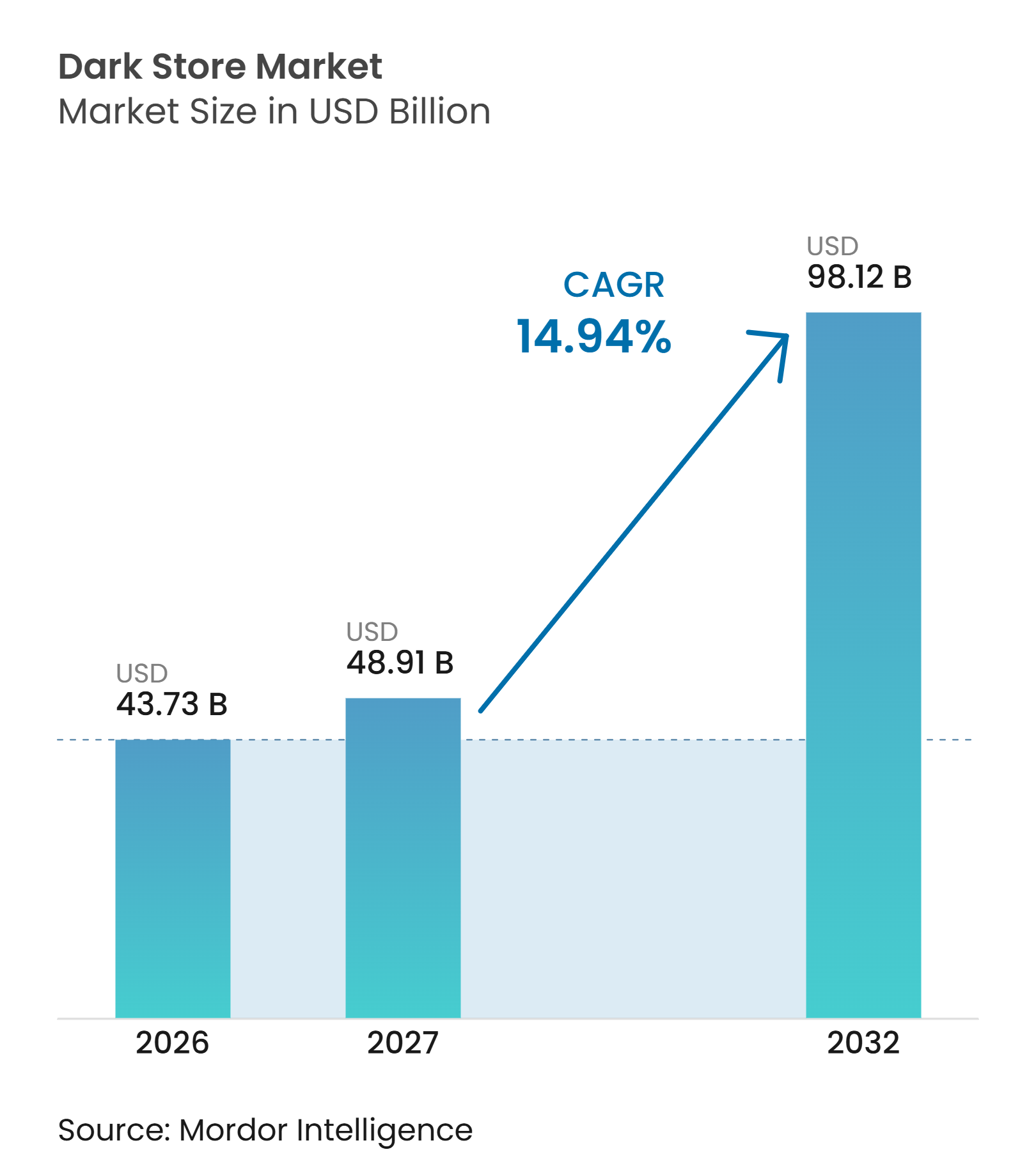
The global dark store market size was valued at USD 43.73 billion in 2026 and is estimated to grow from USD 48.91 billion in 2027 to reach USD 98.12 billion by 2032, at a CAGR of 14.94% during the forecast period (2027-2032). Consumer demand for rapid delivery is encouraging retailers and platforms to position inventory near dense urban neighborhoods. The global dark store market benefits from localized assortment planning, reliable picking, cold-chain handling, and last-mile delivery. Small fulfillment sites require sufficient daily orders to cover rent, labor, and delivery costs. Automation supports efficiency where labor costs are high and product assortments are broad. Regulations classifying dark stores as retail outlets or warehouses influence site selection and expansion speed. Global dark store operators are expanding micro-fulfillment networks for rapid delivery. China has approximately 10,000 dark stores, while India’s network is projected to reach 7,800 stores across over 100 cities in 2026, supporting localized inventory, AI-driven forecasting, and efficient last-mile fulfillment[1].
Key Report Takeaways
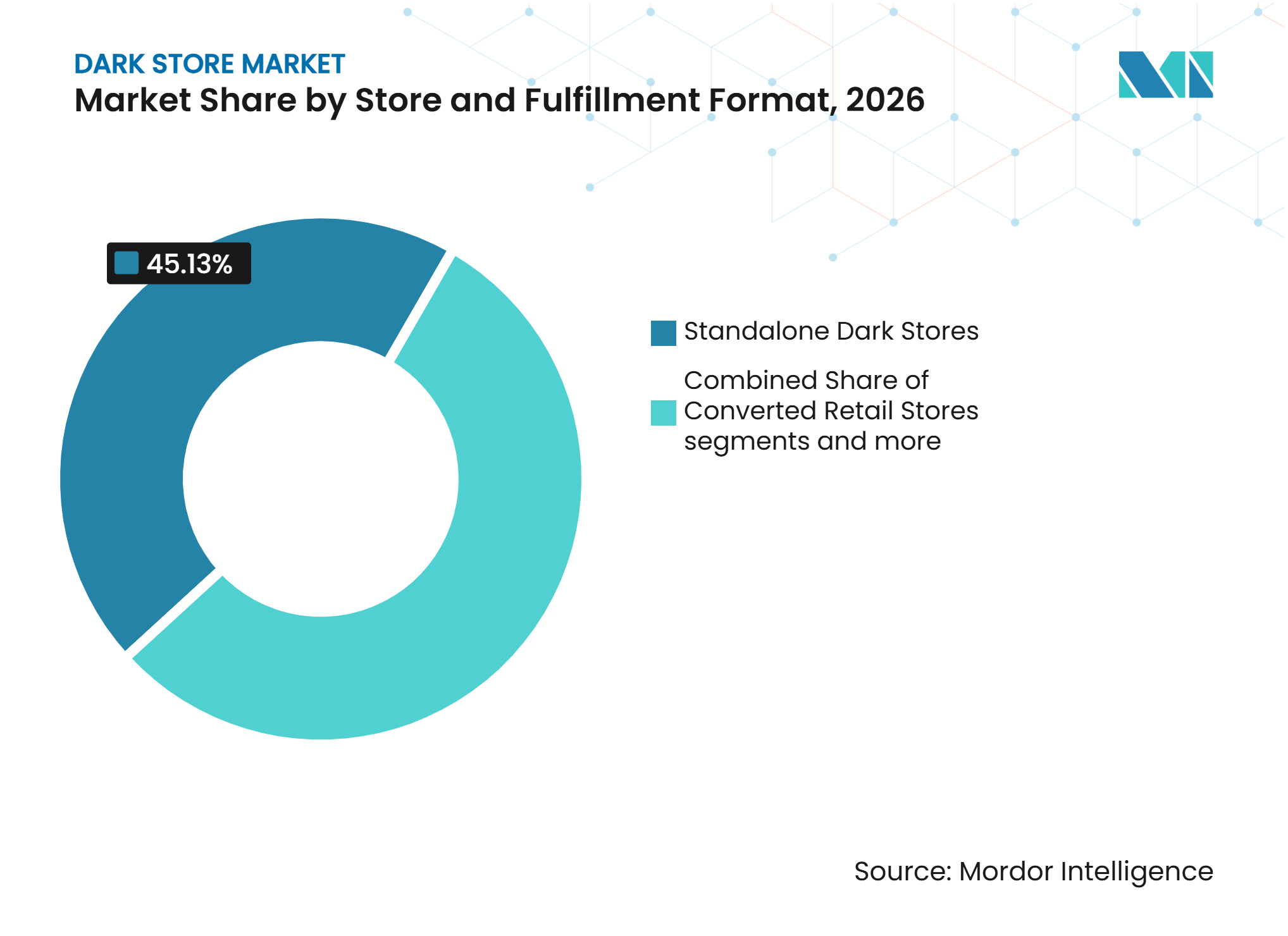
- By store/fulfillment format, standalone dark stores accounted for 45.13% of the global dark store market share in 2026, while micro-fulfillment centers are projected to grow at a 17.12% CAGR through 2032.
- By business model, quick commerce accounted for 56.71% of the global dark store market share in 2026, while omnichannel fulfillment is projected to grow at a 19.23% CAGR through 2032.
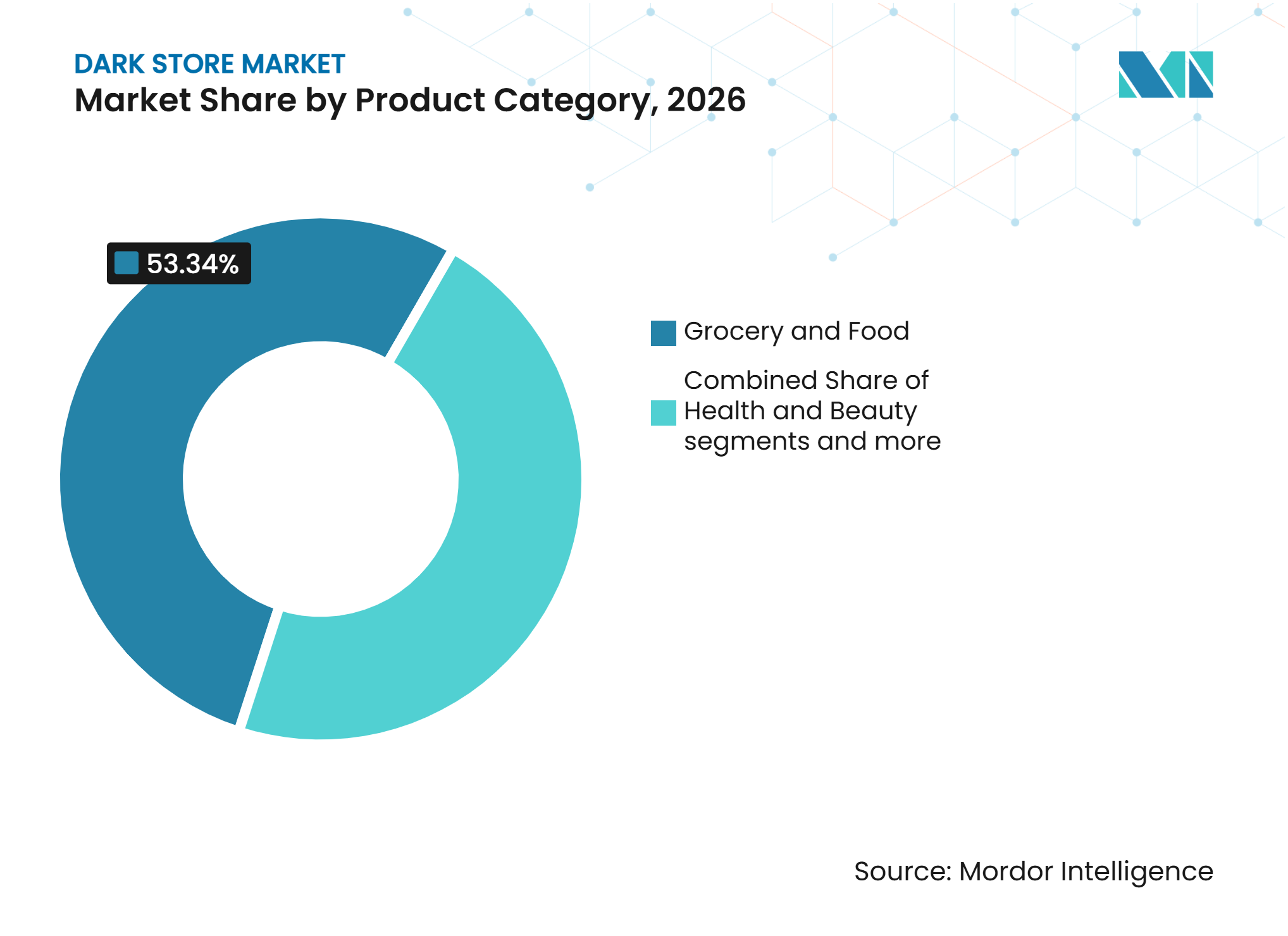
- By product category, grocery and food accounted for 53.34% of the global dark store market share in 2026, while pharmaceuticals and healthcare are projected to grow at a 17.75% CAGR through 2032.
- By store size, small dark stores accounted for 58.93% of the global dark store market share in 2026, while medium dark stores are projected to grow at an 18.93% CAGR through 2032.
- By geography, North America accounted for 34.72% of the global dark store market share in 2026, while Asia-Pacific is projected to grow at a 19.12% CAGR through 2032.
Note: Market numbers in this report are based on Mordor Intelligence's proprietary estimation framework, which combines nine months of actuals with Q4 projections for base year 2026.
Market Trends and Insights
Drivers Impact Analysis of Dark Store Market*
| Driver | (~) % Impact on CAGR Forecast | Geographic Relevance | Impact Timeline |
|---|---|---|---|
| Consumer Demand for Same-Day and Ultra-Fast Delivery | +3.5% | Global, most pronounced in North America, India, and Gulf Cooperation Council (GCC) | Short term (≤ 2 years) |
| Expansion of Online Grocery and Quick Commerce | +3.2% | Global, with India and Southeast Asia as hotspots | Short term (≤ 2 years) |
| Urban Density and Last-Mile Distance Reduction | +1.8% | Asia-Pacific core, North America urban corridors, and Europe | Medium term (2-4 years) |
| Automation, AI, and Real-Time Inventory Visibility | +2.1% | Global, led by Europe and North America | Medium term (2-4 years) |
| Adaptive Reuse of Vacant Retail Real Estate | +1.4% | North America and European Union, spillover to Asia-Pacific | Medium term (2-4 years) |
| Retailer Shift Toward Distributed Fulfillment Networks | +1.6% | Global, anchored in North America and Europe | Long term (≥ 4 years) |
| Source: Mordor Intelligence | |||
Consumer Demand for Same-Day and Ultra-Fast Delivery
Fast delivery drives demand in the global dark store market, particularly in high-density neighborhoods where consumers frequently purchase food and daily essentials. Short delivery windows encourage repeat orders by reducing the need to plan grocery purchases in advance. This behavior increases the importance of local inventory availability compared with large central warehouses for urgent orders. Consequently, quick commerce operators prioritize locations that serve compact catchment areas with predictable travel times. The global dark store market also benefits from consumer demand for broad product availability, as fast delivery has limited value when substitutions and stockouts occur frequently.
Expansion of Online Grocery and Quick Commerce
Online grocery adoption provides the global dark store market with a steady flow of high-frequency orders, as grocery baskets include recurring household purchases. The quick commerce model relies on strong local demand, a curated assortment, and sufficient delivery capacity during peak periods. Grocery-focused operators can use purchase history to improve replenishment and reduce waste in perishable inventory. In India and Southeast Asia, high urban population density and widespread mobile ordering support neighborhood fulfillment networks. Growth opportunities increase when operators build demand in Tier-II and Tier-III cities before opening sites, ensuring sufficient local order density.
Urban Density and Last-Mile Distance Reduction
Urban density supports the global dark store market by shortening delivery distances, improving rider utilization, and reducing order fulfillment times. Operators can locate small fulfillment nodes closer to customers, although their economic viability depends on rental costs, loading access, power availability, and cold-chain capacity. Vacant retail properties provide conversion opportunities when their locations align with delivery demand and local planning regulations permit logistics-related use. WareSpace converted a former Fry’s Electronics property in Plano, Texas, into a small-business industrial hub in 2025, demonstrating how vacant big-box retail space can be repurposed for logistics-adjacent activities. Retailers are also adopting distributed fulfillment networks that combine localized inventory with delivery, collection, and store-based operations.
Automation, AI, and Real-Time Inventory Visibility
Automation can improve the economics of the global dark store market by reducing picker travel time, increasing accuracy, and accelerating replenishment. In October 2025, Veloq and AutoStore opened an automated grocery fulfillment center in Vienna. The facility handles 20,000 stock keeping units (SKUs) across seven temperature zones and integrates real-time delivery route sorting[2]. This model demonstrates how compact sites can store fresh, ambient, and frozen goods while supporting rapid order preparation. Ocado reported an 18% reduction in the implied labor cost of fulfilling a 50-item basket in its 2025 accounts, highlighting the value of technology and operational learning in fulfillment. Real-time inventory tools also enable operators to offer a broader relevant assortment without increasing waste or substitution rates.
Restraints Impact Analysis of Dark Store Market*
| Restraint | (~) % Impact on CAGR Forecast | Geographic Relevance | Impact Timeline |
|---|---|---|---|
| High Urban Real-Estate and Store-Retrofit Costs | -1.8% | North America and European Union, spillover to Asia-Pacific Tier-I cities | Medium term (2-4 years) |
| Margin Pressure from Delivery Subsidies and Price Competition | -1.5% | Global, most acute in India and Europe | Short term (≤ 2 years) |
| Building-Code, Loading-Bay, and Utility Mismatch in Converted Sites | -0.9% | North America, European Union, and urban India | Medium term (2-4 years) |
| Local Traffic, Noise, and Community-Impact Opposition | -0.6% | European Union, particularly Netherlands, France, Denmark, and United Kingdom | Long term (≥ 4 years) |
| Source: Mordor Intelligence | |||
High Urban Real-Estate and Store-Retrofit Costs
High urban rents constrain dark store expansion because the most attractive delivery catchments are often in the most expensive locations. Conversion costs increase when former retail sites lack loading bays, refrigeration infrastructure, adequate utility capacity, or safe rider access. In France, planning policy classifies dark stores as warehouses when operators convert premises from retail use; operators must therefore obtain municipal approval before making this change. Before committing to a lease, operators must assess local zoning classifications, fire-safety requirements, and delivery access. These constraints favor businesses that can distribute technology, procurement, and compliance costs across larger networks.
Margin Pressure from Delivery Subsidies and Price Competition
The global dark store market faces margin pressure as delivery-fee subsidies and discounts reduce revenue per order. Price competition can increase order volumes but may delay profitability when operators maintain low fees to support customer acquisition. Store-level breakeven does not ensure company-level profitability, as operators must also cover central technology, marketing, and expansion costs. Community concerns over delivery traffic, loading and unloading, noise, and public-space congestion can restrict dark-store locations and prompt stricter zoning controls. The Dutch Council of State upheld Amsterdam’s Darkstores zoning plan in June 2025. The plan generally prohibits dark stores across much of the city unless an environmental permit authorizes an exception, allowing authorities to assess impacts on residential amenity and the urban environment[3].
*Our forecasts treat driver/restraint impacts as directional, not additive. The impact forecasts reflect baseline growth, mix effects, and variable interactions.
Dark Store Market Segment Analysis
By Store/Fulfillment Format:
Standalone Sites Lead While Automation ExpandsStandalone dark stores accounted for 45.13% of the market in 2026, reflecting demand for purpose-built facilities closed to the public and designed for rapid picking. These sites are typically located near customers and stock frequently purchased products. Their compact model reduces the time from storage to dispatch when demand is concentrated locally. Converted retail stores offer an alternative where former retail sites provide strong catchment access. Hybrid retail-fulfillment stores enable established grocers to serve in-store and online demand from shared inventory. Each format requires a different balance of site flexibility, inventory control, and delivery speed.
Micro-fulfillment centers are projected to grow at a CAGR of 17.12% through 2032, the highest among store formats. They combine urban proximity with automated storage and retrieval systems. Veloq and AutoStore’s Vienna facility demonstrate this model, with 20,000 Stock Keeping Units (SKUs), seven temperature zones, and real-time route sorting. Automated sites support broader assortments, reduce manual walking, and improve consistency during peak delivery periods. Adoption is most likely where labor costs and service expectations justify capital investment.



By Business Model:
Quick Commerce Leads While Omnichannel Fulfillment AcceleratesQuick commerce accounted for 56.71% of the market in 2026, as rapid delivery remained the primary driver for localized fulfillment capacity. The model requires sufficient local order volumes to support dedicated inventory, picking teams, and delivery operations. It performs best where customers purchase frequently and value short delivery windows. E-commerce fulfillment and click-and-collect serve customers who prioritize product availability or convenience over immediate delivery. These models enable retailers to use local sites for a broader range of customer needs and reduce reliance on a single delivery promise when preferences vary by location.
Omnichannel fulfillment is forecast to grow at a 19.23% CAGR through 2032, making it the fastest-growing business model segment. It integrates home delivery, collection, ship-from-store, and localized fulfillment. DoorDash announced a definitive agreement in October 2026 to acquire Maplebear Inc. (Instacart) in a transaction valued at approximately USD 17 billion[4]. The proposed combination integrates DoorDash’s delivery network and DashMart Fulfillment Services with Instacart’s grocery technology platform, which serves nearly 100,000 stores. The integration could expand retailers’ access to delivery infrastructure, increase online order-fulfillment capacity, and improve delivery flexibility during peak-demand periods. However, operational efficiencies will depend on effective post-acquisition integration.
By Product Category:
Grocery Remains Central While Healthcare ExpandsGrocery and food accounted for 53.34% of the global dark store market size in 2026, representing the largest product category. Fresh food, staples, and household replenishment products generate recurring demand and support predictable local inventory planning. Perishable inventory requires close monitoring, as waste and stockouts can undermine rapid delivery economics. Consumer electronics, fashion, and apparel are more difficult to manage from compact locations because they require broader product variants and often have higher return rates. Health and beauty remain relevant adjacent categories because customers may need personal care items quickly. Product mix decisions must balance demand frequency with local storage constraints.
Pharmaceuticals and healthcare are forecast to grow at a CAGR of 17.75% through 2032. This category requires licensed storage, pharmacist oversight, and reliable verification in jurisdictions with medicine-dispensing requirements. Compliance requirements create higher entry barriers for general-purpose platforms expanding into regulated healthcare products. Providers that establish compliant facilities early can develop a more defensible operating model. Regulated healthcare fulfillment allows dark stores to expand beyond daily convenience orders while maintaining service quality and safety. Delivery speed cannot override regulatory handling requirements.

By Store Size:
Small Formats Hold the Largest Position While Medium Sites ScaleSmall dark stores accounted for 58.93% market share in 2026, as compact facilities can operate close to neighborhood demand with lower initial capital requirements. Operators can test, modify, or close small sites with less risk than large dedicated warehouses. These facilities suit dense micro-markets, where high-frequency products support rapid replenishment. Shelf-layout optimization and inventory tools improve picking routes and order accuracy without expanding the site footprint. Small stores remain a durable component of the global dark store market by aligning limited space with frequently ordered local products.
Medium dark stores are forecast to grow at a CAGR of 18.93% through 2032 as operators expand proven sites to accommodate more Stock Keeping Units (SKUs) and higher daily order volumes. This format balances assortment depth, throughput, and lease exposure while supporting a broader mix of fresh and ambient inventory than small neighborhood sites. Large dark stores remain suited to dense urban corridors, where high order volumes can offset higher facility costs. Medium-site growth indicates a shift from initial testing to established neighborhood networks, enabling operators to expand product ranges without the risk of a large regional facility.
By Ownership/Operating Model:
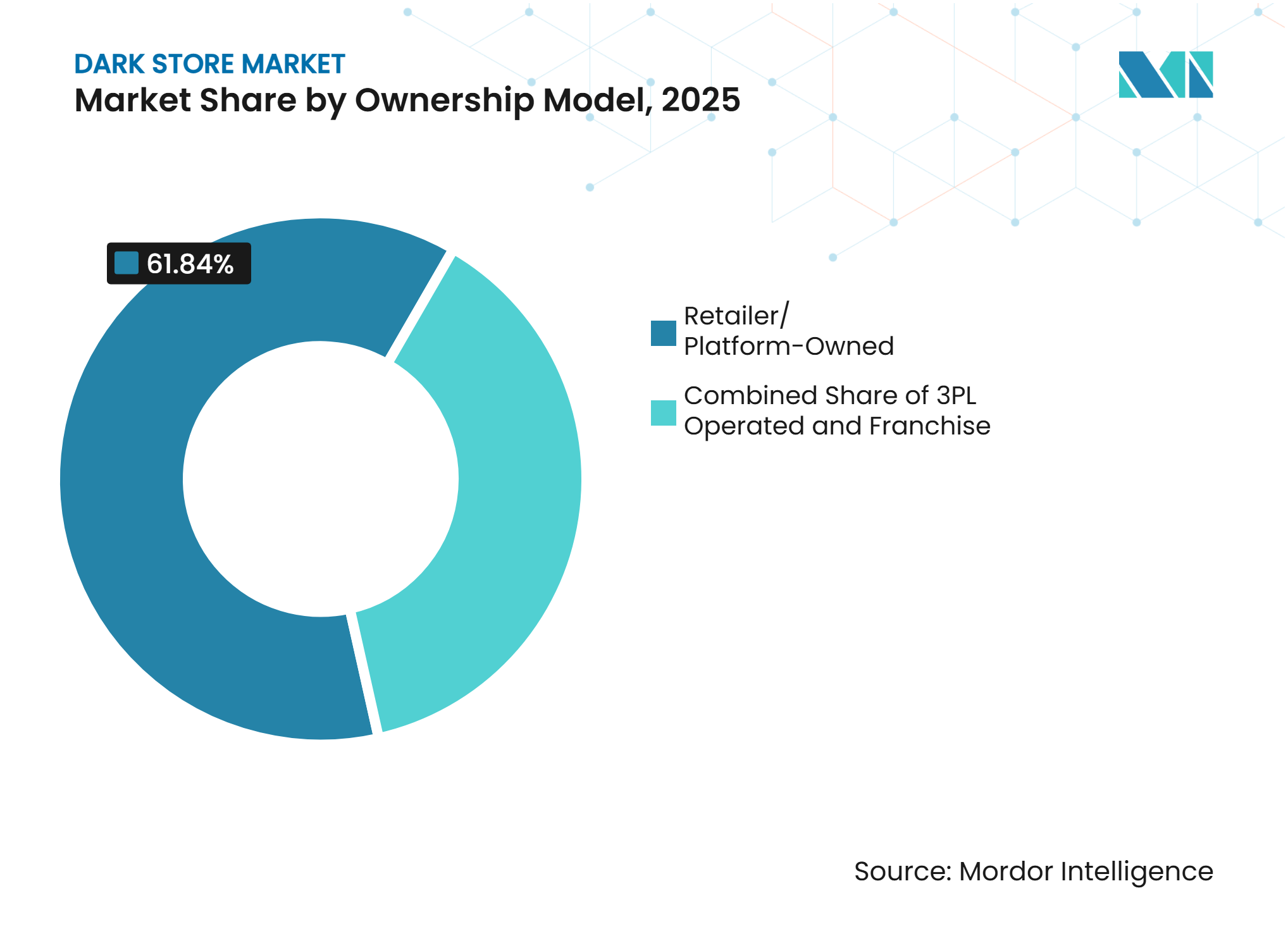
Platform-Owned Dominates, 3PL Model Fastest GrowingRetailer/Platform-Owned locations held an estimated 61.84% of dark store revenue in 2025, giving this model the leading share by ownership type. Direct ownership gives platforms greater control over inventory accuracy, picker productivity, and fulfillment consistency. These operating variables can influence order reliability and customer experience. Owned networks can also generate detailed demand information that supports assortment, pricing, and promotional decisions. Franchise and partner-operated models can provide an alternative where platforms want to expand with lower direct capital requirements. The ownership decision, therefore, reflects a balance between operational control, capital requirements, and network expansion speed. Direct ownership can support greater standardization, while partnership models can provide greater flexibility. The appropriate model depends on an operator's financial resources, operational capabilities, and desired pace of expansion.
Third-party/3PL-operated dark stores are forecast to grow at a 19.74% CAGR through 2031 in this market analysis, making them the fastest-growing ownership model. Outsourced urban fulfillment can become more attractive when logistics providers can combine fulfillment operations with established delivery networks. Shadowfax has announced plans to expand its quick-commerce dark-store operations, illustrating the potential role of logistics providers in supporting distributed fulfillment networks. A technology-enabled 3PL with an existing delivery network may be able to connect new fulfillment nodes with last-mile capacity more efficiently than a new standalone operator. This model can be particularly relevant in India as quick-commerce platforms expand beyond established metropolitan markets. However, 3PL-operated dark stores still require close coordination over inventory accuracy, fulfillment performance, and customer experience. The attractiveness of the model ultimately depends on whether network scale generates sufficient operational and cost efficiencies.
Geography Analysis
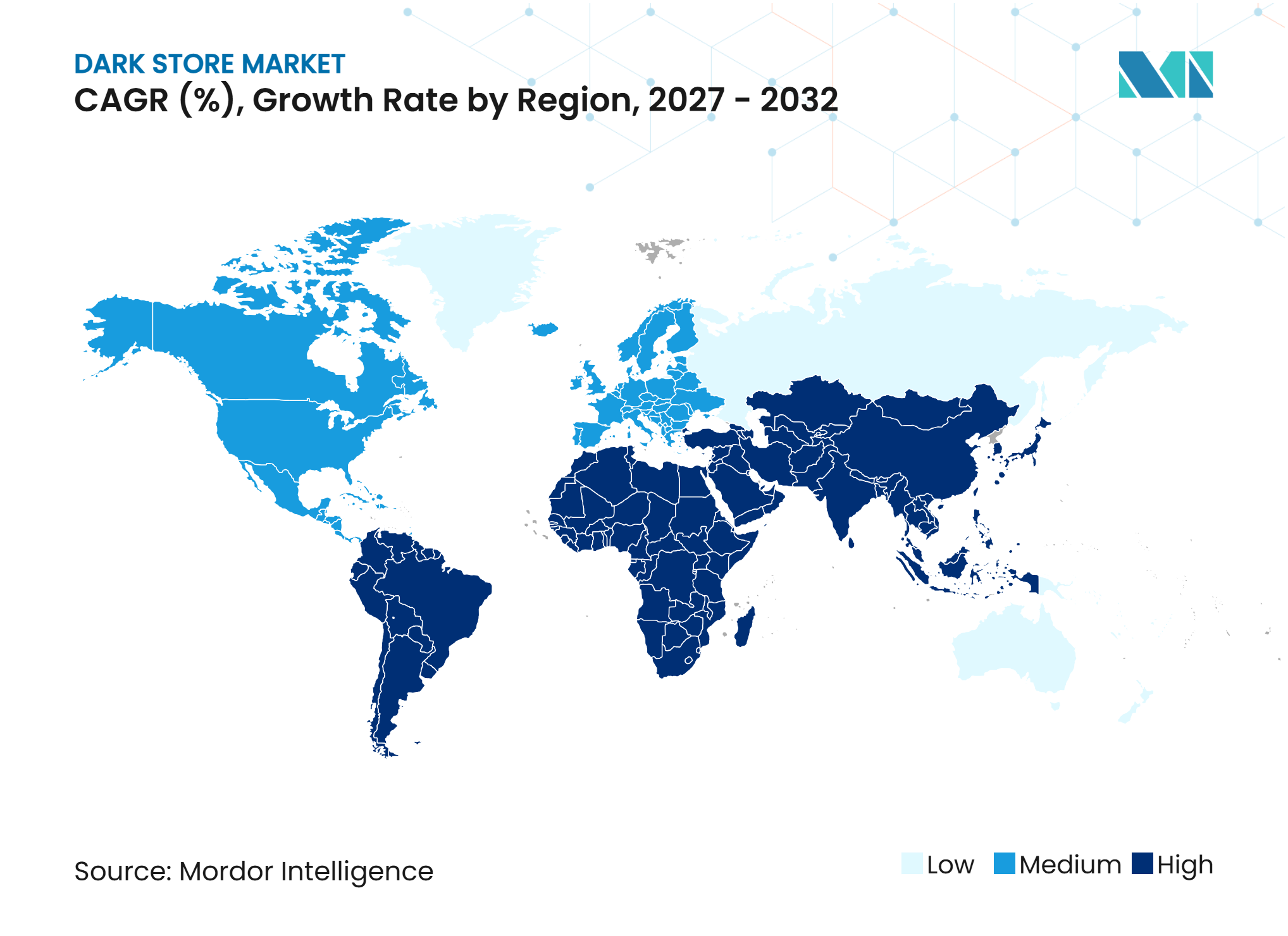
North America accounted for 34.72% of the market in 2026. High e-commerce adoption and retailer investments in local fulfillment and same-day delivery support growth. Former retail sites can be converted when they offer suitable loading areas, refrigeration, and access to delivery catchments. These locations can reduce site-selection time and support local inventory and rider operations. Established stores, delivery, and procurement networks further support the global dark store market in North America.
Asia-Pacific is forecast to grow at a 19.12% CAGR through 2032, the highest among the regions covered. India’s urban density and mobile ordering support frequent short-distance deliveries. China has a mature on-demand ecosystem built around real-time demand aggregation and localized inventory. In Southeast Asia, fragmented markets may favor supermarket partnerships over owned standalone networks. Growth will depend on operators’ ability to build demand density and adapt assortments, pricing, and fulfillment models to local income, infrastructure, and delivery conditions.
Europe is influenced by local regulations governing dark store locations and approvals. Amsterdam restricted dark stores to business estates in 2025, while France requires authorization for retail premises converted into dark stores. The UAE and Saudi Arabia are expanding rapid-delivery services, while payment systems and last-mile connectivity constrain parts of Africa. Brazil and Chile are South America’s more established markets for on-demand grocery and rapid delivery. Compliant site selection and effective fulfillment design remain important across regions.
Competitive Landscape
Market Concentration
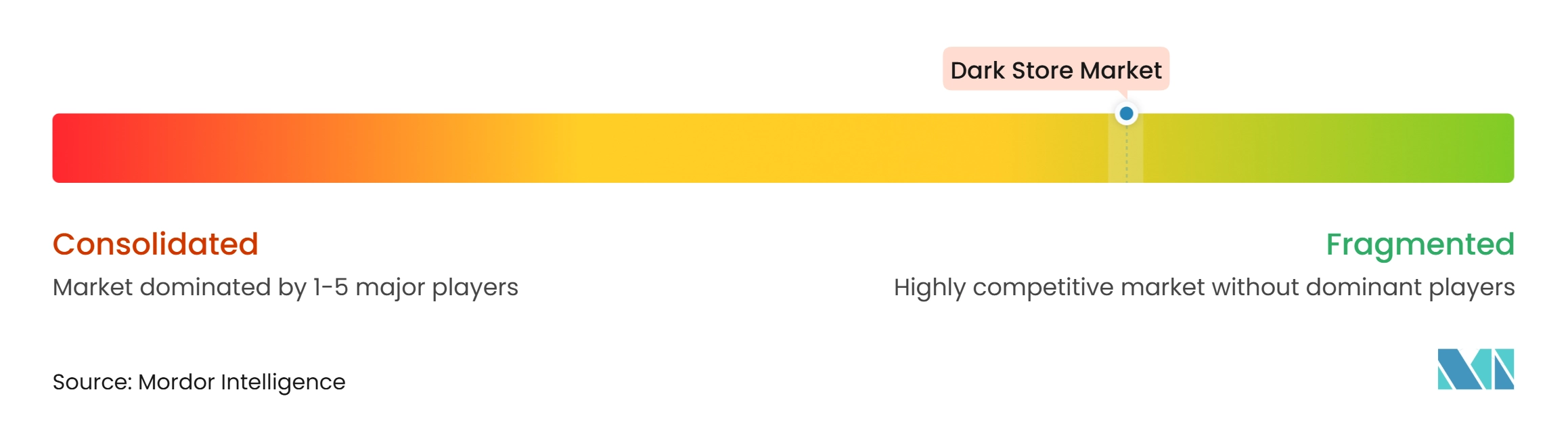
The global dark store market is fragmented, with the five largest operators estimated to account for 30% to 40% of global market value. Amazon, Walmart, Eternal Limited, Swiggy Limited, and Maplebear Inc. use strategies shaped by their assets and regional positions. Amazon and Walmart combine localized fulfillment with broad logistics and retail networks. Eternal’s Blinkit and Swiggy’s Instamart compete through dense urban operations and rapid delivery in India. Maplebear, operating as Instacart, provides grocery technology and fulfillment capabilities that help retailers meet online demand.
Partnerships and acquisitions are expanding fulfillment capabilities. DoorDash’s planned USD 17 billion acquisition of Instacart would combine its delivery network and DashMart with Instacart’s grocery technology platform. In September 2026, Instacart and gopuff partnered to add gopuff to the Instacart Marketplace, provide access to its micro-fulfillment inventory, and adopt Instacart’s Carrot Ads platform. These moves integrate inventory, delivery, retailer services, and advertising.
Technology investment supports cost control and short delivery windows. Ocado’s 2025 accounts covered manual dark-store picking, store-based automation, and robotic fulfillment centers. Ocado Retail opened a Nottingham distribution spoke in August 2026, adding over 400 jobs. Improved accuracy, inventory visibility, and labor efficiency strengthen operations as demand varies by neighborhood and time of day.
Dark Store Industry Leaders
-
Amazon.com, Inc.
-
Walmart Inc.
-
Eternal Limited
-
Swiggy Limited
-
Maplebear Inc. (Instacart)
- *Disclaimer: Major Players sorted in no particular order
Dark Store Market Companies Covered in this Report
- Amazon.com, Inc.
- Walmart Inc.
- Maplebear Inc. (Instacart)
- Eternal Limited
- Swiggy Limited (Instamart)
- Zepto
- BigBasket
- Target Corporation
- Auchan Retail International
- Grab Holdings Limited
- Uber Technologies, Inc.
- DoorDash, Inc. (Wolt)
- Gopuff
- Ocado Group plc
- Flink SE
- Prozo Private Limited
- Carrefour S.A.
- The Kroger Co.
- JioMart / Reliance Retail Ventures Limited
Recent Industry Developments in Dark Store Market
- October 2026: DoorDash agreed to acquire Instacart for approximately USD 17 billion, combining its delivery network and DashMart with Instacart’s grocery technology platform serving nearly 100,000 stores. Closing is expected by early 2028, subject to regulatory and shareholder approvals.
- September 2026: Instacart and gopuff announced a United States partnership bringing gopuff’s groceries and daily essentials to Instacart customers, with delivery in as little as 15 minutes.
- November 2025: Superdrug partnered exclusively with Just Eat to offer over 8,000 health and beauty products from 29 stores, with delivery in as little as 30 minutes. The service expanded nationwide in March 2026, extending rapid delivery into health and beauty retail.
- August 2025: Ocado Retail opened a regional distribution center in Nottingham, expecting to create over 400 jobs. The facility brings fulfillment capacity closer to customers, supporting higher order volumes, improved delivery efficiency, and expansion of online grocery operations.
Global Dark Store Market Report Scope
The global dark store market report analyzes dedicated fulfillment facilities supporting rapid delivery and online order fulfillment across global retail markets. The market is segmented by store format, business model, product category, store size, and geography. The study examines key drivers, including demand for ultra-fast delivery, expansion of online grocery and quick commerce, urban density, automation, AI-enabled inventory management, adaptive reuse of vacant retail properties, and distributed fulfillment networks. It also assesses restraints such as high real-estate and retrofit costs, delivery-related margin pressure, building-code and loading constraints, and community opposition over traffic and noise. The report evaluates value chains, regulations, technology adoption, and competitive forces. It provides market size and growth forecasts, competitive landscape analysis, market concentration, market share assessment, strategic developments, and profiles of leading operators. It also explores opportunities in underserved cities, micro-market expansion, and automation-enabled operational efficiency. Market estimates and forecasts are presented in value (USD) across all covered segments.
Segmentation Overview
| Standalone Dark Stores |
| Converted Retail Stores |
| Micro-Fulfillment Centers |
| Hybrid Retail-Fulfillment Stores |
| Quick Commerce |
| E-commerce Fulfillment |
| Omnichannel Fulfillment |
| Click-and-Collect |
| Grocery & Food |
| Health & Beauty |
| Pharmaceuticals & Healthcare |
| Consumer Electronics |
| Fashion & Apparel |
| Household & Consumer Goods |
| Others |
| Small |
| Medium |
| Large |
| North America | United States |
| Canada | |
| Mexico | |
| South America | Brazil |
| Peru | |
| Chile | |
| Argentina | |
| Rest of South America | |
| Europe | United Kingdom |
| Germany | |
| France | |
| Spain | |
| Italy | |
| BENELUX (Belgium, Netherlands, and Luxembourg) | |
| NORDICS (Denmark, Finland, Iceland, Norway, and Sweden) | |
| Russia | |
| Rest of Europe | |
| Asia-Pacific | India |
| China | |
| Japan | |
| Australia | |
| South Korea | |
| South East Asia (Singapore, Malaysia, Thailand, Indonesia, Vietnam, and Philippines) | |
| Rest of Asia-Pacific | |
| Middle East and Africa | United Arab Emirates |
| Saudi Arabia | |
| South Africa | |
| Nigeria | |
| Rest of Middle East and Africa |
| By Store/Fulfillment Format | Standalone Dark Stores | |
| Converted Retail Stores | ||
| Micro-Fulfillment Centers | ||
| Hybrid Retail-Fulfillment Stores | ||
| By Business Model | Quick Commerce | |
| E-commerce Fulfillment | ||
| Omnichannel Fulfillment | ||
| Click-and-Collect | ||
| By Product Category | Grocery & Food | |
| Health & Beauty | ||
| Pharmaceuticals & Healthcare | ||
| Consumer Electronics | ||
| Fashion & Apparel | ||
| Household & Consumer Goods | ||
| Others | ||
| By Store Size | Small | |
| Medium | ||
| Large | ||
| By Geography | North America | United States |
| Canada | ||
| Mexico | ||
| South America | Brazil | |
| Peru | ||
| Chile | ||
| Argentina | ||
| Rest of South America | ||
| Europe | United Kingdom | |
| Germany | ||
| France | ||
| Spain | ||
| Italy | ||
| BENELUX (Belgium, Netherlands, and Luxembourg) | ||
| NORDICS (Denmark, Finland, Iceland, Norway, and Sweden) | ||
| Russia | ||
| Rest of Europe | ||
| Asia-Pacific | India | |
| China | ||
| Japan | ||
| Australia | ||
| South Korea | ||
| South East Asia (Singapore, Malaysia, Thailand, Indonesia, Vietnam, and Philippines) | ||
| Rest of Asia-Pacific | ||
| Middle East and Africa | United Arab Emirates | |
| Saudi Arabia | ||
| South Africa | ||
| Nigeria | ||
| Rest of Middle East and Africa | ||
Key Questions Answered in the Report
What is driving demand for dark stores?
Demand is supported by consumer expectations for fast delivery, recurring grocery purchases, urban density, and retailer investment in local fulfillment networks.
How large is the global dark store market?
The global dark store market is projected to grow from USD 43.73 billion in 2026 and USD 50.26 billion in 2027 to USD 98.12 billion by 2032, at a 14.94% CAGR.
Which store/fulfillment format is growing fastest?
Micro-fulfillment centers are forecast to grow at a 17.12% CAGR through 2032, supported by automation and local inventory placement.
Why are retailers investing in omnichannel fulfillment?
Omnichannel fulfillment is forecast to grow at a 19.23% CAGR because it combines delivery, collection, ship-from-store, and local fulfillment capabilities.
What are the main constraints on dark store expansion?
High urban rents, retrofit needs, delivery subsidies, price competition, and zoning restrictions can delay site activation and reduce returns.
Which region is expected to grow fastest?
Asia-Pacific is forecast to expand at a 19.12% CAGR through 2032, supported by urban demand and established on-demand delivery ecosystems.