
Corporate Retreat Market Size and Share
Market Overview
| Study Period | 2021 - 2031 |
|---|---|
| Market Size (2026) | USD 25.32 Billion |
| Market Size (2031) | USD 36.72 Billion |
| Growth Rate (2026 - 2031) | 7.71 % |
| Fastest Growing Market | Asia-Pacific |
| Largest Market | North America |
| Market Concentration | Medium |
Major Players *Disclaimer: Major Players sorted in no particular order Image © Mordor Intelligence. Reuse requires attribution under CC BY 4.0. | |
Corporate Retreat Market Analysis by Mordor Intelligence
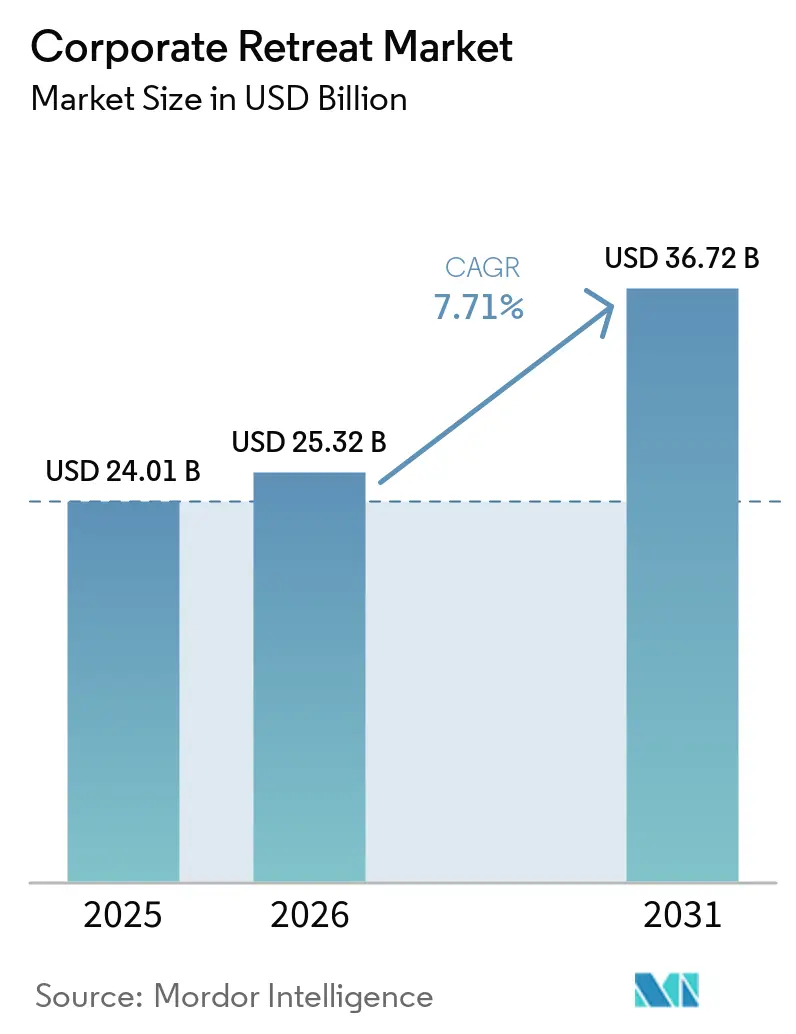
The Global Corporate Retreat Market was valued at USD 24.01 billion in 2025 and is estimated to grow from USD 25.32 billion in 2026 to reach USD 36.72 billion by 2031, at a CAGR of 7.71% during the forecast period (2026–2031). Growth is driven by companies increasingly viewing off-sites as strategic investments in people and performance. Organizations with stronger performance averaged 2.8 off-sites annually, compared to 2.4 for underperforming peers, reflecting formalized retreat spending. Burnout management is expanding the spending base, with wellness budgets increasingly tied to retreat planning. Official data indicated 76% of employers plan to increase mental health investments in 2026. Advancements in planning technology are reshaping competition, as providers offering integrated solutions for venue sourcing, travel, attendee management, and reporting simplify execution and improve renewal rates. Despite cost pressures, the market benefits from stronger links to employee retention, organizational culture, collaboration, and executive alignment compared to previous years[1].
Key Report Takeaways
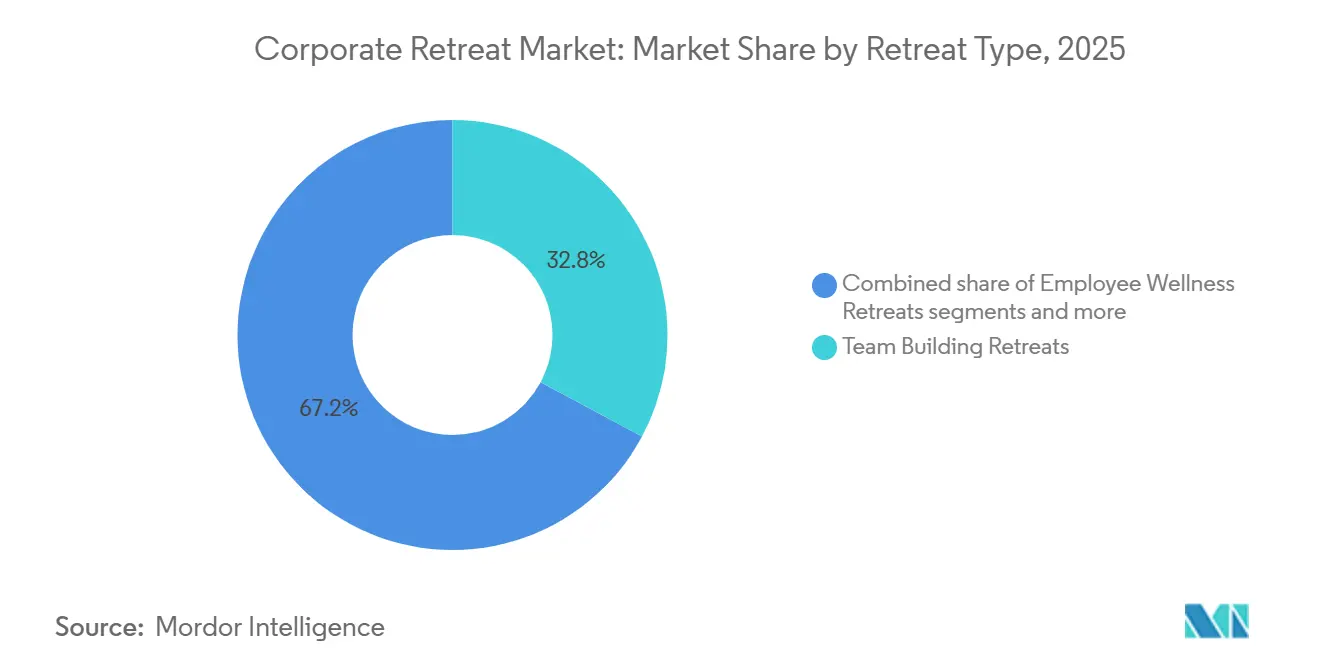
- By retreat type, Team Building Retreats commanded a 32.82% share of the Global Corporate Retreat Market in 2025, while Employee Wellness Retreats are projected to grow at the highest CAGR of 8.93% through 2031.
- By enterprise size, Large Enterprises commanded a 48.53% share of the Global Corporate Retreat Market in 2025, while Mid-Sized Enterprises are projected to grow at the highest CAGR of 8.34% through 2031.
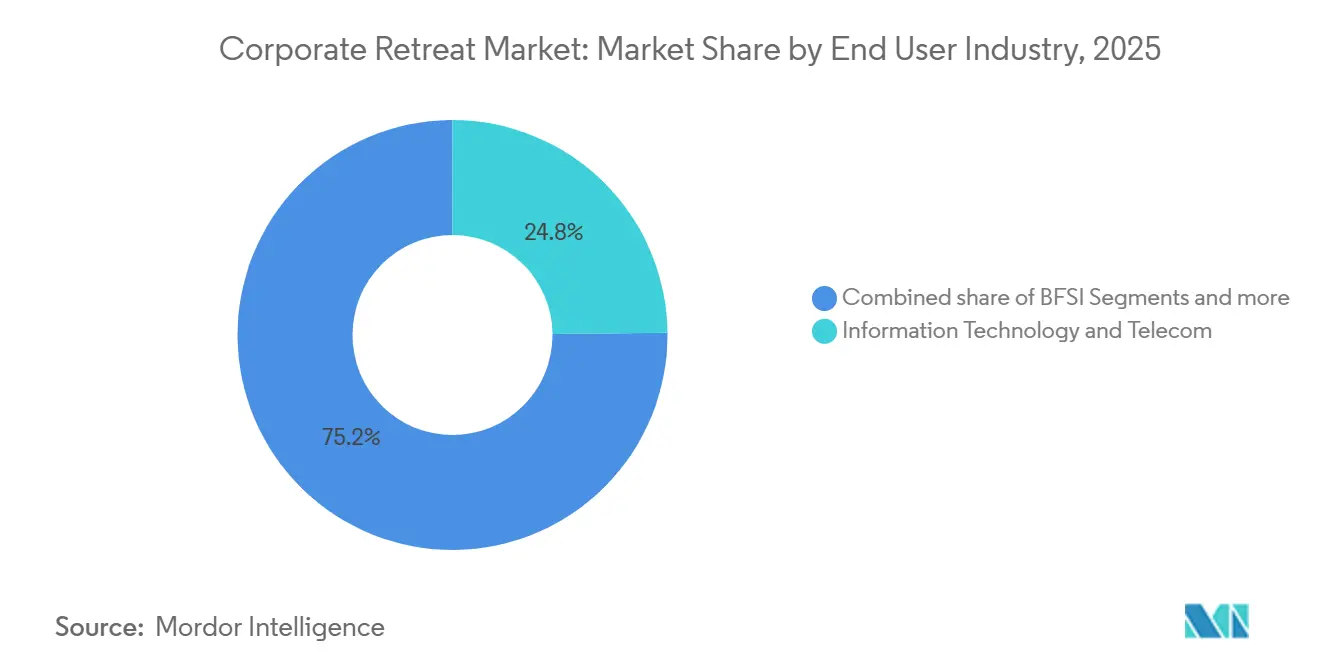
- By end-user industry, Information Technology and Telecom accounted for 24.84% of the Global Corporate Retreat Market in 2025, while Healthcare and Life Sciences are projected to grow at the highest CAGR of 8.58% through 2031.
- By booking channel, Direct Booking commanded a 36.61% share of the Global Corporate Retreat Market in 2025, while Event Management and Retreat Organizers are projected to grow at the highest CAGR of 9.12% through 2031.
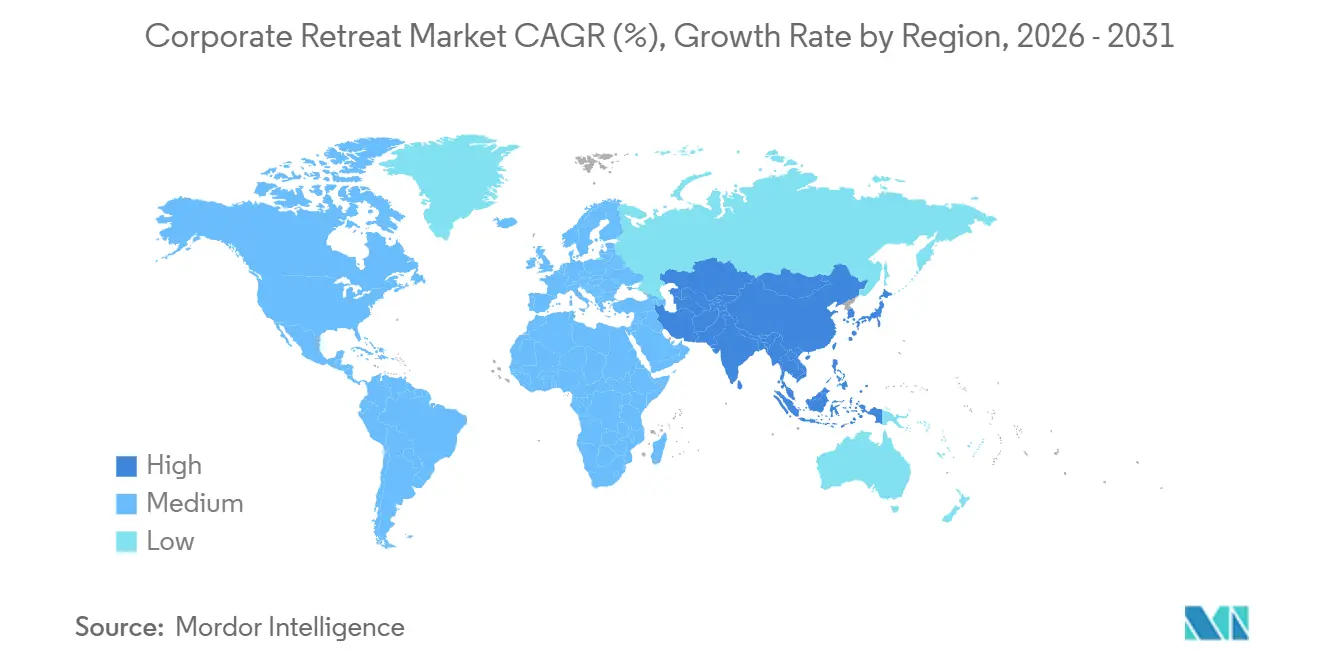
- By geography, North America commanded a 34.76% share of the Global Corporate Retreat Market in 2025, while Asia-Pacific is projected to grow at the highest CAGR of 8.64% through 2031.
Note: Market size and forecast figures in this report are generated using Mordor Intelligence’s proprietary estimation framework, updated with the latest available data and insights as of January 2026.
Global Corporate Retreat Market Trends and Insights
Drivers Impact Analysis*
| Driver | (~) % Impact on CAGR Forecast | Geographic Relevance | Impact Timeline |
|---|---|---|---|
| Rising demand for off-site leadership alignment and culture reset programs | +1.8% | Global, with the strongest activity in North America and Western Europe | Medium term (2-4 years) |
| Expansion of hybrid work, increasing value of in-person collaboration | +1.5% | Global, with the highest uptake in North America, the United Kingdom, Australia, and India’s IT hubs | Short term (≤ 2 years) |
| Corporate wellbeing and burnout reduction budgets supporting retreat spend | +1.4% | Global, with elevated activity in high-burnout markets including the United States, Japan, South Korea, and Germany | Short term (≤ 2 years) |
| Greater use of retreats for strategy off-sites, sales kick-offs, and innovation sprints | +1.2% | North America and Europe, with spillover into the Asia-Pacific | Medium term (2-4 years) |
| Rising preference for premium experiential venues and curated team-building formats | +0.9% | North America, Europe, and luxury destinations in the Asia-Pacific | Long term (≥ 4 years) |
| Growth of ESG-conscious event planning and low-carbon retreat sourcing | +0.5% | Core Europe, with spillover into the United States and Asia-Pacific | Long term (≥ 4 years) |
| Source: Mordor Intelligence | |||
Rising demand for off-site leadership alignment and culture reset programs
The Global Corporate Retreat Market is growing as organizations focus on aligning leadership, especially in those with distributed teams and extensive operations. Surveys indicate that off-site events enhance organizational connections, shifting their purpose from team rewards to fostering internal cohesion. Agenda designs now allocate more time to social programming and team-building activities compared to work-related tasks, reflecting a deliberate approach to culture-building. Changing workforce demographics, with younger generations forming a significant share of the global workforce, underscore the importance of in-person experiences that foster communication and belonging[2]. These trends are driving demand for structured offsite programs, small-group sessions, and recurring event schedules that align with organizational planning processes.
Expansion of hybrid work, increasing value of in-person collaboration
Hybrid work has reduced the frequency of physical gatherings, increasing the importance of well-organized in-person interactions in the Global Corporate Retreat Market. Research indicates a rise in the number of annual off-site events, alongside a decline in the number of companies holding none. Findings also show that nearly half of off-site attendees travel in business class or higher, and high-performing companies adopt bleisure travel to enhance the value of these events. Additionally, a significant portion of corporate travel programs now include defined bleisure policies, with improved employee satisfaction as a key driver[3]. For the Global Corporate Retreat Market, this reflects a growing focus on evaluating destinations not only for meeting logistics but also for travel convenience, employee retention, and overall appeal.
Corporate wellbeing and burnout reduction budgets supporting retreat spend
The Global Corporate Retreat Market is supported by the growing alignment between workforce well-being budgets and retreat spending. Reports indicate that a significant percentage of United States employees experienced burnout, leading to substantial productivity and turnover costs per affected employee. In response, many employers are increasing investments in mental health and expect overall benefit spending to rise, creating opportunities for wellness-oriented retreat formats to receive funding from HR and benefits departments. Research shows that employees at high-performing companies engage in wellness activities during offsite events at a higher rate compared to those at underperforming organizations, highlighting the value of structured wellness content. This trend supports retreat programs that focus on stress management, guided recovery, wellbeing facilitation, and measurable follow-up, rather than solely offering leisure activities.
Greater use of retreats for strategy off-sites, sales kick-offs, and innovation sprints
The Global Corporate Retreat Market is growing as companies shift toward decision-focused retreat formats rather than general morale-boosting events. High-performing companies allocate more offsite time to operational meetings than underperforming organizations, suggesting that effective programs are more structured and goal-oriented. Leading organizations are increasingly evaluating offsite outcomes using engagement surveys, productivity metrics, and collaboration network analysis, providing finance teams with a clearer basis for renewal decisions. Strategy retreats, sales kickoffs, and innovation sessions are more likely to be preserved during budget reviews when tied to execution milestones rather than general cultural objectives. This trend is driving demand for facilitators, well-defined agendas, pre-read materials, and post-event tracking, rather than focusing solely on venue coordination.
Restraints Impact Analysis*
| Restraint | (~) % Impact on CAGR Forecast | Geographic Relevance | Impact Timeline |
|---|---|---|---|
| High total trip cost across premium lodging, transport, and facilitator fees | -1.8% | Global; acute in North America and Western Europe, where ultra-luxury venue pricing rose 15–25% since 2022 | Short term (≤ 2 years) |
| Volatile corporate travel policies and budget approval cycles | -1.3% | Global; most pronounced in large enterprises and government-linked organizations | Medium term (2–4 years) |
| Seasonal venue scarcity in high-demand destinations is limiting availability | -0.8% | Global; most acute in North America and the United Kingdom, where multi-city assembly increases per-head travel costs | Short term (≤ 2 years) |
| Measurable ROI remains difficult for many retreat programs | -0.6% | Global, particularly constraining in cost-discipline environments across large European and North American enterprises | Medium term (2–4 years) |
| Source: Mordor Intelligence | |||
High total trip cost across premium lodging, transport, and facilitator fees
Cost inflation remains a significant challenge for the Global Corporate Retreat Market, as retreat expenses include travel, lodging, food, facilitation, and activities. Reports indicate that meeting and event prices have risen substantially compared to pre-pandemic levels, with budgets often lagging supplier costs. Venue rates in the United States have also increased, with further growth expected, adding pressure on destination programs. Additionally, many Gen Z and Millennial attendees report financial impacts from offsite participation, raising concerns for employers about equity and reimbursement. These cost pressures are driving trends such as shorter program durations, regional venue selections, smaller attendee lists, and stronger negotiation efforts by buyers with centralized travel or meeting management systems.
Volatile corporate travel policies and budget approval cycles
The Global Corporate Retreat Market faces challenges due to approval cycles, as retreat budgets require alignment among HR, finance, procurement, and travel teams. Planner confidence was affected by a prolonged government shutdown and tariff-related uncertainty, leading to soft attendance in some sectors before conditions improved. Travel managers express concerns about duty of care, expense tracking, and insurance coverage when blended travel policies interact with company programs, often delaying approvals even for strong retreat proposals. International registrations at client programs declined, driven by higher visa fees and logistical challenges, indicating that approval risks are not solely internal. Suppliers offering flexible contracting, improved reporting, and integrated policy controls are better positioned to address market uncertainties.
*Our forecasts treat driver/restraint impacts as directional, not additive. The impact forecasts reflect baseline growth, mix effects, and variable interactions.
Segment Analysis
By Retreat Type: Wellness Demand Accelerating Beyond Legacy Team-Building Formats
Team Building Retreats held 32.82% of the Global Corporate Retreat Market share in 2025, reflecting the importance of fostering cohesion, informal interaction, and cross-functional bonding through structured offsite programs. Emburse reported that 44% of offsite agendas are allocated to social programming and team-building activities, while 36% focus on work-related tasks. This format remains the largest category due to its ability to reconnect distributed teams and its versatility for early-stage team integration, annual culture resets, and post-reorganization regrouping. Leadership and Strategy retreats are significant, but team-building retreats dominate due to their broader applicability across employee groups.
Employee Wellness Retreats are the fastest-growing segment in the Global Corporate Retreat Market, with a projected CAGR of 8.93% through 2031. Wellable stated that 76% of employers plan to increase mental health investments by 2026, expanding budgets for wellness-focused retreats[4]. Maritz found that employees at high-performing companies participated in wellness activities at a 46% rate during offsites, compared to 26% at underperforming companies. This growth drives demand for structured wellness content, including guided sessions, stress recovery programs, and measurable follow-ups, rather than spa-oriented experiences. Retreat operators with expertise in health-focused programming and clear outcome frameworks are better positioned to meet this demand.

By Enterprise Size: Mid-Sized Enterprises Outpacing Large Counterparts
Large enterprises held 48.53% of the Global Corporate Retreat Market share in 2025, driven by strategic meetings management programs, centralized procurement, and stronger buying leverage with hotel and travel partners. These organizations benefit from recurring offsite calendars, global policy frameworks, and clear internal ownership of travel and meeting expenditures. They effectively implement leadership retreats, sales kickoffs, and culture programs across business units. Despite tighter scrutiny, they remain a key driver of demand because they align with annual management processes, incentive programs, and communication needs. Their scale supports partnerships with global travel management companies and hotel groups, ensuring policy compliance, negotiated rates, and enterprise-level reporting.
Mid-sized enterprises are the fastest-growing segment in the Global Corporate Retreat Market, with a projected CAGR of 8.34% through 2031. Emburse reported that 67% of companies with 51 to 100 employees increased offsite budgets since 2019, compared to 54% of large enterprises. These companies often seek external planning support to achieve high-quality retreats, as they may lack fully developed meetings teams or sourcing processes. This creates opportunities for turnkey planners, digital-first organizers, and managed platforms to simplify venue sourcing, travel coordination, and attendee communication. Small enterprises face challenges in market penetration due to cost sensitivity and planning complexity. However, simpler booking tools and packaged formats are expected to gradually improve access for this segment.
By End User Industry: IT Sector Leads, Healthcare Stakes Its Claim
The Information Technology and Telecom sector accounted for 24.84% of the Global Corporate Retreat Market in 2025. This reflects the sector's reliance on distributed teams, product collaboration, and competition for talent. IT and telecom companies require periodic in-person alignment after extended periods of remote or hybrid work. They prioritize strategy sprints, innovation sessions, and cross-functional integration formats that enable swift execution. The retreat model suits software, digital services, and telecom organizations, where team cohesion and knowledge exchange are as important as direct output. This vertical remains the largest demand pool despite increased travel scrutiny.
The Healthcare and Life Sciences segment is projected to grow at a CAGR of 8.58% through 2031. Growth is driven by workforce resilience initiatives and leadership development following restructuring in research and healthcare environments. Maritz identified life sciences as a key client vertical, alongside financial services, automotive, and technology. This segment supports interdisciplinary formats that unite research, commercial, medical, and operational teams. The BFSI sector remains a significant buyer for leadership and incentive programs. Manufacturing and industrial companies increasingly use off-site retreats to support transformation and enhance management capabilities. Other service sectors are adopting blended formats that combine team-building, wellbeing, and structured planning, moving beyond traditional annual events.
By Booking Channel: Direct Booking Dominant, Managed Solutions Gaining
Direct booking held 36.61% of the Global Corporate Retreat Market share in 2025, showing continued reliance on established supplier relationships, repeat venue contracts, and internal procurement processes. This segment remains strong among buyers with preferred hotels, fixed event schedules, or travel managers handling direct negotiations. Direct sourcing provides greater control over terms, rate transparency, and vendor selection, especially for standardized retreat formats. For recurring annual events, it is a straightforward model when the destination, room requirements, and agenda are predetermined. However, its efficiency decreases for programs requiring complex facilitation, attendee travel coordination, or detailed post-event reporting.
Event management and retreat organizers are the fastest-growing booking channel, with the Global Corporate Retreat Market for this segment projected to grow at a 9.12% CAGR through 2031. Growth is driven by demand for managed outcomes, including facilitation, wellness programming, experience design, and measurable post-event reporting in a single contract. BCD Meetings and Events launched The Collective in Germany in 2025 to enhance strategic, creative, and production capabilities in Europe, addressing the need for comprehensive content and experience support. Navan introduced Navan Events in June 2026, offering integrated venue sourcing, hotel RFPs, registration, attendee travel management, and AI-assisted planning, strengthening digital capabilities. Providers combining creative design, policy control, and booking technology in a unified workflow are increasingly preferred across the market.
Geography Analysis
North America held 34.76% of the Global Corporate Retreat Market share in 2025, driven by strong enterprise density and a mature meetings ecosystem. The United States led the region, with companies averaging 2.6 offsite events annually and 59% increasing budgets since 2019. Canada contributed significantly, with Toronto, Vancouver, and Montreal ranked as top incentive destinations by Maritz, supported by exchange-rate advantages for United States buyers. Mexico and Caribbean destinations benefited from well-developed resort infrastructure and all-inclusive pricing, helping offset travel inflation.
The Asia-Pacific market is projected to grow at a CAGR of 8.64% through 2031, driven by expanding corporate sectors in India, China, Japan, and Southeast Asia. Growth reflects increasing knowledge work, technology demand, and cross-border business activity. Maritz identified a strong interest in Southeast Asian destinations such as Thailand and Bali, with Singapore and Thailand serving as key conference hubs. In India, hybrid work adoption, technology hiring, and formalized corporate travel are driving demand for retreats. Regional growth is supported by destination appeal and structured offsite programs.
Europe remains a major market due to its established MICE infrastructure, multinational operations, and focus on sustainable event procurement. Buyers increasingly include sustainability in RFPs, favoring suppliers with documented standards. Diversified destination options reduce reliance on traditional capitals, optimizing costs and program design. The Middle East is gaining visibility with destination development and wellness-focused hospitality projects. Latin America is attracting investment as travel technology companies expand. Geographic competition is shaped by cost, accessibility, sustainability, and support for work and experience-driven retreats.
Competitive Landscape
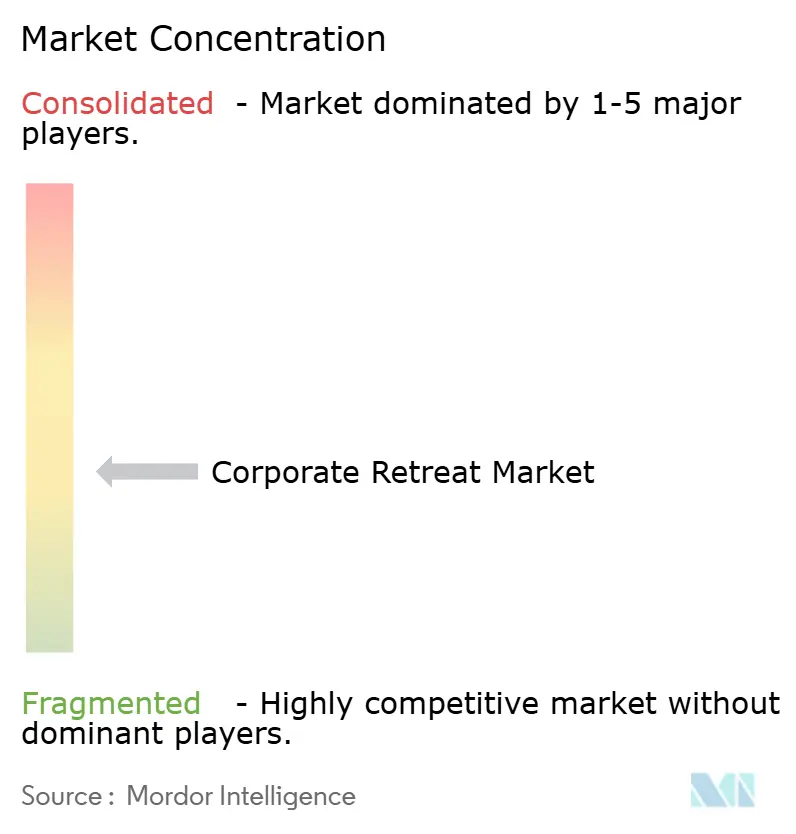
The Global Corporate Retreat Market is moderately fragmented, with the top five players - American Express Global Business Travel, BCD Travel, CWT, Maritz, and Flight Center Travel Group - accounting for a significant portion of identifiable managed spend. No single provider dominates all retreat categories, as demand is distributed among travel management companies, MICE specialists, venue operators, and digital event platforms. Success depends on service breadth, network strength, and execution reliability rather than scale alone. Large buyers prefer suppliers managing travel, meetings, policies, and reporting under one platform, while smaller buyers lean toward digital-first or boutique providers. Competition is shifting from basic sourcing to comprehensive offerings that include planning, experience design, analytics, and traveler support.
Consolidation is a key trend in the Global Corporate Retreat Market. Long Lake Management announced plans to acquire American Express Global Business Travel in an all-cash transaction, with the aim of integrating applied AI capabilities. Cvent completed its acquisition of ON24 after acquiring Goldcast, expanding its reach across in-person meetings, digital engagement, and AI-enabled workflows. Navan launched Navan Events and agreed to acquire Smartrips in Brazil, reflecting a strategy of product and geographic expansion. These developments indicate a shift toward a platform-driven market, where buyers prefer fewer vendors and greater control.
Technology is a critical factor in the Global Corporate Retreat Market, as buyers demand faster sourcing, clearer policy alignment, and improved post-event visibility. Navan’s AI tools simplify vendor coordination. Cvent’s investments and recognition for its software and event operations platform highlight its evolution. BCD Travel is enhancing workflows with payment integration and AI adoption. Competitive advantage increasingly depends on integrated execution, automation, and seamless connections between travel, event design, and reporting.
Corporate Retreat Industry Leaders
-
American Express Global Business Travel
-
ATPI Group
-
BCD Travel
-
Flight Centre Travel Group
-
Maritz
- *Disclaimer: Major Players sorted in no particular order
Recent Industry Developments
- June 2026: Navan launched Navan Events, a platform integrating venue sourcing, hotel RFPs, attendee registration, and AI-powered travel management. Available in the United States, the United Kingdom, and Europe, this launch positions Navan as a competitor in the corporate meetings and events market.
- June 2026: Navan signed an agreement to acquire Smartrips, a Brazilian travel management company. This marks its first acquisition as a public company and expands its presence in Latin America's corporate travel market.
- May 2026: Long Lake Management, backed by General Catalyst and Alpha Wave, agreed to acquire American Express Global Business Travel for USD 6.3 billion at USD 9.50 per share. The deal, expected to close in H2 2026, will take Amex GBT private. Shareholders holding 69% of shares support the transaction.
- March 2026: Cvent acquired ON24, an enterprise-grade webinar and digital engagement platform, for USD 400 million in cash, enhancing its AI-powered digital event capabilities. This follows its December 2025 acquisition of Goldcast, an AI-powered video content platform.
Global Corporate Retreat Market Report Scope
| Team Building Retreats |
| Leadership & Executive Retreats |
| Strategy & Planning Retreats |
| Employee Wellness Retreats |
| Incentive & Reward Retreats |
| Large Enterprises |
| Mid-Sized Enterprises |
| Small Enterprises |
| Information Technology and Telecom |
| BFSI |
| Healthcare and Life Sciences |
| Manufacturing & Industrial |
| Other Industries |
| Direct Booking |
| Corporate Travel Management Companies (TMCs) |
| Event Management & Retreat Organizers |
| Online Booking Platforms |
| North America | United States |
| Canada | |
| Mexico | |
| South America | Brazil |
| Peru | |
| Chile | |
| Argentina | |
| Rest of South America | |
| Europe | United Kingdom |
| Germany | |
| France | |
| Spain | |
| Italy | |
| BENELUX (Belgium, Netherlands, and Luxembourg) | |
| NORDICS (Denmark, Finland, Iceland, Norway, and Sweden) | |
| Rest of Europe | |
| Asia-Pacific | India |
| China | |
| Japan | |
| Australia | |
| South Korea | |
| South East Asia (Singapore, Malaysia, Thailand, Indonesia, Vietnam, and Philippines) | |
| Rest of Asia-Pacific | |
| Middle East and Africa | United Arab Emirates |
| Saudi Arabia | |
| South Africa | |
| Nigeria | |
| Rest of Middle East and Africa |
| By Retreat Type | Team Building Retreats | |
| Leadership & Executive Retreats | ||
| Strategy & Planning Retreats | ||
| Employee Wellness Retreats | ||
| Incentive & Reward Retreats | ||
| By Enterprise Size | Large Enterprises | |
| Mid-Sized Enterprises | ||
| Small Enterprises | ||
| By End User Industry | Information Technology and Telecom | |
| BFSI | ||
| Healthcare and Life Sciences | ||
| Manufacturing & Industrial | ||
| Other Industries | ||
| By Booking Channel | Direct Booking | |
| Corporate Travel Management Companies (TMCs) | ||
| Event Management & Retreat Organizers | ||
| Online Booking Platforms | ||
| By Geography | North America | United States |
| Canada | ||
| Mexico | ||
| South America | Brazil | |
| Peru | ||
| Chile | ||
| Argentina | ||
| Rest of South America | ||
| Europe | United Kingdom | |
| Germany | ||
| France | ||
| Spain | ||
| Italy | ||
| BENELUX (Belgium, Netherlands, and Luxembourg) | ||
| NORDICS (Denmark, Finland, Iceland, Norway, and Sweden) | ||
| Rest of Europe | ||
| Asia-Pacific | India | |
| China | ||
| Japan | ||
| Australia | ||
| South Korea | ||
| South East Asia (Singapore, Malaysia, Thailand, Indonesia, Vietnam, and Philippines) | ||
| Rest of Asia-Pacific | ||
| Middle East and Africa | United Arab Emirates | |
| Saudi Arabia | ||
| South Africa | ||
| Nigeria | ||
| Rest of Middle East and Africa | ||
Key Questions Answered in the Report
What is the size outlook for the Global Corporate Retreat Market through 2031?
The Global Corporate Retreat Market was valued at USD 24.01 billion in 2025, rose to USD 25.32 billion in 2026, and is forecast to reach USD 36.72 billion by 2031 at a 7.71% CAGR.
What is driving demand for corporate retreats globally?
Demand is supported by higher offsite budgets, greater use of retreats for leadership alignment, wider adoption of hybrid work, and rising employer spending on mental health and wellbeing programs.
Which type of retreat leads to revenue, and which one is growing the fastest?
Team Building Retreats led with 32.82% share in 2025, while Employee Wellness Retreats are projected to grow the fastest at an 8.93% CAGR through 2031.
Which company size segment is expanding the fastest?
Large Enterprises remained the largest segment with 48.53% share in 2025, but Mid-Sized Enterprises are growing faster with an 8.34% CAGR through 2031.
Which region shows the strongest growth potential?
North America led with 34.76% share in 2025, while Asia-Pacific is the fastest-growing region with an 8.64% CAGR through 2031.
How concentrated is the competitive landscape?
The space remains fragmented, with the top 5 players accounting for 35% to 45% of identifiable managed spend, which supports a market concentration score of 3 out of 10.