
Corporate Leadership Training Market Size and Share
Market Overview
| Study Period | 2021 - 2031 |
|---|---|
| Market Size (2026) | USD 39.73 Billion |
| Market Size (2031) | USD 57.64 Billion |
| Growth Rate (2026 - 2031) | 7.73 % |
| Fastest Growing Market | Asia-Pacific |
| Largest Market | North America |
| Market Concentration | Low |
Major Players *Disclaimer: Major Players sorted in no particular order Image © Mordor Intelligence. Reuse requires attribution under CC BY 4.0. | |
Corporate Leadership Training Market Analysis by Mordor Intelligence
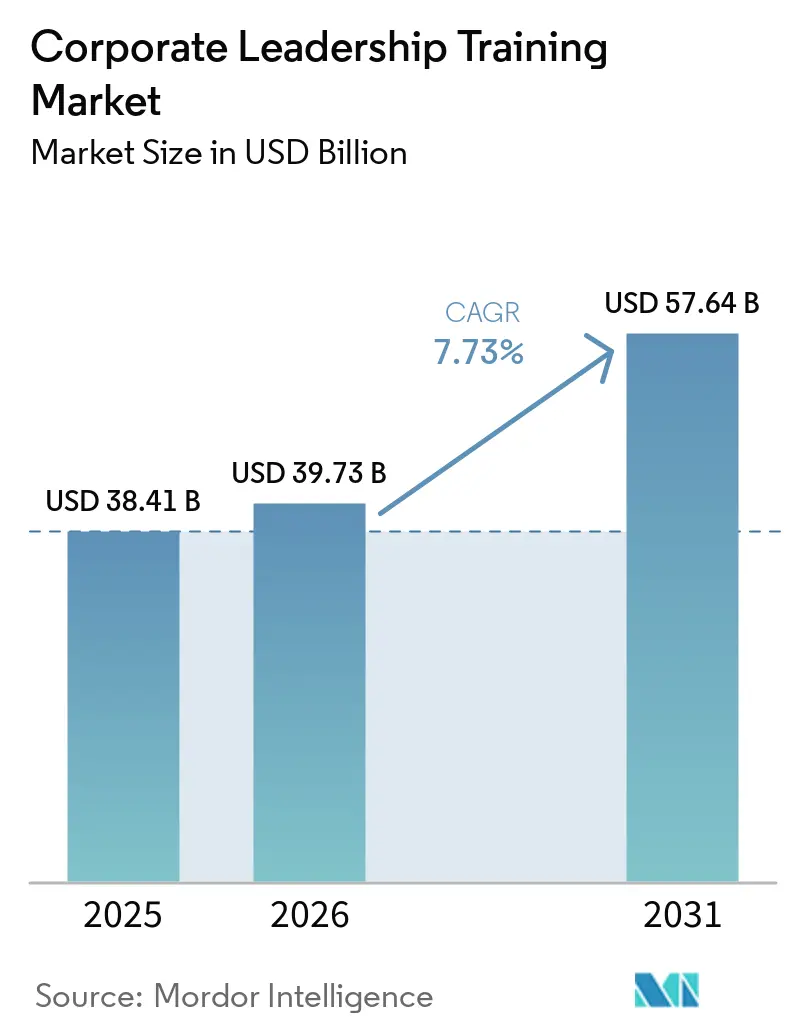
The Global Corporate Leadership Training Market is expected to grow from USD 38.41 billion in 2025 to USD 39.73 billion in 2026 and is forecast to reach USD 57.64 billion by 2031 at 7.73% CAGR over 2026-2031. The market is transitioning from periodic cohort programs to continuous capability building focused on daily execution. Management and supervisory training remained the top funding priority for the 13th consecutive year in 2026, reflecting its perceived impact on business performance[1]. Demand is driven by AI adoption, succession risks, and hybrid leadership gaps, making leadership development increasingly critical. In Europe, compliance-driven spending is rising as AI literacy mandates shift training budgets from optional to mandatory. The competitive landscape remains fragmented, with the top five providers holding a combined 35% market share in 2025. This fragmentation creates opportunities for regional specialists, digital coaching platforms, and consulting-backed learning providers to compete across various delivery models and buyer segments.
Key Report Takeaways
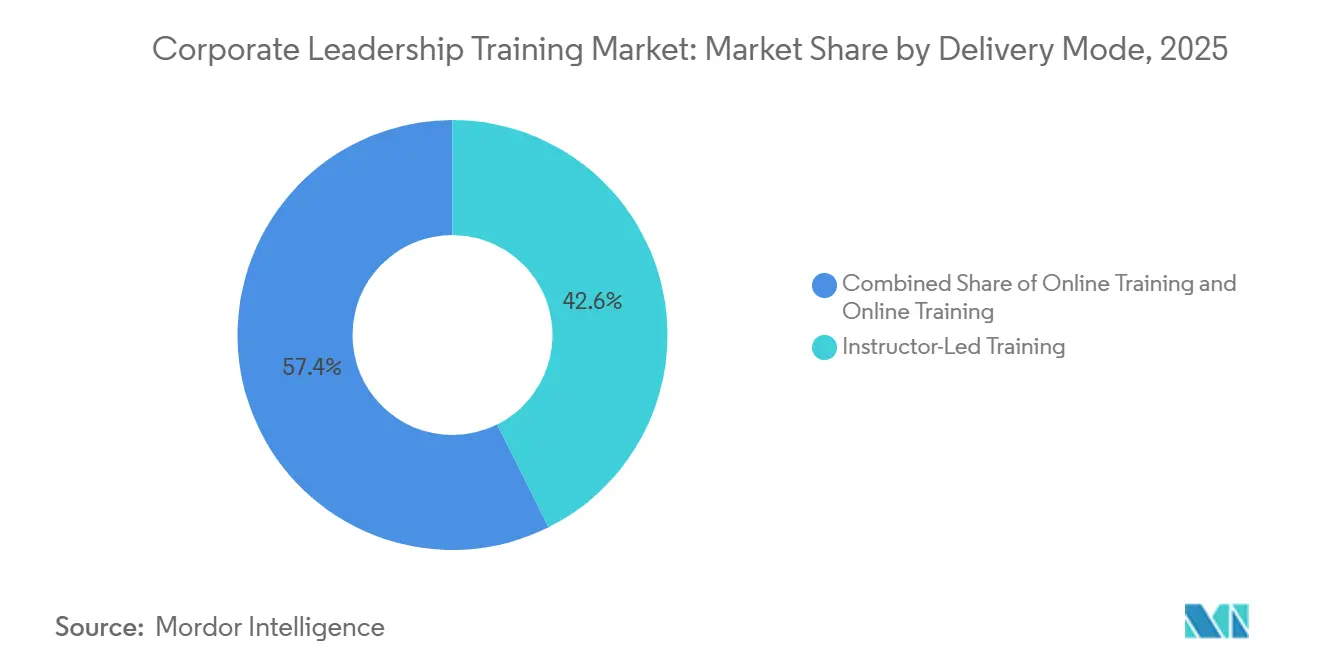
- By delivery mode, Instructor-Led Training held a 42.63% share of the Global Corporate Leadership Training Market in 2025, while Online Training is projected to expand at a 7.94% CAGR through 2031.
- By leadership level, Mid-Level Leadership accounted for a 44.81% share of the Global Corporate Leadership Training Market in 2025, while Emerging Leadership is expected to expand at an 8.06% CAGR through 2031.
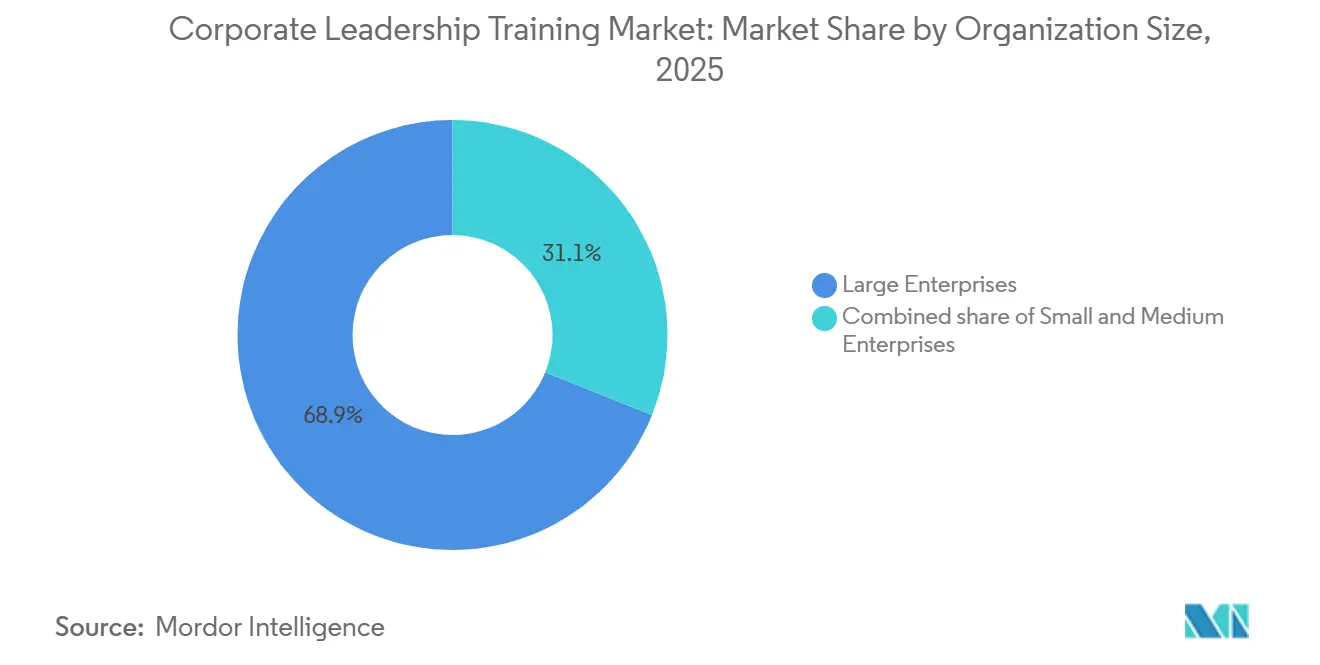
- By organization size, Large Enterprises represented a 68.94% share of the Global Corporate Leadership Training Market in 2025, while SMEs are projected to advance at a 9.46% CAGR through 2031.
- By industry vertical, BFSI held an 18.53% share of the Global Corporate Leadership Training Market in 2025, while IT & Telecom is expected to grow at a 9.83% CAGR through 2031.
- By geography, North America held 36.87% share of the Global Corporate Leadership Training Market in 2025, while Asia-Pacific is projected to expand at a 9.83% CAGR through 2031.
Note: Market size and forecast figures in this report are generated using Mordor Intelligence’s proprietary estimation framework, updated with the latest available data and insights as of January 2026.
Global Corporate Leadership Training Market Trends and Insights
Drivers Impact Analysis*
| Drivers | (~) % Impact on CAGR Forecast | Geographic Relevance | Impact Timeline |
|---|---|---|---|
| Hybrid and distributed team leadership gaps | +1.4% | Global, with highest intensity in North America and Northern Europe | Short term (≤ 2 years) |
| Succession-pipeline rebuilding across manager layers | +1.2% | Global, concentrated in North America, Europe, and Japan | Medium term (2-4 years) |
| AI transformation requires people-leader upskilling | +1.8% | Global, with early gains in North America, Asia-Pacific tech hubs, and the European Union | Short term (≤ 2 years) |
| Shift toward personalized and measurable learning journeys | +1.0% | North America and the European Union, with spillover to core Asia-Pacific markets | Medium term (2-4 years) |
| Leaner organizations widen manager span of control | +0.9% | Global, with strongest effect in post restructuring markets such as the United States, the United Kingdom, and Germany | Medium term (2-4 years) |
| Return-to-office policy friction raises manager judgment needs | +0.6% | North America and the European Union, with early gains in Asia-Pacific gateway cities | Short term (≤ 2 years) |
| Source: Mordor Intelligence | |||
Hybrid and distributed team leadership gaps
Hybrid work has exposed a significant training gap for frontline and mid-level managers in the corporate leadership training market. Only 25% of managers have received training in leading teams, reflecting slow adaptation to new work patterns. A 2025 study highlighted the need for managers to combine technological knowledge, soft skills, and management expertise, emphasizing the demand for updated leadership curricula over narrow virtual team modules[2]. Gen Z employees advocate technology-enabled leadership and are more likely to leave employers whose leadership culture does not align with hybrid work expectations. Gallup identified a broader training shortfall, with only 10% of managers receiving mandatory hybrid leadership training. This reveals a substantial opportunity for targeted programs in the corporate leadership training market.
Succession-pipeline rebuilding across manager layers
Succession risk is a key driver in the corporate leadership training market as organizations face high turnover and cannot rely on informal promotion pipelines. 56% of companies lacked a structured succession strategy, exposing a significant readiness gap for critical roles[3]. Only 20% of CHROs had leaders prepared to fill essential business positions, highlighting weak bench strength across organizations. Succession planning has emerged as a top concern for most HR leaders, reflecting its growing strategic importance. As a result, training budgets are increasingly tied to measurable readiness outcomes rather than general leadership development. Providers that can accelerate leadership readiness for director and vice president successors are well positioned to secure longer-term contracts and expanded mandates in the corporate leadership training market.
AI transformation requires people-leader upskilling
AI adoption is increasing demand in the corporate leadership training market as managers handle both personnel and AI-enabled workflows. Over half of organizations (55%) are incorporating generative AI and machine learning into leadership programs, integrating AI into mainstream training. The European Union AI Act, under Article 4, will enforce AI literacy requirements starting August 2026, driving compliance training across European operations. A 2026 findings indicate that organizations embedding AI strategies into HR and learning functions are 54% more effective. This highlights the need to integrate AI leadership training into broader managerial development rather than treating it as a standalone technical area.
Shift toward personalized and measurable learning journeys
The corporate leadership training market is transitioning from uniform open enrollment models to personalized learning journeys. Organizations using personalized workforce learning approaches were nearly three times more likely to achieve better business and human outcomes in 2026. However, only 8% of organizations rated themselves as highly effective in meeting continuous learning needs. This gap benefits providers focusing on competency, retention, and decision-making quality over course completion rates. A 2025 Study revealed that 62% of organizations still relied on employee surveys to measure leadership effectiveness, highlighting the limitations of current systems. As buyers demand clearer value proof, the market is experiencing increased demand for subscriptions, assessments, AI-driven coaching, and integrated business impact tracking within learning processes.
Restraints Impact Analysis*
| Restraints | (~) % Impact on CAGR Forecast | Geographic Relevance | Impact Timeline |
|---|---|---|---|
| ROI attribution remains difficult for soft-skill programs | -0.5% | Global, most acute in North America and Europe where CFO scrutiny is highest | Medium term (2-4 years) |
| High program cost and time-away-from-work burden | -0.4% | Global, most limiting for SMEs and organizations with lean manager spans | Short term (≤ 2 years) |
| Privacy and works-council friction around AI-led diagnostics | -0.3% | The European Union and the United Kingdom, with spillover to global firms that employ European workforces | Medium term (2-4 years) |
| Self-paced content fatigue weakens behavior transfer | -0.3% | Global, with the strongest effect in markets with high e learning penetration | Long term (≥ 4 years) |
| Source: Mordor Intelligence | |||
ROI attribution remains difficult for soft-skill programs
Linking leadership behavior changes to financial outcomes remains a key challenge in the corporate leadership training market. AI-driven cost pressures and tighter budgets have increased scrutiny on HR teams to justify learning investments. While 62% of organizations use employee surveys to measure leadership effectiveness, these fail to meet finance teams’ need for operational or commercial evidence. Many companies do not track financial KPIs for learning initiatives, exposing gaps in measurement infrastructure compared to content innovation[4]. Although advancements in analytics are expected to gradually address this issue, budget growth for enterprise buyers continues to face restrictions in this market.
High program cost and time-away-from-work burden
Cost remains a major challenge in the corporate leadership training market. Instructor-led formats often require travel, facilitator time, and employee hours away from work. Large enterprises manage these costs more easily due to larger budgets and flexibility for multi-cohort programs. United States organizations spent USD 102.8 billion on training in 2025, with large companies averaging USD 11.7 million annually, highlighting their scale advantage. Smaller buyers, lacking such resources, have historically underinvested in leadership development. However, lower-cost subscription models are now improving access. The market is experiencing faster digital adoption among smaller buyers, as flexible delivery reduces direct costs and minimizes lost managerial time.
*Our forecasts treat driver/restraint impacts as directional, not additive. The impact forecasts reflect baseline growth, mix effects, and variable interactions.
Segment Analysis
By Delivery Mode: Digital Personalization Reshapes the Blended Core
Instructor-Led Training (ILT) held a 42.63% share of the corporate leadership training market in 2025. This reflects the ongoing demand for trust-based, cohort-focused experiences at senior and executive levels, where feedback and accountability outweigh convenience. Only 26% of leaders rated their development programs as high quality, explaining why organizations continue to invest in facilitated experiences instead of fully adopting lower-cost digital modules. The corporate leadership training market continues to value live facilitation for programs targeting senior decision-makers or high-potential successors, as ILT remains effective in enabling deeper behavioral change and stronger peer interaction.
Online Training is projected to grow at a 7.94% CAGR through 2031, driven by the increasing importance of scalability and flexibility. Skillsoft reported a 341% year-over-year increase in engagement with its CAISY simulator in fiscal 2026, with the tool available in over 40 languages, demonstrating the effectiveness and localization capabilities of AI-enabled online formats. Organizations are increasingly adopting blended delivery models that combine classroom learning, virtual instructor-led sessions, job aids, and coaching, reinforcing the continued role of hybrid learning over full digital substitution. Buyers in regulated sectors are focusing on auditable designs and service quality, enabling structured online programs to expand without replacing live formats. ILT retains its position, while online and blended formats continue to grow among first-line managers and emerging leaders.
By Leadership Level: Mid-Level Incumbents Drive Revenue, Emerging Leaders Drive Growth
Mid-Level Leadership held 44.81% of the corporate leadership training market share in 2025, making it the largest segment. This group bridges strategy and execution, translating plans into daily operations while managing changes from senior leaders and frontline teams. 73% of organizations recognize the need to redefine the manager’s role, but only a small share have made significant progress, highlighting strong unmet demand. Programs for mid-level managers focused on coaching, delegation, and execution continue to generate substantial revenue, while executive leadership programs, though smaller in participant numbers, contribute significantly due to higher per-participant pricing.
Emerging Leadership is the fastest-growing segment, with an 8.06% CAGR projected through 2031, reflecting a broader expansion of leadership development across all employee levels. This shift is driven by increasing emphasis on early-career leadership pipelines and structured development pathways before employees’ step into management roles. It also aligns with retention strategies, as younger employees prioritize clarity in growth opportunities. However, only 35% of frontline leaders report finding their roles purposeful, indicating that skill development alone may not be sufficient to retain talent. Providers that integrate skills development with purpose-building and career clarity are better positioned to gain share in this segment of the corporate leadership training market.
By Organization Size: Large Enterprises Anchor, SMEs Accelerate
Large enterprises accounted for 68.94% of the corporate leadership training market in 2025 due to their larger budgets, centralized procurement, and ability to secure multi-year agreements. These organizations invest in custom content, manage time away from work, and implement diverse delivery models across regions and leadership levels. United States organizations spent USD 102.8 billion on training in 2025, reflecting a 4.9% increase from the previous year.. Large companies averaged USD 11.7 million in spending, reflecting their scale advantage. Although this figure declined from the USD 13.3 million average in 2024, budgets remained sufficient to support extensive programs and deployments. The market relies on large enterprises for revenue stability, as they fund comprehensive learning journeys rather than isolated courses.
SMEs are growing at a 9.46% CAGR through 2031, driven by affordable delivery methods that reduce access barriers. Growth stems from improved product design, subscription pricing, and AI-supported coaching that scale without heavy in-person delivery. BetterUp introduced AI Coaching in January 2025, combining evidence-based AI with scalable human coaching to address affordability and customization challenges for smaller organizations. Vendors are increasingly offering enterprise-grade leadership support in modular, seat-based formats, enabling smaller companies to adopt digital-first approaches instead of traditional consulting. While SMEs grow faster than the overall market, their revenue base remains smaller than that of large enterprises.
By Industry Vertical: BFSI Leads by Spend, Technology Accelerates by Urgency
The BFSI sector held an 18.53% share of the corporate leadership training market in 2025, driven by strict governance requirements, structured management hierarchies, and consistent demand for risk-aware leadership in regulated teams. Leadership training in BFSI is critical as supervisory quality impacts compliance, customer trust, and operational control. This ensures steady demand even when budgets tighten, making BFSI a reliable source of formalized demand in the market.
IT and Telecom is the fastest-growing sector, with a 9.83% CAGR through 2031, fueled by rapid scaling, quick promotions, and the need to develop technical specialists into leaders. The sector also faces pressure to build AI-ready leadership while maintaining execution speed, increasing the importance of structured management training. Healthcare and Life Sciences are key growth areas as organizations adapt to post-pandemic changes and digital integration. Manufacturing remains significant for frontline leadership training. In July 2025, NIIT Learning Systems announced its acquisition of MST Group to enhance managed learning capabilities in Germany’s industrial and automotive sectors. Public sector demand is rising as governments prioritize AI readiness, governance, and leadership development in public workforces, expanding the market beyond traditional private sector buyers.
Geography Analysis
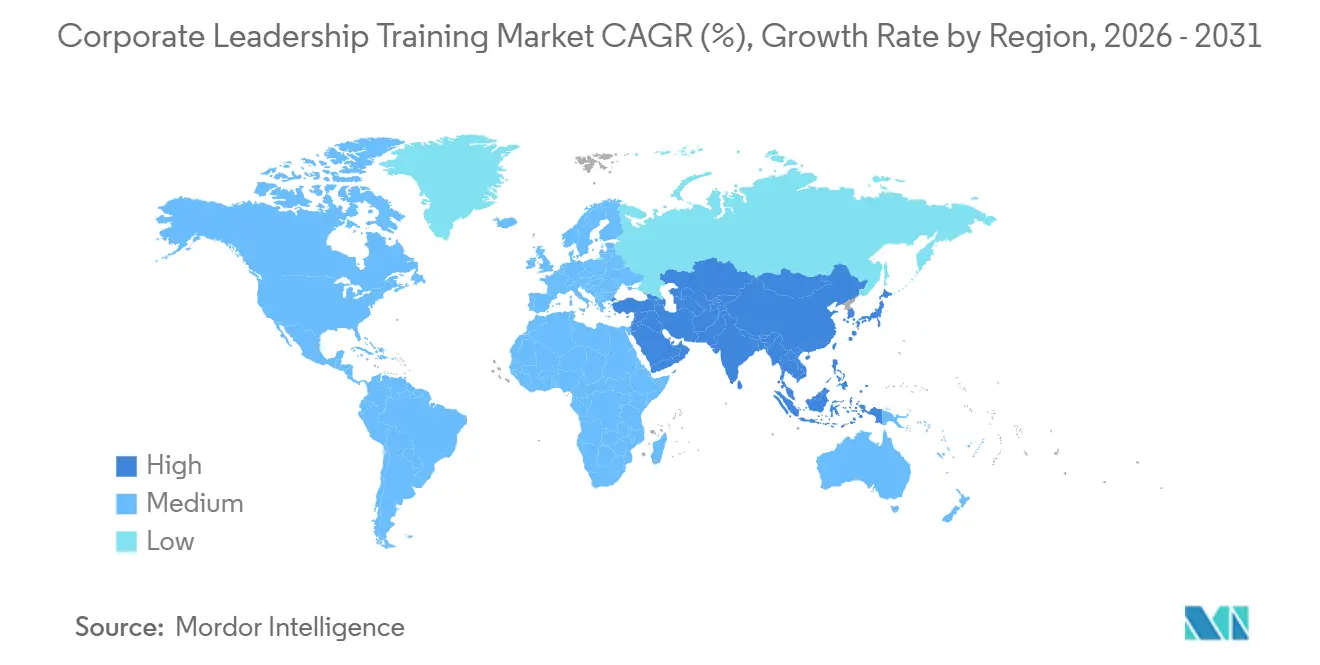
North America accounted for 36.87% of the corporate leadership training market share in 2025, maintaining its leading revenue position. The United States drove this dominance with its extensive corporate training base, mature external provider ecosystem, and established enterprise learning functions. The United States organizations spent USD 102.8 billion on training in 2025, with spending on external products and services rising 29% to USD 16 billion, reflecting increased reliance on third-party providers. Nearly 25% of organizations expanded their talent development staff in 2025, alongside broader adoption of diverse delivery methods. Canada and Mexico contributed through multinational program spillovers and local succession planning investments, though ROI scrutiny remains a key challenge.
Asia-Pacific is the fastest-growing region in the corporate leadership training market, with a projected CAGR of 9.83% through 2031. Growth is driven by large emerging leader populations, enterprise digitization, and increased investment in management training across India, China, Japan, and Southeast Asia. Over 5,000 participants from 90+ client companies across 30+ countries engaged with HR development services in FY2025, alongside the launch of new English-language leadership programs in 2026. Additionally, an MOU signed with the Confederation of Indian Industry in May 2026 aims to advance AI governance and digital leadership training in India, strengthening program delivery infrastructure. These developments position Asia-Pacific for faster growth compared to Western markets.
Europe’s corporate leadership training market is shaped by regulatory pressures and compliance-driven learning demand. The European Union AI Act has increased the need for AI literacy and responsible use training, adding a compliance layer to budgets. Germany and the United Kingodm are the largest markets, though Germany’s co-determination framework slows AI-based diagnostics adoption while favoring providers with strong compliance documentation. NIIT Learning Systems acquired Germany-based MST Group in July 2025 for EUR 22.37 million (USD 24.1 million), signaling confidence in the DACH region. The Middle East and Africa, though smaller in revenue, are gaining importance due to national talent development agendas and sovereign-backed initiatives.
Competitive Landscape
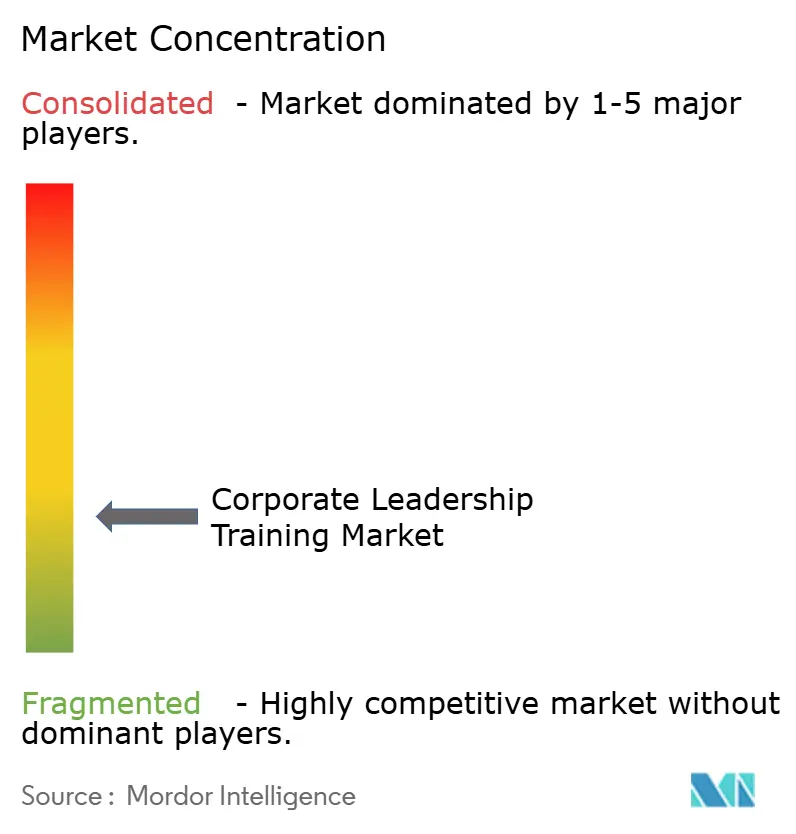
The corporate leadership training market remains fragmented, with the top providers accounting for a limited share of total revenue. Dale Carnegie & Associates, FranklinCovey, Korn Ferry, Center for Creative Leadership, and Skillsoft collectively hold a small portion, leaving significant demand for regional specialists, digital coaching platforms, academic affiliates, and consulting-linked providers. Korn Ferry introduced the Korn Ferry Talent Suite in early 2026, an AI-powered SaaS platform integrating its people science assets to enhance subscription revenue and reduce reliance on project-based work. Skillsoft reported substantial growth in AI adoption within enterprise learning, with notable increases in AI benchmark completions and simulator launches during fiscal 2026.
Competition is intensifying around sector-specific curricula and AI-driven assessments. FranklinCovey observed a shift in buyer demand toward leadership content that combines execution discipline, trust, and adaptability during AI-driven transformations. Pearson and Deloitte announced a strategic alliance in early 2026 to develop comprehensive solutions for talent, leadership, and workforce development, signaling increased competition among consulting firms and learning IP providers. Enterprise buyers are applying stricter quality standards, including service design and coaching credentials, making it challenging for low-cost providers to compete solely on price. Unlike other HR technology sectors, the market is not consolidating rapidly under a few dominant players.
Smaller challengers continue to disrupt the market with scalable delivery models. CoachHub secured significant growth financing in late 2024 to expand AI investments and product offerings, reflecting investor confidence in digital coaching platforms. BetterUp launched AI Coaching in early 2025, transitioning from a human-only coaching model to a hybrid approach. All companies mentioned remain relevant in leadership development, coaching, and enterprise learning. While emerging names like Cornerstone OnDemand and Pearson Enterprise Learning & Skills gain visibility, the market continues to support a diverse range of providers rather than consolidating into a winner-takes-most structure.
Corporate Leadership Training Industry Leaders
-
Dale Carnegie & Associates
-
FranklinCovey
-
Korn Ferry
-
Center for Creative Leadership
-
Skillsoft
- *Disclaimer: Major Players sorted in no particular order
Recent Industry Developments
- May 2026: Skillsoft launched its Leadership Development Refresh (SLDP) on the Percipio Platform, featuring 12 modules based on an Excellence Framework developed with 11 experts. The update includes a modernized UX and supports over 95 million learners, including 60% of Fortune 1000 companies.
- May 2026: NUS-ISS (National University of Singapore's Institute of Systems Science) signed an MOU with the Confederation of Indian Industry (CII) at the CII Annual Business Summit 2026 in New Delhi to promote AI governance and digital leadership training in India, with biannual programs planned through 2028.
- April 2026: GLOBIS Corporation launched its first English-language Visionary Leadership Program in Japan for global executives. By FY2025, it aims to deliver leadership development programs to over 5,000 participants from 90+ client companies across 30+ countries.
- February 2026: Pearson and Deloitte formed a strategic alliance to develop and deliver integrated talent, leadership, and workforce development solutions for global enterprises and governments, combining Pearson's learning expertise with Deloitte's consulting capabilities and client network.
Global Corporate Leadership Training Market Report Scope
| Online Training |
| Instructor-Led Training |
| Blended Training |
| Emerging Leadership |
| Mid-Level Leadership |
| Executive Leadership |
| Large Enterprises |
| Small and Medium Enterprises |
| Information Technology and Telecom |
| BFSI |
| Healthcare and Life Sciences |
| Manufacturing |
| Retail and E-commerce |
| Professional Services |
| Energy and Utilities |
| Public Sector and Government-Linked Enterprises |
| North America | United States |
| Canada | |
| Mexico | |
| South America | Brazil |
| Peru | |
| Chile | |
| Argentina | |
| Rest of South America | |
| Europe | United Kingdom |
| Germany | |
| France | |
| Spain | |
| Italy | |
| BENELUX (Belgium, Netherlands, and Luxembourg) | |
| NORDICS (Denmark, Finland, Iceland, Norway, and Sweden) | |
| Rest of Europe | |
| Asia-Pacific | India |
| China | |
| Japan | |
| Australia | |
| South Korea | |
| South East Asia (Singapore, Malaysia, Thailand, Indonesia, Vietnam, and Philippines) | |
| Rest of Asia-Pacific | |
| Middle East and Africa | United Arab Emirates |
| Saudi Arabia | |
| South Africa | |
| Nigeria | |
| Rest of Middle East and Africa |
| By Delivery Mode | Online Training | |
| Instructor-Led Training | ||
| Blended Training | ||
| By Leadership Level | Emerging Leadership | |
| Mid-Level Leadership | ||
| Executive Leadership | ||
| By Organization Size | Large Enterprises | |
| Small and Medium Enterprises | ||
| By Industry Vertical | Information Technology and Telecom | |
| BFSI | ||
| Healthcare and Life Sciences | ||
| Manufacturing | ||
| Retail and E-commerce | ||
| Professional Services | ||
| Energy and Utilities | ||
| Public Sector and Government-Linked Enterprises | ||
| By Geography | North America | United States |
| Canada | ||
| Mexico | ||
| South America | Brazil | |
| Peru | ||
| Chile | ||
| Argentina | ||
| Rest of South America | ||
| Europe | United Kingdom | |
| Germany | ||
| France | ||
| Spain | ||
| Italy | ||
| BENELUX (Belgium, Netherlands, and Luxembourg) | ||
| NORDICS (Denmark, Finland, Iceland, Norway, and Sweden) | ||
| Rest of Europe | ||
| Asia-Pacific | India | |
| China | ||
| Japan | ||
| Australia | ||
| South Korea | ||
| South East Asia (Singapore, Malaysia, Thailand, Indonesia, Vietnam, and Philippines) | ||
| Rest of Asia-Pacific | ||
| Middle East and Africa | United Arab Emirates | |
| Saudi Arabia | ||
| South Africa | ||
| Nigeria | ||
| Rest of Middle East and Africa | ||
Key Questions Answered in the Report
What is the projected value of the corporate leadership training market by 2031?
The corporate leadership training market is projected to reach USD 57.64 billion by 2031 from USD 39.73 billion in 2026, with a 7.73% CAGR over 2026 to 2031.
Which delivery format leads revenue and which one grows fastest?
Instructor-Led Training led with 42.63% share in 2025, while Online Training is projected to grow fastest at a 7.94% CAGR through 2031.
Why are companies increasing spending on leadership development now?
Spending is being supported by AI related manager upskilling, succession gaps, hybrid work capability shortages, and stronger pressure to show measurable leadership outcomes.
Which leadership level creates the most demand today?
Mid-Level Leadership generated the largest share at 44.81% in 2025 because these managers sit at the center of execution and organizational change.
Which buyer group is expanding fastest?
SMEs are growing fastest at a 9.46% CAGR through 2031 as digital platforms and AI coaching lower the cost and delivery barriers that once limited adoption.
Which region is expanding the quickest?
Asia-Pacific is projected to grow fastest at a 9.83% CAGR through 2031, supported by rising talent investment, larger emerging leader pools, and stronger institutional partnerships across the region.