
Consumer Stationery Retailing Market Size and Share
Market Overview
| Study Period | 2022 - 2032 |
|---|---|
| Market Size (2027) | USD 64.41 Billion |
| Market Size (2032) | USD 76.92 Billion |
| Growth Rate (2027 - 2032) | 3.61 % |
| Fastest Growing Market | Asia-Pacific |
| Largest Market | Asia-Pacific |
| Market Concentration | High |
Major Players *Disclaimer: Major Players sorted in no particular order Image © Mordor Intelligence. Reuse requires attribution under CC BY 4.0. | |
Consumer Stationery Retailing Market Analysis by Mordor Intelligence
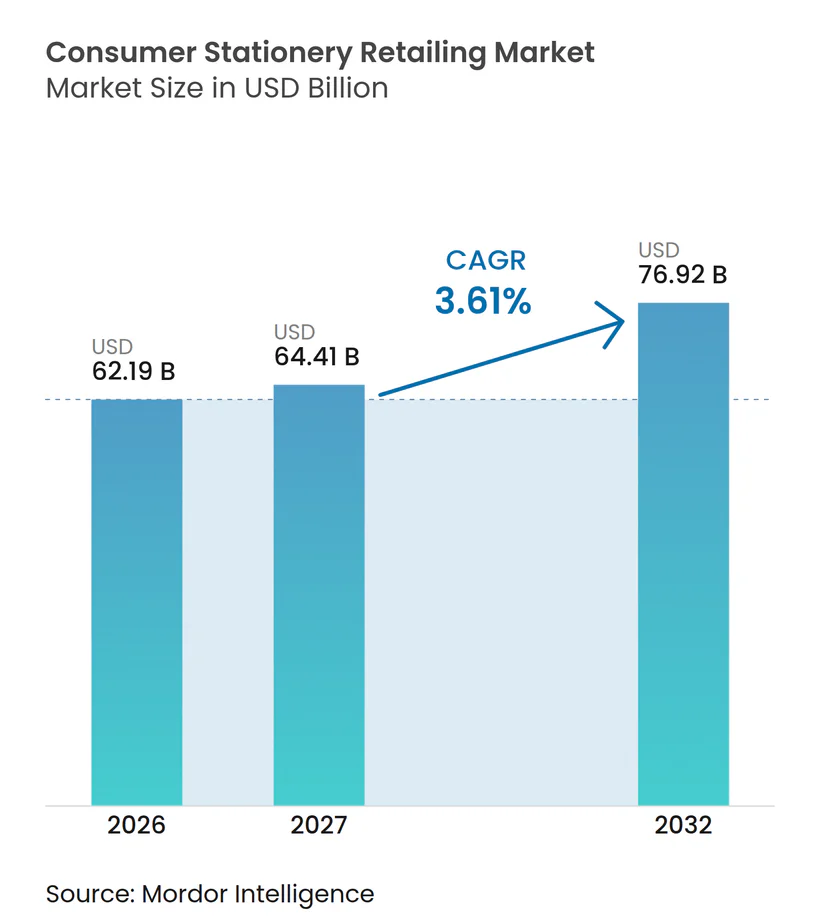
The global consumer stationery retailing market size was valued at USD 62.19 billion in 2026 and is estimated to grow from USD 64.41 billion in 2027 to reach USD 76.92 billion by 2032, at a CAGR of 3.61% during the forecast period (2027-2032). Recurring school-related purchases support demand, particularly in countries with large student populations and established academic calendars. The category reflects a divide between value-driven purchases of basic supplies and higher-value purchases of writing, planning, gifting, and creative products. Retailers are expanding online ordering, smaller store formats, experiential retail concepts, and curated assortments. The global consumer stationery retailing market remains fragmented, with local operators, global marketplaces, and specialist chains competing on availability, pricing, product selection, and convenience.
Key Report Takeaways
- By product type, Paper Products accounted for 32.84% of the global consumer stationery retailing market share in 2026, while Art and Craft Supplies are projected to grow at a 4.85% CAGR through 2032.
- By distribution channel, Specialty Stationery Stores accounted for 30.61% of the global consumer stationery retailing market share in 2026, while Online Retail is projected to grow at a 6.45% CAGR through 2032.
- By store format, Small-Format Stores accounted for 46.91% of the global consumer stationery retailing market share in 2026, while Online-Only Retailers are projected to grow at a 6.12% CAGR through 2032.
- By geography, Asia-Pacific accounted for 36.62% of the global consumer stationery retailing market share in 2026 and is projected to grow at a 5.35% CAGR through 2032.
Note: Market numbers in this report are based on Mordor Intelligence's proprietary estimation framework, which combines nine months of actuals with Q4 projections for base year 2026.
Market Trends and Insights
Drivers Impact Analysis of Consumer Stationery Retailing Market*
| Driver | (~) % Impact on CAGR Forecast | Geographic Relevance | Impact Timeline |
|---|---|---|---|
| Omnichannel Stationery Purchasing and Marketplace Expansion | +0.8% | Global, with concentrated gains in North America, Asia-Pacific, and Western Europe | Medium term (2-4 years) |
| Private-Label and Value Retailer Penetration | +0.5% | North America, Western Europe, and Australia | Short term (≤ 2 years) |
| Back-to-School and Academic Calendar Demand Resilience | +0.7% | Global, with highest concentration in North America, South Asia, and Southeast Asia | Short term (≤ 2 years) |
| Premiumization of Writing, Planning, and Creative Products | +0.6% | East Asia, Western Europe, and North America | Medium term (2-4 years) |
| Digital Discovery Driving Offline and Online Conversion | +0.5% | Global, with highest relevance in the United States, United Kingdom, South Korea, and Australia | Medium term (2-4 years) |
| Localized Assortment and Small-Format Retail Expansion | +0.4% | Asia-Pacific, Middle East and Africa, and South America | Long term (≥ 4 years) |
| Source: Mordor Intelligence | |||
Omnichannel Stationery Purchasing and Marketplace Expansion
The global consumer stationery retailing market is increasingly adopting purchase journeys that integrate product search, comparison, fulfillment, and store visits. Australia Post reported that online spending on books, stationery, and multimedia reached AUD 2.5 billion (USD 1.68 billion) in 2025, up 24.1% from the previous year and accounting for 45% of category revenue[1]. The report also found that 19% of category purchases used same-day or next-day delivery. These expectations increase the importance of accurate inventory visibility, rapid fulfillment, and consistent pricing across channels. Physical stores remain important because they allow shoppers to assess paper quality, pen performance, color, and gifting suitability before purchasing.
Private-Label and Value Retailer Penetration
Private-label products strengthen the value proposition of mass retailers in the global consumer stationery retailing market. Retailers can sell basic pencils, pens, notebooks, folders, and composition books under their own labels because these items are familiar and frequently purchased. This trend increases pressure on national brands that rely on shelf visibility and higher pricing in commodity categories. Value retailers also use multipacks and seasonal bundles to simplify school-list shopping for households. As a result, the market shows a wider divide between price-sensitive staples and differentiated products, for which design, durability, refillability, or brand appeal can support higher prices.
Back-to-School and Academic Calendar Demand Resilience
Back-to-school remains the most predictable demand period in the global consumer stationery retailing market. In 2025, total back-to-school spending among K-12 households in the United States was projected to reach USD 39.4 billion, according to the National Retail Federation[2]. These households planned to spend an average of USD 143.77 on school supplies, contributing USD 6.6 billion to total K-12 school-supply spending. Earlier purchasing extended the selling season, making inventory availability critical well before schools reopened. In India, a similar seasonal pattern enabled retailers to align replenishment cycles, school-list bundles, and local-language assortments with state and private school admission schedules.
Premiumization of Writing, Planning, and Creative Products
Higher-value writing, planning, and creative products are expanding the addressable customer base of the global consumer stationery retailing market. Newell Brands Japan reported in 2025 that one in three surveyed consumers preferred higher-priced, longer-lasting products for everyday purchases. The survey identified luxury fountain pens and high-end ballpoint pens as aspirational purchases. This preference was particularly evident among consumers in their 20s and 30s, who associated tactile quality with personal use and self-expression. These trends support demand for journals, planners, art supplies, high-end pens, and gifting-oriented assortments. Indian retailers can address this opportunity by offering accessible entry-level products alongside clearly differentiated higher-end ranges, rather than positioning all stationery products as low-priced items.
Restraints Impact Analysis of Consumer Stationery Retailing Market*
| Restraint | (~) % Impact on CAGR Forecast | Geographic Relevance | Impact Timeline |
|---|---|---|---|
| Digitization Reducing Demand for Routine Paper-Based Products | -0.9% | North America, Western Europe, Japan, and South Korea | Long term (≥ 4 years) |
| Low Unit Prices and Margin Pressure in Mass-Market Stationery | -0.6% | Global, with concentration in mature markets | Short term (≤ 2 years) |
| Seasonality and Inventory Risk Around Back-to-School Peaks | -0.3% | North America, Western Europe, and South America | Short term (≤ 2 years) |
| Raw Material, Freight, and Packaging Cost Volatility | -0.4% | Global | Medium term (2-4 years) |
| Source: Mordor Intelligence | |||
Digitization Reducing Demand for Routine Paper-Based Products
Digitization remains a long-term restraint on demand for routine paper-based products in the global consumer stationery retailing market. Schools, offices, and households increasingly use digital systems for filing, copying, note sharing, and standard documentation. This shift most affects standard paper, filing products, ring binders, and basic presentation supplies. However, demand remains more resilient for products that provide tactile, creative, personal, or educational value that digital tools cannot fully replace. Retailers can reduce exposure by emphasizing expressive writing products, art supplies, planners, school essentials, and reusable products.
Low Unit Prices and Margin Pressure in Mass-Market Stationery
Low unit prices constrain mass-market stationery retailers’ ability to absorb higher operating costs. Consumers often compare prices for basic items across physical stores, online marketplaces, and value chains. Private-label expansion intensifies this pressure, as retailers can prioritize products with more favorable margins. This challenge is particularly acute for independent retailers that offer broad assortments of basic products but lack the purchasing scale of national chains. To protect profitability, store operators need to balance school-list essentials with higher-margin creative products, gifting items, and carefully selected higher-value ranges.
*Our forecasts treat driver/restraint impacts as directional, not additive. The impact forecasts reflect baseline growth, mix effects, and variable interactions.
Consumer Behavior Analysis
Price sensitivity and selective trading influence stationery purchases. In 2025, 51% of United States K-12 families began school shopping earlier because of potential tariff-driven price increases, according to the National Retail Federation. Retailers can offer affordable essentials alongside branded pens, journals, and art supplies to address budget constraints and demand for quality and gifting products.
Australia’s online books, stationery, and multimedia category grew 24.1% in 2025, reflecting the growing role of digital discovery and purchasing, according to Australia Post. Physical stores remained important for assessing paper texture, pen performance, and product colors. Online inventory visibility, convenient fulfillment, and in-store product evaluation can support these complementary preferences.
Australian online spending in the category averaged AUD 48.32 (USD 32.38) per basket in 2025. Gen Z spending rose 50.9% to AUD 474 million (USD 317.65 million), according to Australia Post. These trends support replenishment campaigns and year-round collections across school supplies, exam preparation, creative hobbies, and gifting, reducing reliance on back-to-school demand.
Retail Sales and Store Performance
Retail performance depends on sales productivity, repeat purchases, and assortment differentiation. MINISO Group reported 28.2% revenue growth to CNY 5.80 billion (USD 0.83 billion) for the quarter ended in September 2025. Same-store GMV grew at a mid-single-digit rate, and gross margin reached 44.7%. The difference between overall revenue and same-store growth indicates that expansion supported performance alongside existing-store growth. For stationery retailers, combining essential paper products with art supplies, planners, and creative kits can increase basket sizes. Seasonal promotions and online product discovery can encourage repeat purchases.
Store economics depend on sales growth exceeding the costs of physical locations. MINISO’s directly operated store revenue rose 69.9% year over year in September 2025, while rental, depreciation, and payroll expenses increased 40.7%. These figures suggest improved operating leverage across its directly operated store network. Compact outlets, shop-in-shop formats, and store-fulfilled online orders can help stationery retailers manage space costs where low-priced essential products generate limited revenue per transaction.
Consumer Stationery Retailing Market Segment Analysis
By Product Type:
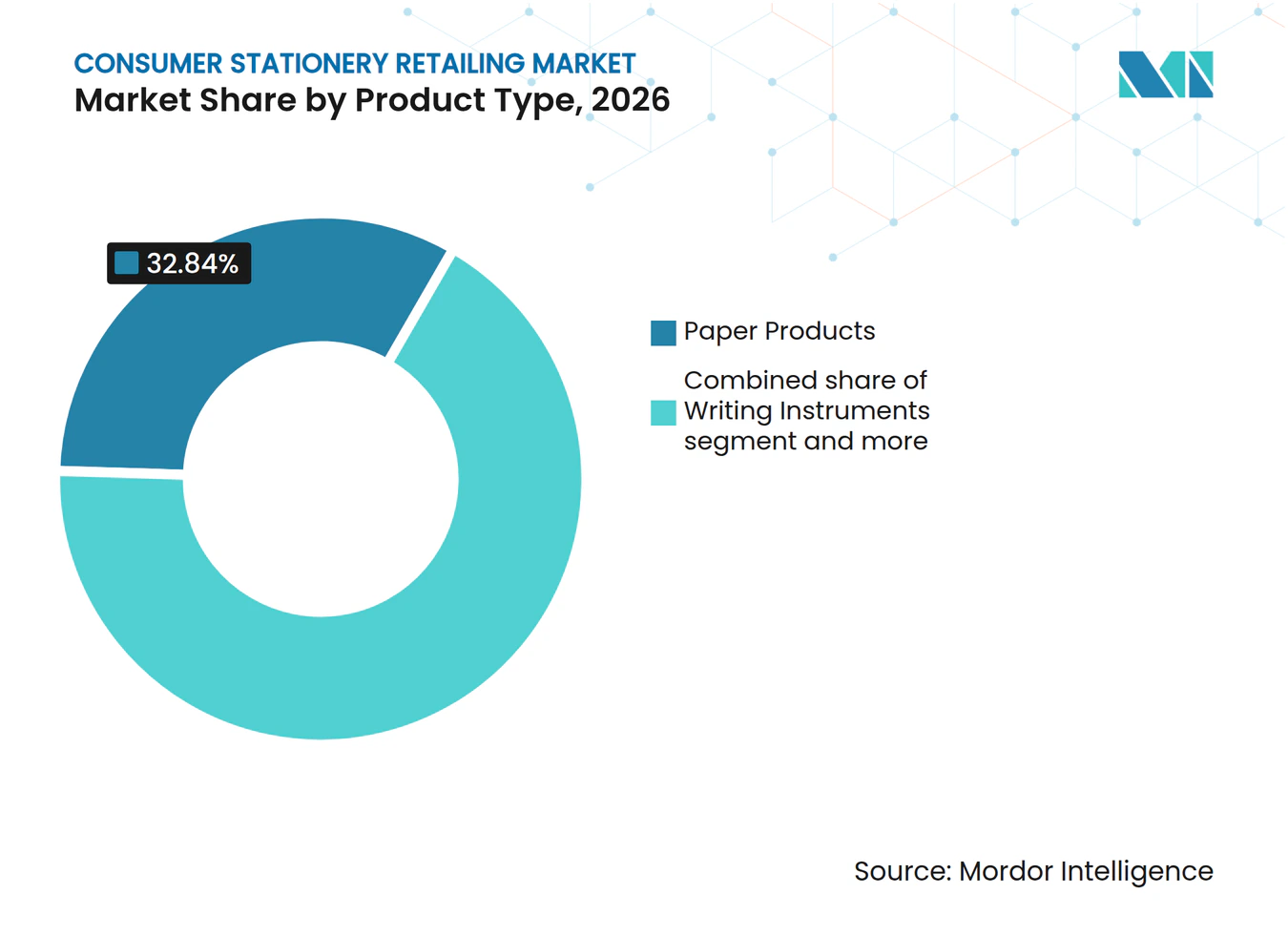
Craft and Creative Formats Expand Within a Paper-Anchored CategoryPaper Products accounted for 32.84% of the global consumer stationery retailing market in 2026, supported by demand for notebooks, exercise books, and copy paper in education. The segment generates predictable traffic during academic cycles but faces price comparison and digital substitution risks. Retailers can support demand through availability, school-list matching, paper quality options, and locally relevant pack sizes.
Art and Craft Supplies are forecast to grow at a 4.85% CAGR through 2032, the highest among product types. Creative activities, hobby purchases, and demand for distinctive formats, colors, kits, and brands support growth. Broader assortments can attract families, hobbyists, and gift buyers while reducing reliance on low-margin commodity lines.
Writing Instruments combine routine demand with opportunities across price points. BIC’s Human Expression business sold writing instruments in more than 160 countries and reported FY2025 net sales of EUR 736 million (USD 865.76 million)[3]. Office and school supplies meet essential demand, while desk accessories and organizers benefit from personalization and workspace needs.



By Distribution Channel:
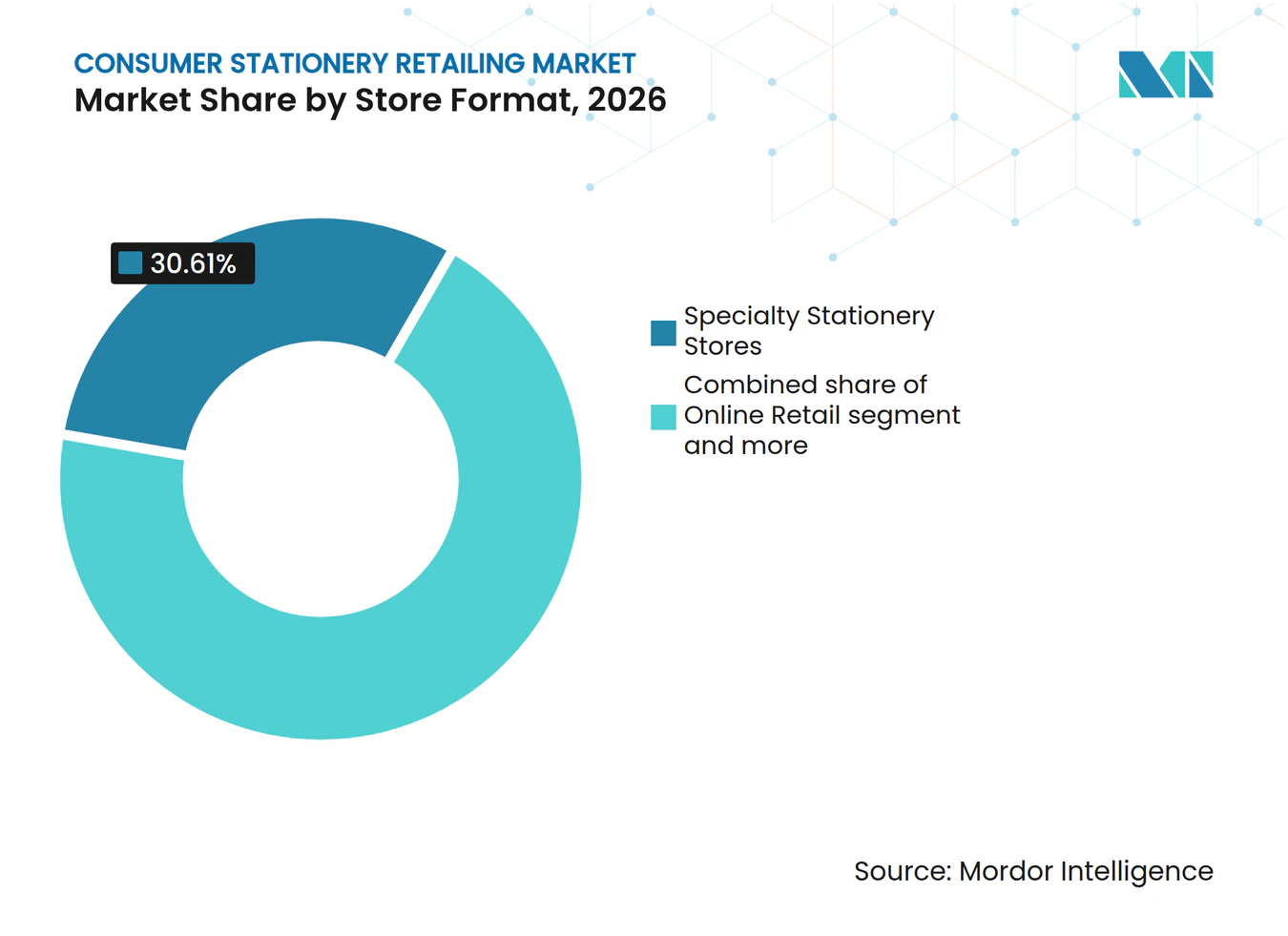
Online Retail Expands Alongside Specialist Store RelevanceSpecialty stationery stores accounted for 30.61% of the global consumer stationery retailing market in 2026. Their position reflects curated assortments, product knowledge, and tactile comparison of paper, pens, planners, and creative supplies. They build loyalty through locally relevant products, school-list support, and staff guidance. Limited delivery reach and lower convenience can constrain competitiveness. Connected online catalogs can show stock availability and enable local delivery or pickup.
Online retail is forecast to grow at a CAGR of 6.45% through 2032, the highest among distribution channels. Australia Post reported that online spending on books, stationery, and multimedia in Australia reached AUD 2.5 billion (USD 1.68 billion) in 2025, up 24.1% year over year. Online channels accounted for 45% of category spending. The average basket value remained stable at AUD 48.32 (USD 32.38), indicating that purchase frequency, rather than transaction value, drove growth. While 19% of category purchases used same-day or next-day delivery, faster fulfillment provides an opportunity for differentiation. For Indian retailers, accurate product listings, broad assortment visibility, and reliable delivery options can support repeat purchases and specialist stationery product discovery.
Hypermarkets, supermarkets, and mass merchandisers benefit from broader household shopping trips, especially during back-to-school periods. Department, discount, convenience, and independent stores support price comparison, immediate replenishment, and neighborhood access. Retailers require channel-specific pricing and pack-size strategies.
By Store Format:
Small Stores Lead, While Online-Only Operators Grow FasterSmall-format stores accounted for 46.91% of the global consumer stationery retailing market size in 2026. They suit high-footfall locations and offer curated assortments without the costs of large destination stores. MINISO demonstrates how frequent assortment rotation and compact lifestyle formats can scale across markets. These stores can drive impulse purchases of stationery, accessories, gifts, and licensed products. In India, they suit malls, transit-linked locations, high streets, and dense residential neighborhoods when assortments reflect local demand.
Online-only retailers are forecast to expand at a 6.12% CAGR through 2032. This model avoids direct store occupancy costs and uses personalization, content, and repeat-order prompts to build customer relationships. It suits customized products, planners, specialty art supplies, and niche writing products. Product discovery, reliable fulfillment, and customer trust remain essential. Pop-ups and partnership displays can help customers assess materials and finishes.
Large-format stores support institutional, school, and project-related purchases but require sufficient traffic and basket value. Shop-in-shop and kiosk formats offer flexibility where full stores are not viable and can pair stationery with complementary categories. The market is likely to retain multiple retail formats.

Geography Analysis
APAC Consumer Stationery Retailing Market
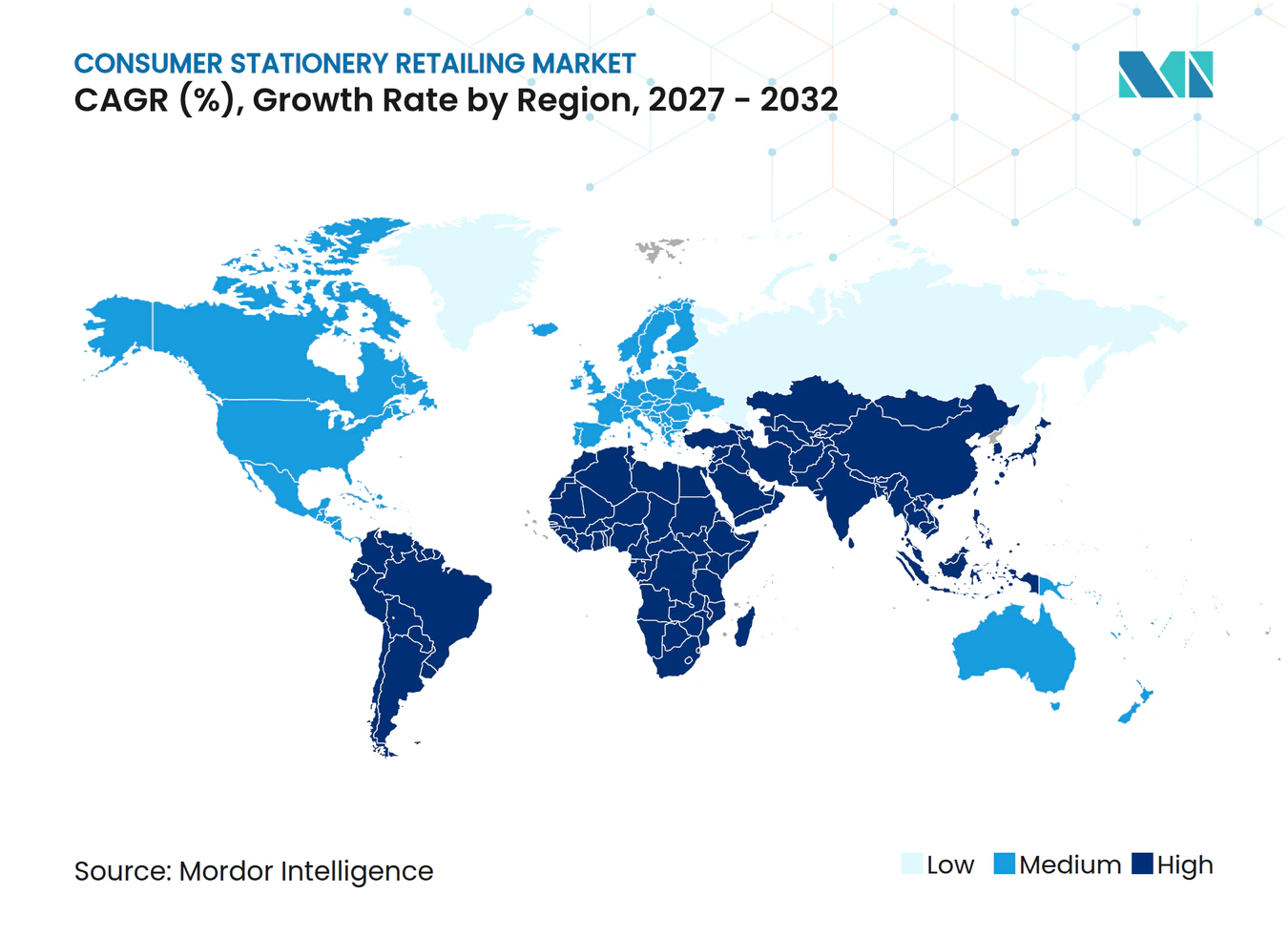
Asia-Pacific accounted for a 36.62% share of the global consumer stationery retailing market in 2026 and is forecast to grow at a 5.35% CAGR through 2032. Large student populations, manufacturing capacity, and demand for creative stationery support growth. India’s school-age population drives recurring demand for notebooks, writing instruments, school supplies, and localized packs, supporting school calendar-based inventory planning. China supports regional availability and price competition through its manufacturing base. Japan and South Korea show demand for higher-priced writing products, design-led stationery, planners, and gifting items. Newell Brands Japan’s 2025 survey highlighted consumer interest in durability and higher-end appeal. MINISO’s expansion demonstrates demand for compact formats and rotating lifestyle assortments.
The Americas and EMEA Consumer Stationery Retailing Market
North America benefits from seasonal school-related demand, with the National Retail Federation estimating USD 6.6 billion in United States K-12 school-supply spending in 2025, supporting demand for stationery and other back-to-school essentials[4]. Europe combines high street, travel retail, specialist, and digital-first formats. South America, the Middle East, and Africa offer opportunities through education demand, urbanization, and organized retail. Market growth depends on purchasing power, school calendars, distribution, and import costs.
Retail Supply & Development Intelligence
The global consumer stationery retailing market includes convenience outlets, specialist stores, and lifestyle-oriented formats, although comparable data on stationery-specific floor space remains limited. As of September 2025, MINISO operated 8,138 stores, comprising 7,831 MINISO stores and 307 TOP TOY stores, after adding 718 new stores year over year. Ryohin Keikaku operates MUJI formats ranging from compact MUJI 500 outlets to larger destination stores. These models balance neighborhood access with product discovery, although neither network exclusively focuses on stationery. Format selection should reflect local rent, foot traffic, assortment depth, and demand for art, craft, and gifting products.
Retail expansion combines smaller, scalable outlets with selective investment in larger, experience-focused stores. Ryohin Keikaku allocated JPY 40.7 billion (USD 0.26 billion) for fiscal 2026 capital investments, including JPY 24.0 billion (USD 0.15 billion) for store openings and JPY 12.0 billion (USD 0.08 billion) for software. This allocation highlights the importance of physical expansion and digital infrastructure. For stationery retailers, flagship stores can support product discovery and broader assortment displays, while compact outlets near schools, residential areas, and transit hubs can serve frequent, smaller purchases. Inventory visibility and online ordering can expand customer reach without requiring each location to maintain a full product range.
Competitive Landscape
Market Concentration
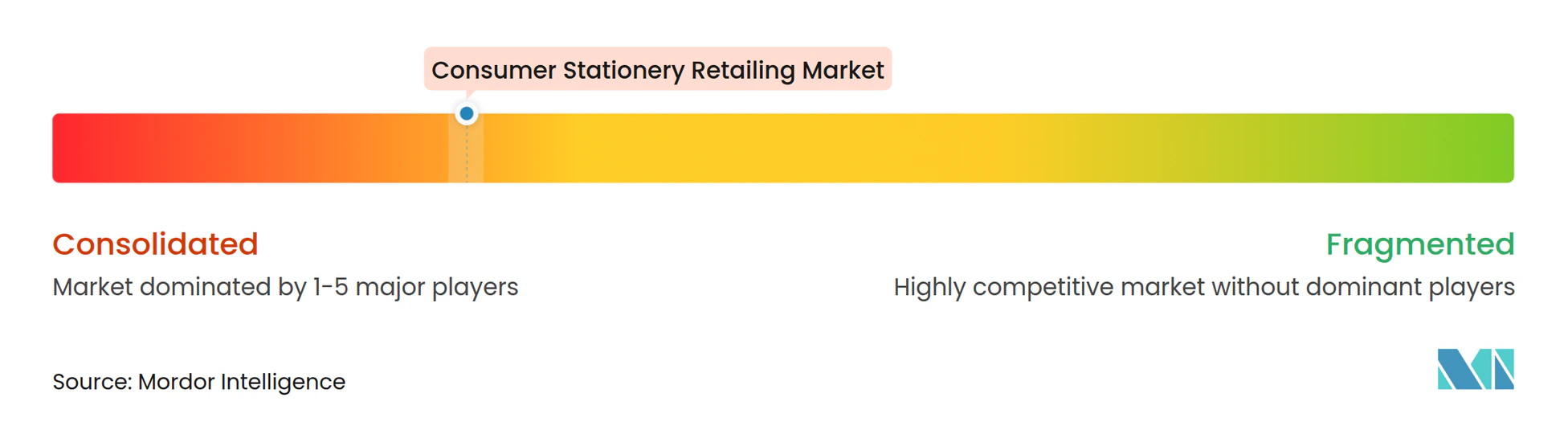
The global consumer stationery retailing market is fragmented. Format competition differs: marketplaces emphasize choice and delivery; stores compete on location, availability, and experience. Price drives school and routine purchases, while differentiation matters for planners, writing instruments, creative, sustainable, and gifting products. MINISO operated 8,138 stores globally in September 2025, adding 718 year-over-year through compact-format expansion and assortment renewal. Its international rollout focused on access and lifestyle merchandising.
MUJI combines express and destination formats while investing in new locations. Both require positioning and disciplined assortments. Manufacturers influence retail through design, packaging, and portfolios. BIC reported that certified or recycled sources supplied all cardboard packaging in 2025. ACCO Brands confirmed its January 2026 EPOS acquisition, moving beyond stationery and consumer products into technology peripherals. These moves create space for specialists and private labels. Retailers combining local assortment knowledge, accessible pricing, digital discovery, and higher-value ranges can compete effectively.
Consumer Stationery Retailing Industry Leaders
-
Staples, Inc.
-
Amazon.com, Inc.
-
Walmart Inc.
-
The ODP Corporation
-
Target Corporation
- *Disclaimer: Major Players sorted in no particular order
Consumer Stationery Retailing Market Companies Covered in this Report
- Walmart Inc.
- Amazon.com, Inc.
- Target Corporation
- Staples, Inc.
- The ODP Corporation
- Tesco PLC
- WH Smith PLC
- Carrefour SA
- Daiso Industries Co., Ltd.
- Ryohin Keikaku Co., Ltd. (MUJI)
- MINISO Group Holding Limited
- Dollar Tree, Inc.
- Dollar General Corporation
- Costco Wholesale Corporation
- Seven & i Holdings Co., Ltd.
- Reliance Retail Ventures Limited
- PNA Retail Management Services
- Ryman Ltd.
- Officeworks
- Smiggle
Recent Industry Developments in Consumer Stationery Retailing Market
- October 2026: MINISO USA opened its 400th United States store, marking a milestone in its nationwide expansion. The company offers lifestyle merchandise, collectibles, beauty products, accessories, and licensed character collaborations. The opening reflects MINISO’s growing United States retail presence and continued expansion of its lifestyle- and IP-led merchandise strategy.
- July 2026: Walmart introduced back-to-school offers featuring 14 popular school supplies at their lowest prices since 2019, with select items starting at USD 0.25. The assortment included stationery, backpacks, binders and licensed accessories, reinforcing its value-led positioning in seasonal consumer stationery retailing.
- May 2026: Ryman partnered exclusively with Deliveroo to offer more than 4,000 products through 185 United Kingdom stores, covering stationery, technology, gifting essentials and print services. The partnership expands Ryman’s omnichannel reach through on-demand delivery, with orders eligible for delivery in as little as 25 minutes.
- March 2025: MUJI opened its largest global store, MUJI Aeon Mall Kashihara, in Japan. The 2,500-tsubo (approx. 8,260 m²) store collaborates with regional producers from Nara Prefecture and the Kinki region.
Global Consumer Stationery Retailing Market Report Scope
The global consumer stationery retailing market report analyzes stationery sales across physical stores, online platforms, and multiple retail formats worldwide. The market is segmented by product type, distribution channel, store format, and geography, covering writing instruments, paper products, office and school supplies, art and craft supplies, and desk accessories and organizers. The study assesses drivers including omnichannel purchasing, marketplace expansion, private-label penetration, back-to-school demand, premium stationery products, digital discovery, and small-format retail expansion, alongside restraints such as digitization of routine paper-based activities, low unit prices, margin pressure, seasonal inventory risks, and raw material, freight, and packaging cost volatility. The report evaluates retail store networks, floor space, new store openings, development pipelines, sales performance, occupancy costs, consumer shopping behavior, channel preferences, spending patterns, and purchase frequency. It provides market size and growth forecasts by product type, distribution channel, store format, and geography for 2022–2031. The study also examines regulatory and technological developments, competitive forces, market concentration, market shares, strategic moves, and profiles of leading retailers and stationery chains. Opportunities in private-label collections, sustainable and refillable stationery, and differentiated product assortments are also assessed. Market estimates and forecasts are presented in value terms across the covered segments.
Segmentation Overview
Key Questions Answered in the Report
What is the projected size of the global consumer stationery retailing sector by 2032?
The global consumer stationery retailing market is projected to reach USD 76.92 billion by 2032, growing at a 3.61% CAGR from 2027.
Which product category is growing fastest in global consumer stationery retailing?
Art and Craft Supplies are forecast to grow at a 4.85% CAGR through 2032, supported by hobby, creative, and lifestyle purchases.
Which sales channel is expanding fast for stationery products?
Online Retail is forecast to grow at 6.45% CAGR through 2032, supported by broad assortments and delivery convenience.
Why is Asia-Pacific important for consumer stationery retailers?
Asia-Pacific held 36.62% of global revenue in 2026 and is forecast to grow at a 5.35% CAGR through 2032, supported by education demand and diversified retail formats.
What matters most for stationery retailers in India?
School demand, localized assortments, accessible price points, digital discovery, and premium creative ranges are important for serving India’s varied consumer base.
How do small-format stores compete with larger retailers?
Small-format stores can use accessible locations, rapid assortment changes, and stationery-led lifestyle products to build sales without the cost of a large destination store.