
Compressor Rental Market Size and Share
Market Overview
| Study Period | 2022 - 2032 |
|---|---|
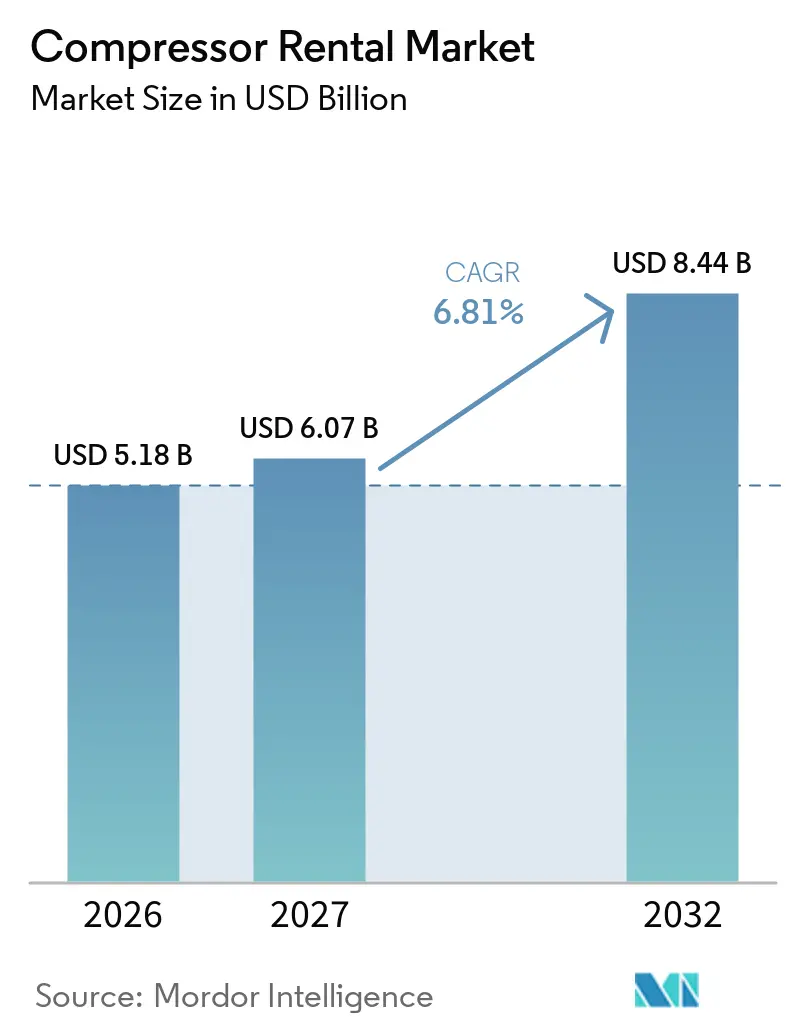
| Market Size (2027) | USD 6.07 Billion |
| Market Size (2032) | USD 8.44 Billion |
| Growth Rate (2027 - 2032) | 6.81 % |
| Fastest Growing Market | Middle East and Africa |
| Largest Market | Asia-Pacific |
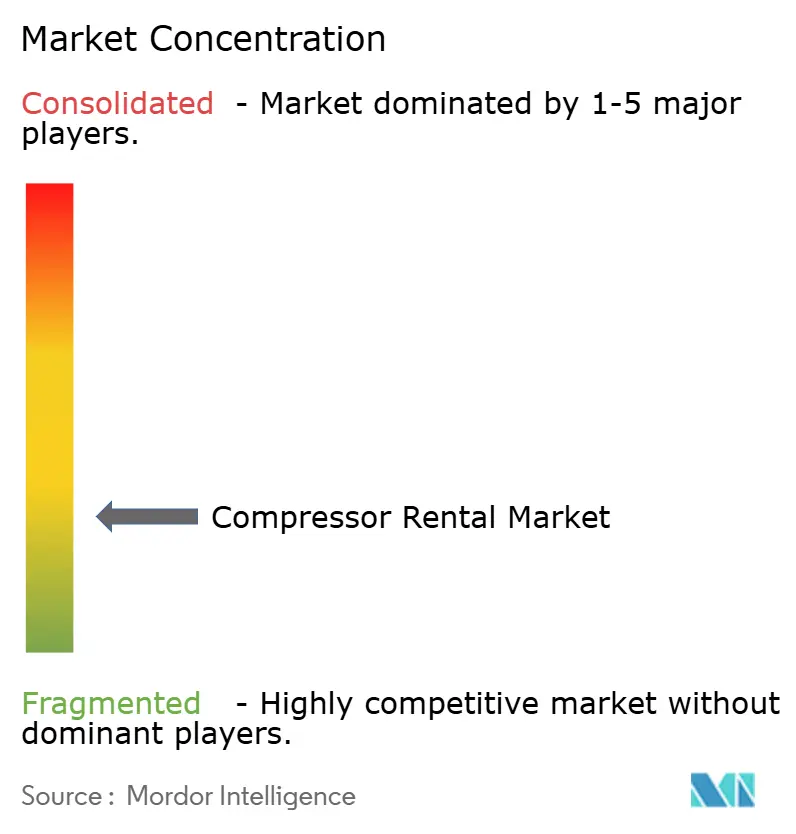
| Market Concentration | Low |
Major Players *Disclaimer: Major Players sorted in no particular order Image © Mordor Intelligence. Reuse requires attribution under CC BY 4.0. | |
Compressor Rental Market Analysis by Mordor Intelligence
The compressor rental market size is expected to increase from USD 5.18 billion in 2026 to USD 6.07 billion in 2027 and reach USD 8.44 billion by 2032, growing at a CAGR of 6.81% over 2027-2032. The market is driven by customers who require equipment for finite project durations without committing capital to owned fleets. Construction, industrial, mining, and energy projects require equipment that can be relocated and operated under varying site conditions. Provider responsibilities extend beyond supplying compressed air to include coordinating delivery, installation, refueling or power arrangements, servicing, and collection within project schedules. Evolving efficiency and emissions requirements further favor providers that maintain current, certified fleets. This creates an advantage for operators with established service networks, technical capacity, spare equipment, and the capital to replace units when customer specifications change. The market also offers customers access to newer equipment when owned units no longer meet their operational or compliance requirements.
Key Report Takeaways
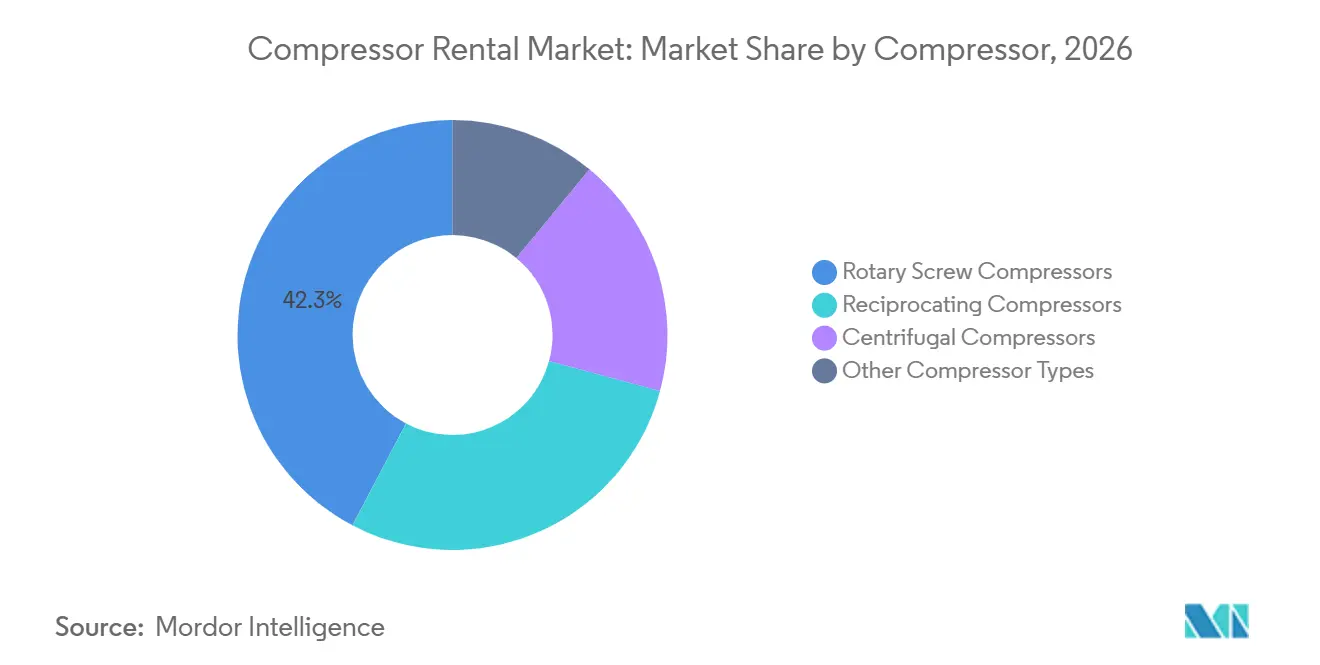
- By compressor type, rotary screw compressors led with a 42.3% revenue share in 2026, while centrifugal compressors are forecast to expand at a 7.2% CAGR through 2032.
- By pressure rating, medium pressure compressors held a 47.4% revenue share in 2026, while high pressure compressors recorded the highest projected CAGR at 6.9% through 2032.
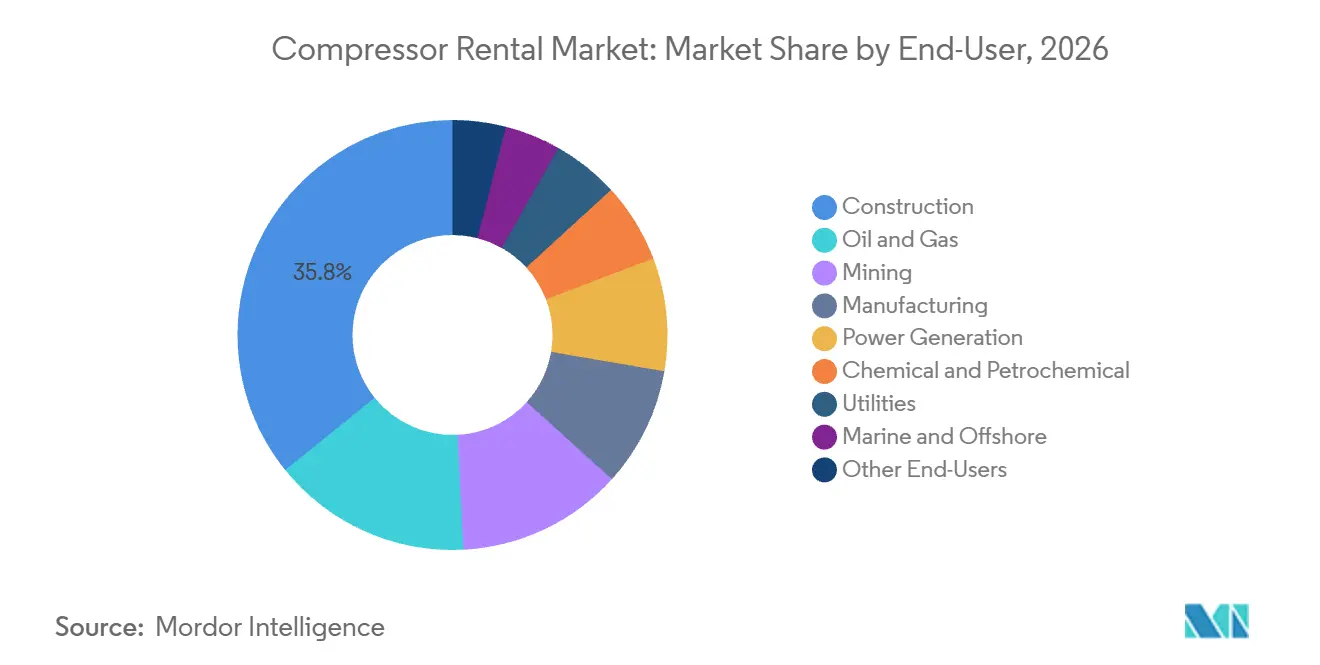
- By end-user, construction held a 35.8% market share in 2026, while the chemical and petrochemical segment recorded the highest projected CAGR at 7.5% through 2032.
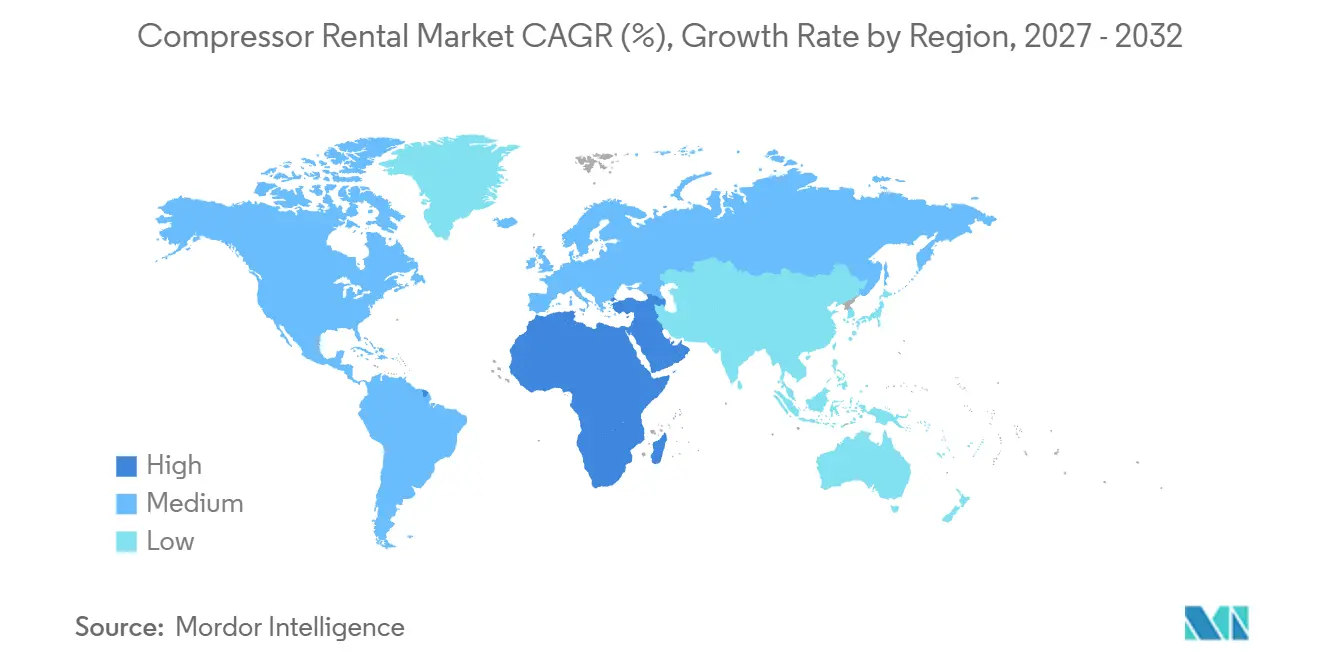
- By geography, Asia-Pacific led with a 34.3% revenue share in 2026, while the Middle East and Africa is forecast to expand at a 7.3% CAGR through 2032.
Note: Market numbers in this report are based on Mordor Intelligence's proprietary estimation framework, which combines nine months of actuals with Q4 projections for base year 2026.
Market Trends and Insights
Drivers Impact Analysis of Compressor Rental Market*
| Driver | (~) % Impact on CAGR Forecast | Geographic Relevance | Impact Timeline |
|---|---|---|---|
| Infrastructure And Project-Based Demand | +1.8% | Global, with concentration in Asia-Pacific and Middle East and Africa | Medium term (2-4 years) |
| Rental Preference For Capital Flexibility | +1.3% | Global | Long term (≥ 4 years) |
| Industrial, Mining, And Oil And Gas Activity | +1.2% | Asia-Pacific, North America, and Middle East and Africa | Medium term (2-4 years) |
| Energy-Efficient And Low-Emission Fleet Upgrades | +0.9% | North America and Europe, with Asia-Pacific spillover | Long term (≥ 4 years) |
| Refinery Turnaround And Maintenance Demand | +0.6% | North America, Middle East, and Europe | Short term (≤ 2 years) |
| Remote Monitoring And Predictive Maintenance | +0.5% | Global, with early adoption in Asia-Pacific and North America | Long term (≥ 4 years) |
| Source: Mordor Intelligence | |||
Infrastructure and Project-Based Demand
Public and private infrastructure spending is moving project pipelines into active construction, creating equipment demand at work sites. India proposed INR 12.2 lakh crore (USD 147 billion) in public capital expenditure for FY2026-27, supporting road, rail, and urban utility work that uses portable compressed air. The compressor rental market benefits most when projects reach the construction phase rather than the planning stage, as contractors need equipment at a defined point in the work program and may not require it for the full life of an asset. Pneumatic tools, pipeline purging, and civil work needs often emerge simultaneously during active execution, so equipment availability can matter as much as the technical rating of an individual unit. This timing makes fleet availability, delivery reliability, and movement between sites important for rental providers operating across multiple projects. Remote road, rail, and power corridors also require portable units where dependable grid power is unavailable, keeping diesel-electric equipment relevant in these operating environments.
Rental Preference for Capital Flexibility
Rental helps operators defer the cost and residual-value risk of purchasing equipment for uncertain project schedules. The compressor rental market therefore serves customers that need flexibility across short contracts, shutdowns, and commissioning work, including those that cannot accurately predict when a project will advance to its next phase. Providers can redeploy units across sectors or locations when individual projects conclude, which ownership cannot easily match without internal fleet-management capability. Telematics can support usage-based service models and help providers schedule maintenance before a failure occurs, particularly when several units are operating away from a central depot. This shifts the customer proposition toward equipment performance and availability rather than contract length. Newer certified rental units can also be more attractive than aging customer-owned units with unclear compliance status.
Industrial, Mining, and Oil And Gas Activity
Industrial activity, mining, and oil and gas operations require different compressor sizes, power sources, and service arrangements. Natural Gas Services Group acquired Flatrock Compression in June 2026 for USD 120 million, adding an 86,000-horsepower rental fleet weighted toward large-horsepower and electric-motor-driven units. The transaction reflected demand for equipment that can maintain throughput while reducing fuel use and operating emissions in areas with adequate power supply, while meeting the uptime expectations of gas-processing customers. Nova Compression added Energy Gas Compression assets in South Texas in July 2026, expanding its fleet to 400,000 horsepower.[1] Mining activity also requires durable portable units capable of serving remote sites with constrained grid access, long travel distances, and limited local repair capacity. These requirements favor providers with mobile fleets, field support, and equipment suited to demanding operating conditions.
Energy-Efficient and Low-Emission Fleet Upgrades
Fleet electrification and variable-speed drive technology are increasingly tied to operating costs and equipment requirements. Atlas Copco states that its GA VSD+ generation can reduce energy use by up to 60% compared to fixed-speed equivalents.[2] The compressor rental market can benefit when operators need updated equipment but do not want to fund an immediate fleet replacement, particularly when a short project does not justify purchasing a higher-specification unit. Rental providers can spread upgrade costs across a larger base of customers and deployments, although this depends on maintaining utilization high enough to support the investment. The resulting refresh cycle makes efficient units more available for high energy-use applications, and raises the importance of fleet planning, maintenance, documentation, and technician training for rental operators.
Restraints Impact Analysis of Compressor Rental Market*
| Restraint | (~) % Impact on CAGR Forecast | Geographic Relevance | Impact Timeline |
|---|---|---|---|
| Fleet Maintenance And Regulatory-Compliance Costs | -0.7% | North America and Europe, with global spillover | Medium term (2-4 years) |
| Project Delays And Cyclical Utilization | -0.5% | Global, most acute in oil and gas dependent areas | Short term (≤ 2 years) |
| Remote-Site Logistics And Limited Supplier Choice | -0.3% | Asia-Pacific, Middle East and Africa, and South America remote project corridors | Medium term (2-4 years) |
| Certified-Technician Scarcity For Advanced Fleets | -0.4% | Global, most severe in Sub-Saharan Africa and Southeast Asia | Long term (≥ 4 years) |
| Source: Mordor Intelligence | |||
Fleet Maintenance and Regulatory-Compliance Costs
Modern fleets require regular maintenance, testing, and replacement spending. The compressor rental market faces pressure when providers need to upgrade equipment before older assets have fully depreciated. Smaller regional providers may find it harder to spread these costs across a large fleet and service network. Compliance-oriented maintenance can therefore favor larger operators with more capital and broader utilization. The same requirements that encourage customers to rent can increase the cost of serving them. Technician availability adds another challenge, as advanced electric and connected equipment requires specialized servicing, particularly at remote locations.
Project Delays and Cyclical Utilization
Rental revenue depends on customers keeping projects active and equipment deployed. The compressor rental market is exposed when infrastructure schedules shift or when oil and gas operators delay capital programs. A unit that remains idle reduces fleet returns while continuing to incur storage, transport, and maintenance costs. Geographic mobility and exposure to multiple end-user groups can reduce dependence on a single project cycle. However, moving equipment between sites requires logistics capacity and local service support, which can be difficult for smaller companies with limited depots or technician coverage.
*Our forecasts treat driver/restraint impacts as directional, not additive. The impact forecasts reflect baseline growth, mix effects, and variable interactions.
Compressor Rental Market Segment Analysis
By Compressor Type:
Rotary Screw Equipment Maintains Broad DemandRotary screw compressors held 42.3% of revenue in 2026, making them the largest segment of the compressor rental market by compressor type. Their widespread use across construction and industrial applications supports this position. Providers offer fixed-speed and variable-speed configurations to meet a range of site conditions. Oil-flooded rotary units remain relevant where reliable, continuous compressed air is required. Their broad installed base makes service familiarity and parts availability practical for rental operators. The consistent operating range also allows customers to use the same equipment class across varying project requirements.
Centrifugal compressors are projected to grow at a 7.2% CAGR through 2032. This growth is linked to pharmaceutical, semiconductor, and food-processing operations that require oil-free compressed air. These applications can require ISO 8573-1 Class 0 air, where contamination risk makes oil-free designs necessary. GenAir UK acquired Netherlands-based RTC Group BV in June 2026 to expand its oil-free centrifugal rental range and enter mainland Europe.[3] The combined offering includes diesel and electric oil-free screw and centrifugal equipment. This broader fleet can reduce the need for customers to engage multiple specialist suppliers for large projects.

By Pressure Rating:
Medium Pressure Units Support Core ApplicationsMedium pressure compressors accounted for 47.4% of the compressor rental market share in 2026. These units typically operate at 7 to 15 bar and support construction, general manufacturing, and food-processing applications. Their specifications are compatible with standard pneumatic tools and many temporary site requirements. Short rental periods can result in frequent fleet turnover and spot-rate activity, making depot access and turnaround speed important for providers serving contractors. Medium pressure equipment also benefits from broad demand across multiple customer groups.
Low pressure compressors serve conveying and aeration applications in utilities and water treatment, providing a more stable demand base than construction-dependent activity. Ultra-high pressure equipment remains specialized, used in well stimulation, water-jet cutting, and scientific applications. High pressure compressors are forecast to grow at a 6.9% CAGR through 2032, supported by LNG terminal projects, hydrogen infrastructure development, and pipeline testing. Atlas Copco Rental Middle East offers high-pressure oil-free compressors operating at 25 to 35 bar for commissioning and offshore support work. These specifications limit the number of providers capable of supplying and maintaining such equipment.
By End-User:
Construction Provides Volume While Chemicals Grow FasterConstruction accounted for 35.8% of the compressor rental market share in 2026. Demand typically rises during ground preparation and civil work, when multiple compressed-air tasks occur simultaneously, creating short-term peaks that require rapid equipment delivery. Mining, oil and gas, power generation, and manufacturing are also significant customer groups. Mining operations often require rugged mobile equipment at remote sites, while utilities and power operations may need sustained medium-pressure supply for auxiliary systems.
The chemical and petrochemical segment is projected to expand at a 7.5% CAGR through 2032. Planned refinery and petrochemical turnarounds require temporary air for instrument use, pipeline purging, pneumatic testing, and hydrocarbon blanketing. This work is typically time-bound and can generate substantial demand for oil-free equipment. Aggreko introduced EPA- and CARB-certified Tier 4 Final diesel and electric oil-free compressors for petrochemical and refining facilities.[4] Marine and offshore customers are also increasingly seeking oil-free solutions. Providers that adapt service terms to different project durations can serve a broader range of accounts within the compressor rental market.
Geography Analysis
Asia-Pacific held 34.3% of the compressor rental market in 2026. China remains a significant market, as chemical manufacturing and mining generate recurring demand during production and maintenance cycles. India's FY2026-27 capital expenditure proposal of INR 12.2 lakh crore (USD 147 billion) supports active procurement for road, metro, and utility projects. Demand in the region is largely concentrated around large civil engineering corridors and industrial sites. Atlas Copco reported solid industrial compressor growth and sharply higher gas and process compressor orders in its second-quarter 2026 results. Rental firms must balance diverse country-level conditions with equipment movement, service access, and power availability.
North America and Europe are mature parts of the compressor rental market, though demand continues to evolve alongside large construction and industrial projects. In the United States, data center construction, electric vehicle battery facilities, refinery activity, and pipeline work require dependable, compressed air during build and commissioning phases. United Rentals raised its 2026 gross capital expenditure guidance to USD 4.9 to 5.3 billion while expanding specialty rental capabilities in power, HVAC, and industrial fluid solutions. Germany remains an active European rental market for stationary and portable equipment. Providers in the region offer daily, weekly, and monthly rental options for construction, sandblasting, and industrial applications. Emissions limits and efficiency requirements are encouraging investment in electrified and variable-speed equipment.
The Middle East and Africa is forecast to grow at a 7.3% CAGR through 2032, the highest geographic growth rate in the compressor rental market. Oil and gas projects, construction activity in Saudi Arabia, and battery-mineral extraction across Africa are supporting demand. Atlas Copco Specialty Rental Africa opened an East African hub in Nairobi in March 2025, offering high-pressure oil-free and oil-injected compressor solutions for mining, oil and gas, and geothermal applications. South America remains a smaller market, with Brazil and Chile generating demand from remote copper and lithium mining operations. Transport constraints at these sites can make rental-service agreements more practical than ownership. Local service capacity and fleet logistics remain important considerations across remote project corridors.
Competitive Landscape
The compressor rental market is moderately fragmented globally, with broad-fleet platforms operating alongside technical specialists. United Rentals, Ashtead Group, and Herc Rentals compete through depot coverage, digital booking, and a wide equipment range. Aggreko, Atlas Copco's rental operations, Onsite Rental Group, and GenAir compete through technical depth, oil-free equipment, and application-specific service. These two models serve different customer requirements but can compete for the same large project accounts. Atlas Copco acquired Cypress Equipment Rental in March 2026 to strengthen its presence in Louisiana corridors serving oil and gas, petrochemical, abrasive blasting, and pipeline construction. The acquisition added local distribution capability without requiring an entirely new buildout.
Technology and service quality are increasingly relevant to competition in the compressor rental market. Connected fleet systems can support maintenance scheduling and equipment availability. Burckhardt Compression launched its PROGNOST-NT Predictive Intelligence module in April 2025, using real-time data and AI-based algorithms to estimate the useful life of key reciprocating compressor components. These tools can help providers reduce unplanned downtime and improve maintenance decisions. ISO 8573-1 Class 0 and EPA Tier 4 Final requirements also make technical credentials important for demanding applications. Smaller firms may find it difficult to match the investment required for connected systems, certified fleets, and broad service coverage.
The compressor rental market presents opportunities in areas where specialist coverage remains limited. Sub-Saharan Africa has growing mining and energy activity, while specialist rental capacity remains thinner than in established regions. Oil-free centrifugal rental in Asia can also benefit from demand from semiconductor and pharmaceutical customers. Ingersoll Rand acquired Lone Star Blower in August 2026, adding rental compression and aftermarket capabilities for North American water and wastewater applications. GenAir's acquisition of RTC Group BV reflects a comparable effort to extend specialist oil-free coverage in Europe. Competition therefore depends on both fleet breadth and the ability to serve tightly specified applications.
Compressor Rental Industry Leaders
-
United Rentals, Inc.
-
Ashtead Group plc
-
Aggreko Ltd
-
Atlas Copco AB
-
Herc Rentals Inc.
- *Disclaimer: Major Players sorted in no particular order
Compressor Rental Market Companies Covered in this Report
- Aggreko Ltd
- Air Equipment Rental Corp.
- Aktio Corporation
- Ashtead Group plc
- Atlas Copco AB
- BigRentz, Inc.
- Caterpillar Inc.
- Coates Hire
- H&E Equipment Services, Inc.
- Herc Rentals Inc.
- HSS Hire Group plc
- Ingersoll Rand Inc.
- Kaeser Kompressoren SE
- Kennards Hire Pty Ltd
- Loxam Group
- Onsite Rental Group
- Sullair, LLC
- Sunstate Equipment Co., LLC
- United Rentals, Inc.
Recent Industry Developments in Compressor Rental Market
- August 2026: Ingersoll Rand acquired Lone Star Blower, Inc. (dba Lone Star Turbo), adding approximately USD 50 million in annual revenue and expanding its blower technology, rental compression, and aftermarket service capabilities across North America. The acquisition strengthens Ingersoll Rand's position in industrial air solutions serving water, wastewater, and industrial customers.
- July 2026: Nova Compression acquired the operating assets of Energy Gas Compression, Inc., adding approximately 52,000 active horsepower to its fleet. The transaction expanded Nova Compression's total rental fleet to roughly 400,000 horsepower and strengthened its presence across the Eagle Ford Basin and South Texas energy markets.
- June 2026: GenAir UK acquired Netherlands-based RTC Group BV on June 12, 2026. The acquisition marked GenAir UK's first expansion into mainland Europe and established a broader oil-free centrifugal compressor rental platform backed by STAR Capital.
- March 2026: Atlas Copco Group acquired Cypress Equipment Rental, Inc., a Louisiana-based portable compressor distributor and rental company with approximately USD 17.6 million in 2025 revenue. The acquisition strengthened Atlas Copco Group's compressor rental presence in key oil and gas, petrochemical, pipeline construction, and industrial corridors between New Orleans and Baton Rouge.
Global Compressor Rental Market Report Scope
Compressor rental refers to the temporary leasing of air and gas compressors to industrial, commercial, and infrastructure customers for short-term, seasonal, emergency, or project-based operations. Compressor rental services provide access to compressed air equipment without requiring large upfront capital investments, helping users meet fluctuating operational demands. These compressors are widely used in construction, mining, oil and gas, manufacturing, power generation, chemical processing, utilities, and marine applications.
The global compressor rental market is segmented by compressor type into rotary screw compressors, reciprocating compressors, centrifugal compressors, and other compressor types. By pressure rating, the market is segmented into low pressure, medium pressure, high pressure, and ultra-high pressure. By end-user, the market is segmented into construction, mining, oil and gas, power generation, manufacturing, chemical and petrochemical, utilities, marine and offshore, and other end-users. The report also covers the market size and forecasts for the global compressor rental market across 26 countries in key regions. For each segment, the market sizing and forecasts have been provided on the basis of value (USD).
Segmentation Overview
| Rotary Screw Compressors |
| Reciprocating Compressors |
| Centrifugal Compressors |
| Other Compressor Types |
| Low Pressure |
| Medium Pressure |
| High Pressure |
| Ultra-High Pressure |
| Construction |
| Mining |
| Oil & Gas |
| Power Generation |
| Manufacturing |
| Chemical & Petrochemical |
| Utilities |
| Marine & Offshore |
| Other End-Users |
| North America | United States |
| Canada | |
| Mexico | |
| Europe | Germany |
| France | |
| Italy | |
| Spain | |
| United Kingdom | |
| Poland | |
| Russia | |
| Rest of Europe | |
| Asia-Pacific | China |
| India | |
| Japan | |
| South Korea | |
| Australia | |
| Indonesia | |
| Vietnam | |
| Thailand | |
| Rest of Asia-Pacific | |
| South America | Brazil |
| Argentina | |
| Chile | |
| Rest of South America | |
| Middle East and Africa | Saudi Arabia |
| United Arab Emirates | |
| Egypt | |
| South Africa | |
| Morocco | |
| Rest of Middle East and Africa |
| By Compressor Type | Rotary Screw Compressors | |
| Reciprocating Compressors | ||
| Centrifugal Compressors | ||
| Other Compressor Types | ||
| By Pressure Rating | Low Pressure | |
| Medium Pressure | ||
| High Pressure | ||
| Ultra-High Pressure | ||
| By End-User | Construction | |
| Mining | ||
| Oil & Gas | ||
| Power Generation | ||
| Manufacturing | ||
| Chemical & Petrochemical | ||
| Utilities | ||
| Marine & Offshore | ||
| Other End-Users | ||
| By Geography | North America | United States |
| Canada | ||
| Mexico | ||
| Europe | Germany | |
| France | ||
| Italy | ||
| Spain | ||
| United Kingdom | ||
| Poland | ||
| Russia | ||
| Rest of Europe | ||
| Asia-Pacific | China | |
| India | ||
| Japan | ||
| South Korea | ||
| Australia | ||
| Indonesia | ||
| Vietnam | ||
| Thailand | ||
| Rest of Asia-Pacific | ||
| South America | Brazil | |
| Argentina | ||
| Chile | ||
| Rest of South America | ||
| Middle East and Africa | Saudi Arabia | |
| United Arab Emirates | ||
| Egypt | ||
| South Africa | ||
| Morocco | ||
| Rest of Middle East and Africa | ||
Key Questions Answered in the Report
What is the projected value of the compressor rental market by 2032?
The compressor rental market is projected to reach USD 8.44 billion by 2032, growing at a CAGR of 6.81% from 2027.
Which compressor type leads rental revenue?
Rotary screw compressors led revenue with a 42.3% share in 2026, driven by their use across construction and industrial applications.
Which pressure class is growing fastest?
High-pressure compressors are forecast to grow at a CAGR of 6.9% through 2032, driven by LNG, hydrogen, and pipeline testing applications.
Which end-user segment has the highest growth outlook?
Chemical and petrochemical applications are forecast to grow at a CAGR of 7.5% through 2032, driven by turnaround and commissioning activity.
Which region has the largest rental demand?
Asia-Pacific held a 34.3% share in 2026, driven by construction, manufacturing, and mining activity.
How concentrated is the competitive landscape?
The compressor rental market has a concentration score of 4/10, as the competitive landscape includes many broad-fleet and specialist providers rather than a small group of players with a disclosed combined market share.