
Circular Knitting Machine Market Size and Share
Market Overview
| Study Period | 2020 - 2031 |
|---|---|
| Market Size (2026) | USD 4.04 Billion |
| Market Size (2031) | USD 5.35 Billion |
| Growth Rate (2026 - 2031) | 5.76 % |
| Fastest Growing Market | Middle East and Africa |
| Largest Market | Asia-Pacific |
| Market Concentration | Medium |
Major Players
*Disclaimer: Major Players sorted in no particular order Image © Mordor Intelligence. Reuse requires attribution under CC BY 4.0. |
|
Circular Knitting Machine Market Analysis by Mordor Intelligence
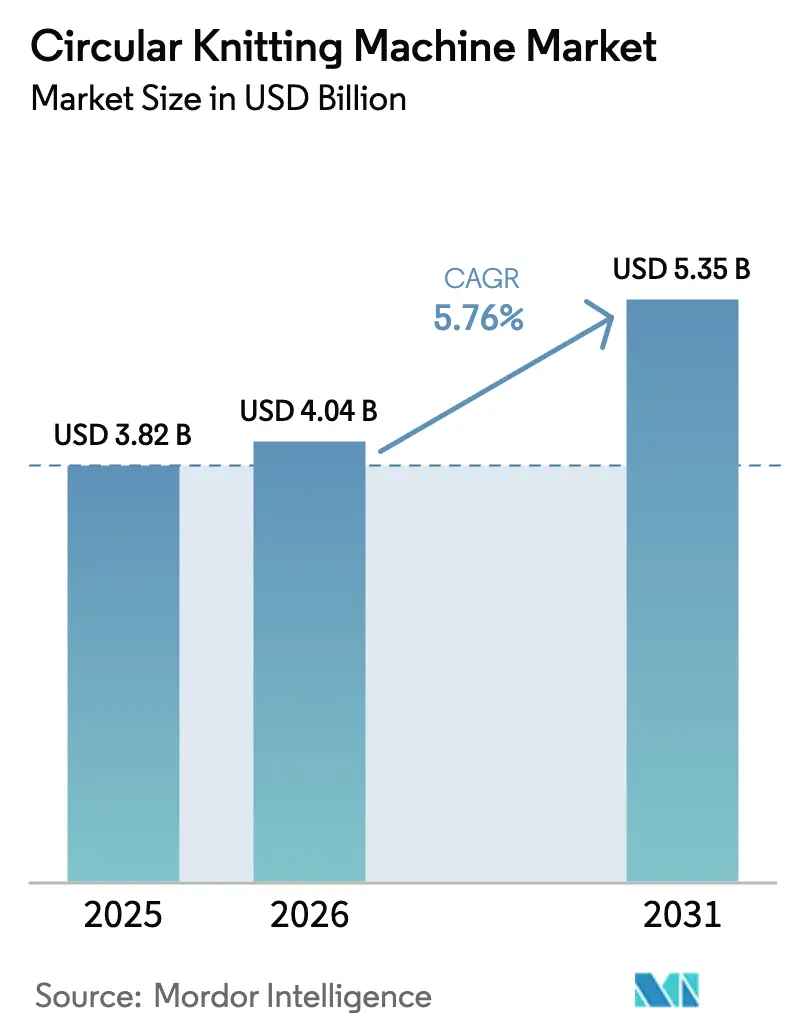
The circular knitting machines market size is expected to grow from USD 3.82 billion in 2025 to USD 4.04 billion in 2026 and is forecast to reach USD 5.35 billion by 2031 at 5.76% CAGR over 2026-2031. Healthy capital spending by apparel, technical, and medical-textile producers, the steady shift toward Industry 4.0 platforms, and regulatory pressure for recycled yarn compatibility are steering demand. Mid-sized manufacturers are scaling electronic control systems to support seamless fashion cycles, while large groups favor fully integrated, sensor-rich machinery that automates quality, maintenance, and supply-chain hand-offs. Asia-Pacific extends its lead through localized supply chains and RCEP tariff advantages, yet the Middle East and Africa show the fastest unit shipment growth as sovereign wealth funds finance greenfield plants. Competitive pressures remain moderate because know-how, after-sales service, and software ecosystems still differentiate the field even when hardware designs converge.
Key Report Takeaways
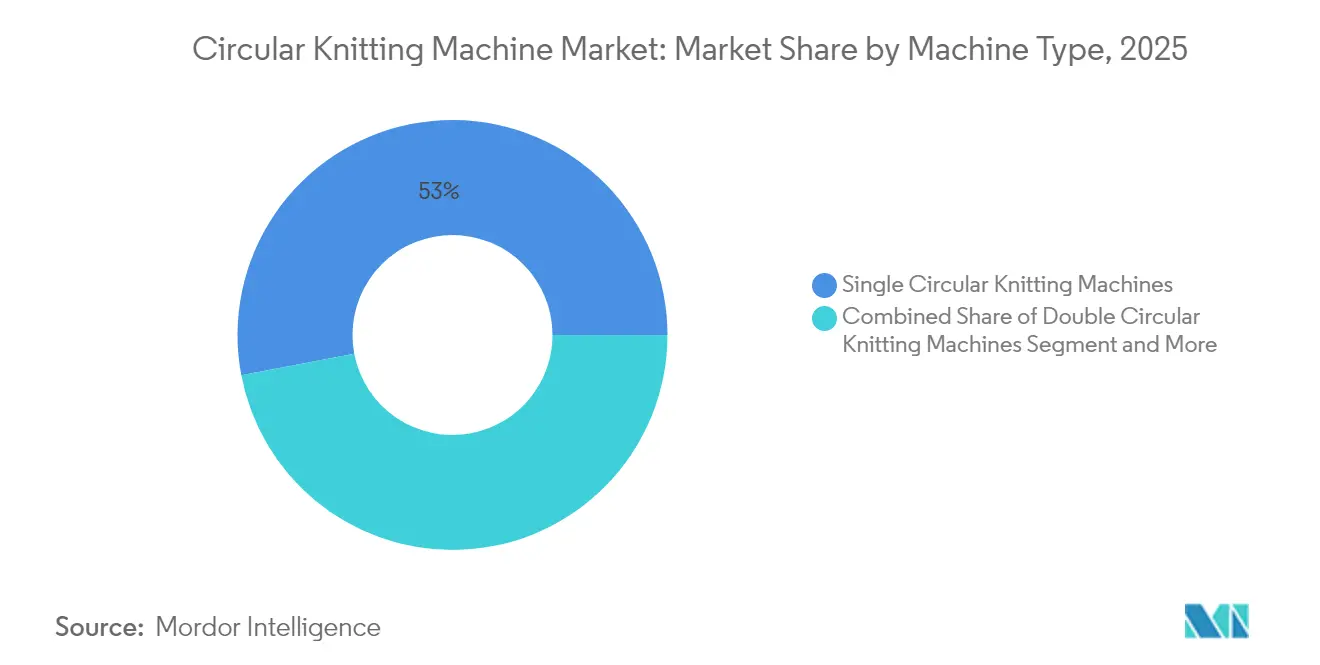
- By machine type, single circular models held 53.00% of the circular knitting machines market share in 2025, whereas specialty jacquard units are set to register the quickest 6.92% CAGR through 2031.
- By gauge, medium-gauge systems captured 47.40% of 2025 revenue, while fine-gauge equipment is forecast to post a 6.02% CAGR to 2031.
- By diameter, mid-diameter machines commanded 41.85% of 2025 sales; small-diameter variants are on track for a 4.58% CAGR during the outlook period.
- By automation level, electronic control platforms accounted for 49.95% share of the circular knitting machines market size in 2025, and Industry 4.0-ready systems should expand at 6.82% CAGR up to 2031.
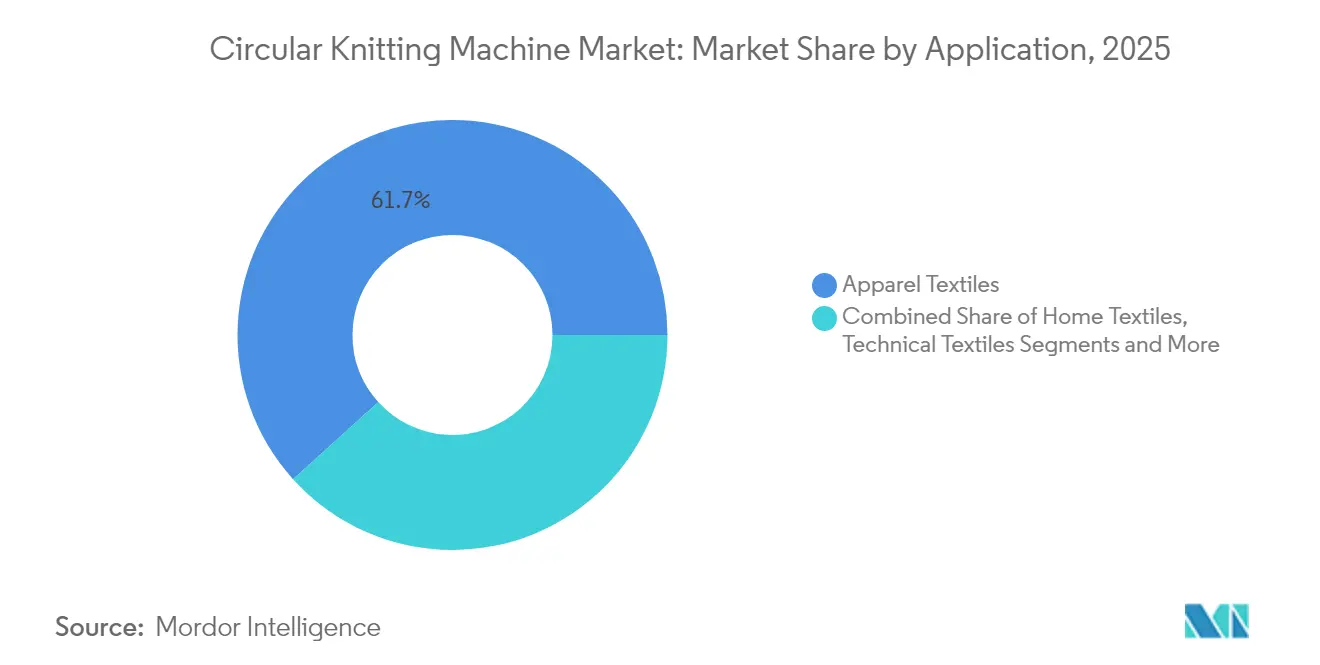
- By application, apparel textiles led with 61.70% revenue share in 2025; technical-textile demand is advancing at an 8.73% CAGR through 2031.
- By yarn type, cotton dominated with a 38.10% share in 2025, yet recycled yarns remain the pace setter at a 7.32% CAGR across the forecast window.
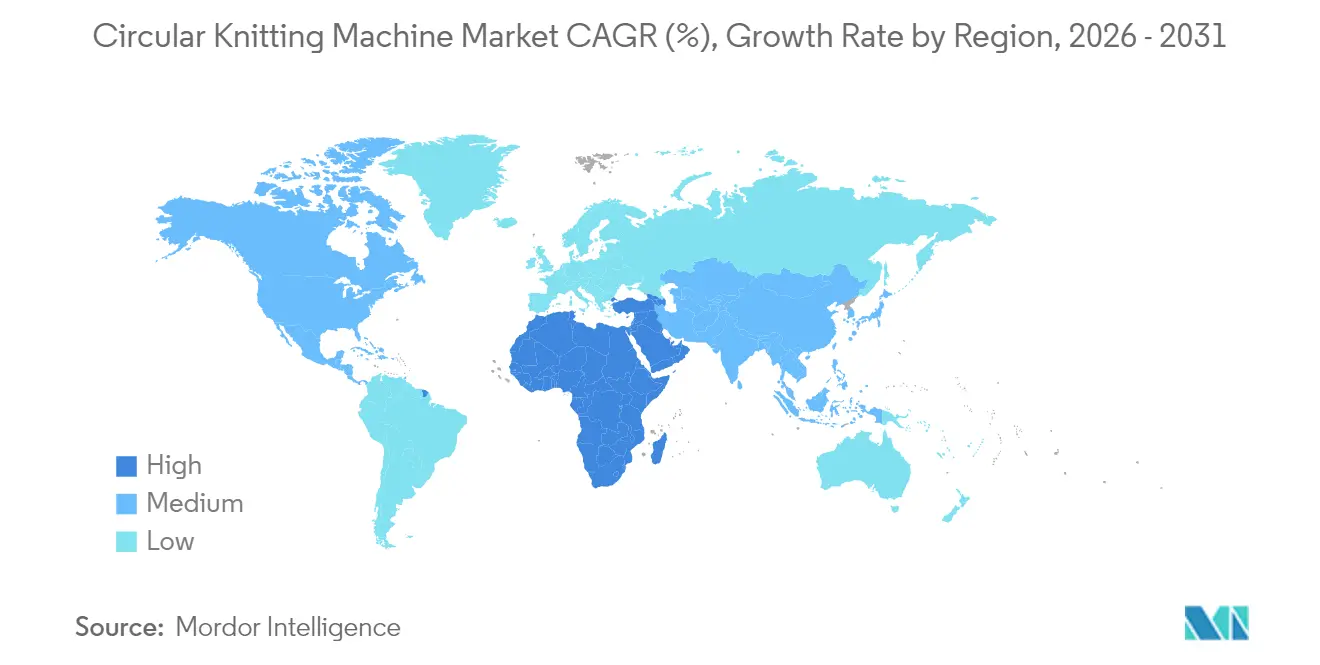
- By geography, Asia-Pacific contributed 47.90% to 2025 shipments, while the Middle East and Africa are projected to deliver the swiftest 5.48% CAGR out to 2031.
Note: Market size and forecast figures in this report are generated using Mordor Intelligence’s proprietary estimation framework, updated with the latest available data and insights as of 2026.
Global Circular Knitting Machine Market Trends and Insights
Drivers Impact Analysis*
| Driver | (~) % Impact on CAGR Forecast | Geographic Relevance | Impact Timeline |
|---|---|---|---|
| Growing demand for seamless/athleisure garments | +1.2% | Global; strongest in North America & Europe | Medium term (2-4 years) |
| Automation & digitization of knitting operations | +1.0% | APAC core; spill-over to North America | Long term (≥ 4 years) |
| Expansion of technical- & medical-textile applications | +0.8% | North America & EU; rising in APAC | Long term (≥ 4 years) |
| Manufacturing migration to cost-efficient Asian clusters | +0.6% | APAC; knock-on to MEA | Medium term (2-4 years) |
| Near-shoring is pressuring flexible, small-lot machinery | +0.5% | North America & EU | Short term (≤ 2 years) |
| Recycled yarn compatibility attracting sustainability capex | +0.4% | Global, led by EU rules | Medium term (2-4 years) |
| Source: Mordor Intelligence | |||
Growing Demand for Seamless/Athleisure Garments
Athleisure’s structural rise is propelling new machinery purchases because seamless technology eliminates cut-and-sew steps that add cost and compromise fit. Santoni’s high-gauge platforms knit compression and ergonomic zones in one pass, creating soft yet durable garments that support premium pricing. Sportswear brands increasingly specify electronic jacquard heads to weave logos and ventilation zones directly into fabric tubes, shrinking lead times for style refreshes. As comfort and performance converge in everyday apparel, fabricators are retrofitting existing bays with multi-gauge cylinders to handle ultrafine yarns. Seamless fashions also trim material waste, bolstering sustainability metrics that retailers track closely in compliance reports.
Automation & Digitization of Knitting Operations
Industry 4.0 integration is rewriting shop-floor management. Pailung’s Manufacturing Execution System records every cam adjustment, enabling exact fabric replication across global plants. IoT sensors feed yarn tension, temperature, and vibration data into cloud analytics that predict faults hours before they stop the line. Digital twins let technicians trial new stitch densities virtually, slashing costly sample loops. Computer vision now flags defects at full speed, so only perfect rolls reach dyeing. With worker shortages in several hubs, autonomous recipe control is no longer optional; it guards uptime and cushions labor risk.
Expansion of Technical- & Medical-Textile Applications
Technical textiles enjoy the fastest adoption curve because circular knitting builds tubes, meshes, and spacer fabrics that weaving cannot replicate. Integer’s micro-diameter equipment knits vascular grafts where pore geometry dictates patient outcomes. Auto makers specify multi-material seat covers that mix polyester face yarns with aramid reinforcements for side-airbag seams, cutting weight and stitching steps. Composite parts for drones and sporting goods emerge from carbon-fiber preforms knitted to net shape, lowering scrap. Hospitals, carmakers, and aerospace OEMs all seek suppliers who can pivot from cotton jerseys to high-modulus synthetics without swapping machines.
Manufacturing Migration to Cost-Efficient Asian Clusters
RCEP has made Vietnam, Bangladesh, and Indonesia magnets for Chinese, Korean, and Japanese groups aiming to hedge labor and tariff exposure. Shared utilities in industrial parks let small knitters access steam and effluent treatment once reserved for giants, spurring pooled orders for mid-range electronic machines. Vendors are rolling out remote-diagnostic dashboards to serve scattered factories with fewer field technicians. As clusters mature, localized spare-part depots shorten downtime, removing a traditional edge held by suppliers located near buyers.
Restraints Impact Analysis*
| Restraint | (~) % Impact on CAGR Forecast | Geographic Relevance | Impact Timeline |
|---|---|---|---|
| High upfront capital expenditure | -0.8% | Global; SMEs hardest hit | Short term (≤ 2 years) |
| Raw material (yarn) price volatility | -0.6% | Worldwide, cotton belts are acute | Medium term (2-4 years) |
| Skilled machine operator shortage | -0.4% | APAC & North America hubs | Long term (≥ 4 years) |
| Secondary (used-machine) market cannibalization | -0.3% | Emerging, cost-sensitive markets | Medium term (2-4 years) |
| Source: Mordor Intelligence | |||
High Upfront Capital Expenditure
A full Industry 4.0 circular knitting line costs USD 15–50 million, covering high-speed cylinders, winding, inspection, and digital backend. Small firms struggle to source that financing, especially where leasing infrastructure lags. Rapid tech cycles magnify risk because equipment can feel dated within five years. Consequently, some buyers postpone upgrades or choose stripped-down models, which slows market acceleration until flexible pay-per-use packages gain traction.
Raw-Material (Yarn) Price Volatility
Cotton futures and polyester feedstock swings squeeze margins when fabric contracts are fixed for seasons. Tax policies in Pakistan that load local cotton with GST highlight how duties distort mill input economics. Recycled yarn premiums fluctuate with collection rates and oil prices, complicating budgeting for eco-labeled programs. Many knitters now stock extra weeks of yarn, raising working-capital needs and warehouse costs[1]Springer, Oluwabusola Dorcas Olagunju, “Investment Decision Modeling for Textile Machinery,” springer.com.
*Our forecasts treat driver/restraint impacts as directional, not additive. The impact forecasts reflect baseline growth, mix effects, and variable interactions.
Segment Analysis
By Machine Type: Single Circular Dominance Faces Jacquard Disruption
Single-cylinder units generated 53.00% of the circular knitting machines market share in 2025 because their straightforward cam architecture delivers high yards per minute for T-shirts, underwear, and sheets. The circular knitting machines market size for specialty jacquard platforms is smaller today, but this niche is on a 6.92% CAGR track as fashion labels chase intricate motifs that lift average selling prices. Modern jacquard heads use micro-step motors for every needle, so patterns change via software rather than hardware plates, trimming setup to minutes. Wellknit’s double computerized jacquard model showcases triple-action knitting, letting mills pivot from plain jerseys at dawn to sculpted relief fabrics by lunch.
Second, double-jersey machinery remains crucial for rib and interlock pieces that demand stretch retention. Although its growth rate trails jacquard, demand holds steady in underwear and sports cuffs. Hybrid platforms now embed removable needle beds, giving operators the choice of single or double knitting without swapping the entire frame. This flexibility appeals to contract manufacturers juggling diverse brand orders under one roof. As a result, the competitive gap between dominant single machines and rising jacquard contenders will narrow through the decade.



By Gauge: Fine Gauge Innovation Drives Premium Applications
Medium gauges (12–24 NPI) owned 47.40% of shipments in 2025 because they balance yarn range, speed, and fabric hand suitable for mass apparel. Fine-gauge models, although costlier, promise a 6.02% CAGR by 2031 as lingerie and athleisure require micro-denier yarns for a second-skin feel. Here, the circular knitting machines market size benefits from technological leaps such as Pailung’s redesigned sinker rings that minimize abrasion at 28 NPI. Ultra-fine cylinders allow seamless hosiery with 200-needle barrels, once exclusive to flat knitting.
Coarse-gauge systems still matter for thermal wear and industrial sleeves, yet face little innovation. The premium differential in yarn weight means coarse fabrics struggle to justify price hikes, capping revenue growth. Consequently, suppliers channel R&D into fine tolerances laser-ground cams, ceramic yarn guides, and oil-mist lubrication to boost speed without compromising needle life.
By Diameter: Small Diameter Growth Reflects Specialized Applications
Mid-diameter machines (15"–30") supplied 41.85% of 2025 revenue, matching common fabric widths for tees and leggings. Small-diameter (<15") cylinders are expanding at a 4.58% CAGR because medical and hosiery demand near-net tubes with minimal seam irritation. Integer’s 8" vascular-graft machine knits implantable polyester sleeves whose uniform wall thickness ensures blood compatibility. Fashion tights benefit, too, since graduated-compression zones are achievable only on tight circumferences.
Large-diameter (>30") frames help terry towel and home-textile makers deliver jumbo rolls, yet plant floor spacing and high power draw limit their adoption. Some mills now adapt modular creels so one large machine feeds several yarn types, maximizing footprint utility. Still, the relative growth edge lies with specialty small-diameter units geared for high-value health and wellness products.

By Automation Level: Industry 4.0 Integration Accelerates
Electronic control held a 49.95% share in 2025 as most mills completed the shift away from purely mechanical cams. Industry 4.0-ready systems, featuring cloud connectivity, digital twins, and AI maintenance, will outpace the base with a 6.82% CAGR. The circular knitting machines market size for computerized platforms rises because sensor-rich cylinders cut defect scrap and unlock predictive uptime. Asian Development Bank studies show Pakistan’s mills expect productivity lifts topping 35% once IoT and analytics mature.
Mechanical rigs persist mainly for entry-level buyers, but component vendors now offer retrofit boards that digitize pattern memory, easing the upgrade path. Still, the step to full smart-factory status is steep: plants must integrate ERP, yarn warehouse, and dye-house data. Vendors that package end-to-end software, not just machines, will capture premium margins.
By Application: Technical Textiles Drive Innovation
Apparel textiles delivered 61.70% of the 2025 turnover owing to global basics consumption. However, technical-textile demand brings the sharpest 8.73% CAGR because automotive, medical, and defense users pay for functionality rather than yards. That pivot enlarges the circular knitting machines market size by inviting higher ASP equipment capable of processing aramid, carbon, and UHMWPE yarns. For instance, Pailung’s spacer-fabric lines knit 3D structures for EV battery insulation where thermal management is critical.
Home textiles remain steady, fed by pandemic-era nesting trends, yet price competition is intense. Niche segments such as filtration sleeves and geotextiles gain traction, but volumes are small. As sustainability metrics harden, brands will prefer mono-material constructions that simplify recycling, pushing mills toward specialized cylinders able to handle stiff technical filaments without needle breakage.
By Yarn Type: Recycled Materials Gain Traction
Cotton kept a 38.10% share thanks to consumer affinity and supply familiarity. Recycled yarns, though, are surging at 7.32% CAGR, elevating the circular knitting machines market share for equipment optimized to handle variable fiber lengths. Mills installing optical yarn evenness testers can knit PET bottle yarn blends at commercial speeds without surge rollers. Research in Polymer Degradation and Stability confirms recycled polyester knit fabrics now match virgin counterparts in pilling and colorfastness after process tweaks.
Synthetic staples such as polyester and nylon still dominate sportswear, and high-tenacity varieties underpin medical and industrial uses. Blends complicate recycling, spurring interest in design-for-disassembly where one polymer rules. Machine suppliers are testing heat-resistant guides to process bio-based PLA filaments that melt at lower temperatures, ensuring future-proof versatility.
Geography Analysis
Asia-Pacific retained 47.90% of 2025 shipments because integrated yarn-to-garment ecosystems, supportive export rebates, and abundant technician pools anchor machinery demand. China leads, yet unit sales migrate to Vietnam and Indonesia as labor costs rise at home and RCEP waives duties on cross-border equipment sales. India’s Production-Linked Incentive scheme fuels fresh orders, though patchy power and zoning rules temper ramp-up speed. Japan’s makers occupy premium niches, supplying micro-diameter lines for medical implants that secure high margins despite modest volume.
North America’s resurgence rests on near-shoring. The United States sees fresh capex as brands value tariff avoidance and carbon-footprint cuts. Shawmut’s North Carolina site demonstrates local investment logic: smart cylinders slash labor reliance while producing specialty fabrics that justify higher wages. Canadian mills, smaller in number, ride the same wave, offering quick-turn knits to e-commerce labels. Mexico absorbs overflow for automotive and protective textiles, helped by USMCA rules of origin.
Europe commands the technology high ground. German and Italian OEMs steer automation breakthroughs and maintain dense service networks. EU Green Deal mandates recycled content, prompting mills in Portugal and Spain to order tension-adaptive machines compatible with reclaimed fibers. The Middle East and Africa register the fastest 5.48% CAGR because Gulf sovereign funds deploy petro-dollars into diversification parks, while Turkey upgrades existing looms to capture EU quick-response orders. Egypt leverages duty-free EU access, yet requires port and energy upgrades to exploit its full potential.

Regulatory Landscape
Safety compliance for circular knitting equipment is shaped by a mix of machinery rules and technical standards. In the European Union, Regulation (EU) 2023/1230 (the Machinery Regulation) replaces the former Machinery Directive framework, with full applicability dated to 20 January 2027. That timetable increases expectations for documentation and risk controls on machinery placed on the EU market, which in turn influences OEM design choices for electronic-control and Industry 4.0-integrated platforms.
Standards underpin global conformity assessments and purchasing specifications. The ISO 11111 series is used as a reference set for safety requirements for fabric manufacturing machinery (covering knitting equipment), while ISO 8121:2007 and ISO 8122:2003 standardize nameplate information and needle-count related specifications used in procurement and service practices. On the sustainability side, the European Commission's EU Strategy for Sustainable and Circular Textiles pushes traceability and circularity measures, including Digital Product Passports and EPR concepts, while EU rules introduce a ban on the destruction of unsold textiles and footwear by large enterprises from 19 July 2026, reinforcing demand for machinery that can process recycled yarns consistently.
Value Chain Analysis
The value chain begins with specialized component supply, including needles, sinkers, cam systems, cylinders, drives, sensors, and electronic control boards. It then moves to OEM engineering and assembly, where mechanical architecture is integrated with software, HMI, and connectivity layers for recipe management and remote diagnostics. Upstream quality and availability of electronics, sensor packages, and precision wear parts are key determinants of lead time and machine uptime, particularly as the market shifts from mechanical and basic electronic control toward computerized and Industry 4.0-integrated systems.
Go-to-market typically combines direct sales for higher-end platforms with distributor and agent networks for mid-range machines. This is followed by commissioning, training, spares, and service contracts, which become a major lifetime revenue stream. After-sales is increasingly software-led, including machine data capture, predictive maintenance, and defect detection integration, which ties mills into vendor ecosystems and raises the importance of interoperability with plant ERP/MES. In Asia-Pacific, regional textile clusters benefit from localized service coverage and spares depots, while cross-border logistics for delicate assemblies and controllers remains a bottleneck for time-sensitive installs in emerging hubs.
Competitive Landscape
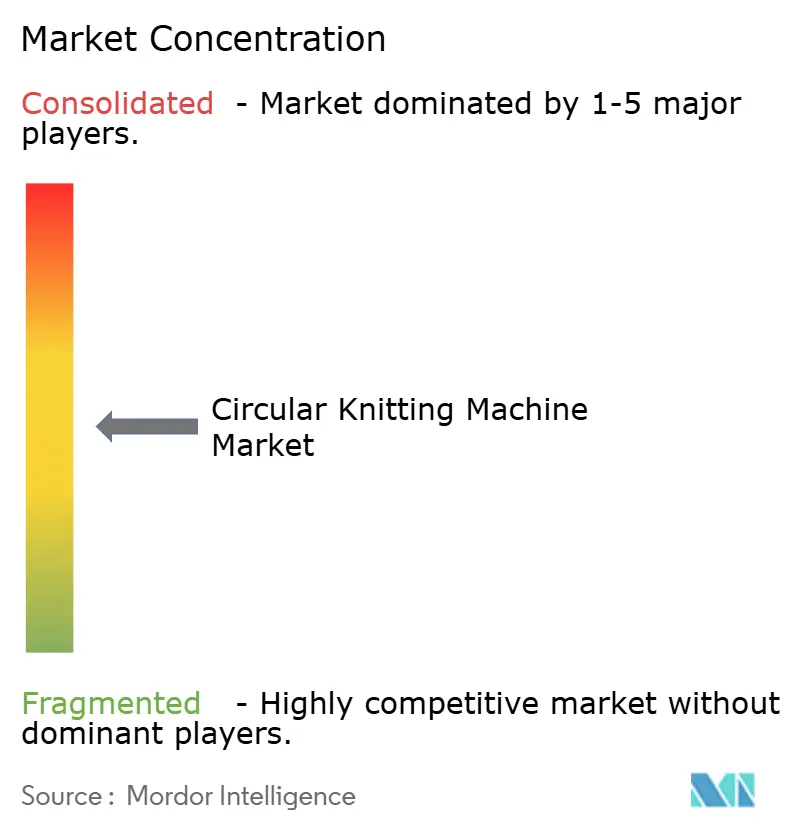
The market remains moderately fragmented: the top five vendors together control just above half of global revenue, leaving room for specialists. Mayer & Cie., Pailung, and Fukuhara headline the tier-1 bracket, leveraging scale for in-house electronics and global service fleets. Chinese challengers, notably Wellknit and Yuanda, undercut on price while closing quality gaps via imported needles and German software modules. Their rapid domestic growth funds foreign expansion, especially into cost-sensitive Africa.
Strategic moves pivot toward platform ecosystems. Pailung bundles IoT dashboards that link creels, knitting heads, and finishing lines, locking clients into proprietary data cycles. Mayer & Cie.’s tie-up with TotalEnergies to co-brand biodegradable machine oil exemplifies value-added consumables that earn annuity margins. Karl Mayer’s acquisition path into tricot broadened its textile architecture reach, hedging against single-technology cyclicality.
Emerging players exploit white spaces. Syre backs recycled-fiber-centric lines, betting regulation will favor its closed-loop narrative. Equipment-as-a-service offers, still nascent, appear in Europe, where banks prefer subscription cash flow over collateral risk. Meanwhile, software houses push retrofit kits that overlay AI defect detection on legacy frames, threatening OEM lock-ins. As cost parity tightens, after-sales uptime guarantees become decisive bid criteria.
Circular Knitting Machine Industry Leaders
-
Baiyuan Machine
-
Mayer & Cie
-
Terrot
-
Santoni
-
Fukuhara
- *Disclaimer: Major Players sorted in no particular order

Market Opportunities and Future Outlook
White space is opening around compliance-ready smart machinery for the European market as OEMs and mills prepare for the EU Machinery Regulation, Regulation (EU) 2023/1230, becoming fully applicable on 20 January 2027. That increases the premium on machines delivered with robust safety engineering, audit-ready technical files, and digital documentation workflows, favoring vendors that can pair machine hardware with software toolchains and lifecycle service.
Sustainability-driven upgrades are another concrete opportunity area, supported by the EU Strategy for Sustainable and Circular Textiles and the 19 July 2026 start of the EU ban on destruction of unsold textiles and footwear by large enterprises. This intensifies operational focus on circularity and recycled-fiber utilization across supply chains. Industry bodies such as VDMA Textile Care, Fabric and Leather Technologies are also pointing to competitiveness shifts from standalone machines to digitally networked production systems, supporting demand for Industry 4.0 integration that improves repeatability across multi-plant footprints and reduces dependence on scarce skilled operators.
Recent Industry Developments
- July 2026: Santoni deepened its partnership with sportswear brand UTO by collaborating on a seamless wool base-layer collection produced using Santoni circular seamless knitting technology. The collaboration points to how machine suppliers are linking hardware capabilities to branded product development, reinforcing demand for high-gauge, pattern-flexible seamless platforms and the associated process know-how.
- April 2026: Mayer & Cie. Global announced completion of the transfer of assets of the former Mayer & Cie. circular knitting segment into the new entity owned by Xu Hongjie, following regulatory approvals. The restart under a new corporate structure reshapes competitive dynamics in premium circular knitting by preserving installed-base support and reactivating product and service roadmaps under new ownership.
- April 2025: Syre Group signed a memorandum of understanding with Binh Dinh Province, Vietnam, to develop a USD 1 billion polyester fabric recycling complex with 250,000 t/y capacity. The scale-up in circular textile infrastructure strengthens the downstream pull for circular knitting machinery that can run recycled polyester inputs consistently and support traceability requirements from apparel supply chains.


Research Methodology Framework and Report Scope
Market Definition and Coverage
This market covers the global revenues generated from selling circular knitting machines used to produce tubular knitted fabric for apparel, home textiles, and technical textile uses. We treat the market in value terms (USD) and align it to where the equipment is purchased and installed.
Scope exclusions: We exclude used machine resale between factories, in-house retrofits sold as spare parts, consumables like needles and cylinders, and downstream knitting job-work service revenue.
Segmentation Overview
-
By Machine Type
- Single Circular Knitting Machines
- Double Circular Knitting Machines
- Hybrid / Convertible Machines
- Specialty Jacquard Machines
-
By Gauge
- Fine Gauge (Over 24)
- Medium Gauge (12-24)
- Coarse Gauge (less than 12)
-
By Diameter
- Small (less than 15”)
- Mid (15”-30”)
- Large (more than 30”)
-
By Automation Level
- Mechanical Control
- Electronic Control
- Computerized Control
- Industry-4.0 Integrated
-
By Application
- Apparel Textiles
- Home Textiles
- Technical Textiles
- Medical Textiles
- Automotive Textiles
- Others
-
By Yarn Type
- Cotton
- Synthetic (Polyester, Nylon)
- Blends
- High-Performance Fibers
- Recycled Yarns
-
By Geography
-
North America
- United States
- Canada
- Mexico
-
South America
- Brazil
- Argentina
- Rest of South America
-
Europe
- United Kingdom
- Germany
- France
- Italy
- Spain
- BENELUX (Belgium, Netherlands, and Luxembourg)
- NORDICS (Denmark, Finland, Iceland, Norway, and Sweden)
- Rest of Europe
-
Asia-Pacific
- China
- India
- Japan
- Australia
- South Korea
- ASEAN (Indonesia, Thailand, Philippines, Malaysia, Vietnam)
- Rest of Asia-Pacific
-
Middle East and Africa
- Saudi Arabia
- United Arab Emirates
- Qatar
- Kuwait
- Turkey
- Egypt
- South Africa
- Nigeria
- Rest of Middle East and Africa
-
North America
Data Sources, Market Sizing, and Validation
Desk Research
Desk work starts with building a clear picture of where circular knitting capacity is being added, and what equipment buyers are prioritizing in each region. We referenced public sources such as UN Comtrade trade statistics for textile machinery flows, World Bank and IMF macro indicators for textile-producing economies, and ILO or national labor statistics that point to changes in where apparel and textile production bases are expanding or contracting.
To keep the model grounded in product reality, we also reviewed patent databases for automation and machine control trends, customs and tariff schedules to avoid mixing adjacent machinery categories, and secondary sources such as company annual reports, investor decks, and reputable press coverage of plant expansions. Where available, paid company financials and news databases were used to cross-check manufacturer revenue exposure and major order announcements. In addition, an import-export shipment-level database was used selectively to validate the direction of trade intensity by region. These sources are illustrative only, and other references were used during the study for data collection, validation, and clarification.
Primary Interviews and Surveys
Primary work focused on expert interviews and structured surveys with machine makers, distributors, textile mill owners, plant engineers, and maintenance heads who influence replacement and new-build decisions. Since demand is global, we covered APAC, EMEA, and the Americas to cross-check capex cycles, lead times, and pricing movements across buyer groups.
Distribution of primary research fieldwork respondents
| Company type | Respondent position | Region |
|---|---|---|
| Top tier: 32% | CXOs: 19% | APAC: 44% |
| Mid tier: 48% | Functional/Unit leaders: 26% | EMEA: 31% |
| Smaller Players: 20% | Managers: 55% | Americas: 25% |
Market-Sizing & Forecasting
Market sizing was built using a top-down and bottom-up flow. On the top-down side, we start from textile machinery spending pools and then narrow into circular knitting using production mix, investment intensity, and replacement cycles in major knitting hubs. To prevent the totals from drifting into broader equipment categories, the split was guided by inputs such as circular knitting capacity additions, modernization rates tied to automation level, the mix of single versus double jersey demand, average machine lifetime, and order lead times that indicate near-term shipment conversion.
The totals were then corroborated through selective bottom-up checks. We used sampled average selling prices by machine class and region and mapped these against estimated annual unit demand from channel feedback and manufacturer discussions. For smaller markets, where direct unit data is thinner, we relied on proxy indicators like import dependence, textile output direction, and installed-base aging to keep values consistent across countries.
For forecasting, we used scenario analysis supported by expert consensus on capex timing. Variables like apparel export outlook, relocation of textile manufacturing, energy and labor cost pressure, and automation adoption acted as the main demand shifters. Assumptions were kept transparent so users can see how shifts in investment cycles or pricing progression move the final market value.
Data Validation & Update Cycle
Outputs were validated by checking for variances against independent signals such as trade flows for relevant machinery categories, regional textile production momentum, and reported expansion activity in major knitting clusters. If a country or segment showed an unusual jump, the drivers were re-reviewed, and follow-up calls were triggered to re-check assumptions on pricing, lead time, and replacement behavior.
Before sign-off, the model and written insights go through multi-step analyst review to ensure arithmetic, scope alignment, and year-on-year movements are consistent. Reports are refreshed annually, and interim updates are made when material events occur that can shift demand or pricing. Right before delivery, a final sweep is completed so clients receive the latest updated view.
Mordor Intelligence's Global Circular Knitting Machine Market Estimate Compared With Other Published Estimates
Published market values for circular knitting machines can vary because different studies mix equipment inclusions, use different base years, or apply different pricing progression logic across regions. Differences also come from whether the numbers reflect only new machine revenues, or whether adjacent items are added in, which changes totals quickly.
The table shows a wide spread in 2026 values, and under Mordor Intelligence's scope only new circular knitting machine sales revenue is counted, with used equipment resale and knitting components excluded even when capex is rising. Gaps also appear when an external estimate is built from a narrower machine class, or when unit assumptions are not checked against lead-time signals and import intensity in major APAC sourcing markets.
Benchmark comparison
| Source | Market Size | Gaps in Research Methodology |
|---|---|---|
| Mordor Intelligence | USD 4.04 B (2026) | |
| Trade Journal A | USD 4.04 B (2026) | Often repeats the headline value without clarifying inclusions like new machine-only revenue versus aftermarket and refurb, which limits reconciliation by machine type, automation level, and application coverage. |
| Global Publisher B | USD 0.71 B (2026) | The lower value suggests partial coverage, such as a narrower machine subset or restricted geography, and it is difficult to map differences without stated ASP setting and replacement-cycle inputs. |
Overall, the comparison points to scope definition and pricing and volume assumptions as the biggest reasons numbers do not line up across sources. By tying the estimate to observable investment signals, practical replacement behavior, and cross-checked price ranges, the resulting market value stays traceable to clear inputs and repeatable steps for future updates.


Key Questions Answered in the Report
What is the current size and growth outlook for circular knitting machinery?
The circular knitting machines market size hit USD 4.04 billion in 2026 and is set to reach USD 5.35 billion by 2031, reflecting a 5.76% CAGR.
Which geographic region leads demand for new circular knitting equipment?
Asia-Pacific accounted for 47.90% of 2025 shipments owing to its integrated textile clusters and trade preferences.
Which machine category is growing the fastest?
Specialty jacquard systems are forecast to expand at 6.92% CAGR because brands seek on-machine patterning and product differentiation.
How are sustainability mandates influencing equipment choices?
Mills are investing in platforms that process recycled polyester and cotton, driving a 7.32% CAGR for recycled-yarn compatible machinery and integrated yarn-quality monitoring systems.
Why are smart, Industry 4.0-ready machines gaining share?
Connected sensors, digital twins and predictive maintenance cut defect rates and labor reliance; such Industry 4.0 platforms are accelerating at a 6.82% CAGR through 2031.
Page last updated on:





