
Business Travel Market Size and Share
Market Overview
| Study Period | 2022 - 2031 |
|---|---|
| Market Size (2026) | USD 1.61 Trillion |
| Market Size (2031) | USD 2.16 Trillion |
| Growth Rate (2026 - 2031) | 6.05 % |
| Fastest Growing Market | Asia-Pacific |
| Largest Market | Asia-Pacific |
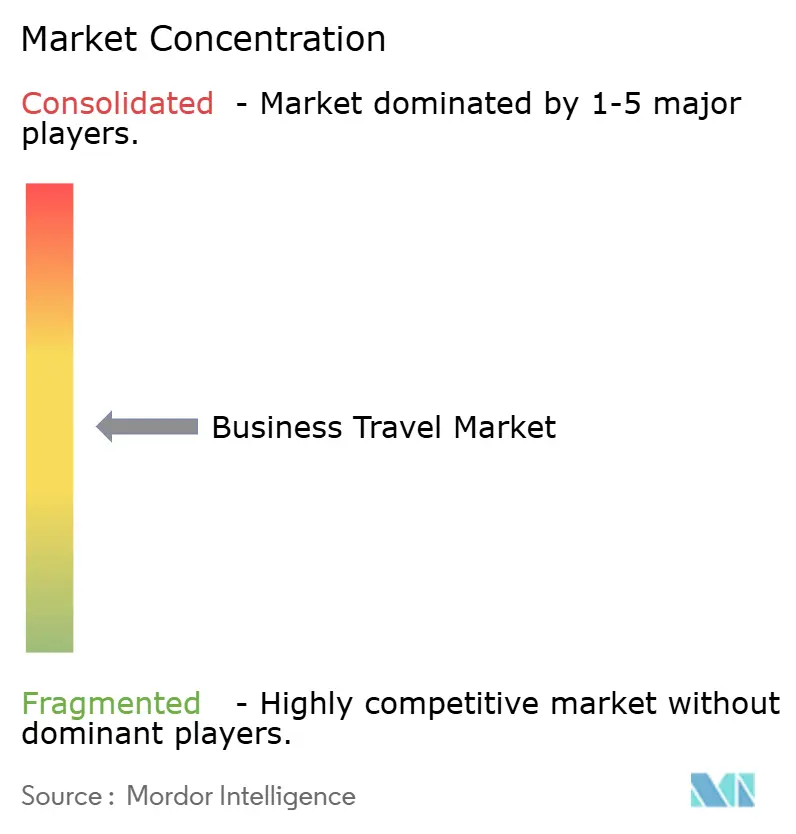
| Market Concentration | Medium |
Major Players *Disclaimer: Major Players sorted in no particular order Image © Mordor Intelligence. Reuse requires attribution under CC BY 4.0. | |
Business Travel Market Analysis by Mordor Intelligence
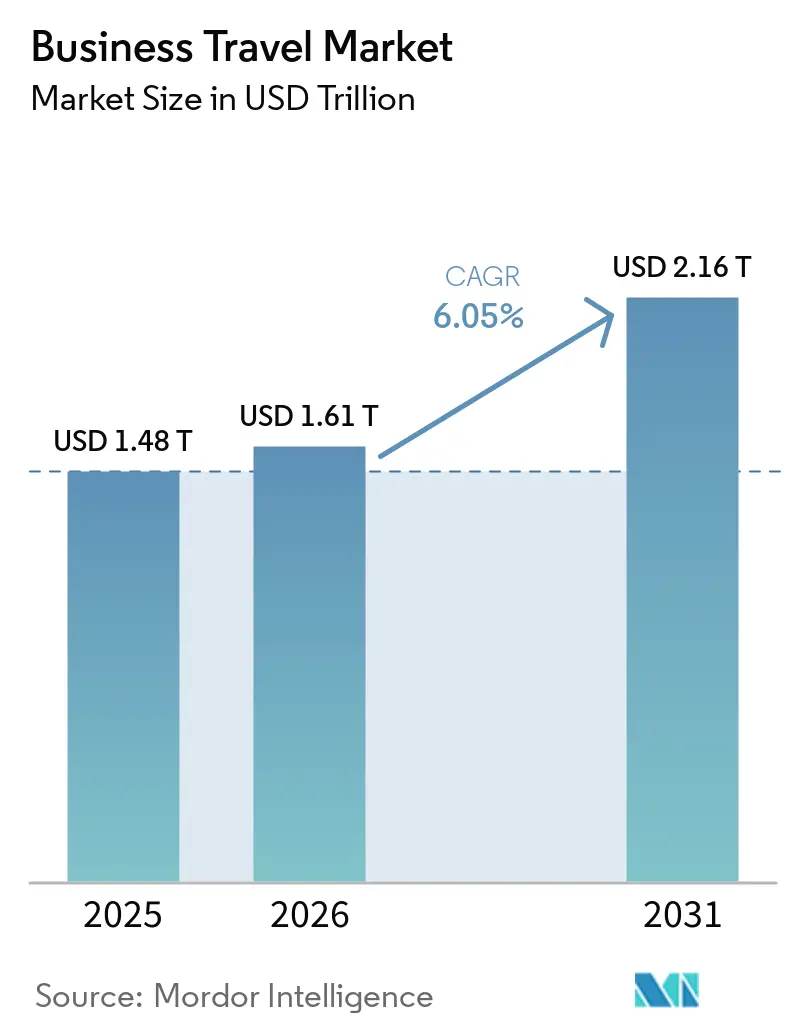
The Business Travel Market size is projected to expand from USD 1.48 trillion in 2025 and USD 1.61 trillion in 2026 to USD 2.16 trillion by 2031, registering a CAGR of 6.05% between 2026 to 2031.
The global business travel market is moving beyond a simple post-pandemic rebound, as demand is now shaped by changes in cross-border supply chains, client-facing travel needs, and the adoption of structured travel programs across large firms and mid-sized enterprises. International business travel volumes recovered to 91% of 2019 levels by Q3 2025, while domestic volumes reached 104% of pre-pandemic levels, indicating that the mix of trips has changed even as overall mobility continues to normalize. Premium travel demand is also becoming more important, as premium-class passenger yields and revenues continue to show strong resilience and an outsized contribution to airline margins, pointing to a stronger focus on trip value, executive productivity, and traveler experience rather than simple trip frequency. Competitive intensity remains high after American Express Global Business Travel’s acquisition of CWT in September 2025, and that scale shift is pushing the global business travel market toward platform-led competition, tighter enterprise servicing, and faster technology adoption.[1]
Key Report Takeaways
- By traveler type, Group Travelers held 62.3% of the global business travel market share in 2025, while the same segment is forecast to expand at an 8.9% CAGR through 2031.
- By trip purpose, Meetings & Events accounted for 41.0% of the global business travel market size in 2025, while Trade Shows/Exhibitions is advancing at a 9.7% CAGR through 2031.
- By service type, Transportation captured 48.2% of the global business travel market share in 2025, while Meetings & Events Services is projected to grow at a 7.5% CAGR through 2031.
- By industry, Corporate accounted for 78.1% of the global business travel market in 2025, and the same segment is projected to record a 9.1% CAGR through 2031.
- By geography, Asia-Pacific held a 39.2% share of the global business travel market in 2025, and the region is expected to register the fastest CAGR of 7.1% through 2031.
Note: Market size and forecast figures in this report are generated using Mordor Intelligence’s proprietary estimation framework, updated with the latest available data and insights as of January 2026.
Global Business Travel Market Trends and Insights
Drivers Impact Analysis*
| Drivers | (~) % Impact on CAGR Forecast | Geographic Relevance | Impact Timeline |
|---|---|---|---|
| Expansion of Cross-Border Corporate Activity and Client-Facing Travel Reinstatement | +1.5% | Global, concentrated in Asia-Pacific, North America, and emerging trade corridors | Medium term (2-4 years) |
| Shift From Ad Hoc Booking to Managed Travel Programs Across Mid-Market Enterprises | +1.2% | Global, strongest in North America and Europe | Short term (≤ 2 years) |
| Rise in MICE-Led Travel Demand and Event-Driven Mobility Recovery | +1.0% | Global, with the highest activity in Europe and Asia-Pacific | Short term (≤ 2 years) to Medium term (2-4 years) |
| AI-Enabled Travel Policy Compliance and Spend Control Adoption | +0.8% | Global, led by North America and Western Europe | Short term (≤ 2 years) to Medium term (2-4 years) |
| ESG-Linked Travel Procurement and Carbon Reporting Requirements | +0.6% | Europe-led, extending to North America and multinational programs globally | Medium term (2-4 years) |
| Growth in Premium Bleisure and Traveler Experience-Oriented Corporate Policies | +0.5% | Asia-Pacific, North America, and Western Europe | Short term (≤ 2 years) |
| Source: Mordor Intelligence | |||
Expansion of Cross-Border Corporate Activity and Client-Facing Travel Reinstatement
Cross-border business activity is a major driver of the global business travel market, as supplier diversification, new market entry, and client acquisition still depend on in-person visits. Companies are expanding operating footprints across newer business corridors, and Cartus found that 73% of firms identified business travelers as the most anticipated corporate mobility activity in 2026. The same survey placed India among the top new destinations for corporate moves, which supports a stronger India-linked demand outlook within the broader global business travel market. IATA data also showed that international business travel had not fully recovered to its 2019 level by Q3 2025, indicating there is still room for further recovery on cross-border corporate routes. GBTA’s 2025 study found that the United States firms could unlock USD 2.4 trillion in additional sales by optimizing business travel, reinforcing the commercial role of physical meetings in revenue generation and relationship building. This pattern supports continued demand for executive travel, supplier review visits, and client-facing travel programs across the global business travel market.
Shift From Ad Hoc Booking to Managed Travel Programs Across Mid-Market Enterprises
The shift from unmanaged bookings to formal travel programs is expanding the addressable market for global business travel, especially in the mid-market segment. CTM’s 2026 Corporate Travel Outlook showed that 80% of SMBs expected travel budget growth in 2026, compared with 59% of large enterprises, which signals stronger spending momentum outside the most mature enterprise accounts. This matters because a large part of mid-sized travel spending has historically been less structured, with lower policy compliance and weaker visibility on supplier performance. Internova’s ALTOUR launched ALTOUR One in June 2026 as a digital-first marketplace for growing businesses, with setup measured in days and a clear focus on policy control, payments, and duty of care. Easier implementation lowers the barrier for companies that want formal approval rules and negotiated content without the cost of a traditional large-enterprise deployment. In the global business travel market, this shift means more volume is moving into managed channels, where program oversight, analytics, and supplier monetization are stronger.
Rise In MICE-Led Travel Demand and Event-Driven Mobility Recovery
MICE demand remains a major pillar for the global business travel market, because events, conferences, and trade interactions continue to require physical attendance. The Events Industry Council reported that by Q4 2025, global hotel group room nights recovered to 97% of 2019 levels, while RFP activity moved above the pre-pandemic benchmark at 102% of 2019 levels. That forward booking pattern is important because it shows organizations are committing budget earlier and with more confidence than during the initial recovery period. The same industry barometer suggests that event pipelines remain active despite broader global complexity, supporting stronger demand visibility for venue sourcing, travel, lodging, and attendee management services. In the global business travel market, this supports not only trip volume but also higher-value service spending around group coordination, corporate hospitality, and event operations. For India-facing corporate activity, this matters because large meetings and partner gatherings remain central to regional sales, technology collaboration, and supplier engagement.
AI-Enabled Travel Policy Compliance and Spend Control Adoption
AI is becoming a practical operating tool in the global business travel market, with immediate use cases in disruption handling, compliance, itinerary management, and spend visibility. Research published in March 2026 by GBTA, Direct Travel, Marriott International, and Spotnana identified disruption management as the most immediate area of AI value for travel managers. This is important because disruptions affect traveler satisfaction, missed meetings, and cost leakage, which makes faster response a direct service advantage. BCD Travel launched its Model Context Protocol framework across Tripsource in May 2026, enabling natural language access to travel data and agentic AI support across booking, trip management, and program analytics. Navan also integrated AI travel agents into Gemini Enterprise in June 2026, enabling booking and trip management to be moved directly into daily productivity workflows. In the global business travel market, AI is not only improving user convenience but also speeding up decision cycles and changing how enterprise clients compare travel platforms.
Restraints Impact Analysis*
| Restraints | (~) % Impact on CAGR Forecast | Geographic Relevance | Impact Timeline |
|---|---|---|---|
| Video Conferencing Substitution for Routine Internal Meetings | -1.2% | Global, the highest impact in North America and Northern Europe | Medium term (2-4 years) to Long term (≥ 4 years) |
| Volatile Airfare, Hotel, and Ground Transport Costs | -1.0% | Global, most acute in Asia and Africa, where inflation pressure remains elevated | Short term (≤ 2 years) to Medium term (2-4 years) |
| Tightening Corporate Travel Budgets and ROI Scrutiny | -0.8% | Global, led by large enterprises in North America and Europe | Short term (≤ 2 years) |
| Visa Frictions, Geopolitical Disruptions, and Duty-Of-Care Complexity | -0.5% | International routes, particularly cross-border travel programs | Short term (≤ 2 years) to Medium term (2-4 years) |
| Source: Mordor Intelligence | |||
Video Conferencing Substitution for Routine Internal Meetings
Video conferencing remains a clear restraint for the global business travel market, especially for routine internal meetings and lower-priority coordination trips. SAP Concur’s 2025 survey found that 43% of CFOs believed more than half of their company’s travel could be replaced by virtual meetings, indicating strong financial pressure to substitute in some trip categories. The UK Government’s 2025 Business Travel Survey also found that 42% of organizations had already used video conferencing to reduce business trips. This restraint does not eliminate the need for client travel or participation in critical events, but it narrows the range of trips approved without deeper review. Over time, better collaboration tools may continue to limit travel for internal training, project updates, and recurring team reviews. For the global business travel market, the result is a more selective demand base with greater emphasis on trips that have clear revenue, compliance, or relationship value.[2]
Volatile Airfare, Hotel, and Ground Transport Costs
Travel cost inflation is exerting direct pressure on the global business travel market, as higher fares and room rates reduce the number of trips companies can fund within fixed budgets. SAP Concur reported in June 2026 that airfare rose more than 8% year over year, hotel rates increased nearly 6%, and car rental costs climbed around 5% in the January to May 2026 period. BCD Travel’s 2026 outlook also projected a 4.9% increase in global hotel average daily rates, further pressuring corporate lodging budgets. When budgets are set early, and supplier prices move faster than expected, travel managers are forced to tighten approval processes, shorten stays, or change trip mixes. This is especially relevant for long-haul travel linked to Asia and India, where airfare exposure can be significant for multinational programs. In the global business travel market, persistent pricing pressure underscores the value of managed sourcing, negotiated content, and alternative modal choices, such as rail when feasible.
*Our forecasts treat driver/restraint impacts as directional, not additive. The impact forecasts reflect baseline growth, mix effects, and variable interactions.
Segment Analysis
By Traveler Type: Group Mobility Is Reshaping Program Design
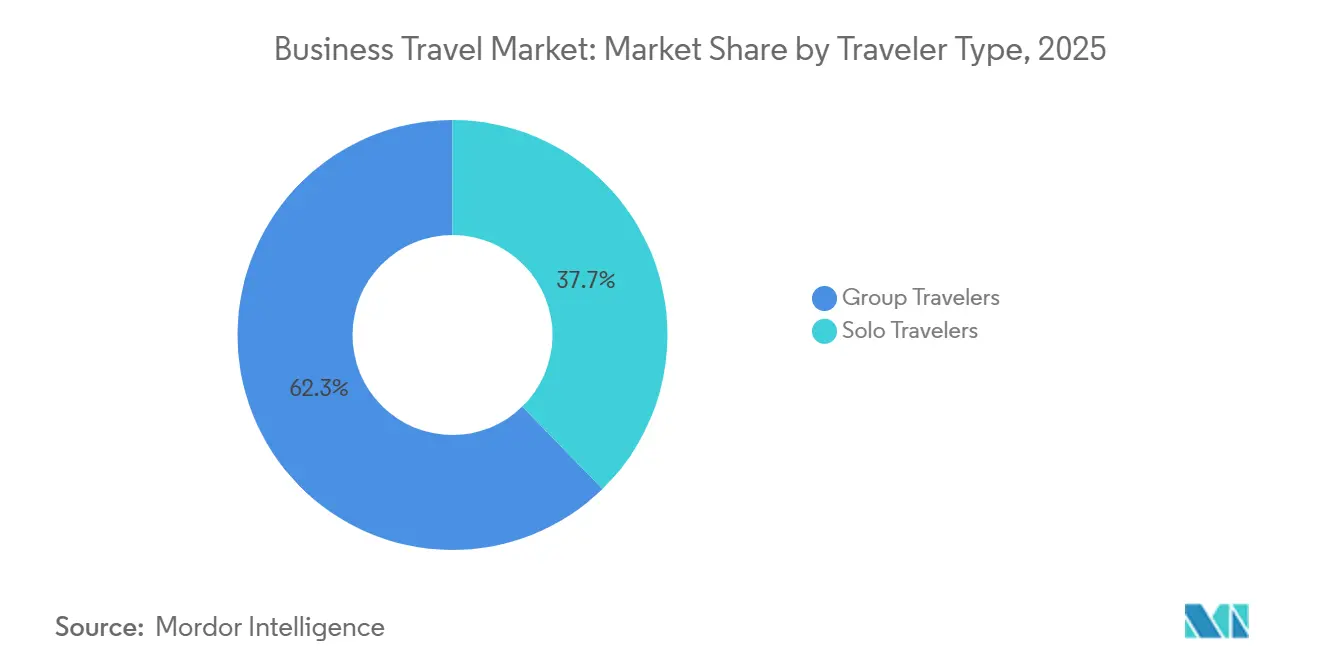
Group Travelers held 62.3% of the global business travel market in 2025, and the segment is projected to expand at an 8.9% CAGR through 2031. This means group travel is both the largest and the fastest-growing traveler segment in the current market structure. The shift reflects the growing importance of off-sites, joint client meetings, partner reviews, and large commercial events that involve multiple employees traveling together. In practical terms, the global business travel market is benefiting from demand that is less about isolated executive movement and more about coordinated team mobility. This pattern is relevant for India-linked travel programs as well, because multinational firms often send cross-functional teams for supplier visits, implementation work, and commercial expansion across the region.
Solo Travelers keeps the segment significant within the global business travel market even as group travel expands faster. Solo trips remain necessary for field sales, consulting work, audits, technical support, regulatory visits, and client servicing, where one person can complete the assignment efficiently. This segment often generates strong supplier value because travel patterns can be frequent, predictable, and more likely to include premium timing needs. Many corporate programs still depend on solo travel for day-to-day revenue support, especially in sectors with distributed account coverage or site-based operations. In India-related travel flows, solo travel remains common for sales visits, vendor qualification, service delivery, and internal coordination across fast-growing regional business centers.

By Trip Purpose: Events and Trade Activity Continue to Anchor Demand
Meetings & Events accounted for 41.0% of the global business travel market in 2025, making it the largest trip purpose segment. Trade Shows/Exhibitions is projected to grow at a 9.7% CAGR through 2031, which makes it the fastest-expanding purpose category in the forecast period. This mix shows that business travel still depends heavily on in-person engagement, where networking, negotiation, product evaluation, and relationship building take place. The global business travel market is therefore being supported by event infrastructure and commercial gatherings rather than by routine internal travel alone. For Indian firms and multinational companies active in India, this is relevant because exhibitions, partner events, and industry conferences remain key channels for sales development and supplier discovery.
Marketing trips, product launches, and other purpose-led travel categories continue to generate meaningful movement across the global business travel market. These categories can create high-value travel demand when launches, brand events, or customer activation programs depend on in-person execution. At the same time, they face higher ROI checks in 2026 because finance teams increasingly want clearer links between travel spending and measurable outcomes. Internal training and coordination travel remains more exposed to digital substitution, especially where collaboration tools can replace lower-priority trips. That makes purpose-based travel management more important, because not every trip category deserves the same budget treatment.
By Service Type: Transportation Leads While Event Services Gain Depth
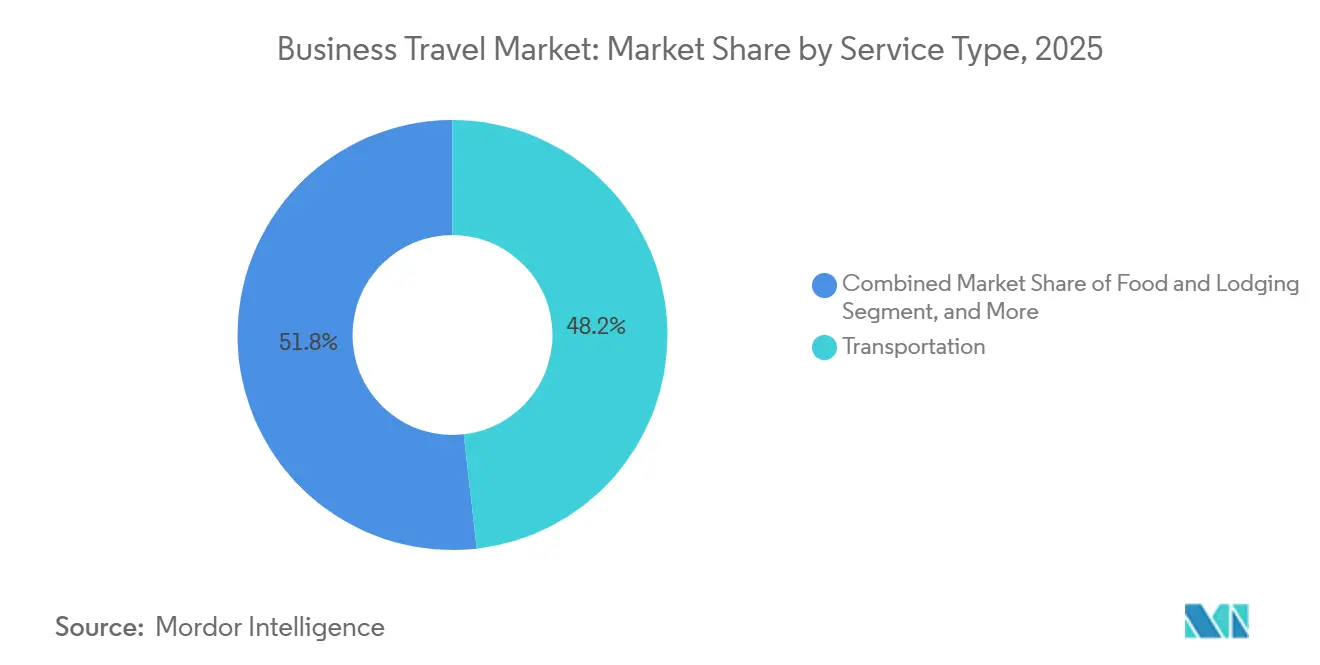
Transportation accounted for 48.2% of the global business travel market in 2025, making it the largest service segment by value. Meetings & Events Services is forecast to grow at a 7.5% CAGR through 2031, indicating that adjacent coordination services are gaining importance faster than the underlying travel base. This reflects a clear shift in buyer expectations, because enterprise clients increasingly want connected booking, attendee management, venue sourcing, and spend control. In the global business travel market, service differentiation is now tied as much to workflow integration as to ticketing or hotel access. India-connected travel programs also reflect this need, since project teams, sales events, and regional partner meetings often require travel and event services to work together.
Transportation continues to anchor spend because air, rail, and local mobility remain essential for nearly every business trip. Supplier access, fare optimization, traveler productivity, and disruption management all directly affect the commercial value of transportation services. For long-haul routes and intercity movement across the Asia-Pacific, transportation choices can materially influence trip approval, policy compliance, and total trip cost. This is why the global business travel market still relies heavily on transportation as the base layer of travel program economics. Even when digital tools improve booking efficiency, the underlying spend weight of transportation remains difficult to displace.
By Industry: Corporate Travel Dominates and Continues to Accelerate
Corporate accounted for 78.1% of the global business travel market size in 2025, and the same segment is projected to grow at a 9.1% CAGR through 2031. This makes corporate the clear center of demand, both in current scale and in future growth pace. The global business travel market is therefore being shaped primarily by private-sector expansion, client coverage strategies, supply chain reconfiguration, and structured employee mobility. In 2026, SAP Concur reported that 82% of CFOs planned to increase travel budgets, indicating that many firms still see travel as a growth enabler despite higher cost pressures. That commitment is important for India-related business corridors as well, because multinational and domestic corporates continue to invest in meetings, supplier engagement, and regional sales activity.
The corporate segment is also undergoing internal changes. CTM found that SMBs were more likely than large enterprises to expect travel budget growth in 2026, which suggests that the next layer of expansion may come from companies with smaller but faster-rising travel programs. This is commercially important for travel providers because mature enterprise accounts often grow more slowly and require heavier servicing. By contrast, mid-sized firms can still shift meaningful unmanaged or lightly managed volume into formal programs. In the global business travel market, this creates space for digital-first solutions that enable faster onboarding and lower operational complexity.
Geography Analysis
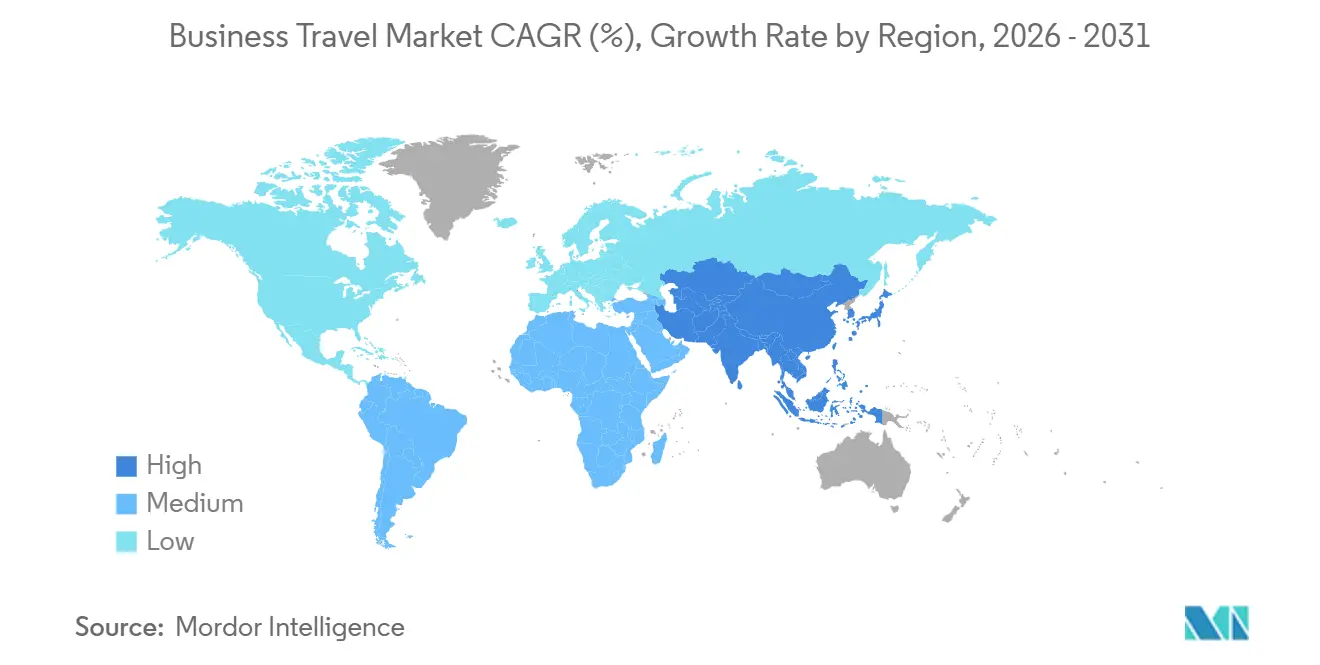
Asia-Pacific held 39.2% of the global business travel market share in 2025, and the region is projected to post the fastest CAGR at 7.1% through 2031. This regional lead matters because Asia-Pacific combines manufacturing growth, digital services expansion, rising business mobility, and deep trade linkages across developed and emerging economies. The global business travel market is therefore increasingly influenced by travel corridors connected to China, India, Southeast Asia, South Korea, and Singapore. India is especially important within this regional mix because it is becoming a larger destination for supplier diversification, corporate mobility, and cross-border commercial activity. IATA’s recovery data also supports the region’s growth backdrop, as international business travel still had further room to recover by late 2025, while domestic travel had already surpassed pre-pandemic levels.
North America remains a major pillar of the global business travel market, even though Asia-Pacific leads in current share and forecast growth. GBTA reported that the United States reclaimed the top single-country position in 2025 in business travel spending, underscoring the scale of corporate activity in the region. Europe remains strategically important because travel programs with stronger sustainability expectations, a greater role for rail, and tighter disclosure requirements in multinational operating models are shaping it. Together, North America and Europe continue to shape sourcing, technology adoption, sustainability rules, and premium travel behavior across the global business travel market.
South America, the Middle East, and Africa account for a smaller share of the global business travel market, but both regions remain important for future corridor development and supplier expansion. These regions also illustrate how market opportunities can expand rapidly when business travel demand is supported by energy, construction, trade, or public investment cycles. For multinational companies with India-linked operations, these geographies are relevant because trade, sourcing, and project deployment often connect them to Asia-based decision centers. The global business travel market, therefore, remains geographically diverse. Still, Asia-Pacific remains the main growth engine, while North America and Europe retain their influence in scale, program sophistication, and policy design.[3]
Competitive Landscape
The global business travel market remains layered, with scale concentrated among large enterprise travel management companies, while digital challengers continue to push into faster-growing client pools. American Express Global Business Travel remained the strongest large-scale player in this structure, and Long Lake Management agreed in May 2026 to acquire the company for USD 6.3 billion, underscoring the strategic value of travel platforms with broad managed travel reach and deep enterprise relationships. This development suggests that the next phase of competition in the global business travel market will be shaped more by platform strength, AI capability, and integrated servicing than by supplier access alone. For India-based corporate buyers, this shift is relevant because travel procurement is increasingly tied to policy control, traveler service quality, and the ability to manage domestic and international trips through a single operating environment.
The competitive landscape is therefore moving toward fewer large platforms at the top, while technology differentiation becomes increasingly important for winning enterprise travel programs. Technology-led competition is also widening across the global business travel market as providers extend both product scope and geographic reach. Navan strengthened that position in June 2026 through its agreement to acquire Smartrips in Brazil, expanding its presence in Latin America and advancing its ambition for a cross-border platform.
SAP Concur also moved the market toward a more connected enterprise model in March 2026, when it announced Joule AI integration with Microsoft 365 Copilot and additional upgrades linked to the Complete platform developed with Amex GBT. These developments show that competition is no longer limited to booking and fulfillment, as vendors now compete on AI-enabled workflows, expense integration, and enterprise compliance support. For Indian enterprises, this underscores the importance of choosing travel platforms that support policy enforcement, cost visibility, and scalable services across both regional and global travel corridors.
Business Travel Industry Leaders
-
American Express Global Business Travel
-
BCD Travel
-
CTM (Corporate Travel Management)
-
Internova Travel Group
-
Direct Travel
- *Disclaimer: Major Players sorted in no particular order
Recent Industry Developments
- June 2026: Navan announced a definitive agreement to acquire Smartrips, Brazil's leading travel management company, marking Navan's first acquisition since its public listing in October 2025 and extending its footprint into Latin America's largest and fastest-growing corporate travel market. The transaction is expected to close in Q2 fiscal year 2027.
- June 2026: Navan launched Navan Anywhere, integrating its AI travel agents into Gemini Enterprise on the Google Cloud Marketplace, enabling corporate travelers to plan, book, and manage trips directly within enterprise productivity environments without accessing a dedicated TMC interface.
- May 2026: Long Lake Management, backed by General Catalyst and Alpha Wave, agreed to acquire Amex GBT for USD 6.3 billion in an all-cash transaction at USD 9.50 per share, a 60.2% premium over the May 1, 2026 closing price, supported by American Express, Expedia, QIA, and BlackRock.
- May 2026: Navan unveiled a suite of AI-powered features at its inaugural Navigate conference, including "Book with AI," video-and-voice expense capture, and Travel & Finance Admin Companions, targeting complete elimination of manual workflows across the travel and expense lifecycle.
Global Business Travel Market Report Scope
| Solo Travelers |
| Group Travelers |
| Meetings & Events |
| Marketing |
| Trade Shows/Exhibitions |
| Product Launch |
| Other Purposes |
| Transportation |
| Food & Lodging |
| Meetings and Events |
| Recreation |
| Corporate |
| Government |
| North America | United States |
| Canada | |
| Mexico | |
| South America | Brazil |
| Peru | |
| Chile | |
| Argentina | |
| Rest of South America | |
| Europe | United Kingdom |
| Germany | |
| France | |
| Spain | |
| Italy | |
| BENELUX (Belgium, Netherlands, and Luxembourg) | |
| NORDICS (Denmark, Finland, Iceland, Norway, and Sweden) | |
| Rest of Europe | |
| Asia-Pacific | India |
| China | |
| Japan | |
| Australia | |
| South Korea | |
| South East Asia (Singapore, Malaysia, Thailand, Indonesia, Vietnam, and Philippines) | |
| Rest of Asia-Pacific | |
| Middle East and Africa | United Arab Emirates |
| Saudi Arabia | |
| South Africa | |
| Nigeria | |
| Rest of Middle East and Africa |
| By Traveler Type | Solo Travelers | |
| Group Travelers | ||
| By Trip Purpose | Meetings & Events | |
| Marketing | ||
| Trade Shows/Exhibitions | ||
| Product Launch | ||
| Other Purposes | ||
| By Service Type | Transportation | |
| Food & Lodging | ||
| Meetings and Events | ||
| Recreation | ||
| By Industry | Corporate | |
| Government | ||
| By Geography | North America | United States |
| Canada | ||
| Mexico | ||
| South America | Brazil | |
| Peru | ||
| Chile | ||
| Argentina | ||
| Rest of South America | ||
| Europe | United Kingdom | |
| Germany | ||
| France | ||
| Spain | ||
| Italy | ||
| BENELUX (Belgium, Netherlands, and Luxembourg) | ||
| NORDICS (Denmark, Finland, Iceland, Norway, and Sweden) | ||
| Rest of Europe | ||
| Asia-Pacific | India | |
| China | ||
| Japan | ||
| Australia | ||
| South Korea | ||
| South East Asia (Singapore, Malaysia, Thailand, Indonesia, Vietnam, and Philippines) | ||
| Rest of Asia-Pacific | ||
| Middle East and Africa | United Arab Emirates | |
| Saudi Arabia | ||
| South Africa | ||
| Nigeria | ||
| Rest of Middle East and Africa | ||
Key Questions Answered in the Report
What is the size outlook for the global business travel space through 2031?
The global business travel market size is expected to increase from USD 1.48 trillion in 2025 to USD 1.61 trillion in 2026 and reach USD 2.16 trillion by 2031, growing at a 6.05% CAGR.
Which traveler type leads demand worldwide?
Group Travelers led with 62.3% share in 2025 and are also the fastest-growing traveler type with an 8.9% CAGR through 2031.
Why are meetings and events still important for corporate travel demand?
Meetings & Events held the largest trip purpose share at 41.0% in 2025, and industry event booking activity moved above 2019 levels by late 2025, indicating continued preference for in-person engagement.
Which region is growing fastest in business travel?
Asia-Pacific held the largest regional share at 39.2% in 2025 and is projected to record the fastest CAGR at 7.1% through 2031.
What is the biggest restraint on future corporate travel growth?
Video conferencing remains the strongest restraint for routine internal trips, with 43% of CFOs saying more than half of company travel could be replaced by virtual meetings.
How is AI changing travel management platforms?
AI is being used for disruption handling, booking support, data access, and policy compliance, with examples including BCD Travel’s MCP framework and Navan’s Gemini Enterprise integration in 2026.