
Boring Tools Market Size and Share
Market Overview
| Study Period | 2022 - 2032 |
|---|---|
| Market Size (2027) | USD 6.54 Billion |
| Market Size (2032) | USD 8.44 Billion |
| Growth Rate (2027 - 2032) | 5.23 % |
| Fastest Growing Market | Asia-Pacific |
| Largest Market | Asia-Pacific |
| Market Concentration | Medium |
Major Players *Disclaimer: Major Players sorted in no particular order Image © Mordor Intelligence. Reuse requires attribution under CC BY 4.0. | |
Boring Tools Market Analysis by Mordor Intelligence
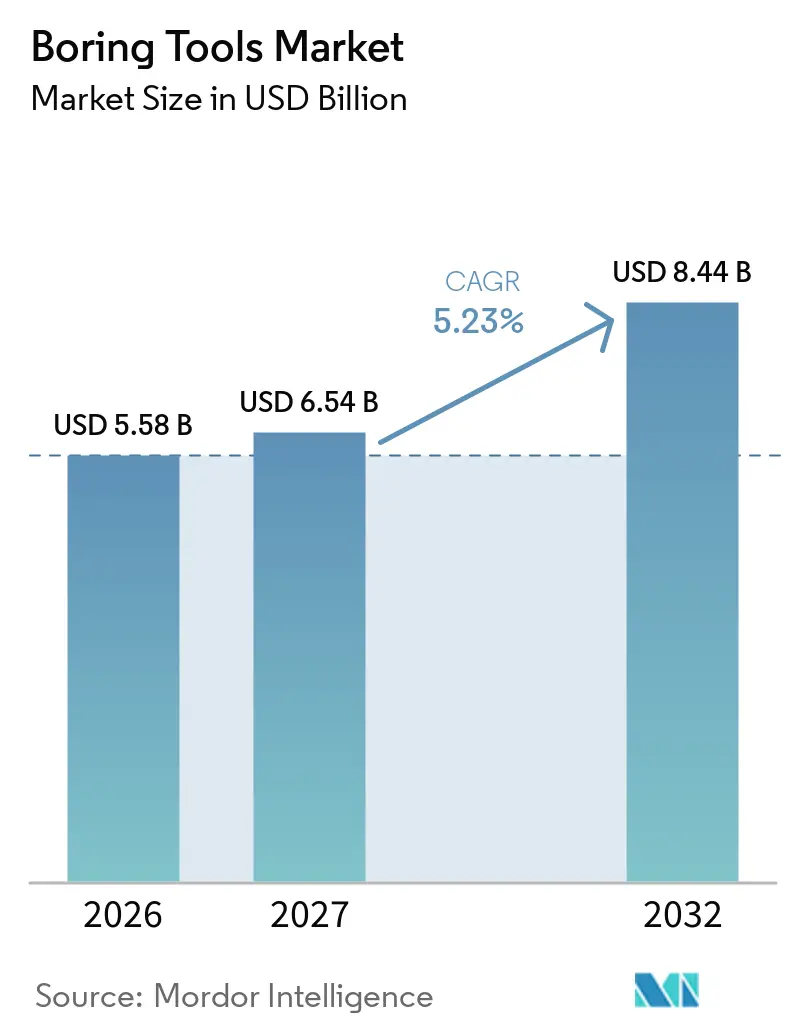
The boring tools market size was valued at USD 5.58 billion in 2026 and is estimated to grow from USD 6.54 billion in 2027 to reach USD 8.44 billion by 2032, at a CAGR of 5.23% during the forecast period (2027-2032). Infrastructure work, precision manufacturing, and energy projects support demand for equipment used in fine boring, rough boring, CNC operations, and field applications. Purchases increasingly depend on the ability to meet tight tolerances, document process capability, and reduce unplanned downtime. Suppliers are responding through modular systems, digital monitoring, and tool materials suited to aluminum, composites, titanium, and hard rock. Input costs and supply availability remain important because carbide and diamond-based products are more expensive than standard alternatives. The Boring Tools Market also has different demand patterns across factory machining, underground construction, and mineral exploration.
Key Report Takeaways
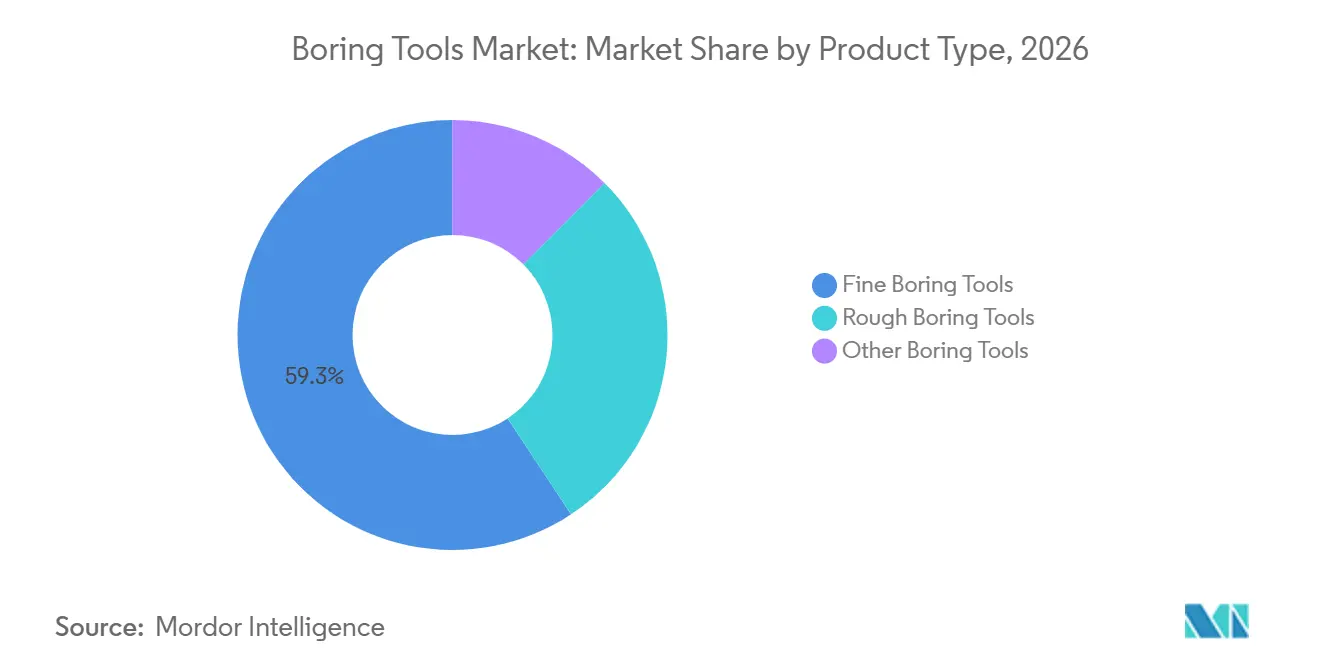
- By product type, fine boring tools held 59.3% of the boring tools market share in 2026 and are projected to record the highest CAGR of 5.9% through 2032.
- By tool material, carbide boring tools held 56.4% of the boring tools market share in 2026, while polycrystalline diamond (PCD) boring tools are projected to record the highest CAGR of 6.1% through 2032.
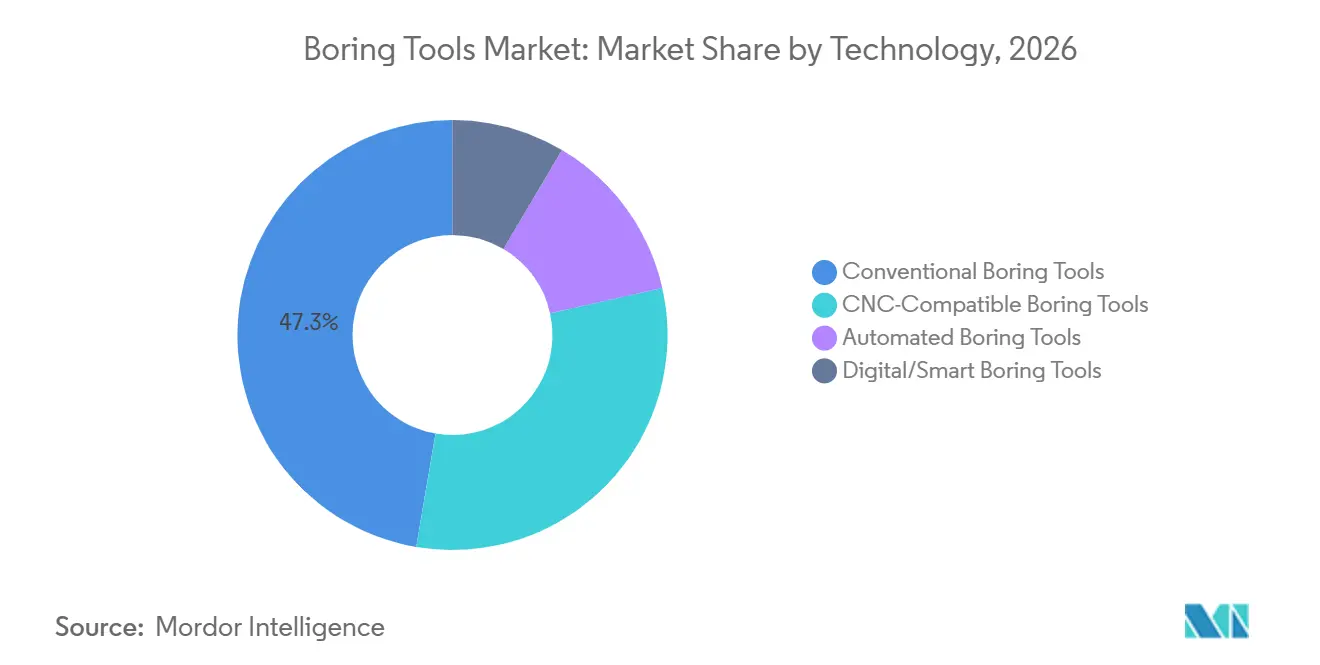
- By technology, CNC-compatible boring tools accounted for 47.3% of market revenue in 2026, while digital and smart boring tools are projected to record the highest CAGR of 7.5% through 2032.
- By tool configuration, single-point boring tools accounted for 33.1% of market revenue in 2026, while modular boring tools are projected to record the highest CAGR of 5.7% through 2032.
- By deployment type, stationary boring tools accounted for 66.5% of market revenue in 2026, while portable boring tools are projected to record the highest CAGR of 6.3% through 2032.
- By application, precision boring accounted for 28.6% of market revenue in 2026, while tunnel and underground boring are projected to record the highest CAGR of 5.6% through 2032.
- By end user, the automotive sector accounted for 29.7% of market revenue in 2026, while the aerospace and defense sector is projected to record the highest CAGR of 6.7% through 2032.
- By geography, Asia-Pacific accounted for 39.5% of market revenue in 2026 and is projected to record the highest CAGR of 6.1% through 2032.
Note: Market numbers in this report are based on Mordor Intelligence's proprietary estimation framework, which combines nine months of actuals with Q4 projections for base year 2026.
Market Trends and Insights
Drivers Impact Analysis of Boring Tools Market*
| Driver | (~) % Impact on CAGR Forecast | Geographic Relevance | Impact Timeline |
|---|---|---|---|
| Infrastructure, Tunneling, and Utility Expansion | +1.1% | Global, with near-term concentration in Asia-Pacific and Western Europe | Medium term (2-4 years) |
| CNC Boring and Precision Machining Adoption | +0.9% | Global, strongest in North America, Germany, Japan, and South Korea | Short term (≤ 2 years) |
| Critical-Mineral Exploration and Deeper Mining | +0.7% | Asia-Pacific and Latin America, with spillover to Sub-Saharan Africa | Medium term (2-4 years) |
| Automation, Digital Monitoring, and Predictive Maintenance | +0.6% | North America, Europe, and Asia-Pacific manufacturing clusters | Medium term (2-4 years) |
| Modular Tooling for Variable Geological Conditions | +0.5% | Global tunnel and underground boring applications | Long term (≥ 4 years) |
| Geothermal, Offshore Wind, and Underground Energy Development | +0.4% | Asia-Pacific, Northern Europe, and the western United States | Long term (≥ 4 years) |
| Source: Mordor Intelligence | |||
Infrastructure, Tunneling, and Underground Utility Expansion Extend Boring Tool Demand
Tunnel, utility, and related underground projects create recurring demand for boring consumables and replacement tooling. The Boring Tools Market benefits when projects need to manage changing rock and soil conditions rather than use a single fixed configuration. Smaller utility corridors for high-voltage cables, fiber networks, and district heating increase the relevance of modular heads and interchangeable components. These jobs differ from large transport tunnels because the work often requires more frequent adjustments during operation. The resulting demand helps reduce dependence on short-term cycles in factory machining. It also gives suppliers opportunities to serve contractors that need tools for both installation and maintenance work.
CNC Boring and Precision Machining Adoption Reshapes the Tool Specification Baseline
Electric vehicle production is changing the requirements for precision boring in motor housing and related components. Aluminum enclosures need controlled bore geometry because deviations can affect motor efficiency. This raises the value of CNC-compatible equipment that can produce repeatable results and supporting documentation. Kennametal developed an additive-manufactured stator boring tool that reduced tool weight from more than 25 kg to 10.7 kg.[1] ISO 9001 requirements and customer process records also reinforce the need for documented machining procedures. The Boring Tools Market therefore favors vendors that combine tooling design with application support and traceable process data.
Automation, Digital Monitoring, and Predictive Maintenance Redefine Tool Lifecycle Economics
Sensors in boring bars can turn a conventional consumable into an asset that is monitored through its working life. A 2025 study of a CNC digital-twin framework reported that multi-sensor fusion improved fault-detection F1 scores from 0.811 to 0.892 and reduced remaining-useful-life estimation error by 22%.[2] These capabilities can reduce tool-change downtime and lower the risk of rejected workpieces. Digital and smart boring tools are forecast to grow at a 7.5% CAGR through 2031, faster than the overall Boring Tools Market. The WGP AutoBohr program in Germany is developing autonomous monitoring for single-part boring and machine responses to wear.[3] ISO 13399 provides a common basis for representing tool data across multi-OEM supply chains.
Geothermal, Offshore Wind, and Underground Energy Development Create Non-Cyclical Demand
Energy projects broaden demand beyond conventional manufacturing cycles. The IEA Geothermal report identifies Polycrystalline Diamond Compact (PDC) tooling as important for enhanced geothermal systems that operate above 400 °C.[4] Offshore wind construction also requires large-diameter boring systems for foundation and monopile work. Turbines exceeding 15 MW need specialized deep-hole boring solutions for large main-shaft bore diameters. A 2024 scientific study found that foundation boring rates materially affect wind-farm installation costs and schedules. These applications support demand for corrosion-resistant and high-temperature tooling in the Boring Tools Market.
Restraints Impact Analysis of Boring Tools Market*
| Restraint | (~) % Impact on CAGR Forecast | Geographic Relevance | Impact Timeline |
|---|---|---|---|
| High Tooling Costs and Long Replacement Payback | -0.4% | Global, most acute in SME-led Asia-Pacific and South American markets | Short term (≤ 2 years) |
| Volatility in Tungsten Carbide, Alloy Steel, and Diamond Inputs | -0.6% | Global, most severe in import-dependent markets outside China | Short term (≤ 2 years) |
| Tool Qualification Across Mixed Ground Conditions | -0.3% | Global tunnel and mining boring applications | Medium term (2-4 years) |
| Fragmented Digital Tool Performance Data Standards | -0.2% | Global, with greatest effect in early-stage smart-factory markets | Long term (≥ 4 years) |
| Source: Mordor Intelligence | |||
Volatility in Tungsten Carbide, Alloy Steel, and Diamond Inputs Creates Procurement Risk
Carbide and diamond inputs are critical to premium boring tool performance, but their prices and availability can limit adoption. China tightened tungsten export licensing in January 2026, increasing supply planning needs for buyers outside the country. The 2025 global tungsten first-use demand estimate was 162 kt WO₃, with cemented carbides accounting for 64% of the total.[5] Longer license timelines make just-in-time purchasing less practical and increase inventory-carrying costs. U.S. defense rules scheduled for January 1, 2027 will prohibit tungsten sourcing from designated countries, creating additional supply-chain changes. The Boring Tools Market is likely to reward suppliers that secure material supply and manage qualification requirements for alternative sources.
High Tooling Costs and Extended Payback Periods Limit Premium Tool Penetration
Digital systems and Polycrystalline Diamond (PCD) or Cubic Boron Nitride (CBN) products can require multiyear payback periods that many smaller job shops cannot support. Large automotive and aerospace suppliers can use total-cost-of-hole contracts to assess the benefits of longer tool life and lower downtime. Smaller operators often choose conventional alternatives when they lack predictable long-run production contracts. This creates a two-tier customer base, with premium adoption concentrated among larger and better-funded manufacturers. Mixed geological conditions create a further qualification burden for tunneling and utility contractors. The Boring Tools Market can grow in volume while high-specification vendors still face limits on margin expansion and premium penetration.
*Our forecasts treat driver/restraint impacts as directional, not additive. The impact forecasts reflect baseline growth, mix effects, and variable interactions.
Boring Tools Market Segment Analysis
By Product Type:
Fine Boring Anchors High-Margin Precision MachiningFine boring tools held 59.3% of 2026 product-type revenue and are forecast to expand at a 5.9% CAGR through 2032. This product group therefore led both current value and projected growth within the Boring Tools Market size for product types. Its position reflects use in automotive electric-powertrain machining, aerospace titanium finishing, and industrial bore finishing. These applications require tight diameter tolerances, including ±0.002 mm or tighter in some documented quality frameworks. AS9100 and ISO 9001 requirements also make process control relevant to supplier selection. Fine boring suppliers can compete through consistency, tool life, application engineering, and documented performance.
Rough boring tools provide the earlier material-removal stage in multistep machining processes. Their demand follows activity in construction machinery components, large engine blocks, and tunnel-boring-machine cutterhead housings. Combination boring-facing tools serve specialized geometries in oil and gas valve bodies and marine-engine bore production. Kennametal introduced KAF82 in September 2026, a fully dense additive tungsten carbide grade intended for hole-finishing tools. The company stated that the process can reduce custom tool production time from months to weeks. Aerospace and automotive contracts remain concentrated among vendors that meet formal qualification and process-capability requirements.

By Tool Material:
Carbide Dominates but Polycrystalline Diamond (PCD) Gains Ground as the Specification Upgrade PathCarbide boring tools accounted for 56.4% of 2026 tool-material revenue. This gave carbide the largest Boring Tools Market share among tool materials because it balances hardness and cost for steel, cast iron, and aluminum workpieces. High-Speed Steel (HSS) remains relevant for low-volume job shops where purchase cost has more weight than tool performance. Ceramic boring tools support high-speed dry machining of hardened steels. CBN inserts are used in hardened-steel and nickel-superalloy applications, especially aerospace and energy turbine finishing. Each material serves a different balance of initial tool cost, wear resistance, finish quality, and machining speed.
PCD boring tools are forecast to expand at a 6.1% CAGR through 2032. This growth reflects rising non-ferrous and composite machining in electric vehicles and aerospace production. PCD can provide longer tool life in aluminum, CFRP, and metal-matrix composites than carbide in high-volume operations. The higher initial price can be offset by a lower cost per hole when replacement intervals are longer. Mitsubishi Materials introduced new small-diameter boring bars in solid carbide and steel for Swiss-type automatic lathes in 2026. The launch supports precision micro-part work for medical-device and electronics customers.
By Technology:
CNC Boring Tools Remain the Volume Foundation While Digital Systems Lead GrowthCNC-compatible boring tools represented 47.3% of 2026 technology revenue. They form the volume base of the Boring Tools Market because CNC machining centers are widely used in automotive, aerospace, and industrial production. Conventional tools remain relevant in developing regions and small-batch work. Automated boring systems are gaining use in high-throughput automotive production cells. Together, these categories support stable demand and fund investment in advanced tool platforms. Tool vendors must still match their products with machine controls, quality records, and production workflows.
Digital and smart boring tools are forecast to grow at a 7.5% CAGR through 2032. Embedded vibration sensors and wireless transmission can alert manufacturing-execution systems to wear before a dimensional rejection occurs. This supports lower scrap rates and less machine downtime in precision work. A 2026 academic publication described cutterhead digital-twin methods for design and assembly simulation optimization. ISO 13399 remains relevant to data exchange across multi-OEM supply chains. Fragmented interoperability remains a restraint where smart-factory implementation is at an early stage.
By Tool Configuration:
Modular Boring Systems Gain Ground as Production Flexibility Becomes CriticalSingle-point boring tools held 33.1% of 2026 configuration revenue. Their broad use in standard cylindrical-bore turning established the largest share of the Boring Tools Market among configuration categories. Multi-point tools support roughing and semi-finishing in automotive cylinder-block machining. Adjustable tools provide diameter flexibility in workplaces with frequent changeovers. Fixed tools provide stability in high-volume production of a single bore size. These alternatives address different needs for flexibility, throughput, setup time, and dimensional repeatability.
Modular boring tools are forecast to grow at a 5.7% CAGR through 2032. Shorter production runs and expanding electric-vehicle platforms raise the value of quick-change tooling that limits machine downtime. Kennametal expanded its modular drilling system during spring 2026 with new coolant-channel geometries and broader adapter compatibility. This development shows that adapter range and system compatibility are becoming product differentiators. Adaptive operating designs also point toward systems that can respond to changing conditions. Such capabilities are particularly relevant in tunnel and underground work, where ground conditions can vary within a project.
By Deployment Type:
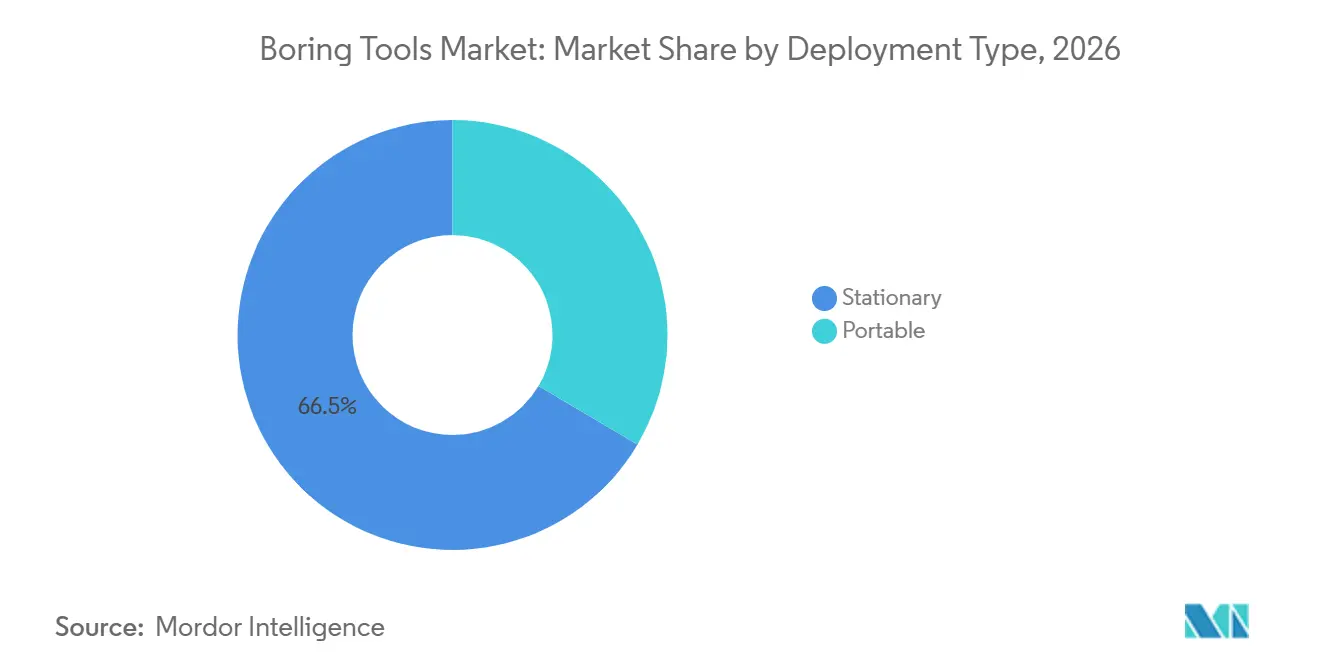
Portable Boring Tools Expand Into Field Demand Beyond the Factory FloorStationary boring tools accounted for 66.5% of 2026 deployment revenue. This Global Boring Tools Market share reflects the concentration of automotive, aerospace, and industrial-machinery work on fixed machine platforms. Horizontal and vertical boring mills provide rigidity and vibration control in factory environments. These conditions are important for components that need repeatable bore geometry. Stationary equipment forms the durable volume base for machining applications. It also supports established purchasing relationships between tool suppliers and factory operators.
Portable boring tools are forecast to grow at a 6.3% CAGR through 2032. They serve field maintenance, tunnel and utility construction, and resource extraction where workpieces cannot be moved to a machining center. Vedanta commissioned India’s first high-speed portable rig for critical-mineral exploration in Chhattisgarh in August 2026. The company stated that the rig can drill to 1,000 meters, compared with a typical 300-400 meter range. This application shows why field equipment performance matters when exploration programs move deeper.
By Application:
Precision Boring Leads Value While Tunnel and Underground Boring Drives Volume GrowthPrecision boring held 28.6% of 2026 application revenue. It led the Boring Tools Market share by application because automotive and aerospace contracts often specify premium tools and shorter replacement cycles. Hole enlargement and finishing are used in intermediate and final operations for engine components, transmission housings, and structural aircraft parts. Rough boring supports initial material removal in heavy engineering. Rock drilling uses percussion boring tools in mining, quarrying, and geothermal formation penetration. Application demand therefore combines high-value finishing work with heavy-duty material removal and ground-penetration requirements.
Tunnel and underground boring is forecast to grow at a 5.6% CAGR through 2032. China Railway Science & Industry Group and Tsinghua University launched a boring and blasting machine in Wuhan in August 2026. The machine combines full-face tunnel-boring methods with drill-and-blast capability for mixed geological conditions. Hybrid systems can create demand for configurations that operate across hard rock and softer ground. This makes adaptability an important requirement for suppliers serving underground projects.
By End User:
Automotive Retains Scale While Aerospace Defines the Premium Growth ThesisAutomotive accounted for 29.7% of 2026 end-user revenue. This made automotive the largest source of Boring Tools Market size among the listed end-user groups. Demand comes from engine blocks, cylinder heads, transmission housings, and electric-motor housings. General machinery is the next-largest category and includes pumps, compressors, and gearboxes. Construction and mining create demand linked to infrastructure intensity. Energy, oil and gas, and marine customers require tools for turbine casings, valve bodies, and ship-engine bore finishing.
Aerospace and defense is forecast to grow at a 6.7% CAGR through 2032. Boeing and Airbus backlogs exceeded 10,000 aircraft, supporting future precision capacity for titanium frames, wing spars, and turbine casings. AS9100 Rev D requirements administered through the International Aerospace Quality Group require process-capability studies from suppliers. This reinforces procurement barriers for suppliers without the necessary certifications. The segment favors tools that can maintain accuracy in titanium and superalloy machining. It also supports sales of products with longer qualification cycles and stronger application-engineering requirements.
Geography Analysis
APAC Boring Tools Market
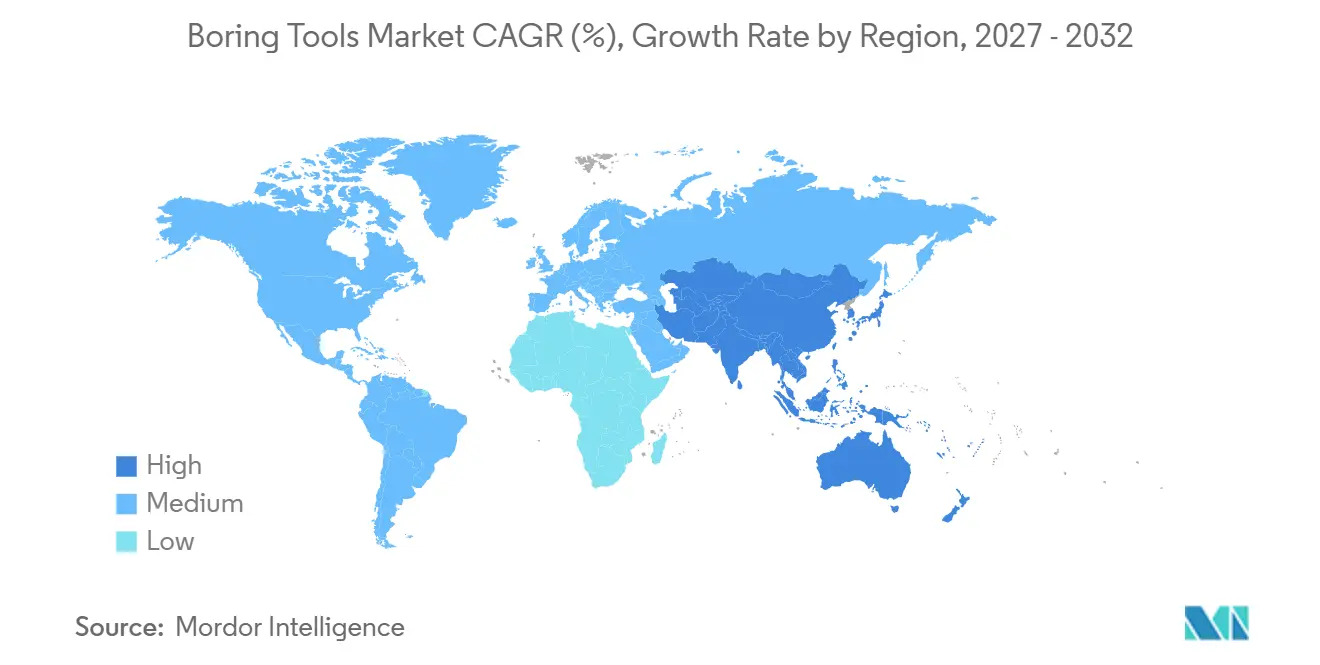
Asia-Pacific held 39.5% of global revenue in 2026 and is forecast to grow at a 6.1% CAGR through 2032. The region therefore represents both the largest Boring Tools Market share and the fastest-growing major geography. China supports demand through automotive manufacturing, commercial aviation activity, and defense-related aerospace production. India is an emerging secondary demand center with an expanding CNC machining base. Vietnam, Indonesia, and Thailand are also adding demand as Japanese and Korean automotive original equipment manufacturers expand regional sourcing.
APAC, North America and Europe Boring Tools Market
The IEA reported that Asia-Pacific was the only major region to increase critical-mineral exploration spending in 2025, with spending up 20%. This supports portable boring-tool procurement across Australia, Indonesia, and Central Asian territories. North America and Europe remain the technology-premium tier for the Boring Tools Market. North American demand is concentrated in aerospace machining, electric-motor housings, and energy maintenance. Germany supports European demand through precision machining, while France, Italy, the United Kingdom, and Poland add aerospace, defense, and heavy-engineering activity.
The Americas and EMEA Boring Tools Market
U.S. tungsten sourcing restrictions scheduled for January 2027 are reshaping carbide procurement plans. European producers also consider Critical Raw Materials Act requirements when planning sourcing strategies. The Middle East draws demand from oil and gas component machining and infrastructure work in Saudi Arabia and the United Arab Emirates. African demand is linked to exploration programs for copper, platinum group elements, and rare earths in South Africa, Egypt, Nigeria, and Morocco. Brazil, Chile, and Peru support South American demand through copper and lithium development. Stillwater Critical Minerals expanded its 2026 exploration program at Stillwater West in Montana by adding a third drill rig.
Competitive Landscape
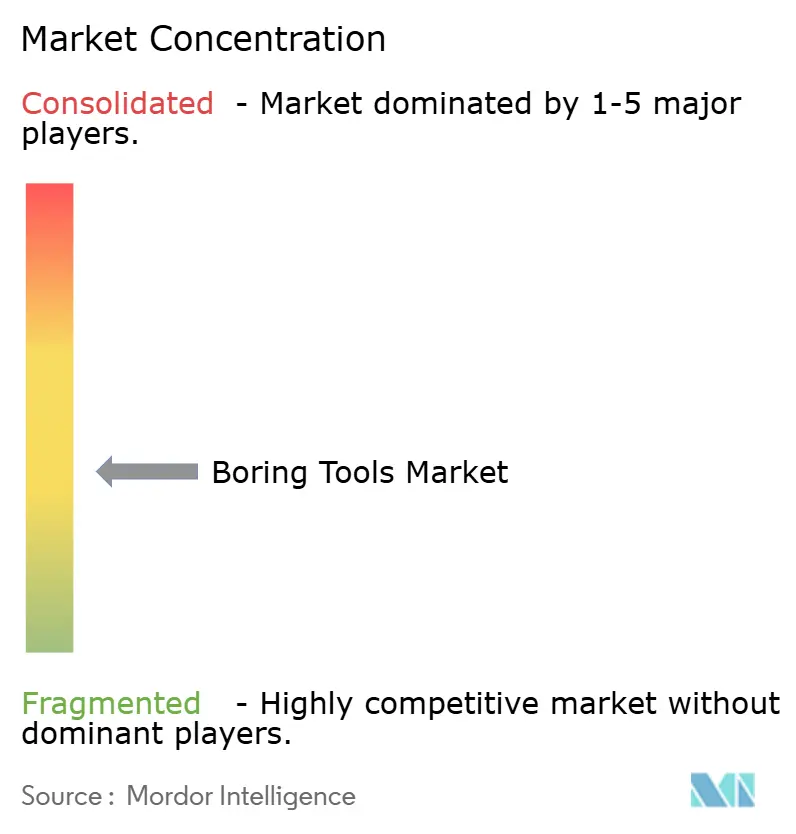
The global boring tools market is moderately fragmented because no supplier holds a dominant position across precision machining and tunnel or underground boring. Kennametal, Sandvik Coromant, and Mitsubishi Materials compete in precision machining through carbide-grade performance, digital capability, and application support. Herrenknecht, Epiroc, and Sandvik Mining and Rock Solutions operate in capital-intensive tunnel and underground equipment. Boart Longyear and Mincon serve exploration-drilling consumables. Chinese, Taiwanese, and South Korean suppliers compete in standard-grade applications. Their presence pressures margins for European and North American suppliers that concentrate on premium specifications.
Competition is increasingly centered on technology and capability rather than only product range. Mincon entered a 3-year exclusive collaboration with Epiroc to integrate its Hybrid Impact Technology into Epiroc Pit Viper surface blast-hole drill rigs. The arrangement expands market reach without a full acquisition. Kennametal introduced KAF82 in September 2026 to provide an additive-manufactured, fully dense tungsten carbide grade for hole-finishing tools. The company said the process reduced custom production lead times from months to weeks.
Digital tool architectures based on ISO 13399 can increase switching costs for customers that operate multi-OEM supply chains. ISO 14001 and related process systems also matter when customers assess supplier capability. Sandvik completed the ramp-up of automation at its Tampere manufacturing site in September 2026 after a SEK 260 million investment program. The company stated that the program increased rock-drill capacity by 25%, with 20% further potential. Strong material supply, digital integration, and application expertise are likely to determine premium-segment performance.
Boring Tools Industry Leaders
-
Sandvik AB
-
Epiroc AB
-
Atlas Copco Group
-
Kennametal Inc.
-
Boart Longyear
- *Disclaimer: Major Players sorted in no particular order
Boring Tools Market Companies Covered in this Report
- Atlas Copco Group
- Baker Hughes Company
- Boart Longyear
- Bosch
- Caterpillar Inc.
- Epiroc AB
- Halliburton Company
- Herrenknecht AG
- Hilti Corporation
- Kennametal Inc.
- Komatsu Ltd.
- Makita Corporation
- Milwaukee Tool
- Mincon Group PLC
- Mitsubishi Materials Corporation
- NOV Inc.
- Robit PLC
- Sandvik
- SLB
- Stanley Black & Decker, Inc.
Recent Industry Developments in Boring Tools Market
- September 2026: Kennametal Inc. introduced KAF82, the first commercially scaled, fully dense tungsten carbide grade developed specifically for additive manufacturing of metal-cutting tools. The technology enables custom hole-finishing and boring tools with complex geometries and optimized coolant channels to be produced in weeks rather than months, reducing lead times significantly.
- September 2026: Sandvik AB announced that its SEK 260 million (approximately USD 25 million to USD 27 million) investment program at the Tampere, Finland rock-drill facility had entered the production ramp-up phase. The program included a 1,600 m² factory expansion in 2024, installation of new machine tools in 2025, and deployment of advanced automation systems in 2026.
- August 2026: China Railway Science & Industry Group, together with Tsinghua University, unveiled the world's first boring and blasting machine (BBM) at Wuhan. The equipment combines tunnel boring machine (TBM) technology with integrated drill-and-blast methods, enabling operations in mixed and highly complex geological formations.
- June 2026: Sandvik AB launched the Tundo RH700 cluster hammer unit to increase utilization of existing DU300- and DU400-series in-the-hole (ITH) longhole drill fleets. The modular system allows operators to switch between production drilling and mechanized slot raising using the same drill rig and tooling, eliminating the need for dedicated equipment.
Global Boring Tools Market Report Scope
Boring tools are precision machining tools used to enlarge, finish, and accurately size pre-existing holes in metal, composite, and other engineering materials. They are designed to improve hole diameter accuracy, surface finish, concentricity, and dimensional tolerances in manufacturing operations. Boring tools include boring bars, boring heads, and modular tooling systems that are commonly used in CNC machine tools, lathes, machining centers, and specialized boring machines. These tools are widely used in industries such as automotive, aerospace, energy, oil and gas, construction equipment, and industrial manufacturing, where high-precision internal machining is required.
The global boring tools market is segmented by product type, tool material, technology, tool configuration, deployment type, application, end user, and geography. By product type, the market is segmented into fine boring tools, rough boring tools, and other boring tools. By tool material, the market is segmented into carbide, high-speed steel (HSS), polycrystalline diamond (PCD), cubic boron nitride (CBN), ceramic, and other materials. By technology, the market is segmented into conventional boring tools, CNC-compatible boring tools, automated boring tools, and digital/smart boring tools. By tool configuration, the market is segmented into single-point boring tools, multi-point boring tools, adjustable boring tools, fixed boring tools, and modular boring tools. By deployment type, the market is segmented into portable and stationary boring tools. By application, the market is segmented into hole enlargement, precision boring, rough boring, finishing operations, tunnel and underground boring, rock drilling, and other applications. By end user, the market is segmented into automotive, general machinery, aerospace and defense, construction and mining, energy and power, oil and gas, marine, industrial manufacturing, and others. The report also covers the market size and forecasts for the global boring tools market across 31 countries in key regions. For each segment, the market sizing and forecasts have been provided on the basis of value (USD).
Segmentation Overview
| Fine Boring Tools |
| Rough Boring Tools |
| Other Boring Tools |
| Carbide |
| High-Speed Steel (HSS) |
| Polycrystalline Diamond (PCD) |
| Cubic Boron Nitride (CBN) |
| Ceramic |
| Other Materials |
| Conventional Boring Tools |
| CNC-Compatible Boring Tools |
| Automated Boring Tools |
| Digital/Smart Boring Tools |
| Single-Point Boring Tools |
| Multi-Point Boring Tools |
| Adjustable Boring Tools |
| Fixed Boring Tools |
| Modular Boring Tools |
| Portable |
| Stationary |
| Hole Enlargement |
| Precision Boring |
| Rough Boring |
| Finishing Operations |
| Tunnel and Underground Boring |
| Rock Drilling |
| Other Applications |
| Automotive |
| General Machinery |
| Aerospace and Defense |
| Construction and Mining |
| Energy and Power |
| Oil and Gas |
| Marine |
| Industrial Manufacturing |
| Others |
| North America | United States |
| Canada | |
| Mexico | |
| Rest of North America | |
| South America | Brazil |
| Argentina | |
| Chile | |
| Peru | |
| Rest of South America | |
| Europe | Germany |
| France | |
| Italy | |
| Spain | |
| United Kingdom | |
| Poland | |
| Russia | |
| Rest of Europe | |
| Asia-Pacific | China |
| India | |
| Japan | |
| South Korea | |
| Indonesia | |
| Vietnam | |
| Thailand | |
| Australia | |
| Rest of Asia-Pacific | |
| Middle East | Saudi Arabia |
| United Arab Emirates | |
| Qatar | |
| Jordan | |
| Turkey | |
| Rest of Middle East | |
| Africa | South Africa |
| Egypt | |
| Morocco | |
| Nigeria | |
| Rest of Africa |
| By Product Type | Fine Boring Tools | |
| Rough Boring Tools | ||
| Other Boring Tools | ||
| By Tool Material | Carbide | |
| High-Speed Steel (HSS) | ||
| Polycrystalline Diamond (PCD) | ||
| Cubic Boron Nitride (CBN) | ||
| Ceramic | ||
| Other Materials | ||
| By Technology | Conventional Boring Tools | |
| CNC-Compatible Boring Tools | ||
| Automated Boring Tools | ||
| Digital/Smart Boring Tools | ||
| By Tool Configuration | Single-Point Boring Tools | |
| Multi-Point Boring Tools | ||
| Adjustable Boring Tools | ||
| Fixed Boring Tools | ||
| Modular Boring Tools | ||
| By Deployment Type | Portable | |
| Stationary | ||
| By Application | Hole Enlargement | |
| Precision Boring | ||
| Rough Boring | ||
| Finishing Operations | ||
| Tunnel and Underground Boring | ||
| Rock Drilling | ||
| Other Applications | ||
| By End User | Automotive | |
| General Machinery | ||
| Aerospace and Defense | ||
| Construction and Mining | ||
| Energy and Power | ||
| Oil and Gas | ||
| Marine | ||
| Industrial Manufacturing | ||
| Others | ||
| By Geography | North America | United States |
| Canada | ||
| Mexico | ||
| Rest of North America | ||
| South America | Brazil | |
| Argentina | ||
| Chile | ||
| Peru | ||
| Rest of South America | ||
| Europe | Germany | |
| France | ||
| Italy | ||
| Spain | ||
| United Kingdom | ||
| Poland | ||
| Russia | ||
| Rest of Europe | ||
| Asia-Pacific | China | |
| India | ||
| Japan | ||
| South Korea | ||
| Indonesia | ||
| Vietnam | ||
| Thailand | ||
| Australia | ||
| Rest of Asia-Pacific | ||
| Middle East | Saudi Arabia | |
| United Arab Emirates | ||
| Qatar | ||
| Jordan | ||
| Turkey | ||
| Rest of Middle East | ||
| Africa | South Africa | |
| Egypt | ||
| Morocco | ||
| Nigeria | ||
| Rest of Africa | ||
Key Questions Answered in the Report
What is the forecast for the Boring Tools Market through 2032?
The Boring Tools Market is forecast to grow from USD 6.54 billion in 2027 to USD 8.44 billion by 2032 at a CAGR of 5.23%.
Which product type leads demand for boring tools?
Fine boring tools held the largest product-type revenue share at 59.3% in 2026 and are forecast to grow at a CAGR of 5.9% through 2032.
Why are digital and smart boring tools gaining adoption?
Digital and smart tools use condition data to identify wear, reduce downtime, and limit rejected workpieces. They are forecast to grow at a CAGR of 7.5% through 2032.
Which region has the strongest outlook for boring tools?
Asia-Pacific led global revenue with a 39.5% share in 2026 and is projected to grow at a CAGR of 6.1% through 2032.
Which end user has the highest growth outlook?
Aerospace and defense is forecast to grow at a CAGR of 6.7% through 2032, supported by precision machining requirements for aircraft components.