
Biomass Pellets Market Size and Share
Market Overview
| Study Period | 2022 - 2032 |
|---|---|
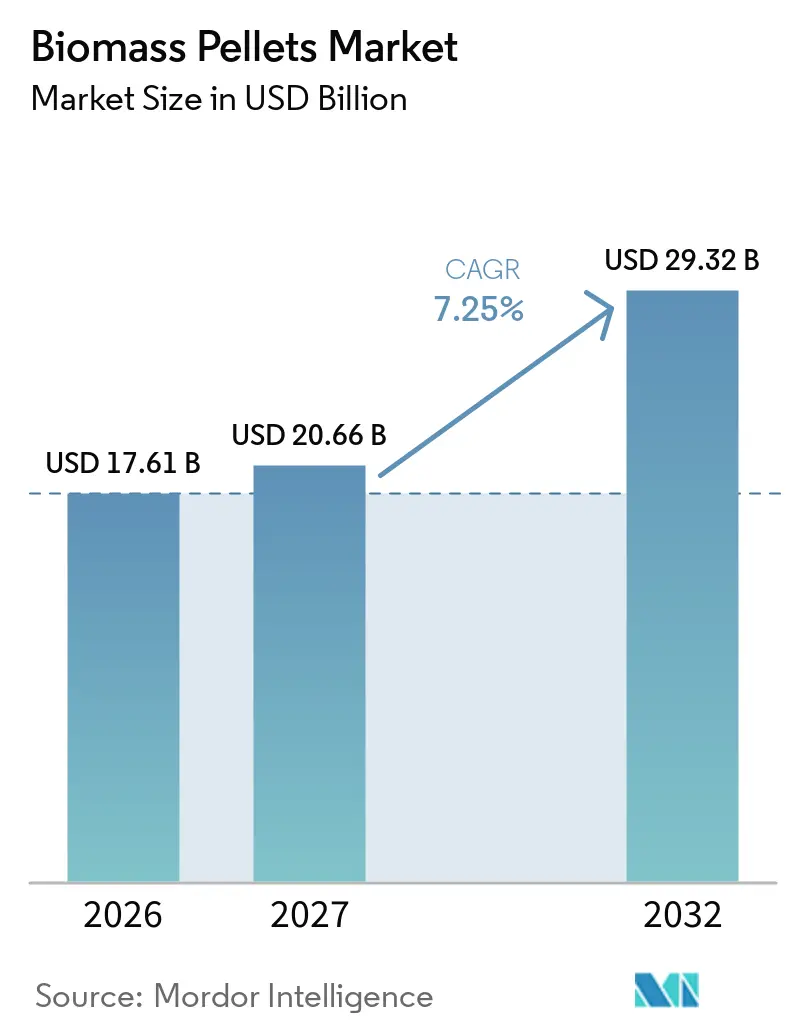
| Market Size (2027) | USD 20.66 Billion |
| Market Size (2032) | USD 29.32 Billion |
| Growth Rate (2027 - 2032) | 7.25 % |
| Fastest Growing Market | Asia-Pacific |
| Largest Market | Europe |
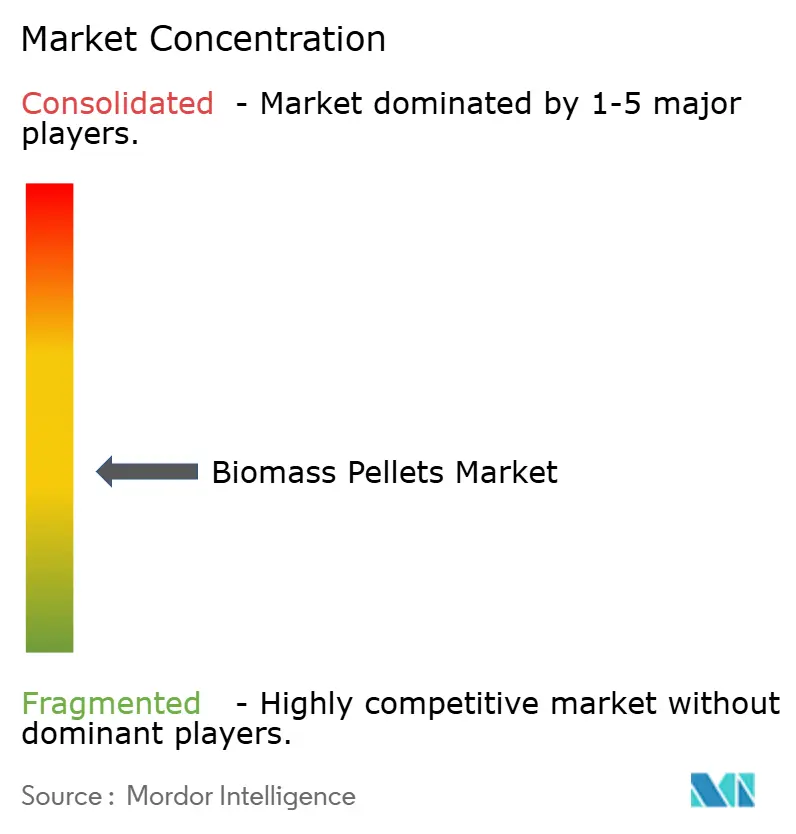
| Market Concentration | Medium |
Major Players *Disclaimer: Major Players sorted in no particular order Image © Mordor Intelligence. Reuse requires attribution under CC BY 4.0. | |
Biomass Pellets Market Analysis by Mordor Intelligence
The global biomass pellets market size is expected to grow from USD 17.61 billion in 2026 to USD 20.66 billion in 2027 and is forecast to reach USD 29.32 billion by 2032 at 7.25% CAGR over 2027-2032. The market is supported by renewable energy targets in Europe and coal retirement programs in East Asia. RED III tightened sustainability and greenhouse gas saving criteria for biomass energy installations, directing procurement toward certified pellet supply chains. In January 2026, the Netherlands published its Verificatieprotocol RED 2026, extending RED III compliance to SDE++ installations that had previously been exempt under earlier subsidy rules. These regulations have increased the importance of traceable sourcing in the biomass pellets market and favor producers with established certification and logistics capabilities. Demand from existing power plants provides volume stability, while residential heating, district energy, and torrefied products create separate opportunities with different purchasing requirements.
Key Report Takeaways
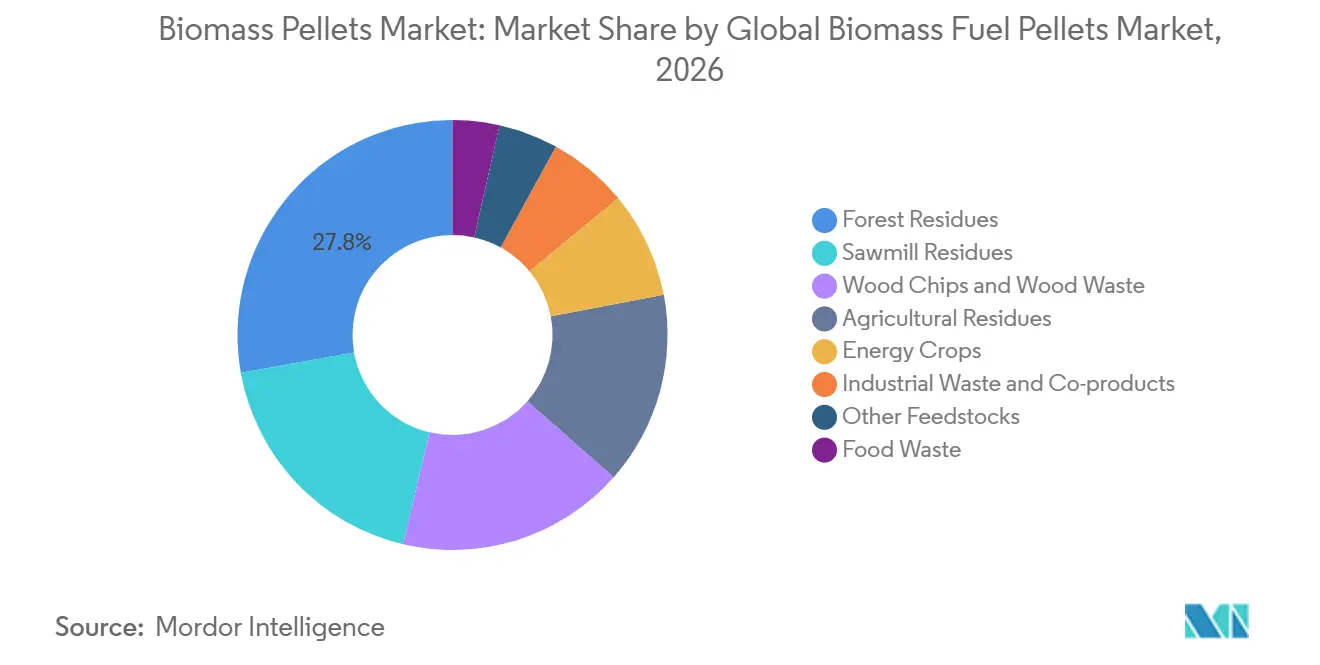
- By feedstock, forest residues accounted for 27.8% of the biomass pellets market share in 2026, while agricultural residues are forecast to grow at a CAGR of 7.5% through 2032.
- By pellet type, wood pellets accounted for 80.2% of the biomass pellets market share in 2026, while torrefied biomass pellets are forecast to grow at a CAGR of 8.6% through 2032.
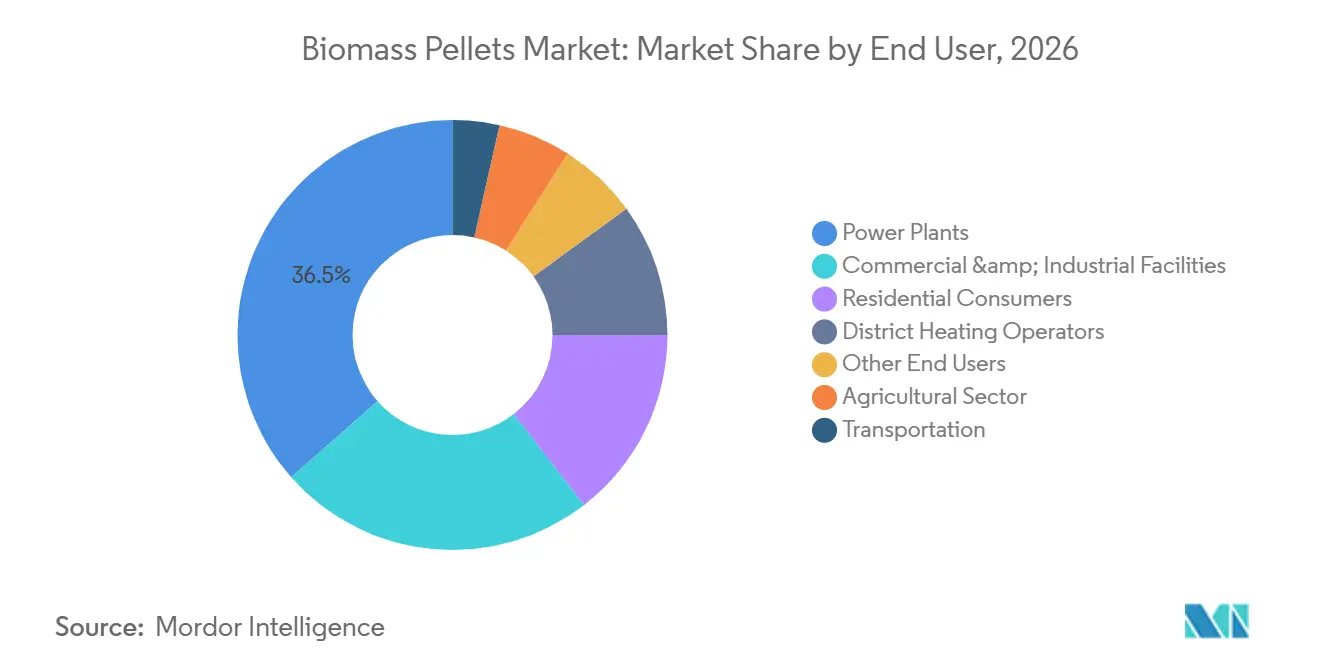
- By end user, power plants accounted for 36.5% of demand in 2026, while the transportation segment is forecast to grow at a CAGR of 8.2% through 2032.
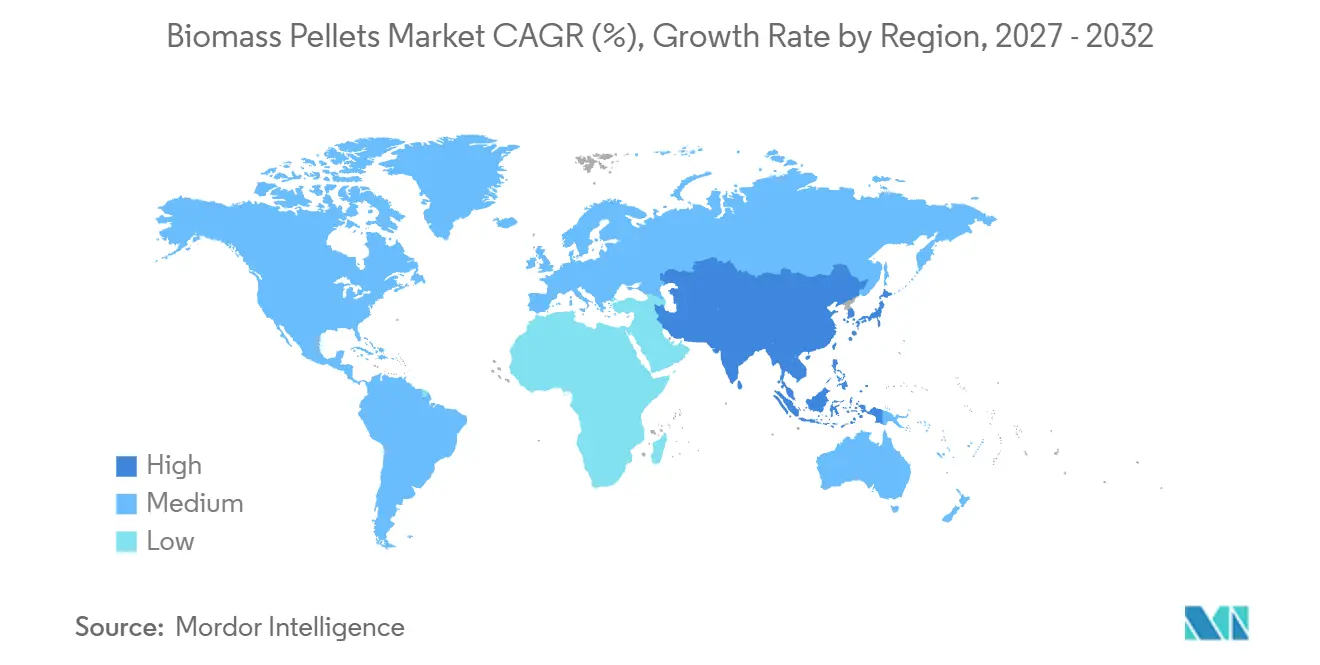
- By geography, Europe accounted for 31.7% of revenue in 2026, while Asia-Pacific is forecast to grow at a CAGR of 9.5% through 2032.
Note: Market numbers in this report are based on Mordor Intelligence's proprietary estimation framework, which combines nine months of actuals with Q4 projections for base year 2026.
Market Trends and Insights
Drivers Impact Analysis of Biomass Pellets Market*
| Driver | (~) % Impact on CAGR Forecast | Geographic Relevance | Impact Timeline |
|---|---|---|---|
| Renewable-Heat and Decarbonization Mandates | +2.0% | Global, strongest in EU, UK, and Japan | Medium term (2-4 years) |
| Coal-to-Biomass Conversions and CHP Expansion | +1.5% | Europe, Japan, and South Korea | Medium term (2-4 years) |
| Asian Co-Firing Demand and Long-Term Offtake Contracts | +1.2% | Asia-Pacific, with North American supply links | Long term (≥ 4 years) |
| Agricultural and Industrial Waste Valorization | +0.9% | India, Vietnam, Indonesia, and South America | Long term (≥ 4 years) |
| EUDR Traceability Premiums and Supplier Consolidation | +0.4% | EU and UK import markets | Short term (≤ 2 years) |
| Mobile Agricultural Pelletizing and Hybrid Boiler Retrofits | +0.3% | India, Brazil, and Southeast Asian rural markets | Long term (≥ 4 years) |
| Source: Mordor Intelligence | |||
Renewable-Heat and Decarbonization Mandates
RED III prioritizes material uses of woody biomass over energy use, which limits the availability of primary wood for pellet production in the European Union.[1] The directive requires biomass installations above 20 MW thermal input to demonstrate at least 80% greenhouse gas savings. This requirement directs biomass pellets market investment toward sawmill co-products, forest residues, and agricultural waste. PEFC issued ST 5002:2025 in May 2025 to establish chain-of-custody requirements for forest biomass under the revised RED III criteria.[2] The European Commission started infringement proceedings in July 2025 against all EU member states except Denmark for missing the April 2025 RED III transposition deadline. Suppliers in North America, the Baltics, and Southeast Asia must meet these standards to retain access to European utility buyers, which increases the value of certified residue-based supply.
Coal-to-Biomass Conversions and CHP Expansion
Coal-to-biomass conversion can generate large pellet demand by using existing generation infrastructure rather than requiring entirely new plants. Drax Power Station will operate under a low-carbon Contract for Difference from April 2027 to March 2031 at a strike price of GBP 157/MWh.[3] This arrangement provides multi-year revenue visibility for the biomass pellets market supply chain. Drax Power Station also completed a strategic review of its Canadian operations following a GBP 337 million write-down, which may redirect Canadian volumes toward Asian buyers. Idemitsu Kosan began commercial operations at its 120,000-tonne-per-year black pellet plant in Gia Lai Province in October 2025. The plant began full-scale shipments in 2026 to Japanese utilities planning coal co-firing at 600 MW and 700 MW units, supporting demand for fuels compatible with existing coal equipment. Combined heat and power projects can also improve biomass project returns where national programs offer stronger support than for electricity-only plants.
Asian Co-Firing Demand and Long-Term Offtake Contracts
Japan's wood pellet and palm kernel shell imports rose 7.7% year on year in the first half of 2026 as large biomass power stations entered operation. The Tahara plant in Aichi Prefecture and the Sendai Port plant in Miyagi Prefecture started operating in 2025, increasing fuel demand in the biomass pellets market. Vietnam supplied 5.68 million tonnes of wood pellets to Japan in 2025, representing more than 60% of Japanese import volume. Japan has relied more on feed-in tariff backed, longer-term contracts, while South Korean utilities have commonly used contracts lasting 6 to 12 months. This difference affects supplier decisions, as shorter contracts provide less certainty for investments in certification and supply chain controls. Japan's 7th Strategic Energy Plan, approved in February 2025, projected biomass at 5-6% of electricity generation through 2040, indicating that future demand will depend more on fuel switching and industrial decarbonization than on new capacity targets.
Agricultural and Industrial Waste Valorization
Pelletized agricultural biomass is attracting attention in markets where restrictions on open-field burning coincide with limited waste disposal options. India's tighter straw-burning restrictions have increased the availability of crop residues in Punjab and Haryana for energy use. Mobile Servoday Pelletbox units deployed in Andhra Pradesh operate at 1 to 4 tonnes per hour and reduce the need to transport loose biomass to centralized facilities. Producers can generate revenue from waste-gate fees and pellet sales, which improves project economics. In Brazil, Paraná State agri-processors deployed corn stover pelleting equipment in 2025 to meet domestic industrial boiler demand. The biomass pellets market can therefore draw on a broader range of feedstocks, although consistent moisture levels, ash content, and collection systems remain necessary for reliable fuel quality.
Restraints Impact Analysis of Biomass Pellets Market*
| Restraint | (~) % Impact on CAGR Forecast | Geographic Relevance | Impact Timeline |
|---|---|---|---|
| Feedstock Competition and Supply Volatility | -1.2% | Global, acute in North America and Europe | Short term (≤ 2 years) |
| High Capital, Logistics and Quality-Control Costs | -0.9% | Global, particularly affecting emerging producers | Medium term (2-4 years) |
| Heat-Pump Substitution and Subsidy Reversals | -0.6% | Europe, including the UK, Germany, Austria, and France | Long term (≥ 4 years) |
| Fire, Explosion Insurance and Certification Costs | -0.5% | North America, Europe, and Asia-Pacific | Medium term (2-4 years) |
| Source: Mordor Intelligence | |||
Feedstock Competition and Supply Volatility
Forest residues face competing demand from pulp and paper mills, engineered-wood producers, and carbon-offset programs, which limits supply availability for pellet producers. Drax Group produced 1.9 million tonnes of pellets in the first half of 2026, compared with 2.1 million tonnes in the first half of 2025, amid constraints in British Columbia's fiber market. The company's GBP 337 million write-down illustrates how local feedstock constraints can affect asset values and supply decisions. A typhoon disrupted Vietnam's central production zones in November 2025 and affected factory operations during the first quarter of 2026. Large EU operators must meet plot-level geolocation obligations from December 30, 2026, which presents challenges for fragmented supply chains. Germany's average pellet price reached EUR 454.21 per tonne in September 2026, 35.6% above the prior-year level, reflecting lower stocks after winter and tighter sawmill residue availability.
Heat-Pump Substitution and Subsidy Reversals
Air-source heat pumps increasingly compete with residential pellet boilers in the biomass pellets market. The International Energy Agency reported in 2025 that annual heat-pump ownership costs were converging with, and in some cases falling below, biomass boiler costs in well-insulated European homes. The UK Boiler Upgrade Scheme provides GBP 7,500 for heat pumps and GBP 5,000 for biomass boilers. Heat-pump grants for off-grid rural properties increased to GBP 9,000 from July 2026, affecting a customer segment that has traditionally relied on biomass boilers. Austria withdrew biomass boiler subsidies in 2025, while Germany recorded a 17% decline in heat-pump sales during the same year. Lower residential sales can reduce demand for higher-margin bagged pellets and pressure European mill profitability, even when utility demand remains stable.
*Our forecasts treat driver/restraint impacts as directional, not additive. The impact forecasts reflect baseline growth, mix effects, and variable interactions.
Biomass Pellets Market Segment Analysis
By Feedstock:
Forest Residues Anchor Supply While Agricultural Streams ScaleForest residues held 27.8% of the biomass pellets market share in 2026, supported by long-established supply links from North American and Baltic sawmills to European utilities. Dedicated port infrastructure and long-term contracts reinforce this position. Sawmill residues remain important as a related source of raw material for pellet plants. Their availability shapes supply conditions in the biomass pellets market, as sawmill throughput limits output in constrained fiber markets. Wood chips and wood waste serve district heating combined heat and power facilities across Scandinavia and Central Europe. These materials require less processing than fuel supplied to large industrial utilities. Food waste and energy crops remain smaller feedstock categories. Separate collection requirements support food-waste use in the European Union, but variable moisture and ash content can restrict combustion performance. Global wood pellet production reached 46.4 million tonnes in 2025, with the United States, Canada, Germany, Vietnam, and Russia accounting for 50% of output.
Agricultural residues are forecast to grow at a 7.5% CAGR through 2032 within the biomass pellets market. Bans on open-field burning in India, Thailand, and Vietnam are encouraging the use of rice straw, corn stover, and cotton stalks in energy applications. India produces more than 120 million tonnes of rice straw each year, although only a portion of this resource reaches energy uses. Farm-scale mobile units can reduce collection and transport costs for dispersed feedstocks. KRONE's Premos 5000 is an in-field pelleting harvester designed for straw and stalks. This equipment can connect field residues with local users in the biomass fuel pellets market without requiring a centralized processing site. Industrial waste, including sawmill fines, paper sludge, and agro-industrial residues, also provides integrated producers with additional raw material options. Residue-based materials can qualify for an exemption from full sustainability certification under RED III, which supports diversification away from primary forest wood. The pace of growth will depend on feedstock preparation, quality control, and reliable local collection systems.

By Pellet Type:
Torrefied Products Challenge a Century-Old Commodity StandardWood pellets held 80.2% of the pellet-type biomass pellets market share in 2026. Their dominant position reflects established market investment in white-pellet mills, port handling systems, and boiler configurations. ENplus A1 certification remains a widely used standard for residential and small commercial supply. German production operated at 98% A1 compliance, reflecting the importance of consistent quality in that segment. Agricultural residue pellets are a smaller category that attracts industrial boiler operators in South and Southeast Asia seeking lower fuel costs. Agro pellets serve similar uses where local biomass is available. Industrial waste pellets are often consumed within paper mills and agro-processing sites that own the raw material. The Sustainable Biomass Program and ISCC EU provide major compliance references for utility-grade wood pellet transactions in Europe. Their audit processes increasingly overlap with EUDR geolocation requirements for wood imports.
Torrefied biomass pellets are projected to expand at an 8.6% CAGR through 2032. These products have higher energy density and better moisture resistance than white pellets. They can reduce covered-storage requirements and can be co-fired in existing coal-mill circuits at ratios of up to 35% without major boiler modifications. Idemitsu Kosan's Gia Lai plant started commercial operations in October 2025 and began supplying Idemitsu Green Energy Pellet to 25 Japanese industrial clients in 2026. Power Wood Holdings secured CAD 84 million (USD 62 million) for two Alberta steam-explosion facilities with 700,000 tonnes of combined annual capacity. The projects are supported by 10-year Japanese take-or-pay agreements. ISO 20024:2020 outlines safe handling and storage practices for commercial and industrial solid biofuel pellets.[4] Safety and product quality compliance are becoming important conditions in industrial procurement.
By End User:
Power Generation Anchors Volume While Transportation Opens a New Demand ChannelPower plants held 36.5% of end-user demand in 2026, representing the largest portion of the biomass pellets market. Much of this demand is covered by 10 to 15-year supply agreements signed during the 2018 to 2023 build-out cycle. These contracts support near-term market volume stability for producers, but also expose suppliers to renegotiation risk as contracts begin to expire in the late 2020s. Drax's new Contract for Difference limits generation to a 27% capacity factor from April 2027, which is close to half the plant's historical average. This lower operating level may release pellet volumes to other buyers or reduce orders from established suppliers. Commercial and industrial facilities use pellets in food processing, textiles, chemicals, and institutional boilers. District heating in Scandinavia, Poland, and the Baltics provides seasonal demand that is commonly served through bilateral contracts. Agricultural users remain a smaller but growing group for crop drying and greenhouse heating.
Transportation is the fastest-growing end-use segment at an 8.2% CAGR through 2032. The segment is linked to efforts to reduce emissions from maritime freight that carries pellets and related fuels. Drax's MV Ultra Yorkshire completed a transatlantic voyage in 2026 using B100 biodiesel and carried more than 29,000 tonnes of pellets from Greater Baton Rouge to Liverpool. Drax estimated that the voyage reduced emissions by 90% compared with standard bunker fuels. A 2025 journal study found that routing optimization could reduce costs by up to 22.1% and CO2 emissions by up to 52.6% in a biomass pellet supply chain. Drax, NYK Line, and Japanese partners signed a 2024 memorandum to develop a commercially operable bioship by the end of 2029.[5] The concept would use gas generated from biomass onboard bulk carriers and could reduce well-to-wake emissions by 22% if commercialized. These efforts broaden the role of the biomass pellets industry beyond fixed energy facilities.
Geography Analysis
Europe Biomass Pellets Market
Europe held 31.7% of the biomass pellets market share in 2026, supported by residential heating, district energy, and utility co-firing. Germany produced 4 million tonnes of wood pellets in 2025 and had 760,000 pellet heating installations. German output reached 940,000 tonnes in Q1 2026 and 1.034 million tonnes in Q2 2026, with sawmill residues supplying more than 90% of raw material. The United Kingdom will reduce subsidized Drax generation from April 2027 under its new Contract for Difference. Italy, Poland, France, and Spain provide complementary demand, while EUDR rules require large operators to meet full traceability obligations from December 30, 2026.
APAC Biomass Pellets Market
Asia-Pacific is forecast to grow at a 9.5% CAGR through 2032, making it the fastest-growing region in the biomass pellets market. Japan's wood pellet and palm kernel shell imports increased 7.7% year on year in the first half of 2026. Vietnam supplied 5.68 million tonnes, or 60%, of Japan's pellet imports in 2025. Japan's 2040 biomass target of 5-6% is largely met by certified capacity, shifting attention to conversion economics and industrial decarbonization. South Korea's certificate-weight reductions may redirect Vietnamese and Indonesian supply toward Japan, where Idemitsu's torrefied pellets serve industrial users.
The Americas and MEA Biomass Pellets Market
North America remained a major supply hub in 2026, with 74 operating U.S. densified biomass manufacturers and 13.2 million tonnes of capacity. Drax's Canadian review could move British Columbia output toward Asian buyers from 2027. South America is expanding corn-stover processing in Paraná and forestry-residue use in Chile. Middle East and Africa countries are primarily import markets, led by Saudi Arabia, the UAE, and South Africa, while Morocco and Egypt are developing agricultural-residue projects.
Competitive Landscape
The biomass pellets market is moderately concentrated in utility-grade supply, while residential and regional heating remain fragmented. Drax Group, Enviva, and AS Graanul Invest lead long-term industrial offtake, with Drax Group developing 18 North American facilities. Graanul Invest operates 2.7 million tonnes of capacity across the Baltics and the United States and increased production by 15% in 2025. Enviva emerged from Chapter 11 in December 2024 after converting more than USD 1 billion of debt into equity and securing USD 1.05 billion in exit financing. Its Epes, Alabama facility continued ramping up toward full operating capacity in 2025.
Leading suppliers use logistics, certification, and contracted sales to maintain their positions in the biomass pellets market. Drax Group's Ultrabulk agreement requires annual CO2 reductions through March 2031, while its Greater Baton Rouge terminal supports export logistics. Graanul Invest and thyssenkrupp Materials Trading announced a May 2026 initiative for certified pellet supply to German industrial customers, combining Graanul Invest's production base with thyssenkrupp Materials Trading's logistics and customer network. Power Wood Holdings is investing CAD 84 million (USD 62 million) in Alberta black-pellet facilities backed by 10-year Japanese take-or-pay agreements.
Vietnamese and Indonesian producers compete effectively in Japanese short-term procurement through lower costs and growing certified volumes, pressuring Baltic and North American suppliers that face higher fiber and logistics costs. PEFC ST 5002:2025 and EUDR origin documentation raise entry requirements in European procurement, making digital traceability an important capability in the biomass pellets market. The source material does not provide combined company market shares, so a concentration score cannot be assigned without estimation.
Biomass Pellets Industry Leaders
-
Drax Group plc
-
Enviva Inc.
-
AS Graanul Invest
-
Pinnacle Renewable Energy
-
Lignetics Inc.
- *Disclaimer: Major Players sorted in no particular order
Biomass Pellets Market Companies Covered in this Report
- An Viet Phat Group
- ANDRITZ AG
- AS Graanul Invest
- CM Biomass Partners A/S
- Drax Group plc
- Energex Pellet Fuel, Inc.
- Enviva Inc.
- Fram Renewable Fuels LLC
- Georgia Biomass LLC
- German Pellets GmbH
- Highland Pellets LLC
- Lignetics Inc.
- Pacific BioEnergy Corp.
- Pfeifer Group
- Pinnacle Renewable Energy
- Scandbio AB
- Segezha Group PJSC
- Stora Enso Oyj
- The Westervelt Company
- Zilkha Biomass Energy
Recent Industry Developments in Biomass Pellets Market
- August 2026: Power Wood Holdings Ltd. agreed to receive up to CAD 84 million in funding from Chair Capital Ltd. to develop two steam-explosion black pellet facilities in Northern Alberta. The planned Peace River and Hay Meadow plants will have a combined production capacity of 700,000 tonnes per year. The company also confirmed 10-year take-or-pay offtake agreements with multiple Japanese energy companies, supporting long-term demand for black pellets as a coal replacement fuel.
- July 2026: AS Graanul Invest and thyssenkrupp Materials Trading announced a joint initiative to supply certified, sustainably sourced wood pellets to German industrial customers. The partnership combines Graanul Invest's production platform across the Baltics and the United States with thyssenkrupp Materials Trading's logistics network and industrial customer base, initially targeting industrial fuel-switching projects in Germany aimed at reducing greenhouse gas emissions.
- April 2026: Drax Group signed a new freight agreement with Ultrabulk extending through March 2031. The contract includes annual carbon-reduction commitments for biomass transportation. During the same period, the MV Ultra Yorkshire completed its first transatlantic voyage carrying more than 29,000 tonnes of biomass pellets from Louisiana to Liverpool using B100 biofuel, reducing voyage CO2 emissions by approximately 90% compared with conventional marine fuels.
- October 2025: Idemitsu Kosan Co., Ltd. commenced commercial operations at its black pellet plant in Gia Lai Province, Vietnam on 8 October 2025. The facility has an annual production capacity of 120,000 tonnes and is described by the company as Vietnam's first commercial-scale black pellet plant and among the largest globally.
Global Biomass Pellets Market Report Scope
Biomass pellets are small, cylindrical pieces of compressed organic matter used as a renewable energy source. They are typically manufactured from agricultural residues, industrial waste, and forestry byproducts, such as wood shavings, sawdust, straw, and corn stalks. The raw materials are dried and compacted through high-pressure processing, relying on the natural lignin in wood to bind the pellets together without added chemicals. When burned in specialized stoves or boilers, these pellets deliver high energy density, low moisture content, and uniform combustion, making them a cleaner alternative to traditional fossil fuels.
The global biomass pellets market is segmented by feedstock into forest residues, sawmill residues, wood chips and wood waste, agricultural residues, energy crops, industrial waste and co-products, food waste, and other feedstocks. By pellet type, the market is segmented into wood pellets, agricultural residue pellets, industrial waste pellets, torrefied pellets, agro pellets, and other biomass pellets. By end user, the market is segmented into power plants, commercial and industrial facilities, residential consumers, district heating operators, agricultural sector, transportation, and other end users. The report also covers the market size and forecasts for the global biomass fuel pellets market across 26 countries in key regions. For each segment, the market sizing and forecasts are provided on the basis of value (USD).
Segmentation Overview
| Forest Residues |
| Sawmill Residues |
| Wood Chips and Wood Waste |
| Agricultural Residues |
| Energy Crops |
| Industrial Waste and Co-products |
| Food Waste |
| Other Feedstocks |
| Wood Pellets |
| Agricultural Residue Pellets |
| Industrial Waste Pellets |
| Torrefied Pellets |
| Agro Pellets |
| Other Biomass Pellets |
| Power Plants |
| Commercial & Industrial Facilities |
| Residential Consumers |
| District Heating Operators |
| Agricultural Sector |
| Transportation |
| Other End Users |
| North America | United States |
| Canada | |
| Mexico | |
| Europe | Germany |
| France | |
| Italy | |
| Spain | |
| United Kingdom | |
| Poland | |
| Russia | |
| Rest of Europe | |
| Asia-Pacific | China |
| India | |
| Japan | |
| South Korea | |
| Australia | |
| Indonesia | |
| Vietnam | |
| Thailand | |
| Rest of Asia-Pacific | |
| South America | Brazil |
| Argentina | |
| Chile | |
| Rest of South America | |
| Middle East and Africa | Saudi Arabia |
| United Arab Emirates | |
| Egypt | |
| South Africa | |
| Morocco | |
| Rest of Middle East and Africa |
| By Feedstock | Forest Residues | |
| Sawmill Residues | ||
| Wood Chips and Wood Waste | ||
| Agricultural Residues | ||
| Energy Crops | ||
| Industrial Waste and Co-products | ||
| Food Waste | ||
| Other Feedstocks | ||
| By Pellet Type | Wood Pellets | |
| Agricultural Residue Pellets | ||
| Industrial Waste Pellets | ||
| Torrefied Pellets | ||
| Agro Pellets | ||
| Other Biomass Pellets | ||
| By End User | Power Plants | |
| Commercial & Industrial Facilities | ||
| Residential Consumers | ||
| District Heating Operators | ||
| Agricultural Sector | ||
| Transportation | ||
| Other End Users | ||
| By Geography | North America | United States |
| Canada | ||
| Mexico | ||
| Europe | Germany | |
| France | ||
| Italy | ||
| Spain | ||
| United Kingdom | ||
| Poland | ||
| Russia | ||
| Rest of Europe | ||
| Asia-Pacific | China | |
| India | ||
| Japan | ||
| South Korea | ||
| Australia | ||
| Indonesia | ||
| Vietnam | ||
| Thailand | ||
| Rest of Asia-Pacific | ||
| South America | Brazil | |
| Argentina | ||
| Chile | ||
| Rest of South America | ||
| Middle East and Africa | Saudi Arabia | |
| United Arab Emirates | ||
| Egypt | ||
| South Africa | ||
| Morocco | ||
| Rest of Middle East and Africa | ||
Key Questions Answered in the Report
What is the projected size of the biomass pellets market by 2032?
The biomass pellets market is forecast to reach USD 29.32 billion by 2032, growing at a 7.25% CAGR from 2027.
Which feedstock led biomass pellet demand in 2026?
Forest residues led feedstock demand with a 27.8% share in 2026. Agricultural residues are expected to be the fastest-growing feedstock at a 7.5% CAGR through 2032.
Why are torrefied pellets gaining demand?
Torrefied pellets are forecast to grow at an 8.6% CAGR because their higher energy density and moisture resistance make them suitable for coal co-firing applications.
Which region is expected to grow fastest through 2032?
Asia-Pacific is projected to grow at a 9.5% CAGR through 2032, supported by Japanese import demand and industrial decarbonization.
What is the largest end use for biomass pellets?
Power plants were the largest end-use segment, holding a 36.5% share of demand in 2026.
What factors can constrain pellet demand in Europe?
Competition for fiber, traceability costs, heat pump adoption, and changes in boiler subsidies can constrain demand and producer margins.