
Bifacial Solar Market Size and Share
Market Overview
| Study Period | 2022 - 2032 |
|---|---|
| Market Size (2027) | USD 19.41 Billion |
| Market Size (2032) | USD 37.88 Billion |
| Growth Rate (2027 - 2032) | 14.30 % |
| Fastest Growing Market | Middle East and Africa |
| Largest Market | Asia-Pacific |
| Market Concentration | Medium |
Major Players *Disclaimer: Major Players sorted in no particular order Image © Mordor Intelligence. Reuse requires attribution under CC BY 4.0. | |
Bifacial Solar Market Analysis by Mordor Intelligence
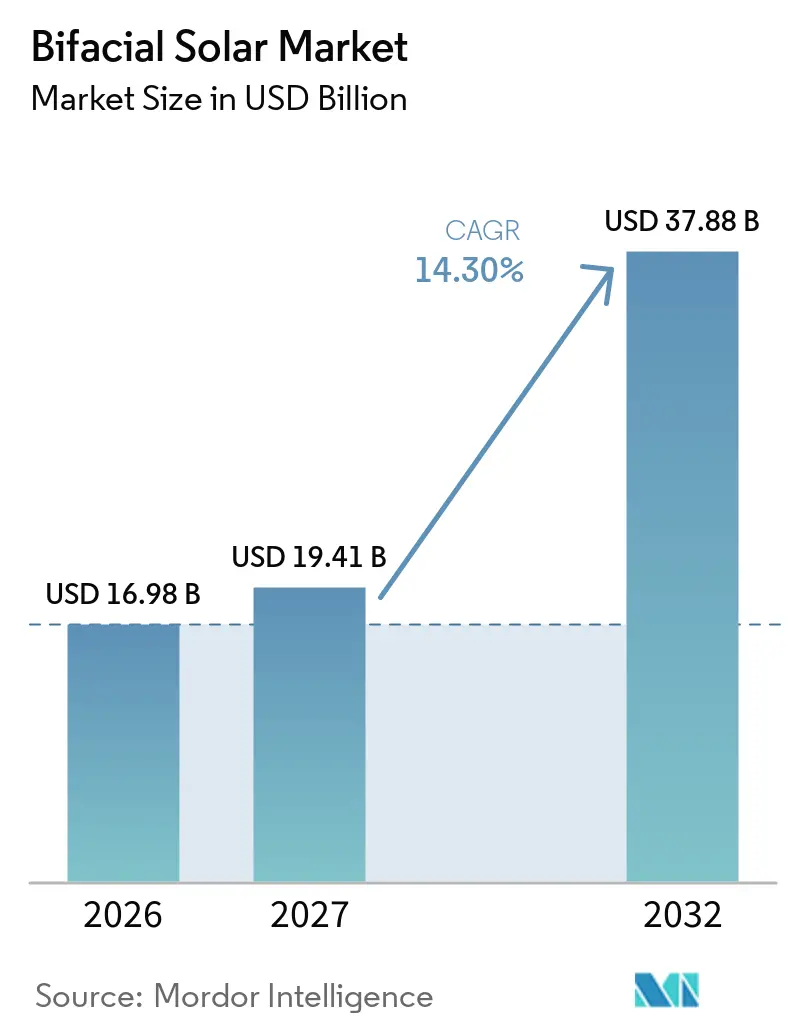
The Bifacial Solar Market size is projected to be USD 16.98 billion in 2026, USD 19.41 billion in 2027, and reach USD 37.88 billion by 2032, growing at a CAGR of 14.30% from 2027 to 2032. The global bifacial solar market is being shaped by utility developers that now focus on selecting cell designs and mounting layouts that improve rear-side generation at each site. This change follows the growth of solar deployment, with global additions reaching 602 GW in 2024 and utility-scale projects contributing 382 GW, up 43% from 2023. Large projects increasingly specify bifacial modules, connecting grid-scale procurement with demand for these systems. The global bifacial solar market also benefits from solar power's favorable cost position, although project returns still depend on site conditions, installation design, and financing requirements. Competition centers on cell efficiency, bifaciality, warranty coverage, and the ability to supply high-volume projects.
Key Report Takeaways
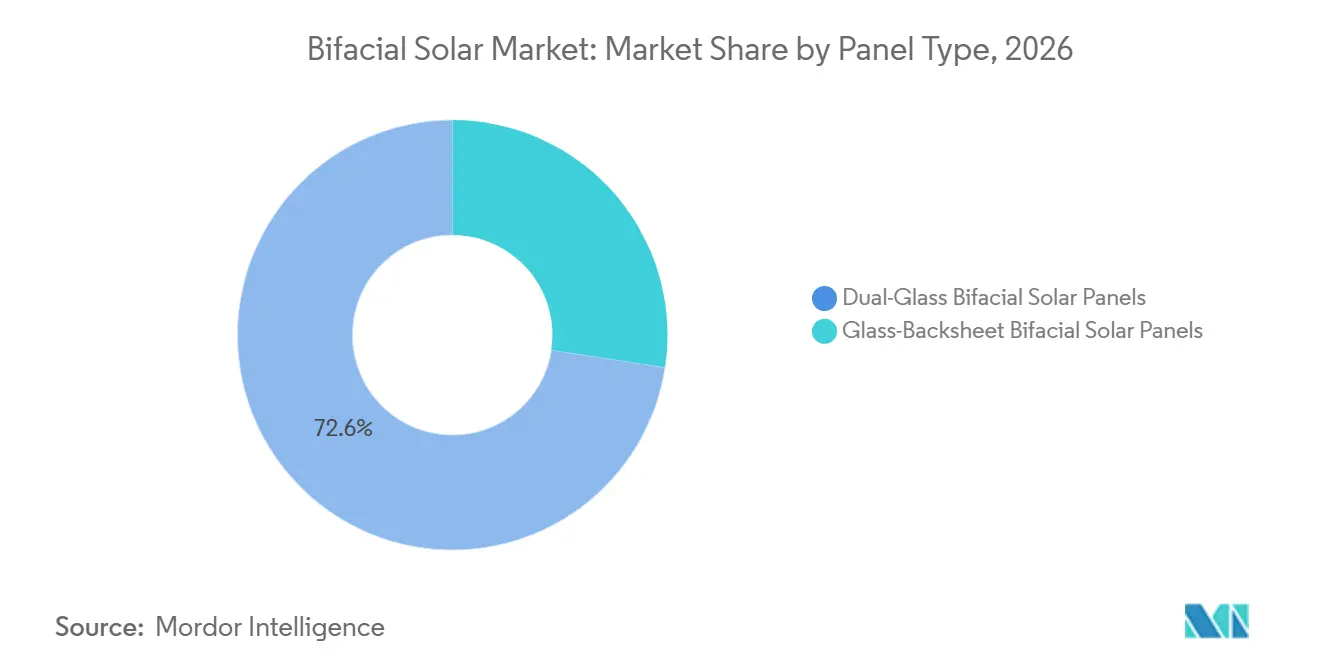
- By panel type, dual-glass panels held 72.6% of the global bifacial solar market in 2026 and are forecast to grow at a 14.8% CAGR through 2032.
- By frame type, framed panels held 69.5% of the global bifacial solar market in 2026, while frameless panels are forecast to grow at a 15.1% CAGR through 2032.
- By cell technology, TOPCon held 50.1% of the global bifacial solar market in 2026 and is forecast to grow at a 14.9% CAGR through 2032.
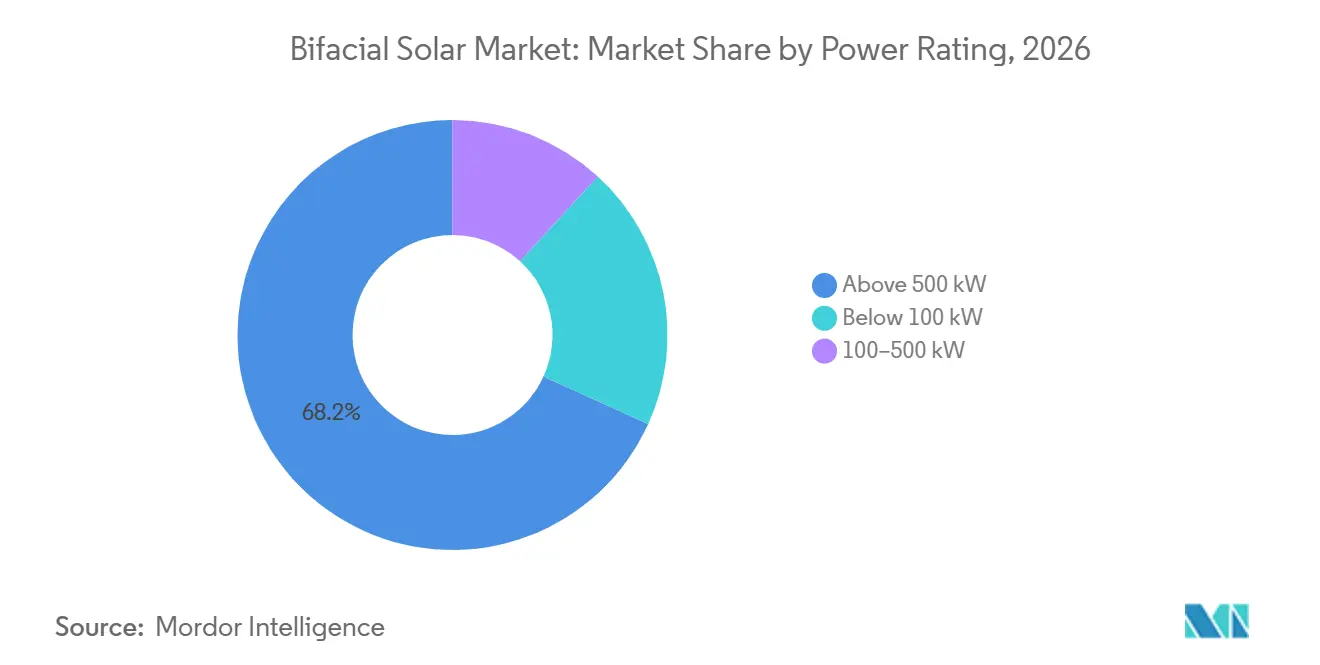
- By power rating, above-500 kW systems held 68.2% of the global bifacial solar market in 2026 and are forecast to grow at a 15.8% CAGR through 2032.
- By application, utility-scale projects held 73.8% of the global bifacial solar market in 2026 and are forecast to grow at a 16.2% CAGR through 2032.
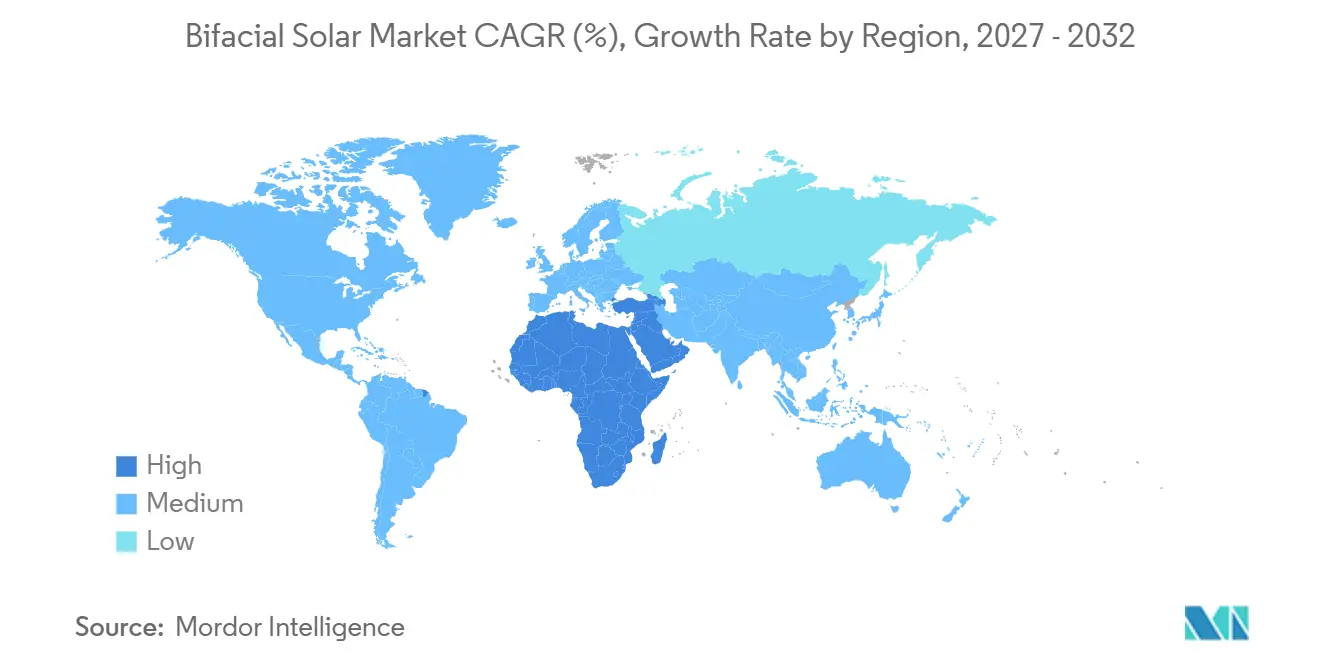
- By geography, Asia-Pacific held 60.2% of the global bifacial solar market in 2026, while the Middle East and Africa is forecast to grow at a 16.7% CAGR through 2032.
Note: Market numbers in this report are based on Mordor Intelligence's proprietary estimation framework, which combines nine months of actuals with Q4 projections for base year 2026.
Market Trends and Insights
Drivers Impact Analysis of Bifacial Solar Market*
| Driver | (~) % Impact on CAGR Forecast | Geographic Relevance | Impact Timeline |
|---|---|---|---|
| Higher Energy Yield and Lower Levelized Cost of Energy | +3.2% | Global, strongest in high-albedo areas including MENA, Atacama, Central Asia, and northern India | Short term (≤ 2 years) |
| Utility-Scale Solar Capacity Expansion | +3.8% | Global, led by China, India, and MENA | Short term (≤ 2 years) |
| Government Incentives and Renewable Energy Targets | +2.3% | North America, Europe, India, and the Middle East | Medium term (2-4 years) |
| N-Type Cell Efficiency and Bifaciality Gains | +2.1% | Global supply, with demand concentrated in utility procurement in China, MEA, and India | Medium term (2-4 years) |
| Land-Use Optimization Through Dual-Use Projects | +1.6% | Europe, India, and the U.S. Midwest | Medium term (2-4 years) |
| Bankable Yield Improvements at High-Albedo Sites | +1% | MENA, Atacama, Central Australia, Rajasthan, and Gujarat | Long term (≥ 4 years) |
| Source: Mordor Intelligence | |||
Higher Energy Yield and Lower Levelized Cost of Energy
The global bifacial solar market benefits when rear-side generation lowers the cost of delivered electricity. A 2025 peer-reviewed study found that TOPCon produced 8.16% more energy than co-located PERC bifacial references in a south-facing vertical installation. The study attributed the difference to a bifaciality coefficient of 83.3% for TOPCon, compared with 78.8% for PERC. Research published through the U.S. Department of Energy's OSTI platform found that bifacial modules combined with single-axis trackers achieved the lowest levelized cost of electricity across 93.1% of global land area.[1] This result supports the use of tracker-mounted modules where ground conditions allow rear-side irradiance capture. The global bifacial solar market therefore depends not only on module performance but also on layouts that turn the performance advantage into measured output.
Utility-Scale Solar Capacity Expansion
Utility-scale procurement remains the strongest source of volume for the global bifacial solar market. Global utility-scale solar additions reached 382 GW in 2024, up 43% from 2023, and represented nearly two-thirds of new solar installations. Larger projects can spread engineering, mounting, and procurement costs over more installed capacity. This favors modules with high power output and predictable long-term performance. India added 14.3 GW of utility-scale solar in the first half of 2025, a 49% increase from the prior-year period. The global bifacial solar market gains from this procurement pattern because large developers can incorporate site-specific rear-side yield studies into project design.
N-Type Cell Efficiency and Bifaciality Gains
N-type cell development is raising the performance baseline for the global bifacial solar market. China Photovoltaic Industry Association data showed that TOPCon accounted for 87.6% of Chinese cell production in 2025.[2] In July 2026, Tongwei announced a 93.07% bifaciality factor for a 770W TOPCon module that TÜV Rheinland verified. Nature Energy reported certified power-conversion efficiency of 26.34% for bifacial TOPCon cells and 32.73% for monolithic perovskite and TOPCon tandem cells. These results show that suppliers continue to improve both front-side conversion and rear-side response. The global bifacial solar market is likely to reward manufacturers that can deliver these gains at scale while maintaining consistent quality.
Land-Use Optimization Through Dual-Use Projects
Dual-use projects add a separate route for demand in the global bifacial solar market. A 2025 Tamil Nadu Agricultural University study found that a 10 kWp bifacial agrivoltaic system achieved a land equivalent ratio of 1.6. This indicated 60% higher combined food and energy output from the same land area than separate land uses. GCL commissioned a 76 MW agrivoltaic project in Germany during 2025 using 146,000 bifacial 550W modules with customizable light transmittance from 15% to 40%.[3] A 2026 PNAS study also found that agrivoltaic effects differ by climate, with maize yield penalties in humid regions and crop benefits in semiarid regions. Project selection consequently requires site-level crop and energy analysis instead of a uniform design approach.
Restraints Impact Analysis of Bifacial Solar Market*
| Restraint | (~) % Impact on CAGR Forecast | Geographic Relevance | Impact Timelin |
|---|---|---|---|
| Site-Specific Albedo and Geometry Dependence | -1.3% | Global, with the highest exposure in low-albedo or vegetation-dense sites in Southeast Asia and parts of Europe | Short term (≤ 2 years) |
| Higher Balance-of-System and Installation Complexity | -0.9% | Global, with greater exposure in MEA and South America | Medium term (2-4 years) |
| Bifacial Performance Standardization Gaps | -0.7% | Global, with important financial-close implications in North America and Europe | Medium term (2-4 years) |
| Tariff, Trade Barrier, and Supply-Chain Volatility | -0.8% | North America, Europe, and India | Short term (≤ 2 years) |
| Source: Mordor Intelligence | |||
Site-Specific Albedo and Geometry Dependence
The global bifacial solar market faces a material performance constraint because bifacial gain changes by site. Ground reflectivity, mounting height, ground cover, row spacing, and seasonal sun angles affect the amount of rear-side energy captured. A 2026 study covering 3 Saudi Arabian sites found gains ranging from 1.12% in Hail to 5.30% in Riyadh and 10.30% in Bisha. These differences were linked to albedo conditions. Developers must therefore maintain ground surfaces and use location-specific irradiance inputs when forecasting generation. IEC TS 60904-1-2:2024 and its 2026 amendment improve I-V measurement for bifacial photovoltaic devices, but they do not replace site-level albedo characterization.[4]
Higher Balance-of-System and Installation Complexity
Bifacial designs can require more specialized construction than monofacial alternatives. Dual-glass modules weigh 15-25% more per unit than comparable monofacial modules and can require structures with higher load-bearing capability. Frameless units may need different clamps and installer training from framed products. Taller single-axis trackers can improve rear-side irradiance capture, but they can increase steel use and wind-load engineering requirements. These added requirements matter most in smaller projects and markets with less experienced engineering, procurement, and construction providers. The global bifacial solar market may therefore advance more slowly in below-100 kW installations, where the added design effort is harder to spread across project capacity.
*Our forecasts treat driver/restraint impacts as directional, not additive. The impact forecasts reflect baseline growth, mix effects, and variable interactions.
Bifacial Solar Market Segment Analysis
By Panel Type:
Dual-Glass Panels Anchored by Durability and Warranty DepthDual-glass panels held 72.6% of the global bifacial solar market in 2026 and are forecast to grow at a 14.8% CAGR through 2032. Glass-backsheet modules remain relevant for rooftops and commercial installations where structural loading limits module weight. These projects can prioritize easier handling over the durability benefits of glass-glass products. The format can face rear-side performance trade-offs because the backing is less transparent. Utility tenders increasingly require certification for damp heat and ammonia resistance. The buying decision depends on structural constraints, environmental exposure, and expected energy yield.

By Frame Type:
Frameless Gains Ground Where Land Value Competes with Energy OutputFramed panels held 69.5% of the global bifacial solar market in 2026. Their aluminum frames provide rigidity and suit established mounting systems. This simplifies handling for large ground-mounted projects. Framed products are widely used in above-500 kW installations where racking systems are standardized. Their lead reflects the value of installation familiarity in large-scale deployment.
Frameless products are forecast to grow at a 15.1% CAGR through 2032, supported by agrivoltaic projects. Frameless glass-glass modules can limit places where dirt and moisture accumulate. SoliTek states that its SOLID Agro frameless bifacial module meets IEC 62716:2013 and IEC 61701:2020 requirements for demanding agricultural and salt-mist conditions. Next2Sun's 4.3 MWp commercial vertical agrivoltaic project in Löffingen uses frameless bifacial modules and leaves more than 90% of the land accessible to machinery. This layout can make frameless products more suitable where agricultural access has priority.
By Cell Technology:
TOPCon Reshapes the Global Efficiency BaselineTOPCon accounted for 50.1% of the global bifacial solar market in 2026 and is forecast to grow at a 14.9% CAGR through 2032. Its large production base reflects the shift toward N-type technologies. TOPCon reached 87.6% of Chinese cell production during 2025. The technology offers a higher bifaciality ceiling than PERC. This supports utility developers that seek stronger rear-side energy contribution.
PERC continues to serve cost-sensitive installations and retrofit work. Its lower bifaciality range of 78-80% limits rear-side performance compared with TOPCon products that have demonstrated more than 93% bifaciality. HJT remains active at the premium end of the sector. Risen Energy reported that its HJT modules delivered a 90% ±5% bifaciality rate and a temperature coefficient of -0.24%/°C during the first half of 2026. Back-contact cells also remain a developing alternative, with LONGi reporting 19.55 GW of Hi-MO 9 BC module sales in the first half of 2026.
By Power Rating:
Above-500 kW Modules Consolidate Utility ProcurementAbove-500 kW systems held 68.2% of the global bifacial solar market in 2026 and are forecast to grow at a 15.8% CAGR through 2032. This is the fastest projected rate among power-rating segments. Higher module wattage can reduce the number of panels, mounting structures, cable runs, and labor hours per megawatt. These effects are most valuable for utility developers. JinkoSolar introduced its Tiger Neo 5.0 module in June 2026 with an efficiency of 25.91% and a power output of above 700W.
The 100-500 kW range serves commercial rooftops and smaller ground-mounted projects. It benefits from technology improvements but can face space and interconnection constraints. Below-100 kW systems are the smallest and slowest-growing power band. Their economics depend more closely on roof conditions, financing, and local electricity rules. Developers need detailed roof, shading, and albedo assessments before using standardized generation assumptions.
By Application:
Utility Projects Drive Volume While C&I Diversifies the Revenue BaseUtility-scale projects accounted for 73.8% of the global bifacial solar market share in 2026 and are forecast to expand at a 16.2% CAGR through 2032. Saudi Arabia's 1,425 MW Al Kahfah project began commercial operations on November 30, 2025, using bifacial photovoltaic modules with horizontal single-axis tracking. This example shows the project scale that supports high-output module procurement. Large procurement rounds also make detailed yield assessment and tracker selection more commercially practical. Utility demand will remain the main volume base for the global bifacial solar market.
Commercial and industrial installations provide a broader customer base. Corporate decarbonization plans and electricity costs are supporting on-site rooftop and ground-mounted systems in Europe, India, and Southeast Asia. Residential deployment is more constrained by upfront costs and limited scope to manage rooftop albedo. Japan and Australia retain favorable conditions for residential bifacial systems in selected cases. Falling module prices may support greater commercial and industrial uptake over time.
Geography Analysis
Asia-Pacific held 60.2% of the global bifacial solar market share in 2026. China reached 1.05 TW of cumulative solar capacity by the end of 2024, representing 47% of the world's total, and added 357 GW during that year. More than two-thirds of China's new capacity was utility-scale. India passed 100 GW of cumulative solar capacity in February 2025 and installed 37.9 GW during calendar year 2025. BIS quality rules and ALMM certification are shaping module specifications for new Indian projects.
Japan, South Korea, Australia, Vietnam, and Indonesia form a secondary regional growth group. Australia is incorporating bifacial products in farming-related solar pilots. China's GB 47834-2026 standard requires Class 1 modules to deliver at least 24% efficiency and at least 75% bifaciality. The rule establishes a higher domestic performance requirement. It can also influence procurement requirements in export markets that use Chinese specifications as reference points.
The Middle East and Africa is forecast to grow at a 16.7% CAGR through 2032. Africa is expected to install 17 GW of solar in 2026, up 45% year over year, with distributed systems contributing substantially to deployment. Saudi Arabia had 43.2 GW of signed renewable capacity by late 2025, including the 2,000 MW Haden and 1,500 MW Al-Khushaybi projects. Chile's Atacama Desert provides strong conditions for bifacial deployment because of high irradiance and favorable ground reflectivity.
Competitive Landscape
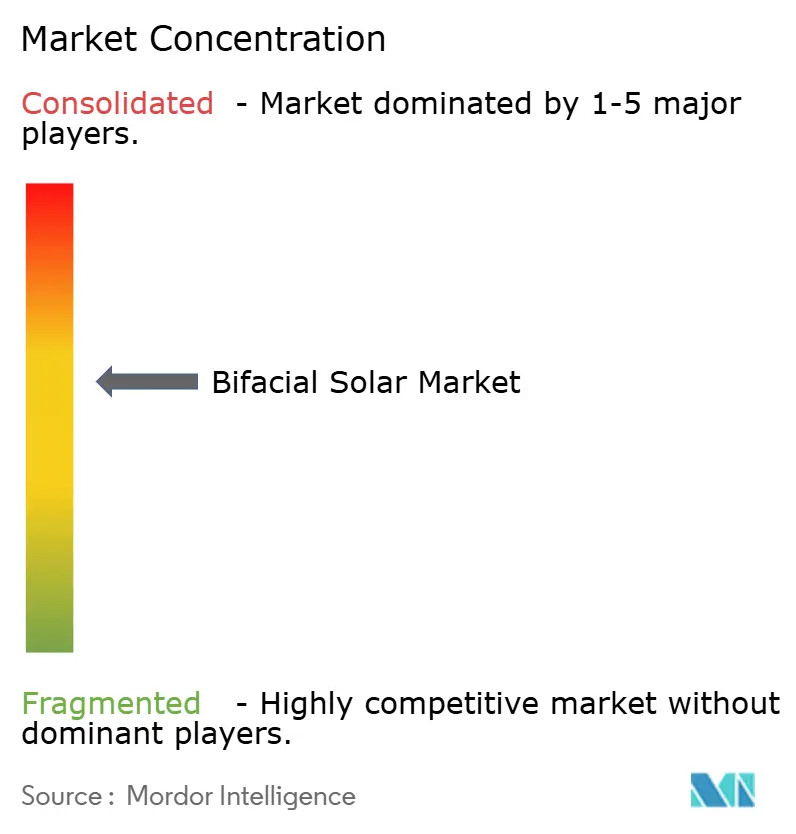
The global bifacial solar market is moderately consolidated among several large suppliers. JinkoSolar, LONGi Green Energy, Trinasolar, JA Solar, Canadian Solar, and Tongwei account for a substantial share of global shipments. A broader group of regional suppliers competes through price, local access, and specialized technologies. JinkoSolar shipped 86.8 GW of modules in 2025 and holds more than 3,500 patents, including more than 700 related to TOPCon. Its scale and intellectual property portfolio strengthen its position in high-volume procurement.
Manufacturers are taking different technology paths. LONGi is expanding back-contact products and reported 19.55 GW of BC module shipments in the first half of 2026. TCL Zhonghuan announced a CNY 2.6 billion (USD 360 million) upgrade in July 2026 to convert 20 GW of cell capacity and 25 GW of module capacity to back-contact technology. JinkoSolar and JA Solar continue to advance TOPCon products, while Risen Energy is positioning HJT modules for premium projects. These choices reflect differing views on which cell architecture will provide the best next-stage performance.
JinkoSolar and LONGi reached a global patent settlement in September 2025 that ended their worldwide litigation and created a cross-licensing arrangement for selected core patents. JinkoSolar also established a 10 GW annual TOPCon joint venture with Saudi Arabia's Public Investment Fund, operating from early 2026. This move addresses demand for local manufacturing in the Middle East.
Bifacial Solar Industry Leaders
-
JinkoSolar Holding Co., Ltd.
-
LONGi Green Energy Technology Co., Ltd.
-
Trinasolar Co., Ltd.
-
JA Solar Technology Co., Ltd.
-
Canadian Solar Inc.
- *Disclaimer: Major Players sorted in no particular order
Bifacial Solar Market Companies Covered in this Report
- Adani Solar
- Astronergy (CHINT New Energy)
- Canadian Solar Inc.
- First Solar, Inc.
- GCL System Integration Technology Co., Ltd.
- Hanwha Solutions Corporation
- JA Solar Technology Co., Ltd.
- JinkoSolar Holding Co., Ltd.
- LONGi Green Energy Technology Co., Ltd.
- RenewSys India Private Limited
- Risen Energy Co., Ltd.
- Seraphim Energy Group Co., Ltd.
- Sharp Corporation
- Silfab Solar Inc.
- SoliTek
- Talesun Solar Technologies Co., Ltd.
- TCL Zhonghuan Renewable Energy Technology Co., Ltd.
- Tongwei Co., Ltd.
- Trinasolar Co., Ltd.
- Vikram Solar Limited
- Waaree Energies Limited
Recent Industry Developments in Bifacial Solar Market
- September 2026: Tongwei announced a world-record 93.07% bifaciality factor for a 770W TOPCon module, verified by TÜV Rheinland, surpassing the 91.7% benchmark it had set in July 2025. The module's 24.8% power conversion efficiency and 30-year warranty set a new reference standard for utility procurement specifications globally.
- August 2026: Risen Energy disclosed in its H1 2026 semi-annual report that its HJT non-silicon manufacturing cost fell to CNY 0.15/W (USD 0.021/W), as it proceeded with a 15 GW HJT cell and 15 GW module capacity expansion in Ninghai, Zhejiang, and an additional 4 GW cell and 6 GW module project in Jintan, Jiangsu.
- June 2026: Canadian Solar commenced mass shipments of its TOPCon 3.0 modules, rated at 670W and 24.8% efficiency, positioning them for Class 1 compliance under China's GB 47834-2026 standard and targeting European and North American utility projects.
Global Bifacial Solar Market Report Scope
A bifacial solar cell (BSC) is a photovoltaic cell that generates electrical energy from both its front and rear sides. In contrast, monofacial solar cells generate electrical energy only when photons strike their front side. Bifacial solar cells and solar panels, which comprise multiple solar cells, can increase electricity output and alter the temporal power generation profile compared with their monofacial counterparts.
The global bifacial solar market is segmented by panel type, frame type, cell technology, power rating, application, and geography. By panel type, the market is segmented into dual-glass bifacial solar panels and glass-backsheet bifacial solar panels. By frame type, the market is segmented into framed bifacial solar panels and frameless bifacial solar panels. By cell technology, the market is segmented into passivated emitter and rear cell (PERC), tunnel oxide passivated contact (TOPCon), heterojunction technology (HJT), interdigitated back contact (IBC), and other cell technologies. By power rating, the market is segmented into below 100 kW, 100–500 kW, and above 500 kW. By application, the market is segmented into residential, commercial & industrial, and utility-scale. The report also covers the market size and forecasts for the global bifacial solar market across 26 countries in the key regions. For each segment, market sizing and forecasts are provided in terms of value (USD).
Segmentation Overview
| Dual-Glass Bifacial Solar Panels |
| Glass-Backsheet Bifacial Solar Panels |
| Framed Bifacial Solar Panels |
| Frameless Bifacial Solar Panels |
| Passivated Emitter and Rear Cell (PERC) |
| Tunnel Oxide Passivated Contact (TOPCon) |
| Heterojunction Technology (HJT) |
| Interdigitated Back Contact (IBC) |
| Other Cell Technologies |
| Below 100 kW |
| 100-500 kW |
| Above 500 kW |
| Residential |
| Commercial & Industrial |
| Utility-Scale |
| North America | United States |
| Canada | |
| Mexico | |
| Europe | Germany |
| France | |
| Italy | |
| Spain | |
| United Kingdom | |
| Poland | |
| Russia | |
| Rest of Europe | |
| Asia-Pacific | China |
| India | |
| Japan | |
| South Korea | |
| Australia | |
| Indonesia | |
| Vietnam | |
| Thailand | |
| Rest of Asia-Pacific | |
| South America | Brazil |
| Argentina | |
| Chile | |
| Rest of South America | |
| Middle East and Africa | Saudi Arabia |
| United Arab Emirates | |
| Egypt | |
| South Africa | |
| Morocco | |
| Rest of Middle East and Africa |
| By Panel Type | Dual-Glass Bifacial Solar Panels | |
| Glass-Backsheet Bifacial Solar Panels | ||
| By Frame Type | Framed Bifacial Solar Panels | |
| Frameless Bifacial Solar Panels | ||
| By Cell Technology | Passivated Emitter and Rear Cell (PERC) | |
| Tunnel Oxide Passivated Contact (TOPCon) | ||
| Heterojunction Technology (HJT) | ||
| Interdigitated Back Contact (IBC) | ||
| Other Cell Technologies | ||
| By Power Rating | Below 100 kW | |
| 100-500 kW | ||
| Above 500 kW | ||
| By Application | Residential | |
| Commercial & Industrial | ||
| Utility-Scale | ||
| By Geography | North America | United States |
| Canada | ||
| Mexico | ||
| Europe | Germany | |
| France | ||
| Italy | ||
| Spain | ||
| United Kingdom | ||
| Poland | ||
| Russia | ||
| Rest of Europe | ||
| Asia-Pacific | China | |
| India | ||
| Japan | ||
| South Korea | ||
| Australia | ||
| Indonesia | ||
| Vietnam | ||
| Thailand | ||
| Rest of Asia-Pacific | ||
| South America | Brazil | |
| Argentina | ||
| Chile | ||
| Rest of South America | ||
| Middle East and Africa | Saudi Arabia | |
| United Arab Emirates | ||
| Egypt | ||
| South Africa | ||
| Morocco | ||
| Rest of Middle East and Africa | ||
Key Questions Answered in the Report
What is driving demand for bifacial solar modules?
Utility-scale procurement, higher N-type cell performance, and designs that improve rear-side generation are the main factors supporting demand.
How large is the global bifacial solar market in 2027?
The Bifacial Solar Market size is projected to be USD 16.98 billion in 2026, USD 19.41 billion in 2027, and reach USD 37.88 billion by 2032, growing at a CAGR of 14.30% from 2027 to 2032.
Which application leads bifacial solar deployment?
Utility-scale projects led with 73.8% share in 2026 and are forecast to grow at a 16.2% CAGR through 2032.
Why are dual-glass bifacial panels widely used?
Dual-glass panels held 72.6% share in 2026 because they support durability, moisture resistance, and long-term warranty requirements.
Which region has the strongest growth outlook?
The Middle East and Africa is forecast to grow at a 16.7% CAGR through 2032, supported by large projects and favorable site conditions.
Which cell technology leads bifacial module adoption?
TOPCon held 50.1% share in 2026 and is forecast to grow at a 14.9% CAGR through 2032.