
Acrylic Solid Surface Wall Panels Market Size and Share
Market Overview
| Study Period | 2021 - 2031 |
|---|---|
| Market Size (2026) | USD 608.02 Million |
| Market Size (2031) | USD 794.20 Million |
| Growth Rate (2026 - 2031) | 5.49 % |
| Fastest Growing Market | Asia-Pacific |
| Largest Market | Asia-Pacific |
| Market Concentration | Medium |
Major Players *Disclaimer: Major Players sorted in no particular order Image © Mordor Intelligence. Reuse requires attribution under CC BY 4.0. | |
Acrylic Solid Surface Wall Panels Market Analysis by Mordor Intelligence
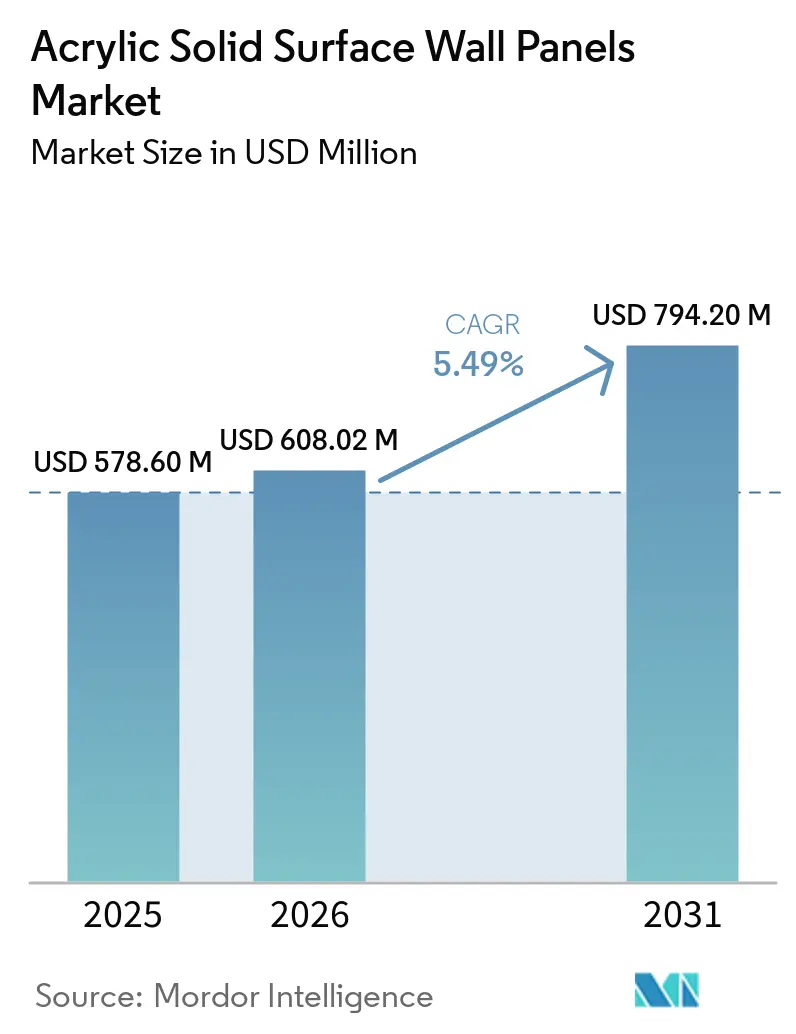
The acrylic solid surface wall panels market size is expected to grow from USD 578.6 million in 2025 to USD 608.02 million in 2026 and reach USD 794.2 million by 2031, growing at a CAGR of 5.49% over 2026-2031. Healthcare construction and renovation are supporting demand for finishes that can meet strict cleaning and infection-control requirements. Commercial and hospitality upgrades are also favoring wall materials that provide a continuous appearance and require limited maintenance. Acrylic panels can be welded at joints, formed into curves, and repaired on site, which supports their use where long service life matters. These characteristics help the acrylic solid surface wall panels market compete with ceramic tile, PVC panels, and laminates, even where those alternatives have a lower initial cost. Manufacturers are responding through product launches, broader distribution coverage, and closer work with architects, fabricators, and institutional buyers.
Key Report Takeaways
- By material composition, pure acrylic solid surface led with a 66.13% share of the acrylic solid surface wall panels market in 2025, while modified acrylic/acrylic-polyester blends are projected to register a 6.96% CAGR through 2031.
- By product/panel format, standard solid surface wall panels led with a 35.62% market share in 2025, while 3D/textured panels are projected to register a 7.88% CAGR through 2031.
- By thickness, 6–8 mm panels led with a 36.16% market share in 2025, while panels under 6 mm are projected to register a 7.47% CAGR through 2031.
- By end-user, commercial applications led with a 75.05% market share in 2025, while commercial healthcare applications are projected to register a 7.62% CAGR through 2031.
- By distribution channel, indirect sales led with a 65.27% market share in 2025, while direct sales are projected to register a 7.75% CAGR through 2031.
- By geography, Asia-Pacific led with a 36.83% market share in 2025 and is projected to register a 7.38% CAGR through 2031.
Note: Market size and forecast figures in this report are generated using Mordor Intelligence’s proprietary estimation framework, updated with the latest available data and insights as of January 2026.
Global Acrylic Solid Surface Wall Panels Market Trends and Insights
Drivers Impact Analysis*
| Driver | (~) % Impact on CAGR Forecast | Geographic Relevance | Impact Timeline |
|---|---|---|---|
| Healthcare And Infection-Controlled Interior Design | +1.4% | Global, strongest in North America, Europe, and the GCC | Short term (≤ 2 years) |
| Commercial Interior Refurbishment And Retrofits | +1.1% | North America and Europe, with spillover to the Asia-Pacific | Medium term (2-4 years) |
| Seamless, Low-Maintenance Wall Finishes | +0.9% | Global | Long term (≥ 4 years) |
| Hospitality And Institutional Construction | +1% | Asia-Pacific core, with spillover to the Middle East and Africa | Medium term (2-4 years) |
| Thermoformed And Integrated Wall Systems | +0.6% | Global premium commercial locations | Medium term (2-4 years) |
| Faster Renovation Through Large-Format Installation | +0.5% | Global | Short term (≤ 2 years) |
| Source: Mordor Intelligence | |||
Healthcare and Infection-Controlled Interior Design
Healthcare facilities are using acrylic solid surface wall panels beyond countertops and into complete vertical cladding systems. The acrylic solid surface wall panels market benefits because nonporous surfaces can reduce the joints and grout lines associated with tile and some sheet systems. This makes cleaning routines easier to manage in clinical rooms, treatment areas, and wet zones. NSF/ANSI 51 and UL GREENGUARD Gold requirements can narrow the pool of materials considered for sensitive applications[1]. LX Hausys has issued a 2026 healthcare brochure that positions HIMACS around antimicrobial performance, chemical resistance, and low-emission characteristics for hospital projects. On-site repair also allows facilities to restore damaged surfaces without taking an entire room out of service.
Commercial Interior Refurbishment and Retrofit Activity
Commercial refurbishment is supporting demand for durable wall finishes in offices, hotels, retail spaces, and public facilities. The American Institute of Architects projected that United States commercial construction spending would grow 4.8% in 2026, with office activity growing 9.6% and hotel construction growing 4.6%[2]. These projects often include reception areas, elevator lobbies, corridors, washrooms, and amenity spaces that need finishes with a consistent visual standard. Acrylic solid surface wall panels can cover wet and dry areas with the same material family, which simplifies specifications for some projects. Large-format panels can also reduce the number of joints compared with tiled finishes. The acrylic solid surface wall panels market gains where landlords and occupiers select materials that balance appearance, maintenance needs, and the practical limits of occupied-building renovations.
Urban Hospitality and Institutional Construction In Asia-Pacific and The Middle East
Hospitality and institutional construction are creating a broad base of project demand across the Asia-Pacific and the Middle East. Hotels, hospitals, senior living facilities, and wellness properties need many of the same wall performance features, including cleanable surfaces, chemical resistance, and color consistency. This overlap allows suppliers to serve more than 1 project type through related product ranges. It also creates a shared need for reliable fabrication and installation support across large, multi-room projects. Hospital wet areas and hotel bathrooms both benefit from seamless panels that are easier to clean than surfaces with many joints. The acrylic solid surface wall panels market is therefore supported by construction activity that combines hygiene requirements with a need for finished interior surfaces.
Architect Demand for Thermoformed, Curved, and Integrated Wall Systems
Architects and designers are using curves, continuous planes, and integrated features more often in premium interior projects. Acrylic solid surface can be heated and formed into curved shapes, allowing vertical and horizontal surfaces to meet with fewer visible transitions. KRION describes thermoforming as a process for shaping its material under controlled heat for customized applications. DuPont introduced its 2026 Nature in Motion collection with 7 new solid surface designs and presented curved and integrated vertical applications as important uses[3]. The availability of qualified fabricators remains important because complex installations need specialized skills and equipment. This requirement can restrict adoption in less developed markets while protecting the position of established fabricators in mature locations.
Restraints Impact Analysis*
| Restraint | (~) % Impact on CAGR Forecast | Geographic Relevance | Impact Timeline |
|---|---|---|---|
| Premium Price Versus Tile, PVC, And Laminates | -0.8% | Global, strongest in price-sensitive Asia-Pacific and South America | Long term (≥ 4 years) |
| Acrylic Resin And Methyl Methacrylate Price Volatility | -0.6% | Global, with the highest exposure in Asia-dependent supply chains | Short term (≤ 2 years) |
| Limited Certified Fabricators For Complex Projects | -0.4% | Asia-Pacific, the Middle East and Africa, and South America | Medium term (2-4 years) |
| Project-Specific Certification Requirements | -0.3% | North America and Europe | Long term (≥ 4 years) |
| Source: Mordor Intelligence | |||
Premium Price Compared With Ceramic Tile, PVC, and Laminates
Acrylic solid surface panels have a higher initial material cost than standard ceramic tile and PVC alternatives. The cost difference reflects MMA-based resin inputs, fabrication time, and the expense of maintaining qualified fabricator networks. This narrows use in residential projects and budget-led commercial renovations. It is particularly relevant in South and Southeast Asia and South America, where installed cost can be the main buying criterion. High-quality PVC and SPC wall panels also provide an alternative for projects that need a lower price point. The acrylic solid surface wall panels market retains an advantage in projects where repairability, hygiene, and longer surface life are given more weight over a 10-15 year facility cycle.
Acrylic Resin and Methyl Methacrylate Feedstock Price Volatility
The growing preference for biophilic and organic architectural forms in commercial and healthcare interiors has elevated thermoformability from a niche capability to a primary specification criterion. Acrylic solid surface panels achieve tight-radius curves without seams or tension marks when heated to approximately 130–160°C, enabling seamless transitions between vertical and horizontal planes that are geometrically impossible with ceramic tile or rigid laminate[4]. Production depends on inputs including acetone, isobutylene, and hydrogen cyanide, leaving producers exposed to several supply chains. Suppliers without their own MMA capacity or longer-term supply arrangements can face greater pressure when project prices are already fixed. Smaller producers may have less ability to manage these changes through procurement scale or hedging. Cost volatility can make it harder to offer stable quotes for long construction schedules. It can also strengthen the relative position of integrated producers that have deeper purchasing capabilities and more resilient supply arrangements.
*Our forecasts treat driver/restraint impacts as directional, not additive. The impact forecasts reflect baseline growth, mix effects, and variable interactions.
Segment Analysis
By Material Composition: Pure Acrylic Supports Clinical and Premium Hospitality Demand
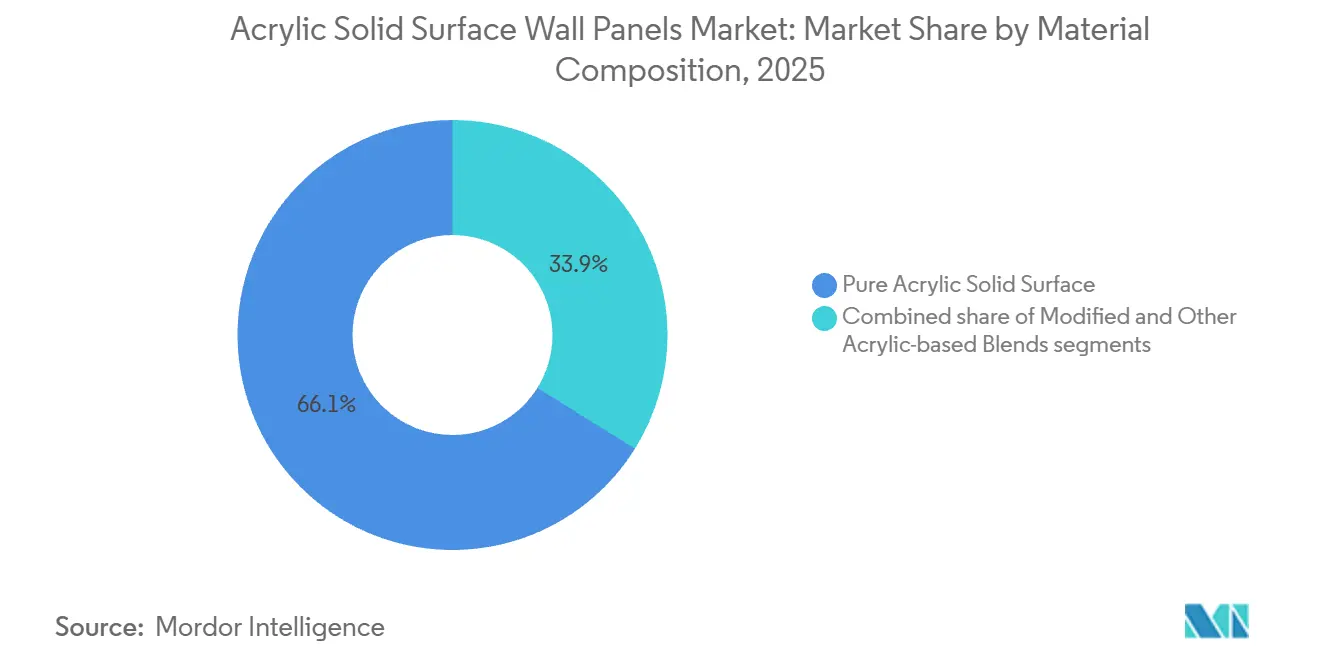
Pure acrylic held 66.13% of the acrylic solid surface wall panels market size in 2025. It is widely used in healthcare, hospitality, and premium commercial sites where chemical resistance and repairability can support a higher upfront cost. Pure acrylic is suited to seamless fabrication and can be repaired where localized damage occurs. These features are valuable in clinical spaces that are cleaned frequently with hospital-grade products. Futrus lists NSF/ANSI Standard 51, GREENGUARD Gold, and Class A fire ratings for its Prima Healthwall system. The same credentials can help suppliers participate in healthcare, food-service, and education specifications. Material choices within the acrylic solid surface wall panels market often reflect the balance between compliance needs, expected service conditions, and planned maintenance.
Modified acrylic and acrylic-polyester blends are forecast to grow at a 6.96% CAGR through 2031. These formulations can offer improved impact resistance and more design options for mid-range commercial and retrofit projects. Their more accessible cost position can support use in hospitality renovations where design consistency remains important. Consistent coloration across longer panel runs is also useful when a project requires continuity through corridors, washrooms, or public areas. The blend format can address projects where a pure acrylic specification is not required across every wall surface. Other acrylic-based blends address education, retail, and light commercial applications with lower cost limits. Product suppliers are seeking to combine relevant certification with practical performance so their materials can qualify for a wider range of projects. The mix is likely to remain led by pure acrylic while blends address a larger group of cost-sensitive specifications.

By Product/Panel Format: 3D And Textured Panels Extend Design Options In Commercial Locations
Standard solid surface wall panels held 35.62% of the market share in 2025. Their position reflects steady demand from healthcare wet rooms, institutional washrooms, and hotel bathroom renovations. These applications tend to prioritize predictable performance, cleaning, and installation over a highly decorative surface. Standard panels also provide a familiar format for fabricators and contractors. Large-format seamless panels are gaining use in reception areas, corridors, and elevator lobbies, where fewer joints can reduce maintenance points. Their size can improve the visual continuity of high-traffic walls and reduce visible interruptions across long runs. The format remains an important base for the acrylic solid surface wall panels market because it serves repeatable institutional applications.
3D and textured panels are forecast to expand at a 7.88% CAGR through 2031. Thermoforming allows acrylic panels to create relief, carved patterns, and curved forms while retaining a nonporous surface. ASST presents its Sculptcor range for healthcare uses that require both hygienic performance and design flexibility. Decorative and patterned panels serve retail, corporate, and education projects where customization can be part of the design brief. These finishes can provide visual distinction while retaining the cleaning characteristics associated with solid surface materials. Larger sheets require reliable handling, transport, and installation capabilities to prevent damage before fitting. Suppliers with regional fabrication networks can respond more quickly to those project needs. This makes operational reach as important as design choice in large-format and textured wall installations.
By Thickness: Sub-6 mm Panels Improve Retrofit Options In Occupied Buildings
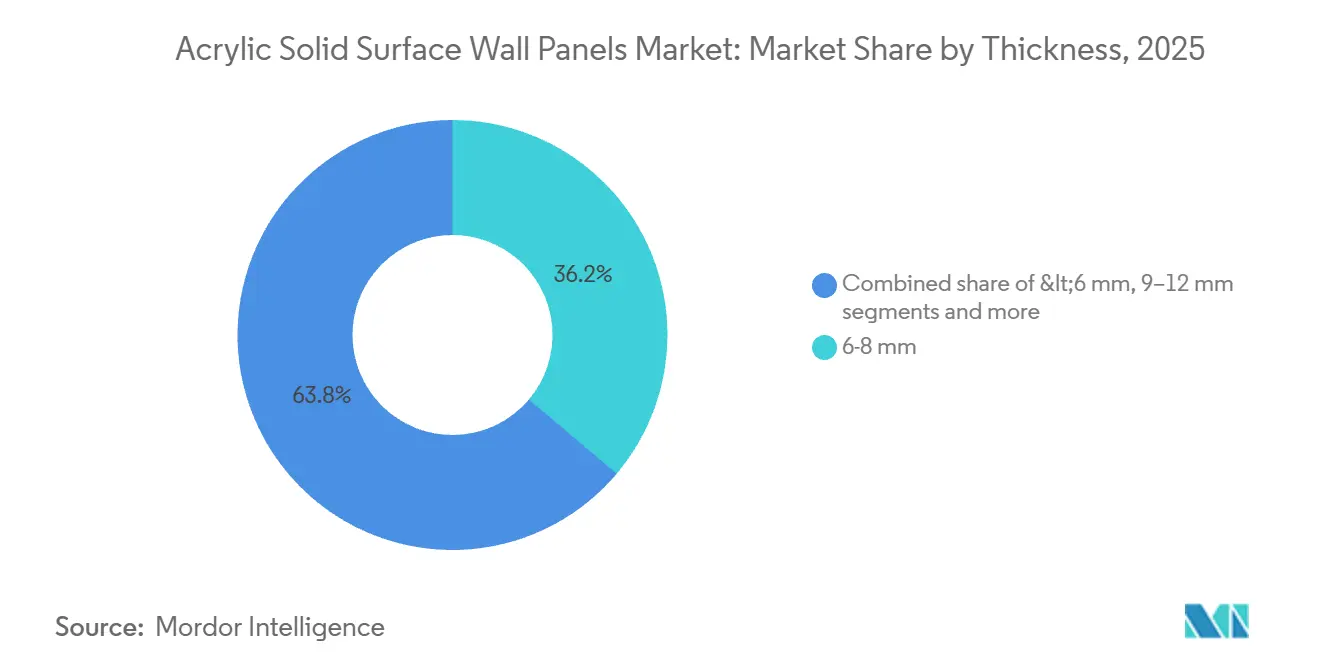
Panels measuring 6-8 mm accounted for 36.16% of the acrylic solid surface wall panels market size in 2025. This thickness is common for wet-zone wall cladding in healthcare facilities, hospitality bathrooms, and commercial washrooms. It provides a practical balance between rigidity, weight, and handling during standard installations. Product selection may also depend on local fire and impact requirements. The ANSI/ASTM NEMA LD-3 standard provides a common reference point for impact resistance across laminate and decorative surface applications. Thicker 9-12 mm panels are used where a project needs greater rigidity or deeper design work. Panels from 13-20 mm and above 20 mm are more relevant for structural features and customized furniture.
Sub-6 mm panels are projected to grow at a 7.47% CAGR through 2031. Lower weight can be valuable in occupied-building renovations with limits on elevator capacity, wall loading, and access routes. A lighter panel may allow more material to be moved in each elevator cycle and reduce disruption in operating buildings. This is relevant in multi-story hospitals, hotels, senior living properties, and other facilities that cannot be fully closed for renovation. Thin sheets are used for commercial-scale hospitality, healthcare, institutional, senior living, and multi-unit residential applications. Fabricators still need to consider substrate condition and fixing methods when using thinner formats. This is important because panel thickness, wall condition, and installation access are considered together in retrofit planning. The acrylic solid surface wall panels market can benefit when project teams select lighter products to shorten a retrofit schedule.
By End User: Commercial Projects Provide Volume While Healthcare Adds Momentum
Commercial end users held 75.05% of the market share in 2025. This includes healthcare, hospitality, offices, retail space, and food-service locations. These buyers value nonporous finishes because the surfaces can withstand repeated cleaning and daily use. Institutional projects can also require fire, indoor-air-quality, and food-contact credentials before a product is approved. Wilsonart documented a Penn Medicine hospital project with more than 300,000 sq ft of solid surface material, more than 1,300 integrated solid surface sinks, patient room headwalls, and furniture surfaces. Such installations show how a single healthcare project can generate substantial material demand. Commercial specifications are likely to remain the principal source of volume for suppliers.
Healthcare is the fastest-growing commercial application and is projected to expand at a 7.62% CAGR through 2031. Hospital construction, renovations, outpatient facilities, and specialized care environments all support the need for durable wall systems. Hospitality and office interiors add a separate demand stream where visual continuity and low maintenance are important. Residential applications form the remaining share, mainly in premium kitchens and bathrooms. Comparisons with quartz, engineered stone, tile, and other lower-cost finishes constrain their wider adoption. Senior living, resort wellness centers, and corporate health clinics combine hospitality and healthcare needs within a single project. These hybrid settings create demand for panels that can work in wet zones and public-facing dry spaces without a major change in material performance. They also allow suppliers to apply healthcare-oriented material attributes in settings where appearance remains a major consideration.
By Distribution Channel: Direct Sales Increase Contact With Project Specifiers
Indirect sales channels held 65.27% of the market share in 2025. Distributors, dealers, and fabricators provide local stock, technical support, and delivery services across dispersed project locations. This network is especially valuable where demand is fragmented across many smaller commercial and residential jobs. It can also give contractors access to familiar fabrication and installation partners. Indirect channels remain important for routine orders that do not warrant dedicated manufacturer resources. Local relationships can reduce lead times and help address site-specific fitting requirements. These functions support the continuing role of distributors in the acrylic solid surface wall panels market.
Direct sales are projected to grow at a 7.75% CAGR through 2031. Manufacturers are investing in architect and specifier relationships for larger healthcare and hospitality projects. Direct engagement can allow suppliers to provide technical advice before a material is fixed in the project specification. Suppliers are also strengthening local availability where projects require quick delivery and qualified fabrication support. This approach combines broad regional access with closer manufacturer contact on major accounts. Direct and indirect routes are therefore likely to remain complementary rather than fully replacing each other.
Geography Analysis
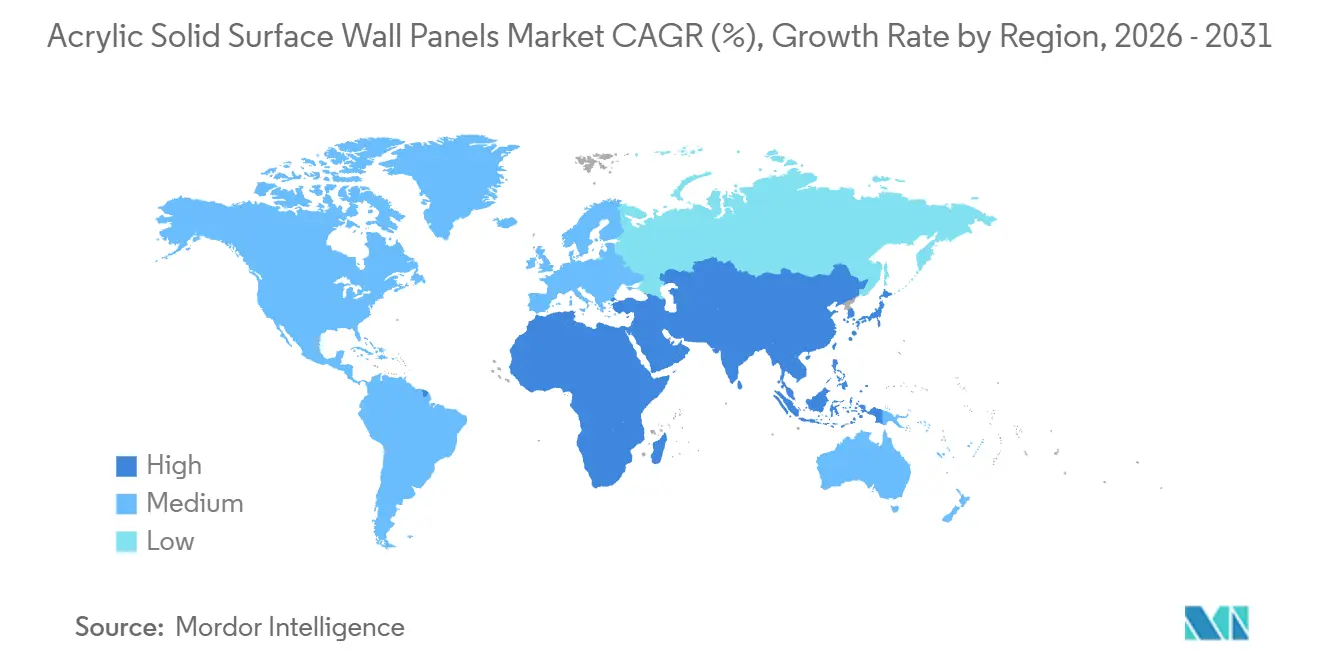
Asia-Pacific accounted for 36.83% of the market share in 2025 and is expected to grow at a 7.38% CAGR through 2031. Hospitality construction and expanding healthcare capacity are the region’s main demand bases. China, India, and Southeast Asia support wall-panel demand across hotel fit-outs, hospital projects, and renovation work. KingKonree operates a 25,000 m² facility in Shenzhen and reports output of more than 15,000 finished products each month under ISO 9001:2015 certification. This manufacturing base helps regional suppliers compete for larger hospitality orders. Low-VOC requirements and green building programs are also making certification more relevant during tender reviews.
North America and Europe are mature demand centers with established distributor networks and long experience in healthcare and commercial renovation. The AIA forecast for United States commercial, office, hotel, and healthcare construction supports demand across key surface applications in 2026. Europe is concentrated in Germany, the United Kingdom, and the Nordic countries, where certified materials are important for hospital renovation work. Sustainability requirements are particularly relevant in BENELUX and Nordic specifications. These regions provide a stable base for established brands with documented fire, VOC, and hygiene credentials.
The Middle East and Africa are supported by GCC healthcare and hospitality investment. Private healthcare and luxury hospitality projects can favor premium interior materials with clear maintenance benefits. South Africa and Nigeria are the main sub-Saharan demand centers, with use concentrated in private healthcare and hospitality developments. Sustainability frameworks in Saudi Arabia and the United Arab Emirates are increasing attention to material emissions and compliance documentation.
Competitive Landscape
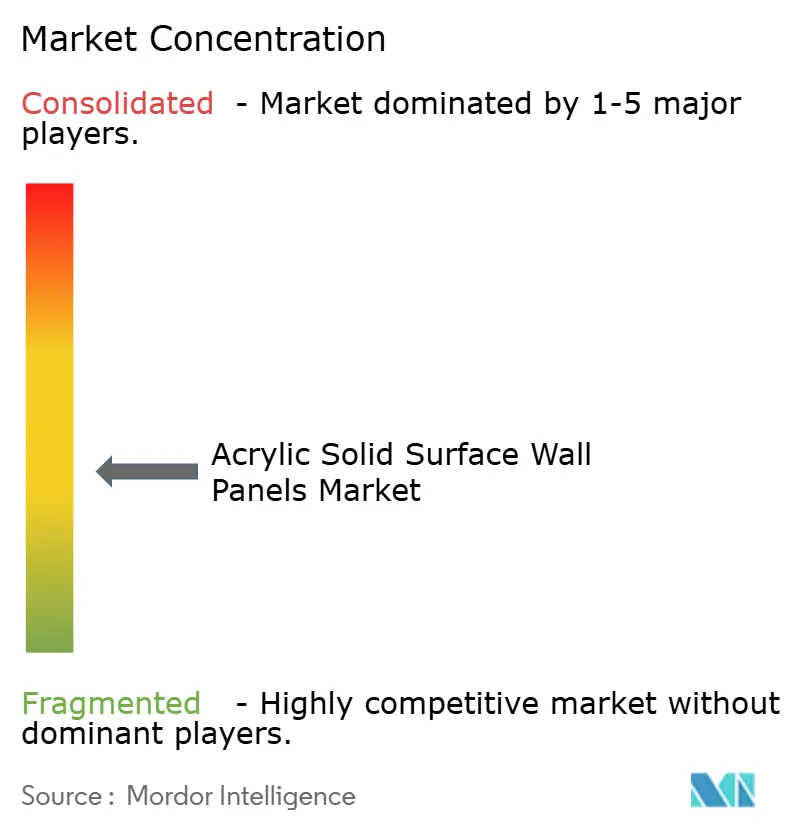
The acrylic solid surface wall panels market is moderately consolidated in premium institutional applications. DuPont through Corian, LX Hausys through HIMACS, Trinseo through Avonite and Wet Wall, and Wilsonart hold strong positions in healthcare and hospitality specifications. These companies benefit from established installed bases, recognized certifications, and long-standing relationships with fabricators. The structure becomes more fragmented below this leading group. Stylam Industries and Durlax Top Surface serve Indian commercial and export demand, while Hyundai L&C, Hanex, KingKonree, and Guangzhou Gelandi address regional applications through local production and distribution. No single company has a commanding worldwide position, which leaves room for focused suppliers that can meet local requirements.
Product development, distribution investment, and compliance credentials are central competitive tools. DuPont launched its Nature in Motion collection in April 2026, adding 7 solid surface designs for curved, vertical, and integrated applications in healthcare, hospitality, food-service, and education projects. LX Hausys is using domestic production and regional logistics to support supply continuity for institutional projects. KingKonree introduced an Integrated Living Collection in January 2026, covering customizable cabinet basins, reception desks, hospitality, and healthcare surfaces. These moves show that suppliers are seeking to cover broader interior systems instead of offering a single-panel product. Distribution partners remain essential for local stock and fabrication support even as direct specification activity increases.
Certification can serve as both a qualification requirement and a competitive advantage. GREENGUARD Gold, NSF/ANSI 51, Class 1A fire performance, ASTM E84, and California Section 1350 requirements can determine whether a product can be considered for institutional tenders. Companies that hold a wider group of credentials can compete for healthcare, education, and food-service projects with demanding specifications. Smaller suppliers can still succeed in regional markets, but they may need external testing, capable fabricators, and clear product documentation to build trust. Curved and 3D panel applications also create barriers because they require specialized molds and installation skills. The competitive environment supports established brands, but it also leaves opportunities for companies that combine reliable compliance with responsive local fabrication.
Acrylic Solid Surface Wall Panels Industry Leaders
-
DuPont de Nemours, Inc.
-
LX Hausys, Ltd.
-
LOTTE Chemical Corporation
-
Trinseo PLC
-
Wilsonart LLC
- *Disclaimer: Major Players sorted in no particular order
Recent Industry Developments
- September 2026: DuPont Corian® Design appointed Blackheath Products as an official distributor for Corian® Solid Surface across the United Kingdom and Ireland, strengthening engagement with architects, designers, fabricators, and trade customers in one of Europe's largest solid surface specification markets. The appointment builds on DuPont's commitment to the United Kingdom market and expands fabricator and retail accessibility across the region.
- August 2026: DuPont Corian® Design expanded its United States distribution network through enhanced partnerships with Hallmark Building Supplies and Parksite, extending coverage across Mid-Atlantic and Midwest markets, including Eastern Illinois, Southern Indiana, Kentucky, Pennsylvania, Delaware, Maryland, and Virginia. The expansion supports the 2026 Nature in Motion color collection and improves service infrastructure for commercial and institutional project demand.
- August 2026: KingKonree unveiled its Translucent Solid Surface Collection at Canton Fair 2026, targeting a light-transmissive decorative wall panel category for commercial and residential interior design, a product segment with no direct equivalent in the incumbent solid surface portfolio. The collection is designed to push the boundaries of illuminated architectural surface applications.
- July 2026: Wilsonart expanded its High-Pressure Laminate collection with 21 new designs across woodgrain, linear, and textile categories, explicitly coordinating the launch with its Solid Surface, Quartz, Thinscape®, and Wetwall® lines to simplify multi-material specification for commercial interior designers across a cohesive materials portfolio.
Global Acrylic Solid Surface Wall Panels Market Report Scope
Acrylic solid surface wall panels are engineered materials composed of acrylic resins, minerals, and pigments that offer a seamless and non-porous alternative to traditional wall claddings. The acrylic solid surface wall panels market is segmented by material composition, product/panel format, thickness, end user, distribution channel, and geography. By material composition, the market is segmented into pure acrylic solid surface, modified acrylic / acrylic-polyester blend solid surface, and other acrylic-based blends. By product/panel format, the market is segmented into standard solid surface wall panels, decorative/patterned wall panels, large-format seamless panels, 3D / textured panels, and others. By thickness, the market is segmented into <6 mm, 6-8 mm, 9–12 mm, 13–20 mm, and >20 mm. By end user, the market is segmented into residential and commercial. By distribution channel, the market is segmented into direct sales and indirect sales. By geography, the market is segmented into North America, South America, Europe, Asia-Pacific, and the Middle East & Africa. The report offers the market size in value terms in USD for all the above-mentioned segments.
| Pure Acrylic Solid Surface |
| Modified Acrylic / Acrylic-Polyester Blend Solid Surface |
| Other Acrylic-based Blends |
| Standard Solid Surface Wall Panels |
| Decorative / Patterned Wall Panels |
| Large-format Seamless Panels |
| 3D / Textured Panels |
| Others |
| Below 6 mm |
| 6-8 mm |
| 9–12 mm |
| 13–20 mm |
| Above 20 mm |
| Residential |
| Commercial |
| Direct Sales |
| Indirect Sales |
| North America | Canada |
| United States | |
| Mexico | |
| South America | Brazil |
| Peru | |
| Chile | |
| Argentina | |
| Rest of South America | |
| Europe | United Kingdom |
| Germany | |
| France | |
| Spain | |
| Italy | |
| BENELUX (Belgium, Netherlands, Luxembourg) | |
| NORDICS (Denmark, Finland, Iceland, Norway, Sweden) | |
| Rest of Europe | |
| Asia-Pacific | India |
| China | |
| Japan | |
| Australia | |
| South Korea | |
| South-East Asia | |
| Rest of Asia-Pacific | |
| Middle East & Africa | United Arab Emirates |
| Saudi Arabia | |
| South Africa | |
| Nigeria | |
| Rest of Middle East & Africa |
| By Material Composition | Pure Acrylic Solid Surface | |
| Modified Acrylic / Acrylic-Polyester Blend Solid Surface | ||
| Other Acrylic-based Blends | ||
| By Product/Panel Format | Standard Solid Surface Wall Panels | |
| Decorative / Patterned Wall Panels | ||
| Large-format Seamless Panels | ||
| 3D / Textured Panels | ||
| Others | ||
| By Thickness | Below 6 mm | |
| 6-8 mm | ||
| 9–12 mm | ||
| 13–20 mm | ||
| Above 20 mm | ||
| By End User | Residential | |
| Commercial | ||
| By Distribution Channel | Direct Sales | |
| Indirect Sales | ||
| By Geography | North America | Canada |
| United States | ||
| Mexico | ||
| South America | Brazil | |
| Peru | ||
| Chile | ||
| Argentina | ||
| Rest of South America | ||
| Europe | United Kingdom | |
| Germany | ||
| France | ||
| Spain | ||
| Italy | ||
| BENELUX (Belgium, Netherlands, Luxembourg) | ||
| NORDICS (Denmark, Finland, Iceland, Norway, Sweden) | ||
| Rest of Europe | ||
| Asia-Pacific | India | |
| China | ||
| Japan | ||
| Australia | ||
| South Korea | ||
| South-East Asia | ||
| Rest of Asia-Pacific | ||
| Middle East & Africa | United Arab Emirates | |
| Saudi Arabia | ||
| South Africa | ||
| Nigeria | ||
| Rest of Middle East & Africa | ||
Key Questions Answered in the Report
What is driving demand for acrylic solid surface wall panels?
Healthcare infection-control requirements, commercial refurbishment, and hospitality construction support demand for seamless and low-maintenance wall finishes.
How large is the acrylic solid surface wall panels market?
The sector is expected to reach USD 794.2 million by 2031 from USD 608 million in 2026, at a 5.49% CAGR.
Which material composition leads to demand?
Pure acrylic led with 66.13% share in 2025 because it supports chemical resistance, seamless fabrication, and on-site repair.
Which panel format is growing fastest?
3D and textured panels are projected to grow at a 7.88% CAGR through 2031 as commercial projects seek dimensional wall designs.
Why are sub-6 mm acrylic panels gaining acceptance?
Sub-6 mm panels are projected to grow at a 7.47% CAGR because their lower weight can simplify retrofits in occupied buildings.
Which region is expected to grow fastest?
Asia-Pacific is forecast to grow at a 7.38% CAGR through 2031, supported by hotel development and healthcare investment.