
Market Overview
| Study Period | 2020 - 2031 |
|---|---|
| Forecast Data Period | 2026 - 2031 |
| Historical Data Period | 2020 - 2024 |
| Growth Rate | 3.88 % |
Major Players *Disclaimer: Major Players sorted in no particular order Image © Mordor Intelligence. Reuse requires attribution under CC BY 4.0. | |
Germany Water Treatment Chemicals Market Analysis by Mordor Intelligence
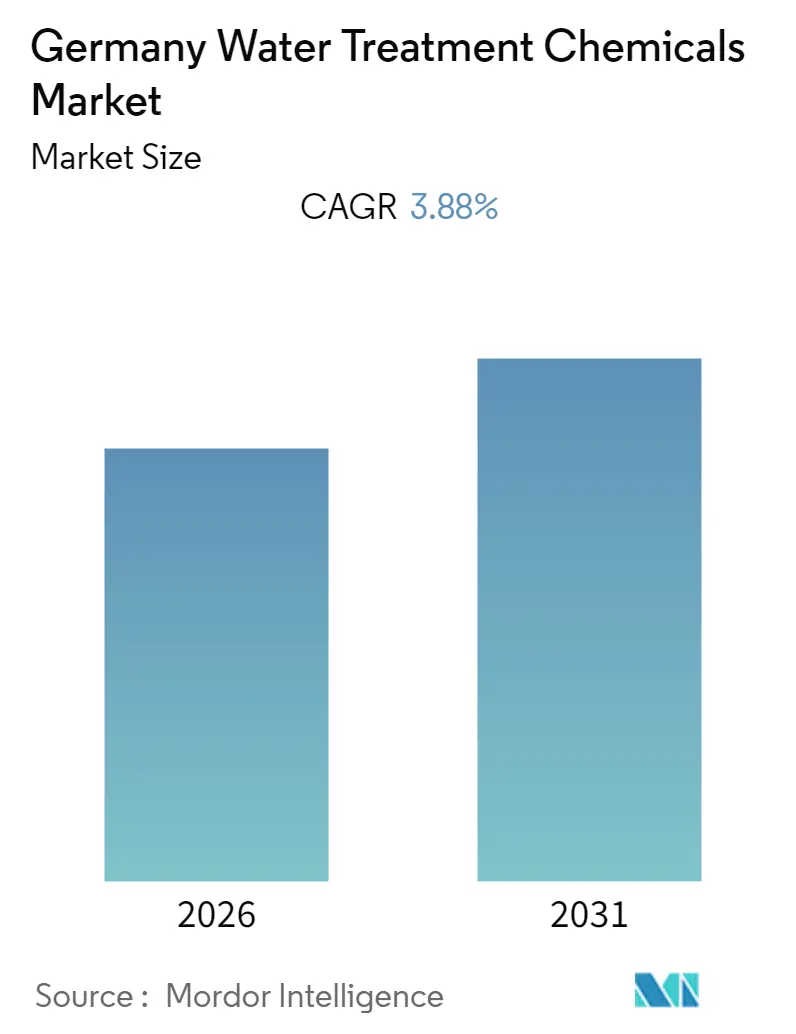
The Germany Water Treatment Chemicals Market size is expected to register a CAGR of 3.88% during the forecast period (2026-2031).
- Some of the other driving factors of the market include increasing demand from the power and industrial sectors in the country
- Shifting focus towards green chemicals is likely to offer a major growth opportunity for the market studied in the coming years.
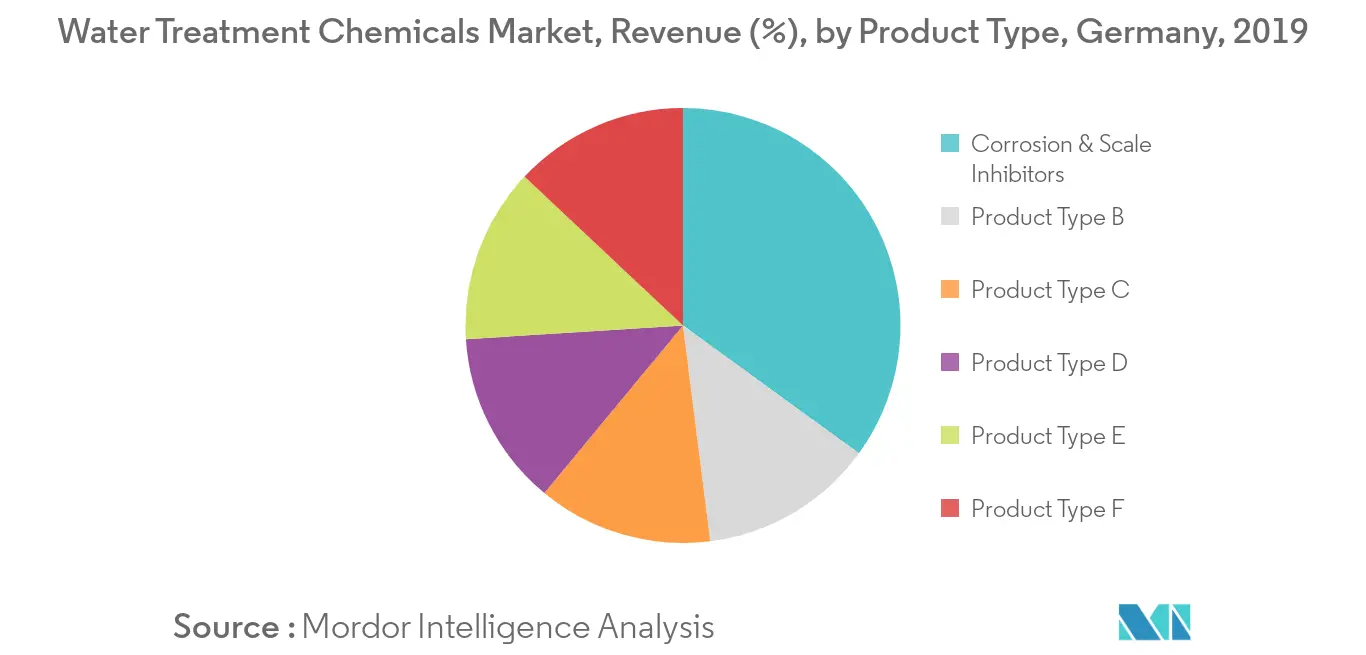
- Among the end-user industries, power generation accounts for the major market share and is expected to maintain its position during the forecast period.
Note: Market size and forecast figures in this report are generated using Mordor Intelligence’s proprietary estimation framework, updated with the latest available data and insights as of 2026.
Germany Water Treatment Chemicals Market Trends and Insights
Coagulants & Flocculants to Witness the Highest Growth Rate
- Flocculants are substances that promote the clumping of destabilized particles, which are obtained after being treated with coagulants; the coagulants neutralize the charge on colloidal particles responsible for keeping them apart.
- These agents promote flocculation by causing colloids and other suspended particles to aggregate and drop out of the liquid. Flocculants are used in various water treatment processes in numerous industries such as chemical processing, food & beverage, oil & gas and power generation among others.
- Municipal water treatment forms the largest market for flocculants. The growing water requirement of the country is likely to boost the consumption of coagulants and flocculants used in municipal industry.
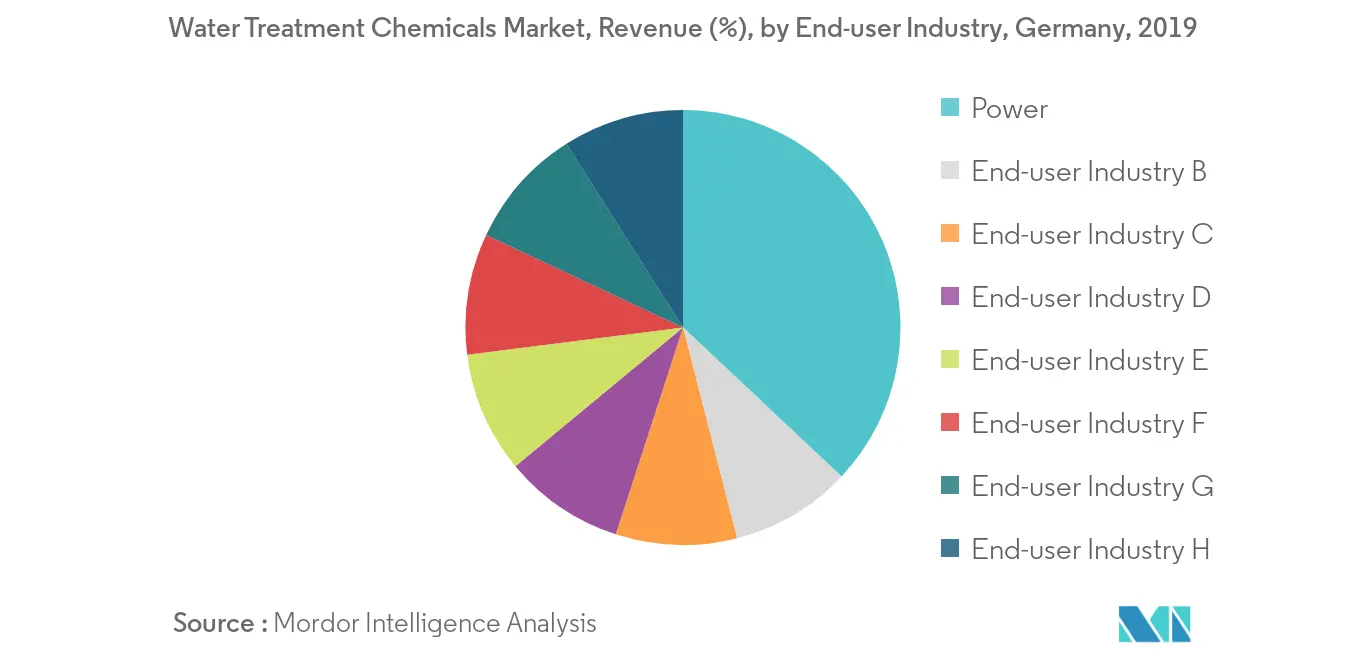
- Hence, owing to the above-mentioned factors, Coagulants and flocculants are expected to witness the highest growth during the forecast period.


Power Industry to Dominate the Market
- Power generation industry is currently occupying the major share of the Germany water treatment chemicals market. The electric power generation industry is one of the major sources of industrial wastewater.
- Most electric power generation plants require water for their day-to-day operations. Hydropower plants use water directly to generate power. Overall, the electric power generation industry is one of the biggest consumers of water worldwide.
- Their wastewater contains significant levels of toxic metal impurities, such as lead, mercury, arsenic, chromium, and cadmium, among others. These impurities can cause significant damage to environment, if not treated properly.
- The growing electricity demand is likely to drive the electricity generated in Germany which in turn is likely to boost the demand for water treatment chemicals in the country.
- Hence, owing to the above-mentioned factors, power generation industry is likely to dominate the germany water treatment chemicals market during the forecast period.
Competitive Landscape
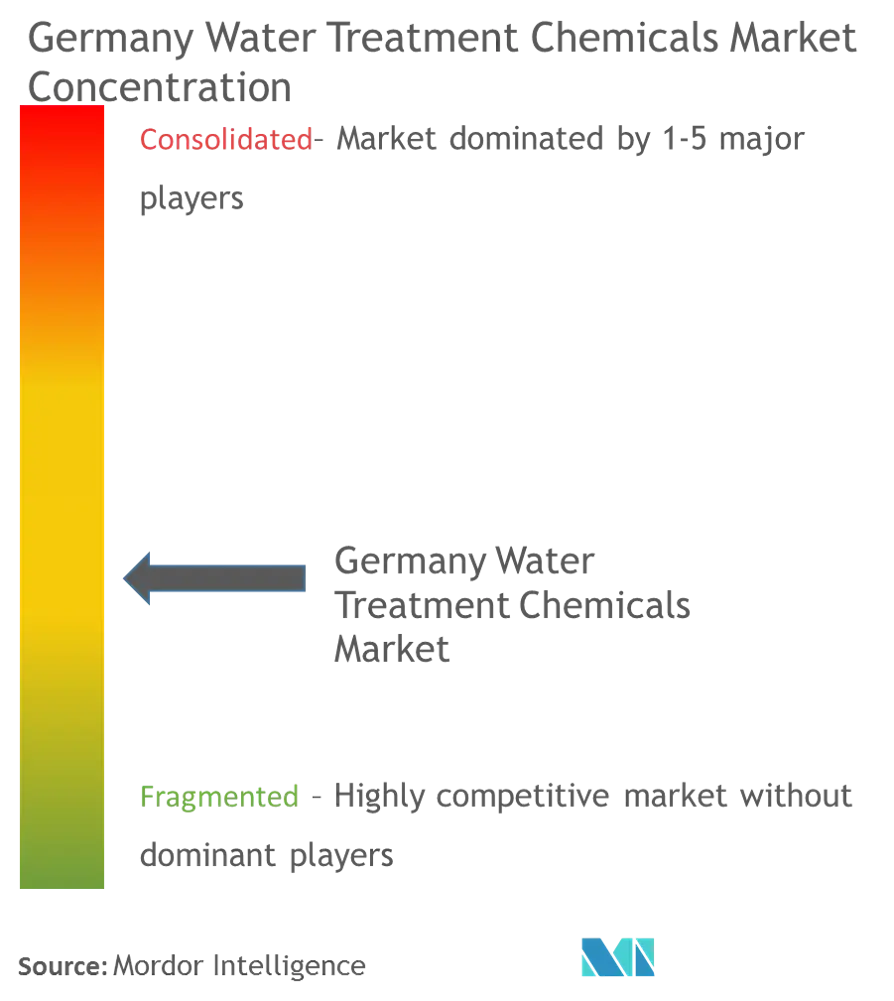
The Germany water treatment chemicals market is moderately consolidated with major players accounting for majority of the market. Some of the major players of the market include Ecolab, Kemira, kurita, Suez, and Solenis, among others.
Germany Water Treatment Chemicals Industry Leaders
Ecolab
Kemira
Kurita Water Industries Ltd.
Suez
Solenis
- *Disclaimer: Major Players sorted in no particular order

Market Opportunities and Future Outlook
A clear opportunity in Germany is the shift from conventional wastewater treatment toward advanced micropollutant removal and PFAS-related solutions, which is already showing up in commissioning and pilot activity at municipal sites. WTA UNISOL reported commissioning of a PFAS-free membrane treatment plant in Lindau (Bavaria), and Fraunhofer UMSICHT is working with Wolfsburg entities on a pilot for a fourth treatment stage. As treatment trains become more complex, these technology upgrades are directly tied to demand for specialty coagulants and flocculants, including tailored polymer programs, oxidizing biocides/disinfectants, and complementary process aids used to stabilize performance.
A second opportunity centers on low-carbon and resource-efficient chemistries and operations. Customers and suppliers are moving beyond compliance toward measurable footprint attributes and process optimization, and Evonik launched a lower-carbon-footprint peracetic acid for the European market, a disinfectant-relevant chemistry. In Germany, equipment and plant-side initiatives such as data-driven dewatering optimization and chemical-free microfiltration pilots are also pushing chemical suppliers to differentiate with programs that reduce dosage, improve sludge dewaterability, and support circularity. This includes nitrogen recovery pilots such as the Steinhaeule wastewater treatment plant initiative, reinforcing demand for application support in municipal and industrial wastewater and for greener formulations with verified traceability or chain-of-custody practices and performance guarantees linked to energy and sludge outcomes.
Recent Industry Developments
- February 2026: Kemira announced the acquisition of SIDRA Wasserchemie, a German coagulant manufacturer, for approximately EUR 75 million, subject to clearance by the Federal Cartel Office. SIDRA operates two production facilities in Germany, which supports local coagulant supply and strengthens Kemira's water solutions footprint in the country.
- December 2025: Ecolab closed the acquisition of Ovivo Inc.'s electronics ultrapure water business. The transaction expands Ecolab's capabilities for high-purity and industrial water management, aligned with demand from semiconductor and advanced manufacturing value chains that also affect specialty chemical requirements.
- May 2025: Kemira deployed its KemConnect DEX disinfection solution (performic acid-based) at the Berlin-Ruhleben wastewater treatment plant to support bathing-water quality requirements during the summer season. The implementation points to the role of targeted disinfection chemistries and on-site application programs in large municipal facilities.


Research Methodology Framework and Report Scope
Market Definition and Coverage
For this study, the market includes the value of chemicals used to treat water and wastewater in Germany across municipal and industrial systems. In scope are chemicals dosed to control solids, microbes, pH, foam, corrosion, and scale.
Scope exclusions: We exclude water treatment equipment, membranes, filter media, and contracted operations services where chemicals are only a pass-through cost.
Segmentation Overview
- Product Type
- Coagulants & Flocculants
- Biocide & Disinfectant
- Defoamer & Defoaming Agent
- pH & Adjuster & Softener
- Scale & Corrosion Inhibitor
- Others
- End-user Industry
- Power
- Oil & Gas
- Chemical Manufacturing
- Municipal
- Mining and Mineral Processing
- Food & Beverage
- Pulp & Paper
- Others
Data Sources, Market Sizing, and Validation
Desk Research
Desk research was used to set the market boundary, map demand centers, and build starting assumptions on volumes and pricing. We reviewed public sources such as the German Federal Statistical Office (Destatis), the Federal Environment Agency (UBA), Eurostat water and industrial activity tables, and ECHA and EU regulatory releases that affect disinfectants and biocides, along with technical literature in peer-reviewed water journals.
To keep the sizing practical, the desk phase also used company annual reports, investor presentations, association websites, and trade press to understand the application mix (municipal versus industrial) and typical consumption patterns in cooling, boiler, and wastewater systems. For items that were harder to find, we selectively used paid subscriptions for company financials and news intelligence, and we used an import and export shipment-level database to sanity-check cross-border flows of key chemical groups. These examples are not exhaustive, and we also used other public and paid sources for data collection, validation, and clarification.
Primary Interviews and Surveys
Primary work focused on validating the real demand drivers in Germany, followed by confirming how product mix and pricing vary by end-use and treatment objective. We spoke with suppliers, distributors, water utility stakeholders, and industrial water management teams, then used their inputs to close data gaps, test desk-research assumptions, and triangulate the final model.
Distribution of primary research fieldwork respondents
| Company type | Respondent position |
|---|---|
| Top tier: 35% | CXOs: 20% |
| Mid tier: 43% | Functional/Unit leaders: 22% |
| Smaller Players: 22% | Managers: 58% |
Market-Sizing & Forecasting
Sizing was built using a top-down and bottom-up logic. First, sector activity in Germany was translated into a chemicals demand pool, then checked against supplier-side reality. On the top-down side, we used industrial output and municipal treatment indicators to reconstruct chemical consumption intensity by major end-use, and then converted it into value using country-relevant pricing and product mix.
The model leaned most on the split of municipal versus industrial water volumes, wastewater treatment load trends, cooling and boiler water treatment intensity in power and process industries, and mix shifts between coagulants and flocculants, biocides and disinfectants, pH adjusters and softeners, and corrosion and scale inhibitors. Price progression was not treated as a flat CAGR. Instead, it was tied to interview-based expectations on formulation changes, regulatory compliance costs (especially for biocides), and the timing of inflation pass-through. Where bottom-up coverage was incomplete, we used conservative penetration assumptions by end-use and then stress-tested them in validation.
For forecasting, we ran scenarios so the base case could reflect expected industrial activity and municipal spending cycles, while still allowing for tighter or looser regulatory enforcement outcomes. The forecast path was finalized only after re-checking the main drivers and price behavior with primary respondents, and aligning the results to the report growth trajectory.
Data Validation & Update Cycle
Model outputs were validated through multiple checks, starting with internal consistency tests across end-use demand, product mix, and implied per-unit chemical intensity. We then ran anomaly checks for sharp year-to-year swings, followed by a second analyst review to re-examine assumptions that drive the largest share of the total.
If a major variance appeared against independent signals such as industrial production direction, wastewater load changes, or unusual pricing behavior, we re-contacted selected experts to confirm whether the change was real or an artifact of assumptions. Reports are refreshed annually, with interim updates when material events occur that can shift volumes or pricing. Before delivery, a final pass is completed to ensure the latest public releases and interview learnings are reflected in the numbers.
Mordor Intelligence's Germany Water Treatment Chemicals Market Market Size Versus Other Published Estimates
Published estimates for Germany water treatment chemicals rarely match perfectly because firms set different boundaries, choose different base years, and apply different price and volume logic across municipal and industrial uses. Differences also come from how companies convert local pricing into USD, and whether they treat biocides and specialty additives as a core part of the market or as adjacent products.
By tracking end-use water and wastewater treatment intensity and then refreshing product-mix and price assumptions through primary checks, Mordor Intelligence keeps the Germany total tied to chemicals that are actually dosed for treatment (excluding equipment and services booked in the same projects). Some external estimates tend to widen scope into broader water and wastewater spending, or apply a single average price path that can overstate value when the mix shifts toward lower-dose chemistries.
Benchmark comparison
| Source | Market Size | Gaps in Research Methodology |
|---|---|---|
| Mordor Intelligence | USD 2.68 B (2024) | |
| Industry Publisher A | USD 2.52 B (2024) | Uses a narrower definition that undercounts specialty biocides and performance additives used in industrial cooling and process water, which lowers the implied value even when volumes are similar. |
| Regional Consultancy B | USD 2.84 B (2024) | Likely blends chemicals with broader water and wastewater treatment spend and applies a higher blended price progression, which can lift the total during years with mixed inflation pass-through. |
The spread across the table is mainly explained by what is counted as in-scope and how pricing is handled across product groups that behave differently. Our approach aims to keep the total traceable to clear demand signals by end-use, with assumptions that can be rechecked and updated when new regulatory or industrial activity data becomes available.


Key Questions Answered in the Report
What is the current Germany Water Treatment Chemicals Market size?
The Germany Water Treatment Chemicals Market is projected to register a CAGR of 3.88% during the forecast period (2026-2031)
Who are the key players in Germany Water Treatment Chemicals Market?
Ecolab, Kemira, Kurita Water Industries Ltd., Suez and Solenis are the major companies operating in the Germany Water Treatment Chemicals Market.
What years does this Germany Water Treatment Chemicals Market cover?
The report covers the Germany Water Treatment Chemicals Market historical market size for years: 2019, 2020, 2021, 2022, 2023 and 2024. The report also forecasts the Germany Water Treatment Chemicals Market size for years: 2026, 2027, 2028, 2029, 2030 and 2031.
Page last updated on:


 Your data is secure and never sold or shared.


