
Germany Solid Waste Management Market Size and Share
Market Overview
| Study Period | 2020 - 2031 |
|---|---|
| Forecast Data Period | 2026 - 2031 |
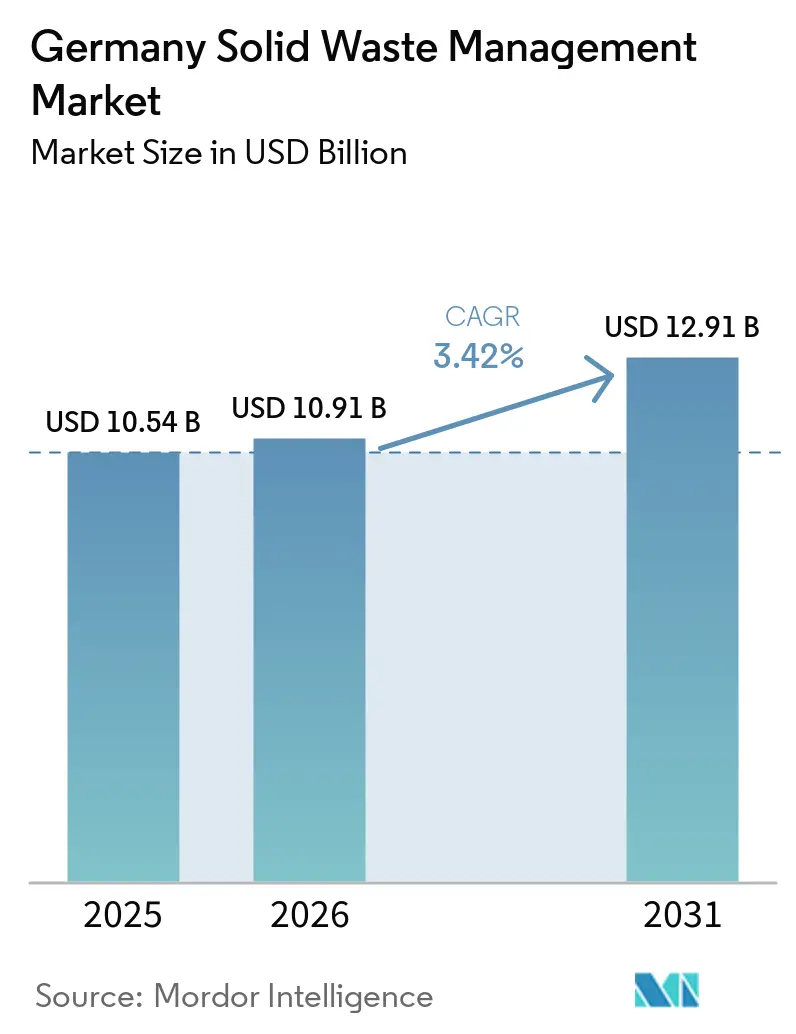
| Base Year Market Size (2025) | USD 10.54 Billion |
| Market Size (2026) | USD 10.91 Billion |
| Market Size (2031) | USD 12.91 Billion |
| Growth Rate (2026 - 2031) | 3.42 % |
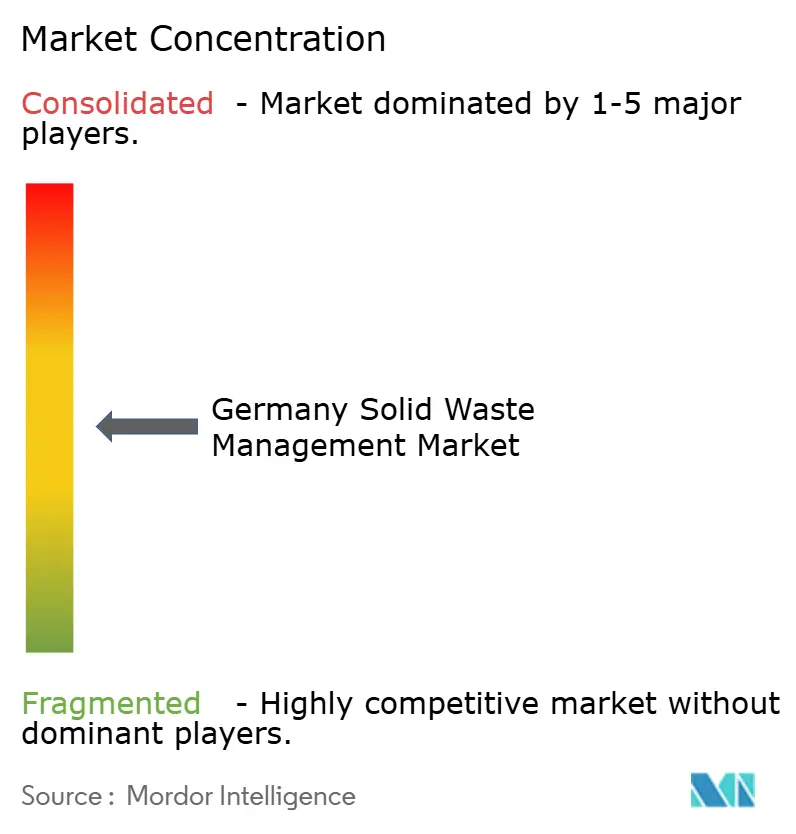
| Market Concentration | Medium |
Major Players *Disclaimer: Major Players sorted in no particular order Image © Mordor Intelligence. Reuse requires attribution under CC BY 4.0. | |
Germany Solid Waste Management Market Analysis by Mordor Intelligence
The Germany Solid Waste Management Market size is projected to expand from USD 10.54 billion in 2025 and USD 10.91 billion in 2026 to USD 12.91 billion by 2031, registering a CAGR of 3.42% between 2026 to 2031.
The Germany solid waste management market is moving toward a system that places greater value on recovered materials, traceable waste flows, and treatment quality. The National Circular Economy Strategy, adopted in December 2024, directs policy toward greater use of secondary materials and provides operators with a clearer basis for investing in sorting and recovery capacity. Packaging rules that took effect in August 2026 create both a larger compliance workload and a more predictable route for packaging into licensed collection and recycling systems. Larger operators are responding by implementing integrated models for collection, processing, and material sales, while municipal providers retain an important role in household collection. The main opportunity lies in producing higher-quality secondary materials from streams that are currently difficult to recycle.
Key Report Takeaways
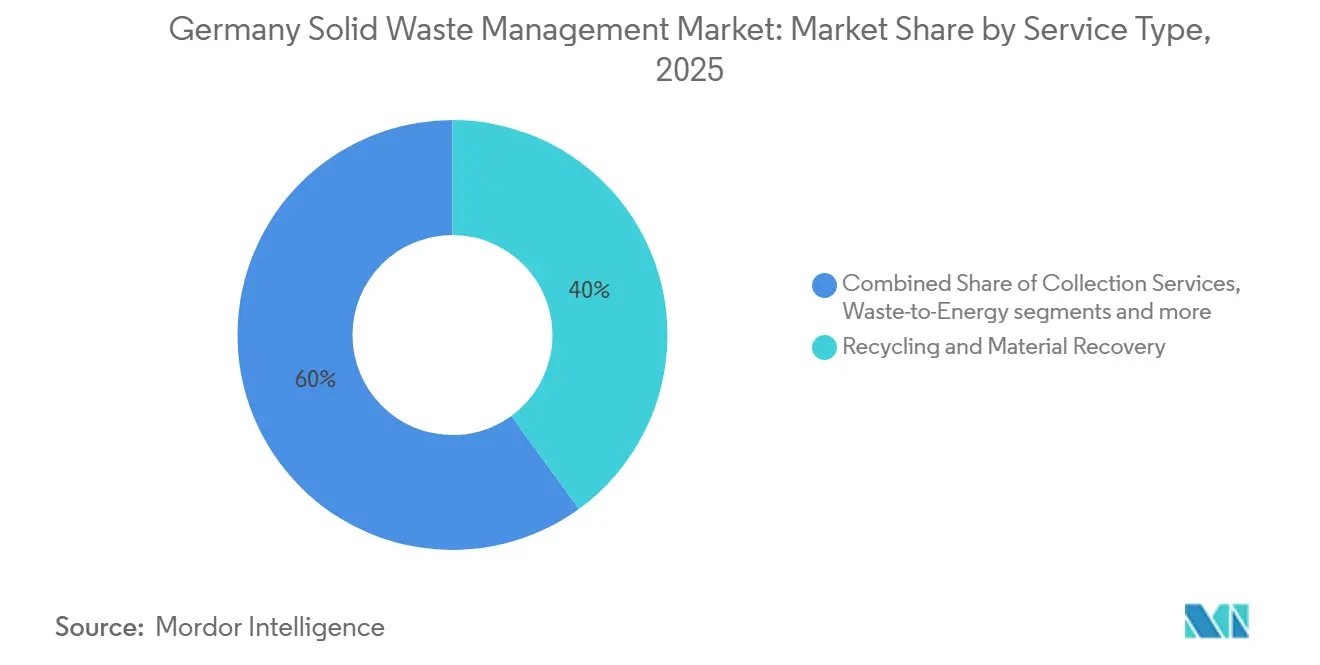
- By service type, recycling and material recovery held 40% of the Germany solid waste management market share in 2025, while waste-to-energy is forecast to grow at a 6.5% CAGR through 2031.
- By waste type, municipal solid waste held 38% of the Germany solid waste management market size in 2025, while hazardous waste is forecast to grow at a 6.4% CAGR through 2031.
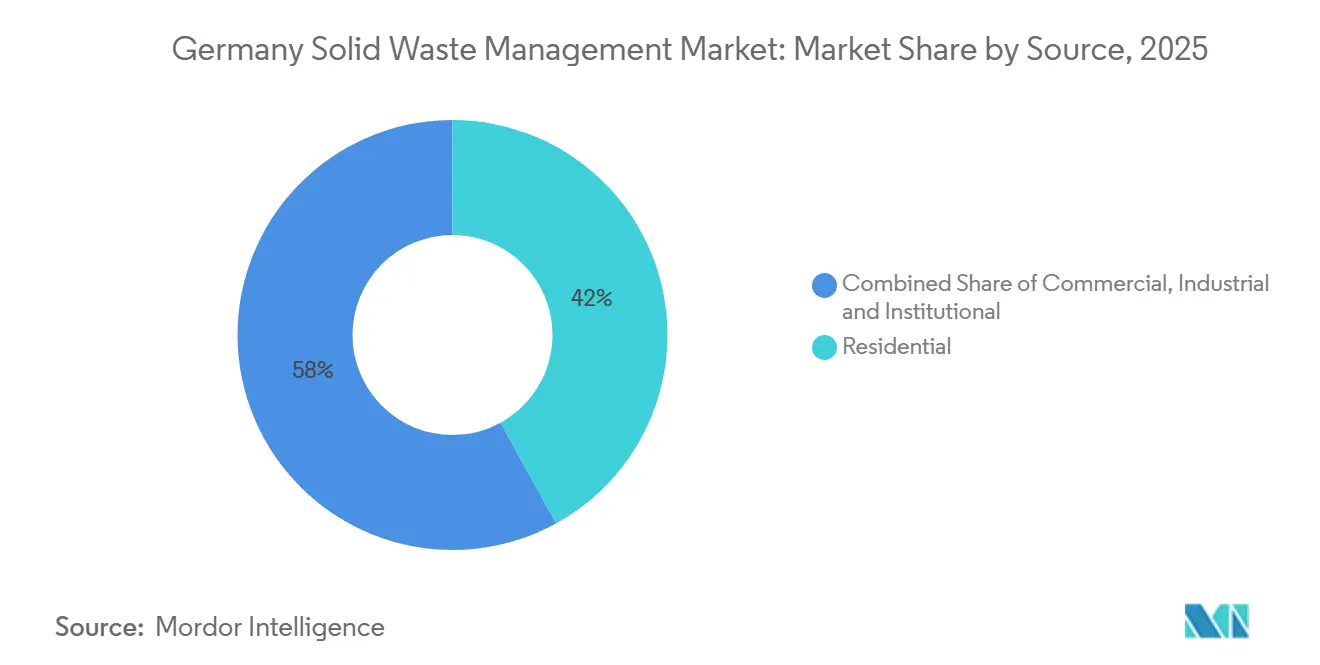
- By source, residential waste held 42% of the Germany solid waste management market in 2025, while industrial sources are forecast to grow at a 4.1% CAGR through 2031.
Note: Market size and forecast figures in this report are generated using Mordor Intelligence’s proprietary estimation framework, updated with the latest available data and insights as of January 2026.
Germany Solid Waste Management Market Trends and Insights
Drivers Impact Analysis*
| Driver | (~) % Impact on CAGR Forecast | Geographic Relevance | Impact Timeline |
|---|---|---|---|
| Mandatory Circular Economy Targets Under the National Circular Economy Strategy (NKWS) | +0.9% | National, with early investment concentration in North Rhine-Westphalia, Bavaria, and Baden-Württemberg | Long term (≥ 4 years) |
| Expansion of Extended Producer Responsibility (EPR) Across Packaging and Consumer Goods | +0.8% | National, with obligations across all federal states | Medium term (2-4 years) |
| Growing Investments in Digital Waste Collection and AI-Based Sorting Facilities | +0.6% | National, with early deployment in urban and logistics-intensive regions | Medium term (2-4 years) |
| Increasing Industrial Demand for Domestic Secondary Raw Materials | +0.5% | National, with high intensity in Bavaria, North Rhine-Westphalia, and Saxony | Long term (≥ 4 years) |
| Rising Waste-to-Energy Capacity for Non-Recyclable Residual Waste | +0.4% | National, with modernization in central and northern Germany | Medium term (2-4 years) |
| Stricter Landfill Diversion and High Recycling Performance Requirements | +0.3% | National, especially for construction and demolition waste in expanding urban areas | Short term (≤ 2 years) |
| Source: Mordor Intelligence | |||
Mandatory Circular Economy Targets Under the National Circular Economy Strategy (NKWS)
The Federal Cabinet adopted the National Circular Economy Strategy on December 4, 2024.[1]Federal Ministry for the Environment, Nature Conservation, Nuclear Safety and Consumer Protection, “Action Program for the Implementation of the National Circular Economy Strategy,” Bundesumweltministerium, bundesumweltministerium.de It places waste policy within a broader effort to reduce primary material use and strengthen secondary material supply. This increases the importance of operators that can document how waste is turned into usable secondary material for German manufacturers. The strategy seeks to double the share of secondary raw materials used in the economy by 2030, with impacts across the collection, sorting, and manufacturing supply chains for plastics, critical minerals, and construction materials. Secondary materials accounted for 13% of Germany's total raw material consumption when the strategy was adopted. The June 2026 action program allocated EUR 260 million (USD 301.73 million) through the Zukunft Kreislaufwirtschaft program for circular-economy investments. For Germany's solid waste management market, the policy supports continued spending on sorting, mechanical processing, recycling infrastructure, and testing recovery routes for materials that have traditionally been discarded.
Expansion of Extended Producer Responsibility (EPR) Across Packaging and Consumer Goods
Regulation (EU) 2025/40 entered into force on February 11, 2025, and applied from August 12, 2026.[2]European Parliament and Council, “Packaging and Packaging Waste From 2026,” EUR-Lex, eur-lex.europa.eu The regulation replaces the earlier EU packaging framework and applies directly across member states. It expands producer responsibility across packaging categories and links fees more closely to packaging design, recyclability, and the practical cost of managing material after use. Producers must meet obligations related to collection, sorting, and recycling, which support licensed waste handling. It also makes packaging design and the quality of material recovery more important in commercial negotiations across the service chain. The Central Packaging Register Authority guides the new system participation rules for own brands and imports.[3]Central Packaging Register Authority, “PPWR and System Participation, Own Brands and Imports,” Verpackungsregister ZSVR, verpackungsregister.org The Germany solid waste management market, therefore, gains more regulated material flows, although operators also face higher documentation and authorization requirements.
Growing Investments in Digital Waste Collection and AI-Based Sorting Facilities
Digital tools are moving from pilots into daily collection and sorting operations in Germany. The SmartRecycling-Up project developed approaches to automated bulky waste sorting using artificial intelligence. These systems can identify material categories earlier in the treatment process and limit unnecessary manual sorting. They also provide facility managers with more consistent information on contamination and the performance of individual separation stages. In July 2025, Recycleye and STADLER commissioned an AI-only optical sorter for construction-and-demolition mineral fractions at HEYDT's Aulendorf facility. The installation separates brick, concrete, gypsum, metals, wood, plastic, tile, and glass from mixed materials. Better separation can raise the purity of recovered material and improve its suitability for downstream buyers. This development gives Germany's solid waste management market a way to pursue value growth even when additional collection volumes are limited, and collection systems already cover most households.
Increasing Industrial Demand for Domestic Secondary Raw Materials
German manufacturers are under greater pressure to secure domestic secondary materials for production. The National Circular Economy Strategy and the EU Critical Raw Materials Act both strengthen the policy case for recovery and reuse. They give industrial buyers a stronger reason to assess whether recovered material can replace part of their primary material requirement. Around 82% of Germany’s total waste was recovered in 2024, including 69% through material recovery and 13% through energy recovery, although secondary materials still account for a limited share of total industrial inputs. The Critical Raw Materials Act sets a 2030 target for EU recycling capacity to meet at least 25% of the EU's annual consumption of strategic raw materials. German steelworks consumed approximately 15.7 million tons of steel scrap for crude-steel production in 2025, while total steel scrap consumption across crude-steel production and foundries reached approximately 19.1 million tons. The Germany solid waste management market can benefit as domestic buyers seek cleaner, more consistent ferrous and non-ferrous scrap, reducing reliance on volatile export demand and imported primary materials.
Restraints Impact Analysis*
| Restraint | (~) % Impact on CAGR Forecast | Geographic Relevance | Impact Timeline |
|---|---|---|---|
| Limited Availability of Additional High-Quality Recyclable Feedstock | -0.6% | National, especially in urban areas with mature collection rates | Long term (≥ 4 years) |
| Declining Profitability Due to Volatile Secondary Material Prices | -0.5% | National, with sharp effects on plastic and paper recyclers in western Germany | Medium term (2-4 years) |
| Increasing Compliance Costs from Tightening Environmental Regulations | -0.4% | National, with a larger burden on smaller operators | Short term (≤ 2 years) |
| Capacity Constraints for Hazardous and Specialized Waste Treatment | -0.3% | National, especially North Rhine-Westphalia, Bavaria, and Saxony | Medium term (2-4 years) |
| Source: Mordor Intelligence | |||
Limited Availability of Additional High-Quality Recyclable Feedstock
Germany has already achieved high collection and recycling performance for several material streams. The municipal waste recycling rate was 67.2% in 2023, above the EU target of 55% for 2025. The central constraint is increasingly material quality rather than the number of tons collected. Mature collection systems can still deliver mixed material that needs further sorting before it can enter applications with strict technical or safety specifications. Composite packaging and contaminated material make it difficult to produce a recyclate that meets the demands of demanding applications. A 2025 BKV and Conversio study projected a post-consumer recyclate gap of 861,000 tons by 2030 under its business-as-usual case. The study also found a 310,000-ton gap under an advanced scenario with stronger investment in collection and sorting. This limitation shifts investment in the Germany solid waste management market toward purification, contamination reduction, and sorting technologies rather than volume expansion alone, particularly where material specifications are demanding.
Declining Profitability Due to Volatile Secondary Material Prices
Recyclers faced weaker margins in 2025 as secondary material prices fell while input bale costs remained high. Eurostat reported that average secondary material prices declined 8% for glass and nearly 2% for paper, cardboard, and plastic in 2025 compared with 2024. The Federal Association of the German Waste Management Industry identifies volatility in secondary raw material prices as a major structural issue for recycling companies. Lower virgin polymer prices can reduce buyers' willingness to pay for recycled alternatives. This leaves processors with less room to absorb changes in energy, labor, transport, and compliance costs when secondary material prices weaken. At the same time, collection and processing costs do not decline at the same speed. Germany's waste law sets municipal recycling targets of 60% by 2030 and 65% by 2035. The Germany solid waste management market will remain exposed until recycled-content requirements create stronger, more stable demand for grades that can compete with virgin material on quality and price.
*Our forecasts treat driver/restraint impacts as directional, not additive. The impact forecasts reflect baseline growth, mix effects, and variable interactions.
Segment Analysis
By Service Type: Recycling Leads, Thermal Recovery Expands
Recycling and material recovery accounted for 40% of the Germany solid waste management market share in 2025. Its position reflects the established dual-system infrastructure and separate collection of paper, glass, plastics, metals, and organic waste, which gives processors a broad base of recoverable material. The Germany solid waste management industry has built collection and processing capacity across all 16 federal states. Collection services, transportation, and logistics are mature, high-volume activities. Their performance depends mainly on efficient routing, reliable contracts, lower vehicle emissions, and the ability to document service quality for municipal and commercial customers.
Waste-to-Energy is the fastest-growing service type and is forecast to expand at a 6.5% CAGR through 2031. Germany had 164 thermal waste-treatment plants with a total input of 25.5 million tons. This installed base supports the treatment of residual commercial waste that does not meet recycling requirements, while also limiting landfill use for material that cannot be economically recovered. Treatment and disposal services manage mixed residual streams and hazardous waste that cannot be processed directly for recycling or thermal recovery. Germany had 381 chemical-physical treatment plants handling 7.1 million tons in 2024. The others category includes vehicle dismantling, e-waste treatment, composting, and related activities that recover materials from product groups with distinct collection and processing needs. The July 2025 AI sorter at Aulendorf shows that technology is also reaching segments that traditionally relied on basic mechanical separation.



By Waste Type: Municipal Waste Anchors Volume, Hazardous Waste Grows Fastest
Municipal solid waste accounted for 38% of Germany solid waste management market share in 2025. Household source separation and the dual system provide a regular flow of packaging and other municipal materials, although contamination remains a persistent obstacle to higher-value recycling. The National Circular Economy Strategy seeks a 10% reduction in per-capita municipal waste by 2030 and a 20% reduction by 2045, using 2020 as the baseline. This means future municipal collection revenue depends more on service quality, contamination control, and digital integration than on simple volume growth from household waste.
Hazardous Waste is the fastest-growing category, forecast to grow at a 6.4% CAGR through 2031. Construction and demolition-related material accounted for 38.8% of hazardous waste in 2025. Industrial Waste and construction and demolition waste are closely linked to manufacturing and construction activity, so their collection and treatment requirements can vary with investment cycles. Construction and demolition treatment plants handled 61.9 million tons in 2024. Agricultural Waste and Medical Waste are smaller but require specific treatment protocols. Fraunhofer IIS developed the DangerSort system to identify lithium-ion batteries in mixed waste with AI-based X-ray technology. These technical requirements make specialized capacity increasingly relevant to the Germany solid waste management market.
By Source: Residential Collection Leads, Industrial Waste Advances
Residential sources accounted for 42% of Germany's solid waste management market in 2025. Separate collection systems for paper, glass, organics, lightweight packaging, and residual waste are widely established across German municipalities. This broad coverage provides a reliable foundation for collection contracts and material recovery. Commercial and institutional sources form a significant intermediate group with distinct procurement and compliance needs. Commercial streams from retail and food service are directly affected by packaging requirements that took effect in August 2026. The new framework requires producers to finance relevant collection, sorting, and recycling activities. This can move previously informal material flows into managed systems. The German Circular Economy Act applies recovery-hierarchy obligations to waste generators across source categories.
Industrial sources are the fastest-growing source category and are forecast to expand at a 4.1% CAGR through 2031. Manufacturing restructuring, material-security concerns, and circular economy obligations are changing industrial waste flows, increasing the value of contracts that combine collection with material reporting and recovery. Institutional clients, including universities, hospitals, and government facilities, commonly use longer public tender contracts. These arrangements offer stable demand but require operators to meet detailed service, reporting, health, safety, and procurement standards over the term of the contract.
Geography Analysis
The Germany solid waste management market spans sixteen federal states, and infrastructure density varies across regions. Western Germany, especially North Rhine-Westphalia, Bavaria, and Baden-Württemberg, has high volumes of industrial waste and a mature treatment network. North Rhine-Westphalia has dense commercial and industrial flows linked to the Rhine-Ruhr urban area, where population density and manufacturing activity support a diverse set of collection and treatment services. Bavaria has substantial vehicle dismantling, electronics processing, and specialized hazardous treatment activity. The Rothensee waste-to-energy facility in Saxony-Anhalt commissioned Block three in February 2025. The expansion increased capacity by 50% and enables annual thermal recovery of 270,000 tons of commercial waste and 55,000 tons of sewage sludge, underscoring the continued role of thermal treatment for residual commercial material and sludge that cannot be readily managed through conventional material recovery.
Eastern Germany is developing from a smaller treatment base and retains infrastructure needs in Saxony, Brandenburg, and Mecklenburg-Vorpommern. Many regional thermal facilities were built around 2005 after the landfill ban and now need modernization. This creates demand for equipment replacement, specialized treatment capacity, and operational upgrades to improve energy efficiency and meet evolving emissions and safety requirements. The regional solid waste management market in Germany is also shaped by the need to handle sewage sludge and hazardous streams closer to their sources. Regional planning must consider available permits, transport distances, treatment capacity, and the technical requirements that apply to streams with higher environmental or safety risks. Northern and central states may attract more investment as operators reduce transport distances. The pattern favors providers that combine local treatment assets with national material marketing, because local capacity reduces transport needs while wider networks can provide reliable buyers for recovered outputs.
Northern Germany, centered on Hamburg and Bremen, plays a distinct role in logistics because of its ports and urban waste streams. Waste-to-Energy plants can generate gate-fee revenue and heat sales when they serve district heating networks, which can improve the use of energy from residual material after recycling options have been considered. The Fuel Emissions Trading Act requires certificates for non-biogenic emissions from waste incineration, adding a cost factor to thermal treatment. Operators must balance reliable residual-waste treatment with carbon costs, recycling priorities, permit conditions, and the need to maintain public acceptance of thermal infrastructure. This balance will shape project selection across the Germany solid waste management market. It also reinforces the need for careful assessment of feedstock composition, heat demand, emissions exposure, and the technical options available for recovering material before thermal treatment.
Competitive Landscape
The Germany solid waste management market has moderate concentration among major integrated operators, while municipal and residential collection remains more dispersed. REMONDIS, PreZero, and ALBA Group compete with regional specialists, municipal utilities, and international groups with operations in Germany. Larger companies can combine collection coverage, sorting assets, treatment capacity, and material sales, allowing them to manage a material stream from pickup through processing and downstream delivery. This structure gives them more control over material quality and downstream contracts. It can also help them match collection volumes to plant capacity and maintain continuity when individual facilities require maintenance or changes in operating procedures. Smaller providers can remain competitive in local collection, specialized treatment, and public tender work, especially where customer relationships, local permits, and technical expertise matter more than nationwide scale.
Competition increasingly depends on the ability to produce high-purity feedstock. Chemical recycling for difficult plastics, battery recovery, and critical-mineral recovery remain areas with scope for further development, because these streams require stringent quality controls and have limited established capacity. Recycleye and STADLER's 2025 installation in Aulendorf is a technology partnership aimed at improving the recovery of construction and demolition materials. The SmartRecycling-Up project is another example of research directed at more automated sorting. These developments show that technology suppliers often work with established operators rather than replacing them. This approach enables waste-management companies to integrate new sorting technologies within existing collection, processing, permitting, and customer networks, rather than building a parallel waste management system.
The Packaging and Packaging Waste Regulation favors operators with established reporting and licensed system capabilities. Larger businesses can spread spending on data systems and quality controls across more facilities, while also using common procedures to respond to licensed-system and customer reporting requirements. Municipal operators retain a firm position in household waste because local authorities control core service arrangements. Regional specialists remain relevant where hazardous waste, medical waste, or industrial streams require specific expertise, specialized permits, or established relationships with local industrial and public-sector customers.
Germany Solid Waste Management Industry Leaders
REMONDIS SE & Co. KG
PreZero
Veolia Umweltservice GmbH
ALBA Group
EEW Energy from Waste GmbH
- *Disclaimer: Major Players sorted in no particular order

Recent Industry Developments
- July 2025: Recycleye and STADLER commissioned an AI-only optical sorting system for Construction and Demolition mineral fractions, capable of separating brick, concrete, gypsum, metals, wood, plastic, tile, and glass, at HEYDT's facility in Aulendorf, Germany.
- February 2025: The Müllheizkraftwerk Rothensee commissioned Block three, expanding facility capacity by 50%. The new unit enables the thermal recovery of 270,000 tons of commercial waste and 55,000 tons of sewage sludge annually.


Germany Solid Waste Management Market Report Scope
The Germany Solid Waste Management Market is Segmented by Service Type (Collection Services, Transportation & Logistics, Recycling & Material Recovery, Treatment & Disposal, and More), by Waste Type (Municipal Solid Waste, Industrial Waste, Agricultural Waste, and More), and by Source (Residential, Commercial, Industrial, and Institutional). The Report Offers Market Size and Forecasts in Value (USD) for all the Above Segments.
| Collection Services |
| Transportation & Logistics |
| Recycling & Material Recovery |
| Treatment & Disposal |
| Waste-to-Energy |
| Others |
| Municipal Solid Waste |
| Industrial Waste |
| Hazardous Waste |
| Construction & Demolition Waste |
| Agricultural Waste |
| Medical Waste |
| Others |
| Residential |
| Commercial |
| Industrial |
| Institutional |
| By Service Type | Collection Services |
| Transportation & Logistics | |
| Recycling & Material Recovery | |
| Treatment & Disposal | |
| Waste-to-Energy | |
| Others | |
| By Waste Type | Municipal Solid Waste |
| Industrial Waste | |
| Hazardous Waste | |
| Construction & Demolition Waste | |
| Agricultural Waste | |
| Medical Waste | |
| Others | |
| By Source | Residential |
| Commercial | |
| Industrial | |
| Institutional |


Key Questions Answered in the Report
What is the expected value of Germany solid waste management market by 2031?
The Germany solid waste management market is forecast to reach USD 12.91 billion by 2031, growing at a 3.42% CAGR from 2026.
Which service type leads solid waste management in Germany?
Recycling and material recovery led in 2025, registering a 40% market share, because of established separate collection and processing infrastructure.
Why is Waste-to-Energy growing in Germany?
It treats residual commercial and municipal material that cannot be recycled, and 164 thermal treatment plants handled 25.5 million tons in 2024.
What role does the Packaging and Packaging Waste Regulation play in Germany?
The regulation applies as of August 2026 and expands producers' responsibilities for packaging collection, sorting, and recycling.
Which waste stream is growing fastest in Germany?
Hazardous Waste is the fastest-growing waste type, registering a 6.40% CAGR in 2025, handling around 23 million tons annually.
What is the main constraint on recycling growth in Germany?
The key constraint is the limited availability of clean, high-quality recyclable feedstock, especially for complex and contaminated packaging.
Page last updated on:


 Your data is secure and never sold or shared.


