
Germany Senior Living Market Size and Share
Market Overview
| Study Period | 2021 - 2032 |
|---|---|
| Forecast Data Period | 2027 - 2032 |
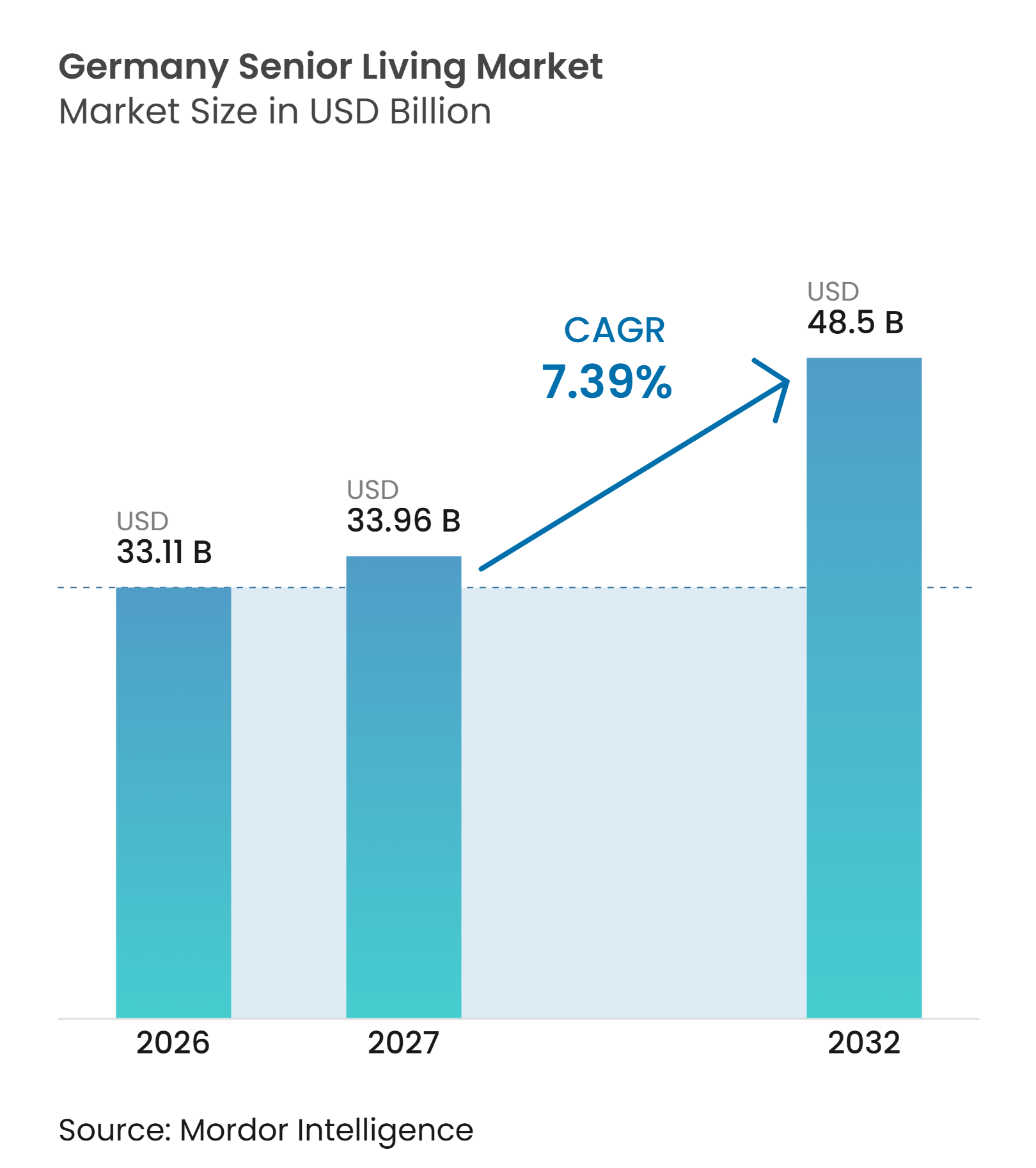
| Base Year Market Size (2026) | USD 33.11 Billion |
| Market Size (2027) | USD 33.96 Billion |
| Market Size (2032) | USD 48.5 Billion |
| Growth Rate (2027 - 2032) | 7.39 % |
| Market Concentration | Low |
Major Players *Disclaimer: Major Players sorted in no particular order Image © Mordor Intelligence. Reuse requires attribution under CC BY 4.0. | |
Germany Senior Living Market Analysis by Mordor Intelligence
The Germany Senior Living Market was valued at USD 33.11 billion in 2026 and is expected to increase to USD 33.96 billion in 2027 and USD 48.5 billion by 2032, registering a CAGR of 7.39% during 2027–2032.
Population aging, limited accessible housing, and a reduced development pipeline are keeping demand ahead of available capacity. Eurostat expects Germany’s population aged 65 years or older to reach 20.9 million by 2030, compared with 18.7 million in 2024, which supports demand for accommodation with care and daily living support. The Germany senior living market is also attracting operators and property owners that can manage longer leases, care delivery, and regulatory compliance across several states. Digital housing and care technologies are gaining relevance because they can support safety, independence, and staff productivity. Labor availability, development costs, affordability, and state-level licensing rules remain the main limits on the pace of new capacity.
Key Report Takeaways
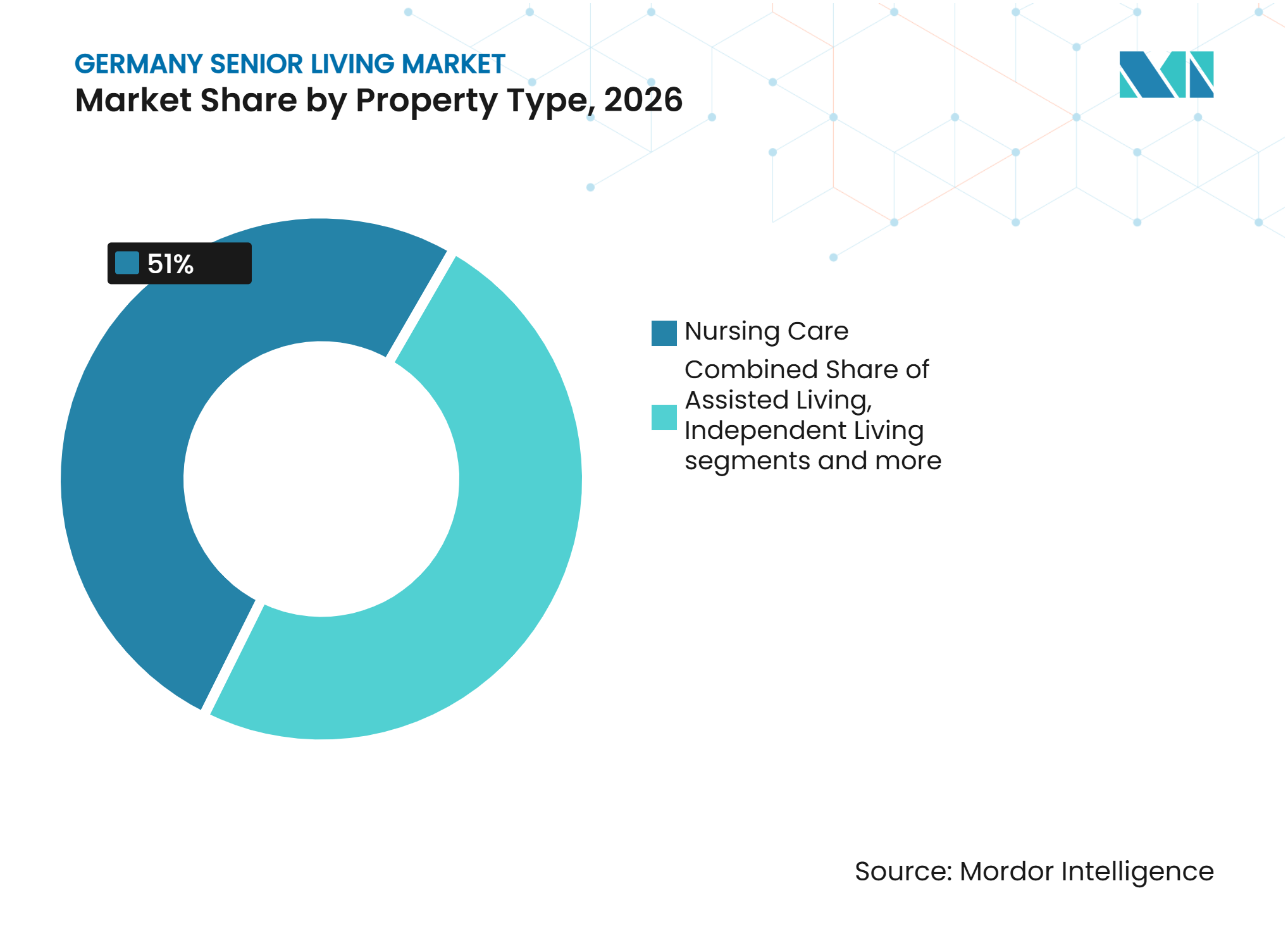
• By property type, nursing care held 51% of the Germany senior living market size in 2026, while assisted living and service-wohnen are forecast to grow at an 8.9% CAGR through 2032.
• By business model, long-lease / rental held 76% of the Germany senior living market share in 2026 and is forecast to grow at an 8.23% CAGR through 2032.
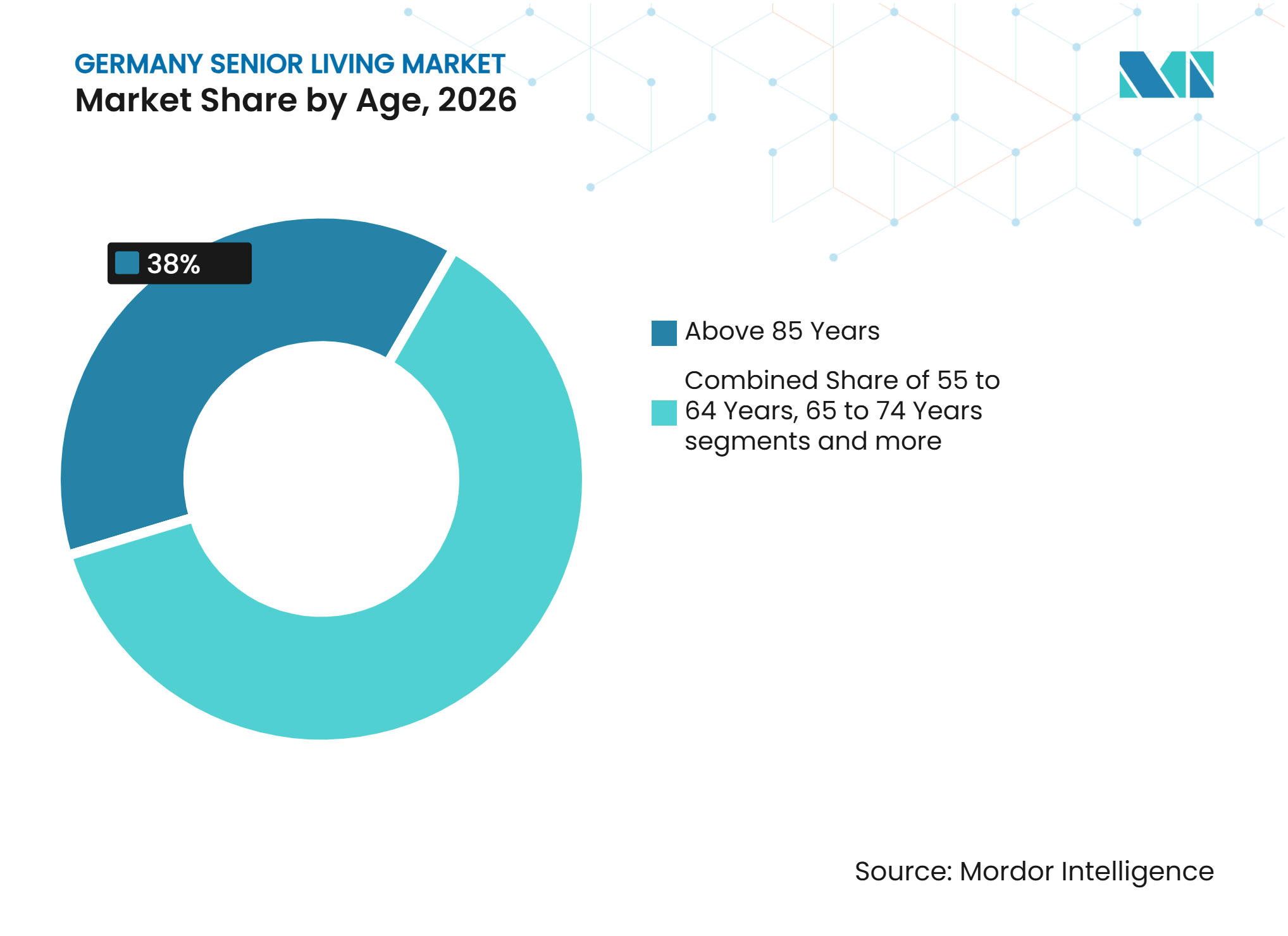
• By age group, residents above 85 years held 38% of the Germany senior living market size in 2026, while the same cohort is forecast to expand at an 8.8% CAGR through 2032.
• By city, Rest of Germany held 82% of the Germany senior living market share in 2026, while Berlin is forecast to grow at an 8.1% CAGR through 2032.
Note: Market numbers in this report are based on Mordor Intelligence's proprietary estimation framework, which combines nine months of actuals with Q4 projections for base year 2026.
Market Trends and Insights
Drivers Impact Analysis of Germany Senior Living Market*
| Drivers | (~) % Impact on CAGR Forecast | Geographic Relevance | Impact Timeline |
|---|---|---|---|
| Aging Population and Purpose-Built Demand | +2.5% | National, strongest in Berlin, Hamburg, and Munich | Long term (≥ 4 years) |
| Older Adults Living Alone | +1.8% | National, most acute in Berlin, Cologne, and Duisburg | Medium term (2-4 years) |
| Barrier-Free and Active Retirement Preferences | +1.0% | National, accelerated in major cities and western Germany | Medium term (2-4 years) |
| Integrated Healthcare and Assisted Living | +0.8% | National, strongest in metropolitan regions | Medium term (2-4 years) |
| Institutional Investment and Modernization | +0.6% | National, anchored by portfolio assets in major cities | Short term (≤ 2 years) |
| Smart Monitoring and Assisted Living Technology | +0.4% | National, initially concentrated in operator-managed facilities | Long term (≥ 4 years) |
| Source: Mordor Intelligence | |||
Germany’s Aging Population Deepens Structural Demand
Germany's ageing population is expanding the base of residents who may require accessible housing, daily support, or nursing care. The population aged 67 and above is projected to reach approximately 18.5–18.9 million by 2030, increasing to 20.3–21.3 million by 2040, supporting long-term demand across the German senior living market. Care requirements generally rise with age, increasing the importance of housing that accommodates changing mobility and support needs. The shortage of barrier-reduced housing further limits options for older people seeking to maintain independent living. With approximately 1.2 million barrier-free or barrier-reduced homes against a substantially higher estimated requirement, the gap creates opportunities for purpose-built senior residences in major cities and regional care locations. This also encourages operators to integrate accessible design with flexible care and support services from the initial project planning stage.
Growing Solo Living Among Older Adults Strengthens Assisted Living Demand
Older adults living alone often need support before they need full-time nursing care. This creates demand for assisted living that combines private space with help for daily routines. Berlin, Cologne, and Duisburg have been identified as cities where assisted-living provision has not reached saturation in the source material. Assisted-living projects increasingly combine apartments with day-care services, which broadens the group of people who can use the site[1]. This model can serve people with partial care needs while allowing residents to stay in a familiar setting. The Germany senior living market therefore has room for formats that support independence without requiring an immediate move into a nursing home.
Preference for Barrier-Free, Active Retirement Lifestyles
Many prospective residents now look for accessible homes that preserve independence and community life. The source material reports more than 8,300 Betreutes Wohnen locations and 387,000 apartments nationwide, indicating a substantial installed base for this model. Demand is moving beyond traditional care-led properties toward homes that can be adapted as needs change. SmartLivingNEXT is developing interoperable digital applications for housing, care, and energy services, including barrier-free adaptation and activity monitoring[2]. These tools can make a residence safer while helping staff identify changing support needs earlier. Accessible planning and digital readiness are becoming more important when operators select new sites or improve older facilities.
Healthcare and Assisted Living Integration Reshapes Property Use
Integrated campuses can serve residents whose needs change from independent living to intensive support. This structure reduces dependence on a single care format and can create a broader income base for operators. Threestones Capital acquired 2 German healthcare assets in 2026 that combine nursing, assisted living, intensive care, and day-care uses. The projects show how property owners are pairing different care settings within the same operating structure. The proposed care reform also includes provisions related to technology and digitalization costs where facilities can demonstrate staff relief[3]. This gives larger, integrated operators a practical reason to invest in shared clinical and digital systems.
Restraints Impact Analysis of Germany Senior Living Market*
| Restraints | (~) % Impact on CAGR Forecast | Geographic Relevance | Impact Timeline |
|---|---|---|---|
| Caregiver and Nursing Staff Shortages | -1.5% | National, most acute in Berlin, North Rhine-Westphalia, and urban centers | Long term (≥ 4 years) |
| Land, Construction, and Financing Costs | -1.2% | National, most severe in Munich, Frankfurt, Hamburg, and Berlin | Medium term (2-4 years) |
| Affordability of Fees and Care Charges | -0.8% | National, particularly affecting Betreutes Wohnen and premium residences | Medium term (2-4 years) |
| State-Level Care Rules and Licensing | -0.5% | National, variable across German federal states | Short term (≤ 2 years) |
| Source: Mordor Intelligence | |||
Staff Shortages Constrain Operational Capacity
Staff availability is the most immediate operating constraint for many care providers. The supplied research states that more than 70,400 eldercare roles were advertised nationally in the third quarter of 2026, while advertised training places declined. Facilities cannot simply add beds when they do not have enough qualified people to meet care and quality requirements. The German Nursing Council has warned that the workforce gap could reach 500,000 nursing and eldercare professionals by 2034. Staffing pressure increases wage costs and limits the speed at which operators can accept new residents. Digital tools may relieve some administrative or monitoring work, but they do not replace clinical and personal care staff.
Construction and Financing Costs Suppress New Supply
New senior-living projects need sufficient land, construction funding, and achievable resident fees to proceed. High costs can make projects difficult to support, particularly in cities where sites are scarce and building costs are elevated. The source material identifies a shortage of premium senior-living apartments, but also notes that new construction remains financially challenging at mid-market price points. This can widen the difference between demand and completed capacity in the Germany senior living market. The challenge is especially important for barrier-free development because accessible design requires careful planning from the start. Existing assets that can be modernized may therefore become more attractive than projects that must begin on undeveloped land.
*Our forecasts treat driver/restraint impacts as directional, not additive. The impact forecasts reflect baseline growth, mix effects, and variable interactions.
Germany Senior Living Market Segment Analysis
By Property Type:
Nursing Care Leads While Assisted Living ExpandsNursing care held 51% of the Germany senior living market share in 2026, reflecting the established role of inpatient care under Germany’s long-term care system. This segment remains important because many residents eventually require regular clinical supervision and personal assistance. Its large base also reflects decades of investment in conventional care homes across the country. Assisted living and service-wohnen are expected to expand at an 8.9% CAGR through 2032, which is faster than the established nursing care format. These properties allow residents to retain more control over daily life while accessing support when it is needed. This makes them relevant for people who do not yet require continuous nursing care.
Independent living includes barrier-reduced apartments and senior communities without embedded care staffing. It can appeal to people who plan their accommodation before a major care need develops. Memory care is a more specialized format for residents with dementia and requires a different operating model from general senior housing. The University of Siegen’s GAiST project is testing smart-home technology in 30 residential units across 2 senior centers to support self-determined living. The project shows how monitoring and assistance tools can help residents stay independent for longer. A provider with several property types can support a resident through changing needs without requiring an unfamiliar move. It can also share clinical knowledge, digital systems, and local service partners across formats. That approach can improve continuity for residents and families while using the same local operating base. The Germany senior living industry is likely to need a fuller range of formats because the needs of older residents differ widely by health status and household situation.



By Business Model:
Long-Lease / Rental Structures Support InvestmentLong-lease / rental structures held 76% of the Germany senior living market in 2026, making them the dominant business model. The model links property ownership with specialist care operations through lease agreements. It is well suited to institutional investors that want real estate income without running care services directly. Long-lease / rental is also the fastest-growing model, with an 8.23% forecast CAGR through 2032. Inflation-indexed lease structures can offer a clearer income arrangement for property owners and operators. The dominance of rental also reflects Germany’s established residential tenancy culture.
The model requires a financially stable operator because the property owner depends on the operator’s ability to sustain care delivery and lease obligations. This makes operational quality, staffing, and compliance central to investment decisions. Australian Retirement Trust committed as an anchor investor in Elevation Advisors’ European senior-living platform in 2026, targeting German nursing homes and assisted-living facilities. The platform’s properties use long-dated, inflation-indexed leases with Alloheim Group as operator, according to the supplied material. Hybrid arrangements can also separate property ownership from operations while preserving a long-term operating relationship. Lease terms cannot remove the underlying operating risks created by labor shortages, resident affordability, or regulatory change. They can, however, define responsibilities more clearly between owner and operator. This clarity can help investors assess an asset’s property income and care-service exposure separately. The Germany senior living market benefits when these structures channel property capital toward providers that can maintain care quality.
By Age Group:
Residents Above 85 Years Drive Care IntensityResidents above 85 years held 38% of the Germany senior living market in 2026 and represent the largest age cohort in the supplied segmentation. Their care requirements tend to be more intensive than those of younger residents. This makes the cohort important for nursing care, memory care, and other formats with regular support. The above-85-years group is also forecast to grow at an 8.8% CAGR through 2032. Its growth supports demand for residences that can manage mobility limitations and more complex health needs. Providers need to balance clinical capability with an environment that remains comfortable and familiar for residents.
The 75–84-year-old group is an important transition cohort for assisted living and support-based accommodation. Residents aged 65-74 years are more likely to consider barrier-reduced independent housing and prepare for later-life needs. The 55–64-year-old cohort may begin planning active senior community options well before a direct care requirement emerges. These differences mean that marketing, design, and service packages need to be tailored to life stage rather than applied uniformly. Younger prospective residents may place greater value on location, social activity, and housing quality. Older residents may need more immediate help with mobility, personal care, or clinical support. Smart-home applications can be most useful when they support resident safety without making the home feel institutional. The Germany senior living industry can respond more effectively when it offers a clear path from independent living to higher-support care within related locations.

Geography Analysis
Rest of Germany
The rest of Germany held 82% of the Germany senior living market in 2026, making it the main base of national capacity. North Rhine-Westphalia, Bavaria, and Baden-Württemberg contain much of the established care-home infrastructure cited in the supplied material. These regions combine sizable older populations with a broad network of existing operators and care sites. The local structure is fragmented because Germany’s federal states set different rules for residential care and licensing. This makes administrative capability important for any operator that wants to grow across several states. SmartLivingNEXT projects in Baden-Württemberg and North Rhine-Westphalia indicate that digital housing and care services are moving beyond the largest cities. Alloheim’s acquisition activity also shows continued interest in established regional assets.
Berlin
Berlin is forecast to grow at an 8.1% CAGR through 2032, the fastest rate among the city segments in the supplied research. Its senior-housing need is supported by limited availability of suitable assisted-living capacity. High land costs and development constraints can make this shortage difficult to resolve through new construction alone. The city also faces a demanding care labor environment, which may limit the rate at which providers can open additional beds. Alloheim completed the ProCurand acquisition in 2026, adding inpatient facilities, serviced apartments, day-care centers, and outpatient services to its Berlin and Brandenburg footprint. The transaction shows a preference for adding operating capacity through acquisition where development conditions are difficult. Berlin’s planning authority remains an important regulatory influence because zoning and approval decisions shape the future pipeline.
Munich, Frankfurt, and Hamburg
Munich, Frankfurt, and Hamburg have different demand profiles within the Germany senior living market. Munich’s higher purchasing power supports premium assisted-living and senior-residence concepts in the supplied research. Frankfurt is associated with urban shared-living arrangements for older people who want community without institutional care. Hamburg has an established nursing-home base and has featured in transactions using a separation between the property company and operating company. In 2026, Elevation Advisors agreed to acquire a 9-property German senior-living portfolio while Alloheim agreed to acquire the operations. These city differences suggest that property, care, and resident preferences must be assessed locally. Compliance factors also vary because state-level care home requirements influence operating expansion across all 3 urban markets.
Competitive Landscape
Market Concentration
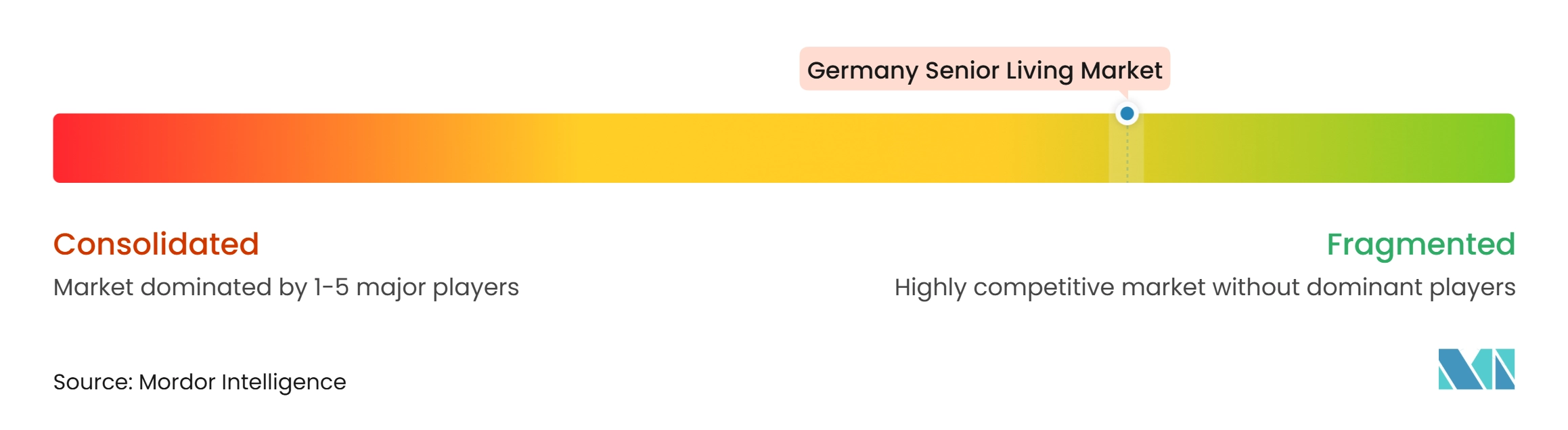
The Germany senior living market remains fragmented because private operators share capacity with religious and nonprofit providers. Caritas, Diakonie, and Johanniter-affiliated organizations continue to have an important presence in the wider care system. Larger private groups can gain an advantage where landlords and investors require consistent reporting, compliance, and lease management. Alloheim is identified in the supplied research as the largest private care operator, with more than 320 senior residences and around 30,000 employees. The group’s size lets it pursue acquisitions while managing a wide operating network.
Consolidation is becoming more visible as larger groups acquire assets or operating platforms from smaller providers. Alloheim’s acquisition of the Troisdorf residence shows how an insolvent site can be retained within a larger operator’s network. Its ProCurand transaction expanded its presence in Berlin and Brandenburg across several care formats. TA Associates also agreed to become Alloheim’s anchor shareholder, subject to merger-control clearance. These moves indicate that access to capital is becoming more important for operators seeking to add capacity or improve facilities.
Technology is another area of differentiation because it can support care staff and improve resident monitoring. Alexianer uses digital support systems that send movement-pattern information to care staff devices, according to the supplied research. Government support for care digitalization under the proposed reform could strengthen the position of operators that already can implement such systems. Mid-market assisted living and service-wohnen remain relevant areas for competition because resident demand is not limited to traditional nursing homes. Smaller providers can still compete through shared senior housing, day-care integration, and local knowledge. The competitive outcome will depend on whether companies can combine resident-focused services with disciplined staffing, compliance, and property management.
Germany Senior Living Industry Leaders
-
Alloheim Senioren-Residenzen SE
-
Korian Deutschland GmbH
-
Victor’s Group
-
emeis Deutschland GmbH
-
compassio B.V. & Co. KG
- *Disclaimer: Major Players sorted in no particular order
Germany Senior Living Market Companies Covered in this Report
- Alloheim Senioren-Residenzen SE
- Korian Deutschland GmbH
- Victor’s Group
- emeis Deutschland GmbH
- compassio B.V. & Co. KG
- Kursana GmbH
- VidaCura GmbH
- Azurit Gruppe
- DOMICIL Senioren-Residenzen Hamburg SE
- Die Johanniter
- Evangelische Heimstiftung GmbH
- Vitanas GmbH & Co. KGaA
- EMVIA Living GmbH
- Charleston Holding GmbH
- CURA Seniorenwohn- und Pflegeheime Dienstleistungs GmbH
- DOREA GmbH
- Alexianer GmbH
- AGAPLESION gemeinnützige AG
- Evangelisches Johanneswerk gGmbH
- Augustinum gemeinnützige GmbH
- Frankfurter Verband für Alten- und Behindertenhilfe e. V.
- SCHÖNES LEBEN Gruppe B.V. & Co. KG
- AlexA Seniorendienste GmbH
- Convivo Unternehmensgruppe
- Wohlfahrtswerk für Baden-Württemberg
Recent Industry Developments in Germany Senior Living Market
- October 2026: Alloheim Group announced the change of its anchor shareholder from Nordic Capital to TA Associates. The transaction is expected to close in the first quarter of 2027, subject to merger-control clearance.
- September 2026: Alloheim Group completed the acquisition of ProCurand Group, adding inpatient geriatric care facilities, serviced apartments, day-care centers, and outpatient care services in Berlin and Brandenburg.
- September 2026: Threestones Capital acquired 2 German healthcare properties through its Eurocare V fund, combining nursing care, assisted living, intensive care and day-care services. The acquisition demonstrates institutional investor interest in integrated senior-care properties and the diversification of Germany's elderly-care real estate market.
Germany Senior Living Market Report Scope
Segmentation Overview
| Assisted Living |
| Independent Living |
| Memory Care |
| Nursing Care |
| Outright Sale (Freehold) |
| Long-Lease / Rental |
| Hybrid (Sale + Lease) |
| 55 to 64 Years |
| 65 to 74 Years |
| 75 to 85 Years |
| Above 85 Years |
| Berlin |
| Munich |
| Frankfurt |
| Hamburg |
| Rest of Germany |
| By Property Type | Assisted Living |
| Independent Living | |
| Memory Care | |
| Nursing Care | |
| By Business Model | Outright Sale (Freehold) |
| Long-Lease / Rental | |
| Hybrid (Sale + Lease) | |
| By Age | 55 to 64 Years |
| 65 to 74 Years | |
| 75 to 85 Years | |
| Above 85 Years | |
| By City | Berlin |
| Munich | |
| Frankfurt | |
| Hamburg | |
| Rest of Germany |
Key Questions Answered in the Report
What is the projected size of Germany senior living in 2032?
The Germany senior living market is projected to reach USD 48.5 billion by 2032, growing from USD 33.96 billion in 2027 at a 7.39% CAGR.
Which property type has the largest position in Germany senior living?
Nursing care held 51% of the market in 2026, making it the largest property type in the supplied segmentation.
Which senior-living format is growing fastest in Germany?
Assisted living and service-wohnen are forecast to grow at an 8.9% CAGR through 2032.
Why is demand for senior accommodation increasing in Germany?
Germany’s population aged 65 years or older is expected to reach 20.9 million by 2030, increasing the need for accessible housing and care support.
What is the main operating challenge for care providers in Germany?
Qualified staff shortages limit licensed capacity and increase labor pressure for care operators. Facilities need enough qualified people to meet care obligations, so staff shortages can restrict admissions even where demand is strong.
Which city is expected to grow fastest through 2032?
Berlin is forecast to expand at an 8.1% CAGR through 2032, supported by constrained senior-housing capacity in the supplied research.