
Market Overview
| Study Period | 2020 - 2031 |
|---|---|
| Forecast Data Period | 2026 - 2031 |
| Base Year Market Size (2025) | USD 9.50 Billion |
| Market Size (2026) | USD 9.9 Billion |
| Market Size (2031) | USD 12.15 Billion |
| Growth Rate (2026 - 2031) | 4.18 % |
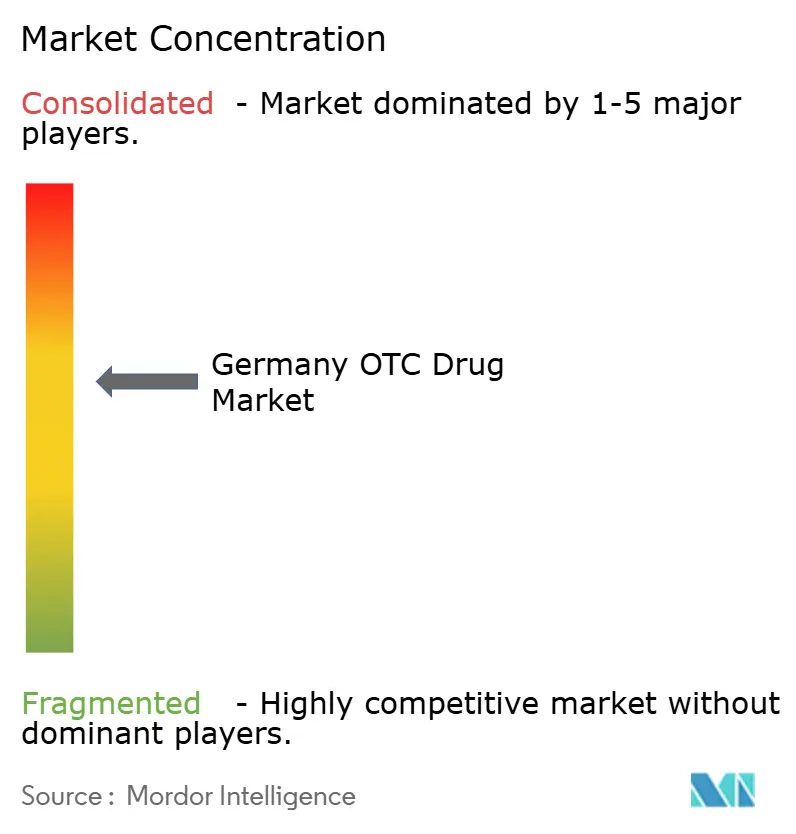
| Market Concentration | Medium |
Major Players *Disclaimer: Major Players sorted in no particular order Image © Mordor Intelligence. Reuse requires attribution under CC BY 4.0. | |
Germany Over-the-Counter Drugs Market Analysis by Mordor Intelligence
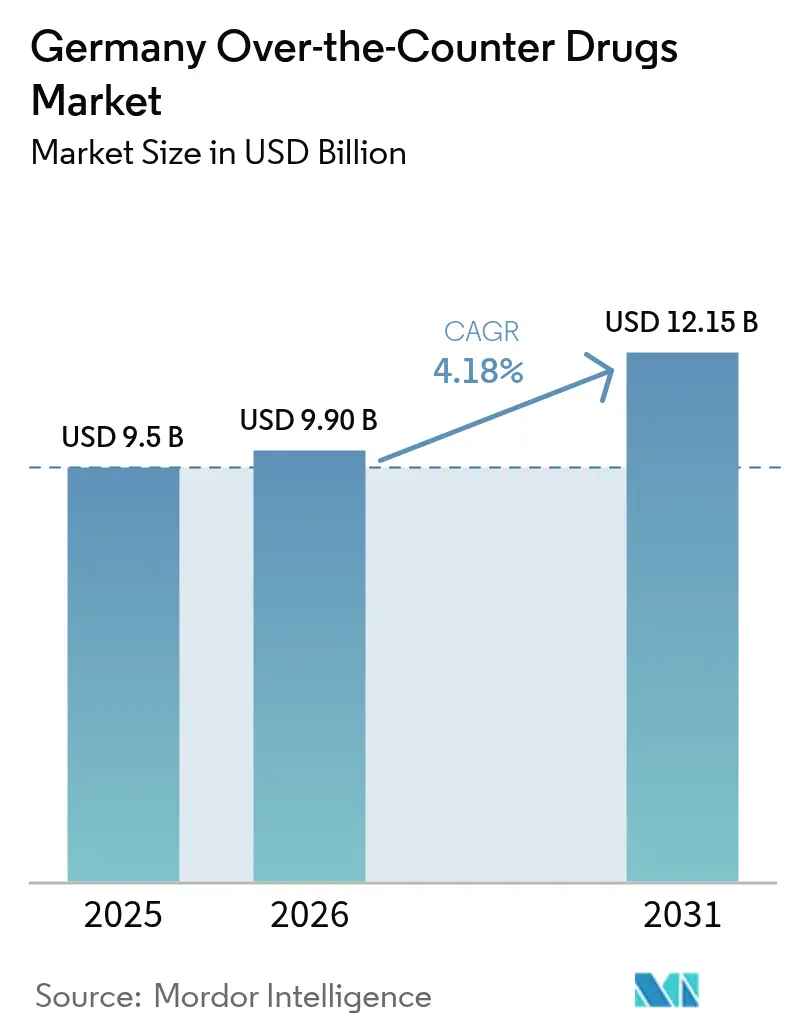
The Germany OTC drug market size was valued at USD 9.50 billion in 2025 and estimated to grow from USD 9.90 billion in 2026 to reach USD 12.15 billion by 2031, at a CAGR of 4.18% during the forecast period (2026-2031). Digitalization is the headline catalyst: mandatory e-prescriptions introduced in 2024 accelerated online fulfilment, fortified omnichannel retail models, and created new data streams that sharpen product targeting. Alongside this shift, a rapidly ageing population, with 17.3 million citizens 65 years or older, keeps chronic-care self-medication demand high.[1]Streamlined BfArM approval pathways for Rx-to-OTC switches lower time-to-market for well-established actives, while post-pandemic health literacy lifts preventive consumption from episodic use to everyday habit. Manufacturers benefit from the 2025 Medical Research Act, which introduces confidential reimbursement agreements that reward German-based R&D and cushion price pressures. However, 466 listed product shortages, EU serialization costs, and the lowest pharmacy count in four decades add operating friction and threaten rural access.[2]
Key Report Takeaways
- By product category, Cough, Cold & Flu led with 22.34% revenue share in 2025; Weight-loss/Dietary Products are projected to expand at an 8.78% CAGR to 2031.
- By distribution channel, Retail Pharmacies held 77.40% of the Germany OTC drug market share in 2025, while Online Pharmacies record the fastest growth at 12.40% CAGR through 2031.
- By route of administration, Oral delivery captured 70.10% share of the Germany OTC drug market size in 2025, whereas Nasal delivery is set to grow at 7.08% CAGR between 2026-2031.
- By dosage form, Tablets & Caplets accounted for 46.05% share of the Germany OTC drug market size in 2025; Liquids & Syrups are forecast to rise at 8.28% CAGR.
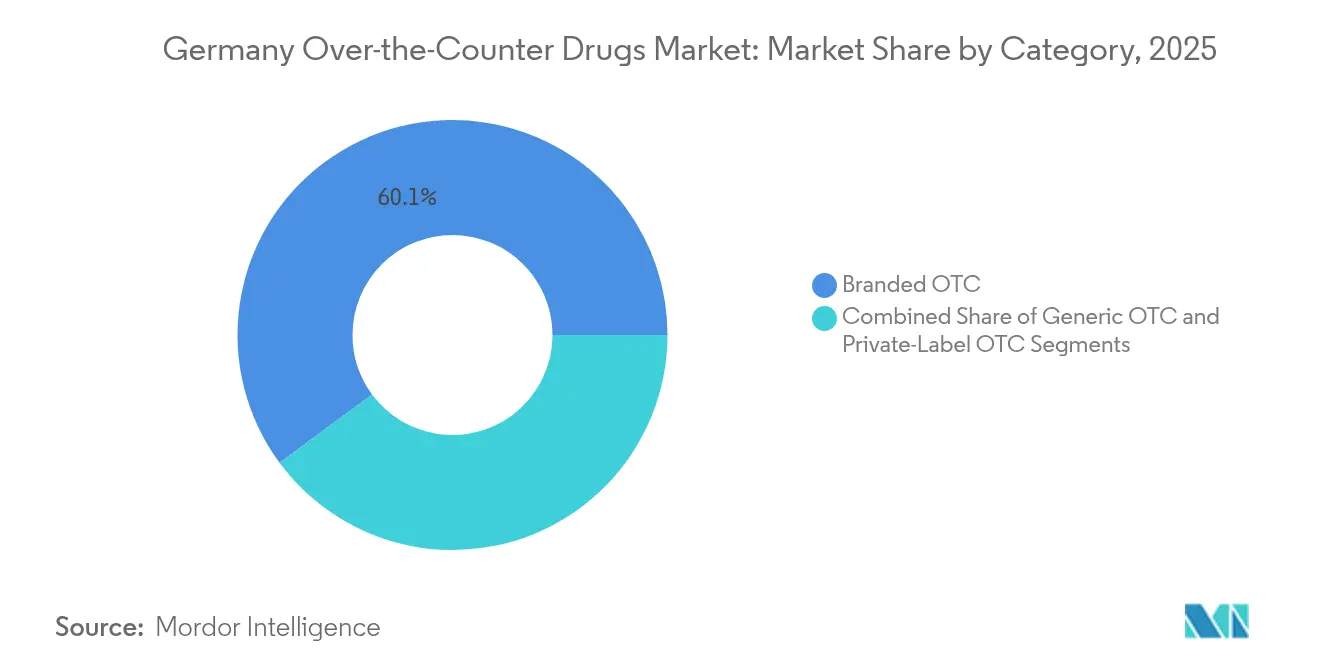
- By category, Branded products commanded 60.12% share in 2025, while Private-label options advance at 7.98% CAGR during the forecast period.
Note: Market size and forecast figures in this report are generated using Mordor Intelligence’s proprietary estimation framework, updated with the latest available data and insights as of 2026.
Germany Over-the-Counter Drugs Market Trends and Insights
Drivers Impact Analysis*
| Driver | (~) % Impact on CAGR Forecast | Geographic Relevance | Impact Timeline |
|---|---|---|---|
| Ongoing Rx-to-OTC switch acceleration | +0.8% | National; harmonised across EU | Medium term (2-4 years) |
| Rising self-medication & health-literacy levels | +1.2% | National; higher in metropolitan areas | Long term (≥ 4 years) |
| Ageing population driving chronic-care demand | +0.9% | National; pronounced in rural and eastern regions | Long term (≥ 4 years) |
| Favourable EU procedures for well-established actives | +0.5% | EU-wide; Germany primary beneficiary | Medium term (2-4 years) |
| Expansion of e-pharmacies & e-prescriptions | +0.7% | National; early adoption in tech-forward cities | Short term (≤ 2 years) |
| Surge in demand for natural/herbal alternatives | +0.6% | National; Baden-Württemberg leads production | Medium term (2-4 years) |
| Source: Mordor Intelligence | |||
Ongoing Rx-to-OTC Switch Acceleration
BfArM’s streamlined protocols now recognise 15 years of safe EU use for traditional herbal medicines instead of the historic 30, cutting approval times nearly in half. The 2025 Medical Research Act supplements this by allowing confidential price negotiations when manufacturers conduct material R&D in Germany, preserving margins even after a switch. Sanofi’s Opella division mirrors industry appetite by gaining FDA clearance for OTC Cialis trials, underscoring global confidence in German regulatory precedents. Wider OTC availability then seeds real-world evidence that supports subsequent switches, reinforcing Germany’s reputation as Europe’s switch test-bed. The virtuous cycle accelerates revenue diversification and expands therapeutic choice for consumers across the Germany OTC drug market.
Rising Self-Medication & Health-Literacy Levels
Electronic patient records became opt-out in January 2025, giving citizens uniform digital access to diagnoses, labs, and prescription data. Visibility of health data fuels informed OTC decisions and has lifted self-medication prevalence to 40.2% of adults. Academic surveys show 47.2% of women and 33.2% of men use OTCs primarily for prevention rather than acute relief. The behavioral shift translates into EUR 21 billion (USD 24 billion) in annual system savings, highlighting policy interest in OTC expansion. Low preventive-care spending, just 3% of the healthcare budget, creates headroom for growth as insurers and employers sponsor self-care programs to curb future chronic-care costs.
Ageing Population Driving Chronic-Care OTC Demand
One in four older Germans practices polypharmacy, blending 3.7 prescription drugs with 1.4 OTCs daily. OTC analgesics achieve 77.2% pain-relief success within 12 weeks among seniors, validating non-prescription pathways. As Germany needs 1.9 million nurses by 2040, OTC modalities ease pressure on professionals and enable home-based management of hypertension, diabetes, and mild cardiovascular conditions. Manufacturers position chronic-care supplements as essential infrastructure, ensuring continuity of care in both urban and underserved rural zones.
Favorable EU Procedures for Well-Established Actives
EMA’s well-established use route now requires only bibliographic safety data for molecules with a 10-year EU track record, slashing dossier complexity. German firms leverage this to expedite launches of herbal expectorants and topical anti-inflammatories that already have robust European safety records. The alignment harmonizes labelling across markets, lowers duplication costs, and lets companies scale evidence-based OTC portfolios in Germany before expanding regionally.
Restraints Impact Analysis*
| Restraint | (~) % Impact on CAGR Forecast | Geographic Relevance | Impact Timeline |
|---|---|---|---|
| Generic Price Erosion from Tender-Based Procurement | -0.70% | Global, particularly pronounced in emerging markets and public healthcare systems | Short term (≤ 2 years) |
| Global Antibiotic Stewardship Restrictions on Broad Use | -0.50% | North America & EU leading, expanding globally through WHO initiatives | Medium term (2-4 years) |
| Poor ROI Despite Pull Incentives Deterring R&D | -0.40% | Global pharmaceutical industry, concentrated in developed markets with high R&D costs | Long term (≥ 4 years) |
| Emerging Non-Antibiotic Modalities (Phage, CRISPR) | -0.30% | North America & EU early adoption, expanding to Asia-Pacific research centers | Long term (≥ 4 years) |
| Source: Mordor Intelligence | |||
Risk of Misdiagnosis and OTC Abuse
After safety concerns linked to Iberogast’s Schöllkraut component, Bayer reformulated the product and added mandatory warnings, signaling stricter post-marketing vigilance. Television audits found common breaches of mandatory risk disclosures, prompting new enforcement guidance and higher fines. PPI sales—2.87 billion tablets sold in a 12-month window—exposed off-label use, leading to guidelines capping therapy at 8 weeks for mild reflux. Collectively, tighter pharmacovigilance and advertising rules raise compliance costs and slow first-to-market strategies inside the Germany OTC drug market.
Stringent Price/Advertising Controls in Germany
The Heilmittelwerbegesetz and Arzneimittelgesetz ban comparative consumer adverts and dictate mandatory wording, limiting creative latitude. Fixed wholesale and pharmacy margins, plus statutory health-insurer discounts, compress OTC profitability. Civil actions and self-regulatory bodies enforce the rules, creating legal uncertainty for aggressive campaigns. Confidential reimbursement agreements under the 2025 Medical Research Act should provide some relief, but only for firms that commit to German-based R&D, raising capital intensity for pipeline development.
*Our forecasts treat driver/restraint impacts as directional, not additive. The impact forecasts reflect baseline growth, mix effects, and variable interactions.
Segment Analysis
By Products: Weight-Loss Surge Challenges Traditional Categories
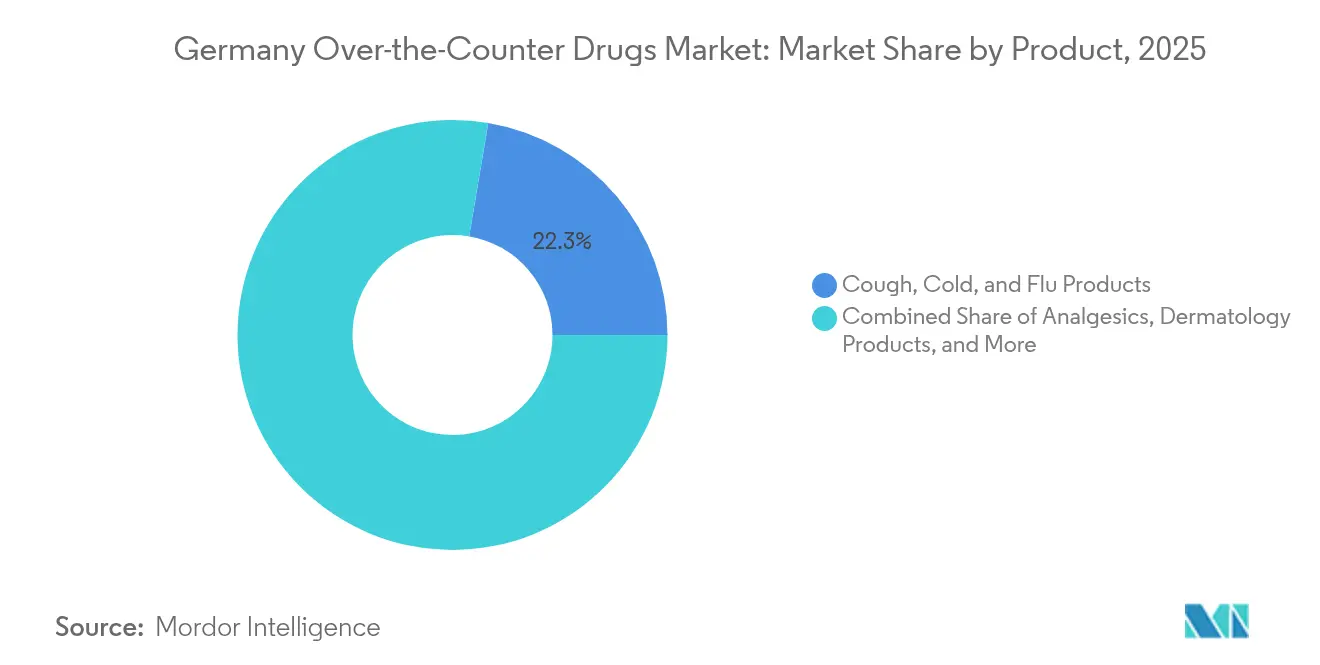
Cough, Cold & Flu remedies retained a 22.34% slice of the German OTC drug market size in 2025, yet growth is tapering as milder post-pandemic winters shrink symptom incidence. Weight-loss/Dietary Products headline segment momentum with an 8.78% CAGR through 2031, powered by nutraceutical demand representing 4.1% of global supplement sales. Analgesics sustain relevance via caffeine-enhanced ibuprofen that delivers 50% pain reduction within 2 hours for 90% of study participants. Vitamins, Minerals, and Supplements capitalize on immunity awareness, while dermatology lines benefit from the ageing cohort’s skin-health focus. Ophthalmic and sleep-aid niches grow steadily as screen time and stress heighten eye strain and insomnia.
Diverse performance shows how German consumers shift from reactive symptom relief to preventive wellness. Scientific proof points underpin purchasing; herbal adaptogens and sports-nutrition blends succeed only when clinical dossiers substantiate claims. Manufacturers employ staged lifecycles: they start with clinical-grade branded launches and extend into value-priced generics once awareness is built. This approach protects margins while expanding access across income tiers in the German OTC drug market.

By Distribution Channel: Digital Disruption Reshapes Pharmacy Landscape
Retail Pharmacies safeguarded a 77.40% share in 2025, underpinned by counselling services and insurance reimbursement for select OTCs. Pharmacy numbers, however, dipped below 18,000, the weakest count in 40 years, exposing rural gaps. Online Pharmacies are compounding at 12.40% and are set to narrow the channel disparity as e-prescription ease encourages basket bundling. Hospital Pharmacies remain niche, mainly supplying inpatient needs, while Convenience/Grocery outlets capture impulse buys but face legal limits on SKU breadth.
The Germany OTC drug market therefore orbits an omnichannel core. Click-and-collect keeps local chemists relevant, while pure-play e-pharmacies harness AI chatbots for triage and cross-sell. Regulatory debates around cross-border e-scripts could widen competition if neighboring EU sites secure German fulfilment rights, although technical interoperability hurdles persist.
By Dosage Form: Innovation Drives Format Evolution
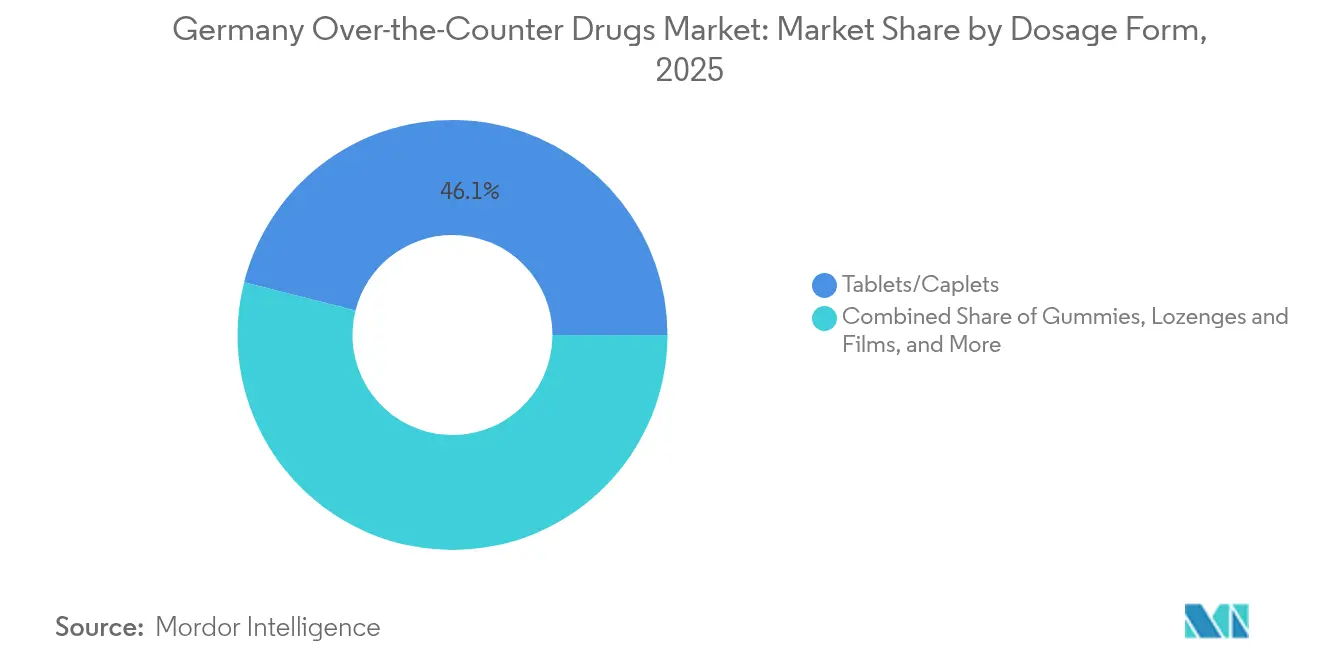
Tablets & Caplets dominate with 46.05% of the German OTC drug market share in 2025 due to cost-efficient production and dosing familiarity. Liquids & Syrups, the fastest-growing format at 8.28% CAGR, resonate with pediatric and geriatric groups who prefer swallow-free options. Gummies & Chewables attract compliance-challenged users through flavor masking, while Sprays & Drops leverage targeted delivery, such as xylometazoline nasal sprays that achieve over 90% user satisfaction.
Patient-centric design is now a differentiator. Formulators invest in taste, texture, and on-the-go packs to align with busy lifestyles. Innovation must still traverse strict German stability and purity tests, which can slow entry for smaller firms but preserve consumer trust in a competitive Germany OTC drug market.
By Route of Administration: Targeted Delivery Gains Momentum
Oral routes continued to command 70.10% of the German OTC drug market size in 2025, yet Nasal delivery posts the fastest expansion at 7.08% CAGR thanks to rapid-onset decongestants and allergy sprays. Topical formats occupy chronic pain and dermatology spaces; clinical data show diclofenac gel brings significant relief to 77.2% of users within 12 weeks. Rectal/Vaginal routes remain specialized but stable, serving hemorrhoid and women’s health indications.
Demand patterns underscore consumer appetite for quick, localized action. Device innovation—metered nasal pumps, airless topical tubes—improves dosing precision and product shelf-life. These advances sustain price premiums and deter commoditization in the German OTC drug market.
By Category: Private-Label Momentum Challenges Brand Dominance
Branded products still control 60.12% share, yet private-label lines are outpacing at 7.98% CAGR as retailers leverage data to target value-conscious segments. STADA’s EUR 3.73 billion (USD 4.31 billion) consumer-health sales prove that dual-track strategies, premium science brands alongside economical generics, can thrive. Brand switching is fluid; transparent ingredient lists and comparable clinical claims narrow perceived quality gaps. Contract manufacturing alliances allow multinationals to supply retailer brands, capturing volume while defending flagship SKUs.
Private-label success pushes branded players to refresh packaging, expand digital education, and secure patent-backed formulation tweaks. Competitive tension, therefore, raises both innovation tempo and consumer value across the German OTC drug market.
Geography Analysis
Germany anchors the EU’s largest OTC consumption base and is a pivotal phytopharmaceutical manufacturing hub. Baden-Württemberg hosts a dense cluster of herbal-medicine specialists that export clinically validated products worldwide, reinforcing regional specialization and high-skill employment. Eastern regions, however, confront care-access headwinds as pharmacy density thins, prompting public concern over medication counselling and compliance. Online channels partly offset the gap, but bandwidth limitations and older demographics slow digital uptake.
Urban centers such as Munich and Berlin display higher per-capita OTC spending, influenced by education levels and disposable income. Pricing studies in large cities reveal that wealthier districts pay up to 15% more for identical OTC SKUs, reflecting brand orientation and convenience premiums. Federal e-health infrastructure aims to reduce such disparities by standardizing data access and enabling universal e-prescription redemption. Yet, state-level policy differences and reimbursement rules still shape local dynamics.
Germany’s central European location supports export logistics, with manufacturers shipping herbal extracts and finished OTC products to neighboring markets within 48 hours. Cross-border trade is poised to expand once the European Health Data Space enables e-prescription interoperability, although cybersecurity and data-sovereignty issues remain unresolved. Incentives under the Medical Research Act encourage regional governments to court pharma investments, reinforcing Germany’s status as a resilient, innovation-driven OTC stronghold.
Regulatory Landscape
German OTC medicines are governed primarily by the Arzneimittelgesetz (AMG), with the Federal Institute for Drugs and Medical Devices (BfArM) operating as the key federal authority for licensing and safety monitoring. Rx-to-OTC switches follow a structured pathway: manufacturers initiate the switch dossier, BfArM evaluates suitability for self-medication, and the Federal Ministry of Health (BMG) implements changes through amendments to the Prescription Ordinance (AMVV). Dispensing is also shaped by classification rules that separate pharmacy-only medicines (apothekenpflichtig) from products permitted for sale outside pharmacies (freiverkaeuflich) under the AMVerkRV.
Reimbursement access runs on a different track from market authorization. Under the statutory health insurance system (GKV), non-prescription medicines are generally excluded unless included in the Federal Joint Committees (G-BA) OTC-UEbersicht as standard therapy for serious diseases, with manufacturers able to apply for additions. The G-BA decision timeline is defined at 90 days. This dual-track structure, with BfArM for authorization and G-BA for reimbursability, influences portfolio strategy, channel mix, and evidence packages for OTC brands operating in Germany.
Competitive Landscape
Competitive intensity is moderate: multinationals, regional specialists, and digital platforms vie for share without any single player eclipsing the field. Bayer is reorganizing its consumer health unit to accelerate switch candidates and gut-health lines, while Sanofi moves ahead with a EUR 20 billion consumer spin-off to unlock capital efficiency.
Digital disruption reshapes engagement more than molecular innovations. DocMorris and Shop Apotheke deploy telemedicine services, loyalty subscription models, and AI-driven adherence reminders that deepen customer lock-in. Smaller firms find niches in herbal remedies and dosage-form novelties, partnering with contract manufacturers to achieve GMP compliance without heavy capex. EU serialization rules erect cost barriers that favor scale; Germany’s national verification system already coordinates data from roughly 100 drug makers.
White-space opportunities lie in evidence-backed natural alternatives, precision-dosage platforms, and OTC devices that integrate with wearables. Strategic alliances and private-equity backing such as Oakley Capital’s stake in WindStar Medical—illustrate how capital pools into scalable consumer-health platforms. As competition pivots from single SKU success to ecosystem engagement, the German OTC drug market rewards agility, regulatory fluency, and data-driven service innovation.
Germany Over-the-Counter Drugs Industry Leaders
-
Bayer AG
-
Sanofi SA
-
Reckitt Benckiser Group PLC
-
Haleon Group of Companies
-
Kenvue Inc.
- *Disclaimer: Major Players sorted in no particular order
Market Opportunities and Future Outlook
The clearest whitespace sits in preventive self-care categories where measured demand has shifted toward daily-use baskets, especially vitamins and minerals. BPI OTC-Daten 2026 pointed to a 7.5% increase in 2025 pharmacy sales for vitamins and minerals, while cough and cold purchases declined in a mild autumn season. That combination supports opportunities for evidence-backed line extensions, premium formulations, and format innovation, such as convenient oral formats and regimen-based packs, aimed at prevention-led shopping rather than episodic symptom relief.
Channel economics are also reshaping how brands reach consumers, and how pharmacies defend value. Deutscher Apothekerverband (DAV) pharmacy economics reporting for 2025 indicated that OTC made up about 41% of physical pharmacy volume, while online and mail order accounted for 23.9% of total OTC volume. This mix creates room for manufacturers to build omnichannel pricing, content, and adherence programs around e-prescription-enabled fulfillment. As stakeholders track physical pharmacy consolidation, pharmacist-supported services, digital counseling, and compliant education under German advertising rules remain a workable route for brands and private labels to compete without relying on broad promotional levers.
Recent Industry Developments
- April 2026: Haleon launched the Centrum Biotic+ range in Germany, expanding its VMS portfolio into gut-health positioning. The rollout strengthens innovation-led differentiation in a segment where preventive, daily-use purchasing is gaining prominence in German OTC baskets.
- November 2025: Bayer Consumer Health in Germany and Austria reported a zero stock-out milestone for its full OTC portfolio, supported by a Dynamic Shared Ownership (DSO) operating model and AI-supported forecasting. The supply reliability focus addresses persistent shortage concerns and supports pharmacy trust and on-shelf availability across high-velocity OTC categories.
- October 2024: Merz Group merged WindStar Medical with Merz Lifecare through a joint holding structure to strengthen OTC reach in the DACH region. The consolidation tightened portfolio and go-to-market alignment across consumer health lines, supporting broader coverage in German pharmacy and adjacent channels.
Research Methodology Framework and Report Scope
Market Definition and Coverage
For this study, the Germany OTC drug market is defined as the annual value (in US dollars) of non-prescription medicines listed in the BfArM register and sold through retail pharmacies, hospital channels, or licensed online pharmacies.
Scope exclusions: Prescription-only medicines, unlicensed homeopathic remedies, and medical devices are excluded from the market size.
Segmentation Overview
- By Product Type
- Cough, Cold & Flu Products
- Analgesics
- Dermatology Products
- Gastrointestinal Products
- Vitamins, Minerals & Supplements (VMS)
- Weight-loss / Dietary Products
- Ophthalmic Products
- Sleeping Aids
- Other Product Types
- By Distribution Channel
- Hospital Pharmacies
- Retail Pharmacies
- Online Pharmacies
- Convenience / Grocery Stores
- By Dosage Form
- Tablets & Caplets
- Liquids & Syrups
- Gummies & Chewables
- Sprays & Drops
- Topicals & Ointments
- By Route of Administration
- Oral
- Topical
- Nasal
- Ophthalmic
- Rectal / Vaginal
- By Category
- Branded OTC
- Private-label / Store Brands
- Generic OTC
Data Sources, Market Sizing, and Validation
Desk Research
Desk work starts by mapping the Germany rules that decide what can be sold as OTC and where it can be sold, since that boundary moves the market more than any single trend. We review official references such as BfArM publications and registers, Federal Statistical Office (Destatis) health and consumer series, and public material from statutory health bodies and pharmacy institutions, which helps keep definitions and channel structure consistent.
To quantify demand signals and pricing direction, we also use broader public sources such as peer reviewed journals on self-medication and demographic health needs, customs and trade releases where relevant, and reputable press coverage of policy shifts like e-prescription rollout. Company annual reports, investor decks, and pharmacy retail announcements are used to sanity check category exposure and the seasonal selling calendar (for example, cold and flu peaks and allergy season). Where needed, we supplement with paid subscriptions focused on company financials and intelligence, patents, and shipment-level import and export records to cross-check manufacturer footprint and product mix. These are illustrative examples, and many other public and paid sources were also used for data collection, validation, and clarification during the research process.
Primary Interviews and Surveys
Primary work is used to confirm how OTC demand is actually purchased and priced across pharmacy, online, and adjacent channels, then to stress test the desk-sourced assumptions that do not capture day-to-day commercial execution. We spoke with a spread of manufacturers, distributors, pharmacy trade participants, and healthcare professionals to validate product-switch behavior, promotion intensity, and the way pack sizes and claims influence average selling price (ASP) movement over time.
Distribution of primary research fieldwork respondents
| Company type | Respondent position |
|---|---|
| Top tier: 27% | CXOs: 17% |
| Mid tier: 53% | Functional/Unit leaders: 39% |
| Smaller Players: 20% | Managers: 44% |
Market-Sizing & Forecasting
Market sizing is built mainly through a top-down approach where pharmacy-channel value pools are reconstructed from category consumption signals and pricing behavior, and then the totals are adjusted to match the OTC boundary defined for Germany. We corroborate those totals with selective bottom-up checks, such as rolling up a sample of supplier and brand revenues, and then validating with channel checks on volume and ASP ranges.
The model uses practical inputs that move the market in predictable ways, including OTC switch activity and reclassification timing, pharmacy and licensed online channel share shifts, seasonal incidence patterns (cold and flu, allergy), aging population related self-care needs, and ASP progression driven by pack mix, promotion cycles, and inflation passthrough. When a bottom-up datapoint is missing for a niche category, we do not force precision, and we bridge the gap using proxy volumes from similar OTC classes and interview-validated price corridors.
For forecasting, scenario analysis is applied around a central case, since policy and consumer behavior can shift quickly for OTC categories. Growth paths are then tuned using expert consensus on near-term category momentum, expected channel mix change, and realistic ASP evolution rather than assuming a flat price curve across the full period.
Data Validation & Update Cycle
Validation is done through multiple cross-checks so we do not rely on a single dataset or a single viewpoint. We compare model outputs against independent signals, such as pharmacy footprint changes, public health utilization patterns, and observable price and promotion direction, and then any large variances are reviewed back to the underlying assumptions.
Before sign-off, the work is reviewed by another analyst who looks for logic breaks, sudden jumps, or category totals that do not fit the known seasonality and channel structure. The report is refreshed annually, and if a material event happens (for example, a major regulation shift or an abrupt pricing change), an interim update is triggered and key assumptions are rechecked through follow-up calls. Right before delivery, we run a final pass so clients receive the most current view available.
Mordor Intelligence's Germany Otc Drug Market Estimate Compared With Other Published Estimates
It is normal to see different market sizes for Germany OTC drugs, even when the topic name looks the same, because the boundary of what counts as OTC and the timing of pricing updates are not handled the same way. Differences also come from whether a number is tied to pharmacy sell-out value versus manufacturer sell-in value, and from how online pharmacy growth is treated.
A refresh-led gap shows up often in this market because ASPs move through pack mix and promotion cycles, and then currency conversion timing can shift the reported USD value in a given year. The table reflects that spread, where the estimate is kept current through scheduled assumption refreshes and a consistent EUR-to-USD conversion timing, a choice applied by Mordor Intelligence.
Benchmark comparison
| Source | Market Size | Gaps in Research Methodology |
|---|---|---|
| Mordor Intelligence | USD 9.90 B (2026) | |
| Regional Consultancy A | USD 9.11 B (2024) | Uses an earlier base year and often applies a broad retail-drugstore definition that can undercount licensed online pharmacy value and recent OTC switch uplifts. |
| Trade Journal B | USD 7.80 B (2024) | Typically relies on a narrower basket focused on pharmacy core categories and may exclude selected self-care classes, which reduces the total and can also mute ASP progression effects. |
Across the three figures, the biggest drivers are year alignment and what is included as an OTC medicine under the German regulator boundary, followed by how ASP changes are carried forward. By keeping the scope rules explicit and tying the value build to observable demand and pricing checks, we end up with a market size that is easier to replicate and explain in practical steps.
Key Questions Answered in the Report
What is the current value of the Germany OTC drug market?
The market stands at USD 9.90 billion in 2026 and is projected to hit USD 12.15 billion by 2031.
Which product category is growing the fastest?
Weight-loss and dietary OTC products lead growth with an 8.78% CAGR forecast for 2026-2031.
How has the e-prescription mandate affected distribution?
Mandatory e-prescriptions processed 730 million transactions by April 2025, propelling online pharmacy growth at 12.40% CAGR.
Why are Rx-to-OTC switches important in Germany?
Streamlined BfArM procedures and the 2025 Medical Research Act shorten approval timelines and sustain price realisation for switched products.
What is the main restraint on OTC market expansion?
Stringent German advertising and price-control laws restrict promotional flexibility and compress margins.