
Germany Electric Truck Market Size and Share
Market Overview
| Study Period | 2020 - 2032 |
|---|---|
| Forecast Data Period | 2027 - 2032 |
| Base Year Market Size (2026) | USD 2.02 Billion |
| Market Size (2027) | USD 2.44 Billion |
| Market Size (2032) | USD 6.32 Billion |
| Growth Rate (2027 - 2032) | 20.97 % |
| Market Concentration | High |
Major Players *Disclaimer: Major Players sorted in no particular order Image © Mordor Intelligence. Reuse requires attribution under CC BY 4.0. | |
Germany Electric Truck Market Analysis by Mordor Intelligence
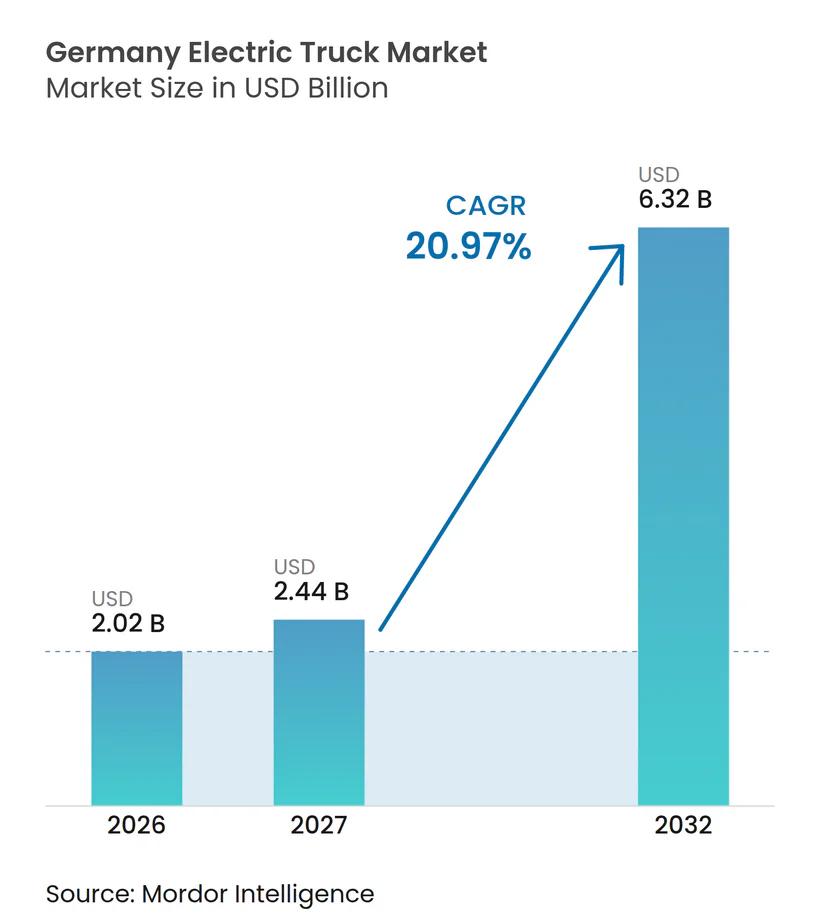
The Germany electric truck market size was valued at USD 2.02 billion in 2026 and is expected to grow from USD 2.44 billion in 2027 to USD 6.32 billion by 2032, at a CAGR of 20.97% during 2027-2032. Germany’s electric truck registration share exceeds the EU and EEA average. Germany represents a significant share of EU and EEA truck sales, meaning fleet purchasing decisions in the country strongly influence European production plans. Toll relief, improved vehicle availability, and charging infrastructure investments are reducing operating barriers for larger fleets. However, the Germany electric truck market continues to show uneven progress, as smaller carriers face challenges with depot grid connections, vehicle prices, and access to finance. Battery-electric models currently lead demand, while hydrogen-powered models remain dependent on public funding and the planned expansion of refueling infrastructure.
Key Report Takeaways
- By vehicle type, heavy-duty trucks held a 53.29% share in 2026, while medium-duty trucks are projected to grow at a 24.28% CAGR through 2032.
- By propulsion, battery-electric trucks held a 94.18% share in 2026, while fuel-cell electric trucks are projected to grow at a 26.32% CAGR through 2032.
- By gross vehicle weight class, above-12-ton trucks held a 56.12% share in 2026 and are projected to grow at a 22.19% CAGR through 2032.
- By range, medium-range trucks held a 59.89% share in 2026, while long-range trucks are projected to grow at a 22.78% CAGR through 2032.
- By battery capacity, above-300-kWh packs held a 49.50% share in 2026 and are projected to grow at a 22.67% CAGR through 2032.
- By battery chemistry, lithium iron phosphate held a 58.39% share in 2026, while lithium nickel manganese cobalt oxide is projected to grow at a 26.87% CAGR through 2032.
- By application, long-haul freight held a 39.29% share in 2026, while regional distribution is projected to grow at a 26.38% CAGR through 2032.
- By end user, logistics and parcel operators held a 34.38% share in 2026 and are projected to grow at a 21.29% CAGR through 2032.
Note: Market numbers in this report are based on Mordor Intelligence's proprietary estimation framework, which combines nine months of actuals with Q4 projections for base year 2026.
Market Trends and Insights
Drivers Impact Analysis of Germany Electric Truck Market*
| Driver | (~) % Impact on CAGR Forecast | Geographic Relevance | Impact Timeline |
|---|---|---|---|
| EU and German Zero-Emission Truck Policy Tightening | +4.8% | Germany, with the strongest national incentive stack in the EU | Medium term (2–4 years) |
| Route-Level Total-Cost-of-Ownership Improvement | +3.5% | Germany and the Netherlands, followed by the EU | Medium term (2–4 years) |
| Expanding OEM Availability of Long-Haul Electric Trucks | +3.1% | Global, with Germany as an early-adoption hub | Short term (≤ 2 years) |
| Public High-Power Truck-Charging Corridor Funding | +2.7% | Germany, with spillover to DACH and Benelux | Medium term (2–4 years) |
| Pay-Per-Use Models Reducing Fleet Capital Barriers | +1.8% | Germany, followed by the EU | Short term (≤ 2 years) |
| Interoperable Megawatt Charging Standardization | +1.6% | Germany, with EU-wide spillover | Long term (≥ 4 years) |
| Source: Mordor Intelligence | |||
EU and German Zero-Emission Truck Policy Tightening
European fleet emissions rules and German toll policy reinforce each other in the Germany electric truck market. The revised EU regulation requires manufacturers to cut average new heavy-duty vehicle CO2 emissions by 45% by 2030 relative to the 2019 baseline, and a 2026 amendment gives them temporary flexibility over 2025–2029 by allowing credits from years in which fleets beat their targets. That flexibility gives manufacturers time to increase deliveries, but the 2030 target still encourages them to place zero-emission trucks in service early. Zero-emission heavy goods vehicles remain exempt from the LKW-Maut toll [1], supporting lower operating costs for fleet operators and helping manufacturers meet compliance requirements.
Route-Level Total-Cost-of-Ownership Improvement
Electric trucks are becoming increasingly viable for German routes with predictable mileage and access to charging infrastructure. Industry assessments indicate that the economics of electric trucks are improving, driven by higher vehicle efficiency, broader charging availability, and rising diesel prices. Electric trucks demonstrate lower operating costs than comparable diesel trucks and can generate substantial annual savings for fleets operating on predictable routes. Operators can further improve cost efficiency through load management and time-based electricity contracts. Therefore, the Germany electric truck market favors fleet operators that can integrate vehicle routes, charging windows, and energy procurement into a single operating plan.
Public High-Power Truck-Charging Corridor Funding
Charging investment is moving from individual pilot locations toward a national corridor network. The European Commission approved up to EUR 1.6 billion (~USD 1.87 billion) in state aid to Germany for public fast chargers at 124 unstaffed motorway rest areas [2]. Autobahn GmbH awarded contracts covering 836 charge points at 124 unstaffed rest areas, including 447 Megawatt Charging System points and 389 Combined Charging System points. The federal government is providing about EUR 1 billion (~USD 1.17 billion) for the motorway truck fast-charging network, with the first sites entering the implementation phase in September 2026. These projects improve the case for trucks that cross German distribution hubs and wider TEN-T routes. Interoperable megawatt charging should further reduce downtime for long-haul operations as compatible vehicles and chargers enter service.
Pay-Per-Use Models Reducing Fleet Capital Barriers
Financing models are gaining importance as smaller carriers face high vehicle purchase costs. Few German logistics companies would consider purchasing an electric truck without financing, while leasing, rental, and hire-purchase options generate substantial procurement interest. Industry participants have introduced pay-per-use arrangements for electric truck deployments. Financial service providers have also launched leasing programs that combine mileage-based leasing, residual-value protection, and maintenance services. These financing arrangements reduce the cash-flow risk that can delay electric truck adoption among owner-operators and regional fleets.
Restraints Impact Analysis of Germany Electric Truck Market*
| Restraint | (~) % Impact on CAGR Forecast | Geographic Relevance | Impact Timeline |
|---|---|---|---|
| High Upfront Vehicle and Charging-System Cost | -3.2% | Global, with a strong effect on German small and medium fleet operators | Short term (≤ 2 years) |
| Grid-Connection Delays and Depot Demand Charges | -2.5% | Germany and the DACH region | Medium term (2–4 years) |
| Range, Payload, Weather, and Long-Haul Utilization Constraints | -1.9% | Germany, including cold-weather and alpine routes | Short term (≤ 2 years) |
| Residual-Value and Small-Carrier Financing Uncertainty | -1.4% | Germany’s fragmented owner-operator base | Medium term (2–4 years) |
| Source: Mordor Intelligence | |||
High Upfront Vehicle and Charging-System Cost
The price gap between electric and diesel trucks remains a significant constraint for smaller operators. Battery-electric tractors typically cost considerably more than comparable diesel trucks. Depot charging equipment adds further costs, ranging from individual charger installations to large-scale depot systems, depending on grid connection requirements. The expiration of support programs has created a financing gap for some operators. New charging support programs may partly reduce this gap, but do not eliminate the need for substantial upfront capital. Residual value uncertainty and limited access to structured financing further intensify this barrier for small fleets.
Grid-Connection Delays and Depot Demand Charges
Depot grid connections can require extended lead times, depending on local capacity and permitting conditions. This timeline can conflict with vehicle ordering and replacement cycles. Peak demand charges also increase operational complexity when multiple trucks charge simultaneously. Managed charging, battery storage, and load shifting can reduce exposure to these charges, but they require engineering expertise and capital investment. Public motorway charging does not address all depot connection challenges, as each site still requires coordination with the local electricity network. Consequently, the electric truck market may progress more rapidly among large logistics groups with dedicated energy and procurement teams.
*Our forecasts treat driver/restraint impacts as directional, not additive. The impact forecasts reflect baseline growth, mix effects, and variable interactions.
Germany Electric Truck Market Segment Analysis
By Vehicle Type:
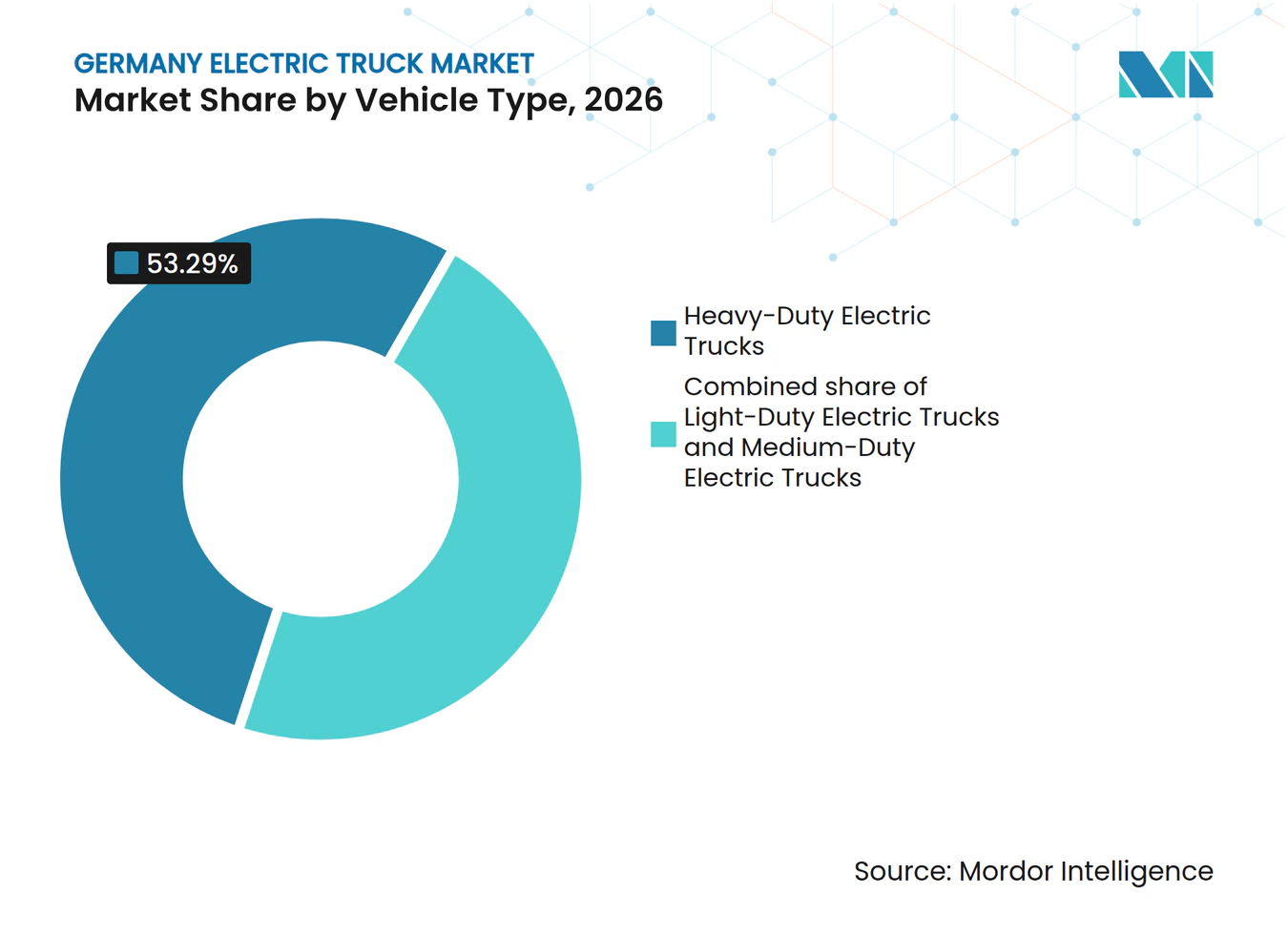
Heavy-Duty Trucks Lead While Medium-Duty Demand ExpandsHeavy-duty trucks accounted for 53.29% of the Germany electric truck market in 2026. Their position reflects early adoption by long-haul fleets and the high emissions value of replacing diesel tractors. Daimler Truck began series production of the eActros 600 at Wörth in late 2024. MAN started production of the eTGX and eTGS at Munich in June 2025. MAN produced 1,300 heavy-duty electric trucks at its Munich plant during the first year of series production. Large tractors also fit the German motorway charging program, which is designed for high-power charging. The segment benefits from fleet demand for vehicles capable of covering intercity and cross-border lanes. Its growth depends on the reliability of public charging as more trucks leave fixed depot routes.
Medium-duty trucks are forecast to grow at a 24.28% CAGR through 2032. These vehicles serve regional logistics, food distribution, and municipal work, with easier-to-plan routes. MAN presented the 16-ton eTGM in May 2026, with production planned for 2027. MAN also began series production of the 12-ton eTGL at its Kraków plant in July 2026. More available models give distributors choices that were previously limited. Light-duty trucks remain relevant for urban delivery and municipal fleets. Their simpler charging needs support adoption, but their revenue contribution remains lower than heavy-duty and medium-duty vehicles. Vehicle availability is widening across the Germany electric truck industry as these use cases become more defined.



By Propulsion:
Battery-Electric Trucks Dominate While Hydrogen Receives SupportBattery-electric trucks accounted for 94.18% of the propulsion mix in 2026. They benefit from established supply chains, dealer coverage, and practical operating experience. Their current dominance also reflects the ease of deploying depot charging. Battery-electric models are available for regional work and increasingly for long-haul transport. Public charging investment gives fleets more confidence to use them beyond fixed routes. The Germany electric truck market remains centered on battery-electric trucks because the installed charging infrastructure is developing faster than hydrogen refueling infrastructure. Manufacturers are also concentrating product launches around battery-electric platforms. This supports a broad service and maintenance base for fleet operators.
Fuel-cell electric trucks are forecast to grow at a 26.32% CAGR through 2032 from a very small base. Daimler Truck presented the NextGenH2 Truck in 2026 with a range of over 1,000 km on liquid hydrogen. The program covers 100 customer vehicles from the end of 2026 and has EUR 226 million (~USD 264 million) in federal and state support. Toyota and Scania announced in September 2026 that Toyota would supply 40 fuel-cell systems for Scania’s Pilot Partner program. Plug-in hybrid and hybrid trucks have a limited and declining role because they do not qualify as zero-emission vehicles under the relevant manufacturer rules. Hydrogen remains a longer-term complement where payload, distance, and refueling time are decisive. Its progress will depend on refueling infrastructure and operating evidence from fleet trials.
By Gross Vehicle Weight Class:
Above-12-Ton Trucks Hold Share and Growth LeadershipAbove-12-ton trucks accounted for 56.12% of the Germany electric truck market size in 2026. The class is also forecast to grow at a 22.19% CAGR through 2032. Articulated tractors used on German motorway freight explain both measures. Manufacturers receive greater emissions benefits when they replace heavier diesel vehicles. This supports early production focus on the largest truck class. The national motorway charging plan also prioritizes charging systems suited to heavy-duty tractors. Large freight fleets can coordinate routes and charge more readily than smaller operators. These conditions support continued demand for heavier electric trucks.
The above-3.5- to 12-ton class serves regional distribution and public-service roles. It is expanding as product choices improve in 2026. MAN’s eTGM and eTGL address a wider range of distribution loads. These trucks can return to the depot for charging after predictable shifts. They may therefore avoid some public charging constraints faced by long-haul fleets. The under-3.5-ton class overlaps with electric vans and light commercial vehicles. That overlap limits its contribution to truck revenue. Weight-class demand in the Germany electric truck industry reflects the distinct needs of freight, regional distribution, and local service operators.
By Range:
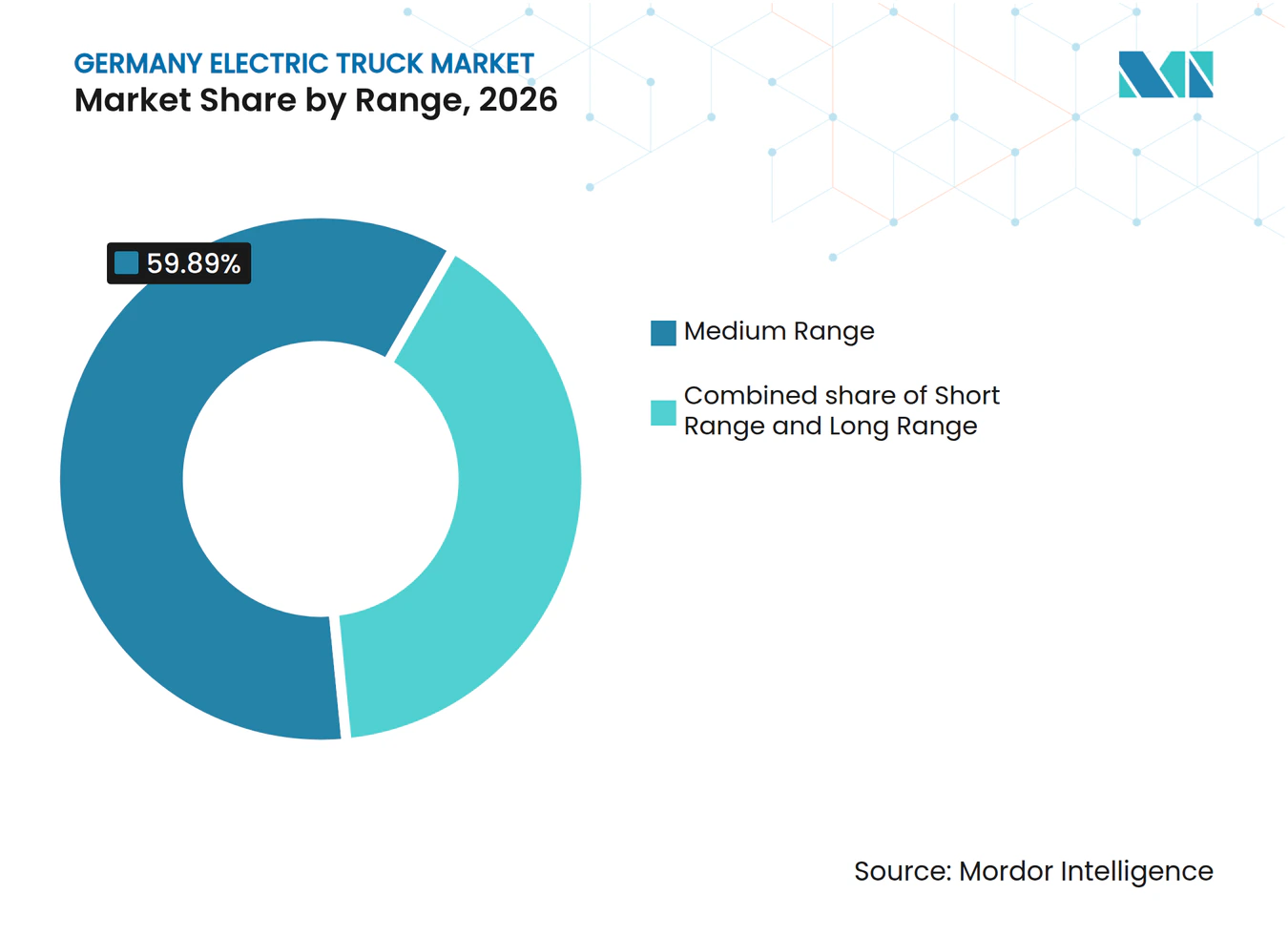
Medium-Range Trucks Lead While Long-Range Capability ImprovesMedium-range trucks held 59.89% of the Germany electric truck market in 2026. Their 200-500 km operating range suits distribution centers, supermarket supply, and parcel routes. Such fleets can normally charge at a depot. That reduces dependence on public charging availability during a working day. The segment reflects the routes that are already easiest to electrify. Operators can schedule vehicles around known stops and known charging windows. These advantages have supported the early adoption of electric trucks. Medium-range operations also provide useful real-world data for fleet planning.
Long-range trucks are forecast to grow at a 22.78% CAGR through 2032. Volvo Trucks opened orders for the 2026 FH Aero Electric, with a stated range of up to 700 km. MAN’s eTGX offers up to 720 km with a seven-battery, 644 kWh NMC configuration. MCS-capable versions improve the operational case for long routes by reducing charging downtime. Short-range trucks continue to serve urban and last-mile work. Their role remains relevant for municipal fleets and parcel operators. The growing range of heavy models is widening the Germany electric truck market beyond city and regional missions.

By Battery Capacity:
Above-300 kWh Packs Support Long-Haul OperationsAbove-300-kWh battery packs accounted for 49.50% of the Germany electric truck market share in 2026. They are forecast to grow at a 22.67% CAGR through 2032. Large packs support the range requirements of long-haul electric tractors. Daimler Truck uses a 621 kWh LFP system in the eActros 600. MAN uses battery configurations ranging from 552 kWh to 644 kWh in its eTGX and eTGS range. These systems support freight applications that cannot rely solely on overnight depot charging. Installed capacity is therefore closely linked to vehicle weight and route length. Faster public charging may later change the optimal battery size for some operations.
Volvo Trucks reported 725 kWh of usable energy from a 780 kWh gross pack in 2026. Usable energy and vehicle weight are becoming more important than nominal capacity alone. Mid-range packs from 100 to 300 kWh remain suited to regional and medium-duty distribution. Packs below 100 kWh remain concentrated in light urban operations. Operators will compare payload, usable range, charging speed, and daily utilization when selecting capacity. MCS deployment can allow selected fleets to use smaller packs with en-route charging. The Germany electric truck market will retain large packs where routes need substantial onboard energy. Capacity choices will remain closely tied to operating patterns.
By Battery Chemistry:
LFP Leads While NMC Grows in Range-Critical RoutesLithium iron phosphate held 58.39% of the battery chemistry segment in 2026. LFP benefits from thermal stability, long cycle life, and lower exposure to cobalt and high-nickel material costs. Daimler Truck uses multiple LFP battery packs in the eActros. The company stated that the vehicle offers high usable battery capacity. It was designed for a long operating life. These characteristics support high-cycle operations that return to a depot, positioning LFP batteries well for heavy-duty and distribution applications.
Lithium nickel manganese cobalt oxide is forecast to grow at a 26.87% CAGR through 2032. NMC has a higher energy density per kilogram, which matters when operators must preserve payload on long-distance routes. MAN selected NMC for the eTGX and eTGS, citing energy density, durability, and cold-weather performance. The chemistry is useful where public charging remains sparse, and a longer onboard range is necessary. LFP and NMC can coexist because they serve different operating requirements. The Germany electric truck industry does not require a single chemistry outcome across all truck classes. Chemistry demand is likely to continue to follow route length, payload sensitivity, and charging access. This supports a divided battery strategy among manufacturers.
By Application:
Long-Haul Freight Leads While Regional Distribution Grows FasterLong-haul freight accounted for 39.29% of the Germany electric truck market in 2026. Germany’s role in European road freight supports this application’s large base. Long-haul fleet operators need dependable charging along national and cross-border routes. They also need vehicles with adequate range and payload. Public MCS charging is designed to address these operating demands. Milence completed a 1,000 km all-electric Paris-to-Berlin convoy in April 2026, using hubs in France, Belgium, the Netherlands, and Germany. The route demonstrated that long-distance operation is possible across the corridor. Reliable charging coverage remains essential before this use case can scale widely.
Regional distribution is forecast to expand at a 26.38% CAGR through 2032. Fleets running 200 to 400 km round-trip can gain from overnight charging and predictable delivery windows. They are less dependent on public infrastructure during the working day. Toll exemptions also improve their operating economics. Urban and last-mile distribution benefit from low-emission requirements in German cities. Construction and municipal work are increasingly served by battery-electric rigid trucks. Mining and industrial haulage remain smaller applications in Germany than in Nordic markets. The Germany electric truck market has a clear opportunity in regional routes because their energy use and charging needs are easier to manage.
By End User:
Logistics and Parcel Operators Combine Scale with Fast GrowthLogistics and parcel operators held 34.38% of the Germany electric truck market in 2026. The group is also forecast to grow at a 21.29% CAGR through 2032. DHL Group, DB Schenker, Dachser, and Rhenus operate large Germany-based fleets. Their centralized procurement can support larger vehicle orders and charging investments. Dedicated energy teams can also manage charging schedules and power contracts. These capabilities reduce several barriers that smaller carriers face. Predictable networks make it easier to match electric trucks with suitable routes. The segment’s leadership reflects the practical advantage of fleet scale.
Retail and e-commerce fleets are adopting electric trucks through emissions commitments and financing models that limit upfront cost. Manufacturing and supplier fleets have more variable routes, although fixed plant-to-plant lanes are suitable for targeted deployment. Construction operators face constraints on site charging, payload, and torque. Municipal fleets operate within defined areas and can charge overnight at fixed locations. Refuse collection, road maintenance, and public-service uses can therefore form a secondary demand base. End-user demand is broadening, but the pace remains uneven across operational profiles. Large logistics operators will continue to establish early operating practices for other fleet groups. Smaller carriers still need charging and financing options that fit their business structure.
Geography Analysis
Germany’s truck registration share exceeds the EU and EEA average. The country accounts for a significant share of new EU truck registrations, placing it at the center of European manufacturers’ plans. A substantial proportion of European road freight passes through Germany, according to Milence. The country’s toll system provides direct incentives for zero-emission heavy-duty vehicles, while Daimler Truck and MAN maintain major manufacturing operations there. The LKW-Maut exemption further strengthens the position of German fleet operators. These factors position the Germany electric truck market as a key early-adoption market in Europe.
North Rhine-Westphalia plays a significant role, as the Rhine-Ruhr region connects German freight corridors with Benelux gateway traffic. Milence is scheduled to open a charging hub in Recklinghausen near a major motorway. Bavaria and Baden-Württemberg benefit from industrial and automotive supply bases that support regional freight activity. Daimler Truck’s Wörth plant in Rhineland-Palatinate produces the eActros and a small series of next-generation hydrogen trucks. Ports in Hamburg and Bremen face more complex charging requirements for refrigerated and bulk logistics. These nonstandard duty cycles may delay large-scale adoption in these locations. Consequently, regional progress will depend on freight density, depot conditions, and charging infrastructure availability.
The Netherlands represents the most comparable neighboring market, as electric-truck economics are expected to improve, according to the same Milence analysis. France is likely to progress more slowly, as it is not expected to adopt an equivalent carbon-based road-toll discount. MAN is expected to begin delivering MCS-ready electric trucks across Belgium, the Czech Republic, Denmark, Germany, Italy, the Netherlands, Norway, Spain, and the United Kingdom. Consequently, German vehicle specifications will remain relevant beyond the domestic market. Electric-truck penetration in Central and Eastern Europe is expected to remain below Germany’s level. Cross-border charging interoperability will determine how quickly operators in neighboring countries can adopt the same vehicle platforms.
Competitive Landscape
Market Concentration
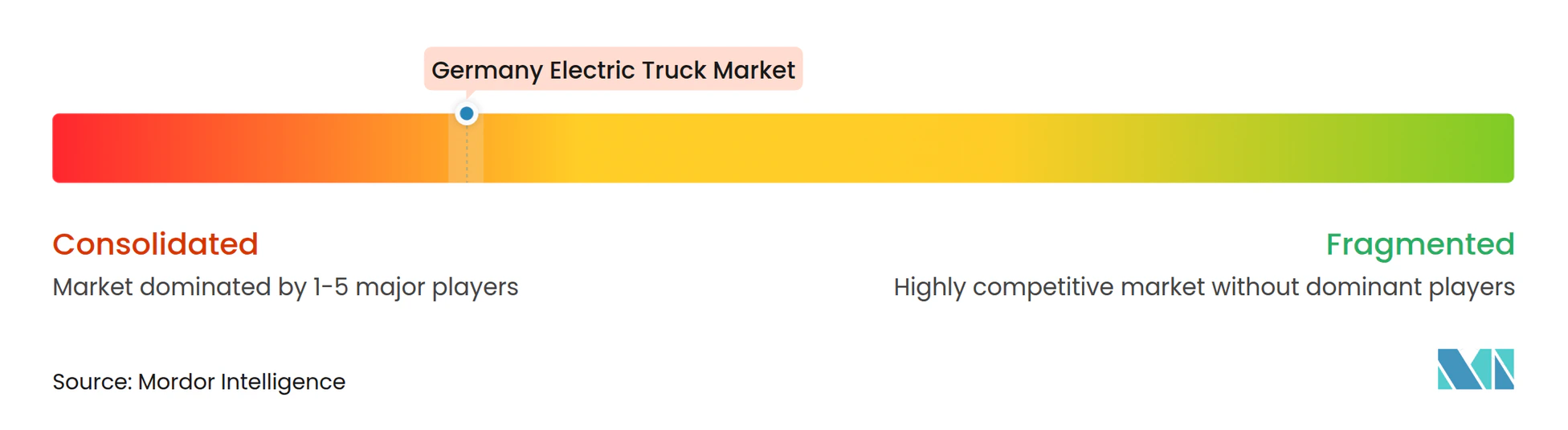
The Germany electric truck market is consolidated at the OEM level. Daimler Truck, MAN Truck & Bus, and Volvo Trucks have established dealer, service, and financing networks. These capabilities help fleets manage vehicle uptime and residual-value risk. Volvo Trucks started production of the FH Aero Electric with up to 700 km range in September 2026, while MAN unveiled a new-generation eTGX with up to 720 km range. These product developments indicate that long-haul range remains a key competitive priority. Service coverage and financing options are equally important as fleets assess the higher upfront costs of electric trucks, favoring established truck manufacturers.
Daimler Truck, TRATON, and Volvo Group support the Milence charging venture. Milence plans to operate charging hubs across several European countries. Daimler Truck has also secured public co-funding for the NextGenH2 Truck program. This support positions hydrogen as a complementary long-term technology rather than a near-term replacement for battery-electric trucks. eService Leasing and pay-per-use programs address the financial aspects of fleet conversion. JUNA and Hylane separate vehicle ownership from freight operations, potentially reducing capital barriers if fleets adopt these models more widely.
BYD unveiled the ETT 44 long-haul electric tractor for Europe at IAA Transportation 2026, with deliveries targeted for 2027. The company has also established a European financing partnership with DLL, covering Germany and other countries. However, EU anti-subsidy tariffs may constrain BYD's cost competitiveness in Europe. Mid-market leasing, bundled depot-charging solutions, and medium-duty vehicles remain areas requiring additional offerings. Nikola Corporation's bankruptcy filing highlights the risks faced by companies that lack scaled manufacturing capacity. Established OEMs hold a stronger competitive position because they can offer vehicles, maintenance services, and financing solutions as an integrated package. Therefore, the competitive landscape remains consolidated, favoring large manufacturers while leaving opportunities for service and financing specialists.
Germany Electric Truck Industry Leaders
-
Daimler Truck AG
-
Volvo Trucks
-
MAN Truck & Bus SE
-
DAF Trucks N.V.
-
Scania AB
- *Disclaimer: Major Players sorted in no particular order
Germany Electric Truck Market Companies Covered in this Report
- Daimler Truck AG
- MAN Truck & Bus SE
- Volvo Trucks
- Scania AB
- DAF Trucks N.V.
- IVECO Group N.V.
- Renault Trucks
- BYD Company Limited
- Tesla, Inc.
- Ford Trucks
- FUSO Truck Europe
Recent Industry Developments in Germany Electric Truck Market
- September 2026: Volvo Trucks started series production of the FH Aero Electric, offering up to 700 km of range with a 780 kWh battery.
- September 2026: Autobahn GmbH moved Germany’s truck fast-charging network into implementation, covering 836 charge points, including 447 MCS points, at 124 unstaffed motorway rest areas.
- July 2026: MAN Truck & Bus started series production of the 12-ton eTGL battery-electric truck at its Kraków plant.
- June 2026: SANY began delivering its long-haul battery-electric trucks to customers in Germany.
Germany Electric Truck Market Report Scope
The Germany Electric Truck Market is Segmented by Vehicle Type (Light-Duty Electric Trucks, Medium-Duty Electric Trucks, and Heavy-Duty Electric Trucks), Propulsion (Battery Electric Trucks, Fuel-Cell Electric Trucks, Plug-In Hybrid Electric Trucks, and Hybrid Electric Trucks), Gross Vehicle Weight Class (Up to 3.5 Tons, Above 3.5 to 12 Tons, and Above 12 Tons), Range (Short Range, Medium Range, and Long Range), Battery Capacity (Below 100 kWh, 100 to 300 kWh, and Above 300 kWh), Battery Chemistry (Lithium Iron Phosphate, Lithium Nickel Manganese Cobalt Oxide, and Other Battery Chemistries), Application (Urban and Last-Mile Distribution, Regional Distribution, Long-Haul Freight, Construction and Municipal Services, and Mining and Industrial Haulage), and End User (Logistics and Parcel Operators, Retail and E-Commerce Fleets, Manufacturing and Supplier Fleets, Construction and Infrastructure Contractors, Municipal and Public-Service Fleets, and Mining and Quarrying Operators). The Market Forecasts are Provided in Both Value (USD) and Volume (Units).
Segmentation Overview
| Light-Duty Electric Trucks |
| Medium-Duty Electric Trucks |
| Heavy-Duty Electric Trucks |
| Battery Electric Trucks |
| Fuel-Cell Electric Trucks |
| Plug-In Hybrid Electric Trucks |
| Hybrid Electric Trucks |
| Up to 3.5 Tons |
| Above 3.5 to 12 Tons |
| Above 12 Tons |
| Short Range |
| Medium Range |
| Long Range |
| Below 100 kWh |
| 100 to 300 kWh |
| Above 300 kWh |
| Lithium Iron Phosphate |
| Lithium Nickel Manganese Cobalt Oxide |
| Other Battery Chemistries |
| Urban and Last-Mile Distribution |
| Regional Distribution |
| Long-Haul Freight |
| Construction and Municipal Services |
| Mining and Industrial Haulage |
| Logistics and Parcel Operators |
| Retail and E-Commerce Fleets |
| Manufacturing and Supplier Fleets |
| Construction and Infrastructure Contractors |
| Municipal and Public-Service Fleets |
| Mining and Quarrying Operators |
| By Vehicle Type | Light-Duty Electric Trucks |
| Medium-Duty Electric Trucks | |
| Heavy-Duty Electric Trucks | |
| By Propulsion | Battery Electric Trucks |
| Fuel-Cell Electric Trucks | |
| Plug-In Hybrid Electric Trucks | |
| Hybrid Electric Trucks | |
| By Gross Vehicle Weight Class | Up to 3.5 Tons |
| Above 3.5 to 12 Tons | |
| Above 12 Tons | |
| By Range | Short Range |
| Medium Range | |
| Long Range | |
| By Battery Capacity | Below 100 kWh |
| 100 to 300 kWh | |
| Above 300 kWh | |
| By Battery Chemistry | Lithium Iron Phosphate |
| Lithium Nickel Manganese Cobalt Oxide | |
| Other Battery Chemistries | |
| By Application | Urban and Last-Mile Distribution |
| Regional Distribution | |
| Long-Haul Freight | |
| Construction and Municipal Services | |
| Mining and Industrial Haulage | |
| By End User | Logistics and Parcel Operators |
| Retail and E-Commerce Fleets | |
| Manufacturing and Supplier Fleets | |
| Construction and Infrastructure Contractors | |
| Municipal and Public-Service Fleets | |
| Mining and Quarrying Operators |
Key Questions Answered in the Report
What is driving electric truck adoption in Germany?
The LKW-Maut exemption through June 2031, EU fleet emissions rules, and public charging investment are supporting adoption.
How large is the Germany electric truck market?
The market was valued at USD 2.02 billion in 2026 and is forecast to reach USD 6.32 billion by 2032, growing at a 20.97% CAGR during 2027-2032.
Which electric truck type has the largest demand in Germany?
Heavy-duty trucks led with 53.29% share in 2026, supported by long-haul freight needs and expanding OEM production.
What is the main barrier for smaller truck fleets?
High purchase and charging-system costs, financing constraints, and long depot grid-connection times remain key barriers.
Are battery-electric trucks more common than fuel-cell trucks?
Yes. Battery-electric trucks accounted for 94.18% of the propulsion mix in 2026, while fuel-cell models are growing from a small base.