
Germany Data Center Logistics Market Size and Share
Market Overview
| Study Period | 2021 - 2032 |
|---|---|
| Forecast Data Period | 2027 - 2032 |
| Base Year Market Size (2026) | USD 2.07 Billion |
| Market Size (2027) | USD 2.28 Billion |
| Market Size (2032) | USD 3.49 Billion |
| Growth Rate (2027 - 2032) | 8.89 % |
| Market Concentration | Medium |
Major Players *Disclaimer: Major Players sorted in no particular order Image © Mordor Intelligence. Reuse requires attribution under CC BY 4.0. | |
Germany Data Center Logistics Market Analysis by Mordor Intelligence
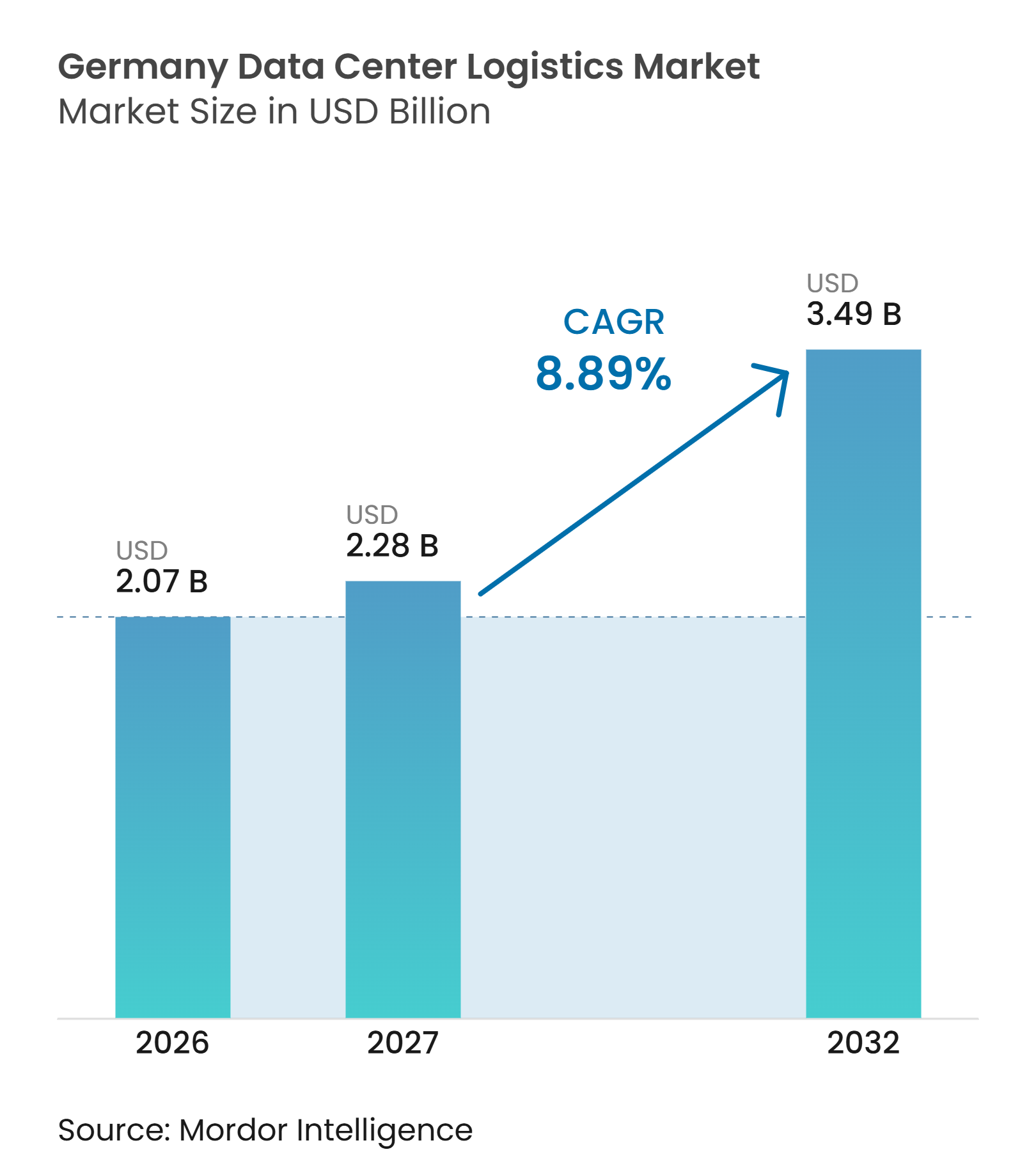
The Germany data center logistics market size is valued at USD 2.07 billion in 2026. It is estimated to grow from USD 2.28 billion in 2027 to reach USD 3.49 billion by 2032, at a CAGR of 8.89% during the forecast period (2027-2032).
The Germany data center logistics market is supported by a large pipeline of data center construction and hardware deployment, particularly around Frankfurt, Brandenburg, and North Rhine-Westphalia. Germany is also moving toward a more distributed pattern of capacity, which creates demand for secure transport, staging, installation, and last-mile services beyond the Rhine-Main area. Logistics providers are responding by adding technical handling, chain-of-custody controls, and installation support instead of relying only on conventional freight services. Long-term contracts with cloud operators favor suppliers that can combine transport, warehousing, configuration, and on-site work within one accountable service model. Grid constraints, skilled labor shortages, and scarce specialized warehouse space may slow the timing of new projects. Still, they also increase the value of experienced operators with established facilities and certified teams.
Key Report Takeaways
- By logistics function, transportation accounts for 57.51% of the Germany data center logistics market share in 2026, while value-added services are projected to register a 10.83% CAGR through 2032.
- By transportation mode, road accounts for 52.38% of the Germany data center logistics market size in 2026, while air freight is projected to register at an 11.18% CAGR through 2032.
- By devices, electrical devices account for 66.25% of Germany data center logistics market share in 2026, while mechanical devices are projected to register at a 10.76% CAGR through 2032.
- By data center size, large-scale data centers account for 64.17% of the Germany data center logistics market size in 2026, while small and medium-scale data centers are projected to register at a 10.70% CAGR through 2032.
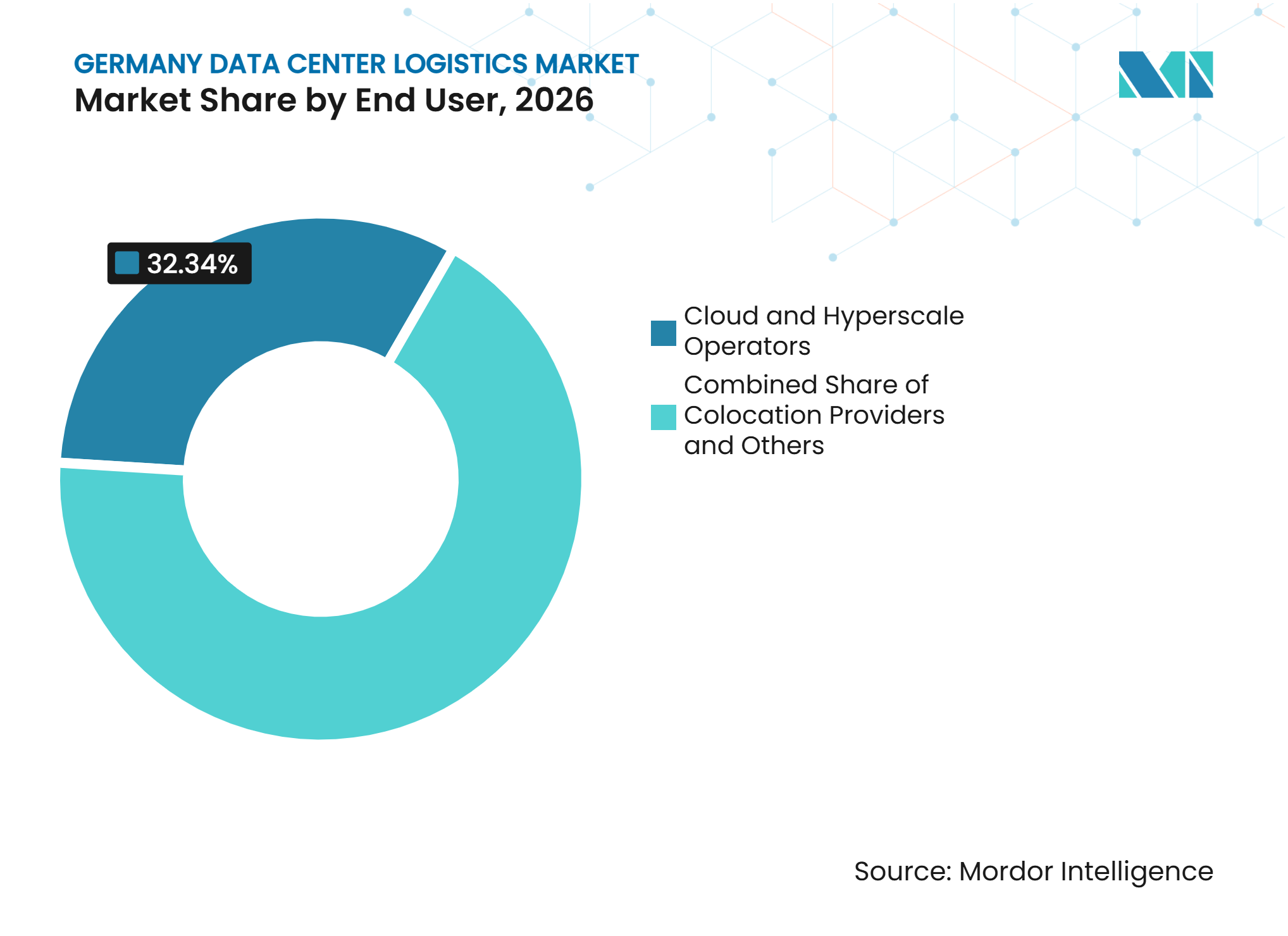
- By end user, cloud and hyperscale operators account for 32.34% of Germany's data center logistics market share in 2026 and are projected to register an 11.84% CAGR through 2032.
Note: Market numbers in this report are based on Mordor Intelligence's proprietary estimation framework, which combines nine months of actuals with Q4 projections for base year 2026.
Market Trends and Insights
Drivers Impact Analysis of Germany Data Center Logistics Market*
| Driver | (~) % Impact on CAGR Forecast | Geographic Relevance | Impact Timeline |
|---|---|---|---|
| Expansion of Hyperscale and AI Data Center Capacity | +2.5% | Frankfurt-Rhine/Main, Brandenburg, North Rhine-Westphalia | Short term (≤ 2 years) |
| Growth of Cloud, Colocation, and Hybrid IT Infrastructure | +1.5% | Frankfurt, Berlin, Munich, Hamburg | Medium term (2-4 years) |
| Demand for Secure Transport of High-Value Equipment | +0.9% | Global, concentrated in the Frankfurt-Rhine/Main corridor | Short term (≤ 2 years) |
| Coordinated Installation and Commissioning Logistics | +1.0% | Frankfurt and secondary German locations | Medium term (2-4 years) |
| Expansion of Secondary German Data Center Locations | +0.8% | Berlin, Munich, Hamburg, Cologne/Düsseldorf, Nuremberg, Stuttgart | Medium term (2-4 years) |
| Energy-Efficient and Circular Logistics Requirements | +0.5% | National, with high activity near Frankfurt and North Rhine-Westphalia | Long term (≥ 4 years) |
| Source: Mordor Intelligence | |||
Hyperscale and AI Buildout Accelerates Logistics Complexity at Every Stage
Germany formalized a strategy in March 2026 to at least double domestic data center capacity and quadruple AI-specific computing infrastructure by 2030. The program includes land designation, faster reviews, and municipal tax reforms intended to support investment. The resulting projects are advancing in parallel across Hesse, Brandenburg, and North Rhine-Westphalia, rather than following a sequential build cycle. Hesse has 2,000 MW under construction, while Brandenburg has 1,301 MW under construction, which increases the need for coordinated inbound flows of servers, switchgear, and liquid-cooling equipment[1]. AI clusters can require up to 12,000 point-to-point cable connections within 2-week installation periods, so shipment errors and rack configuration errors can disrupt expensive construction schedules.
Cloud, Colocation, and Hybrid IT Drive Recurrent Maintenance Logistics
Germany’s colocation capacity grew 17.5% in 2025 as hyperscalers absorbed wholesale space to extend cloud regions. This demand creates recurring hardware refresh, spare-parts, and upgrade work rather than only one-time construction deliveries. Many critical components require delivery within 2 to 4 hours, which gives forward stocking locations greater commercial importance. DHL Supply Chain cites more than 1,800 forward stocking locations and 24/7 control towers across over 55 countries for its data center logistics service network. Maintenance contracts can produce steadier multi-year revenue than construction-only assignments because the installed base requires repeated servicing. As hybrid IT expands, enterprise facilities that were previously managed internally may become additional customers for external technical logistics providers.
Coordinated Installation Logistics Become a Competitive Differentiator
Data center projects increasingly require logistics teams to work beyond the loading dock and into the equipment aisle. The work includes unpacking, in-aisle positioning, cabling preparation, and removal of packaging for recycling under controlled site-access and safety procedures. Kuehne+Nagel’s Secure Cloud Deployment service includes the delivery of server racks to assigned aisle positions through trained deployment teams. DHL reported that 85% of data center operators prefer one end-to-end logistics partner, supporting integrated offers that join transport, warehousing, staging, and installation. ISO 45001 certification is important for providers performing work at hyperscaler campuses because the sites apply strict occupational safety requirements. These conditions raise the importance of trained teams and create a higher entry barrier for conventional freight providers in the German data center logistics market.
Secondary German Markets Create New Last-Mile Logistics Corridors
Capacity demand is moving beyond Frankfurt toward Berlin, Munich, Cologne/Düsseldorf, Hamburg, Stuttgart, and Nuremberg as power constraints limit new connections in the Rhine-Main region. This transition creates a need for local technical teams and specialized staging space in cities with less mature data center supply chains. Arvato opened a 10,000 m² high-tech logistics center in Frankfurt to support the Frankfurt cluster and related delivery corridors, including routes to Berlin and Munich[2]. Equipment from Asian manufacturing hubs commonly enters through Frankfurt Airport before traveling by road to projects in Berlin or Munich. This air-to-road pattern can shorten lead times for equipment that is needed for active fit-out programs. Providers that pre-position warehousing and qualified staff outside Frankfurt can use this shift to develop new last-mile service coverage.
Restraints Impact Analysis of Germany Data Center Logistics Market*
| Restraint | (~) % Impact on CAGR Forecast | Geographic Relevance | Impact Timeline |
|---|---|---|---|
| Grid-Connection Delays and Power Availability Constraints | -1.4% | Frankfurt, Berlin, North Rhine-Westphalia, and other German clusters | Long term (≥ 4 years) |
| Skilled Labor Shortages in Technical Logistics and Installation | -0.8% | National, with high pressure in Frankfurt, Berlin, and Munich | Medium term (2-4 years) |
| Limited Specialized Warehousing Near Frankfurt | -0.4% | Frankfurt-Rhine/Main, with early pressure in Berlin and Munich | Medium term (2-4 years) |
| EnEfG Compliance Increases Retrofit and Handling Complexity | -0.3% | National, with the highest effect on operators of pre-2026 facilities | Medium term (2-4 years) |
| Source: Mordor Intelligence | |||
Grid-Connection Bottlenecks Constrain the Pace of New Logistics Demand
Germany’s 4 transmission system operators received grid connection applications totaling 270 GW at the end of Q3 2025[3]. This backlog limits the availability of high-voltage capacity for new data center projects in major locations. Syna received 800 MW of new capacity requests in the Frankfurt area during the first half of 2026, a volume comparable to Frankfurt’s peak electricity load. Equipment can be delivered to a completed site before it can be energized, requiring costly staged storage for months or years. The Reifegradverfahren, which took effect in April 2026, replaced first-come, first-served allocation with a readiness-based method. The procedure may reduce stranded logistics activity over time, although core locations are still likely to face delayed new capacity.
Skilled Labor Shortages Constrain Technical Logistics Capacity
The OECD identified labor shortages as a structural barrier for investment-intensive German sectors, including construction, engineering, and technical operations. These constraints affect the pool of workers available for warehouse work, rack assembly, electrical testing, fiber installation, and controlled-environment equipment handling. Qualified staff availability is also a leading operational concern for data center operators. Providers that retain certified technical teams can avoid repeated recruitment and training costs. This can support pricing discipline while limiting the speed at which the Germany data center logistics market can add specialized capacity.
*Our forecasts treat driver/restraint impacts as directional, not additive. The impact forecasts reflect baseline growth, mix effects, and variable interactions.
Germany Data Center Logistics Market Segment Analysis
By Logistics Function:
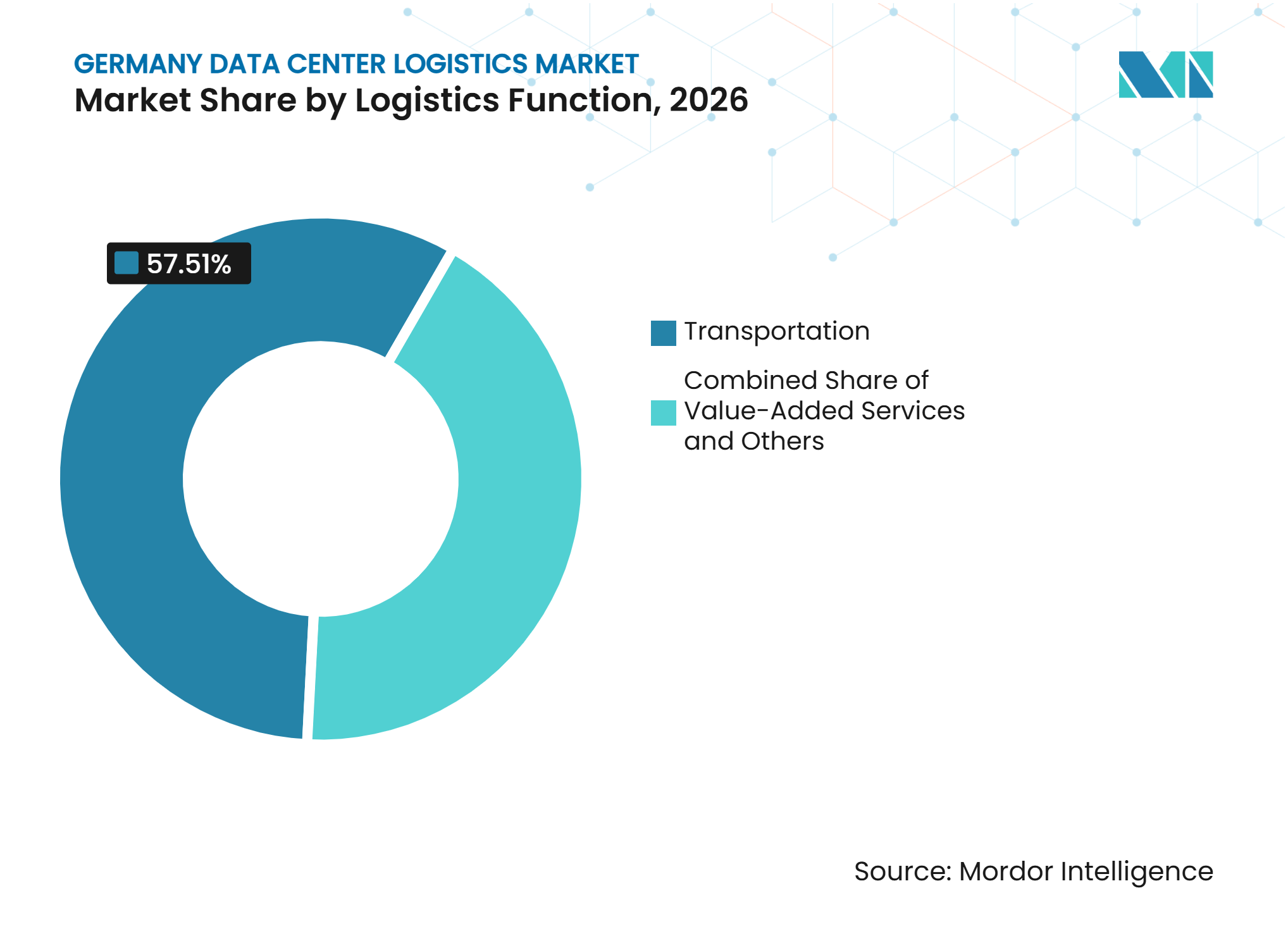
Value-Added Services Outpace Traditional TransportationTransportation accounts for 57.51% of the Germany data center logistics market share in 2026 because equipment needs to move between manufacturing hubs, secure warehouses, and active project sites. Road-based freight supports much of this activity because it can reach construction sites and regional data center locations directly. Air freight is important for time-sensitive AI accelerators and server racks that enter Germany on compressed deployment schedules. Warehousing and storage is expanding as providers add secure, temperature-controlled facilities near major data center clusters.
Value-added services have the highest projected CAGR of 10.83% through 2032, reflecting demand for staging, rack pre-configuration, software loading, thermal conditioning, and reverse logistics. These activities move work from live construction floors into controlled environments where providers can improve sequence control and reduce installation risk. Kuehne+Nagel manages 3.3 million ft² of warehouse space dedicated to hyperscaler activity within its integrated network. Reverse logistics is becoming more relevant as decommissioned hardware needs collection, data erasure, refurbishment, or recycling. Germany’s National Circular Economy Strategy and the Energy Efficiency Act strengthen the need for controlled end-of-life processes. The shift toward pre-staging also allows hyperscalers to reduce congestion inside active sites. Transportation is expected to remain essential, but higher-value work is increasingly located in secure warehouses and at the installation point.



By Transportation Mode:
Air Freight Outpaces Road on AI-Driven UrgencyRoad transport accounts for 52.38% of the Germany data center logistics market share in 2026, supported by Germany’s motorway network and short routes between logistics hubs and project locations. It is well suited to bulky mechanical equipment and controlled deliveries to sites across the country. Road carriers use air-ride vehicles, shock monitoring, tilt monitoring, and real-time tracking to manage sensitive IT infrastructure. The Germany data center logistics market for road activity benefits from links with manufacturing centers in the Netherlands, Belgium, and the Czech Republic.
Air freight is the fastest-growing mode with an 11.18% CAGR through 2032 because hyperscalers require AI hardware from Asian suppliers on short lead times. This requirement makes air transport more useful for GPUs, custom accelerators, and high-value servers than ocean freight for selected deployments. Kuehne+Nagel handled 2.2 million tons of air freight in 2025, with volumes rising 7% from the prior year. The company identified strong cloud and data center customer demand in its air freight activity. Rail, sea, and inland waterways retain a role for generators, transformers, chillers, and other heavy electrical equipment. Rhine barge and rail routes can move these products toward staging locations without relying entirely on long-distance trucking.
By Devices:
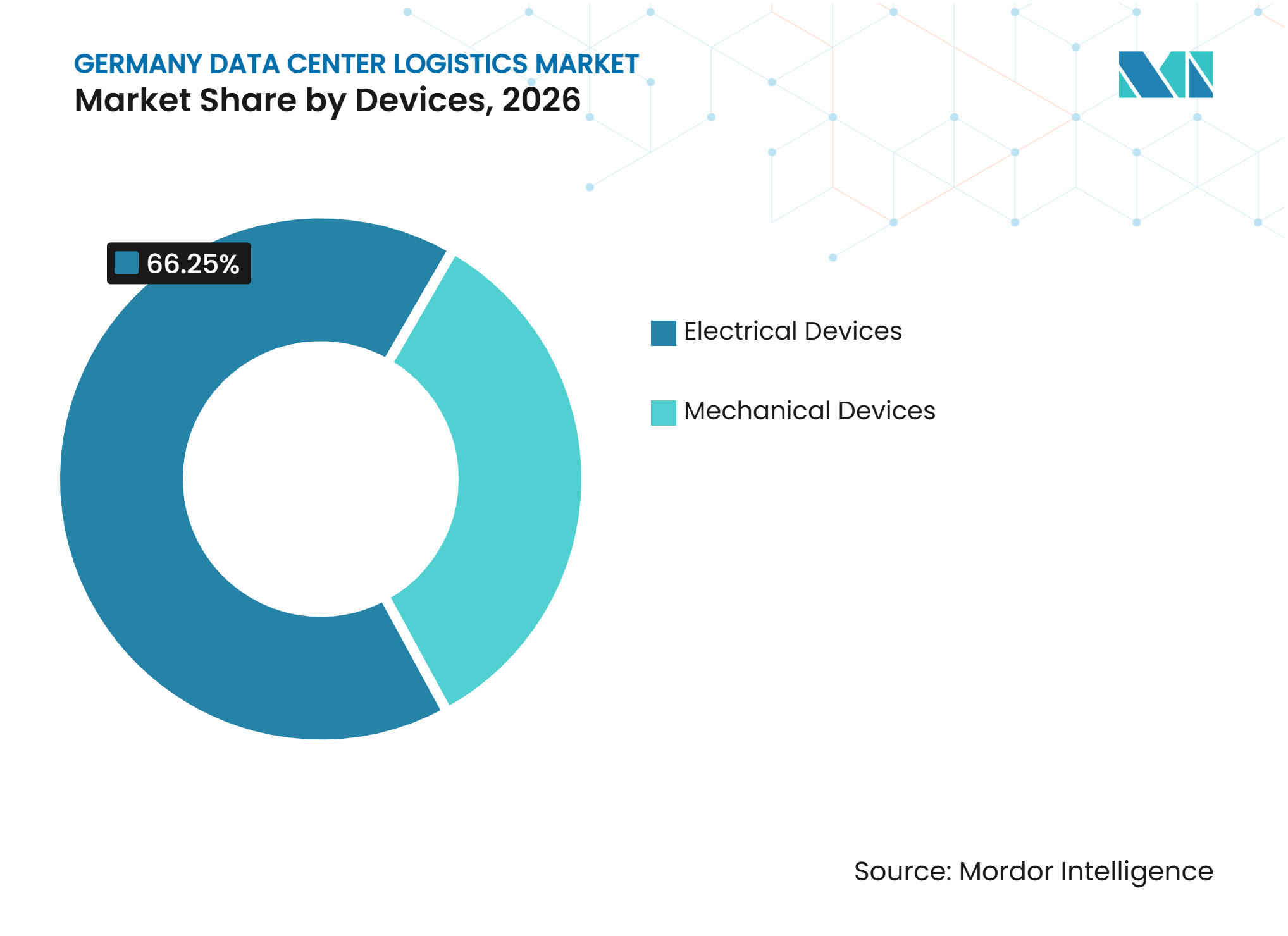
Electrical Devices Lead, Mechanical Devices Scale on Cooling DemandElectrical devices account for 66.25% of Germany's data center logistics market size in 2026, reflecting the high volume of servers, storage equipment, UPS systems, and other electrical infrastructure used in hyperscale development. These products require vibration-isolated transport, controlled staging, and serialized chain-of-custody records. Server racks can weigh several hundred kilograms, so loading and positioning require specialist equipment and trained crews. UPS units add substantial revenue per shipment because of their size, weight, and security requirements.
Mechanical devices are forecast to register a 10.76% CAGR through 2032 as AI facilities deploy more advanced cooling systems. The segment includes cooling systems, racks, and other physical infrastructure that supports dense computing environments. AI clusters use 40-100 kW per rack, compared with 5-15 kW for conventional racks. This shift makes conventional CRAC cooling insufficient for many new high-density deployments and increases demand for liquid-cooling systems. Direct-to-chip and immersion systems require careful hydraulic handling and pressurized testing before energization. Schneider Electric presented its RapidScale Modular Data Center Reference Design 115 in May 2026 with an emphasis on simpler site logistics and faster commissioning. The German data center logistics industry needs to, therefore, support both high shipment volumes for electrical devices and increasingly specialized movement of cooling equipment. This combination favors operators that can coordinate different handling requirements within a single project plan.

By Data Center Size:
Large Campuses Anchor Revenue, Edge Sites Drive GrowthLarge-scale data centers account for 64.17% of the Germany data center logistics market size in 2026. These facilities are usually above 5 MW of IT load and require multi-wave equipment programs over months. Germany’s 100 largest data centers, each above 5 MW, accounted for 52% of national capacity in 2025[4]. Their delivery programs cover the period from first equipment arrivals to full commissioning. Large campuses create high contract values, but their work requires precise scheduling across many vendors. The concentration of equipment in these facilities also increases the need for secure transport and certified installation procedures.
Small and medium-scale data centers are forecast to expand at a 10.70% CAGR through 2032. Demand comes from edge computing, municipal smart-city programs, and manufacturing companies that retain on-premises hybrid IT. Smaller facilities require agile urban deliveries and rapid replacement of service parts rather than large first-fitout shipments. Tight service-level commitments can produce higher margins per shipment for specialist providers. Bitkom’s BlueBook 2.0 work aims to extend cluster planning beyond Frankfurt, which may help medium-scale development in regional locations.
By End User:
Cloud and Hyperscale Operators Drive Both Volume and ValueCloud and hyperscale operators account for 32.34% of Germany's data center logistics market share in 2026 and have the highest projected CAGR at 11.84% through 2032. This combination makes the segment the principal volume and growth driver in the Germany data center logistics market. Google committed EUR 5.5 billion (USD 5.9 billion) for German data centers and offices through 2029, including activity in Dietzenbach and Hanau. These programs require coordinated movement of servers, electrical systems, and cooling infrastructure. The segment also needs ongoing hardware refresh and spare-parts logistics after a facility begins operating.
Colocation providers form the next major customer group and benefited from 17.5% capacity growth in 2025. BFSI and government and defense customers have different requirements because they require high-security transport, traceability, and controlled handling. The Bundesamt für Sicherheit in der Informationstechnik influences security expectations for sensitive infrastructure and data-related operations. IT and telecommunications, healthcare, and content/media/digital services provide additional demand, especially as regional facilities develop. These users support a wider mix of shipment profiles, from new equipment deployment to secure returns and component replacements.
Geography Analysis
Frankfurt/Rhine-Main accounts for more than one-third of German data center capacity and is the largest concentration of data center logistics activity in continental Europe. The German data center logistics market share in the region is supported by Frankfurt Airport, the Rhine-Main motorway network, and DE-CIX, which supports air-to-road equipment flows. These links are particularly important for high-value hardware that arrives from Asian manufacturing hubs. Power availability is tighter than in several competing locations, which makes phased fit-outs and careful timing more important. Arvato’s purchase of ATC and its 10,000 m² Frankfurt site show the value placed on secure technical handling capacity in this cluster. EnEfG compliance also increases demand for controlled hardware handling and end-of-life processes near the largest installed base.
North Rhine-Westphalia is receiving a large share of investment outside Hesse, including Microsoft activity in Grevenbroich, a 200 MW Blackstone-backed campus in the Lippe region, and a 30 MVA project in Bergheim near Cologne. The Rhine corridor supports inland-waterway movement of chillers, transformers, and generator sets that are difficult to move over long distances by road. This gives barge transport a role that is less important in the Frankfurt cluster. Brandenburg is developing large facilities for the AWS European Sovereign Cloud, whose first region launched in January 2026. Routes from Frankfurt to Brandenburg can add 300-400 km to deliveries, increasing schedule risk for just-in-time equipment programs. Providers with dedicated fleets and regional operating capacity can limit reliance on spot-market hauling. These projects also show why national grid allocation rules and local site readiness have a direct effect on logistics planning.
Berlin has a long-term pipeline that includes maincubes’ BER02 at 186 MW of IT load, the Marienpark Virtus campus at 57.6 MW, and Vantage Data Centers’ Berlin I facility, which became operational in October 2026. Permitting has been slow, even where operators have banked sites, so project scheduling remains important. Munich is also developing AI infrastructure, including a Deutsche Telekom and NVIDIA project with up to 10,000 Blackwell GPUs and the 17 MW DCMUC1 development. Hamburg, Nuremberg, and Dusseldorf are attracting enterprise and financial-sector demand, while Hamburg also supports a specialized chemicals corridor connected to semiconductor supply chains. These locations require providers to extend warehousing, trained staff, and secure last-mile coverage beyond the Rhine-Main hub.
Competitive Landscape
Market Concentration
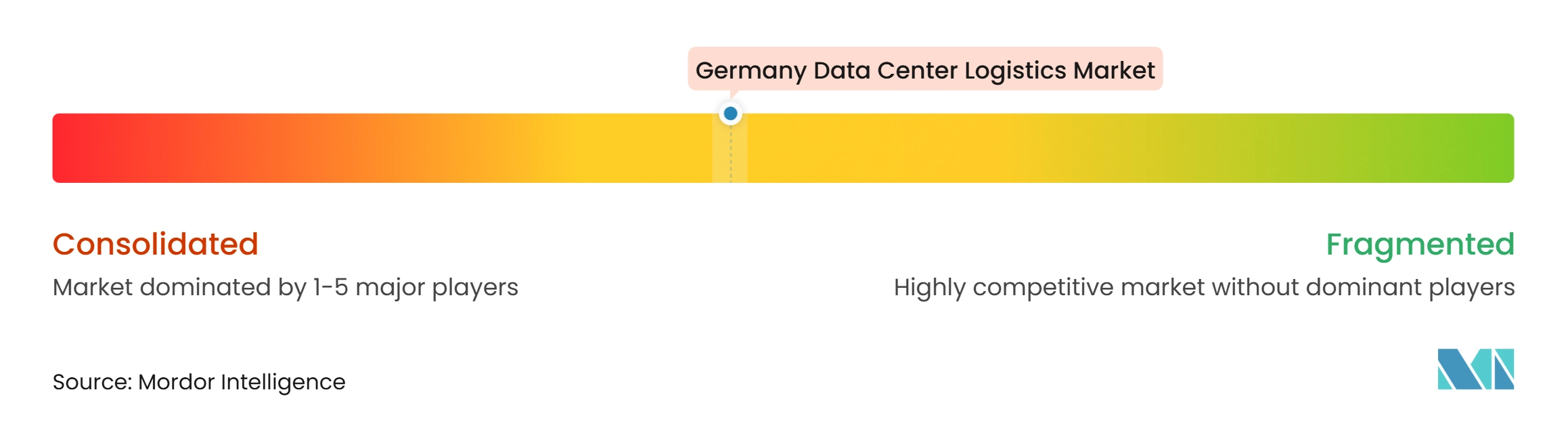
The Germany data center logistics market is moderately consolidated. DHL Group, Kuehne+Nagel, and DSV manage a large share of high-volume hyperscaler transport. DHL offers data center logistics through forward stocking, control towers, secure warehousing, and deployment support. Kuehne+Nagel combines global freight operations with secure deployment work for cloud infrastructure. DSV completed its acquisition of DB Schenker in April 2025 for EUR 14.3 billion (USD 15.6 billion), which expanded the group’s scale in freight forwarding and contract logistics.
Vertical integration is changing competitive behavior because large providers are building warehousing, staging, and on-site installation capabilities rather than subcontracting all technical work. Arvato completed its acquisition of ATC Computer Transport & Logistics in January 2025, combining ATC’s technical delivery services with a broader supply-chain network. Rhenus High Tech uses server-courier teams and specialist vehicles fitted with GPS, air-ride suspension, and hydraulic lifts for complex deployments. Kuehne+Nagel’s long-term agreement with Amazon covers end-to-end supply chain services for global data center infrastructure and includes a 7-year option to purchase company shares after commercial milestones. These moves support longer contracts and raise the operational threshold for local freight providers. The Germany data center logistics market is, therefore, shaped by the ability to offer secure handling, global capacity, and project accountability together.
Technology has become another basis for supplier selection. Real-time shock and tilt sensors, IoT-enabled chain-of-custody systems, and asset tracking can reduce the risk of damaged or misplaced equipment. GXO introduced an off-site rack assembly and wiring approach that moves work from active construction zones to warehouse environments and can reduce commissioning time to 30 days per facility. GEODIS expanded TAPA Facility Security Requirements Level C certification to 5 additional European sites, including centers in Cologne, Rodgau, and Aurach, covering 50% of its German network. Circular services such as WEEE collection, data-secure hardware remarketing, and handling of waste-heat recovery equipment are also becoming more relevant under EnEfG and broader EU circular economy requirements.
Germany Data Center Logistics Industry Leaders
-
DHL Group
-
DSV
-
Kuehne+Nagel
-
GXO Logistics
-
GEODIS
- *Disclaimer: Major Players sorted in no particular order
Germany Data Center Logistics Market Companies Covered in this Report
- DHL Group
- DSV
- Arvato
- ATC Computer Transport and Logistics GmbH
- Kuehne+Nagel
- GEODIS
- Rhenus High Tech
- SCHOLPP GmbH
- Dachser
- GXO Logistics, Inc.
- Expeditors International of Washington, Inc.
- DP World
- Logistics Plus Inc.
- Datalog Spedition GmbH
- CCS-Express GmbH
- ITL logistics GmbH
- Transall Spedition GmbH
- hasenkamp Holding GmbH
- P.O.C. GmbH
- Hellmann Worldwide Logistics
Recent Industry Developments in Germany Data Center Logistics Market
- July 2026: DHL Supply Chain completed the development and handover of its new 26,600 m² logistics centre in Rheinbach, Germany. The carbon-neutral facility offers modular warehousing, automated fulfilment capabilities, and multimodal connectivity, strengthening DHL's logistics infrastructure in Germany.
- May 2026: Schneider Electric presented its RapidScale Modular Data Center Reference Design 115 at Data Centre World Frankfurt. The design uses an 800 VDC power architecture co-developed with NVIDIA, an AI-assisted supply-chain tool, and gasless switchgear to simplify logistics and accelerate AI infrastructure commissioning.
- March 2026: DHL Supply Chain announced 10 dedicated North American data center logistics warehouse sites totaling more than 650,000 m². The facilities are designed for hyperscale and colocation operators with white-glove handling, rack pre-configuration, and specialized warehouse-to-site transport.
- April 2025: DSV completed its EUR 14.3 billion (USD 15.6 billion), all-cash acquisition of DB Schenker from Deutsche Bahn. The combined company has approximately 160,000 employees across 90 countries and is integrating a Technology vertical that includes AI and data center logistics as a priority commercial segment.
Germany Data Center Logistics Market Report Scope
Segmentation Overview
| Transportation | Road |
| Rail | |
| Sea and Inland Waterways | |
| Air | |
| Warehousing and Storage | |
| Value-Added Services |
| Electrical Devices | UPS Systems |
| Servers and Storage Devices | |
| Other Electrical Infrastructure | |
| Mechanical Devices | Cooling Systems |
| Racks | |
| Other Mechanical Infrastructure |
| Small and Medium-Scale Data Centers |
| Large-Scale Data Centers |
| Cloud and Hyperscale Operators |
| Colocation Providers |
| IT and Telecommunications Companies |
| Banking, Financial Services and Insurance (BFSI) |
| Government and Defense |
| Healthcare |
| Content, Media and Digital Services |
| Other End Users |
| By Logistics Function | Transportation | Road |
| Rail | ||
| Sea and Inland Waterways | ||
| Air | ||
| Warehousing and Storage | ||
| Value-Added Services | ||
| By Devices | Electrical Devices | UPS Systems |
| Servers and Storage Devices | ||
| Other Electrical Infrastructure | ||
| Mechanical Devices | Cooling Systems | |
| Racks | ||
| Other Mechanical Infrastructure | ||
| By Data Center Size | Small and Medium-Scale Data Centers | |
| Large-Scale Data Centers | ||
| By End User | Cloud and Hyperscale Operators | |
| Colocation Providers | ||
| IT and Telecommunications Companies | ||
| Banking, Financial Services and Insurance (BFSI) | ||
| Government and Defense | ||
| Healthcare | ||
| Content, Media and Digital Services | ||
| Other End Users | ||
Key Questions Answered in the Report
What is the forecast growth rate for Germany data center logistics?
The Germany data center logistics market is forecast to register an 8.89% CAGR from 2027 to 2032, reaching USD 3.49 billion by 2032.
Which logistics function generates the largest share of revenue?
Transportation accounts for 57.51% of revenue in 2026, while value-added services have the highest forecast CAGR at 10.83% through 2032.
Why is air freight becoming more important for German data center projects?
Air freight is expected to register an 11.18% CAGR because AI accelerators and high-value servers often need faster delivery from Asian suppliers.
Which users create the most demand for data center logistics services?
Cloud and hyperscale operators account for 32.34% of revenue in 2026 and are forecast to grow at an 11.84% CAGR through 2032. Their large projects also create ongoing demand for hardware refreshes, spare parts, secure returns, and technical installation support.
What is limiting new data center development in Germany?
Grid connection delays and limited power availability are a major constraint, particularly in Frankfurt and other core clusters. Skilled labor shortages and a limited supply of specialized warehousing can also delay equipment handling and commissioning activity.
How are logistics providers adapting to AI data center deployment?
Providers are adding secure warehousing, rack staging, installation support, asset tracking, and reverse logistics to meet complex deployment requirements. These capabilities help customers coordinate high-value equipment from arrival through final placement and later replacement or recovery.