
Geotextiles and Civil Engineering Technical Textile Market Size and Share
Market Overview
| Study Period | 2021 - 2032 |
|---|---|
| Market Size (2027) | USD 3.96 Billion |
| Market Size (2032) | USD 5.30 Billion |
| Growth Rate (2027 - 2032) | 6.00 % |
| Fastest Growing Market | Middle East and Africa |
| Largest Market | Asia-Pacific |
| Market Concentration | Medium |
Major Players *Disclaimer: Major Players sorted in no particular order Image © Mordor Intelligence. Reuse requires attribution under CC BY 4.0. | |
Geotextiles and Civil Engineering Technical Textile Market Analysis by Mordor Intelligence
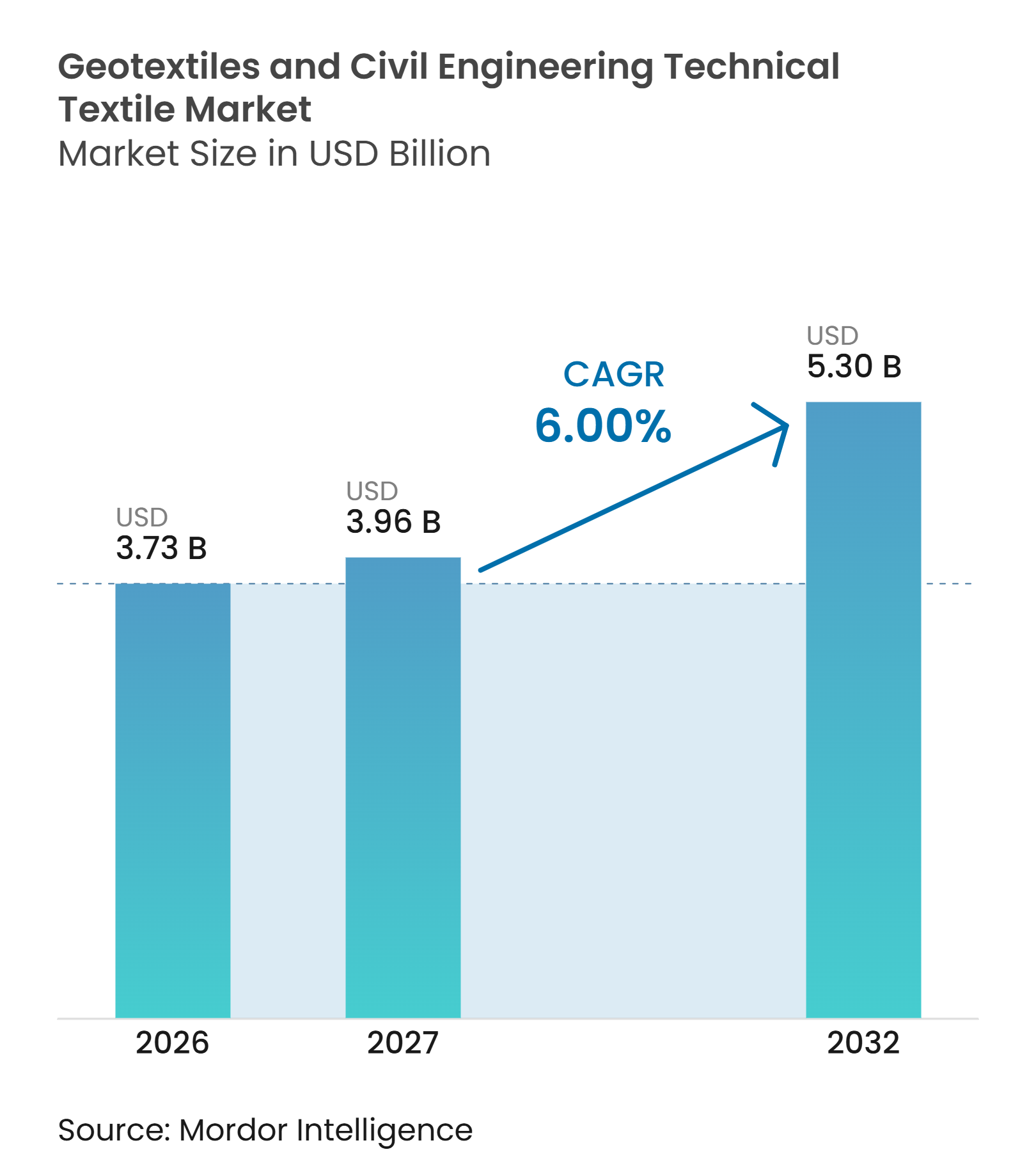
The Geotextiles And Civil Engineering Technical Textile Market size is expected to increase from USD 3.73 billion in 2026 to USD 3.96 billion in 2027 and reach USD 5.30 billion by 2032, growing at a CAGR of 6% over 2027-2032.
The geotextiles and civil engineering technical textile market is supported by public investment in roads, railways, and other transport assets, particularly where new construction also requires drainage, filtration, separation, and reinforcement materials. Climate adaptation is creating a second source of demand as operators address aging embankments, drainage channels, riverbanks, and coastal structures exposed to higher rainfall and flooding risks. Environmental containment rules are also widening the use of protective layers and drainage systems in waste and mining facilities. Suppliers are responding with broader product ranges, capacity expansion, application support, and products that can meet lifecycle documentation requirements. Procurement standards and resin-price swings remain important constraints because they can slow down qualifications or limit margins on fixed-price infrastructure contracts.
Key Report Takeaways
- By product type, nonwoven geotextiles held 38.5% of the geotextiles and civil engineering technical textile market in 2026, while textile-based geogrids are forecast to grow at a 7.5% CAGR through 2032.
- By material type, polypropylene held 42% of the geotextiles and civil engineering technical textile market size in 2026, while natural fibers are forecast to grow at a 7.8% CAGR through 2032.
- By end-use application, transportation infrastructure held a 36.5% share in 2026, while mining and energy infrastructure are forecast to grow at a 7.2% CAGR through 2032.
- By geography, Asia-Pacific held a 40.6% share in 2026, while the Middle East and Africa are forecast to grow at a 6.9% CAGR through 2032.
Note: Market numbers in this report are based on Mordor Intelligence's proprietary estimation framework, which combines nine months of actuals with Q4 projections for base year 2026.
Market Trends and Insights
Drivers Impact Analysis of Geotextiles and Civil Engineering Technical Textile Market*
| Driver | (~) % Impact on CAGR Forecast | Geographic Relevance | Impact Timeline |
|---|---|---|---|
| Expansion of Road, Highway and Railway Infrastructure Investments | +1.5% | Global, concentrated in Asia-Pacific and Middle East and Africa | Long term (≥ 4 years) |
| Increasing Adoption of Geotextiles for Soil Stabilization and Ground Reinforcement | +1.2% | Asia-Pacific, South America, Middle East and Africa | Medium term (2-4 years) |
| Rising Demand for Erosion Control and Climate-Resilient Infrastructure | +0.9% | Global, with urgency in South and Southeast Asia and South America | Medium term (2-4 years) |
| Growing Adoption of Geotextile-Based Drainage and Filtration Systems | +0.8% | North America, Europe, and Asia-Pacific | Short term (≤ 2 years) |
| Increasing Investment in Coastal Protection and Flood Management Infrastructure | +0.7% | Asia-Pacific coastal belt, North America, and Europe | Medium term (2-4 years) |
| Growing Demand for Geotextile Protection Layers in Waste Containment Facilities | +0.5% | Europe, North America, and Asia-Pacific | Long term (≥ 4 years) |
| Source: Mordor Intelligence | |||
Expansion of Road, Highway, and Railway Infrastructure Investments
Public investment in transport infrastructure remains a central source of demand for the geotextiles and civil engineering technical textile market. Inland transport infrastructure investment ranged from 0.1% to 3% of GDP across International Transport Forum member countries in 2025.[1] China maintained high investment under the Belt and Road Initiative, while 4 countries spent more than 2% of GDP on inland transport infrastructure. The Asian Transport Observatory projected USD 43 trillion in Asia-Pacific transport investment between 2020 and 2035, including USD 27 trillion for roads and USD 4.2 trillion for heavy rail. In the United States, the Federal Railroad Administration is deploying USD 102 billion in rail funding through fiscal year 2026, and it awarded USD 1.1 billion for 123 grade-crossing projects in 41 states in January 2025.[2] Rail trackbeds can create recurring demand because filtration fabrics require replacement during the asset life, rather than only during the initial capital program.
Increasing Adoption of Geotextiles for Soil Stabilization and Ground Reinforcement
Soil stabilization is extending from highway embankments to unpaved roads, haul roads, and airfield subgrades in the geotextiles and civil engineering technical textile market. A 2025 study found that nonwoven geotextile reinforcement increased the California Bearing Ratio of weak sandy subgrades from 3% to 14%.[3] This evidence supports the geotextiles and civil engineering technical textile market, where weak soils raise construction and maintenance requirements. ISO technical guidance continues to inform reinforcement design in jurisdictions that incorporate ISO standards into project specifications. Roads represented 32% of Africa’s total infrastructure investment requirement in the OECD’s 2025 assessment. Financing conditions that require geosynthetic design standards can move projects from informal soil and aggregate methods toward engineered reinforcement solutions.
Rising Demand for Erosion Control and Climate-Resilient Infrastructure
Higher rainfall intensity is expanding erosion-control needs beyond temporary slope protection in the geotextiles and civil engineering technical textile market. ISO/TR 18228-8:2026 provides design guidance for using geosynthetics in surface erosion control on slopes and riverbanks. A 2025 Scientific Reports study on Taiwan’s Keelung River found that reinforced-earth revetments with geotextiles achieved 13% higher vegetation coverage than gabion alternatives. The same research found stronger ecological outcomes and reduced peak flow depths under modeled extreme typhoon conditions. A 2025 geotechnical study reported a factor of safety of 1.790 for drainage-enabled geotextiles under rapid drawdown, compared with 1.439 for non-drainage geotextiles. Road and rail specifications that adopt ISO design methods can make these performance measures more relevant to future project selection.
Growing Adoption of Geotextile-Based Drainage and Filtration Systems
Drainage and filtration systems are replacing some aggregate-based solutions in roads, railways, and retaining walls. Network Rail published a 2025 framework valued at GBP 3.025 million (USD 4.08 million) for drainage materials that specified geotextile composites, geogrids, and geocomposites. Austroads issued its ATS-2255 Subsoil Drainage specification in January 2025 and updated its road drainage guidance in July 2025, both addressing geotextile-lined drainage practices. The New York State Department of Transportation updated its approved geotextile list in July 2025 to improve AASHTO M-288 compliance in public projects. A 2025 Transportation Research Record study found that wicking geotextiles can improve slope stability in flood-prone coastal highway applications. Within the geotextiles and civil engineering technical textile market, these specifications support a specialty category that combines drainage and reinforcement functions.
Restraints Impact Analysis of Geotextiles and Civil Engineering Technical Textile Market*
| Restraint | (~) % Impact on CAGR Forecast | Geographic Relevance | Impact Timeline |
|---|---|---|---|
| Volatility in Polypropylene and Polyester Raw Material Prices | -1.3% | Global, with a high effect on Europe and South Asia manufacturers | Short term (≤ 2 years) |
| Competition from Conventional Aggregates and Non-Textile Geosynthetics | -0.8% | Developing markets in the Middle East and Africa and South America, and mature North American markets | Medium term (2-4 years) |
| Stringent Product Qualification and Long-Term Performance Requirements | -0.6% | North America, Europe, Australia, and Gulf states | Long term (≥ 4 years) |
| Installation Damage and Long-Term Creep Performance Concerns | -0.4% | Global, with emphasis on high-load reinforcement in Asia-Pacific | Medium term (2-4 years) |
| Source: Mordor Intelligence | |||
Volatility in Polypropylene and Polyester Raw Material Prices
Polypropylene and polyester prices remained major cost variables for producers in 2025 and 2026. European polypropylene homopolymer prices were EUR 270 (USD 317.6) per metric ton below the prior-year level by August 2025. Propylene monomer prices fell by EUR 120 (USD 141.2) per metric ton over the same period, which placed pressure on producer margins. Middle East geopolitical escalation in mid-2025 also caused rapid changes in spot ethylene and propylene prices. Fixed-price public contracts can leave manufacturers unable to pass a resin-price increase through to buyers after a tender award. In the geotextiles and civil engineering technical textile market, smaller suppliers can face greater pressure because they may lack long-term resin contracts or vertically integrated fiber operations.
Competition from Conventional Aggregates and Qualification Requirements
Conventional aggregate and granular-fill systems compete with textile solutions where upfront cost receives more attention than lifecycle performance. Their immediate price advantage can be easier for public agencies to evaluate than reduced excavation, aggregate savings, or a longer pavement life. The International Transport Forum noted in 2025 that several developed economies spend less than 1% of GDP on new inland transport infrastructure. Maintenance-led programs can adopt newer composite systems slowly without application-specific performance evidence. Non-textile geosynthetics, including high-density polyethylene geogrids and geomembranes, also retain a place in reinforcement and containment specifications. In the geotextiles and civil engineering technical textile market, EN 13249 through EN 13253, AASHTO M-288, and European construction-product requirements raise testing, documentation, installation, durability, and long-term creep expectations.
*Our forecasts treat driver/restraint impacts as directional, not additive. The impact forecasts reflect baseline growth, mix effects, and variable interactions.
Geotextiles and Civil Engineering Technical Textile Market Segment Analysis
By Product Type:
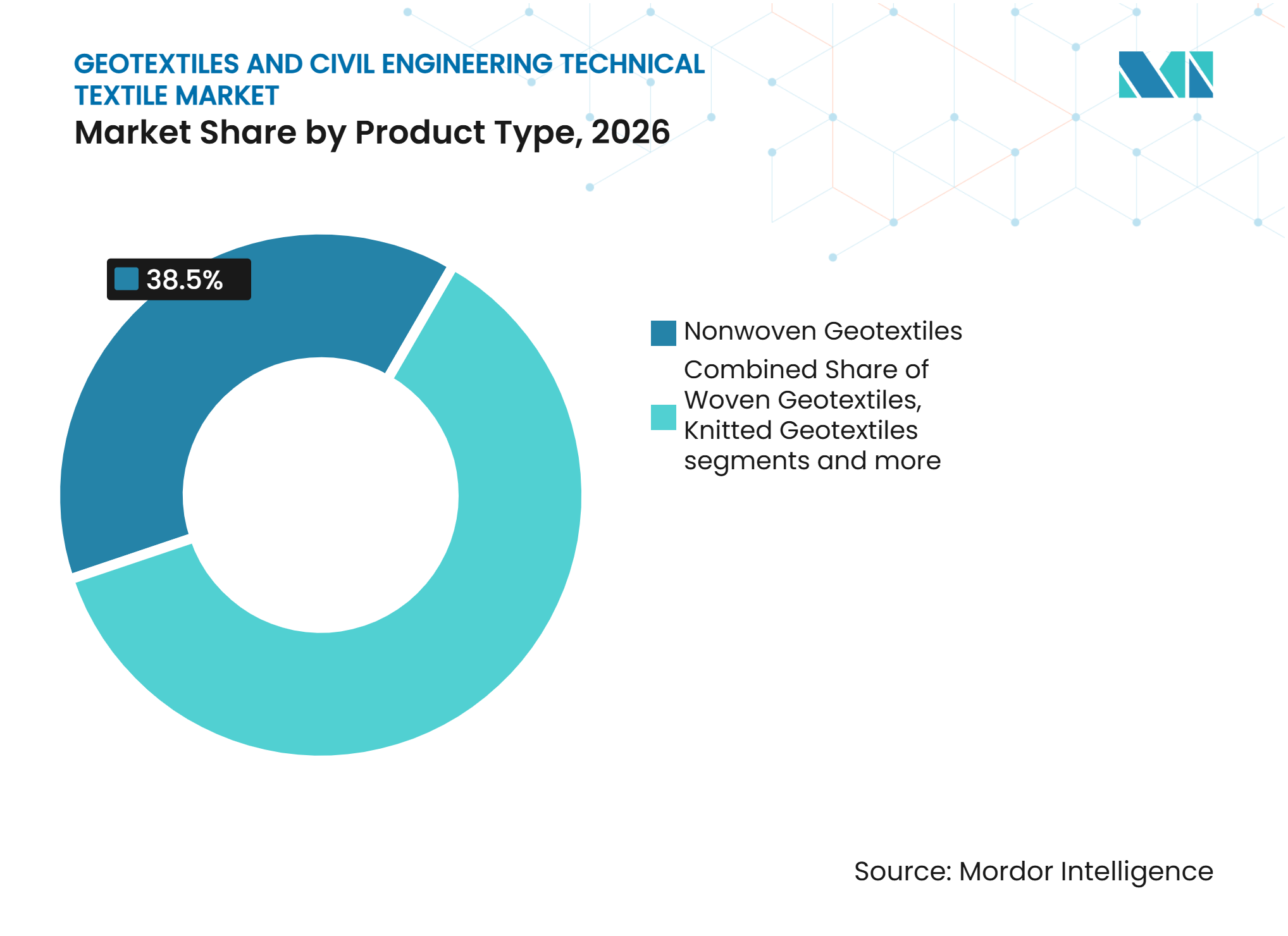
Nonwoven Geotextiles Lead While Textile-Based Geogrids Grow FastestNonwoven geotextiles accounted for 38.5% of the geotextiles and civil engineering technical textile market size in 2026. Their lead reflects established use in filtration, separation, and protection across roads, earthworks drainage, and environmental projects. A single nonwoven layer can perform separation and filtration functions, which supports specifications where installation simplicity and cost efficiency matter. The geotextiles and civil engineering technical textile industry relies on these products across a broad range of routine geotechnical applications. Textile-based geogrids are projected to grow at a 7.5% CAGR from 2027 to 2032. Their growth is tied to use in mechanically stabilized earth structures and pavement reinforcement across road and rail projects.
Woven geotextiles remain important for high-tensile reinforcement and separation applications because controlled aperture geometry supports more precise engineering performance. Within the geotextiles and civil engineering technical textile market, knitted geotextiles occupy a smaller specialist role in asphalt interlayer reinforcement. Geotextile-based geocomposites combine drainage cores with filter layers for retaining-wall drainage and tunnel waterproofing, replacing some aggregate packages and shortening installation time. ISO 10318-1:2026 updates terminology for geosynthetic product families, which can improve consistency in cross-border procurement.



By Material Type:
Polypropylene Holds the Cost Position While Natural Fibers Gain UsePolypropylene held 42% of the geotextiles and civil engineering technical textile market share in 2026. It benefits from cost competitiveness, chemical resistance, ultraviolet stabilization, and wide fiber manufacturing capacity across Asia, Europe, and the Americas. Polypropylene staple fiber and spunbond production is well established in needle-punched nonwoven geotextiles. This footprint supports supply resilience relative to less widely available alternatives. Within the geotextiles and civil engineering technical textile market, polyester is a significant secondary material in high-strength woven geotextiles and geogrids. Its higher modulus and lower creep under sustained loading suit long-term reinforcement designs.
Natural fibers are expected to grow at a 7.8% CAGR from 2027 to 2032 in the geotextiles and civil engineering technical textile market. Coir, jute, and related plant-based materials are used where biodegradable erosion control and revegetation outcomes are required. A 2025 review found that coir’s higher lignin content can provide greater durability than many natural fibers, with medium-term erosion-control uses spanning 18 to 36 months. A 2025 study found that a single resin treatment extended mechanical viability to 120 days under ultraviolet exposure, rain, and microbial conditions, while polyethylene and polyamide retain roles in drainage composites and high-abrasion applications.
By End-Use Application:
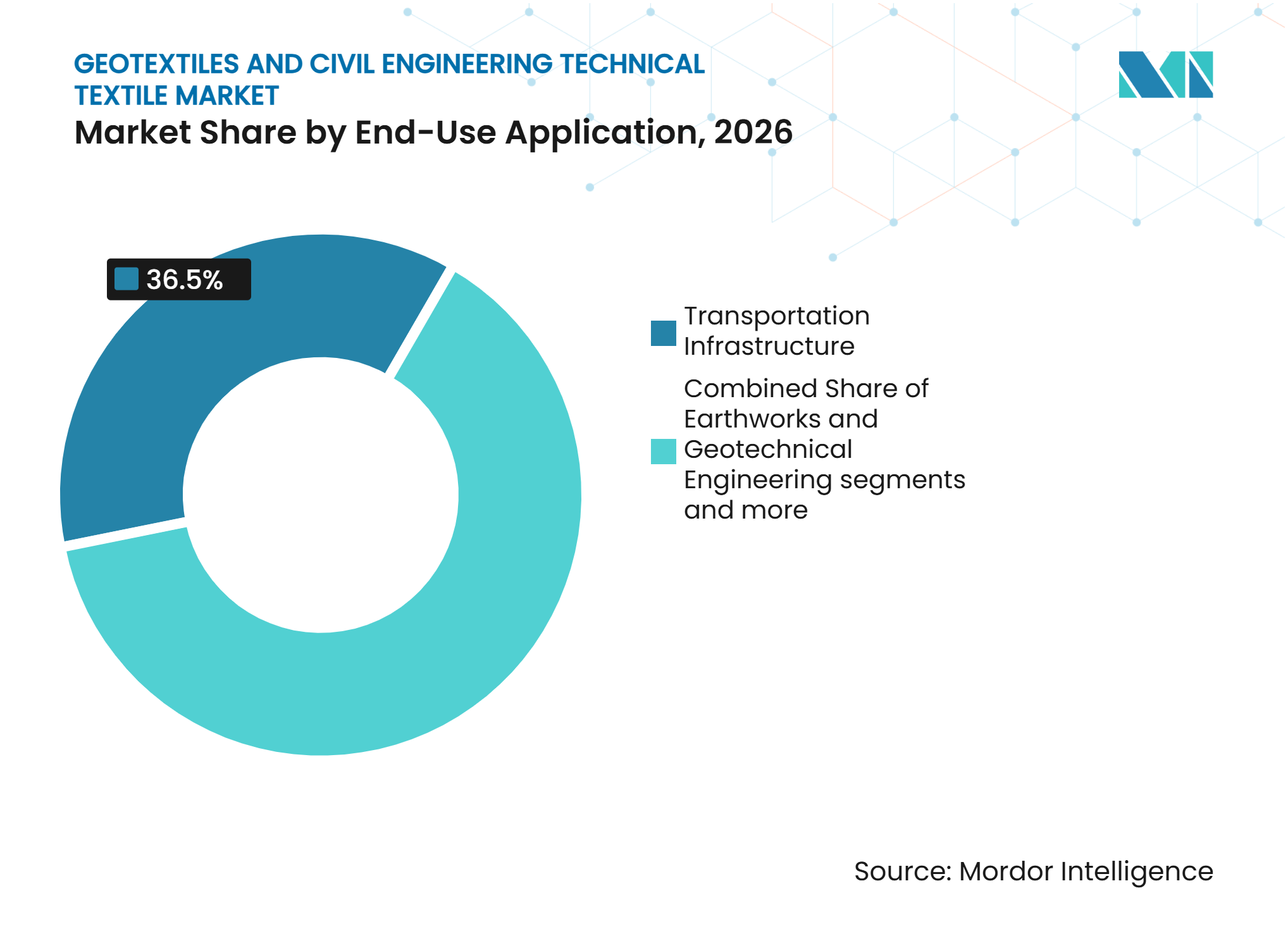
Transportation Anchors Demand While Mining and Energy Grow FasterTransportation infrastructure represented 36.5% of the geotextiles and civil engineering technical textile market size in 2026. Roads use these materials for subgrade separation, aggregate-base filtration, and slope erosion protection. Railways require filtration and separation at the subgrade-ballast interface, where performance specifications are demanding. EN 13250 provides requirements for railway geotextile applications and is used as a reference by national rail authorities in several European markets. Airports and airfields represent a smaller application, but their high loads can support use of woven materials with verified hydraulic and separation performance. The geotextiles and civil engineering technical textile industry therefore depends on transport volume while serving a range of technically distinct assets.
Mining and energy infrastructure is forecast to grow at a 7.2% CAGR from 2027 to 2032. In the geotextiles and civil engineering technical textile market, tailings facilities supporting copper, lithium, and gold production use protective cushion layers above geomembranes, drainage geocomposites, and erosion-control materials. More than 900,000 square meters of bituminous geosynthetic material were deployed at the Talison Lithium Greenbushes facility in Western Australia during 2024 and 2025, showing the material intensity of large mining earthworks. Earthworks, water and coastal infrastructure, and waste containment remain stable demand areas, and landfill standards can require protective layers within multicomponent barrier systems.

Geography Analysis
Asia-Pacific held 40.6% of the geotextiles and civil engineering technical textile market share in 2026. China’s road and rail programs, India’s highway and freight corridors, and Southeast Asia’s urban infrastructure programs support regional demand. The Asian Transport Observatory projected USD 43 trillion in regional transport investment from 2020 to 2035. That total includes USD 27 trillion for roads and USD 4.2 trillion for heavy rail.
North America and Europe are led by highly specification-driven demand in the geotextiles and civil engineering technical textile market. The United States rail program is deploying USD 102 billion through fiscal year 2026. New York tightened its approved geotextile list in July 2025 through its AASHTO M-288 compliance process. European procurement is influenced by recovery funding and requirements for lifecycle documentation under the revised Construction Products Regulation. Italy directed EUR 25.4 billion (USD 29.9 billion) to high-speed rail under NextGenerationEU, supporting trackbed demand through 2026.
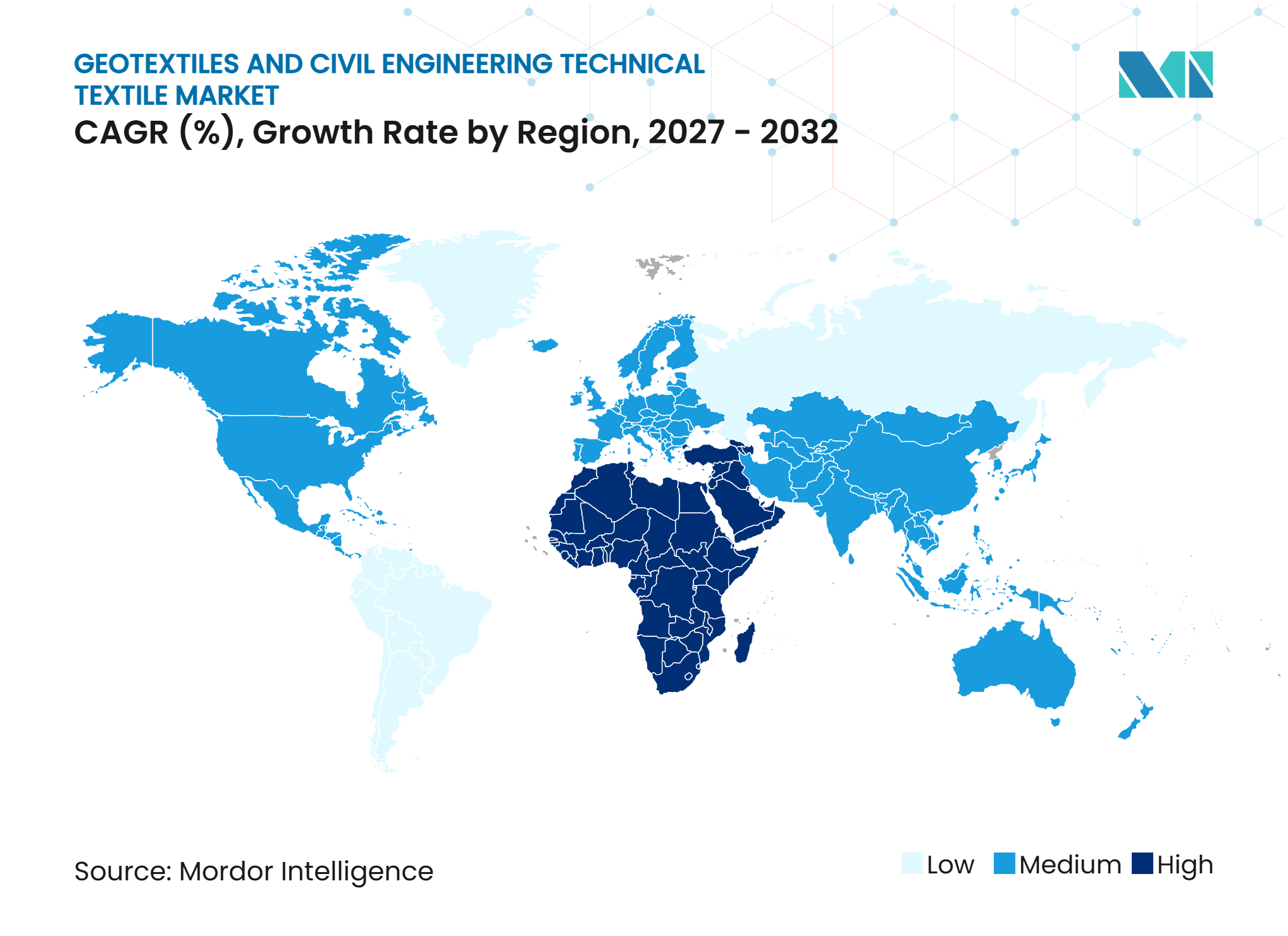
The Middle East and Africa is expected to record the highest regional CAGR at 6.9% through 2032 in the geotextiles and civil engineering technical textile market. Gulf infrastructure programs and Africa’s road funding requirements provide the main support, with roads accounting for 32% of the continent’s infrastructure investment needs. India’s Kerala government allocated funding for geobag seawall construction in 2025 in response to coastal erosion. South America receives steady demand from road and mining activity, led by Brazil and Chile. Brazil’s São Paulo municipality issued a geotextile drainage tender to NBR 21138 in 2025, while Chile’s copper sector supports tailings-facility demand.
Competitive Landscape
Market Concentration
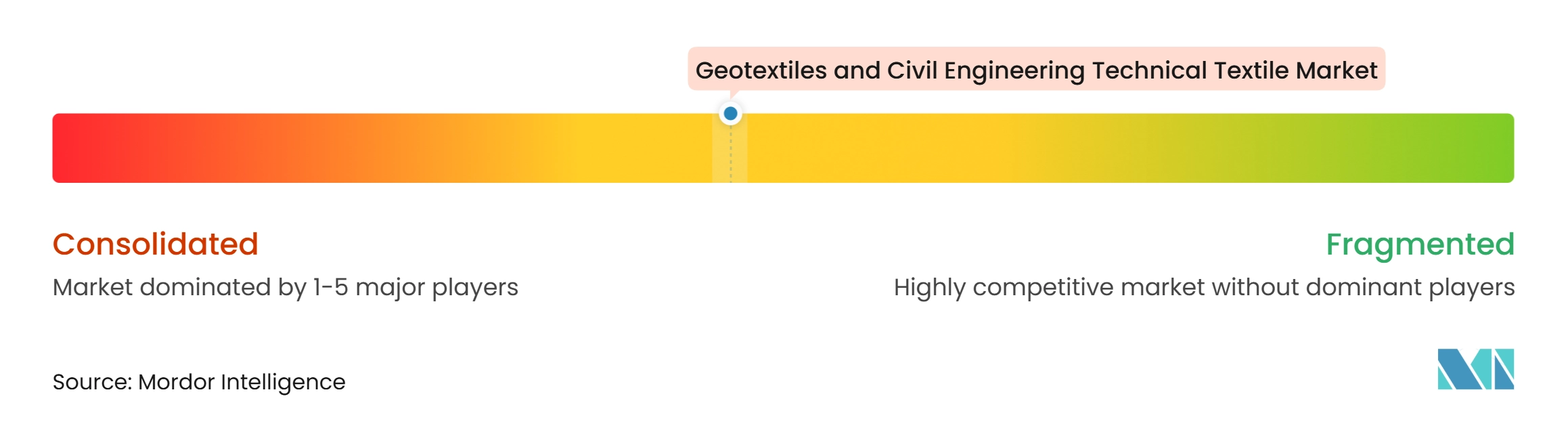
The geotextiles and civil engineering technical textile market exhibits a medium level of market concentration. Solmax, HUESKER Synthetic GmbH, Naue GmbH & Co. KG, and Officine Maccaferri hold leading positions through manufacturing scale, broad portfolios, and access to infrastructure specifications. Larger producers combine product breadth with application engineering and established certification credentials. Regional specialists compete through local approval, technical service, and knowledge of local project requirements.
Solmax consolidated its Americas manufacturing footprint in September 2025 to concentrate production in larger, more advanced facilities. In May 2026, the company began construction of an 8-hectare European center in Les Mureaux, France, to consolidate nonwoven operations from Linz and Bezons. Across the geotextiles and civil engineering technical textile market, HUESKER reopened NaBento production in Dülmen, acquired Sineco International, and extended its Dülmen facilities during 2025. It also introduced the Fortrac eco geogrid, which uses recycled materials and is rated for 100-year reinforcement applications. The company’s Tektoseal Active PFAS geocomposite targets contaminated-site drainage and aligns product development with environmental documentation demands.
TechFab India received AASHTO PEAS acceptance for its TechGrid geogrid in April 2025 and opened its 7th manufacturing facility in 2026. Solmax launched InfraSolve in 2025, a web-based tool for roadway stabilization and drainage design. In the geotextiles and civil engineering technical textile market, these steps show how manufacturing scale, product documentation, and specification support can reinforce each other. Kaytech Engineered Fabrics and ACE Geosynthetics maintain positions through local certification while expanding selectively. Fibertex Nonwovens A/S, Thrace Group, and Freudenberg Performance Materials pursue differentiation to limit commoditization pressure.
Geotextiles and Civil Engineering Technical Textile Industry Leaders
-
Solmax
-
HUESKER Synthetic GmbH
-
Naue GmbH & Co. KG
-
Officine Maccaferri S.p.A.
-
BontexGeo Group
- *Disclaimer: Major Players sorted in no particular order
Geotextiles and Civil Engineering Technical Textile Market Companies Covered in this Report
- Solmax
- HUESKER Synthetic GmbH
- Naue GmbH & Co. KG
- Officine Maccaferri S.p.A.
- BontexGeo Group
- Fibertex Nonwovens A/S
- Thrace Group
- Freudenberg Performance Materials (Enka Solutions)
- Geofabrics Australasia Pty Ltd.
- SKAPS Industries
- TechFab India Industries Ltd.
- Strata Geosystems
- ACE Geosynthetics
- Mattex Geosynthetics
- Kaytech Engineered Fabrics
- Geo&Tex 2000 S.p.A.
- ABG Geosynthetics
- Belton Industries Inc.
Recent Industry Developments in Geotextiles and Civil Engineering Technical Textile Market
- October 2026: Solmax completed a comprehensive refinancing of its capital structure, strengthening its financial foundation for the next phase of its transformation and growth strategy and providing liquidity to support its European manufacturing expansion and global operations.
- May 2026: Solmax began construction of its flagship European geosynthetics manufacturing center in Les Mureaux, France, an 8-hectare site designed to consolidate nonwoven operations from Linz, Austria, and Bezons, France, targeted to become operational by the end of 2026.
- February 2026: TechFab India Industries Ltd. opened its 7th geosynthetics manufacturing facility in Bhopal, Madhya Pradesh, targeting 100+ million square meters of annual installed capacity across geogrids, woven geotextiles, geocells, and drainage composites.
- June 2025: Solmax launched its Performance Materials platform, unifying the industrial fabric expertise of legacy TenCate Geosynthetics and Propex brands into a globally coordinated offering spanning agriculture to civil infrastructure applications.
Global Geotextiles and Civil Engineering Technical Textile Market Report Scope
The Geotextiles and Civil Engineering Technical Textile Market Report is segmented by Product Type (Woven Geotextiles, Nonwoven Geotextiles, and more), by Material Type (Polypropylene (PP), Polyester (PET), and more), by End-Use Application (Transportation Infrastructure, Earthworks and Geotechnical Engineering, and more), and by Geography (North America and More). The Market Forecasts are Provided in Terms of Value (USD).
Segmentation Overview
| Woven Geotextiles |
| Nonwoven Geotextiles |
| Knitted Geotextiles |
| Textile-Based Geogrids |
| Geotextile-Based Geocomposites |
| Geotextile Containers and Fabricated Products |
| Textile-Based Erosion Control Products |
| Other Civil Engineering Technical Textiles |
| Polypropylene (PP) |
| Polyester (PET) |
| Polyethylene (PE) |
| Polyamide (Nylon) |
| Natural Fibers (Coir, Jute, Other Natural Fibers) |
| Other Specialty Fibers and Materials |
| Transportation Infrastructure | Roads and Highways |
| Railways | |
| Airports and Airfield Infrastructure | |
| Earthworks and Geotechnical Engineering | |
| Water and Coastal Infrastructure (including dams and water management infrastructure) | |
| Environmental and Waste Containment (landfills, waste containment, etc.) | |
| Mining and Energy Infrastructure | |
| Other Civil Engineering Applications |
| North America | United States |
| Canada | |
| Mexico | |
| Europe | Germany |
| United Kingdom | |
| France | |
| Italy | |
| Spain | |
| Netherlands | |
| Rest of Europe | |
| Asia-Pacific | China |
| Japan | |
| India | |
| South Korea | |
| Taiwan | |
| Australia | |
| Indonesia | |
| Vietnam | |
| Rest of Asia-Pacific | |
| Middle East and Africa | Saudi Arabia |
| United Arab Emirates | |
| Turkey | |
| South Africa | |
| Rest of Middle East and Africa | |
| South America | Brazil |
| Argentina | |
| Chile | |
| Rest of South America |
| By Product Type | Woven Geotextiles | |
| Nonwoven Geotextiles | ||
| Knitted Geotextiles | ||
| Textile-Based Geogrids | ||
| Geotextile-Based Geocomposites | ||
| Geotextile Containers and Fabricated Products | ||
| Textile-Based Erosion Control Products | ||
| Other Civil Engineering Technical Textiles | ||
| By Material Type | Polypropylene (PP) | |
| Polyester (PET) | ||
| Polyethylene (PE) | ||
| Polyamide (Nylon) | ||
| Natural Fibers (Coir, Jute, Other Natural Fibers) | ||
| Other Specialty Fibers and Materials | ||
| By End-Use Application | Transportation Infrastructure | Roads and Highways |
| Railways | ||
| Airports and Airfield Infrastructure | ||
| Earthworks and Geotechnical Engineering | ||
| Water and Coastal Infrastructure (including dams and water management infrastructure) | ||
| Environmental and Waste Containment (landfills, waste containment, etc.) | ||
| Mining and Energy Infrastructure | ||
| Other Civil Engineering Applications | ||
| By Geography | North America | United States |
| Canada | ||
| Mexico | ||
| Europe | Germany | |
| United Kingdom | ||
| France | ||
| Italy | ||
| Spain | ||
| Netherlands | ||
| Rest of Europe | ||
| Asia-Pacific | China | |
| Japan | ||
| India | ||
| South Korea | ||
| Taiwan | ||
| Australia | ||
| Indonesia | ||
| Vietnam | ||
| Rest of Asia-Pacific | ||
| Middle East and Africa | Saudi Arabia | |
| United Arab Emirates | ||
| Turkey | ||
| South Africa | ||
| Rest of Middle East and Africa | ||
| South America | Brazil | |
| Argentina | ||
| Chile | ||
| Rest of South America | ||
Key Questions Answered in the Report
What is the 2027 value of the geotextiles and civil engineering technical textile market?
The value is projected at USD 3.96 billion in 2027, before reaching USD 5.30 billion by 2032 at a 6% CAGR.
Which product category leads geotextile demand?
Nonwoven geotextiles lead with a 38.5% share in 2026 because they serve separation, filtration, and protection needs across the Geotextiles and civil engineering technical textile market.
Which material category is expanding most quickly?
Natural fibers are forecast to grow at a 7.8% CAGR through 2032, supported by biodegradable erosion-control uses.
Which end-use application has the greatest demand?
Transportation infrastructure holds a 36.5% share in 2026, supported by road, rail, and airfield applications.
Which application is growing fastest through 2032?
Mining and energy infrastructure is forecast to expand at a 7.2% CAGR, supported by tailings and related earthworks.
Which region has the highest projected growth?
The Middle East and Africa are forecast to grow at a 6.9% CAGR through 2032, supported by infrastructure programs and road investment needs.