
Geopolymer Repair Mortars Market Size and Share
Market Overview
| Study Period | 2022 - 2032 |
|---|---|
| Market Size (2027) | USD 128.54 Million |
| Market Size (2032) | USD 219.93 Million |
| Growth Rate (2027 - 2032) | 11.34 % |
| Fastest Growing Market | Asia-Pacific |
| Largest Market | Asia-Pacific |
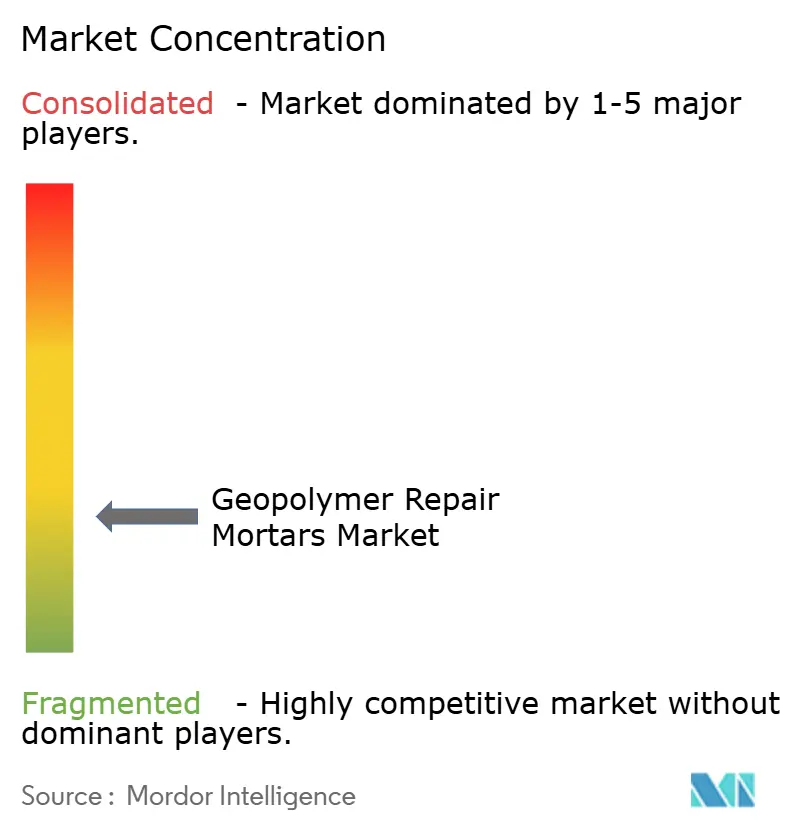
| Market Concentration | Low |
Major Players *Disclaimer: Major Players sorted in no particular order Image © Mordor Intelligence. Reuse requires attribution under CC BY 4.0. | |
Geopolymer Repair Mortars Market Analysis by Mordor Intelligence
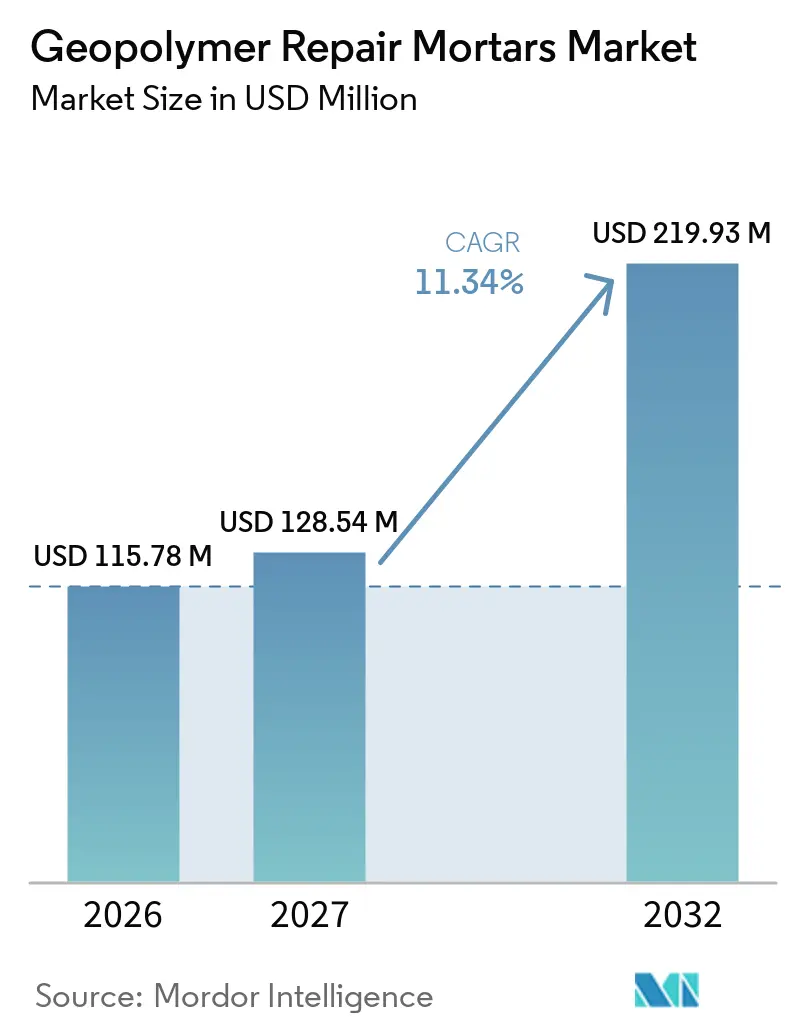
The geopolymer repair mortars market size was valued at USD 115.78 million in 2026 and is estimated to grow from USD 128.54 million in 2027 to USD 219.93 million by 2032, at a CAGR of 11.34% during the forecast period (2027-2032). The geopolymer repair mortars market is benefiting as asset owners place greater weight on embodied carbon and long-term maintenance costs when selecting materials. A 2026 life-cycle assessment found that geopolymer concrete systems had a cumulative cost of USD 240 per cubic meter over 50 years, compared with USD 820 per cubic meter for uncoated conventional concrete, as maintenance intervals extended to 15 years rather than 5-8 years. This difference in operating costs supports the use of geopolymer repair mortars in applications where longer service intervals can offset higher initial material costs. Public procurement requirements for lower-carbon materials and increased investment in rehabilitation are also expanding opportunities for qualified suppliers. Competition is shifting toward products that combine tested durability, simple field application, verified environmental declarations, and dependable precursor supply.
Key Report Takeaways
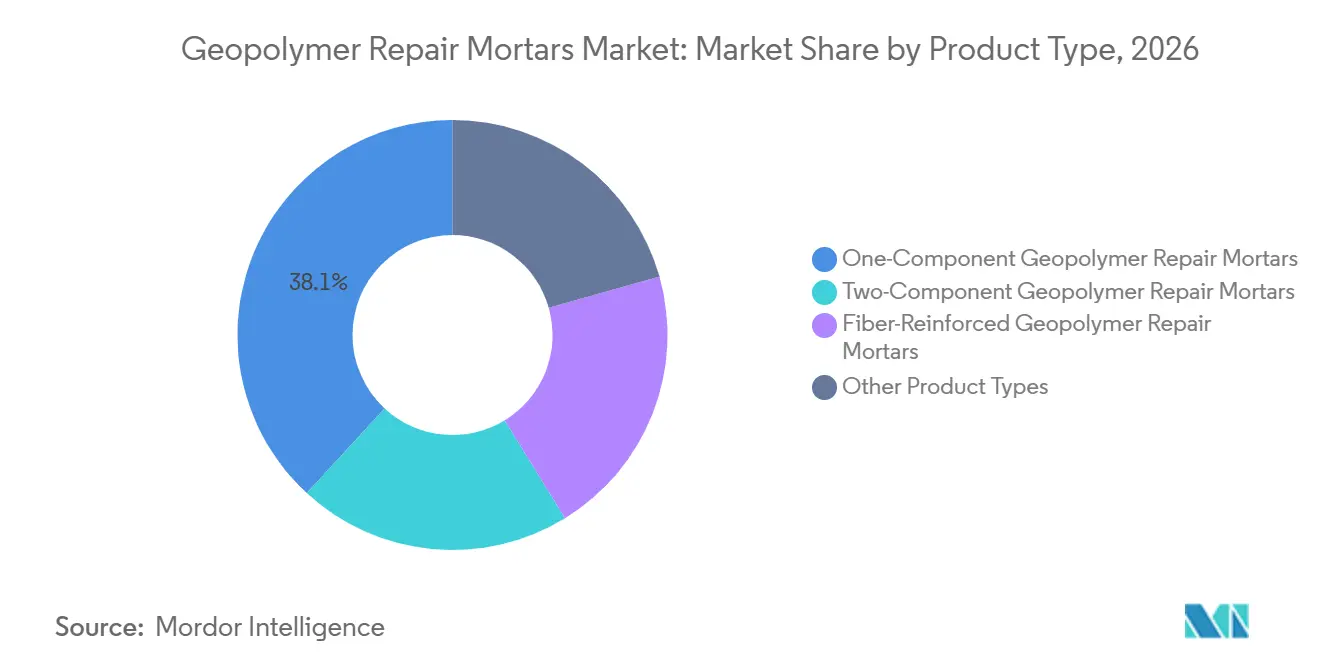
- By product type, one-component systems accounted for 38.14% of the geopolymer repair mortar market share in 2026, while fiber-reinforced formulations are projected to grow at a CAGR of 12.56% through 2032.
- By raw material, fly ash-based systems accounted for 45.72% of the geopolymer repair mortars market share in 2026, while metakaolin-based formulations are forecast to advance at a CAGR of 12.42% through 2032.
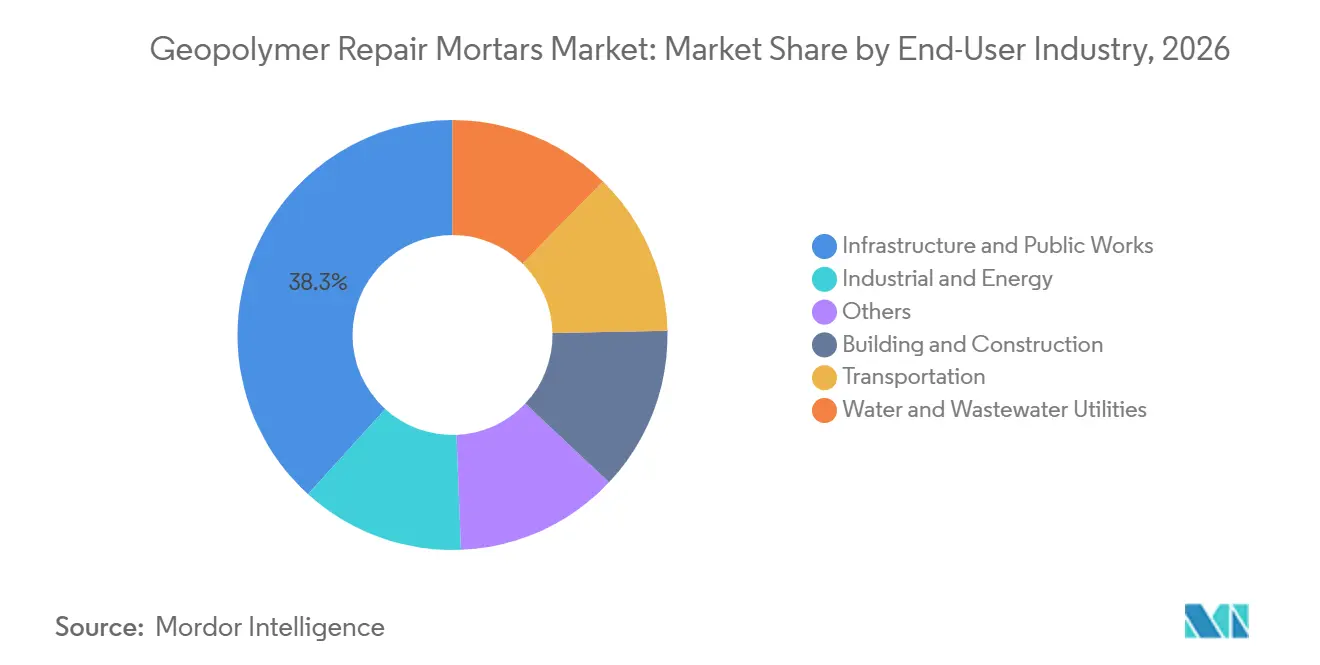
- By end-user industry, infrastructure and public works held 38.28% market share in 2026, while water and wastewater utilities are projected to grow at a CAGR of 13.27% through 2032.
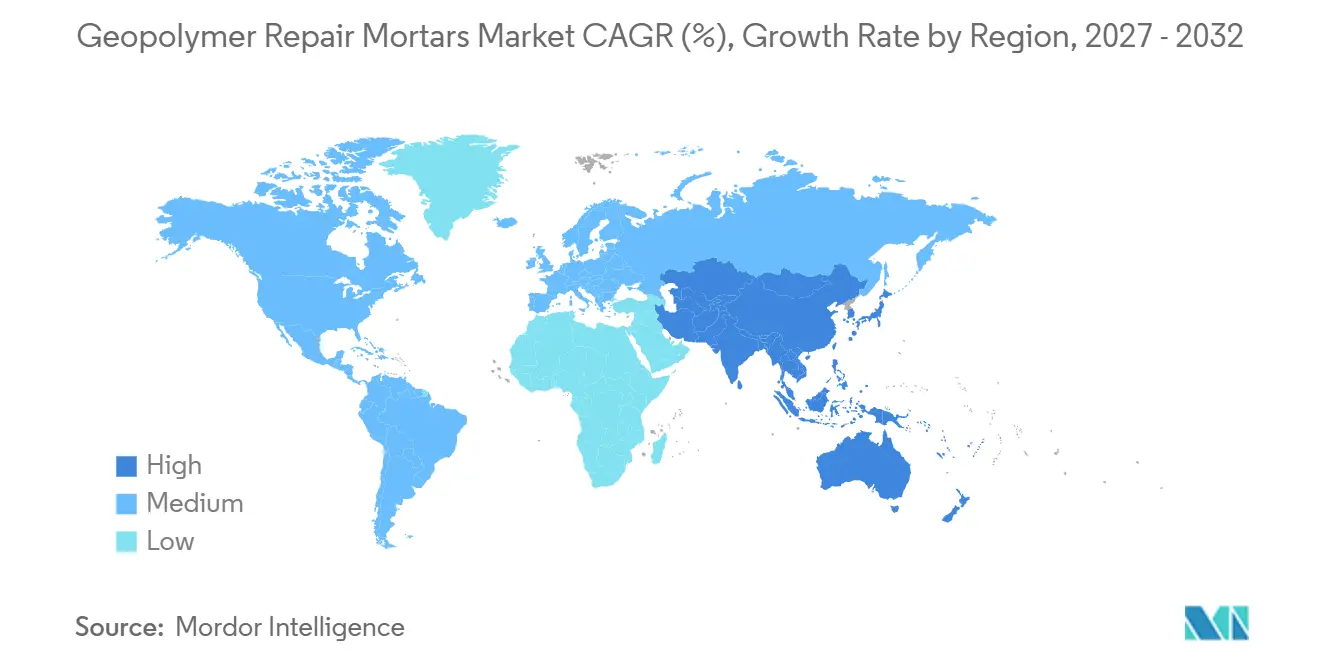
- By geography, Asia-Pacific accounted for 37.13% of the market share in 2026, and the region is forecast to grow at a CAGR of 12.78% through 2032.
Note: Market numbers in this report are based on Mordor Intelligence's proprietary estimation framework, which combines nine months of actuals with Q4 projections for base year 2026.
Market Trends and Insights
Drivers Impact Analysis of Geopolymer Repair Mortars Market*
| Drivers | (~) % Impact on CAGR Forecast | Geographic Relevance | Impact Timeline |
|---|---|---|---|
| Low-Carbon Construction and Circular-Economy Procurement | +2.5% | Global, with early gains in North America, the EU, and Australia | Short term (≤ 2 years) |
| Aging Infrastructure and Planned Life-Cycle Rehabilitation | +2.8% | Global, particularly the United States, Europe, and China | Medium term (2-4 years) |
| Chloride, Sulfate, Acid, and Thermal Exposure Resistance | +1.8% | Global, concentrated in sewer, marine, and industrial environments | Long term (≥ 4 years) |
| One-Part, Just-Add-Water Formulations | +1.5% | Global, accelerating in North America and core Asia-Pacific markets, with spillover to the Middle East and Africa | Medium term (2-4 years) |
| Digital Specification and Project-Level Carbon Accounting | +0.7% | North America and the EU, with early gains in Australia and Singapore | Short term (≤ 2 years) |
| Source: Mordor Intelligence | |||
Low-Carbon Construction and Circular-Economy Procurement
Canada's Treasury Board Standard on Embodied Carbon in Construction, amended in March 2025, requires procurements initiated after September 1, 2025, to demonstrate a minimum 30% reduction in embodied carbon against a project baseline[1]. This requirement directs public buyers toward materials that can provide verified environmental data and lower-carbon results. Research published in 2025 reported that geopolymer mortars can achieve up to 58% lower global warming potential than ordinary Portland cement alternatives. Waste-based geopolymer mortars using construction and demolition feedstocks can also reduce carbon dioxide emissions by 35-50% compared with conventional systems. The geopolymer repair mortars market benefits where fly ash, ground granulated blast-furnace slag, and metakaolin meet circular procurement criteria under public purchasing programs. Suppliers with environmental product declarations can meet tender requirements earlier and face a smaller pool of qualified competitors.
Aging Infrastructure and Planned Life-Cycle Rehabilitation
Growing demand to repair bridges, pipes, tunnels, and wastewater assets before they require full replacement supports the geopolymer repair mortars market. The American Society of Civil Engineers identified USD 191.3 billion in U.S. bridge rehabilitation needs in 2025, while the Bridge Formula Program provided USD 27.5 billion over five years, and the Bridge Investment Program provided an additional USD 12.5 billion. More than half of U.S. public water systems identify the rehabilitation of aging infrastructure as their most critical challenge. Repair budgets favor materials that can maintain performance under aggressive operating conditions and reduce the need for repeat repairs. A 2025 study found that fly ash and ground granulated blast-furnace slag (GGBS) geopolymer mortars retained mechanical performance better than ordinary Portland cement mortars following sulfuric acid exposure. This positions the geopolymer repair mortars market for projects where asset owners are shifting from reactive maintenance to planned service-life management.
Chloride, Sulfate, Acid, and Thermal Exposure Resistance
Durability in corrosive operating environments expands the range of applications for the geopolymer repair mortars market. Vortex's GeoKrete-Water technical sheet reports 0% mass loss after 12 weeks of sulfuric acid immersion at pH 1.0, chloride ion penetration below 250 coulombs at 28 days, compressive strength of 55.1 MPa, and bond strength of 20.7 MPa. The low chloride penetration is rated very low per ASTM C1202, supporting use in sewer, marine, and industrial settings. Research published in the ASCE Journal of Materials in Civil Engineering in 2025 found stronger durability performance for fly ash-GGBS geopolymer mortar under sulfuric acid exposure than for ordinary Portland cement mortar. A 2025 review also reported that geopolymer concrete can retain more than 90% of compressive strength at temperatures up to 800°C. These characteristics support the value proposition for petrochemical, smelting, power generation, drainage, and industrial repair applications.
One-Part, Just-Add-Water Formulations
One-part systems are making geopolymer repair mortar easier for contractors to use in field applications. Earlier two-component products required concentrated liquid alkali activators, which introduced corrosive handling conditions, heat during mixing, and more demanding protective procedures. One-part formulations use dry activators and can be mixed with water using standard batch-mixing equipment. A 2025 conference paper reported that construction and demolition waste-based one-part alkali-activated binders had an embodied carbon of 0.4 kg CO₂e per kilogram, compared with 0.85 kg CO₂e per kilogram for ordinary Portland cement. Sika's SikaMonoTop-4500 Geo Hybrid, released in January 2025, specifies an initial set time of 60-70 minutes under ASTM C266. Simpler mixing procedures and conventional working times reduce a significant barrier to contractor adoption in water, infrastructure, and public works projects.
Restraints Impact Analysis of Geopolymer Repair Mortars Market*
| Restraints | (~) % Impact on CAGR Forecast | Geographic Relevance | Impact Timeline |
|---|---|---|---|
| Inconsistent Precursor Chemistry and Batch Qualification | -1.2% | Global, more acute in North America and the EU, as coal plant retirements reduce fresh fly ash supply | Medium term (2-4 years) |
| Alkali-Activator Cost, Handling, and Safety Burden | -1.8% | Global, most acute in locations distant from sodium silicate production centers | Long term (≥ 4 years) |
| Limited Design-Code Recognition and Project Approvals | -1.5% | Global, except Australia; constraints are highest in the EU and North American structural applications | Medium term (2-4 years) |
| Source: Mordor Intelligence | |||
Inconsistent Precursor Chemistry and Batch Qualification
Precursor consistency remains a major constraint on the geopolymer repair mortars market because it directly affects product qualification and long-term performance. A 2025 review found that aluminosilicate gel formation is sensitive to the SiO₂/Al₂O₃ molar ratio and the reactive-glass content of the precursor. These properties vary with coal combustion conditions, plant age, and collection methods. Coal plant closures are reducing the availability of fresh Class F fly ash in high-income regions, encouraging the use of stockpiled ash and alternative precursors. Eco Material Technologies is processing 2 million tons of high-grade Class F pozzolan from historical stockpiles in Pennsylvania[2]. Each new source must be qualified against applicable specifications, and approvals can delay commercialization by 6-18 months. These delays can discourage contractors working on projects with limited procurement timelines.
Alkali-Activator Cost, Handling, and Safety Burden
Alkali activators constrain the geopolymer repair mortars market, particularly in regions located far from sodium silicate supply centers. A 2025 study reported that sodium silicate accounts for 65-70% of activator expenses and that activators account for 54% of the total geopolymer concrete cost per cubic meter. This cost structure can reduce the price advantage of a repair material even when its service-life performance is strong. Research on waste-glass-derived sodium silicate reported a production cost of USD 16.81 per kilogram, compared with USD 34 per kilogram for commercial sodium silicate. Industrial production of alternative activators requires capital investment, which is difficult for smaller producers to fund. Distribution, labeling, and occupational safety requirements also limit the reach of liquid activator systems within smaller contractor networks.
*Our forecasts treat driver/restraint impacts as directional, not additive. The impact forecasts reflect baseline growth, mix effects, and variable interactions.
Geopolymer Repair Mortars Market Segment Analysis
By Product Type:
One-Component Systems Lead, Fiber-Reinforced Formulations Outpace Broader MarketOne-component systems held a 38.14% share in 2026, while fiber-reinforced formulations are forecast to expand at a 12.56% CAGR through 2032. One-component products lead because they are compatible with standard contractor mixing and placement practices and remove the need to handle liquid activators at the jobsite. Fiber-reinforced products are used for wastewater lining and transportation repairs that require crack-bridging performance. Two-component systems remain relevant in specialized industrial applications where high early strength is important. Self-leveling and rapid-setting products address narrower uses in industrial flooring and precast repair.
Fiber-reinforced products are gaining traction as asset owners adopt planned maintenance programs rather than waiting for visible deterioration. Spray-applied mortar can reline large-diameter pipes and culverts in a single layer up to 50 mm thick, avoiding excavation, lane closures, and resurfacing work. Sika's January 2025 release of SikaMonoTop-4500 Geo Hybrid specifies a 60-70-minute working time under ASTM (American Society for Testing and Materials) C266 for vertical and overhead repairs, supporting scheduling patterns already used for conventional repair mortar. Commercial fiber-reinforced formulations consistently achieve bond strengths exceeding 20 MPa, meeting specifications requiring documented bond performance. The product mix in the geopolymer repair mortars market is therefore shifting toward simpler applications while retaining high-performance options.

By Raw Material:
Fly Ash Leads on Economics, Metakaolin Advances on ConsistencyFly ash-based systems accounted for 45.72% of the market in 2026, while metakaolin-based formulations are expected to grow at a CAGR of 12.42% through 2032. Fly ash remains important because it has historically provided a lower-cost precursor in regions with coal or biomass combustion. Metakaolin gives formulators more consistent aluminosilicate chemistry. Slag-based products hold a meaningful position because they can cure at ambient temperature, which suits field repair. Silica fume and multi-precursor systems support narrower uses that require stronger chemical resistance or potable-water suitability. The raw material mix reflects a balance between cost, local supply, handling requirements, and performance needs.
The decline in fresh coal ash supply is reshaping how suppliers plan their precursor networks. Fresh Class F fly ash supply is declining in North America and Europe as coal plants retire. Eco Material Technologies processes 2 million tons of high-grade Class F pozzolan from stockpiles in Pennsylvania, beneficiating it to meet applicable quality requirements. Stockpiled ash can provide an alternative supply route, but it requires a consistent qualification process. Metakaolin has a more distributed supply base and uses a calcination temperature of 550-750°C, lower than the 1,450°C used for Portland cement clinker. A 2025 review reported that metakaolin-based geopolymers can reduce carbon dioxide emissions by 64% compared with Portland cement. These attributes support the use of metakaolin, where supply assurance and lower-carbon procurement are both priorities.
By End-User Industry:
Infrastructure Anchors Demand While Water Utilities Drive GrowthInfrastructure and public works accounted for 38.28% of the market in 2026, while water and wastewater utilities are projected to grow at a CAGR of 13.27% through 2032. Infrastructure applications include bridge deck patching, highway repairs, and tunnel rehabilitation, where chemical resistance can extend the interval between repair cycles. Transportation applications include airport pavement and rail maintenance, where rapid early strength is useful. Building and construction, industrial and energy, and other uses make up the balance of demand. The end-user profile shows that high-demand public assets and high-corrosion utility assets remain central to the geopolymer repair mortars market.
Water utilities have a distinct opportunity to use certified materials on drinking-water infrastructure. NSF/ANSI/CAN 61 certification supports potable-water contact applications for qualified geopolymer mortar products, enabling rehabilitation work that requires a clear route for health and material compliance. The same assets often experience repeated exposure to water, sulfates, acids, and biological corrosion. Sustainable building programs also support adoption in building repairs, where an environmental product declaration can demonstrate lower global warming potential. The geopolymer repair mortars market can benefit when specification teams treat carbon documentation as a procurement requirement and favor manufacturers that combine test evidence, environmental data, and local contractor support.
Geography Analysis
APAC Geopolymer Repair Mortars Market
Asia-Pacific accounted for a 37.13% share in 2026 and is forecast to record a CAGR of 12.78% through 2032. China's infrastructure renewal cycle supports repair demand across urban bridges, sewers, rail tunnels, and industrial structures built during earlier expansion phases. India's National Infrastructure Pipeline targets INR 111 lakh crore (USD 1.5 trillion) over the decade and includes rehabilitation of highways, bridges, and water networks. South Korea and Japan are advancing adoption through government-funded research and municipal procurement pilots. Coal fleets in China, India, Indonesia, and Australia support local fly ash availability, which can lower precursor costs and reduce the price premium of geopolymer products.
North America Geopolymer Repair Mortars Market
North America presents a procurement-driven opportunity for the geopolymer repair mortars market. Canada requires a minimum 30% reduction in embodied carbon relative to a project baseline for relevant public procurements initiated after September 1, 2025. The Embodied Carbon in Construction Calculator (EC3) tool assists project teams in using environmental product declaration data for material selection. The United States initiated 12,306 bridge projects under the Infrastructure Investment and Jobs Act through the first quarter of 2025. Chemical-resistant materials are relevant where owners specify repairs for an additional design life. California's reporting methodology, issued in October 2025, applies whole-building life-cycle assessment requirements to certain commercial projects from January 2026.
EMEA and South America Geopolymer Repair Mortars Market
Europe's demand is tied to the repair of bridges, tunnels, and wastewater infrastructure, while the Middle East and Africa focus more heavily on water networks and saline operating conditions. Germany's DIN 19573 framework supports the use of geopolymer liners in corrosive sewer environments and has facilitated the entry of commercial products into the wastewater repair market. European suppliers are building acceptance through project records, testing, and sector-specific approvals. In the Middle East, Dubai's stormwater rehabilitation program has projected spending of AED 30 billion (USD 8.2 billion) to support materials suited to water-system repairs. Saudi Arabian desalination and pipeline projects offer use cases where brine and acid-wash resistance are relevant. South America accounts for a smaller share of the geopolymer repair mortars market, although Brazilian bridge and highway renewal programs can generate demand where a regional supply chain is available.
Competitive Landscape
The geopolymer repair mortars market is fragmented, with no single supplier holding a dominant position across product types and regions. Sika AG, BASF, RPM International, and Heidelberg Materials compete through broad construction-chemicals portfolios and established distribution networks. Wagners, Zeobond Pty Ltd, Geopolymer Solutions LLC, Alchemy Geopolymer Solutions, and Betolar PLC compete by leveraging technical expertise in precursor qualification and co-development with infrastructure owners. Larger suppliers can introduce geopolymer products through existing repair-mortar sales channels, while smaller specialists can adapt material chemistry and supply arrangements to project-level needs. This mix keeps us competitive in product formulation, regulatory approvals, delivery, and technical service.
Sika offers SikaCem-900 Geo W for one-component geopolymer shotcrete, SikaMonoTop-4500 Geo Hybrid for vertical and overhead repair, and Sikacrete-6000 Geo Hybrid for deep-pour concrete repair. The company reports greenhouse gas emission reductions of 20-50% for these products compared with ordinary Portland cement alternatives. In January 2025, Sika released SikaMonoTop-4500 Geo Hybrid with a 60-70 minute initial set time, supporting conventional repair scheduling. In November 2025, Heidelberg Materials agreed to acquire Walan Specialty Construction Products in Delaware, including a 150,000 tons-per-year slag grinding plant. The acquisition strengthened its low-carbon cementitious portfolio and expanded access to Ground Granulated Blast-furnace Slag (GGBS) supply. These developments indicate that application readiness and precursor control are competitive priorities.
Another competitive opportunity is products that combine durability data, environmental product declarations, and compatibility with digital carbon-accounting tools. Suppliers with recognized approvals for wastewater rehabilitation can access a more defined pool of eligible projects, and materials certified across multiple jurisdictions can reduce the approval burden for asset owners and contractors. Sika Technology AG's patent activity includes a geopolymer foam patent granted in 2024, reflecting investment in application-method development. Competition in the geopolymer repair mortars market, therefore, extends beyond binder formulation to include product handling, field application methods, environmental documentation, and project approvals.
Geopolymer Repair Mortars Industry Leaders
-
Sika AG
-
Saint-Gobain
-
BASF
-
The Euclid Chemical Company
-
Pidilite Industries Ltd.
- *Disclaimer: Major Players sorted in no particular order
Geopolymer Repair Mortars Market Companies Covered in this Report
- Alchemy Geopolymer Solutions
- BASF
- Betolar PLC
- ClockSpring|NRI
- Flexcrete Technologies Ltd.
- Geopolymer Solutions, LLC
- Heidelberg Materials AG
- Kryton International Inc.
- Pidilite Industries Ltd.
- RPM International Inc.
- Saint-Gobain
- Sika AG
- The Euclid Chemical Company
- Wagners
- Zeobond Pty Ltd
Recent Industry Developments in Geopolymer Repair Mortars Market
- November 2025: Heidelberg Materials North America signed a binding purchase agreement to acquire Walan Specialty Construction Products in Wilmington, Delaware. The acquisition included a three-year-old slag grinding plant with a capacity of 150,000 tons per year, utilizing a vertical mill located near the Port of Wilmington. The acquisition expanded the company's evoBuild low-carbon cementitious portfolio and extended its reach in the Mid-Atlantic United States, a region with substantial demand for bridge and wastewater infrastructure rehabilitation.
- March 2025: Vortex Europe GmbH announced that its Quadex GeoKrete geopolymer repair mortar received DIBt (Deutsches Institut für Bautechnik) certification in Germany. The certification permitted commercial use in wastewater infrastructure rehabilitation and validated the product's chemical resistance, structural durability, and environmental compliance standards, supporting market entry in one of Europe's largest infrastructure rehabilitation markets.
Global Geopolymer Repair Mortars Market Report Scope
Geopolymer repair mortar is a cement-free construction material used to patch, restore, and strengthen damaged concrete and masonry structures. It is produced by combining aluminosilicate-rich materials, such as fly ash, slag, or metakaolin, with an alkaline activator solution.
The geopolymer repair mortars market is segmented by product type, raw material, end-user industry, and geography. By product type, the market is segmented into one-component geopolymer repair mortars, two-component geopolymer repair mortars, fiber-reinforced geopolymer repair mortars, and other product types. By raw material, the market is segmented into fly ash-based, slag-based, metakaolin-based, silica fume-based, and others. By end-user industry, the market is segmented into building and construction, infrastructure and public works, transportation, water and wastewater utilities, industrial and energy, and others. The report also covers the market size and forecasts for geopolymer repair mortars in 15 countries across major regions. The market sizes and forecasts are provided in terms of value (USD).
Segmentation Overview
| One-Component Geopolymer Repair Mortars |
| Two-Component Geopolymer Repair Mortars |
| Fiber-Reinforced Geopolymer Repair Mortars |
| Other Product Types |
| Fly Ash-Based |
| Slag-Based |
| Metakaolin-Based |
| Silica Fume-Based |
| Others |
| Building and Construction |
| Infrastructure and Public Works |
| Transportation |
| Water and Wastewater Utilities |
| Industrial and Energy |
| Others |
| Asia-Pacific | China |
| India | |
| Japan | |
| South Korea | |
| ASEAN Countries | |
| Rest of Asia-Pacific | |
| North America | United States |
| Canada | |
| Mexico | |
| Europe | Germany |
| United Kingdom | |
| France | |
| Italy | |
| NORDIC Countries | |
| Rest of Europe | |
| South America | Brazil |
| Argentina | |
| Rest of South America | |
| Middle East and Africa | Saudi Arabia |
| South Africa | |
| Rest of Middle East and Africa |
| By Product Type | One-Component Geopolymer Repair Mortars | |
| Two-Component Geopolymer Repair Mortars | ||
| Fiber-Reinforced Geopolymer Repair Mortars | ||
| Other Product Types | ||
| By Raw Material | Fly Ash-Based | |
| Slag-Based | ||
| Metakaolin-Based | ||
| Silica Fume-Based | ||
| Others | ||
| By End-User Industry | Building and Construction | |
| Infrastructure and Public Works | ||
| Transportation | ||
| Water and Wastewater Utilities | ||
| Industrial and Energy | ||
| Others | ||
| By Geography | Asia-Pacific | China |
| India | ||
| Japan | ||
| South Korea | ||
| ASEAN Countries | ||
| Rest of Asia-Pacific | ||
| North America | United States | |
| Canada | ||
| Mexico | ||
| Europe | Germany | |
| United Kingdom | ||
| France | ||
| Italy | ||
| NORDIC Countries | ||
| Rest of Europe | ||
| South America | Brazil | |
| Argentina | ||
| Rest of South America | ||
| Middle East and Africa | Saudi Arabia | |
| South Africa | ||
| Rest of Middle East and Africa | ||
Key Questions Answered in the Report
What is current market size of Geopolymer Repair Mortars Market?
The geopolymer repair mortars market size was valued at USD 115.78 million in 2026 and is estimated to grow from USD 128.54 million in 2027 to USD 219.93 million by 2032, at a CAGR of 11.34% during the forecast period (2027-2032).
Which raw material leads to geopolymer repair mortar production?
Fly ash-based systems held a 45.72% share in 2026, while metakaolin-based formulations are forecast to grow at a CAGR of 12.42% through 2032.
Which end user offers the strongest growth opportunity?
Water and wastewater utilities are projected to grow at a CAGR of 13.27% through 2032, supported by rehabilitation needs and certified potable-water applications.
Which region leads global demand?
Asia-Pacific held a 37.13% share in 2026 and is forecast to record a CAGR of 12.78% through 2032.