
Genetically Modified Feed Market Size and Share
Market Overview
| Study Period | 2022 - 2032 |
|---|---|
| Market Size (2027) | USD 96.69 Billion |
| Market Size (2032) | USD 129.47 Billion |
| Growth Rate (2027 - 2032) | 6.01 % |
| Fastest Growing Market | Asia-Pacific |
| Largest Market | North America |
| Market Concentration | Medium |
Major Players *Disclaimer: Major Players sorted in no particular order Image © Mordor Intelligence. Reuse requires attribution under CC BY 4.0. | |
Genetically Modified Feed Market Analysis by Mordor Intelligence
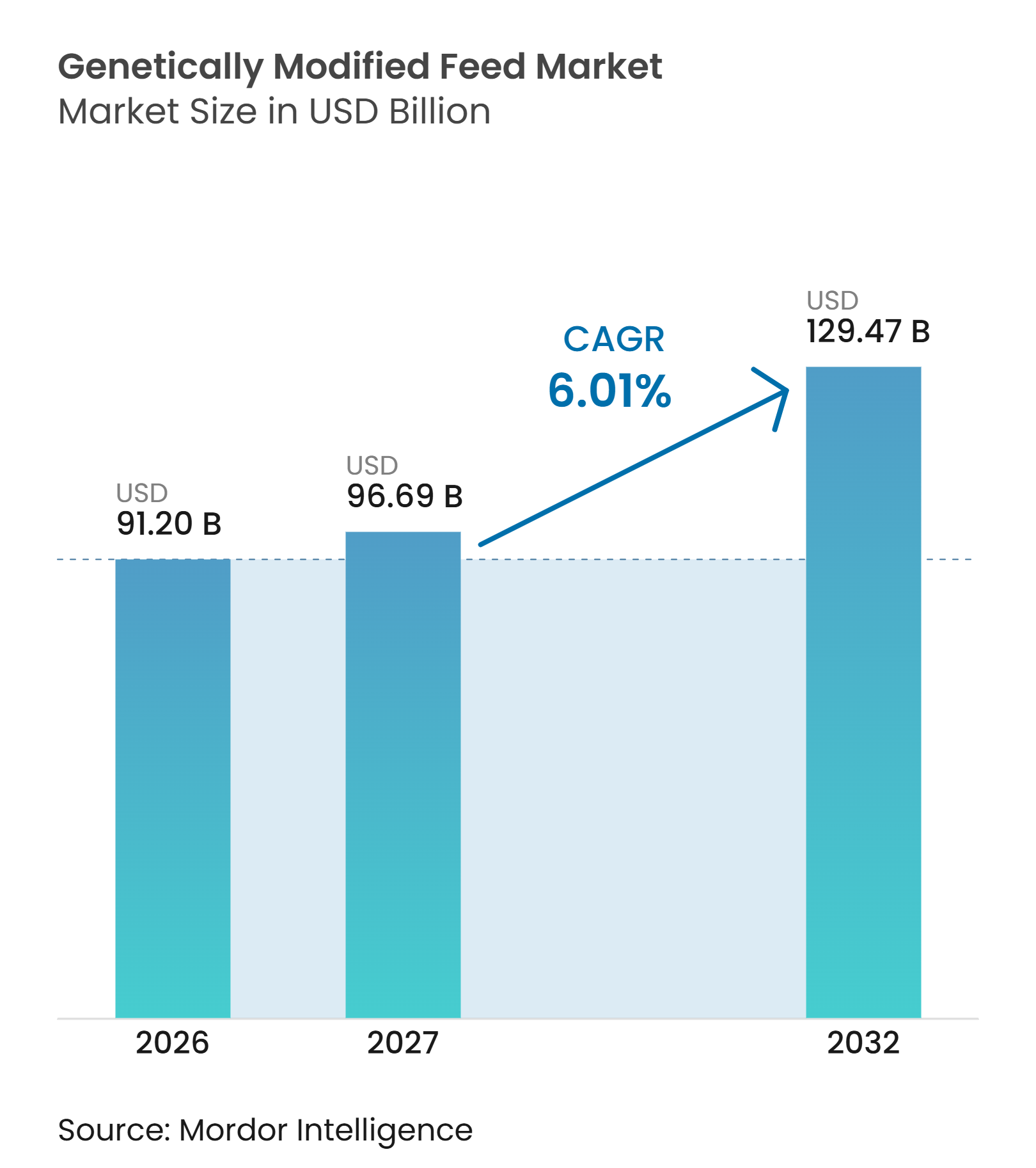
The genetically modified feed market size was valued at USD 91.20 billion in 2026 and is forecast to grow from USD 96.69 billion in 2027 to USD 129.47 billion by 2032, at a CAGR of 6.01% from 2027 to 2032. The market is supported by the established use of genetically modified soybeans and corn in commercial feed supply chains serving poultry, swine, ruminants, and aquaculture producers. Feed buyers are placing greater value on crop traits that support nutrient delivery, ingredient consistency, and formulation choices. Low-phytate soybeans, high-lysine corn, and stacked-trait crops can reduce reliance on selected supplemental nutrients and strengthen the role of feed formulation in procurement decisions. Regulatory differences, non-genetically modified sourcing requirements, and identity-preservation costs continue to create friction, particularly in trade-oriented supply chains. Demand for competitively priced animal protein in Asia-Pacific and Africa supports continued use of genetically modified crop inputs across large commercial production systems.
Key Report Takeaways
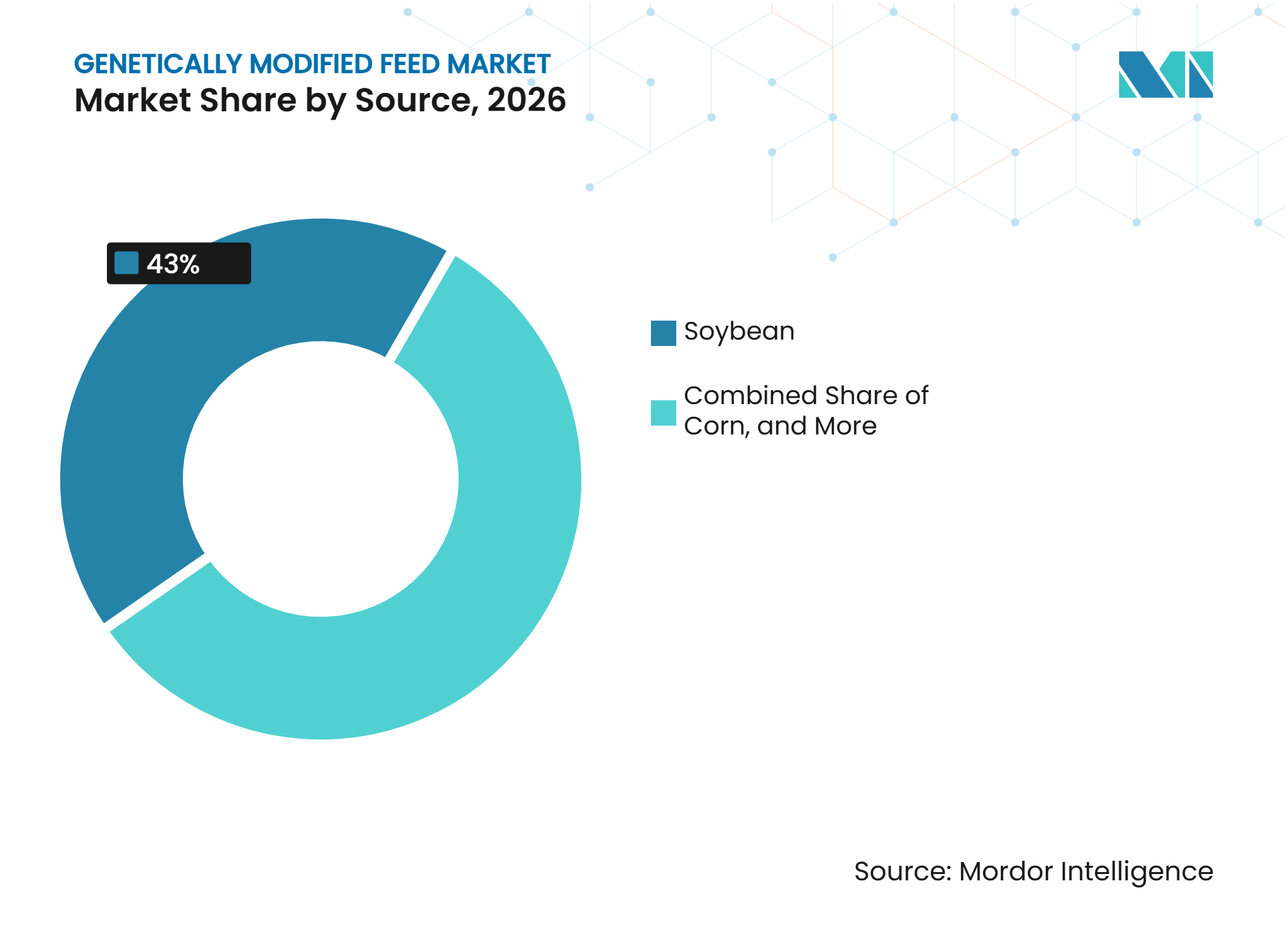
- By source, soybean accounted for 43% of the genetically modified feed market share in 2026, while corn is forecast to grow at a CAGR of 6.8% from 2027 to 2032.
- By feed type, concentrates accounted for 52% of the genetically modified feed market size in 2026 and are forecast to grow at a CAGR of 6.3% from 2027 to 2032.
- By form, pellets accounted for 46% of the market share in 2026, while liquid feed is forecast to grow at a CAGR of 6.7% from 2027 to 2032.
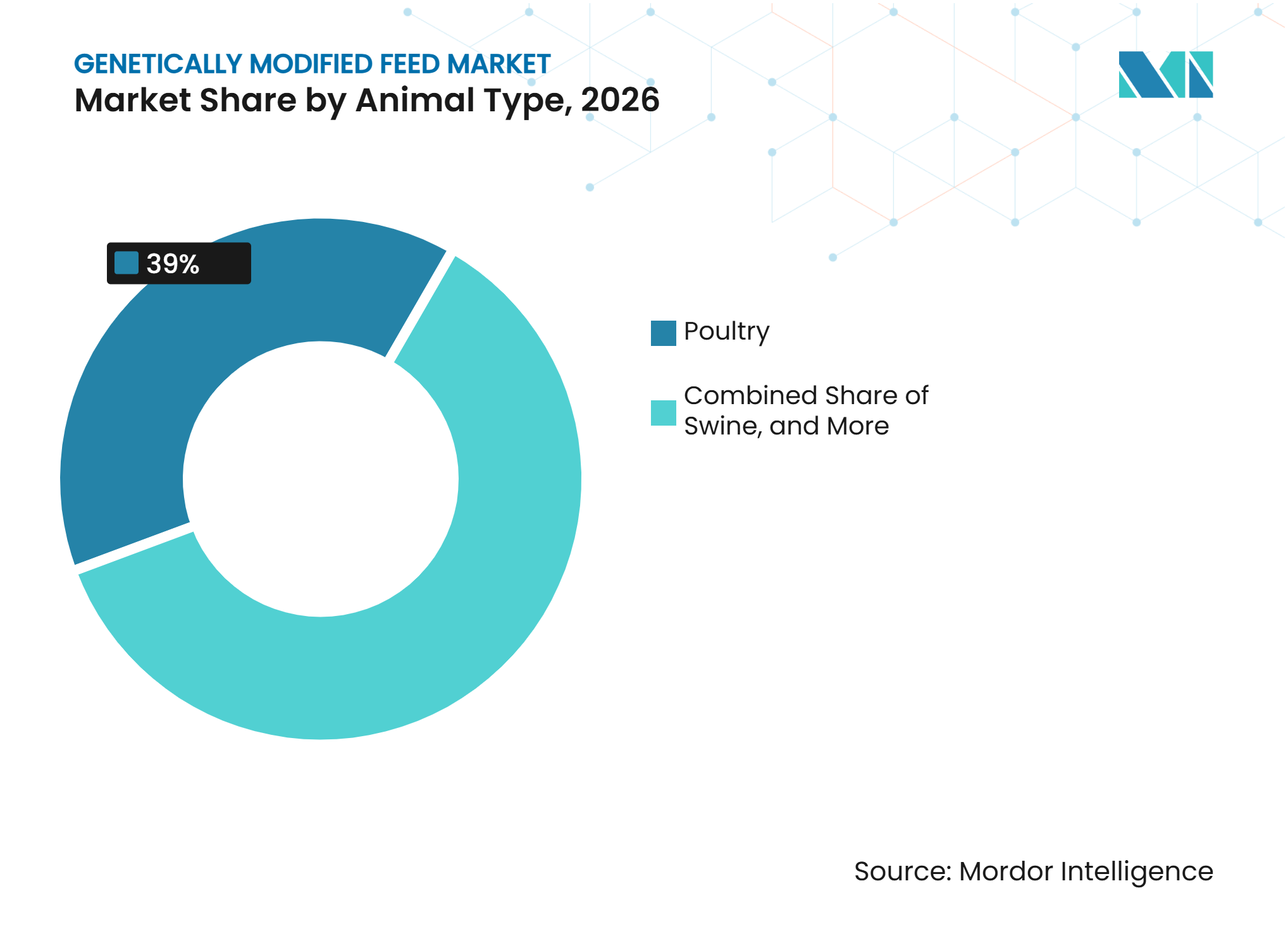
- By animal type, poultry accounted for 39% of the market share in 2026, while aquaculture is forecast to grow at a CAGR of 7.4% from 2027 to 2032.
- By geography, North America accounted for 30% of the market share in 2026, while Asia-Pacific is forecast to grow at a CAGR of 7.2% from 2027 to 2032.
Note: Market numbers in this report are based on Mordor Intelligence's proprietary estimation framework, which combines nine months of actuals with Q4 projections for base year 2026.
Market Trends and Insights
Drivers Impact Analysis of Genetically Modified Feed Market*
| Driver | (~) % Impact on CAGR Forecast | Geographic Relevance | Impact Timeline |
|---|---|---|---|
| Rising Demand for Affordable Animal Protein | +1.5% | Global, strongest in Asia-Pacific and Africa | Long term (≥ 4 years) |
| Expanding Adoption of Biotech Corn and Soybean in Feed Supply Chains | +1.2% | North America and South America, extending to Asia-Pacific | Medium term (2-4 years) |
| Feed Conversion and Nutrient-Use Efficiency | +0.8% | Global, strongest in Europe and Asia-Pacific | Medium term (2-4 years) |
| Growth of Intensive Poultry, Swine, and Aquaculture Production | +1.0% | Asia-Pacific, Africa, and the Middle East | Long term (≥ 4 years) |
| Growing Demand for Traceable and Trait-Specific Feed Ingredient Sourcing | +0.5% | Europe, North America, and Asia-Pacific trade corridors | Medium term (2-4 years) |
| Increasing Adoption of Nutritionally Enhanced Genetically Modified Crops | +0.4% | Global, with early gains in North America, Europe, and Asia-Pacific | Long term (≥ 4 years) |
| Source: Mordor Intelligence | |||
Rising Demand for Affordable Animal Protein
Animal protein consumption in lower- and middle-income economies continues to support demand for commercial animal feed. The United States Department of Agriculture (USDA) projected domestic soybean meal disappearance to increase by 2% in the 2025/26 marketing year, supported by higher pork and poultry production [1]. This demand sustains the use of soybean meal and corn in large-scale feed formulations. The genetically modified feed market benefits from the established role of genetically modified crop-derived ingredients in the cost structures of commercial livestock producers. Although non-genetically modified ingredients are available through specific sourcing programs, their availability and cost can limit their use as large-scale substitutes in mainstream feed formulations. As poultry and pork production expands, feed manufacturers have stronger incentives to secure consistent supplies of protein- and energy-rich ingredients, supporting demand for genetically modified feed inputs.
Expanding Adoption of Biotech Corn and Soybean in Feed Supply Chains
Genetically modified grain has become an established commercial input across major feed-producing regions, particularly in the Americas. The widespread cultivation of genetically modified corn and soybean supports the availability of key ingredients, including soybean meal and corn, used in animal feed formulations. The genetically modified feed market also benefits from the wider adoption of trait-stacked varieties, which can support crop productivity and supply reliability under commercial farming conditions. Brazil and Argentina play important roles in this supply system, as their soybean and corn production links regional agriculture to the global feed trade. Large feed manufacturers and livestock integrators operating in these markets also benefit from established genetically modified crop sourcing networks, making a shift to alternative ingredients more complex.
Feed Conversion and Nutrient-Use Efficiency
Trait-linked crop characteristics are giving feed buyers reasons to evaluate genetically modified ingredients beyond their purchase cost. A study supported by the National Pork Board found that pigs fed diets containing genetically modified low-phytate corn and soybean meal, without supplemental inorganic phosphorus, excreted 53% less phosphorus in manure than pigs fed conventional corn- and soybean meal-based diets [2]. Low-phytate crops improve phosphorus availability to animals, reducing the need for supplemental phosphorus and helping livestock producers manage nutrient requirements and manure composition. These nutritional benefits create opportunities for the genetically modified feed market, particularly among feed manufacturers and livestock producers seeking to improve nutrient utilization and reduce feed-related environmental impacts.
Growth of Intensive Poultry, Swine, and Aquaculture Production
Intensive poultry, swine, and aquaculture production systems depend on consistent supplies of high-volume, nutritionally balanced feed. The United States Department of Agriculture (USDA) projected corn feed and residual use at 6.1 billion bushels for the 2025/26 marketing year, underscoring corn's substantial role in domestic animal feed consumption. Poultry and swine producers rely heavily on standardized corn- and soybean meal-based rations, while aquaculture provides an additional outlet for plant-based protein ingredients. Soy protein concentrates can replace a portion of the fishmeal used in selected aquaculture feed formulations. Constraints on wild-caught fish supplies also encourage feed manufacturers to explore alternative protein sources for farmed fish and shrimp. As aquaculture capacity expands across Asia, South America, and East Africa, demand for plant-based feed ingredients is likely to create additional opportunities for the genetically modified feed market.
Restraints Impact Analysis of Genetically Modified Feed Market*
| Restraint | (~) % Impact on CAGR Forecast | Geographic Relevance | Impact Timeline |
|---|---|---|---|
| Divergent Approval, Labeling, and Import Regulations Across Markets | -0.8% | European Union and United Kingdom, extending to Japan and South Korea | Long term (≥ 4 years) |
| Consumer and Retailer Preference for Non-Genetically Modified Products | -0.6% | Europe and North American premium retail channels | Medium term (2-4 years) |
| Segregated Logistics, Identity Preservation, and Trait Testing Costs | -0.5% | Global, strongest in export-oriented supply chains | Medium term (2-4 years) |
| Concentrated Trait Licenses and Seed Supplier Dependence | -0.3% | North America and South America, extending to Asia-Pacific | Long term (≥ 4 years) |
| Source: Mordor Intelligence | |||
Divergent Approval, Labeling, and Import Regulations Across Markets
Differences in approval, labeling, and import requirements across countries remain a significant constraint on the genetically modified feed market. The European Union assesses genetically modified crop events individually under its food and feed authorization framework, with the European Food Safety Authority conducting the scientific safety assessment. The Belgian Biosafety Advisory Council also reviews applications and provides scientific advice as part of this process, while its register lists food and feed applications at different stages of assessment [3]. China may approve imported crop events on a different timetable from that of major crop-producing countries. These differences create a risk of shipment rejection when consignments include events that have not received approval in the destination market. Feed manufacturers sourcing ingredients across multiple jurisdictions must therefore monitor event-specific approvals, labeling requirements, and import regulations. Regulatory divergence increases compliance costs and creates uncertainty in international procurement and feed ingredient sourcing.
Consumer and Retailer Preference for Non-Genetically Modified Products
Premium retail and food programs in Europe and North America may require animal products to come from livestock raised on non-genetically modified feed. CropLife Europe estimated that a ban on genetically modified soybean imports could increase commercial feed costs in the European Union by up to 20%, as feed manufacturers would need to source more expensive non-genetically modified soybeans and alternative ingredients. These requirements increase the cost of supplying products that meet non-genetically modified claims. However, their influence varies across sales channels, as commodity and food-service markets may place less emphasis on such claims. Retailer specifications can also extend to feed manufacturers and grain suppliers, even where regulations permit genetically modified feed. As a result, the genetically modified feed market may face limited access to premium retail channels where non-genetically modified sourcing requirements are prevalent.
*Our forecasts treat driver/restraint impacts as directional, not additive. The impact forecasts reflect baseline growth, mix effects, and variable interactions.
Genetically Modified Feed Market Segment Analysis
By Source:
Soybean Leads While Corn ExpandsSoybean accounted for 43% of the genetically modified feed market share in 2026, reflecting its central role as a plant-based protein input in commercial rations. Soybean meal supports poultry, swine, aquaculture, and ruminant diets due to its established protein content. Canola contributes protein and energy where soybean production is less competitive, notably in Canada and parts of Europe. Genetically modified canola offers herbicide tolerance and yield stability traits that support localized feed supply. Cottonseed meal is mainly used as a ruminant protein input in cotton-producing regions. Genetically modified alfalfa, including Roundup Ready varieties commercially grown in the United States, is primarily used as animal feed, particularly for dairy cattle. Other genetically modified feed inputs include sugar beet-derived ingredients. In 2025, the European Food Safety Authority issued a favorable scientific opinion on genetically modified sugar beet KWS20-1 for food and feed uses, supporting its regulatory assessment in the European Union.
Corn is forecast to grow at a CAGR of 6.8% from 2027 to 2032. Corn remains a major component of domestic feed-grain consumption in the United States, supported by its extensive use in animal feed formulations. Trait-stacked corn supports both energy supply and production reliability in intensive animal systems. Soybean and corn are the core ingredients in the genetically modified feed market because feed mills can source them at a global commercial scale. This combination of high feed inclusion rates and established commercial availability supports corn's expanding role in genetically modified animal feed formulations.



By Feed Type:
Concentrates Lead and Grow FastestConcentrates accounted for 52% of the genetically modified feed market size in 2026 and are forecast to grow at a CAGR of 6.3% from 2027 to 2032. Soybean meal, corn grain, canola meal, and cottonseed meal are protein-dense or energy-dense inputs that fall within this category. Poultry and swine systems depend on concentrates because they cannot efficiently use highly fibrous roughage diets. Their growth therefore supports larger feed volumes of genetically modified crop-based ingredients. The continued expansion of monogastric production systems that rely on standardized concentrate formulations drives the genetically modified feed market.
Roughages include hay, silage, and alfalfa-based products and are most relevant to dairy and beef cattle. Genetically modified alfalfa extends biotech crop use into forage supply in approved markets, especially the United States and Canada. Its use is more limited due to the slower pace of intensification in ruminants compared to poultry or aquaculture. Export-oriented hay supply chains also face coexistence concerns where non-genetically modified forage commands an import premium. Japan and South Korea are notable examples of markets with this preference. Roughages remain relevant to the genetically modified feed market, but their growth is slower than that of concentrate-led commercial feeding systems.
By Form:
Pellets Lead While Liquid Grows FastestPellets accounted for 46% of the market share in 2026, as they are widely used in poultry, swine, aquaculture, and specialty animal diets. Pelleting improves nutrient uniformity, limits ingredient separation, and supports automated feed delivery. Crumbles are used mainly in poultry starter and grower diets, while mash remains relevant in backyard, lifestyle, and smaller commercial operations where pelleting equipment is not economical. Feed form selection depends on species, farm scale, ingredient handling needs, and delivery methods.
Liquid feed is forecast to grow at a CAGR of 6.7% from 2027 to 2032, supported by its increasing adoption in swine production, where it can incorporate wet co-products from food and biofuel processing. Liquid feed supports more targeted feeding programs, especially where wet co-products are locally available. In October 2025, Archer-Daniels-Midland Company expanded its SINCRO data-driven animal nutrition services into Mexico, Indonesia, and European markets. The expansion strengthens the company's regional technical support and precision nutrition capabilities. These services reflect the increasing use of data-enabled formulation and monitoring across commercial livestock production.
By Animal Type:
Poultry Leads While Aquaculture Grows FastestPoultry accounted for 39% of the genetically modified feed market share in 2026, supported by the substantial feed requirements of commercial broiler and layer operations. Poultry diets commonly rely on corn and soybean meal, which are widely available as genetically modified crop-derived ingredients. Swine also represents a major animal type, particularly in China, the European Union, and North America, where large-scale pork production requires consistent supplies of corn- and soybean meal-based feed.
Aquaculture is forecast to grow at a CAGR of 7.4% from 2027 to 2032, supported by the increasing use of plant-protein concentrates as partial substitutes for fishmeal in shrimp, tilapia, salmon, and catfish feed. The use of these ingredients creates additional opportunities for the use of genetically modified crop-derived proteins in aquaculture feed formulations. Ruminants remain an important segment, as dairy and beef production systems require substantial supplies of forage and concentrate feed. Pet food, equine feed, and other animal categories account for smaller shares of the market, with demand varying based on animal nutrition requirements and feed formulations.

Geography Analysis
North America: Established Genetically Modified Crop Infrastructure Supports Market Scale
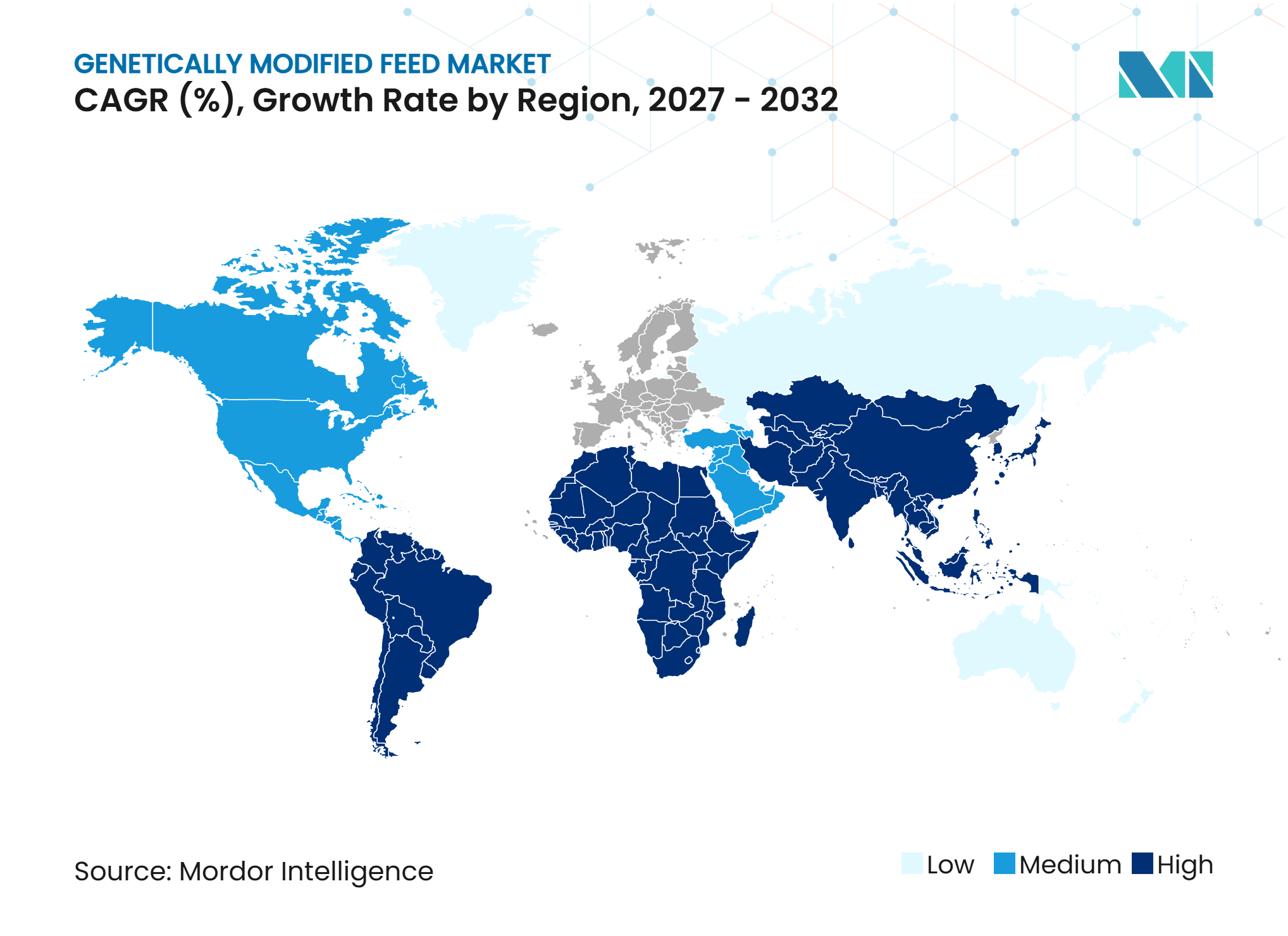
North America accounted for 30% of the market share in 2026. The region has established biotech-crop infrastructure and widespread commercial adoption of genetically modified corn and soybeans. Growth is more closely linked to precision formulation, species-specific nutrition, and functional ingredients than to major increases in the penetration of genetically modified crops. The United States and Canada benefit from closely connected grain and feed supply chains. Regulatory oversight is carried out by the Food and Drug Administration (FDA) in the United States and the Canadian Food Inspection Agency (CFIA) in Canada. Mexico represents an important market for genetically modified feed ingredients, with corn imports forecast to reach a record 25.9 million metric tons in the 2024/25 marketing year to meet demand from the animal feed industry. However, restrictions on domestic cultivation of genetically modified corn and regulatory uncertainty surrounding biotechnology continue to affect sourcing and market access. Feed suppliers are responding by combining crop sourcing with data-enabled formulation and delivery services.
Asia-Pacific: Expanding Feed Production Supports Ingredient Demand
Asia-Pacific is forecast to grow at a CAGR of 7.2% from 2027 to 2032, the fastest rate among regions. China, Vietnam, Thailand, Indonesia, India, and South Korea are expanding production of poultry, swine, and aquaculture. Feed demand is increasing alongside import capacity for soybeans and other genetically modified crop inputs. In Japan, South Korea, and parts of Southeast Asia, genetically modified import rules for feed use can be more permissive than those governing food use. This regulatory distinction supports continued feed ingredient flows even where consumer labeling standards are strict. The role of imported genetically modified feed inputs may strengthen as mills seek consistent protein supply for these more specialized programs.
South America, Europe, Africa, and the Middle East: Divergent Growth Paths
South America benefits from Brazil and Argentina's integrated soybean and corn production systems, which support the regional supply of genetically modified feed ingredients. In August 2025, BASF SE, Corteva, Inc., and M.S. Technologies, L.L.C. signed a licensing agreement to introduce a nematode-resistant soybean trait into Enlist E3 and Conkesta E3 varieties in Brazil, expanding the country's pipeline of biotechnology-based crop traits. Europe remains reliant on imported soybean meal and corn while applying event-specific approval requirements, which increases compliance costs. The European Food Safety Authority (EFSA) conducts scientific risk assessments of genetically modified food and feed applications in the European Union. The Belgian Biosafety Advisory Council also provides scientific advice on biosafety matters and maintains information on applications undergoing regulatory assessment. In Africa, the expansion of commercial poultry and aquaculture operations is supporting demand for compound feed and genetically modified crop-derived ingredients. The Middle East continues to rely on imported grain and compound feed, while food security programs in Saudi Arabia and the United Arab Emirates support investment in livestock and aquaculture systems. These regions face different regulatory and logistics conditions, creating distinct opportunities in the genetically modified feed market: South America is strengthening upstream crop supply, Europe is emphasizing regulatory compliance, and Africa and the Middle East are supporting downstream feed demand.
Competitive Landscape
Market Concentration
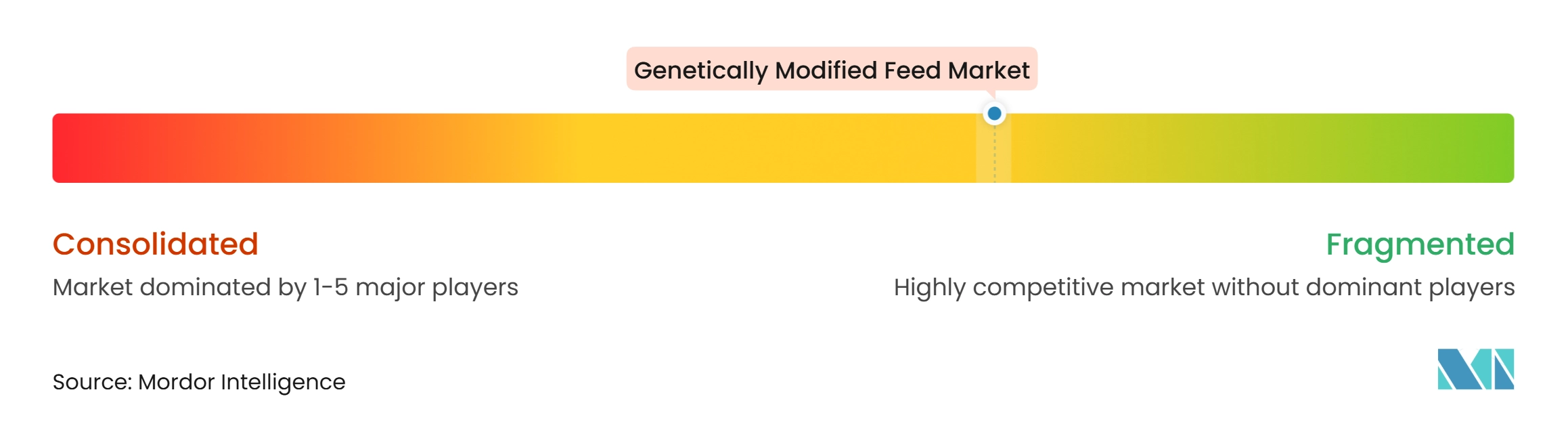
The genetically modified feed market was moderately fragmented in 2026. Bayer AG, Corteva, Inc., Cargill, Incorporated, Archer-Daniels-Midland Company, and Nutreco N.V. are among the key companies operating across the market's upstream biotechnology and agricultural commodity processing segments and downstream animal nutrition segment. Bayer AG and Corteva, Inc. strengthen the upstream competitive landscape through genetically modified crop traits and seed technologies, while Cargill and Archer-Daniels-Midland Company participate through agricultural commodity processing, feed ingredient sourcing, and animal nutrition. Nutreco N.V. contributes through compound feed production and animal nutrition solutions for livestock and aquaculture. Competition across these value chain stages is influenced by biotechnology development, access to agricultural raw materials, feed formulation capabilities, sourcing efficiency, and distribution networks. Companies with integrated sourcing and feed production capabilities can better manage raw material availability and serve diverse animal nutrition requirements.
Archer-Daniels-Midland Company and Alltech announced a definitive agreement in September 2025 to establish a North American animal feed joint venture that will combine 43 feed mills across the United States and Canada. The venture was expected to launch in the first quarter of 2026. The planned venture combines feed manufacturing capacity with nutrition and technical services. Cargill, Incorporated opened a new retail feed facility in Granger, Washington, in August 2025, with an annual production and packaging capacity of 120,000 tons. The facility features automated bag weighing, precision mixing and dosing systems, and artificial intelligence-based bag-sealing assurance. These developments indicate that service capability is becoming an increasingly important competitive factor in the genetically modified feed market.
Opportunities remain in trait-specific formulations, traceability systems, and aquaculture diets that reduce fishmeal use. Guangdong Haid Group, New Hope Liuhe, and Tongwei are expanding integrated feed-to-farm models in Asian production systems, giving them cost and local-market advantages in poultry, swine, and aquaculture. Compliance factors also influence competitive positioning, as broader event approvals can expand raw material sourcing options. BASF SE's 2025 soybean trait agreement in Brazil reflects continued investment in biotechnology-based crop traits and efforts to expand their availability in major agricultural markets. The genetically modified feed market continues to be shaped by relationships between trait developers, commodity processors, feed manufacturers, and farm operators.
Genetically Modified Feed Industry Leaders
-
Bayer AG
-
Corteva, Inc.
-
Cargill, Incorporated
-
Archer-Daniels-Midland Company
-
Nutreco N.V.
- *Disclaimer: Major Players sorted in no particular order
Genetically Modified Feed Market Companies Covered in this Report
- Bayer AG
- Corteva, Inc.
- Cargill, Incorporated
- Archer-Daniels-Midland Company
- Charoen Pokphand Foods Public Company Limited
- Nutreco N.V.
- Land O'Lakes, Inc.
- Guangdong Haid Group Co., Ltd.
- New Hope Liuhe Co., Ltd.
- Tongwei Co., Ltd.
- De Heus Voeders B.V.
Recent Industry Developments in Genetically Modified Feed Market
- March 2026: KOMO Biosciences granted Syngenta a research evaluation license to assess its KOMbine platform for precision genome modification in maize. The agreement enables Syngenta to evaluate KOMO's non-viral, integrase-based technology for targeted DNA integration in maize, supporting early-stage research into crop trait development.
- August 2025: BASF SE, Corteva, Inc., and M.S. Technologies, L.L.C. signed a trait licensing agreement to develop and commercialize a nematode-resistant GM soybean trait, the first biotech solution targeting root lesion nematodes and soybean cyst nematodes for the Brazilian market, to be integrated into Corteva's Enlist E3 and Conkesta E3 soybean platforms, pending regulatory approval.
- March 2023: Corteva, Inc. and Bunge announced a multi-year collaboration to develop and commercialize soybean varieties with higher protein content, improved amino acid profiles, and lower antinutritional factors. Corteva will contribute its germplasm, gene-editing, and trait-discovery capabilities, while Bunge will serve as the exclusive processor of the oilseed and merchandiser of the resulting soybean meal and oil for feed applications.
Global Genetically Modified Feed Market Report Scope
Genetically modified feed consists of animal feed ingredients derived from crops whose genetic material has been modified using genetic engineering techniques to introduce specific traits, such as herbicide tolerance, insect resistance, or improved nutritional characteristics. These ingredients are used in feed formulations for different animal types to support animal nutrition and meet the requirements of commercial feed production. The genetically modified feed market report is segmented by source (soybean, corn, canola, cottonseed, alfalfa, and other sources), by feed type (roughages and concentrates), by form (pellets, crumbles, mash, and liquid), by animal type (poultry, swine, ruminants, aquaculture, pet food, equine, and other animal types), and by geography (North America, South America, Europe, Asia-Pacific, Middle East, and Africa). The market forecasts are provided in terms of value (USD).
Segmentation Overview
| Soybean |
| Corn |
| Canola |
| Cottonseed |
| Alfalfa |
| Other Sources |
| Roughages |
| Concentrates |
| Pellets |
| Crumbles |
| Mash |
| Liquid |
| Poultry |
| Swine |
| Ruminants |
| Aquaculture |
| Pet Food |
| Equine |
| Other Animal Types |
| North America | United States |
| Canada | |
| Mexico | |
| Rest of North America | |
| South America | Brazil |
| Argentina | |
| Rest of South America | |
| Europe | Germany |
| France | |
| Spain | |
| United Kingdom | |
| Italy | |
| Russia | |
| Rest of Europe | |
| Asia-Pacific | China |
| India | |
| Japan | |
| South Korea | |
| Thailand | |
| Vietnam | |
| Indonesia | |
| Rest of Asia-Pacific | |
| Middle East | Saudi Arabia |
| United Arab Emirates | |
| Turkey | |
| Rest of Middle East | |
| Africa | South Africa |
| Egypt | |
| Nigeria | |
| Rest of Africa |
| By Source | Soybean | |
| Corn | ||
| Canola | ||
| Cottonseed | ||
| Alfalfa | ||
| Other Sources | ||
| By Feed Type | Roughages | |
| Concentrates | ||
| By Form | Pellets | |
| Crumbles | ||
| Mash | ||
| Liquid | ||
| By Animal Type | Poultry | |
| Swine | ||
| Ruminants | ||
| Aquaculture | ||
| Pet Food | ||
| Equine | ||
| Other Animal Types | ||
| By Geography | North America | United States |
| Canada | ||
| Mexico | ||
| Rest of North America | ||
| South America | Brazil | |
| Argentina | ||
| Rest of South America | ||
| Europe | Germany | |
| France | ||
| Spain | ||
| United Kingdom | ||
| Italy | ||
| Russia | ||
| Rest of Europe | ||
| Asia-Pacific | China | |
| India | ||
| Japan | ||
| South Korea | ||
| Thailand | ||
| Vietnam | ||
| Indonesia | ||
| Rest of Asia-Pacific | ||
| Middle East | Saudi Arabia | |
| United Arab Emirates | ||
| Turkey | ||
| Rest of Middle East | ||
| Africa | South Africa | |
| Egypt | ||
| Nigeria | ||
| Rest of Africa | ||
Key Questions Answered in the Report
What is the size of the genetically modified feed market?
The genetically modified feed market size was valued at USD 91.20 billion in 2026 and is forecast to grow from USD 96.69 billion in 2027 to USD 129.47 billion by 2032, at a CAGR of 6.01% from 2027 to 2032.
Which feed type accounts for the largest share of the genetically modified feed market?
Concentrates accounted for 52% of the genetically modified feed market in 2026, reflecting their use to provide concentrated energy and protein in livestock diets.
Which animal type accounts for the largest share of the genetically modified feed market?
Poultry accounted for 39% of the genetically modified feed market share in 2026, supported by the extensive use of soybean meal and corn in poultry diets.
Which segment is forecast to grow fastest by source in the genetically modified feed market?
Corn is forecast to grow at a CAGR of 6.8% from 2027 to 2032, supported by its widespread use as an energy ingredient in animal feed.
Which region is forecast to grow fastest in the genetically modified feed market?
Asia-Pacific is forecast to grow at a CAGR of 7.2% from 2027 to 2032, supported by expanding poultry, swine, and aquaculture production.