
Generative AI In Digital Twin Simulation and Scenario Modeling Market Size and Share
Market Overview
| Study Period | 2020 - 2031 |
|---|---|
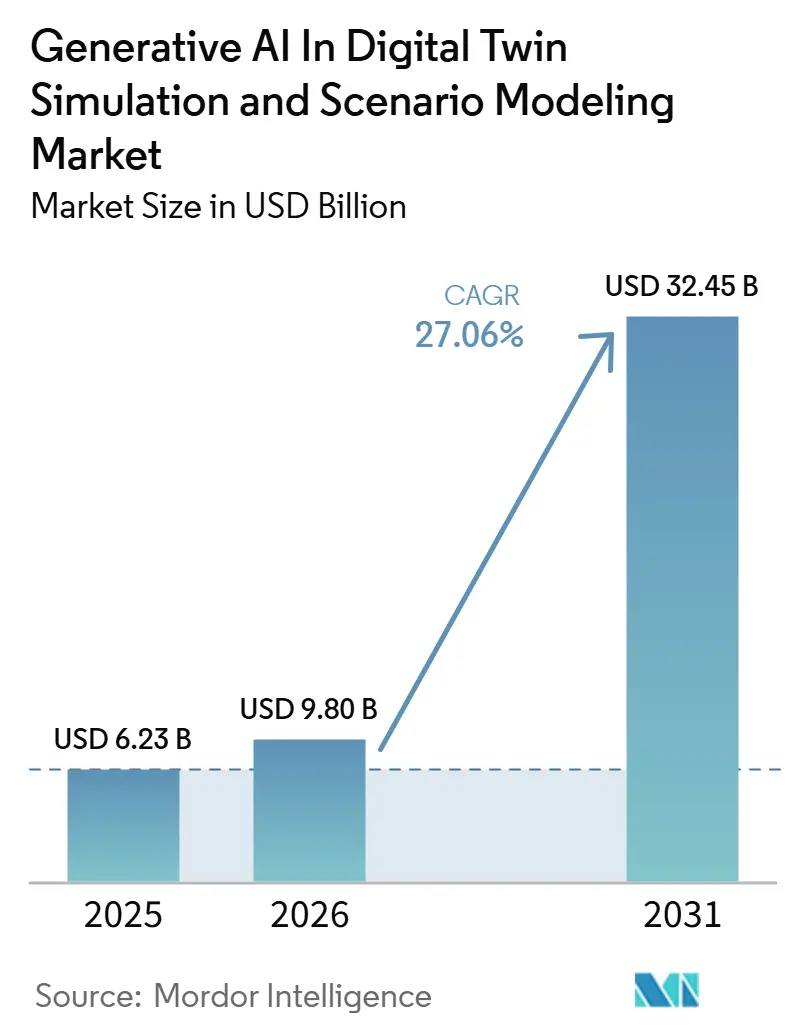
| Market Size (2026) | USD 9.80 Billion |
| Market Size (2031) | USD 32.45 Billion |
| Growth Rate (2026 - 2031) | 27.06 % |
| Fastest Growing Market | Asia-Pacific |
| Largest Market | North America |
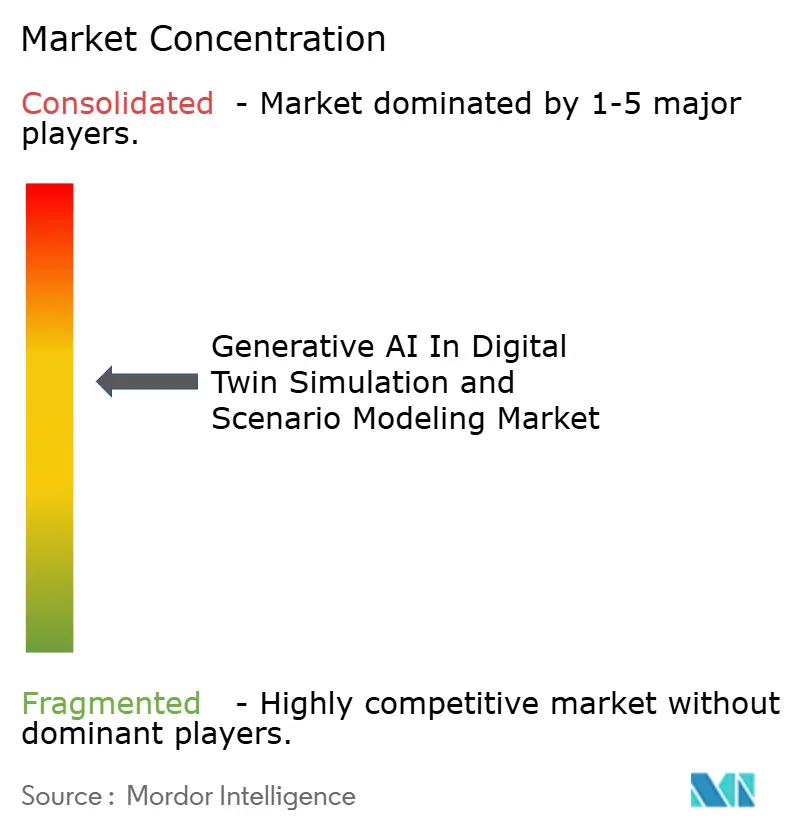
| Market Concentration | Medium |
Major Players *Disclaimer: Major Players sorted in no particular order Image © Mordor Intelligence. Reuse requires attribution under CC BY 4.0. | |
Generative AI In Digital Twin Simulation and Scenario Modeling Market Analysis by Mordor Intelligence
The generative AI in digital twin simulation and scenario modeling market size is expected to increase from USD 6.23 billion in 2025 to USD 9.80 billion in 2026 and reach USD 32.45 billion by 2031, growing at a CAGR of 27.06% over 2026-2031. The generative AI in digital twin simulation and scenario modeling is expanding as enterprises move from pilot use cases to full operational use, where virtual models are tied to live data, simulation tools, and decision workflows. The strongest demand is from companies seeking faster scenario testing, better design validation, and more reliable planning across production, maintenance, and asset operations. The generative AI in digital twin simulation and scenario modeling market is also becoming harder for smaller standalone vendors to enter, because major simulation software firms are now building deeper links with GPU providers and cloud platforms. At the same time, the generative AI in digital twin simulation and scenario modeling market still faces limits from validation cost, fragmented data systems, and governance gaps, which slow adoption in highly regulated settings. Even with those limits, the generative AI in digital twin simulation and scenario modeling market is opening wider opportunities for managed services, hybrid deployment models, and industry-specific tools that support scenario modeling at scale.
Key Report Takeaways
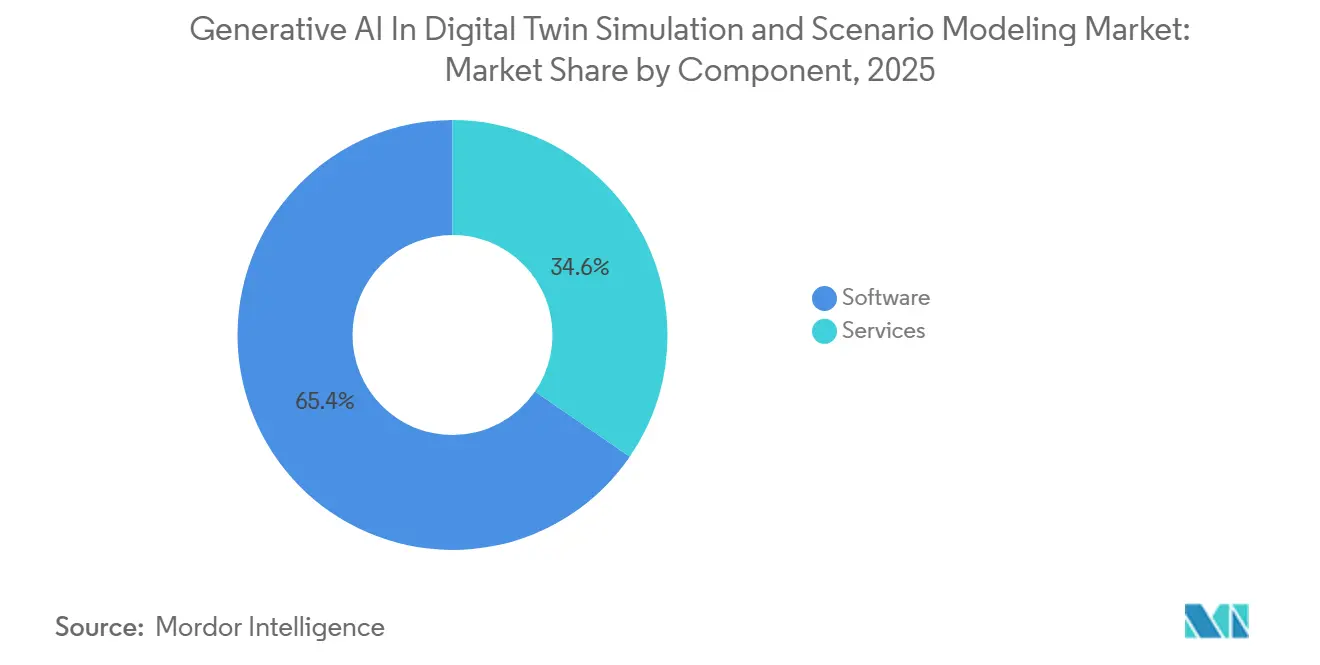
- By component, software led with a 65.43% share in 2025, while services are projected to expand at a 27.62% CAGR through 2031.
- By deployment mode, cloud accounted for 62.45% of the generative AI in digital twin simulation and scenario modeling market in 2025, while hybrid is expected to record the fastest CAGR of 27.92% through 2031.
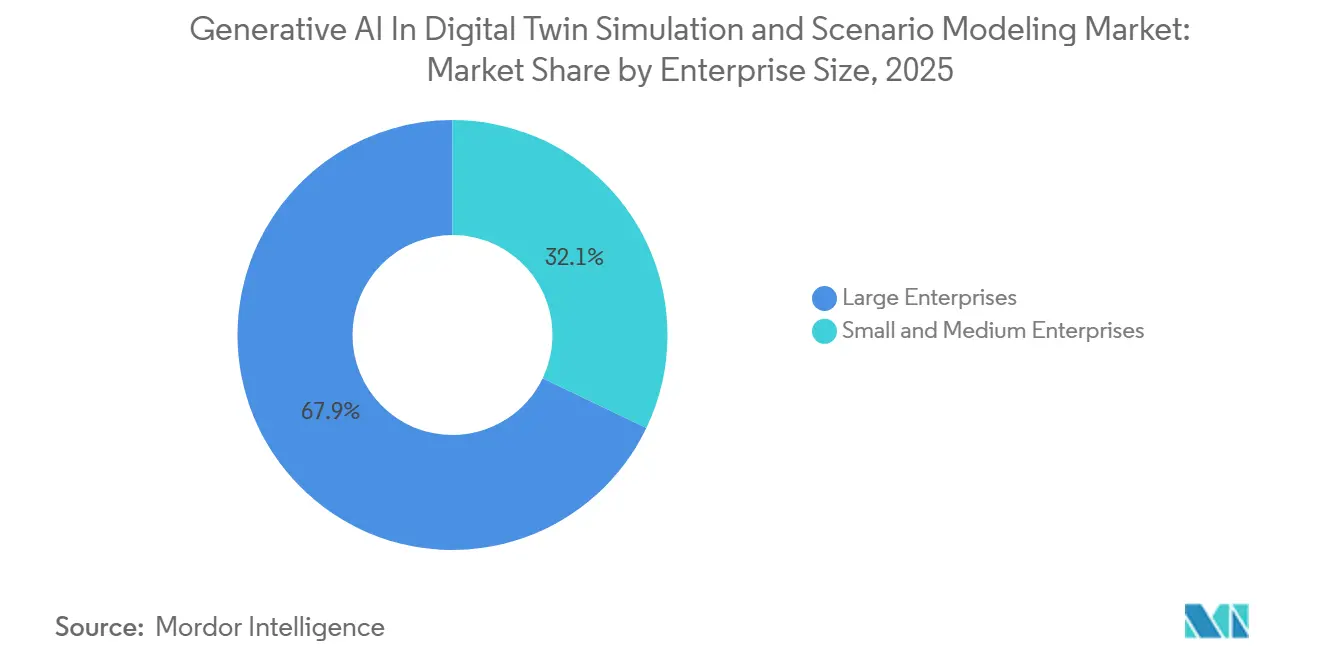
- By enterprise size, large enterprises held 67.89% share in 2025, while small and medium enterprises are projected to grow at a 28.12% CAGR through 2031.
- By application, design and simulation accounted for 37.89% share of the generative AI in digital twin simulation and scenario modeling market size in 2025, while scenario and what-if modeling is projected to expand at a 27.71% CAGR through 2031.
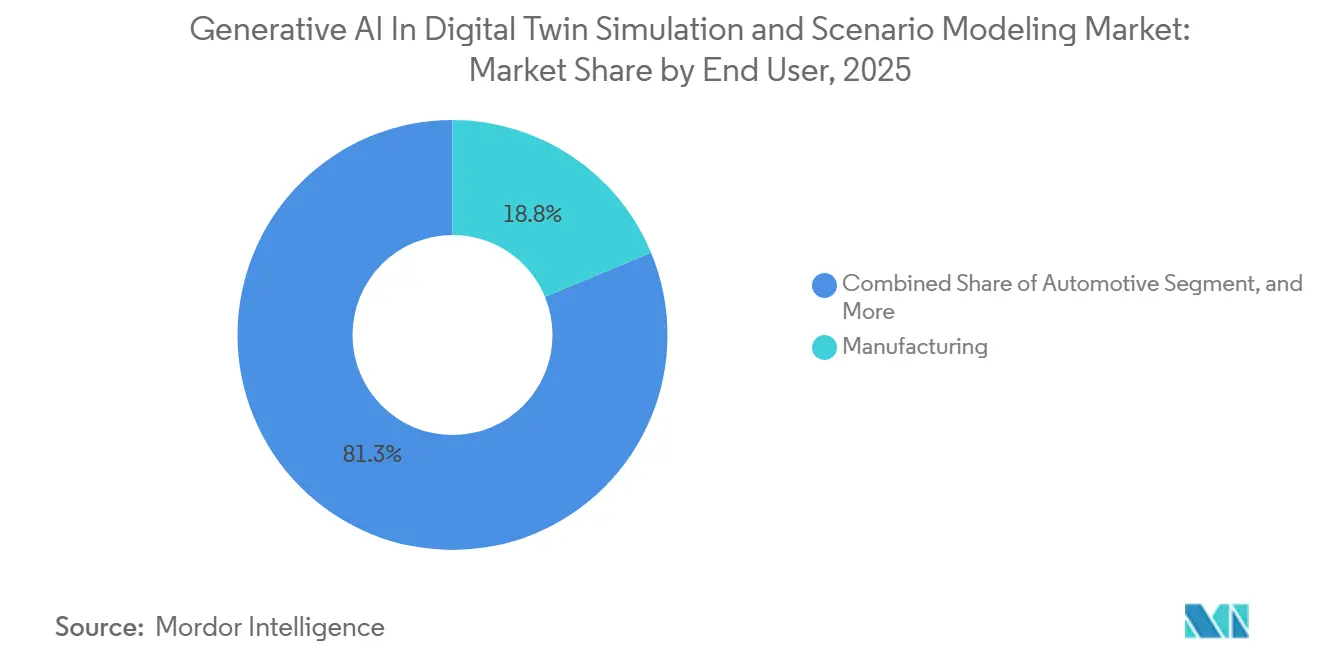
- By end user, manufacturing led with an 18.75% share in 2025, while aerospace and defense is expected to post the highest CAGR at 28.09% through 2031.
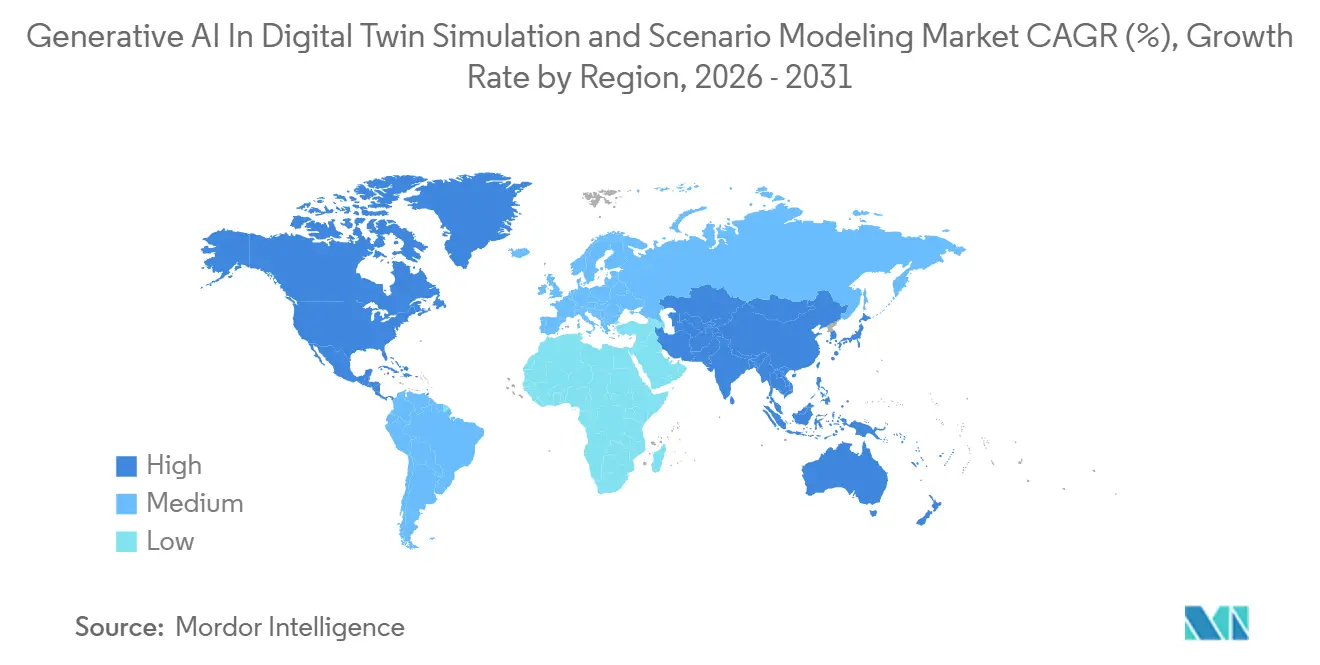
- By geography, North America held 36.78% share in 2025, while Asia-Pacific is projected to advance at a 28.34% CAGR through 2031.
Note: Market size and forecast figures in this report are generated using Mordor Intelligence’s proprietary estimation framework, updated with the latest available data and insights as of January 2026.
Market Trends and Insights
Drivers Impact Analysis of Generative AI In Digital Twin Simulation and Scenario Modeling Market*
| Driver | (~) % Impact on CAGR Forecast | Geographic Relevance | Impact Timeline |
|---|---|---|---|
| Rapid Enterprise Adoption of Generative AI Capabilities Across Industrial Platforms | +7.2% | Global, concentrated in North America and Europe | Short term (≤ 2 years) |
| Rising Demand for Scalable, Scenario-Based Decision-Making and Risk Simulation Tools | +5.3% | Global, with early gains in North America and Asia-Pacific | Medium term (2-4 years) |
| Cloud-Native Digital Transformation and Platform-as-a-Service Deployment Models | +4.6% | North America, Western Europe, and Asia-Pacific core | Short term (≤ 2 years) |
| Need for Accelerated Product Development and Compressed Time-to-Market | +3.8% | North America, Western Europe, and East Asia | Medium term (2-4 years) |
| Twin Data Exhaust from IoT, PLM, and Operational Systems | +3.2% | Global, concentrated in North America, Europe, and Asia-Pacific | Medium term (2-4 years) |
| Growth in Autonomous Operations and AI-Driven Self-Optimization in Industrial Settings | +2.8% | North America and EU, spill-over to East Asia | Long term (≥ 4 years) |
| Source: Mordor Intelligence | |||
Rapid Enterprise Adoption of Generative AI Capabilities Across Industrial Platforms
The generative AI in digital twin simulation and scenario modeling market is moving faster because industrial software vendors are adding generative models to simulation environments that enterprises already use at scale. This change reduces the time needed to test design options and operating scenarios, making simulation useful to a wider group of teams beyond specialist engineers. Siemens stated in January 2026 that Digital Twin Composer helped PepsiCo reach near-100% design validation, improve throughput by 20%, and reduce capital expenditure by 10-15% in early deployments. That shift makes proprietary operating data more valuable because the quality of AI-generated scenarios depends on the depth and relevance of the data that trains and updates the models. As a result, the generative AI in digital twin simulation and scenario modeling market is rewarding vendors that can combine physics models, industrial data, and high-performance computing into a single offering.
Rising Demand for Scalable, Scenario-Based Decision-Making and Risk Simulation Tools
The generative AI in digital twin simulation and scenario modeling market is also benefiting from the need to evaluate supply chain disruptions, maintenance risks, energy cost swings, and production tradeoffs far more often than static simulation tools can support. Companies now want digital twins that do not just reflect current conditions, but also generate plausible operating paths and compare them against business objectives. Airbus stated in April 2025 that its digital twin environment is used by more than 50,000 engineers to predict wear, optimize maintenance schedules, and reduce unplanned downtime across the aircraft lifecycle.[1]Airbus SE, “Digital Twins, Accelerating Aerospace Innovation from Design to Operations,” Airbus Newsroom, airbus.com Dassault Systèmes and Airbus also extended their strategic partnership in April 2025 to deploy the 3DEXPERIENCE platform across more than 20,000 users for future civil and military aircraft and helicopter programs.[2]Siemens AG, “Siemens Unveils Technologies to Accelerate the Industrial AI Revolution at CES 2026,” BusinessWire, businesswire.com This is widening the role of the generative AI in digital twin simulation and scenario modeling market beyond engineering teams and into broader planning, risk, and operational decision functions.
Cloud-Native Digital Transformation and Platform-as-a-Service Deployment Models
The generative AI in digital twin simulation and scenario modeling market is benefiting from cloud delivery, which removes the heavy upfront burden of dedicated simulation hardware and large in-house specialist teams. Platform-based delivery lets users scale compute up when they need large simulation runs, then scale down when workloads ease. Oracle stated in June 2025 that Oracle Cloud Infrastructure, integrated with NVIDIA DGX Cloud Lepton, offers on-demand and long-term GPU compute for AI training, inference, digital twins, and high-performance computing, including sovereign AI support.[3]Oracle Corporation, “Oracle and NVIDIA Help Enterprises and Developers Accelerate AI Innovation,” Oracle Newsroom At the same time, Siemens and NVIDIA are advancing a hybrid architecture in which cloud resources handle generative simulation at scale, while inference stays close to physical assets when latency matters. This balance between scalability, control, and compliance is making cloud-first and hybrid models central to the next phase of generative AI in digital twin simulation and scenario modeling.
Need for Accelerated Product Development and Compressed Time-to-Market
The generative AI in digital twin simulation and scenario modeling industry is being driven by companies seeking to shorten development cycles without increasing error rates or rework costs. Generative simulation helps teams compare design paths earlier, detect constraints faster, and reduce the number of physical prototypes needed before launch. Siemens reported in January 2026 that early Digital Twin Composer deployments reduced tasks that once took months to days while also improving validation and throughput in production planning. PTC also expanded this direction in June 2026 through Creo 13, which added an AI assistant and wider simulation coverage across assemblies and electronics scenarios to help engineers address problems before physical prototyping. This is one reason generative AI in digital twin simulation and scenario modeling is seeing faster service demand: firms still need external support to connect design tools, workflows, and operational data in a usable way.
Restraints Impact Analysis of Generative AI In Digital Twin Simulation and Scenario Modeling Market*
| Restraint | (~) % Impact on CAGR Forecast | Geographic Relevance | Impact Timeline |
|---|---|---|---|
| High Model Validation Costs and Technical Accuracy Barriers | -3.0% | Global, most acute in North America and Europe where certification standards are strictest | Medium term (2-4 years) |
| Fragmented Data Architecture and Cross-System Integration Gaps | -2.4% | Global, most pronounced in emerging markets and SME segments | Medium term (2-4 years) |
| Rising Compute Infrastructure Costs and Energy Intensity of AI Simulation | -1.8% | Global, with near-term pressure in energy-constrained markets | Short term (≤ 2 years) |
| Governance Gaps and Regulatory Uncertainty Surrounding Generative AI Decision Outputs | -1.3% | EU and North America, with spillover to Asia-Pacific | Long term (≥ 4 years) |
| Source: Mordor Intelligence | |||
High Model Validation Costs and Technical Accuracy Barriers
The generative AI in digital twin simulation and scenario modeling market still faces a major barrier in proving that AI-generated models reflect physical reality across a wide range of conditions. High-quality validation requires sensor data, physics checks, repeated testing, and review against real operating behavior, which keeps cost and time high even when model generation becomes faster. A 2025 peer-reviewed study in the Journal of Intelligent Manufacturing found that validation remained the main bottleneck to broader enterprise adoption even when generative AI accelerated digital twin design cycles.[4]Omar Mata, Pedro Ponce, Citlaly Perez, et al., “Digital Twin Designs with Generative AI, Crafting a Comprehensive Framework for Manufacturing Systems,” Journal of Intelligent Manufacturing This creates a difficult trade-off: firms that skip validation face operational and liability risks, while firms that perform full checks can struggle to justify the return on investment at scale. Because of that, the generative AI in digital twin simulation and scenario modeling market favors vendors that can automate more of the checking process and support regulated use cases with stronger evidence.
Fragmented Data Architecture and Cross-System Integration Gaps
The generative AI in digital twin simulation and scenario modeling market also depends on data quality and consistency across ERP, MES, IoT, and PLM environments, and many enterprises still lack that foundation. If data remains isolated across systems, digital twins cannot remain well synchronized enough to support continuous AI-driven scenario generation. A 2025 study in Computers identified inconsistent data formats, weak semantic structures, limited benchmarking protocols, and regional fragmentation as core barriers to interoperability and scale in intelligent digital twin systems. Schneider Electric, AVEVA, and ETAP joined the Alliance for OpenUSD in November 2025 to support more interoperable digital twin and 3D asset standards, demonstrating that vendors are addressing the problem at the ecosystem level. Even so, the generative AI in digital twin simulation and scenario modeling market is likely to feel this restraint for several years, especially in small and medium enterprises that lack large integration budgets.
*Our forecasts treat driver/restraint impacts as directional, not additive. The impact forecasts reflect baseline growth, mix effects, and variable interactions.
Generative AI In Digital Twin Simulation and Scenario Modeling Market Segment Analysis
By Component:
Software Anchors Platform Revenue While Services Redefine Value CreationSoftware held 65.43% of the generative AI in digital twin simulation and scenario modeling market share in 2025, which reflected the central role of simulation engines, AI orchestration layers, and lifecycle data management tools in enterprise deployments. Software remains the revenue anchor because customers usually start with the core platform before expanding into higher-value scenario libraries, model management, and workflow integration. As more assets, production lines, and design histories move into the same environment, the underlying platform becomes harder to replace and more useful over time. This dynamic keeps software in a leading position across the generative AI in digital twin simulation and scenario modeling market, even as the mix of value is changing.
Services are projected to grow at a 27.62% CAGR through 2031, which shows how quickly buyers are asking for help with fine-tuning, ongoing model operations, and system-level integration. The shift is important because competitive advantage is moving away from one-time deployment work toward continuous model improvement in live operating settings. PTC reinforced that direction in June 2026 with PTC Orbit, a cloud-native asset intelligence solution that connected PLM, ERP, CRM, IoT, EAM, and FSM systems into a unified AI-powered asset record. That kind of release shows why the generative AI in digital twin simulation and scenario modeling market is creating more room for recurring service revenue, because customers need support after deployment, not just during initial installation.


By Deployment Mode:
Cloud Leads While Hybrid Gains Strategic WeightCloud accounted for a 62.45% share in 2025, reflecting enterprise preference for scalable GPU access, lower upfront costs, and easier links to AI model-serving environments. The cloud model fits well with generative simulation because usage often occurs in bursts when teams run large batches of scenarios, compare design alternatives, or test multiple operating conditions in parallel. It also reduces the need for organizations to build and maintain their own high-end simulation infrastructure. That cost and access advantage keeps cloud at the center of the generative AI in digital twin simulation and scenario modeling market as adoption widens across industries.
Hybrid is the fastest-growing deployment mode, with a 27.92% CAGR for 2026-2031, because many users need real-time inference near physical assets while still relying on the cloud for large-scale model training and rendering. Siemens and NVIDIA expanded their partnership in January 2026 to build an Industrial AI Operating System that combined GPU acceleration with simulation and inference across industrial environments. This model is especially relevant when firms face latency constraints, data residency rules, or site-level control requirements. For that reason, the generative AI in digital twin simulation and scenario modeling market is likely to keep cloud as the largest mode while hybrid becomes the preferred architecture for more complex industrial operations.
By Enterprise Size:
Large Enterprises Lead Adoption While SMEs Expand the User BaseLarge enterprises held a 67.89% share in 2025 because full digital twin deployments have usually required capital, deep integration, and specialist staff that larger organizations can support more easily. These companies also operate in sectors where even small gains in design accuracy, throughput, or downtime reduction can justify meaningful investment. Long procurement cycles and multi-year agreements with major platform vendors add further staying power to their position. This keeps large organizations at the core of the generative AI in digital twin simulation and scenario modeling market in the current phase of adoption.
Small and medium enterprises are projected to grow at a 28.12% CAGR through 2031, as modular and cloud-based tools lower the entry barrier for firms without dedicated simulation teams. A 2026 study in Advanced Engineering Informatics found that modular digital twin strategies in SME manufacturing settings could reduce average downtime-related costs by up to 83% and average repair time by up to 42% compared with reactive maintenance approaches. That evidence matters because it turns adoption from a long-term aspiration into a more practical investment case for smaller firms. As a result, the generative AI in digital twin simulation and scenario modeling market is broadening from a large-enterprise base toward a much wider user population, even though SMEs still face data and integration constraints.
By Application:
Design and Simulation Remains the Core Use Case While Scenario Modeling Gains GroundDesign and simulation accounted for 37.89% of the market in 2025, indicating that virtual engineering remained the primary commercial foundation for this field. The segment leads because manufacturers already understand the value of testing designs before production, and generative AI makes that process faster and more flexible. PTC strengthened this use case in June 2026 through Creo 13, which added an AI assistant and broader simulation support across assemblies and electronics scenarios. That steady product expansion keeps design and simulation central to the generative AI in digital twin simulation and scenario modeling market, especially in engineering-heavy sectors.
Scenario and what-if modeling is set to expand at a 27.71% CAGR through 2031, driven by the need to test multiple future operating states quickly across supply chain, maintenance, energy, and risk functions. This part of the market is growing because firms now want digital twins that can compare many possible outcomes rather than simply describe the current condition of an asset or system. Airbus has already used digital twins to support predictive models for maintenance and wear across the aircraft lifecycle, demonstrating how scenario tools can move from engineering into ongoing operational decision support. That shift suggests the generative AI in digital twin simulation and scenario modeling market will keep expanding into cross-functional planning environments where simulation, optimization, and decision logic are used together.
By End User:
Manufacturing Leads Revenue While Aerospace and Defense Posts the Fastest GrowthManufacturing accounted for 18.75% share in 2025, making it the largest end user segment because the sector benefits directly from better design validation, lower defect risk, higher throughput, and tighter control of production performance. The value case is clear in manufacturing, where digital twins can support both product development and plant-level operations within a single, broad workflow. This segment also benefits from long-established use of simulation and automation, which makes adoption easier than in less mature sectors. That position keeps manufacturing at the front of the generative AI in digital twin simulation and scenario modeling market by current revenue contribution.
Aerospace and defense is projected to grow at a 28.09% CAGR through 2031, which reflects both high-value use cases and the need for better lifecycle decision support across complex systems. Dassault Systèmes and Airbus extended their strategic partnership in April 2025 to use the 3DEXPERIENCE platform across more than 20,000 users for future aircraft and helicopter programs, including sovereign cloud and on-premises deployment options. A 2025 IEEE conference paper also presented a framework for generative AI-powered digital twins in aviation, which shows that domain-specific research is moving in step with commercial adoption. Because of those factors, the generative AI in digital twin simulation and scenario modeling market is likely to see aerospace and defense remain one of the most active growth areas through the forecast period.

Geography Analysis
North America Generative AI in Digital Twin Simulation and Scenario Modeling Market
North America held 36.78% of the generative AI in digital twin simulation and scenario modeling in 2025, making it the largest regional contributor. The region benefits from strong enterprise software adoption, deep access to GPU and cloud infrastructure, and close ties between industrial software vendors and large corporate users. The United States remains the center of this position, supported by active development work around Siemens, NVIDIA, PTC, and other platform ecosystems. Siemens and NVIDIA stated in January 2026 that customers such as PepsiCo were already using combined capabilities tied to the Industrial AI Operating System direction, which reflects how quickly production-linked use cases are moving into real deployments.
APAC Generative AI in Digital Twin Simulation and Scenario Modeling Market
Asia-Pacific is projected to expand at a 28.34% CAGR through 2031, which makes it the fastest-growing regional segment in the generative AI in digital twin simulation and scenario modeling market. China, Japan, South Korea, and India form the core of this growth corridor, each with different strengths in manufacturing, engineering talent, or technology services. China is pushing industrial digitalization across major manufacturing sectors, while Japan is using advanced simulation and automation to offset labor constraints and protect export competitiveness. South Korea brings strong use cases in semiconductors and shipbuilding, where process quality and scenario testing carry high value. India is emerging as an important services-layer base for the generative AI in digital twin simulation and scenario modeling market, because its IT services ecosystem can support managed simulation delivery for global clients.
EMEA and South America Generative AI in Digital Twin Simulation and Scenario Modeling Market
Europe held a significant share in 2025, led by Germany, France, the United Kingdom, Italy, and Spain, where precision manufacturing and process industries continue to support demand for advanced simulation environments. The region is also shaping deployment choices through GDPR and EU AI Act compliance needs, which makes hybrid and sovereign cloud models more relevant than in some other markets. Schneider Electric, AVEVA, and ETAP joined the Alliance for OpenUSD in November 2025, which signaled a clear push toward interoperability standards across the European industrial software base. South America remains earlier in adoption, with Brazil showing the clearest demand path through oil and gas and agricultural equipment manufacturing. The Middle East and Africa are still less penetrated, but Saudi Arabia, the UAE, Turkey, South Africa, and Egypt are building longer-term demand through infrastructure, energy, and industrial modernization programs, which keeps the generative AI in digital twin simulation and scenario modeling market relevant in these regions even from a smaller base.

Competitive Landscape
The generative AI in digital twin simulation and scenario modeling market shows moderate concentration at the platform layer, where Siemens AG, Dassault Systèmes SE, Microsoft Corporation, NVIDIA Corporation, and PTC Inc. hold strong positions through integrated product ecosystems and long enterprise relationships. These firms compete by linking simulation software, industrial data, AI models, and compute infrastructure into broader operating environments that are difficult to replace once deployed. The main strategic pattern in the generative AI in digital twin simulation and scenario modeling market is not simple product expansion, but tighter control over the full chain from model development to deployment and ongoing optimization. That is raising entry barriers for smaller firms that lack access to industrial training data, installed customer bases, or large-scale compute partnerships.
Siemens and NVIDIA expanded their partnership in January 2026 to build the Industrial AI Operating System, which moved the competitive focus toward autonomous simulation and adaptive manufacturing environments. Dassault Systèmes and NVIDIA announced a long-term strategic partnership in February 2026 to build an industrial AI platform for virtual twins and science-validated industry world models, which shows how competition is shifting toward deeper model and platform integration. SAP and NVIDIA also expanded their partnership in March 2026 by embedding NVIDIA NIM microservices into SAP AI Core and the generative AI hub, which pushed simulation intelligence closer to ERP and planning workflows. PTC and NVIDIA introduced a robotics design-to-simulation workflow in March 2026 by connecting Onshape with NVIDIA Isaac Sim, which showed how design environments and physical AI training tools are becoming more tightly linked. Together, these moves show that the generative AI in digital twin simulation and scenario modeling market is being defined by ecosystem depth as much as by individual software features.
At the same time, the generative AI in digital twin simulation and scenario modeling market still has open space in healthcare, smart cities, retail, and other vertical tools where adoption remains less mature than in manufacturing and aerospace. Emerging vendors can still compete in these areas by offering lower-cost, more focused products built around specific workflows or domain models. Schneider Electric, through AVEVA and with NVIDIA, introduced a lifecycle digital twin architecture for large-scale AI factories in March 2026, which shows how incumbents are also moving into specialized infrastructure-linked scenarios. No clearly irrelevant companies were identified in the listed competitive set, because each named firm participates directly through platform software, cloud and AI infrastructure, enterprise systems, or industrial simulation and operations capabilities.
Generative AI In Digital Twin Simulation and Scenario Modeling Industry Leaders
Siemens AG
NVIDIA Corporation
Microsoft Corporation
PTC Inc.
Dassault Systèmes SE
- *Disclaimer: Major Players sorted in no particular order
Generative AI In Digital Twin Simulation and Scenario Modeling Market Companies Covered in this Report
- Siemens AG
- NVIDIA Corporation
- Microsoft Corporation
- PTC Inc.
- Dassault Systemes SE
- ANSYS, Inc.
- IBM Corporation
- SAP SE
- Autodesk, Inc.
- Amazon Web Services, Inc.
- Rockwell Automation, Inc.
- Schneider Electric SE
- Bentley Systems, Incorporated
- Hexagon AB
- General Electric Company
- Oracle Corporation
- Honeywell International Inc.
- Emerson Electric Co.
- Altair Engineering Inc.
- AVEVA Group Limited

Recent Industry Developments in Generative AI In Digital Twin Simulation and Scenario Modeling Market
- June 2026: PTC launched PTC Orbit, a cloud-native asset intelligence solution connecting PLM, ERP, CRM, IoT, EAM, and FSM systems into a unified, AI-powered asset record. The solution applies AI to detect service patterns, calculate asset health scores, and forecast maintenance demand, extending PTC's Intelligent Product Lifecycle platform into AI-augmented digital twin operations management and closing the visibility gap between designed and maintained product states.
- March 2026: Schneider Electric, through AVEVA and in partnership with NVIDIA, unveiled a lifecycle digital twin architecture embedded throughout the NVIDIA Omniverse DSX Blueprint for large-scale AI factories, targeting maximization of GPU efficiency and acceleration of AI factory deployment timelines at gigawatt scale.
- March 2026: PTC and NVIDIA introduced a robotics design-to-simulation workflow connecting PTC's Onshape cloud-native CAD platform with NVIDIA Isaac Sim at NVIDIA GTC 2026, enabling teams to simulate robot designs while maintaining a single source of product truth and supporting physical AI training via NVIDIA Isaac Lab.
- January 2026: Siemens launched Digital Twin Composer at CES 2026, a software solution building Industrial Metaverse environments at scale using NVIDIA Omniverse libraries and real-time physical data. Early adopter, PepsiCo reported a 20% increase in throughput, near-100% design validation, and a 10-15% reduction in capital expenditures. Siemens confirmed the solution will be available via the Siemens Xcelerator Marketplace in mid-2026.


Global Generative AI In Digital Twin Simulation and Scenario Modeling Market Report Scope
The Generative AI in Digital Twin Simulation and Scenario Modeling Market Report is Segmented by Component (Software, and Services), Deployment Mode (Cloud, On-Premises, and Hybrid), Enterprise Size (Large Enterprises, and SMEs), Application (Predictive Maintenance, Design/Simulation, What-If Modeling, and Optimization), End User (Manufacturing, Automotive, Aerospace and Defense, Energy and Utilities, Healthcare and Life Sciences, Telecommunications, Smart Cities and Infrastructure, Retail and E-Commerce, and Others End Users), and Geography (North America, South America, Europe, Asia-Pacific, Middle East, and Africa). The Market Forecasts are Provided in Terms of Value (USD).
| Software |
| Services |
| Cloud |
| On-Premises |
| Hybrid |
| Small and Medium Enterprises |
| Large Enterprises |
| Predictive Maintenance |
| Design and Simulation |
| Scenario/"What-If" Modeling |
| Optimization |
| Manufacturing |
| Automotive |
| Aerospace and Defense |
| Energy and Utilities |
| Healthcare and Life Sciences |
| Telecommunications and IT |
| Smart Cities and Infrastructure |
| Retail and E-Commerce |
| Other End Users |
| North America | United States |
| Canada | |
| Mexico | |
| South America | Brazil |
| Argentina | |
| Rest of South America | |
| Europe | Germany |
| United Kingdom | |
| France | |
| Italy | |
| Spain | |
| Russia | |
| Rest of Europe | |
| Asia-Pacific | China |
| Japan | |
| India | |
| South Korea | |
| Australia | |
| Rest of Asia-Pacific | |
| Middle East | Saudi Arabia |
| United Arab Emirates | |
| Turkey | |
| Rest of Middle East | |
| Africa | South Africa |
| Egypt | |
| Rest of Africa |
| By Component | Software | |
| Services | ||
| By Deployment Mode | Cloud | |
| On-Premises | ||
| Hybrid | ||
| By Enterprise Size | Small and Medium Enterprises | |
| Large Enterprises | ||
| By Application | Predictive Maintenance | |
| Design and Simulation | ||
| Scenario/"What-If" Modeling | ||
| Optimization | ||
| By End User | Manufacturing | |
| Automotive | ||
| Aerospace and Defense | ||
| Energy and Utilities | ||
| Healthcare and Life Sciences | ||
| Telecommunications and IT | ||
| Smart Cities and Infrastructure | ||
| Retail and E-Commerce | ||
| Other End Users | ||
| By Geography | North America | United States |
| Canada | ||
| Mexico | ||
| South America | Brazil | |
| Argentina | ||
| Rest of South America | ||
| Europe | Germany | |
| United Kingdom | ||
| France | ||
| Italy | ||
| Spain | ||
| Russia | ||
| Rest of Europe | ||
| Asia-Pacific | China | |
| Japan | ||
| India | ||
| South Korea | ||
| Australia | ||
| Rest of Asia-Pacific | ||
| Middle East | Saudi Arabia | |
| United Arab Emirates | ||
| Turkey | ||
| Rest of Middle East | ||
| Africa | South Africa | |
| Egypt | ||
| Rest of Africa | ||


Key Questions Answered in the Report
What is the size of the generative AI in digital twin simulation and scenario modeling market in 2026 and where is it expected to reach by 2031?
The generative AI in digital twin simulation and scenario modeling market stood at USD 9.80 billion in 2026 and is projected to reach USD 32.45 billion by 2031, growing at a 27.06% CAGR over 2026-2031.
Which component leads revenue generation in this field?
Software led in 2025 with a 65.43% share, supported by simulation engines, AI orchestration layers, and lifecycle data management tools.
Which deployment model is growing the fastest?
Hybrid is projected to grow the fastest at a 27.92% CAGR through 2031 because firms want cloud scalability while keeping some inference close to physical assets.
Why are small and medium enterprises becoming more important here?
SMEs are forecast to expand at a 28.12% CAGR as modular, cloud-based tools reduce entry barriers and make digital twin adoption more practical for smaller operations.
Which application area currently leads adoption?
Design and simulation led with a 37.89% share in 2025 because virtual engineering remains the most established use case across manufacturing, automotive, and aerospace settings.
Which region offers the fastest expansion outlook?
Asia-Pacific is expected to post the highest regional CAGR at 28.34% through 2031, supported by growth across China, Japan, South Korea, and India.
Page last updated on:





