
GCC Staycation Market Size and Share
Market Overview
| Study Period | 2021 - 2031 |
|---|---|
| Forecast Data Period | 2026 - 2031 |
| Base Year Market Size (2025) | USD 23.15 Billion |
| Market Size (2026) | USD 23.38 Billion |
| Market Size (2031) | USD 29.89 Billion |
| Growth Rate (2026 - 2031) | 5.04 % |
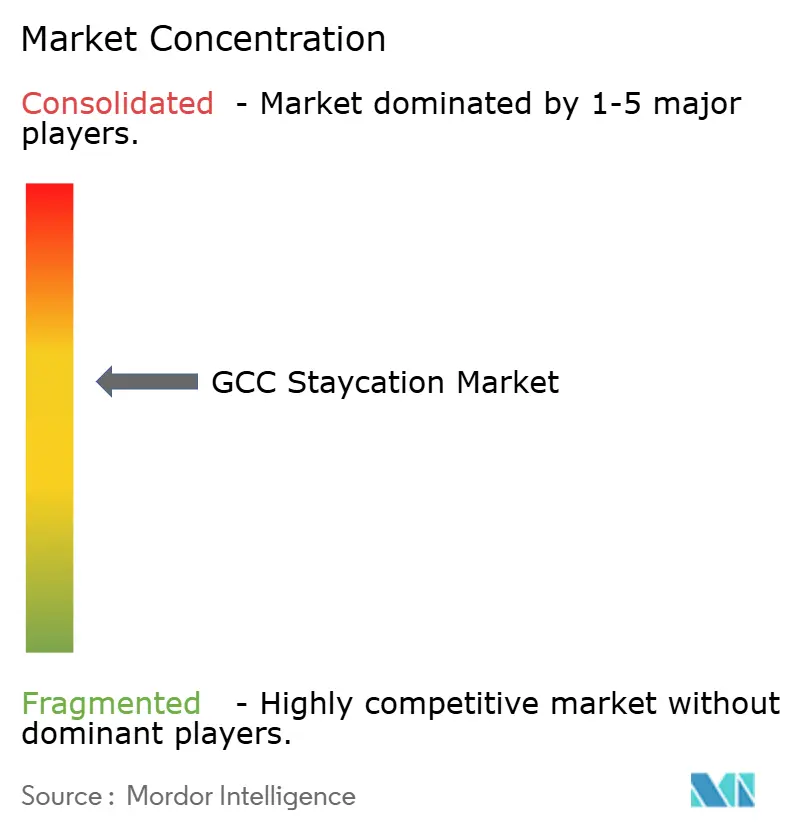
| Market Concentration | Medium |
Major Players *Disclaimer: Major Players sorted in no particular order Image © Mordor Intelligence. Reuse requires attribution under CC BY 4.0. | |
GCC Staycation Market Analysis by Mordor Intelligence
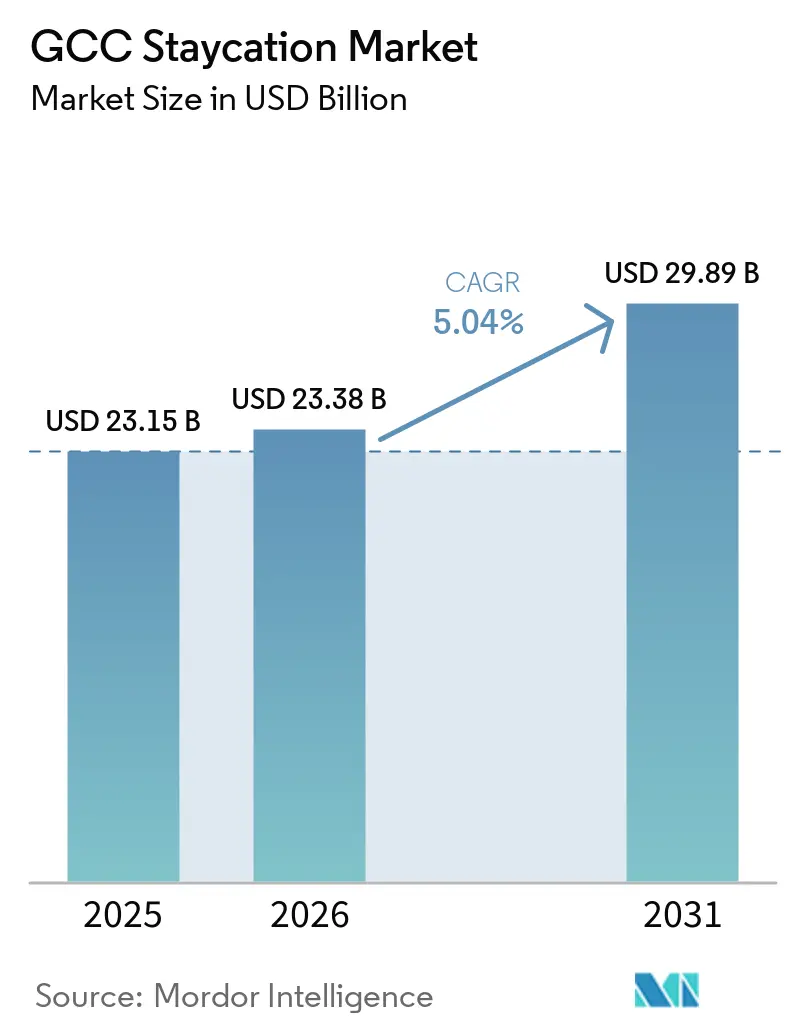
The GCC staycation market was valued at USD 23.15 billion in 2025 and estimated to grow from USD 23.38 billion in 2026 to reach USD 29.89 billion by 2031, at a CAGR of 5.04% during the forecast period (2026-2031). Residents in the six GCC countries are increasingly choosing domestic and nearby regional destinations for short breaks over outbound travel. Regional disruptions in 2026, such as airspace closures and uncertainties, reinforced this preference, making local travel a reliable option for households. Domestic tourism in Saudi Arabia reached 28.9 million visitors in Q1 2026, with spending reaching SAR 34.7 billion (USD 9.25 billion), reflecting a 16% and 8% year-on-year increase, respectively[1]. This demand is supported by actual spending behavior rather than marketing efforts. On the supply side, the Middle East hotel construction pipeline included 710 projects and 176,402 rooms by Q4 2025, with 394 projects in Saudi Arabia. While this expansion increases options, it also pressures room rates and occupancy strategies. Growth is supported by digital booking adoption, investments in secondary destinations, and stronger domestic travel habits. However, seasonal demand concentration, peak-period rate inflation, and cross-border frictions continue to limit faster growth.
Key Report Takeaways
- By accommodation type, Hotels and Resorts commanded a 48.93% share of the GCC Staycation Market in 2025, while Desert Camps and Boutique Retreats are projected to grow at the highest CAGR of 5.65% in the GCC Staycation Market by 2031.
- By traveler type, Families commanded a 38.51% share of the GCC Staycation Market in 2025, while Couples are projected to grow at the highest CAGR of 5.97% in the GCC Staycation Market by 2031.
- By booking channel, Direct Digital Booking commanded a 46.84% share of the GCC Staycation Market in 2025, while also recording the highest expected growth at a 6.74% CAGR in the GCC Staycation Market by 2031.
- By purpose and theme, Leisure and Weekend Getaways commanded a 42.79% share of the GCC Staycation Market in 2025, while Wellness and Spa Retreats are projected to grow at the highest CAGR of 6.12% in the GCC Staycation Market by 2031.
- By geography, Saudi Arabia commanded a 35.64% share of the GCC Staycation Market in 2025, while the UAE is projected to grow at the highest CAGR of 5.94% in the GCC Staycation Market by 2031.
Note: Market size and forecast figures in this report are generated using Mordor Intelligence’s proprietary estimation framework, updated with the latest available data and insights as of January 2026.
GCC Staycation Market Trends and Insights
Drivers Impact Analysis*
| Driver | (~) % Impact on CAGR Forecast | Geographic Relevance | Impact Timeline |
|---|---|---|---|
| Rising Intra-GCC Domestic Travel | +1.4% | GCC-wide, particularly Saudi Arabia, UAE, Qatar | Short term (≤ 2 years) |
| Visa Liberalization and Cross-Border Mobility | +0.8% | GCC-wide, strongest for Kuwait and Bahrain inbound flows | Medium term (2-4 years) |
| Shift Toward Curated, Culture-Led Short Breaks | +0.7% | Saudi Arabia, UAE, Oman | Medium term (2-4 years) |
| Growth of Wellness, Luxury, and Family-Centric Packages | +1.0% | UAE, Saudi Arabia, Qatar | Short term (≤ 2 years) to Medium term (2-4 years) |
| Expansion of Digital Discovery and Direct Booking Behavior | +0.9% | Saudi Arabia, UAE, with spillover to Kuwait and Bahrain | Short term (≤ 2 years) |
| Public and Private Tourism Investment in Secondary Destinations | +0.7% | Saudi Arabia, UAE, Oman | Long term (≥ 4 years) |
| Source: Mordor Intelligence | |||
Rising Intra-GCC Domestic Travel
Intra-GCC travel accounted for a significant portion of the bloc's total international tourist flows in 2024, with strong growth observed over the preceding years. This trend reflects the increasing reliance on internal travel within the GCC, reducing dependence on long-haul arrivals that are more susceptible to external factors such as currency fluctuations, political instability, and travel restrictions. The shift has enabled hotel operators in both major cities and smaller destinations to retain regional leisure spending that previously went to other regions. Domestic tourism spending in Saudi Arabia saw notable growth in 2025, supported by initiatives aimed at enhancing local travel options. The Saudi Tourism Authority’s campaign introduced additional domestic flight seats and new tourism experiences, further strengthening the GCC staycation market and providing travelers with expanded choices within the region[2].
Visa Liberalization and Cross-Border Mobility
Visa policies are directly supporting the GCC staycation market by enabling easier movement, which increases the number of residents interested in short regional trips. Kuwait’s Ministry of Interior introduced a directive allowing GCC-resident expatriates to obtain a 90-day tourist visa on arrival at all entry points, significantly expanding the traveler base[3]. The GCC Grand Tours Visa is expected to simplify multi-country travel planning, as its legal and technical framework is nearly aligned across participating authorities. These changes also enhance hotel bookings, as travelers often require confirmed accommodations for trip planning and documentation. Operators with efficient digital inventory systems and seamless confirmation processes are well-positioned to convert increased mobility into bookings within the GCC staycation market.
Shift Toward Curated, Culture-Led Short Breaks
The GCC staycation market is shifting from repetitive urban hotel stays to culturally distinct short breaks. Al Ain’s designation as the Gulf Tourism Capital for 2025 highlights efforts to redirect leisure demand toward heritage-rich secondary destinations instead of focusing solely on major capitals. Abu Dhabi’s culture and tourism sector reported significant visitor arrivals in 2025, with Al Ain experiencing a 9% year-on-year increase in hotel guests, driven by leisure tourism. In Saudi Arabia, destinations such as AlUla and the Red Sea project recorded notable booking growth in early 2026, reflecting a broader preference for immersive travel experiences. This trend is expanding the appeal of the GCC staycation market by integrating cultural depth and unique destination characteristics into its value proposition.
Growth of Wellness, Luxury, and Family-Centric Packages
Package design is driving growth in the GCC staycation market as wellness, luxury, and family travel are increasingly offered as comprehensive short-break experiences rather than simple room bookings. The Global Wellness Institute highlights the Middle East as the fastest-growing region for wellness tourism spending, reflecting rising demand for wellness-focused hospitality. Qatar’s Zulal Wellness Resort by Chiva-Som introduced its Body Transformation Retreat, offering seven-night stays with all-inclusive treatment access, showcasing how operators are creating higher-value resident packages. Family-oriented offerings are also evolving, with hotels such as Dusit Thani Abu Dhabi including Yas Island access in multi-night Eid packages to encourage longer stays and enhance value. These strategies help properties increase per-night spending while providing residents with compelling reasons to choose domestic leisure over outbound trips.
Restraints Impact Analysis*
| Restraint | (~) % Impact on CAGR Forecast | Geographic Relevance | Impact Timeline |
|---|---|---|---|
| Seasonality and Weather-Driven Demand Concentration | -0.9% | GCC-wide, most acute in Saudi Arabia, Kuwait, UAE | Short term (≤ 2 years) |
| Limited Novelty in Repeated Weekend Destinations | -0.6% | UAE, especially Dubai, and Saudi Arabia | Medium term (2-4 years) |
| Hotel Rate Inflation in Peak Leisure Windows | -0.8% | UAE, especially Dubai and Abu Dhabi, and Saudi Arabia, especially Riyadh | Short term (≤ 2 years) |
| Connectivity and Border Friction Across GCC Routes | -0.5% | Kuwait-Saudi and Bahrain-Qatar corridors | Medium term (2-4 years) |
| Source: Mordor Intelligence | |||
Seasonality and Weather-Driven Demand Concentration
Seasonality significantly impacts the GCC staycation market, concentrating demand into specific months. Dragonpass data indicates most GCC travel occurs between June and November, with March being the only month where all six GCC markets experienced a simultaneous slowdown[4]. This demand concentration boosts peak-season revenues but complicates monetization during off-peak periods and increases pricing volatility. Hotels have introduced summer packages, bundling offerings such as food and beverage credits, spa access, and waterpark entry to sustain booking values during less favorable outdoor conditions. However, extreme summer heat continues to limit demand for desert camps, adventure retreats, and coastal villas for several months each year, despite these efforts.
Limited Novelty in Repeated Weekend Destinations
Destination fatigue remains a challenge for the GCC staycation market, particularly in frequently visited weekend destinations. In familiar city markets, repeat visitors may perceive short-break options as repetitive, especially when hotels rely on standard room-and-pool packages. This issue is evident in Dubai and parts of Saudi Arabia, where attracting repeat guests becomes difficult without offering new experiences, engaging events, or unique destination narratives. The increasing appeal of locations such as Al Ain, AlUla, Hatta, the Red Sea, and Ras Al Khaimah highlights the demand for novelty. Travelers are showing a stronger preference for heritage, nature, and wellness-focused stays over routine urban weekend getaways. Properties that fail to innovate and refresh their offerings face a higher risk of reduced repeat visits within the GCC staycation market.
*Our forecasts treat driver/restraint impacts as directional, not additive. The impact forecasts reflect baseline growth, mix effects, and variable interactions.
Segment Analysis
By Accommodation Type: Hotels Drive Revenue, Desert Retreats Lead Growth
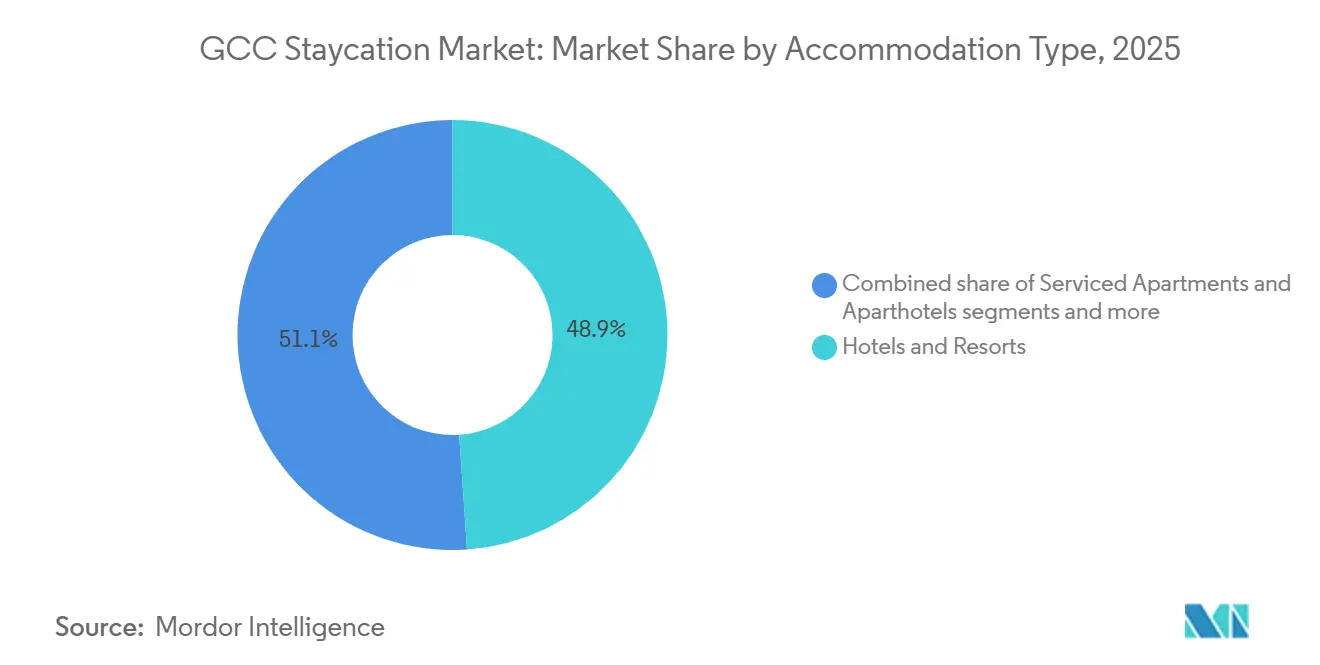
Hotels and Resorts accounted for 48.93% of the GCC staycation market share in 2025, driven by branded distribution, loyalty programs, and family-friendly offers during Eid and national holidays. These establishments dominate the market as residents prefer leisure packages with dining, children’s amenities, and consistent service. Major hotel brands benefit from visibility through direct channels and OTAs, making them easier to book compared to independent options. Their presence is strong in cities like Dubai, Abu Dhabi, and Riyadh, where branded hospitality sets the standard for domestic leisure. Many households prioritize familiar hotel formats over alternative accommodations for short breaks.
Desert Camps and Boutique Retreats are forecast to grow at a 5.65% CAGR from 2026 to 2031, making them the fastest-growing accommodation type in the GCC staycation market. Their appeal lies in offering immersion, privacy, and unique destination experiences. Sharjah’s retreat portfolio, including Nomad, Moon Retreat, Kingfisher Retreat, and Al Badayer Retreat, showcases how natural and heritage landscapes are being developed into short-break destinations. The expansion of glamping and experiential lodging, such as Our Habitas’ planned 50-unit Airstream site in Hatta by December 2026, reflects this trend, though these formats remain smaller in scale compared to urban hotels.
Serviced Apartments and Aparthotels meet the needs of families and extended leisure travelers by offering flexibility and longer stays. Saudi Arabia’s domestic tourists averaged 18.6 nights in 2025, indicating demand beyond weekend trips. Apartment-style accommodations cater to travelers seeking space, kitchen access, and cost control. Vacation Rentals and Short-Term Stays are also expanding, with Saudi Arabia’s 1,250% rise in rural lodge and private home licenses between 2024 and 2025, diversifying value-driven options in the GCC staycation market.

By Traveler Type: Family Demand Anchors Volume, Couples Redefine Premium
Families accounted for 38.51% of the GCC staycation market in 2025, reflecting household structures, young demographics, and the significance of school breaks, Eid periods, and multi-generational travel. Hotels in the region have adapted by offering waterparks, interconnecting rooms, suites, kids’ clubs, and activity-focused weekend packages. In the UAE, there was a more than 40% year-on-year increase in demand for interconnecting rooms and suites during the 2025 summer, with domestic leisure travel rising to 35% of total occupancy from 28% the previous year. Family travel drives volume and influences room design, package offerings, and amenities. Its predictable nature during holiday periods provides operators with a stable domestic base compared to discretionary demand.
Couples are projected to grow at a 5.97% CAGR from 2026 to 2031, becoming the fastest-growing segment in the GCC staycation market. This growth is supported by wellness retreats, private villas, and curated romantic getaways in destinations such as AlUla, the Red Sea, Musandam, and desert resorts. Two-person travel aligns with short breaks, as couples can manage higher room rates when focused on privacy or wellness. Properties like Zulal and Six Senses Southern Dunes highlight the shift toward experience-specific stays.
Solo travelers and groups hold smaller shares of the market but show distinct patterns. Solo travel is increasing in Saudi Arabia due to evolving norms, rising incomes, and growing acceptance of independent leisure. Group travel remains relevant for corporate off-sites, incentive trips, and wellness-led events, often combining accommodation with meeting facilities, dining, and activities. These segments diversify demand and reduce reliance on a single resident profile.
By Booking Channel: Direct Digital Leads, OTAs Retain Distribution Scale
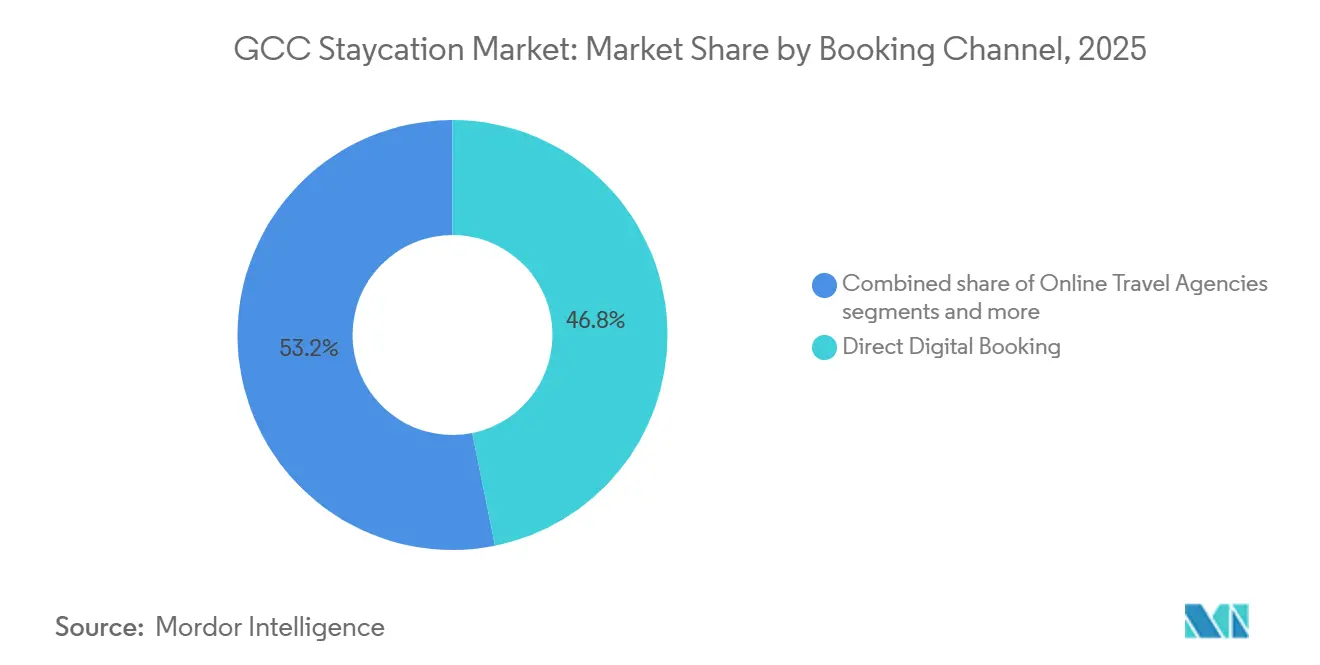
Direct Digital Booking held 46.84% of the GCC staycation market in 2025 and is projected to grow at a 6.74% CAGR through 2031. This growth indicates a shift toward stronger hotel-consumer relationships and reduced reliance on intermediaries. Governments in Saudi Arabia, the UAE, Qatar, and other GCC nations are promoting online hotel bookings, targeting 70% adoption by 2030. Operators are responding with loyalty programs, improved mobile platforms, and bundled offers marketed through owned channels. Bundling dining, activities, and event access with room bookings enhances conversions and reduces commission losses.
Hotel groups are investing in technology to gain a competitive edge in channel control. Rotana’s updated booking platform, launched in August 2025, integrates stays, dining, and event bookings, along with multi-property request-for-proposal functionality, boosting direct conversions for bundled trips. Loyalty systems like Marriott Bonvoy encourage repeat bookings within their networks, aligning with the preference of domestic and intra-GCC travelers for multiple short breaks over long vacations. This focus on direct channels strengthens margins and guest retention in the GCC staycation market.
OTAs remain essential for discovery and comparison. Booking.com accounted for nearly 60% of the OTA hotel market in Saudi Arabia, while Almosafer and Wego cater to regional niches. OTAs are particularly useful for comparing destinations or price ranges during peak periods. Traditional travel agencies serve large family groups with tailored itineraries, and corporate and MICE bookings, though smaller in volume, deliver high per-night value. These channels ensure diverse distribution as direct digital bookings grow.
By Purpose and Theme: Leisure Dominates, Wellness Closes the Gap Fastest
Leisure and Weekend Getaways accounted for 42.79% of the GCC staycation market in 2025, driven by Eid travel, national holiday escapes, and summer weekend breaks. Midscale and upper-midscale international hotel brands met this demand by offering packages with rooms, dining credits, and pool access at appealing price points. The market relies on familiar leisure formats that are easy for households to book with minimal planning, keeping leisure-led demand dominant despite the growth of niche travel formats.
Wellness and Spa Retreats are projected to grow at a 6.12% CAGR from 2026 to 2031, supported by a focus on integrative health, retreat design, and therapeutic experiences. The Therme Dubai project, valued at over USD 500 million and expected to attract 1.7 million visitors annually from 2028, highlights the region’s investment in wellness infrastructure. Shorter wellness packages are also targeting residents seeking structured spa and recovery weekends, making this segment a key growth area.
Cultural and Heritage Experiences and Adventure and Nature Escapes are gaining popularity as destination offerings diversify. Abu Dhabi’s hotel revenue increased by 19.5% year-on-year in 2025, driven by cultural tourism and new attractions bundled into resident packages. Workcations, though smaller, are evolving in the UAE, where destinations like Dubai cater to remote professionals with extended hotel stays offering office-grade connectivity and lifestyle services. These emerging themes are diversifying the GCC staycation market, reducing reliance on single travel occasions.
Geography Analysis
Saudi Arabia accounted for 35.64% of the GCC staycation market share in 2025, supported by a domestic tourism base of 123 million tourists and SAR 304 billion (USD 81 billion) in tourism spending. Its hospitality pipeline included 394 projects with over 106,000 rooms. Domestic travel behavior shifted to planned multi-day leisure trips. The Saudi Tourism Authority’s Spring 2026 campaign in Aseer, AlUla, and the Red Sea coast expanded demand beyond urban centers, strengthening the GCC staycation market.
The UAE is projected to grow at a 5.94% CAGR from 2026 to 2031. Abu Dhabi recorded 26.6 million visitors in 2025, with hotel revenue rising 19.5% and average daily rates increasing 19%. Domestic travel spending in the UAE recorded a 68% year-on-year rise in 2025. Dubai and Abu Dhabi’s luxury supply converted short breaks into annual routines, while Ras Al Khaimah’s nature and adventure offerings diversified growth beyond urban models.
Qatar, Oman, Kuwait, and Bahrain contributed to the GCC staycation market with varied leisure formats. Qatar sold 10.84 million room nights in 2025, an 8.6% increase from 2024, with 71.3% occupancy across 42,500 hotel keys. Oman’s travel and tourism GDP grew 5.5% in 2025, with Hilton adding three Barr Al Jissah hotels in 2026. Bahrain’s 208% year-on-year rise in 2025 travel volumes highlighted cross-border demand, particularly from Saudi residents, while Kuwait maintained a smaller scale.
Competitive Landscape
The GCC staycation market is moderately concentrated, with a few operators holding significant shares. Jumeirah Group, Rotana Hotel Management Corporation, Hilton, Emaar Hospitality Group, and Accor collectively account for a notable portion of the market. This structure enables international hotel chains, regional luxury groups, and boutique operators to address overlapping demand tiers. The market demonstrates growth and innovation, allowing operators to expand their presence through destination alignment, tailored packages, and channel strategies without requiring dominance at the national level.
Competition focuses on pipeline expansion and portfolio positioning. Accor, Marriott, and IHG are scaling operations regionally, while Jumeirah is refining its brand into Icons, Privé, Hotels and Resorts, and Residences, emphasizing boutique properties with up to 150 keys for leisure markets. Hilton’s January 2026 launch of three managed Barr Al Jissah properties in Oman, in partnership with The Zubair Corporation, highlights the role of national development goals and private collaborations. IHG’s first EVEN Hotel in Dammam, which was signed in 2025 and is slated to open in early 2029, demonstrates the growing importance of wellness-focused sub-brands in meeting resident demand. Growth strategies now prioritize brand alignment and trip purpose over room additions.
Technology and format innovation are key differentiators. Rotana’s AI-driven booking platform integrates hotel, dining, and event reservations, strengthening consumer connections. Boutique operators, including Our Habitas and Sharjah Collection, focus on off-grid, heritage, and eco-friendly travel, offering experiences that larger chains may not replicate as effectively. The GCC staycation market is expected to remain competitive, balancing branded growth with experience-driven specialization.
GCC Staycation Industry Leaders
-
Jumeirah Group
-
Rotana Hotel Management Corporation PJSC
-
Emaar Hospitality Group
-
Accor S.A.
-
Hilton Worldwide Holdings Inc.
- *Disclaimer: Major Players sorted in no particular order
Recent Industry Developments
- January 2026: Emaar Hospitality Group and Alef Group launched Palace Residences Al Mamsha in Sharjah, the first Palace Residences property in the emirate. Valued at over AED 500 million (USD 136 million), this collaboration expands Emaar Hospitality's presence into Sharjah, increasing staycation options in the Northern Emirates beyond Dubai and Abu Dhabi.
- January 2026: Hilton has opened Hilton Muscat Al Bandar in the Barr Al Jissah complex, featuring 198 guest rooms, six dining venues, and a spa with treatment villas. This launch introduces Hilton's flagship brand to Muscat and expands Oman’s branded luxury staycation options.
- January 2026: Hilton expanded its presence in Oman by opening three hotels at Barr Al Jissah: Hilton Muscat Al Bandar, DoubleTree by Hilton Muscat Al Waha, and Al Husn Hotel Muscat (to rebrand as a Waldorf Astoria). This move doubled Hilton's footprint and positioned Barr Al Jissah as a key resort destination for GCC leisure travelers.
- November 2025: IHG Hotels & Resorts signed a dual management agreement with Al Mosa and Sons for Crowne Plaza Al Khobar Al Bandariyah and Holiday Inn Riyadh Rose Yard, increasing its Saudi Arabia pipeline to 47 hotels under development.
GCC Staycation Market Report Scope
| Hotels and Resorts |
| Serviced Apartments and Aparthotels |
| Vacation Rentals and Short-Term Stays |
| Desert Camps and Boutique Retreats |
| Families |
| Couples |
| Solo Travelers |
| Groups |
| Online Travel Agencies |
| Direct Digital Booking |
| Traditional Travel Agencies |
| Corporate and MICE Booking Channels |
| Leisure and Weekend Getaways |
| Wellness and Spa Retreats |
| Cultural and Heritage Experiences |
| Adventure and Nature Escapes |
| Workcations |
| Saudi Arabia |
| United Arab Emirates |
| Qatar |
| Oman |
| Kuwait |
| Bahrain |
| By Accommodation Type | Hotels and Resorts |
| Serviced Apartments and Aparthotels | |
| Vacation Rentals and Short-Term Stays | |
| Desert Camps and Boutique Retreats | |
| By Traveler Type | Families |
| Couples | |
| Solo Travelers | |
| Groups | |
| By Booking Channel | Online Travel Agencies |
| Direct Digital Booking | |
| Traditional Travel Agencies | |
| Corporate and MICE Booking Channels | |
| By Purpose and Theme | Leisure and Weekend Getaways |
| Wellness and Spa Retreats | |
| Cultural and Heritage Experiences | |
| Adventure and Nature Escapes | |
| Workcations | |
| By Geography | Saudi Arabia |
| United Arab Emirates | |
| Qatar | |
| Oman | |
| Kuwait | |
| Bahrain |
Key Questions Answered in the Report
What is the projected value of the GCC staycation space by 2031?
The GCC staycation market is projected to reach USD 29.89 billion by 2031, rising from USD 23.38 billion in 2026 at a CAGR of 5.04% over 2026-2031.
Which country leads staycation demand across the GCC?
Saudi Arabia led with a 35.64% share in 2025, supported by a very large domestic tourism base, strong infrastructure expansion, and active destination development.
Which booking channel is growing the fastest in the GCC staycation space?
Direct Digital Booking is both the largest and fastest-growing channel, with a 46.84% share in 2025 and a forecast CAGR of 6.74% through 2031.
What type of accommodation is most used for staycations in the GCC?
Hotels and Resorts remain the leading accommodation type with a 48.93% share in 2025 because they combine branded trust, amenities, and family-focused packages.
Which travel purpose is expanding the fastest across GCC short-break demand?
Wellness and Spa Retreats are the fastest-growing purpose segment, with a projected CAGR of 6.12% from 2026 to 2031.
Why are domestic and regional short breaks becoming more common in the GCC?
Stronger domestic travel habits, easier digital booking, tourism investment in secondary destinations, and occasional outbound travel disruption have made local and intra-GCC leisure trips more attractive.