
GCC Countries Travel Agency Services Market Size and Share
Market Overview
| Study Period | 2022 - 2031 |
|---|---|
| Forecast Data Period | 2026 - 2031 |
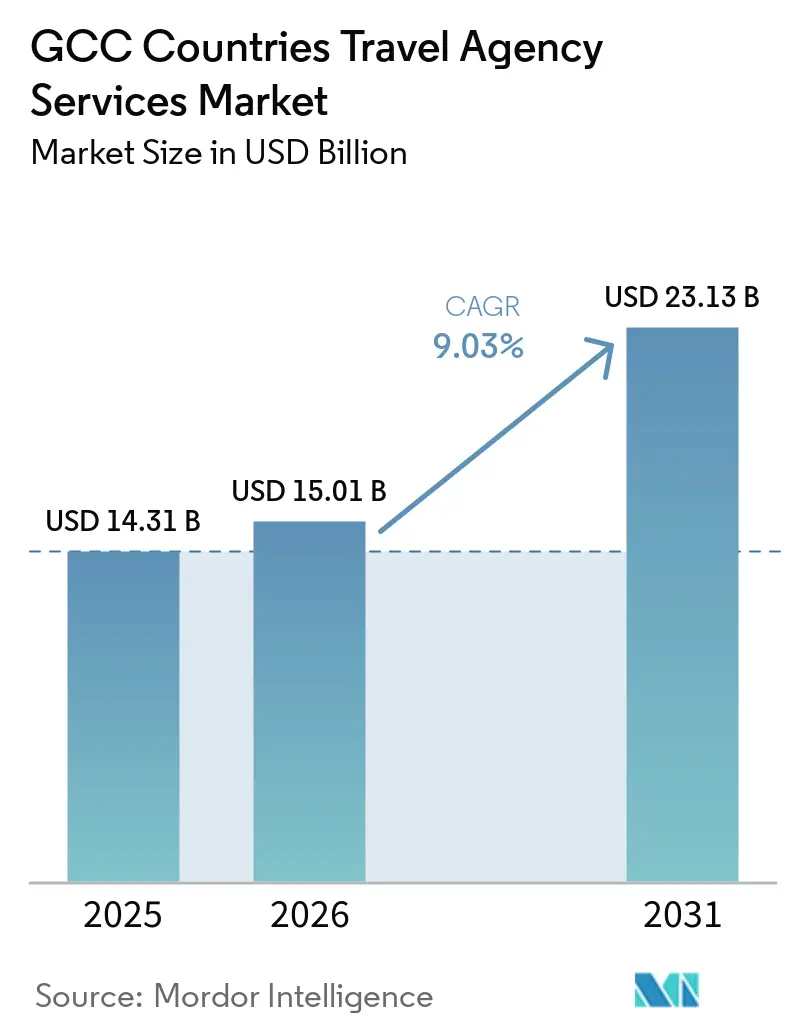
| Base Year Market Size (2025) | USD 14.31 Billion |
| Market Size (2026) | USD 15.01 Billion |
| Market Size (2031) | USD 23.13 Billion |
| Growth Rate (2026 - 2031) | 9.03 % |
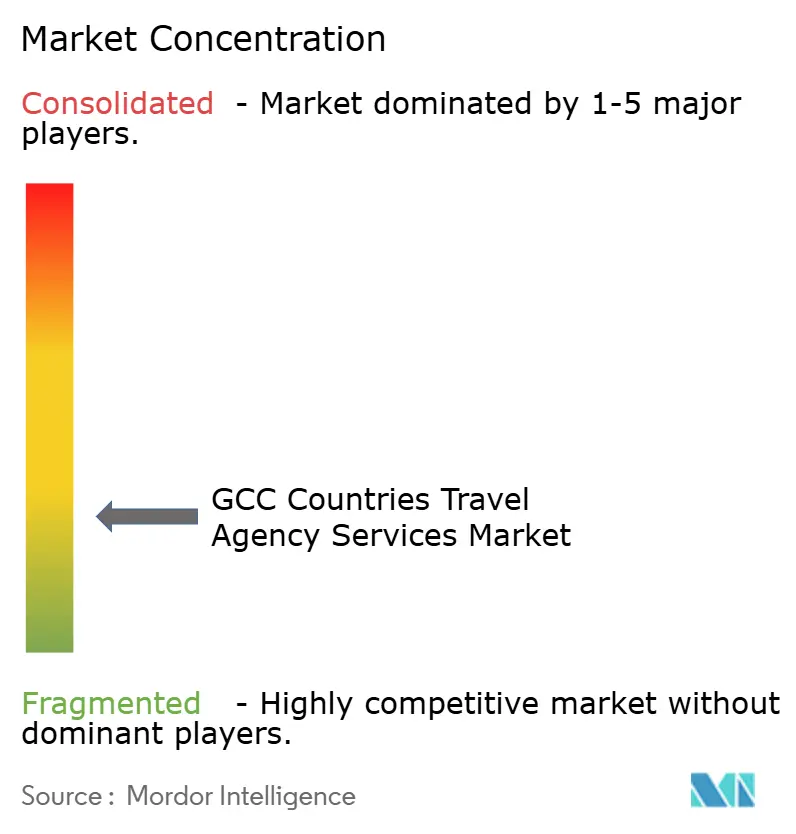
| Market Concentration | Low |
Major Players *Disclaimer: Major Players sorted in no particular order Image © Mordor Intelligence. Reuse requires attribution under CC BY 4.0. | |
GCC Countries Travel Agency Services Market Analysis by Mordor Intelligence
The GCC countries travel agency services market was valued at USD 14.31 billion in 2025 and estimated to grow from USD 15.01 billion in 2026 to reach USD 23.13 billion by 2031, at a CAGR of 9.03% during the forecast period (2026-2031). The market is shifting from basic ticketing to comprehensive itinerary planning, integrating flights, hotels, transfers, insurance, and destination experiences into a single booking process. In 2024, the GCC tourism sector contributed USD 247.1 billion to GDP, with intra-GCC tourist flows reaching 19.3 million, expanding demand for intermediary travel services[1]. In 2025, the Middle East travel and tourism sector grew by 5.3%, surpassing the global average of 4.1%, reflecting strong spending on leisure and business travel. Saudi Arabia drives growth through scale and tourism-focused policies, while the UAE enhances demand with aviation connectivity and a developed corporate travel ecosystem. Competitive intensity remains high due to fragmented leadership across product lines and countries. However, the market has shown resilience, recovering from regional disruptions within quarters as air capacity, tourism promotion, and booking demand stabilize.
Key Report Takeaways
- By service type, airline ticketing held 34.93% of the GCC Countries Travel Agency Services Market in 2025, while cruises are projected to record the fastest growth at a 9.95% CAGR through 2031.
- By booking mode, OTAs accounted for 58.21% of the GCC Countries Travel Agency Services Market in 2025, while hybrid agencies are the faster-growing model without a quantified CAGR through 2031.
- By trip purpose, leisure travel held 63.12% of the GCC Countries Travel Agency Services Market in 2025, while corporate and MICE are forecast to expand at a 9.74% CAGR through 2031.
- By traveler type, international travelers accounted for 57.80% of the GCC Countries Travel Agency Services Market in 2025, while domestic travelers are projected to grow at a 9.85% CAGR through 2031.
- By geography, Saudi Arabia held 36.49% of the GCC Countries Travel Agency Services Market in 2025, while the UAE is projected to grow at a 10.53% CAGR through 2031.
Note: Market size and forecast figures in this report are generated using Mordor Intelligence’s proprietary estimation framework, updated with the latest available data and insights as of January 2026.
GCC Countries Travel Agency Services Market Trends and Insights
Drivers Impact Analysis*
| Driver | (~) % Impact on CAGR Forecast | Geographic Relevance | Impact Timeline |
|---|---|---|---|
| Tourism diversification and destination investment | +2.2% | Concentrated in Saudi Arabia and UAE | Long term (≥ 4 years) |
| Digital and mobile booking adoption | +1.8% | Saudi Arabia and UAE core, spill-over to Qatar and Kuwait | Medium term (2-4 years) |
| Aviation and hotel capacity expansion | +1.5% | Saudi Arabia and UAE dominant, incremental across Qatar, Oman, Bahrain | Medium term (2-4 years) |
| Corporate travel and MICE rebound | +1.3% | UAE and Saudi Arabia primary, Qatar growing | Medium term (2-4 years) |
| Unified GCC visa and multi-country itineraries | +0.7% | GCC-wide, with early gains in UAE-Bahrain corridor | Short term (≤ 2 years), Long term (≥ 4 years) |
| Rail and multimodal intra-GCC connectivity | +0.3% | National in the UAE during 2026, incremental GCC-wide post-2030 | Long term (≥ 4 years) |
| Source: Mordor Intelligence | |||
Tourism diversification and destination investment
Saudi Arabia's tourism-driven diversification is strengthening the GCC countries' travel agency services market. The Kingdom recorded significant visitor numbers in 2025, with tourism spending reaching SAR 300 billion (USD 79.94 billion), positioning it as a key hub for regional travel demand. Major projects such as NEOM, Diriyah, and the Red Sea development are shifting tourism trends toward longer stays and complex travel planning, moving beyond traditional city or religious trips. This shift benefits travel agencies, which are better equipped than direct channels to bundle lodging, transfers, experiences, and multi-stop itineraries into seamless packages. At the regional level, GCC tourism is expected to grow significantly, with its contribution to GDP projected to rise substantially over the next decade, supporting sustained destination-led demand.
Digital and mobile booking adoption
The GCC countries' travel agency services market has transitioned to a mobile-first phase, transforming how demand is captured, priced, and serviced. Digital distribution has become the primary channel for consumer travel demand, with OTAs holding a significant share of bookings. Digital behavior is shifting from self-service searches to assisted itinerary creation, favoring platforms with extensive inventories and strong Arabic and English interfaces. Larger digital players now integrate discovery, recommendations, payments, and post-booking support into a single experience. Smaller agencies, however, rely on hybrid models to remain competitive. The market benefits from digital adoption through channel migration and improved conversions on complex travel products.
Aviation and hotel capacity expansion
The GCC countries' travel agency services market benefits from capacity additions that expand the inventory for intermediate bookings. Strong travel and tourism demand in the Middle East supported airline expansions, hotel openings, and cross-border trips across the Gulf[2]. Riyadh Air launched commercial flights to London Heathrow in October 2025, adding a long-haul option to Saudi Arabia’s aviation network and reinforcing its role in route expansion. Hotel development pipelines, primarily in Saudi Arabia, continue to create revenue opportunities for agencies in reservations, packaging, and ground service coordination. Increased room supply and flight frequency may pressure unit margins on basic ticketing but typically boost booking volumes and expand the pool of sellable bundled travel.
Corporate travel and MICE rebound
The GCC countries' travel agency services market is experiencing growth due to increased corporate demand, particularly in Saudi Arabia and the UAE. Business travel spending in the Middle East rose significantly in 2025, with Saudi Arabia showing a notable increase of over 55%. This trend highlights the renewed importance of enterprise mobility and event-driven travel as key revenue sources. Business events have enhanced the quality of agency bookings, as conference travel often involves higher service requirements and precise coordination. In response to this demand, FCM Travel expanded its Meetings and Events division in the UAE in February 2026, addressing the need for comprehensive event support[3]. MICE demand in the GCC market supports growth by boosting traveler numbers and driving bookings that require managed service layers.
Restraints Impact Analysis*
| Restraint | (~) % Impact on CAGR Forecast | Geographic Relevance | Impact Timeline |
|---|---|---|---|
| Direct airline and hotel disintermediation | -1.4% | UAE and Saudi Arabia concentrated, secondary in Qatar and Bahrain | Medium term (2-4 years) |
| Margin pressure from OTA and offline competition | -1.2% | GCC-wide, most acute in UAE hotel market | Short term (≤ 2 years) |
| Fraud, cybersecurity, and payment compliance burden | -0.5% | UAE and Saudi Arabia core, systemic GCC risk | Medium term (2-4 years) |
| Uneven cross-border execution and visa-tech rollout | -0.4% | GCC-wide, most complex in Kuwait and Oman | Short term (≤ 2 years) |
| Source: Mordor Intelligence | |||
Direct airline and hotel disintermediation
The market faces challenges as airlines and hotels aim to strengthen direct customer relationships. Hotels and independent operators are improving loyalty programs, mobile platforms, and direct booking tools, enabling repeat travelers to bypass third-party sellers. Airlines are exerting similar pressure through enhanced content strategies and direct distribution efforts, requiring agencies to adopt advanced technology to remain competitive in air retail. As a result, incumbents are focusing on NDC-linked capabilities and supplier partnerships instead of relying solely on legacy ticketing models. Agencies unable to match the quality of direct-channel content or service reliability risk declining margins and reduced booking retention over time.
Margin pressure from OTA and offline competition
The market is highly competitive, with global OTAs, regional digital brands, and offline specialists vying for market share. OTAs dominate with a significant share, enhancing price visibility for consumers but limiting smaller operators' pricing flexibility. Offline agencies remain active in corporate travel, Hajj and Umrah services, and complex itinerary planning, preventing any single model from dominating. This competitive environment forces middle-tier agencies to rely on low-margin inventory unless they specialize or enhance service offerings. The market favors hybrid and scale-driven operators capable of balancing digital customer acquisition with consultative selling.
*Our forecasts treat driver/restraint impacts as directional, not additive. The impact forecasts reflect baseline growth, mix effects, and variable interactions.
Segment Analysis
By Service Type: Cruises Outpace Air as the Highest-Growth Category
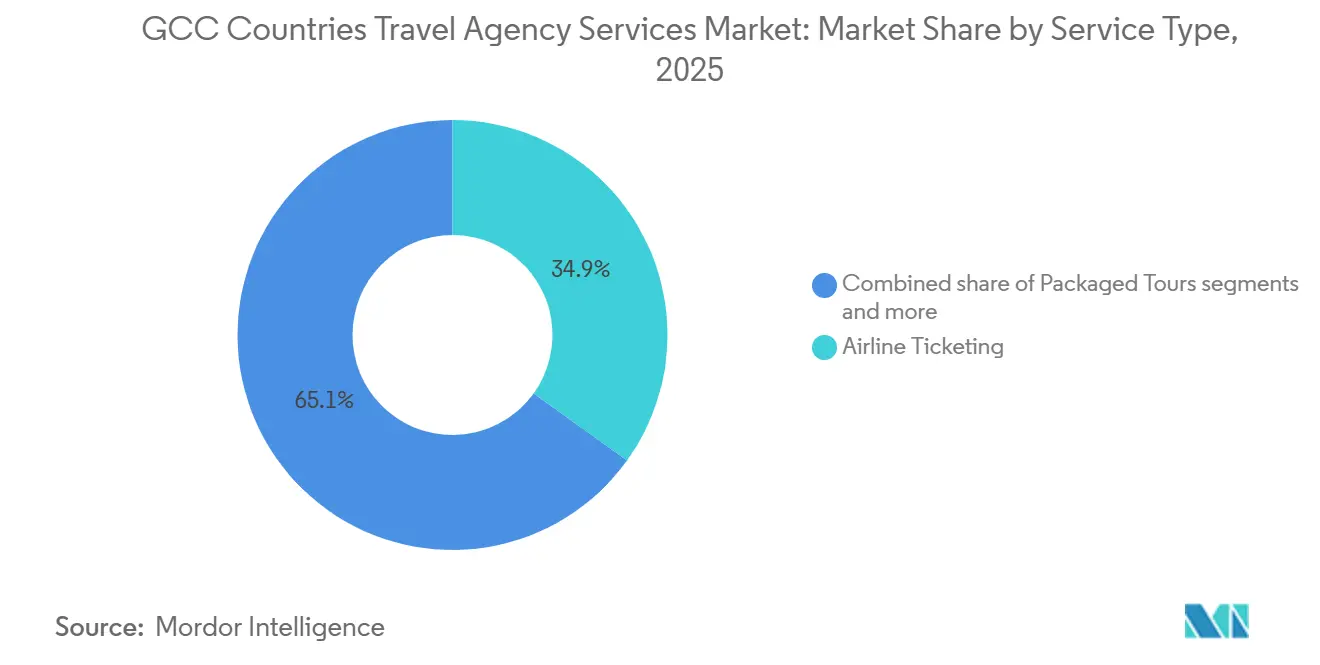
Airline ticketing accounted for 34.93% of the market in 2025, reflecting the region's reliance on aviation for international and regional travel, particularly in corridors involving Saudi Arabia, the UAE, and Qatar. It remains central as it forms the basis for broader itineraries, including hotels, insurance, and destination services. Despite the shift toward bundled trip designs, airline ticketing continues to anchor agency revenues. Cruises are projected to grow at a 9.95% CAGR from 2026 to 2031, driven by increased port activity, destination collaboration, and the appeal of multi-stop Gulf travel. Cruises support bundled bookings, including pre-stay hotels, transfers, insurance, and excursions, while requiring more service support than standard reservations.
Lodging reservations, travel insurance, packaged tours, and ancillary transportation maintain significant roles in the GCC countries' travel agency services market. Growth in hotel supply and destination development boosts demand for reservations beyond transport sales, offering agencies higher revenue potential per booking. Agencies integrating supplier inventory with dynamic bundling are better positioned to capture end-to-end travel spending. The market is broadening its service mix while retaining air services as a core component. Differentiation by traveler type and purpose is increasing, with leisure bookings combining flights, resorts, insurance, and experiences, while corporate and MICE travel incorporates policy controls and managed accommodations. Religious and domestic tourism further drives demand for bundled services.

By Booking Mode: OTAs Consolidate, But Hybrid Channels Capture Premium Travelers
Online Travel Agencies (OTAs) held a 58.21% share in the market in 2025 and are projected to grow at a 10.74% CAGR during 2026–2031. Digital booking remains dominant, driven by mobile usage, multilingual platforms, broad inventory access, and quick comparison tools for flights and hotels. OTAs benefit from repeat usage, as users often return to familiar platforms for leisure or hotel bookings. This creates an advantage for large digital players in high-volume, straightforward bookings. Offline and traditional agencies remain relevant for complex travel needs, including Hajj and Umrah arrangements, corporate travel, multi-country itineraries, and consultative bookings. These scenarios require human support, documentation assistance, policy checks, and after-sales services, which self-booking platforms cannot fully replicate. Offline channels persist where trust and assistance are critical.
Hybrid agencies are addressing the divide in the GCC countries' Travel Agency Services Market by combining digital booking tools with call centers, branches, or assisted services. This model captures online demand while maintaining margins in complex bookings. It aligns with corporate travel, where policy compliance and workflow integration are essential. The market is shifting toward a blended service model, integrating online reach with offline support. Consolidation is increasing as well-capitalized players invest in technology, service infrastructure, supplier relationships, and brand visibility, outpacing smaller agencies reliant on mark-ups.
By Trip Purpose: Leisure Leads, But MICE Redefines Agency Revenue Quality
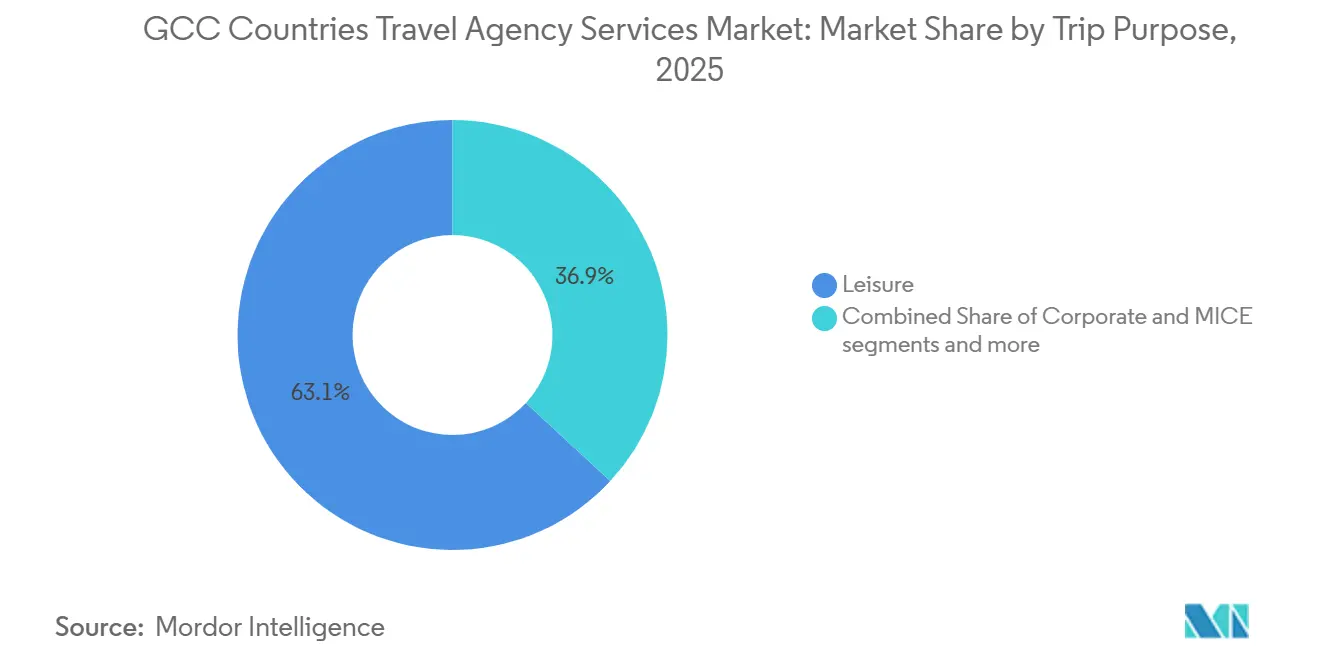
Leisure travel accounted for 63.12% of the GCC countries' travel agency services market in 2025, remaining the largest trip-purpose category. This share reflects strong outbound demand from Gulf residents, growing domestic tourism, and steady inbound leisure traffic into Saudi Arabia and the UAE. The segment spans a wide range of offerings, from holiday packages to customized itineraries, maintaining its volume even as business travel grows. Leisure bookings attract both residents and international visitors. Revenue within this segment is improving as travelers increasingly seek customized itineraries, experiential add-ons, and longer stays tied to destination projects. These bookings often include more ancillary services than basic reservations, allowing agencies to capture higher spending on the travel journey. The segment’s growth is driven by its evolving and diverse offerings.
Corporate and MICE are projected to grow at a 9.74% CAGR through 2031, making it the fastest-growing segment in the market. Growth is supported by increased business travel spending, an expanding events calendar, and demand for managed travel services in conferences and exhibitions. Business travel spending across the Middle East rose by 23% in 2025, with Saudi Arabia recording over 55% growth. MICE bookings often involve complex requirements, including venue coordination, group air arrangements, and real-time itinerary adjustments. These factors enhance the value of agencies offering integrated technology and human services, creating barriers for generic booking tools. MICE-capable agencies are likely to achieve stronger client retention and higher margins compared to leisure-focused competitors.
By Traveler Type: Domestic Momentum Challenges International Dominance
International travelers represented 57.80% of the GCC travel agency services market in 2025, driven by strong inbound tourism, extensive air connectivity, and Gulf residents’ outbound leisure trips. Agencies in the region serve dual roles as inbound destination managers and outbound itinerary sellers, diversifying revenue streams across services and seasons. Qatar exemplified this trend, receiving 5.1 million international visitors in 2025, a 3.7% year-on-year increase, while hotel room nights sold rose 8.6% to 10.84 million, indicating robust inbound demand[4]. International travel, with its complex booking needs, reinforces the importance of agencies in leisure and corporate channels, remaining a core value driver for the market.
Domestic travelers are projected to grow at a 9.85% CAGR through 2031, making them the fastest-growing segment in the GCC travel agency services market. Growth is fueled by Saudi Arabia’s destination development, expanding domestic tourism across GCC states, and formalizing local travel products. Domestic travel enhances booking frequency, reduces reliance on cross-border demand, and creates opportunities for religious tourism, short breaks, and family packages in local languages. In Saudi Arabia, large-scale tourism projects have increased bookable itineraries combining accommodation, transport, and experiences, strengthening agencies’ roles in trip planning. Domestic growth also smooths year-round demand by reducing dependence on international seasonality. The market is expected to benefit from a more balanced mix of domestic and international demand over the forecast period.
Geography Analysis
Saudi Arabia accounted for 36.49% of the GCC Countries Travel Agency Services Market in 2025, driven by destination investments, religious travel, and a growing domestic tourism base. Tourism spending in the Kingdom reached SAR 300 billion (USD 79.94 billion) in 2025, reinforcing its position as the largest demand driver. Saudi Arabia contributed significantly to regional travel and tourism GDP in 2025, representing a major share of Middle East tourism output. However, evolving licensing and operational requirements create challenges for agencies compared to neighboring markets.
The UAE is projected to grow at a 10.53% CAGR through 2031, supported by Dubai’s aviation role, Abu Dhabi’s destination appeal, and a strong corporate travel base. The UAE generated USD 68.5 billion in travel and tourism GDP and USD 56.9 billion in international visitor spending in 2025. dnata’s travel division earned AED 2.0 billion (USD 0.54 billion) in revenue in the first half of fiscal 2025–26, up 11% year-on-year, reflecting strong demand.
Qatar, Oman, Bahrain, and Kuwait play a smaller but strategically important role in the GCC Countries Travel Agency Services Market. Qatar recorded 5.1 million international visitors and 10.84 million hotel room nights in 2025, supporting inbound and leisure travel. Oman benefits from rising domestic tourism and a measured hospitality pipeline. Bahrain attracts short-stay traffic from Saudi Arabia, while Kuwait remains more significant as an outbound source market. Together, these countries enhance route density, corporate mobility, and regional package opportunities.
Competitive Landscape
The GCC countries travel agency services market remains fragmented, with leadership divided across product categories, booking modes, and national markets. Booking Holdings, Almosafer, dnata Travel Group, Kanoo Travel, and musafir.com collectively account for a portion of the market, leaving space for smaller agencies, specialists, and country-focused operators. Booking Holdings excels in hotel-focused OTA distribution in key Gulf markets, while Almosafer holds a strong position in Saudi OTA air distribution. This segmentation reduces the likelihood of any single firm dominating the entire value chain. Competition remains intense but allows room for differentiated regional players.
Incumbents are focusing on technology, workflow integration, and capability expansion to strengthen their positions. Kanoo Travel partnered with QuadLabs to introduce the eo corporate travel solution on the Travog platform, offering real-time booking, approvals, policy controls, and expense tracking for enterprise clients. dnata enhanced its travel capabilities by investing in WonderMiles, an NDC-enabled booking platform, and launching a B2B online booking portal for GSA products. FCM Travel expanded its Meetings and Events division in the UAE, emphasizing the shift toward building high-value service layers over transaction volume. The market increasingly rewards firms that combine content access, service depth, and enterprise integration.
Opportunities remain in SME-managed travel and multi-country leisure packaging. Many smaller businesses still book trips directly, indicating potential for tech-enabled managed travel products outside large corporate accounts. Broader GCC visa coordination could create a new category of packaged trips combining multiple Gulf destinations, which agencies are well-suited to manage. Regulatory requirements and supplier technology standards are expected to favor well-capitalized firms capable of maintaining airline content access and meeting tourism authority standards. While the market is likely to stay fragmented, the gap between larger operators and smaller sellers is expected to widen over time.
GCC Countries Travel Agency Services Industry Leaders
-
Booking Holdings (Booking.com)
-
Almosafer
-
dnata Travel Group
-
Kanoo Travel
-
musafir.com
- *Disclaimer: Major Players sorted in no particular order
Recent Industry Developments
- March 2026: dnata Travel Group's travel division reported AED 2.0 billion (USD 0.54 billion) in revenue for the first half of 2025-26, an 11% increase, with a total transactional value of AED 5.0 billion (USD 1.36 billion). The group launched a B2B online booking portal for GSA products and invested in WonderMiles, an NDC-enabled corporate booking platform.
- February 2026: FCM Travel introduced an expanded Meetings and Events solution in the UAE to address growing MICE demand. The company deployed local experts to enhance event planning, venue sourcing, and delegate management services within its UAE operations.
- October 2025: Riyadh Air has launched daily flights to London Heathrow under its "Pathway to Perfect" program and introduced the "Sfeer" loyalty program. The airline aims to serve 100 global destinations by 2030 and has an order book of 132 aircraft.
- July 2025: Kanoo Travel partnered with QuadLabs to introduce 'eo', a corporate travel management solution. Built on QuadLabs’ Travog platform, it provides real-time booking, policy compliance, and expense integration for corporate clients in the Middle East.
GCC Countries Travel Agency Services Market Report Scope
| Airline Ticketing |
| Packaged Tours |
| Cruises |
| Lodging Reservations |
| Travel Insurance |
| Other Transportation and Ancillary Services |
| Online Travel Agencies (OTAs) |
| Offline/Traditional Agencies |
| Hybrid Agencies |
| Leisure | All-inclusive Vacations |
| Cruises | |
| Escorted Tours | |
| FIT and Custom Itineraries | |
| Corporate and MICE | SME and Enterprise Managed Travel |
| Meetings, Incentives, Conferences and Events |
| Domestic Travelers |
| International Travelers |
| Saudi Arabia |
| United Arab Emirates |
| Qatar |
| Kuwait |
| Oman |
| Bahrain |
| By Service Type | Airline Ticketing | |
| Packaged Tours | ||
| Cruises | ||
| Lodging Reservations | ||
| Travel Insurance | ||
| Other Transportation and Ancillary Services | ||
| By Booking Mode | Online Travel Agencies (OTAs) | |
| Offline/Traditional Agencies | ||
| Hybrid Agencies | ||
| By Trip Purpose | Leisure | All-inclusive Vacations |
| Cruises | ||
| Escorted Tours | ||
| FIT and Custom Itineraries | ||
| Corporate and MICE | SME and Enterprise Managed Travel | |
| Meetings, Incentives, Conferences and Events | ||
| By Traveler Type | Domestic Travelers | |
| International Travelers | ||
| By Geography | Saudi Arabia | |
| United Arab Emirates | ||
| Qatar | ||
| Kuwait | ||
| Oman | ||
| Bahrain | ||
Key Questions Answered in the Report
What is the projected value of the GCC countries travel agency services market by 2031?
The GCC countries travel agency services market is projected to reach USD 23.13 billion by 2031, rising from USD 15.01 billion in 2026 at a 9.03% CAGR over 2026-2031.
Which country leads the GCC countries travel agency services market?
Saudi Arabia led with 36.49% share in 2025, supported by its scale, tourism investment pipeline, and strong domestic and religious travel flows.
Which country is growing the fastest in GCC countries travel agency services?
The UAE is the fastest-growing geography with a projected 10.53% CAGR through 2031, supported by aviation strength, premium tourism, and corporate travel demand.
Which service category is largest in GCC countries travel agency services?
Airline ticketing was the largest service type in 2025 with 34.93% share, reflecting the region’s reliance on air travel for both international and intra-GCC movement.
Which segment is expected to grow the fastest by trip purpose?
Corporate and MICE is expected to grow the fastest, with a 9.74% CAGR through 2031, supported by stronger business travel and event-led demand.
Why are hybrid agencies gaining importance in the GCC countries travel agency services market?
Hybrid agencies combine digital booking with assisted servicing, which works well for premium leisure, corporate travel, Hajj and Umrah, and complex multi-country itineraries.