
GCC Cargo Insurance Market Size and Share
Market Overview
| Study Period | 2020 - 2031 |
|---|---|
| Forecast Data Period | 2026 - 2031 |
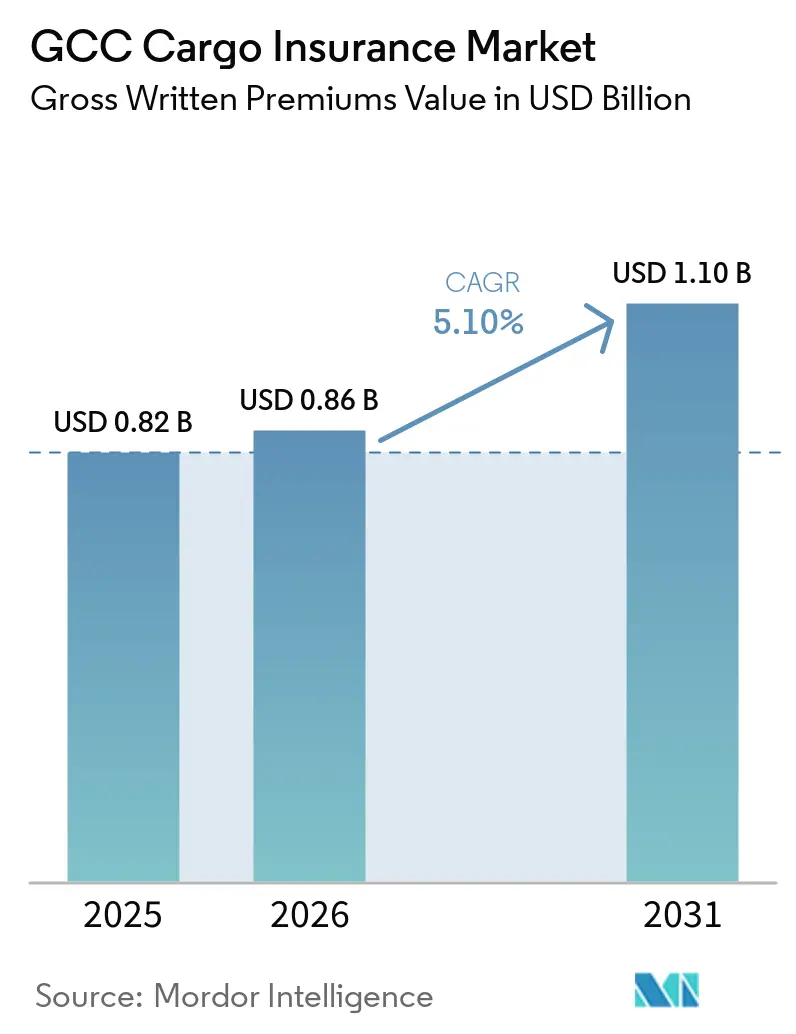
| Base Year Market Size (2025) | USD 0.82 Billion |
| Market Size (2026) | USD 0.86 Billion |
| Market Size (2031) | USD 1.10 Billion |
| Growth Rate (2026 - 2031) | 5.10 % |
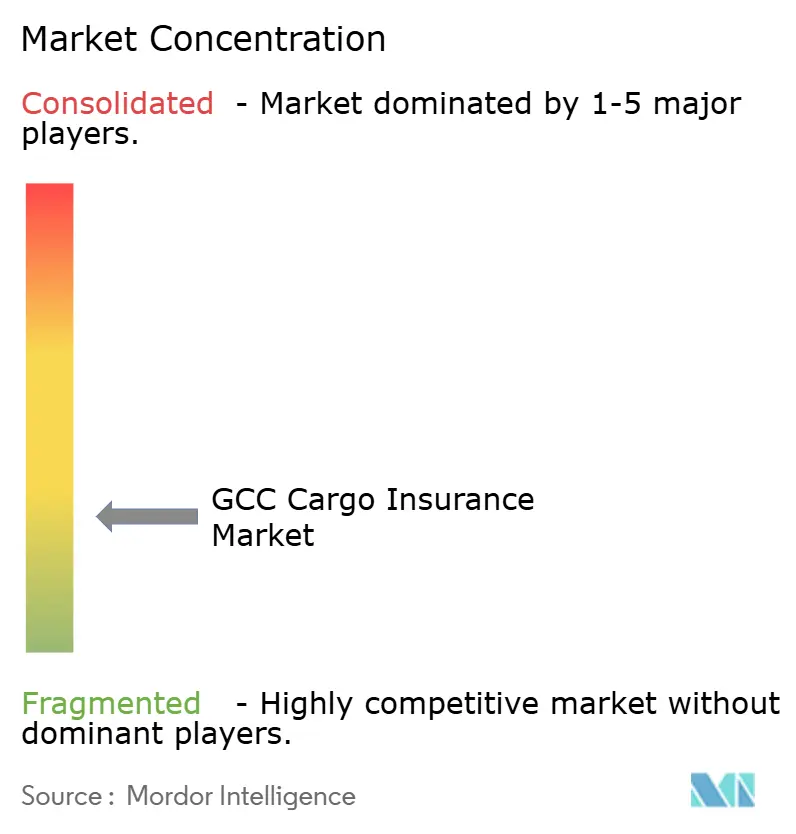
| Market Concentration | Low |
Major Players *Disclaimer: Major Players sorted in no particular order Image © Mordor Intelligence. Reuse requires attribution under CC BY 4.0. | |
GCC Cargo Insurance Market Analysis by Mordor Intelligence
The GCC Cargo Insurance Market, measured in terms of gross written premiums, was valued at USD 0.82 billion in 2025, is estimated at USD 0.86 billion in 2026, and is forecast to reach USD 1.10 billion by 2031, registering a CAGR of 5.10% from 2026 to 2031. The GCC cargo insurance market is supported by the region’s role in international trade, re-export activity, and transport links across sea, road, rail, and air routes. The United Arab Emirates recorded non-oil foreign trade above USD 1 trillion in 2025, while re-exports reached USD 226 billion, which increased the value of goods moving through insurable transit routes. Cargo movements can be rerouted, repriced, or reinsured when operating conditions change, making the volume and declared value of goods in transit important to premium demand. The GCC cargo insurance market also faces tighter capacity for war-risk cover, although public and private reinsurance facilities are helping sustain coverage availability on higher-risk routes. Digital certificate issuance, specialized project-cargo cover, and Takaful-compatible products provide opportunities for insurers that can meet local compliance and technical underwriting needs.
Key Report Takeaways
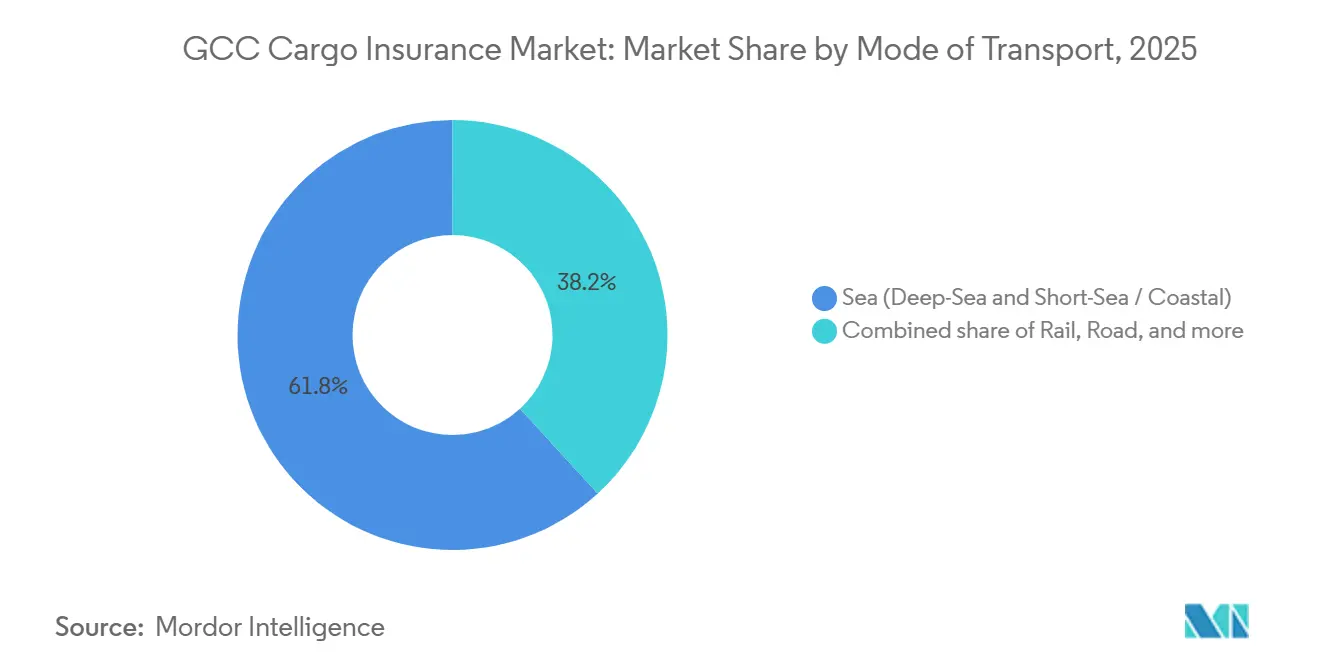
- By mode of transport, sea transport captured 61.8% of the GCC cargo insurance market share in 2025, while rail freight is projected to grow at 8.7% CAGR through 2031.
- By cargo profile, containerized cargo captured 40.6% of the GCC cargo insurance market share in 2025, while project, heavy-lift, and out-of-gauge cargo is projected to grow at 6.9% CAGR through 2031.
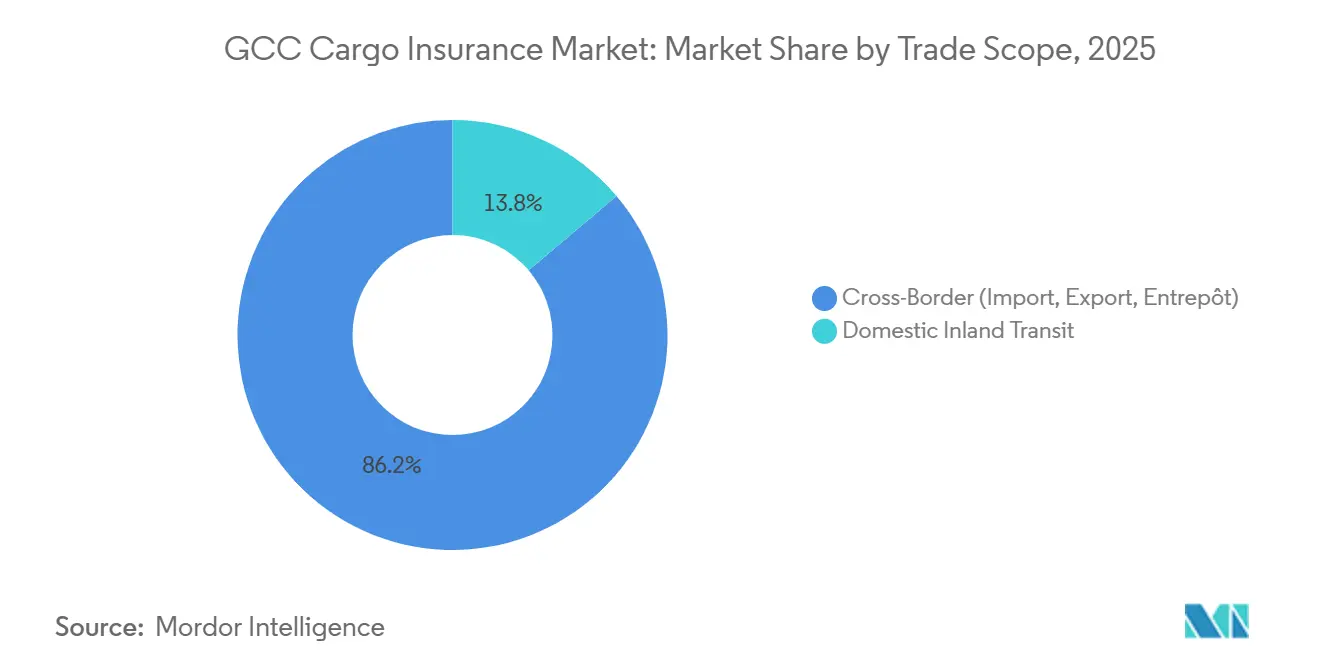
- By trade scope, cross-border trade captured 86.2% of GCC cargo insurance premiums in 2025 and is projected to grow at 5.7% CAGR through 2031.
- By distribution channel, brokers and agents captured 63.8% of GCC cargo insurance premiums in 2025, while online and digital platforms are projected to grow at 12.3% CAGR through 2031.
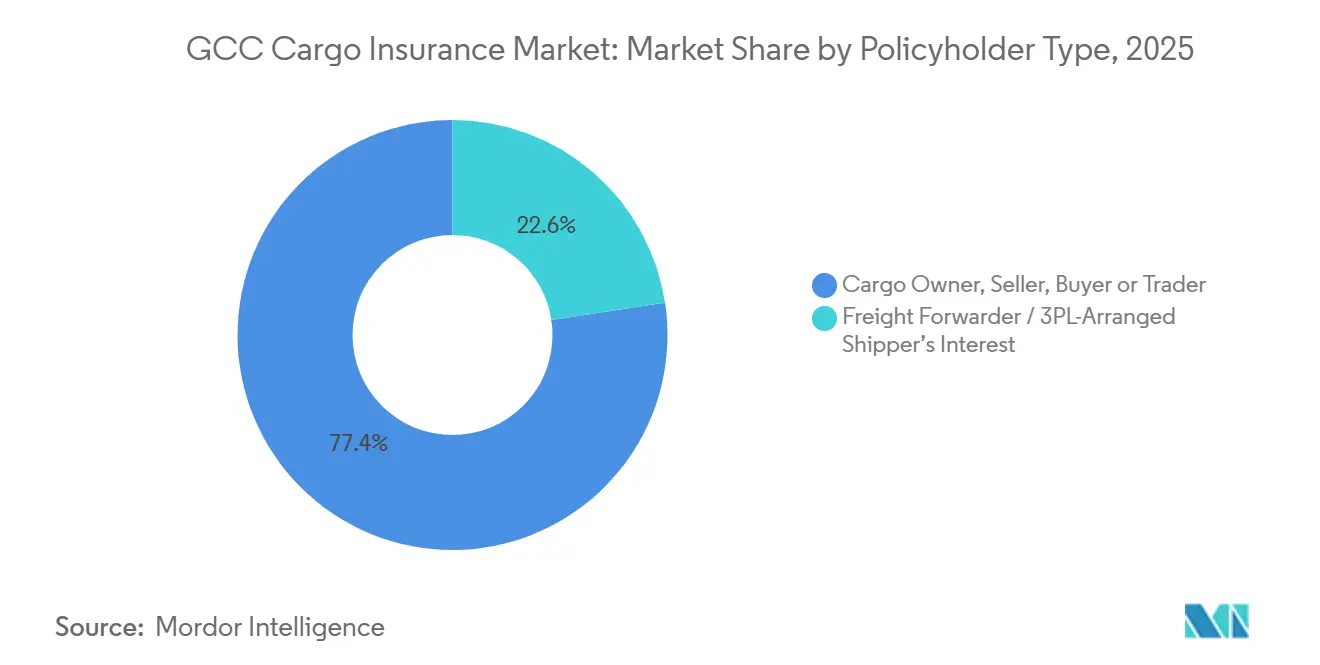
- By policyholder type, cargo owners, sellers, buyers, and traders captured 77.4% of GCC cargo insurance premiums in 2025, while freight forwarders and 3PL-arranged shippers’ interest policies are projected to grow at 6.5% CAGR through 2031.
- By end-user industry, chemicals and pharmaceuticals captured 27.1% of GCC cargo insurance premiums in 2025 and are projected to grow at 6.7% CAGR through 2031.
- By geography, Saudi Arabia captured 42.6% of GCC cargo insurance premiums in 2025, while the United Arab Emirates is projected to grow at 6% CAGR through 2031.
Note: Market size and forecast figures in this report are generated using Mordor Intelligence’s proprietary estimation framework, updated with the latest available data and insights as of January 2026.
GCC Cargo Insurance Market Trends and Insights
Drivers Impact Analysis*
| Driver | (~) % Impact on CAGR Forecast | Geographic Relevance | Impact Timeline |
|---|---|---|---|
| GCC Logistics-Hub and Re-Export Concentration | +0.9% | United Arab Emirates, Saudi Arabia, Qatar | Long term (≥ 4 years) |
| E-Commerce and Cross-Border Shipment Growth | +0.7% | United Arab Emirates, Saudi Arabia, broader GCC | Medium term (2-4 years) |
| Infrastructure and Economic-Diversification Projects | +0.8% | Saudi Arabia, United Arab Emirates, Oman | Long term (≥ 4 years) |
| Bank and Incoterm-Driven Insurance Requirements | +0.5% | Global, with core impact in Saudi Arabia and the United Arab Emirates | Short term (≤ 2 years) |
| Digital Quotation, Certificates, and Claims Processing | +0.7% | United Arab Emirates, Saudi Arabia | Medium term (2-4 years) |
| Geopolitical and Route-Risk Repricing | +1% | Global, with acute relevance in the Red Sea and the Gulf of Oman corridors | Short term (≤ 4 years) |
| Growth of Multimodal and Integrated Logistics Networks | +0.6% | United Arab Emirates, Saudi Arabia, Qatar, and Oman | Medium term (2–4 years) |
| Source: Mordor Intelligence | |||
GCC Logistics-Hub and Re-Export Concentration Anchors Baseline Premium Volume
The GCC cargo insurance market draws recurring demand from the region’s ports, free zones, and re-export networks. Jebel Ali handled 15.6 million twenty-foot equivalent units (TEU) in 2025, and DP World reported 9% growth in origin-and-destination container volumes during the year[1]. These direct trade flows add to transshipment volumes and widen the base of cargo that requires declared values and insurance certificates. Breakbulk volumes at Jebel Ali reached 5.67 million tonnes in 2025, the highest level in nearly 2 decades. JAFZA recorded USD 190 billion in trade volume during 2025, a 15% increase that reinforced its importance as a re-export location. Large volumes also increase accumulation exposure because a disruption at one terminal can affect many shipments covered through open-cover arrangements.
E-Commerce and Cross-Border Shipment Growth Reshapes SME Coverage Demand
E-commerce is expanding the base of smaller merchants and direct-to-consumer shippers that need cargo protection. These shipments often carry lower values than traditional commercial freight, which can make conventional broker-placed open covers less suitable. High shipment frequency, varied goods, and the use of multiple carriers create a more complex risk pattern for underwriters. Automated risk categorization is better suited to these shipment profiles than manual review for every declaration. Embedded cargo cover and parametric delay products are gaining attention because they can be included within digital shipment journeys. The GCC cargo insurance market can therefore reach smaller shippers when digital products provide simple certificates and clear terms without losing underwriting discipline.
Infrastructure and Economic-Diversification Projects Drive Project-Cargo Insurance Demand
Saudi Arabia’s infrastructure projects are increasing the demand for cover for heavy-lift and out-of-gauge shipments. Port of NEOM received development investment above SAR 7.5 billion (USD 2 billion) and became fully operational in 2026[2]. The port is handling project cargo for hydrogen facilities, data center construction, and Oxagon’s industrial development. Its main container terminal is designed for a capacity of up to 1.5 million TEU each year. In April 2026, NEOM, Pan Marine, and DFDS activated a multimodal land bridge linking Europe through Egypt with the Port of NEOM and the GCC. Insurers with project-cargo expertise can address the need for marine warranty surveys and customized cover for large infrastructure components.
Bank and Incoterm-Driven Insurance Requirements Support Contractual Demand
Cross-border trade often requires cargo insurance as part of documentary and financing arrangements. Incoterms such as CIF and CIP place insurance obligations on sellers for goods moving to the port of destination. Letters of credit issued by GCC banks commonly require supporting insurance documentation for covered shipments. These requirements make insurance a contractual part of many international transactions rather than an optional purchase. The resulting demand is more stable than voluntary cover among shippers that have no bank or buyer requirement. This supports the GCC cargo insurance market because it links premium volume to established trade documentation practices.
Restraints Impact Analysis*
| Restraint | (~) % Impact on CAGR Forecast | Geographic Relevance | Impact Timeline |
|---|---|---|---|
| Fragmented GCC Regulatory and Compliance Requirements | -0.4% | All 6 GCC states, particularly cross-border placements | Long term (≥ 4 years) |
| Price Competition and Limited Underwriting Differentiation | -0.3% | United Arab Emirates, Saudi Arabia | Medium term (2-4 years) |
| War-Risk, Climate, and Accumulation Volatility | -0.4% | Red Sea, Strait of Hormuz, Gulf of Aden corridors | Short term (≤ 4 years) |
| Low Cargo-Insurance Awareness Among Smaller Shippers | -0.3% | All GCC states, with stronger relevance in SME logistics | Medium term (2-4 years) |
| Source: Mordor Intelligence | |||
Fragmented GCC Regulatory and Compliance Requirements Complicate Cross-Border Placements
Each GCC state has its own supervisory framework for insurance activity and admitted-market requirements. Saudi Arabia applies cooperative, or Takaful-based, insurance rules through its Insurance Authority. The Central Bank of the United Arab Emirates regulates insurers in the United Arab Emirates under Federal Decree-Law No. 6 of 2025[3]. Qatar, Kuwait, Bahrain, and Oman also apply separate supervision, coverage requirements, and local-content expectations. A certificate issued in the United Arab Emirates may not meet Saudi customs requirements when the issuing insurer is not admitted in Saudi Arabia. Until mutual recognition or harmonized rules develop, cross-border cargo programs will face added cost and administrative work.
Price Competition and Limited Underwriting Differentiation Constrain Premium Adequacy
Containerized general trade has faced rate competition from regional and international insurers. The United Arab Emirates has more than 60 licensed insurers, which has contributed to price pressure in standardized cargo products. This competition can limit the room available to absorb claims volatility without reinsurance support. Takaful structures, parametric delay cover, and cold-chain endorsements offer some areas for differentiation because their terms reflect specific risks. Product design and technical underwriting remain important where broker negotiations would otherwise focus mainly on price. The GCC cargo insurance market, therefore, needs specialized cover to support pricing that reflects the underlying exposure.
*Our forecasts treat driver/restraint impacts as directional, not additive. The impact forecasts reflect baseline growth, mix effects, and variable interactions.
Segment Analysis
By Mode of Transport: Sea Transport Leads While Rail Freight Expands
Sea transport held 61.8% of the GCC cargo insurance market size in 2025. This position reflects the region’s reliance on maritime trade through Jebel Ali, Dammam, and Shuwaikh. Trade connections with Asia Pacific, Europe, East Africa, the United Kingdom, and the United States primarily rely on ocean routes because of geography and cargo volumes. Chemicals, pharmaceuticals, and electronics are among the higher-value goods that commonly move in containerized maritime shipments. Short-sea coastal services also form part of the insured maritime freight base. Sea transport consequently remains central to premium generation across the GCC cargo insurance market.
Rail freight is projected to grow at 8.7% CAGR through 2031, the highest rate among transport modes. Etihad Rail operates a 900-kilometer freight network across all 7 emirates and is expanding toward a 60 million-ton annual target by 2030. Saudi Arabian Railways launched 5 multimodal logistics corridors in 2026 to connect Gulf ports, inland regions, and Red Sea ports. Road transport remains important for intra-GCC movements and final delivery, while air freight serves time-sensitive and high-value shipments. Rail-specific risks have a different accumulation pattern from sea and road movements. Insurers need terms that recognize overland rail transit as volumes move from infrastructure plans into operating freight corridors.
By Cargo Profile: Containerized Cargo Leads While Project Cargo Requires Specialized Cover
Containerized cargo held 40.6% premium share in the GCC cargo insurance market in 2025. Jebel Ali, Khalifa, and Dammam support standardized container trade for a wide range of general merchandise. Containerization allows insurers to use open-cover arrangements and standard Institute Cargo Clauses for many shipments. This reduces underwriting complexity compared with individual assessments of irregular loads. Dry bulk, liquid bulk, and roll-on, roll-off cargo serve energy, petrochemical, and automotive supply chains. The GCC cargo insurance market continues to depend on containerized cargo because it is the most established form of regional trade movement.
Project, heavy-lift, and out-of-gauge cargo is forecast to grow at 6.9% CAGR through 2031. These loads include turbines, modular construction units, offshore platforms, and energy infrastructure components for NEOM, the Red Sea Project, and Amaala. Their movement requires bespoke underwriting, marine warranty surveyors, and policy terms that standard open covers cannot provide. Port of NEOM’s terminal has capacity for up to 1.5 million TEU and is receiving project cargo for hydrogen facilities and data center construction. The more complex the shipment, the more important specialist engineering and survey capacity becomes. Global specialty insurers are well placed where technical capability is needed for the largest project movements.
By Trade Scope: Cross-Border Trade Provides the Core Premium Base
Cross-border trade captured 86.2% of GCC cargo insurance premiums in 2025. Imports, exports, and entrepôt re-exports place the GCC at the center of goods movement between regions. CIF and CIP terms commonly require sellers to insure goods through the port of destination. GCC banks also use insurance documentation in letters of credit for covered cargo transactions. This creates a contractual demand base for policies linked with international trade. The scale of cross-border activity makes it the principal source of premium concentration in the GCC cargo insurance market.
Domestic inland transit accounted for the remaining 13.8% share in 2025. It grows more slowly because GCC intra-city movements are shorter and often involve lower declared values than international shipments. Saudi Arabia’s Marine Insurance Coverage Instructions established frameworks for domestic as well as international marine transit cover. The cross-border segment is forecast to grow at 5.7% CAGR through 2031. Continued re-export expansion, Comprehensive Economic Partnership Agreement activity, and customs-linked certificate issuance support that outlook. Domestic coverage remains relevant as regulatory attention and multimodal freight networks expand across the region.
By Distribution Channel: Brokers Lead While Online Platforms Grow Faster
Brokers and agents held 63.8% of GCC cargo insurance premiums in 2025. Their role is strongest in large-account placements, project cargo, and war-risk endorsements. These risks require negotiation, reinsurance placement, and technical advice that automated systems do not fully replicate. Direct insurers hold a smaller but stable role with captives, state-linked operators, and standardized cargo profiles. Brokers also help clients interpret coverage terms when transit routes, values, and risk conditions change. Their share is expected to erode gradually rather than disappear because complex accounts continue to need specialist support.
Online and digital platforms are forecast to grow at 12.3% CAGR through 2031. Digital tools support open-cover declarations, instant certificate generation, and claims triage. Parsyl launched its Chauncey for Brokers submission tool in March 2026, showing that digital capability is also entering broker workflows. Digital providers in the United Arab Emirates must meet the licensing requirements created by Federal Decree-Law No. 6 of 2025. The transition period for the consolidated rulebook ended on September 16, 2026. Online access can widen use among smaller shippers while formal authorization increases confidence in technology-enabled distribution.
By Policyholder Type: Cargo Owners Lead While 3PL-Arranged Cover Increases
Cargo owners, sellers, buyers, and traders held 77.4% of GCC cargo insurance premiums in 2025. This reflects the long-standing structure of international trade, where the party with a financial interest in goods is normally the insured party. The group includes large commodity traders and smaller importers using bank-required policies. CIF, CIP, and FOB terms influence which party arranges protection for a shipment. Buyers and sellers also need cover that matches their declared interest and contractual obligation. This policyholder group remains the main source of established premium volume across the GCC cargo insurance market.
Freight forwarder and 3PL-arranged shipper’s interest policies are projected to grow at 6.5% CAGR through 2031. Forwarders increasingly bundle cargo insurance with logistics services to offer integrated supply-chain risk management. This model places the forwarder in the position of both distribution intermediary and risk aggregator. A forwarder that facilitates insurance transactions may need financial services authorization under United Arab Emirates rules. Tawuniya and TT Club formed a liability insurance partnership approved by Saudi Arabia’s insurance regulator in January 2025. The arrangement shows how insurance products are being adapted to the commercial and regulatory position of logistics providers.
By End-User Industry: Chemicals and Pharmaceuticals Lead Demand and Growth
Chemicals and pharmaceuticals held 27.1% of the GCC cargo insurance market size in 2025. The segment is supported by the region’s pharmaceutical imports and its role in cold-chain distribution across the Middle East and Africa. Dubai and Abu Dhabi airports support the movement of FMCG products and biologic therapies. Pharmaceutical shipments require careful handling because temperature excursion can affect product quality and result in regulatory destruction costs. Their cargo values and handling requirements make insurance terms more important than for many general merchandise shipments. Chemicals and pharmaceuticals, therefore, lead the GCC cargo insurance market among the end-user industries identified in the report.
Chemicals and pharmaceuticals are projected to grow at 6.7% CAGR through 2031. Red Sea disruption can extend Europe-to-GCC ocean transit from 25 days to more than 40 days, increasing temperature-excursion exposure for biologics and oncology products. In April 2026, AP Moller-Maersk suspended Value Protect refrigerated cargo insurance across Oman, the United Arab Emirates, Iraq, Kuwait, Qatar, Bahrain, and Saudi Arabia due to elevated regional risk. This leaves cold-chain shippers with potential coverage gaps and highlights the limits of carrier-provided protection. Food, beverage, and agricultural commodities form the second-largest end-user group because the GCC depends on food imports. Energy and bulk commodities remain supported by established open covers between state energy companies and global specialty markets.
Geography Analysis
Saudi Arabia held 42.6% premium share in the GCC cargo insurance market in 2025. Its scale reflects the size of its wider insurance base, infrastructure spending, and domestic policy framework. DP World modernized the South Container Terminal at Jeddah through USD 800 million of investment, lifting capacity to 4 million TEU. Saudi Arabian Railways also launched 5 logistics corridors that link Gulf ports with inland and Red Sea locations. The Saudi War Risks Insurance Pool creates a domestic backstop for cargo and vessel risk during elevated geopolitical conditions.
The United Arab Emirates is forecast to grow at 6% CAGR through 2031, the fastest pace in the GCC cargo insurance market. JAFZA recorded USD 190 billion in trade volume in 2025. DP World also reported 9% growth in origin-and-destination container volumes during 2025. The country has the broadest use of InsurTech platforms among GCC markets. The single insurance rulebook and related licensing requirements affect digital cargo platforms, embedded insurance providers, and comparison portals. These rules can reduce fragmentation among technology-enabled intermediaries while strengthening compliance standards.
Qatar and Kuwait have demand concentrated in energy, petrochemical, and sovereign trade flows. Qatar Insurance Company and Qatar Islamic Insurance Company provide Sharia-compliant marine cargo options for corporate buyers that use Islamic finance structures. Bahrain has a smaller physical trade base but serves as a financial and reinsurance location for entities seeking GCC access. Oman is gaining importance through the Sohar Industrial Port and the Hafeet Rail link with Abu Dhabi industrial zones. The link adds a transport option for energy and industrial commodity flows that would otherwise depend on other routes. Across these markets, war-risk exposure is generally reinsured or excluded under standard policies, which supports credit stability during regional tension.
Competitive Landscape
The GCC cargo insurance market is fragmented. Allianz, AXA XL, Chubb, Zurich, and Generali compete for large-account, project-cargo, and war-risk mandates. GCC-headquartered insurers such as Sukoon Insurance, GIG Gulf, ADNIC, and Orient Insurance compete in SME, retail, and Takaful-compatible products. The United Arab Emirates has more than 60 licensed insurers, which keeps competition active in standardized cargo lines. Capacity access, local compliance knowledge, and technical underwriting affect competitive positions. Competition is therefore more concentrated for complex risks than for local and commoditized placements.
Chubb became the lead underwriter for the United States International Development Finance Corporation Gulf Maritime Reinsurance Facility in March 2026. The facility expanded with AIG, Berkshire Hathaway, Liberty Mutual, CNA, Travelers, and Starr as co-reinsurers and reached USD 40 billion of capacity. This move showed the importance of government relationships and reinsurance capacity for higher-risk cargo business. Generali Global Corporate and Commercial went live on Insurity Marine Suite in 2026 to support digital certificate management and broker-facing workflows. Otonomi is developing a parametric delay cover for freight forwarders, adding another digital route to cargo insurance access. Takaful-compatible SME offerings remain an area where regional insurers can develop more integrated digital products.
DP World launched an end-to-end cargo war-risk insurance solution for Middle East trade routes in May 2026. The solution covers ocean or air transit, port storage, and inland delivery within one policy. It addresses gaps where conventional marine policies only protect a single transit leg. A logistics operator can use relationships across its port and inland network to offer insurance alongside cargo movement. This creates competitive pressure for conventional broker-insurer partnerships that focus on separate policy placement. Existing Institute Cargo Clauses and insurance frameworks were designed for conventional carriers and policyholders, so this distribution approach has different operational and regulatory considerations.
GCC Cargo Insurance Industry Leaders
-
Allianz SE
-
American International Group, Inc.
-
Chubb Limited
-
Zurich Insurance Company Ltd.
-
AP Moller Maersk A/S
- *Disclaimer: Major Players sorted in no particular order
Recent Industry Developments
- September 2026: Saudi Arabia's Council of Ministers approved the establishment of the Saudi War Risks Insurance Pool for Cargo and Vessels. Saudi Re was appointed by the Insurance Authority to lead the public-private pool, which covers cargo transported by land, sea, and air as well as marine hull, charterers' liability, and protection and indemnity risks. The pool is designed to maintain trade continuity and reduce dependence on global reinsurance markets during periods of heightened geopolitical risk, with the Insurance Authority identifying 4 objectives: absorptive capacity, supply-chain continuity, reinsurance cost containment, and Saudi Arabia's logistics-hub competitiveness.
- July 2026: Indicative war risk premiums for southern Red Sea voyages surged above 1% of vessel value, from 0.3% the prior week, after Houthi forces attacked Saudi-flagged tankers Encelia and Layla near Jizan. Rates for Saudi-port voyages reached as high as 3%, according to insurance market sources cited by Reuters, highlighting the direct pass-through of geopolitical escalation into GCC cargo insurance pricing.
- June 2026: Lloyd's unveiled a new war-risk insurance consortium with Chubb as lead underwriter, supported by participating Lloyd's syndicates, providing up to USD 200 million of dedicated cargo capacity for vessels and cargo transiting the Strait of Hormuz. The consortium operates separately from, but is complementary to, the DFC-backed facility announced in March 2026.
- May 2026: DP World launched a first-of-its-kind cargo war risk insurance solution for Middle East trade routes, providing continuous coverage across ocean or air transit, port storage, and inland delivery in a single policy. The product, leveraged through DP World's global insurance market relationships, is designed to address the multi-leg coverage gaps left by conventional marine policies that insure only a single transit leg.
GCC Cargo Insurance Market Report Scope
| Sea (Deep-Sea and Short-Sea / Coastal) |
| Inland Waterway |
| Road |
| Rail |
| Air |
| Containerized Cargo |
| Dry Bulk Cargo |
| Liquid Bulk Cargo |
| Break-Bulk and General Cargo |
| Project, Heavy-Lift and Out-of-Gauge |
| Rolling Cargo / Ro-Ro |
| Cross-Border (Import, Export, Entrepôt) |
| Domestic Inland Transit |
| Brokers and Agents |
| Direct Insurers |
| Online and Digital Platforms |
| Cargo Owner, Seller, Buyer or Trader |
| Freight Forwarder / 3PL-Arranged Shipper’s Interest |
| Food, Beverage, and Agri-Commodities |
| Energy and Bulk Commodities |
| Chemicals and Pharmaceuticals |
| Automotive and Industrial Equipment |
| Electronics and High-Value Manufactured Goods |
| Retail, Consumer Goods, and E-Commerce |
| Construction and Infrastructure Project Owners |
| Other End-User Industries |
| United Arab Emirates |
| Saudi Arabia |
| Qatar |
| Kuwait |
| Bahrain |
| Oman |
| By Mode of Transport | Sea (Deep-Sea and Short-Sea / Coastal) |
| Inland Waterway | |
| Road | |
| Rail | |
| Air | |
| By Cargo Profile | Containerized Cargo |
| Dry Bulk Cargo | |
| Liquid Bulk Cargo | |
| Break-Bulk and General Cargo | |
| Project, Heavy-Lift and Out-of-Gauge | |
| Rolling Cargo / Ro-Ro | |
| By Trade Scope | Cross-Border (Import, Export, Entrepôt) |
| Domestic Inland Transit | |
| By Distribution Channel | Brokers and Agents |
| Direct Insurers | |
| Online and Digital Platforms | |
| By Policyholder Type | Cargo Owner, Seller, Buyer or Trader |
| Freight Forwarder / 3PL-Arranged Shipper’s Interest | |
| By End-User Industry | Food, Beverage, and Agri-Commodities |
| Energy and Bulk Commodities | |
| Chemicals and Pharmaceuticals | |
| Automotive and Industrial Equipment | |
| Electronics and High-Value Manufactured Goods | |
| Retail, Consumer Goods, and E-Commerce | |
| Construction and Infrastructure Project Owners | |
| Other End-User Industries | |
| By Geography | United Arab Emirates |
| Saudi Arabia | |
| Qatar | |
| Kuwait | |
| Bahrain | |
| Oman |
Key Questions Answered in the Report
What is the forecast for the GCC cargo insurance market?
The GCC cargo insurance market is forecast to rise from USD 0.86 billion in 2026 to USD 1.10 billion by 2031 at a 5.1% CAGR.
Which transport mode leads cargo insurance demand in the GCC?
Sea transport led with 61.8% share in 2025 because the region relies heavily on maritime trade and containerized cargo routes.
Why is rail freight important for cargo insurance in the GCC?
Rail freight is projected to grow at 8.7% CAGR through 2031 as new freight corridors and the Etihad Rail network support more overland cargo movement.
Which end-user sector has the largest role in GCC cargo cover?
Chemicals and pharmaceuticals led with 27.1% share in 2025 and are forecast to grow at 6.7% CAGR through 2031.
What is driving online cargo insurance distribution in the GCC?
Online and digital platforms are forecast to grow at 12.3% CAGR through 2031 because they automate declarations, certificate issuance, and claims processes.
Which GCC country holds the largest cargo insurance share?
Saudi Arabia held 42.6% share in 2025, while the United Arab Emirates is the fastest-growing geography at 6% CAGR through 2031.