
GCC Beach Hotels and Resorts Market Size and Share
Market Overview
| Study Period | 2022 - 2032 |
|---|---|
| Forecast Data Period | 2027 - 2032 |
| Base Year Market Size (2026) | USD 40.76 Billion |
| Market Size (2027) | USD 43.85 Billion |
| Market Size (2032) | USD 61.64 Billion |
| Growth Rate (2027 - 2032) | 7.05 % |
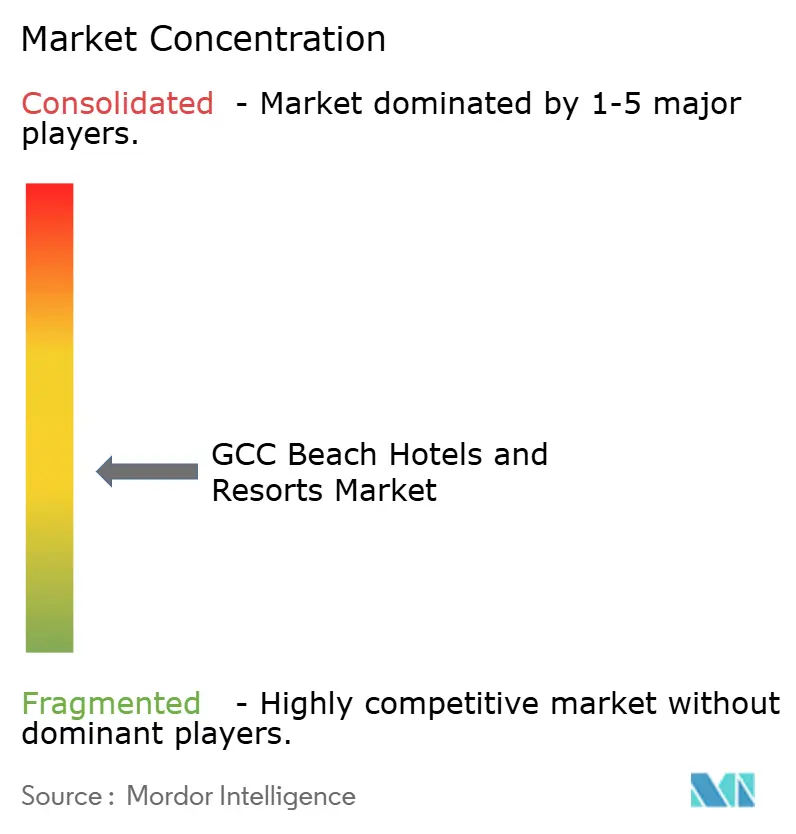
| Market Concentration | Medium |
Major Players *Disclaimer: Major Players sorted in no particular order Image © Mordor Intelligence. Reuse requires attribution under CC BY 4.0. | |
GCC Beach Hotels and Resorts Market Analysis by Mordor Intelligence
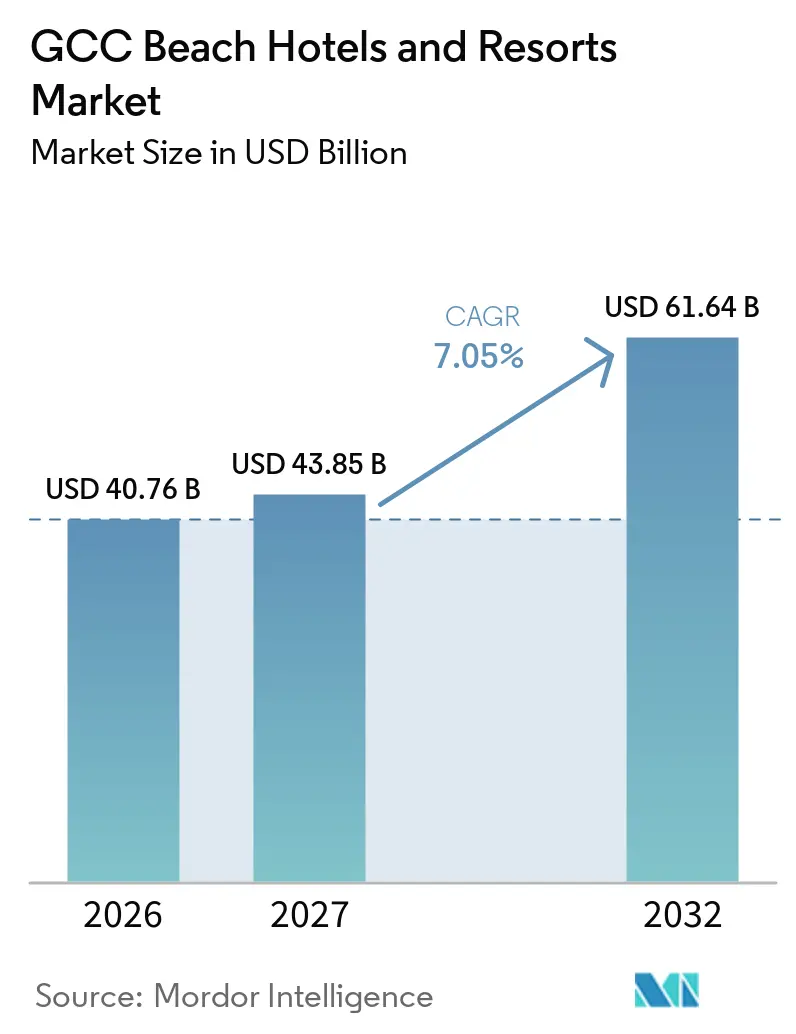
The GCC beach hotels and resorts market size was valued at USD 40.76 billion in 2026 and is estimated to grow from USD 43.85 billion in 2027 to reach USD 61.64 billion by 2032, at a CAGR of 7.05% during the forecast period (2027-2032). Public investment in coastal destinations, branded resort formats, and domestic travel growth in Saudi Arabia and the UAE support the market. Saudi Arabia is diversifying beyond religious travel, with leisure demand becoming increasingly important to its accommodation base. Developers are adding branded residences, wellness facilities, and low-density resorts to improve project economics and attract high-spending guests. High summer temperatures limit outdoor activities, while new supply may intensify competition in major coastal corridors. Opportunities favor operators that balance international and domestic demand, strengthen direct distribution, and offer distinctive coastal experiences.
Key Report Takeaways
- By accommodation type, Luxury Beach Hotels and Resorts accounted for 37.74% of the GCC beach hotels and resorts market share in 2026, while Eco-Resorts and Regenerative Beach Resorts are projected to grow at a 7.84% CAGR through 2032.
- By booking channel, Online Travel Agencies accounted for 41.93% of revenue in 2026, while Direct Booking Channels are projected to grow at an 8.93% CAGR through 2032.
- By property type, Chain / Branded Properties accounted for 54.93% of revenue in 2026 and are projected to grow at an 8.09% CAGR through 2032.
- By tourism type, International Tourism accounted for 60.93% of revenue in 2026, while Domestic Tourism is projected to grow at an 8.76% CAGR through 2032.
- By geography, the UAE accounted for 42.81% of revenue in 2026, while Saudi Arabia is projected to grow at an 8.56% CAGR through 2032.
Note: Market numbers in this report are based on Mordor Intelligence's proprietary estimation framework, which combines nine months of actuals with Q4 projections for base year 2026.
Market Trends and Insights
Drivers Impact Analysis of GCC Beach Hotels and Resorts Market*
| Driver | (~) % Impact on CAGR Forecast | Geographic Relevance | Impact Timeline |
|---|---|---|---|
| Strong Tourism Diversification Agendas Supporting Coastal Resorts Investment | +1.8% | Saudi Arabia and UAE dominant, with spillover to all GCC markets | Long term (≥ 4 years) |
| Giga-projects and large-scale coastal developments expanding resort supply | +1.5% | Saudi Arabia dominant, UAE secondary | Long term (≥ 4 years) |
| Premiumization of beachfront stays, ultra-luxury resorts, private island retreats, and villa-based hospitality | +1.3% | UAE and Saudi Arabia, with spillover to Oman and Qatar | Medium term (2-4 years) |
| Expansion of integrated resorts combining accommodation, dining, wellness, marine activities, and entertainment | +0.9% | UAE and Saudi Arabia | Medium term (2-4 years) |
| Rising international arrivals and improved air connectivity through Emirates, Etihad, Qatar, and new airports | +0.7% | Global, with early gains in Dubai, Jeddah, and Doha | Short term (≤ 2 years) |
| Growth in domestic and regional staycation demand, along with increasing mobile bookings and direct hotel reservations | +0.5% | Saudi Arabia, UAE, Oman, and intra-GCC corridors | Short term (≤ 2 years) |
| Source: Mordor Intelligence | |||
Strong tourism diversification agendas driving coastal resort investment
Saudi Arabia recorded 122 million overnight visitors in 2025, surpassing its previous target of 100 million visitors for the third consecutive year. The country has raised its 2030 visitor target to 150 million, increasing the need for leisure accommodation across coastal destinations[1]. This policy direction provides the GCC beach hotels and resorts market with a demand base beyond seasonal international leisure travel. Government-linked events and business travel can support occupancy at coastal properties during periods of weaker leisure demand. The shift also improves the viability of coastal resort investments in locations where private demand would otherwise take longer to develop.
Giga-projects and large-scale coastal developments expanding resort supply
Red Sea Global has opened resorts at The Red Sea destination and continues to develop a broader hotel portfolio under a controlled coastal development model. AMAALA welcomed its first guests in 2026, with Four Seasons Resort and Residences AMAALA at Triple Bay opening in June 2026, and limits visitor numbers to protect marine ecosystems. In Ras Al Khaimah, Wynn Al Marjan Island reached a major construction milestone in December 2025 and is scheduled to open in September 2027[2]. These projects add rooms, leisure facilities, and destination visibility. They may increase competition for nearby hotels while expanding the visitor base across the broader coastal corridor. The GCC beach hotels and resorts market benefits from destination-building investments but faces a greater need for product differentiation.
Premiumization of Beachfront Stays, Ultra-Luxury Resorts, Private Island Retreats, and Villa-Based Hospitality
Luxury resort developers combine hotel rooms with villas, residences, and wellness amenities to strengthen project funding and enhance guest appeal. Marriott’s regional development activity reflects the role of international luxury brands in developing coastal destinations. Branded residences generate an additional revenue stream before resorts reach stabilized operations. This model supports higher service standards and provides guests with more private accommodation options. It is particularly relevant for coastal projects requiring significant upfront investment. These factors support the GCC beach hotels and resorts market, where demand depends on destination quality and differentiated accommodation formats.
Expansion of Integrated Resorts Combining Accommodation, Dining, Wellness, Marine Activities, and Entertainment
Integrated resorts increase the value of beach stays by combining accommodation with dining, wellness, marine activities, and entertainment. AMAALA is developing a cluster of resorts featuring wellness-focused brands and facilities centered on health and recovery programs. The development will also include residences and specialized hospitality formats. These offerings can extend guest stays by providing access to multiple activities within a single destination and reducing reliance on the beach as the primary attraction. This approach enables the GCC beach hotels and resorts market to target high-value travelers seeking specialized experiences.
Restraints Impact Analysis of GCC Beach Hotels and Resorts Market*
| Restraint | (~) % Impact on CAGR Forecast | Geographic Relevance | Impact Timeline |
|---|---|---|---|
| Seasonal demand fluctuations driven by extreme summer temperatures and humidity across Gulf coastlines | -0.9% | All GCC markets, most acute in UAE, Kuwait, and Qatar | Long term (≥ 4 years) |
| Dependence on international tourism and exposure to geopolitical tensions and regional instability | -0.8% | UAE and Qatar most exposed, Saudi Arabia partly buffered | Short term (≤ 2 years) |
| Competition from holiday homes, serviced apartments, short-term rentals, and non-beach urban hotels | -0.6% | UAE dominant, growing in Saudi Arabia and Qatar | Medium term (2-4 years) |
| High development costs, labor and skilled workforce constraints, and environmental restrictions on coastal and marine ecosystems | -0.5% | Saudi Arabia and Oman, with partial impact in UAE | Long term (≥ 4 years) |
| Source: Mordor Intelligence | |||
Seasonal Demand Fluctuations Driven by Extreme Summer Temperatures and Humidity Across Gulf Coastlines
Extreme summer conditions remain a structural constraint, as beach amenities are less usable for several months each year. This concentrates leisure demand in more comfortable months and pressures operators to maintain rates during a shorter high season. Resorts also require indoor amenities, cooling infrastructure, and summer programming to retain guests. Oman provides a contrasting case, as Salalah’s Khareef season attracts summer travelers, unlike much of the region. Therefore, the GCC beach hotels and resorts market must manage seasonality at the property level rather than treat the region as a uniform climate market. Resorts offering wellness facilities, indoor recreation, and family activities can reduce exposure to the summer revenue gap.
Dependence on International Tourism and Exposure to Geopolitical Tensions and Regional Instability
The UAE and Qatar are more exposed to international source markets due to their roles as aviation gateways and leisure hubs. Saudi Arabia has a stronger domestic travel base, with domestic visitors accounting for 78% of arrivals in the first quarter of 2026[3]. These differences can result in uneven occupancy levels across GCC destinations during periods of regional uncertainty. Hotels with diversified source markets and strong loyalty databases are better positioned to manage sudden demand changes. The GCC beach hotels and resorts market remains sensitive to route restoration and traveler confidence in major source regions.
*Our forecasts treat driver/restraint impacts as directional, not additive. The impact forecasts reflect baseline growth, mix effects, and variable interactions.
Consumer Behavior Analysis
Beach resort demand across the GCC is driven by domestic leisure travelers, regional families, and international visitors seeking coastal holidays, accommodations, and experiential stays. Saudi Arabia recorded 122.6 million overnight visitors in 2025, including 93.3 million domestic tourists. Domestic tourism revenue reached SAR 127.1 billion (USD 33.89 billion), up 10%, while inbound travel receipts totaled SAR 176.6 billion (USD 47.09 billion), up 5%. These trends create opportunities for family packages, wellness retreats, marine activities, and differentiated luxury experiences. However, national tourism figures do not directly measure beach resort demand.
Booking preferences also shape resort distribution strategies. Global Hotel Alliance reported a 26% increase in direct web and app room revenue in 2025, while room nights rose 30%. More than 70% of direct bookings involved cross-brand stays. This trend highlights the potential of loyalty programs and direct channels to encourage repeat bookings. Online travel agencies (OTAs) can also help resorts reach new customers and compare accommodation options.
Hospitality Performance Intelligence
GCC beach resort performance varies by destination, demand mix, and pricing power. In Saudi Arabia, Jeddah’s RevPAR increased 4.4% year over year in Q1 2026, supported by a 3.8-percentage-point rise in occupancy to 66.1%. Riyadh’s RevPAR declined 9.5% as occupancy fell to 52.2%. Domestic tourism remained resilient, with 28.9 million domestic tourists in Q1 2026, up 16%, including about 10 million during the Ramadan and Eid Al-Fitr holidays, when spending reached SAR 10.2 billion (USD 2.72 billion). These trends support coastal resorts targeting domestic leisure and holiday demand alongside international visitors.
In the UAE, international demand and room rates supported hotel returns. Dubai’s occupancy reached 80.7% in 2025, while the average daily rate rose 8% to AED 579 (USD 157.66) and RevPAR increased 11% to AED 467 (USD 127.16). Abu Dhabi recorded 81% occupancy in 2025, with RevPAR up 23% year over year. These benchmarks highlight opportunities for beach resort operators to combine room rates with destination experiences while monitoring new supply and seasonal occupancy to protect revenue performance.
GCC Beach Hotels and Resorts Market Segment Analysis
By Accommodation Type:
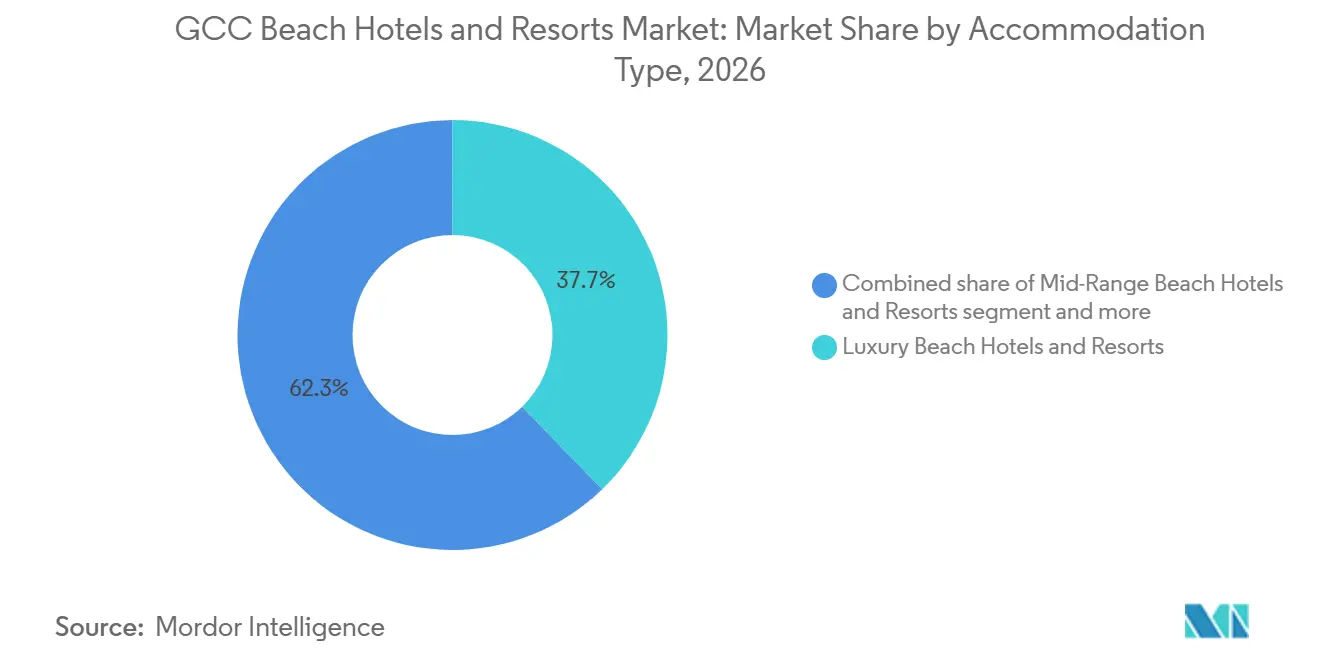
Eco-Luxury Growth Alongside Luxury Revenue LeadershipLuxury beach hotels and resorts accounted for 37.74% of the GCC beach hotels and resorts market share in 2026. Branded residences, villa stays, and high-service resort formats support this position. AMAALA’s portfolio includes wellness-focused properties that extend luxury travel beyond conventional accommodations. These properties can command higher rates by combining privacy, beachfront access, and a strong brand proposition. They also attract guests who value destination experiences alongside room quality. This segment continues to contribute a substantial share of market revenue.
Eco-resorts and regenerative beach resorts are projected to grow at a 7.84% CAGR through 2032. Red Sea Global positions the Red Sea around regenerative tourism and limits development to protect natural assets. Hawar Resort by Mantis offers a similar ecology-led format within a wildlife sanctuary. These properties appeal to travelers seeking lower-density stays in environmental settings. Mid-range properties serve growing domestic travel in emerging coastal corridors, while budget and hostel formats remain limited in high-cost beachfront areas. Boutique and lifestyle hotels meet demand for smaller-scale stays with local character and curated services.

By Booking Channel:
OTA Reach and Direct Booking Margin GrowthOnline Travel Agencies accounted for 41.93% of booking revenue in 2026 in the GCC beach hotels and resorts market. Their scale enables resorts to reach guests comparing destinations, rates, and package options across the region. These platforms are particularly valuable for new resorts without established direct customer relationships and for short booking windows and mobile-led leisure planning. Resorts must manage commission costs and avoid excessive reliance on a limited number of intermediaries. Corporate and travel management company channels remain relevant in the UAE and Qatar, where events and government-linked travel generate predictable room blocks.
Direct Booking Channels are forecast to grow at a CAGR of 8.93% through 2032. GHA Discovery’s UAE hotel results indicate that loyalty members drive higher room-night growth and spending than guests booking through other channels. Direct channels enable resorts to promote room upgrades, dining, spa services, and return offers before arrival, strengthening guest relationships and supporting revenue beyond room rates. This channel is most effective when operators provide practical loyalty benefits and a seamless mobile booking experience. Resorts can use direct reservations to improve margins while retaining Online Travel Agencies for broader reach.
By Property Type:
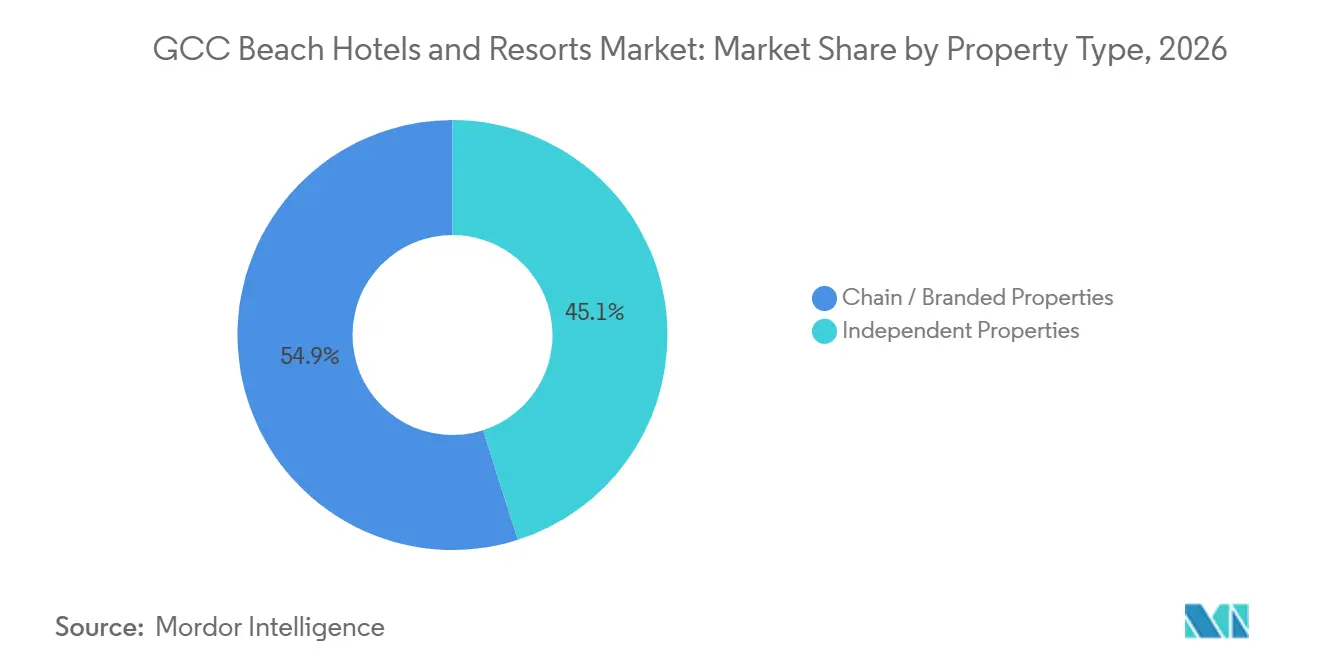
Brand Scale and Independent DifferentiationChain / Branded Properties accounted for 54.93% of revenue share in 2026 and are projected to grow at an 8.09% CAGR through 2032. Large hotel groups deploy global loyalty programs, operating systems, and brand recognition across GCC markets. Marriott opened The Red Sea EDITION on Shura Island in October 2025, adding a branded coastal luxury option. Major chains also support branded residence projects, which require consistent operating standards and sales support. Their portfolios serve multiple price points and traveler segments, giving branded operators an advantage in the GCC beach hotels and resorts market.
Independent properties remain relevant in boutique coastal destinations, particularly in Oman and smaller UAE emirates. They compete through local design, lower guest capacity, and direct connections to specific beaches or landscapes. However, limited access to global loyalty programs and cross-brand customer referrals create challenges during demand shocks. Independent operators therefore emphasize distinctive guest experiences and local partnerships, especially where visitors prioritize authenticity over standardization. The presence of large chains and specialized independent properties keeps the GCC beach hotels and resorts market moderately concentrated.
By Tourism Type:
Domestic Demand Builds ResilienceInternational tourism accounted for 60.93% of revenue in 2026, making it the largest tourism type in the GCC beach hotels and resorts market. Dubai welcomed a record 19.59 million international overnight visitors in 2025, reinforcing the UAE’s position as one of the world’s leading global tourism and business destinations. International guests support leisure resorts through longer stays and greater use of paid facilities. However, this segment is sensitive to air access, geopolitical confidence, and competing destinations. Resort operators need diverse source markets to reduce dependence on a single long-haul region. The planned GCC unified tourist visa could support multi-destination coastal itineraries once launched.
Domestic tourism is projected to expand at an 8.76% CAGR through 2032. Saudi Arabia recorded 93.3 million domestic tourists in 2025, while domestic visitors accounted for approximately 78% of total tourist arrivals in Q1 2026, reaching 28.9 million, up 16% year over year. Jeddah’s RevPAR increased 4.4% during Q1 2026, supporting the importance of domestic demand[4].
Geography Analysis
The UAE accounted for 42.81% of the GCC beach hotels and resorts market in 2026. Ras Al Khaimah welcomed a record 1.35 million overnight visitors in 2025, reinforcing its role as a leisure destination beyond Dubai. The Marjan Beach plan includes 12,000 hotel keys and 22,000 residential units. Wynn Al Marjan Island, scheduled for September 2027, will introduce an integrated resort format new to the GCC. Strong global connectivity, established luxury brands, and tourism services support the UAE, although new beachfront districts will increase the need for differentiated guest experiences.
Saudi Arabia is the fastest-growing geography, with its market projected to grow at an 8.56% CAGR through 2032. Public investment supports coastal developments along the Red Sea, in Jeddah, and elsewhere. Red Sea Global combines resort development with infrastructure and environmental controls. Luxury brands are entering the Red Sea coast, while domestic visitors accounted for 78% of arrivals in the first quarter of 2026. Key challenges include developing services, access, and demand alongside the resort pipeline.
Oman, Qatar, Bahrain, and Kuwait serve distinct coastal tourism roles. Oman benefits from the Khareef season and nature-based travel. Hilton opened three hotels at Barr Al Jissah in January 2026. Qatar is developing Lusail’s waterfront, while Bahrain and Kuwait target smaller high-end leisure segments. These markets require clear product identities to compete with the UAE and Saudi Arabia.
Hospitality Supply & Development Intelligence
The GCC beach resort market is expanding as Saudi Arabia’s Red Sea developments and the UAE’s coastal masterplans add resort inventory. Red Sea Global is developing regenerative tourism projects across approximately 28,000 sq. km. Its Red Sea destination is expected to include around 50 resorts and 8,000 hotel rooms by 2030, supporting low-density luxury concepts. In Ras Al Khaimah, the Marjan Beach masterplan targets 12,000 hotel keys and 22,000 residential units, requiring phased openings and demand-generation strategies.
Supply growth remains significant. Saudi Arabia had 171,650 existing quality hotel keys as of September 2025, with about 94,500 rooms in the pipeline, according to a report published in February 2026. Luxury properties are expected to account for 75% of new supply, increasing competition for resort demand. Across the GCC, approximately 711,500 hotel rooms were available in 2024, according to the GCC Statistical Center. Developers should align opening schedules with destination accessibility, visitor growth, and differentiated coastal experiences to mitigate occupancy and pricing pressure.
Competitive Landscape
The GCC beach hotels and resorts market is moderately concentrated, with Marriott International, Accor, Hilton, IHG, and Jumeirah Group competing alongside regional and independent operators. Major chains are expanding through luxury brands, branded residences, and mixed-use destinations. Marriott International’s October 2025 opening of The Red Sea EDITION reflects international brands’ entry into Saudi coastal destinations. Accor’s multi-brand capabilities support varied price points and resort formats, while Hilton’s three-hotel development at Barr Al Jissah reflects a similar approach in Oman.
Operators compete through loyalty programs, operating standards, owner relationships, and large-scale project capabilities. State-backed developers influence competition through coastal land, infrastructure, and destination investment. Red Sea Global acts as a developer, operator, and asset owner, controlling key resort sites and setting environmental design standards and development limits for The Red Sea destination.
Wynn Al Marjan Island in Ras Al Khaimah is scheduled to include the GCC’s first land-based gaming facility. AMAALA’s wellness-focused resorts emphasize specialized guest experiences. Independent and regional operators serve boutique and smaller-scale segments through local relationships, site-specific design, and flexible concepts, but lack global guest databases and loyalty programs. Large operators use loyalty partnerships and direct booking ecosystems to reduce reliance on online travel agencies. No small group controls most coastal supply across all GCC countries.
GCC Beach Hotels and Resorts Industry Leaders
-
Marriott International
-
Accor
-
Hilton
-
InterContinental Hotels Group (IHG)
-
Jumeirah Group
- *Disclaimer: Major Players sorted in no particular order
GCC Beach Hotels and Resorts Market Companies Covered in this Report
- Marriott International
- Hilton
- Hyatt Hotels Corporation
- Accor
- InterContinental Hotels Group (IHG)
- Four Seasons Hotels and Resorts
- Minor Hotels (Anantara)
- Jumeirah Group
- Kerzner International
- Rotana Hotels & Resorts
- Emaar Hospitality Group
- Red Sea Global
- Rixos Hotels
- Kempinski Hotels
- Shangri-La Group
- Rosewood Hotel Group
- Aman Group
- Radisson Hotel Group
- Omran Group
Recent Industry Developments in GCC Beach Hotels and Resorts Market
- January 2026: Hilton opened Al Husn Hotel Muscat, Hilton Muscat Al Bandar, and DoubleTree by Hilton Muscat Al Waha at Barr Al Jissah, Oman. The three properties expand coastal accommodation options across luxury, leisure, family stays, and business events.
- December 2025: Wynn Al Marjan Island topped out its 70-story tower at 283 meters, with all 1,530 guest accommodations reaching full structural completion. The resort is scheduled to open in September 2027.
- August 2025: Shurooq invested more than AED 300 million (USD 81.69 million) in the Sharjah Collection, comprising seven luxury eco-retreats with 154 high-end accommodation units. The portfolio combines nature, heritage, and wellness experiences to strengthen Sharjah’s appeal for sustainable and experiential tourism.
- June 2025: Miraval Resorts & Spas and Red Sea Global unveiled 20 exclusive beach-villa residences at Miraval the Red Sea on Shura Island, Saudi Arabia. Designed around holistic living and personalized well-being, the residences extend the destination’s luxury offering beyond conventional resort accommodation.
GCC Beach Hotels and Resorts Market Report Scope
The GCC beach hotels and resorts market report analyzes coastal hospitality across the UAE, Saudi Arabia, Oman, Qatar, Bahrain, and Kuwait. The study segments the market by accommodation type, booking channel, property type, tourism type, and geography, covering luxury, mid-range, budget, boutique, and eco-resorts. It assesses drivers including tourism diversification, giga-projects, premium beachfront stays, integrated resort development, improved air connectivity, and domestic staycations, alongside restraints such as seasonality, geopolitical risks, alternative accommodation, high development costs, labor constraints, and environmental restrictions. The report evaluates hospitality supply, room inventory, development pipelines, occupancy rates, average daily rates, traveler preferences, booking behavior, and spending patterns. It provides market size and growth forecasts by segment and country for 2022–2032. The study also examines regulatory and technological developments, competitive forces, market concentration, market shares, strategic moves, and profiles of leading hotel groups and resort developers. Opportunities in sustainable and regenerative beach resorts and premium experiential hospitality are also assessed. Market estimates and forecasts are presented in value terms across the covered segments.
Segmentation Overview
Key Questions Answered in the Report
What is the projected growth rate for the GCC beach hotels and resorts market?
The GCC beach hotels and resorts market was valued at USD 40.76 billion in 2026 and is projected to reach USD 61.64 billion by 2032, growing at a 7.05% CAGR from 2027 to 2032.
Which GCC country leads beach hotel and resort revenue?
The UAE led with 42.81% of regional revenue in 2026, supported by established luxury tourism infrastructure and global air connectivity.
Which country is growing fastest in GCC coastal hospitality?
Saudi Arabia is projected to grow at an 8.56% CAGR through 2032, supported by new Red Sea destinations and domestic travel demand.
What booking channel is growing fastest for GCC beach resorts?
Direct Booking Channels are forecast to grow at an 8.93% CAGR through 2032 as loyalty programs and mobile booking tools gain importance.
What is the largest accommodation category in GCC beach resorts?
Luxury Beach Hotels and Resorts held 37.74% of revenue in 2026, supported by villa stays, branded residences, and wellness facilities.
What are the main constraints on GCC beach resort growth?
Summer heat, international travel exposure, alternative accommodation, and high coastal development costs remain the main constraints.