
Market Overview
| Study Period | 2020 - 2032 |
|---|---|
| Forecast Data Period | 2027 - 2032 |
| Base Year Market Size (2026) | USD 5.02 Billion |
| Market Size (2027) | USD 5.5 Billion |
| Market Size (2032) | USD 8.87 Billion |
| Growth Rate (2027 - 2032) | 10.03 % |
| Market Concentration | Medium |
Major Players *Disclaimer: Major Players sorted in no particular order Image © Mordor Intelligence. Reuse requires attribution under CC BY 4.0. | |
GCC Aircraft MRO Market Analysis by Mordor Intelligence
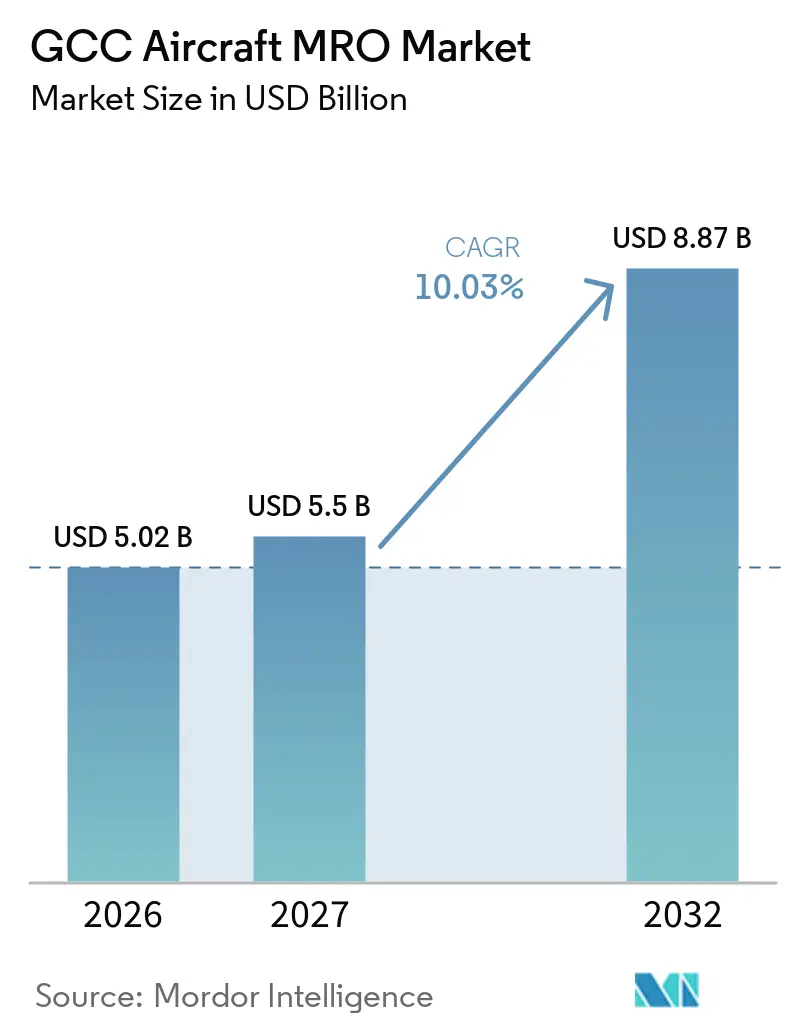
The GCC aircraft MRO market size was valued at USD 5.02 billion in 2026 and is forecast to grow from USD 5.50 billion in 2027 to USD 8.87 billion by 2032, registering a 10.03% CAGR between 2027 and 2032. Fleet additions in the GCC are increasing maintenance demand faster than regional capacity can expand. Widebody fleets carry more maintenance labor hours than narrowbody fleets over comparable check intervals. Engine work remains central as CFM LEAP and Pratt & Whitney GTF fleets enter scheduled overhaul cycles. Airline engineering units are expanding third-party services while new carriers rely on outside maintenance support. Saudi Arabia offers a growing opportunity as localization programs and new airlines create demand for approved capacity across the region.
Key Report Takeaways
- By MRO type, engine MRO held 41.30% revenue share in 2026, while modifications and upgrades are forecast to grow at a 12.88% CAGR through 2032.
- By aircraft type, fixed-wing aircraft held 91.50% revenue share in 2026, while rotary-wing aircraft are forecast to grow at a 12.04% CAGR through 2032.
- By application, commercial aviation held 72.22% revenue share in 2026 and is forecast to grow at an 11.25% CAGR through 2032.
- By service provider, airline-affiliated MRO providers held 45.90% revenue share in 2026, while independent third-party MRO providers are forecast to grow at a 12.05% CAGR through 2032.
- By geography, the UAE held 41.50% revenue share in 2026, while Saudi Arabia is forecast to grow at an 11.20% CAGR through 2032.
Note: Market numbers in this report are based on Mordor Intelligence's proprietary estimation framework, which combines nine months of actuals with Q4 projections for base year 2026.
Market Trends and Insights
Drivers Impact Analysis of GCC Aircraft MRO Market*
| Driver | (~) % Impact on CAGR Forecast | Geographic Relevance | Impact Timeline |
|---|---|---|---|
| Saudi Arabian and UAE fleet expansion accelerating MRO demand | +2.80% | UAE and Saudi Arabia core, with spillover to Qatar and Kuwait | Short term (≤ 2 years) |
| Saudi Vision 2030 and UAE aviation hub investments driving MRO localization | +2.30% | Saudi Arabia and UAE, with early gains in Jeddah, Abu Dhabi, and Dubai | Medium term (2-4 years) |
| Expanding GCC LEAP, GTF, GEnx, and Trent fleets increasing engine shop visits | +2.10% | UAE and Saudi Arabia primary, with global spillover for slot capacity | Medium term (2-4 years) |
| GCC airline fleet growth driving third-party MRO outsourcing | +1.20% | UAE and Saudi Arabia, with emerging demand in Qatar | Short term (≤ 2 years) |
| Desert heat, sand exposure, and intensive regional operations increasing component maintenance | +1.10% | GCC-wide, with highest intensity in the UAE, Saudi Arabia, and Kuwait | Short term (≤ 2 years) |
| GCC aviation hubs accelerating predictive maintenance adoption | +0.80% | UAE-led, with Dubai and Abu Dhabi as primary hubs and Saudi Arabia following | Medium term (2-4 years) |
| Source: Mordor Intelligence | |||
Saudi and UAE Fleet Expansion Accelerating MRO Demand
Fleet expansion and modernization initiatives in Saudi Arabia and the UAE are expected to create long-term maintenance opportunities for GCC aircraft MRO providers. Saudia received its first LEAP-1A-powered A321XLR in May 2026, as part of its order for 15 aircraft. In July 2026, flynas confirmed orders for an additional 20 A321neo and five A330-900 aircraft. In the UAE, Emirates received 18 aircraft between January and September 2026, including 11 A350s and seven B777 freighters. Emirates is also expanding its widebody fleet and plans to develop a USD 5.1 billion, 1.1-million-square-meter engineering complex at Dubai South. Upon completion in mid-2030, the facility will be capable of servicing 28 widebody aircraft simultaneously.[1] These fleet additions and MRO capacity investments are expected to increase demand for airframe, engine, component, and heavy-maintenance services across the GCC.
Saudi Vision 2030 and UAE Aviation Hub Investments Driving MRO Localization
Saudi Arabia and the UAE are expanding domestic aircraft maintenance capabilities through infrastructure investments and technical partnerships. In February 2026, Saudi Arabia's General Authority for Military Industries (GAMI) and GE Aerospace signed an agreement to strengthen F110 engine repair capabilities through specialized equipment and technical training. In May 2026, Emirates began construction of its USD 5.1 billion engineering complex at Dubai South, which is designed to accommodate 28 widebody aircraft simultaneously when completed in mid-2030. In July 2026, the UAE-based AMMROC signed an agreement with Airbus Defense and Space to explore expanded maintenance capabilities for C295 and A330 MRTT military aircraft. These developments will support the localization of commercial and military maintenance activities, improve access to specialized technical capabilities, and position GCC providers to capture a greater share of regional maintenance expenditure.
Expanding GCC LEAP, GTF, GEnx, and Trent Fleets Increasing Engine Shop Visits
The growing installed base of next-generation aircraft engines is expected to expand opportunities for specialized engine maintenance across the GCC. In June 2026, IATA highlighted the rising LEAP and GTF shop-visit requirements driven by fleet growth, durability challenges, and increasing demand for engine overhaul services. In July 2026, Sanad announced investments exceeding AED 25 million (USD 6.81 million) to expand LEAP-1A and LEAP-1B engine testing capabilities in Abu Dhabi, enabling complete overhaul and testing services within the UAE.[2] In May 2026, the company appointed Group AMANA to develop a 64,000-square-meter GTF engine MRO center in Al Ain, which is scheduled to commence operations by the end of 2028. Sanad's existing GEnx and Trent 700 maintenance activities further demonstrate the region's diverse capabilities in engine servicing. These developments will support the expansion of GCC engine MRO capacity and create opportunities to capture additional regional and international overhaul work for carriers in Europe, Africa, and Asia.
Desert Heat, Sand Exposure, and Intensive Regional Operations Increasing Component Maintenance
High temperatures, sand, and airborne dust increase maintenance requirements for aircraft operating in GCC environments. Particulate ingestion can accelerate engine erosion, contribute to deposits on hot-section components, and affect turbine durability, thereby increasing the need for engine inspections and component repairs. In June 2026, Emirates reiterated concerns about the durability of the Trent XWB-97 under harsh Gulf operating conditions. Rolls-Royce confirmed in July 2026 that the engine had received two durability enhancement packages, with a third package scheduled for introduction in 2028 to improve time on wing under challenging operating conditions. These developments underscore the continuing technical challenges associated with desert operations. Consequently, compressor cleaning, engine health monitoring, borescope inspections, and component maintenance will remain important service requirements, supporting recurring MRO demand across commercial, military, and rotary-wing operations in the GCC.
Restraints Impact Analysis of GCC Aircraft MRO Market*
| Restraint | (~) % Impact on CAGR Forecast | Geographic Relevance | Impact Timeline |
|---|---|---|---|
| High MRO infrastructure investments and lengthy GACA-GCAA certification processes | -1.10% | Saudi Arabia faces the most acute certification delays, followed by the UAE | Medium term (2-4 years) |
| Shortage of GACA and GCAA-licensed aircraft maintenance professionals | -0.90% | GCC-wide, most acute in the UAE and Saudi Arabia | Medium term (2-4 years) |
| Global engine shop-slot shortages delaying GCC fleet maintenance | -0.70% | Global constraint affecting GCC widebody operators, especially the UAE and Qatar | Medium term (2-4 years) |
| OEM-controlled engine technologies and parts limiting GCC MRO independence | -0.60% | UAE and Saudi Arabia primary, affecting independent LEAP and GTF shops | Long term (≥ 4 years) |
| Source: Mordor Intelligence | |||
Shortage of GACA and GCAA-Licensed Aircraft Maintenance Professionals
The limited availability of licensed engineers, type-rated technicians, and specialized maintenance personnel may constrain the expansion of GCC aircraft MRO operations. Boeing's 2026 Pilot and Technician Outlook projected a global requirement for 728,000 new commercial aircraft maintenance technicians between 2026 and 2045, reflecting substantial long-term recruitment and training needs. In July 2026, the UAE's AMMROC launched its Ruwad AMMROC program to train and employ 100 Emirati military aircraft maintenance technicians by 2030. These initiatives highlight the importance of developing specialized technical capabilities as maintenance facilities expand. However, personnel must acquire practical experience, aircraft-specific qualifications, and relevant authorizations before undertaking certain maintenance responsibilities. Therefore, shortages of qualified personnel may restrict hangar utilization, delay engine and component maintenance, and increase recruitment costs for GCC MRO providers.
Global Engine Shop-Slot Shortages Delaying GCC Fleet Maintenance
Global shortages of engine repair capacity, spare parts, and replacement engines are expected to continue affecting maintenance planning and aircraft availability. In June 2026, IATA reported that durability challenges and constrained engine MRO capacity are reducing time on wing and increasing demand for unscheduled shop visits. The study projected that annual LEAP shop visits could exceed 5,000 globally by 2040, while GTF maintenance requirements are also expected to increase. GCC airlines will remain exposed to these constraints through their LEAP- and GTF-powered fleets and their reliance on international overhaul networks. Limited shop availability can extend maintenance turnaround times, increase spare-engine leasing costs, and keep aircraft out of service for longer periods. Although these conditions will support investment in regional engine MRO facilities, existing capacity constraints and material shortages may limit maintenance throughput and delay the completion of scheduled overhauls.
*Our forecasts treat driver/restraint impacts as directional, not additive. The impact forecasts reflect baseline growth, mix effects, and variable interactions.
GCC Aircraft MRO Market Segment Analysis
By MRO Type:
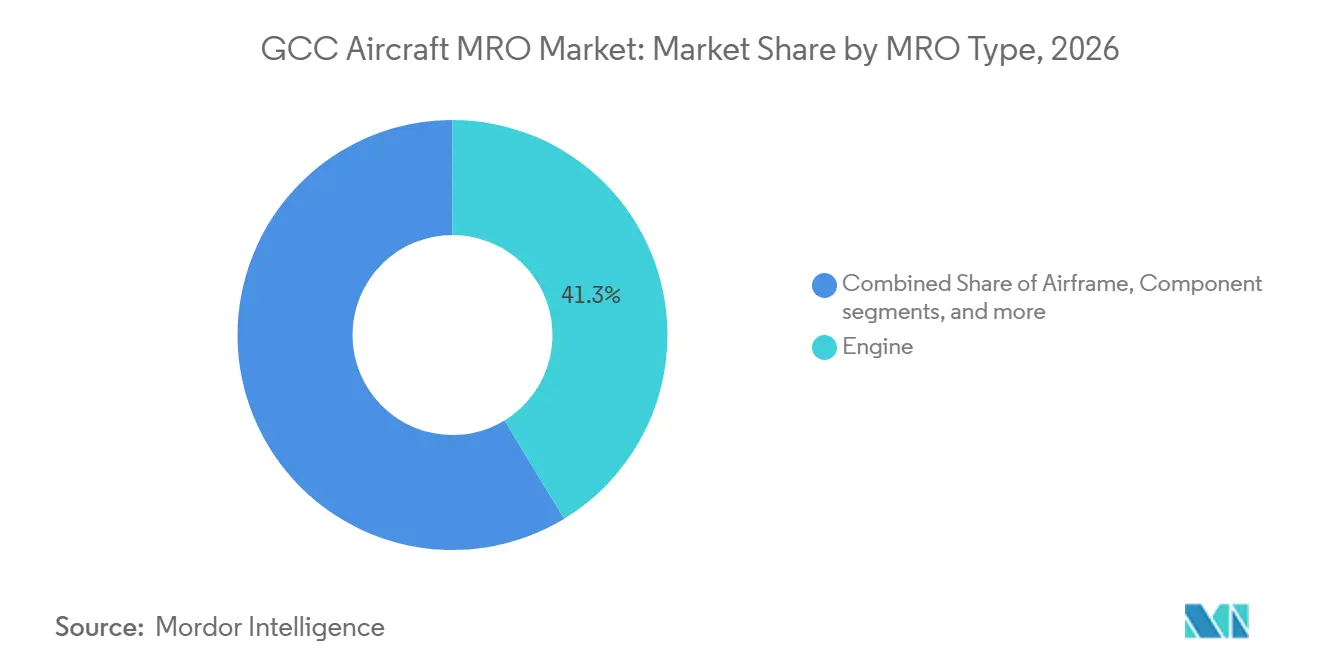
Engine Overhaul Demand Anchors Revenue, Upgrades Lead GrowthEngine MRO held 41.30% of the GCC aircraft MRO market share in 2026. The segment reflects the region’s widebody fleet composition and operating conditions that reduce time on wing for LEAP, GE90, GEnx, Trent 700, and Trent XWB engines. Sanad expanded its relationship with Rolls-Royce Trent 700 in February 2026. The agreement covers up to 612 shop visits through 2031 and includes AED 125 million (USD 34.04 million) for tools and automation. This capability allows Abu Dhabi to pursue engine work from Africa and South Asia, as well as domestic demand. Engine work also attracts supporting investment in test cells, tooling, repair approvals, and skilled labor. Those requirements favor established providers with OEM relationships and a large capital base.
Modifications and upgrades are forecast to record a 12.88% CAGR through 2032. Emirates is undertaking a USD 5 billion cabin retrofit program for 219 widebody aircraft. Its program had completed 100 aircraft by July 2026 after 4.40 million collective work hours at Dubai hangars. The B777X delivery delays are directing cabin investment toward existing aircraft rather than new aircraft interiors. This preserves demand for GCC aircraft MRO services, including refurbishment and interior modification work. Airframe MRO is also becoming more demanding as composite-intensive narrowbodies enter heavy-check cycles. Line and component work remain steady, with desert conditions increasing wear on avionics, landing gear, and hydraulic systems. Approval requirements keep complex component repair concentrated among providers with approved maintenance data.



By Aircraft Type:
Fixed-Wing Dominates While Rotary-Wing AcceleratesFixed-wing aircraft held 91.50% revenue share in 2026. Commercial and military fixed-wing fleets dominate the aircraft bases across the 6 GCC states. Regional maintenance infrastructure has also been built primarily around widebody and narrowbody airframes. Emirates Engineering’s Dubai South complex will be designed to service 28 widebody aircraft simultaneously after its expected mid-2030 completion. The facility demonstrates the scale of fixed-wing capacity that operators expect to need. Heavy checks on large aircraft require large hangars, special tooling, and a substantial certified workforce. This makes capacity expansion costly and raises barriers for smaller regional shops. Therefore, fleet growth continues to support large, integrated maintenance campuses.
Rotary-wing MRO is projected to advance at a 12.04% CAGR through 2032. Demand comes from defense fleets, offshore energy activity, tourism projects, and search-and-rescue operations. AMMROC became the first Sikorsky-authorized Black Hawk helicopter blade depot outside the US in February 2025. Gulf Helicopters also signed a GE Aerospace TrueChoice agreement in November 2025 for CT7-2E1 engines powering its Leonardo AW189 aircraft. These authorizations build GCC aircraft MRO market capability through OEM-approved service scopes. Mission-critical helicopter operations require frequent inspections and dependable turnaround times. Gulf operating conditions can further increase inspection needs. This supports MRO spending per helicopter above the level associated with narrowbody commercial aircraft.
By Application:
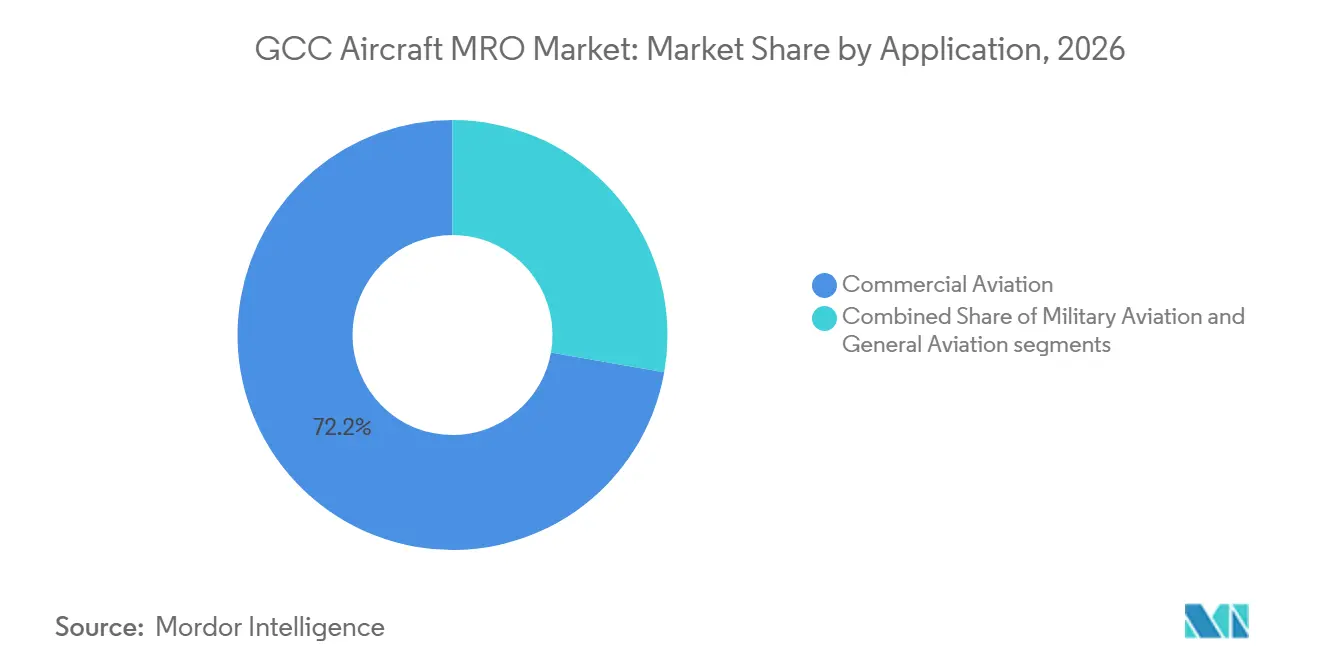
Commercial Aviation Consolidates Demand While Military Deepens CapabilityCommercial aviation accounted for 72.22% of the GCC aircraft MRO market size in 2026. The segment includes passenger services and cargo operations, supported by the GCC's role as a hub connecting Europe, Asia, and Africa. Emirates and Etihad Engineering agreed on A380 heavy maintenance work covering 9-year and 12-year C-checks from August 2026 through January 2029. This work illustrates the depth of demand for passenger aircraft maintenance in the region. Cargo demand is gaining importance as Emirates' 90-unit B777-8 freighter order requires dedicated maintenance capacity. Freighters have different loading, landing gear cycle, and cargo door maintenance requirements from passenger aircraft. Commercial aviation is also the fastest-growing application, with a forecast 11.25% CAGR through 2032. This places pressure on providers' capacity planning for those already handling large hub fleets.
Military aviation has a distinct maintenance structure and supports sovereign capability objectives. AMMROC in Al Ain provides depot-level maintenance for C-130 Hercules, UH-60 Black Hawk, and Eurocopter AS350 aircraft. It signed a memorandum of understanding with Boeing Global Services in November 2025 covering possible CH-47 Chinook component work. AMMROC also signed an MoU with Airbus Defence and Space in July 2026 to explore sustainment work for the C295 and A330 MRTT platforms. These agreements can expand the company's platform and component scope. General aviation remains the smallest application segment in the GCC aircraft MRO market. It gains incremental demand from VVIP aircraft completions and upgrades commissioned by GCC state operators. Such work delivers high revenue per aircraft hour despite its smaller fleet base.

By Service Provider:
Airline MRO Leadership Faces Structural Challenge from IndependentsAirline-affiliated providers held 45.90% revenue share in 2026. Emirates Engineering and Etihad Airways Engineering account for much of this activity through maintenance for their own fleets and third-party contracts. Etihad Engineering plans to double revenue by 2030 and add an A380-capable hangar from 2027. It expects its workforce to exceed 3,000 professionals by 2028. Airline-owned providers begin with large, predictable internal workloads. This gives them a basis for investing in hangars, shops, and specialized aircraft capabilities. Their strategic position is particularly strong in widebody base maintenance. The provider model also creates natural links between engineering requirements, fleet planning, and aircraft operations.
Independent third-party MRO is expected to grow at a 12.05% CAGR through 2032. New airlines without established engineering organizations are more likely to outsource maintenance from the beginning. Riyadh Air exemplifies this pattern because its B787-9 operations began without a legacy maintenance organization. Lufthansa Technik signed a 10-year Total Component Support agreement for Riyadh Air’s B787-9 fleet at the 2025 Dubai Airshow. This arrangement illustrates the GCC aircraft MRO market opportunity for independent providers. OEM-captive providers are gaining influence in newer engine work because they control repair data and specialized tooling. GE Aerospace is investing USD 50 million in a 120,000-square-foot on-wing support facility at Dubai South, scheduled to open in Q1 2027. The facility will support LEAP quick-turn work and GE9X preparation.
Geography Analysis
United Arab Emirates Aircraft MRO Market
The UAE held 41.50% of the GCC aircraft MRO market share in 2026. Its position reflects two decades of aviation infrastructure development, OEM-approved capability, and the widebody fleets operated by Emirates and Etihad. Emirates broke ground on a USD 5.10 billion engineering complex at Dubai South in May 2026. The facility will cover 1.10 million square meters and is intended to accommodate 28 widebody aircraft at a time upon completion in mid-2030. Collins Aerospace and Etihad Airways Engineering announced a joint venture for nacelle and thrust-reverser MRO in July 2026. Its 3,250-square-meter Abu Dhabi facility is expected to become operational in Q1 2027.[3] Etihad Engineering provides A380 heavy maintenance for Emirates from August 2026 through January 2029. These investments reinforce the UAE’s role in heavy maintenance and specialized component work.
Saudi Arabia Aircraft MRO Market
Saudi Arabia is forecast to grow at an 11.20% CAGR through 2032. Vision 2030, investment in Saudia Technic, and the launch of Riyadh Air are expanding the country’s need for locally available maintenance support. Lufthansa Technik’s 10-year Riyadh Air agreement covers B787-9 component support from entry into service. Atitech and Alnimr Alarabi Holding announced a joint venture in October 2025 for a Saudi-based maintenance center serving the SAMEA region. Flyadeal is expanding its A320 fleet, creating a new category of line-maintenance outsourcing in Riyadh. Lufthansa Technik will support aircraft production inspection work for incoming flyadeal A320 and A330neo aircraft. The aircraft MRO market in Saudi Arabia is therefore supported by new airline demand and industrial policy.
GCC Aircraft MRO Market
Qatar, Oman, Kuwait, and Bahrain are also growth centers for the market. Qatar Airways Engineering remains Qatar’s principal maintenance anchor, but it is using external providers for some overflow widebody checks. Turkish Technic and Joramco have received overflow work after Qatar Airways reduced maintenance intervals for selected fleets to 14 months in 2025. Oman Air Engineering focuses mainly on line and base work for Oman Air’s narrowbody and widebody fleets. Bahrain supports smaller technical operations linked to the Gulf Aviation Academy and third-party line-maintenance activity. Kuwait is gaining demand as Kuwait Airways modernizes its fleet and LCC activity increases at Kuwait International Airport. These countries have smaller maintenance bases than the UAE and Saudi Arabia. Their needs create opportunities in the GCC aircraft MRO market for providers that can offer fast, approved line and component support.
Competitive Landscape
Market Concentration
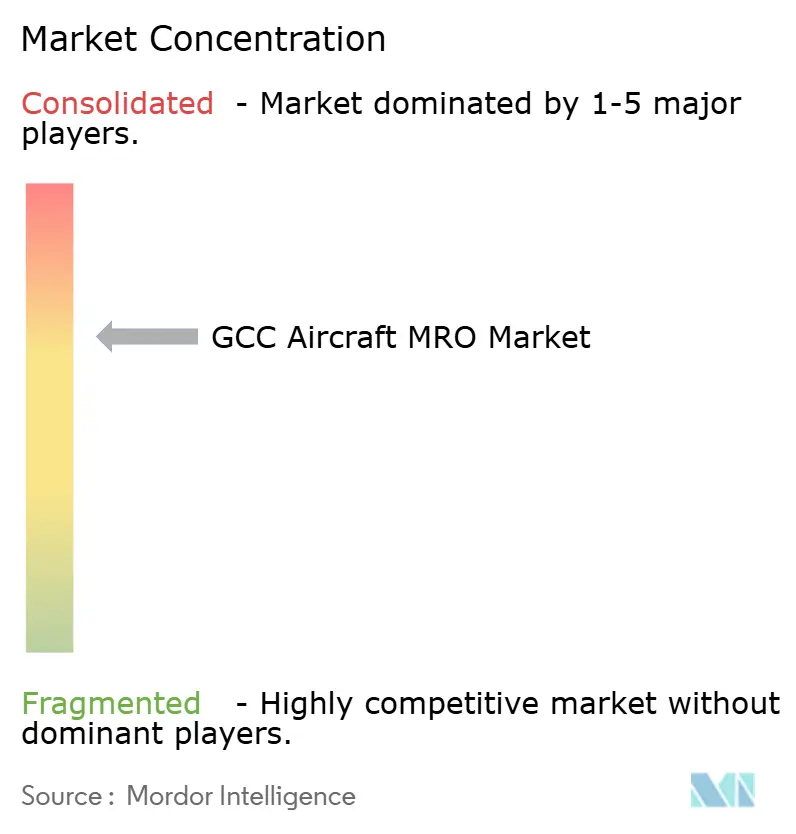
The GCC aircraft MRO market is moderately consolidated, dominated by a small group of large airline-related and state-backed providers. Emirates Engineering, Etihad Airways Engineering, Saudia Technic, and Sanad anchor the largest revenue pools. Their strategies focus on vertical integration, larger service scopes, and accumulation of OEM approvals. Sanad is building LEAP and GTF capacity in Abu Dhabi, while Emirates Engineering is concentrating on landing gear, engine piece-part, and composite repair capability at Dubai South. Saudia Technic is planning to produce 300 jet engines and 500 auxiliary power units each year by 2030. These projects require investment in licensed staff, tooling, facilities, and access to technical data. They give leading providers advantages in high-value work that cannot be delivered through generic workshop capacity. Competition is therefore strongest in the specialized scope required by new-generation engines and widebody fleets.
International entrants are generally using partnerships instead of standalone greenfield investments. Atitech’s Saudi joint venture brings Italian D-check and base-maintenance capabilities together with local capital and access to licensing. Lufthansa Technik has expanded its presence through agreements with Riyadh Air, Saudia Technic, and flyadeal. Etihad Airways and Lufthansa Technik also formed a strategic MRO relationship in November 2025 covering components, landing gear, production inspections, and digital engineering services. This approach lets international firms bring technical standing and service processes while domestic partners contribute access and local operating knowledge. It also allows local providers to gain access to established supply chains. The model is likely to remain important while Saudi and UAE operators expand approved maintenance capacity.
Technology and intellectual property are becoming more relevant to competition in the GCC aircraft MRO market. Emirates deployed Airbus Skywise Fleet Performance+ across its A380 and A350 fleets in 2025 for real-time predictive maintenance analytics. Sanad is investing in AI-enabled inspection activity as part of automation plans. Safran’s sand-resistant turbine-coating patents and Rolls-Royce’s Trent XWB-97 durability-improvement work affect which shops can deliver advanced engine services. GE Aerospace’s planned Dubai South facility will add quick-turn LEAP support and GE9X readiness. The main opening for smaller providers remains narrowbody line maintenance and component support outside the 3 largest regional hubs. No single provider has built a distributed, independent network to address this gap in the GCC aircraft MRO market. This preserves opportunities for providers that can obtain needed approvals and locate services near underserved routes.
GCC Aircraft MRO Industry Leaders
-
Emirates Engineering (Emirates Group)
-
Saudia Technic
-
Etihad Airways Engineering L.L.C.
-
Qatar Airways Group Q.C.S.C.
-
Sanad Aerotech (Sanad Group)
- *Disclaimer: Major Players sorted in no particular order
GCC Aircraft MRO Market Companies Covered in this Report
- Emirates Engineering (Emirates Group)
- Etihad Airways Engineering L.L.C.
- Saudia Technic
- Sanad Aerotech (Sanad Group)
- RTX Corporation
- Safran SA
- GE Aerospace
- Lufthansa Technik AG
- Advanced Military Maintenance, Repair and Overhaul Center (AMMROC)
- Global Aerospace Logistics LLC
- The Helicopter Company
- Pannesma Co. Ltd.
- AeroGulf Services Company LLC
- Oman Air Engineering (Oman Air)
- Qatar Airways Group Q.C.S.C.
- AMAC Aerospace AG
Recent Industry Developments in GCC Aircraft MRO Market
- July 2026: Collins Aerospace (RTX) and Etihad Airways Engineering announced a joint venture for nacelle and thrust-reverser MRO at the Farnborough International Airshow, targeting A350 and B787 operators across the region. The 3,250-square-meter Abu Dhabi facility doubles Collins' Middle East MRO nacelle footprint and is scheduled to begin operations in Q1 2027.
- July 2026: AMMROC and Airbus Defence and Space signed an MoU at the Farnborough International Airshow to explore strategic cooperation on military aircraft sustainment, including the C295 and A330 MRTT platforms, thereby deepening AMMROC's defense MRO scope beyond the US-platform work that has historically defined its portfolio.
- May 2026: Emirates broke ground on its USD 5.1 billion engineering complex at Dubai South, covering 1.1 million square meters with simultaneous 28-widebody-aircraft servicing capacity. Construction, delivered by China Railway Construction Corporation, targets completion by mid-2030, positioning the facility as the world's most advanced MRO campus and a strategic overflow center for heavy checks.
GCC Aircraft MRO Market Report Scope
Aircraft maintenance, repair, and overhaul (MRO) encompasses the inspection, maintenance, repair, overhaul, modification, and technical support activities required to keep aircraft, engines, components, and systems airworthy and operational. These services include scheduled and unscheduled maintenance, engine and component repair, line maintenance, airframe checks, modifications, upgrades, and related activities performed by airline-affiliated facilities, independent MRO providers, OEM-linked service centers, and military maintenance organizations.
The GCC aircraft MRO market is segmented by MRO type, aircraft type, application, service provider, and geography. By MRO type, the market is segmented into engine, airframe heavy maintenance, component, line and routine checks, and modifications and upgrades. By aircraft type, the market is segmented into fixed-wing and rotary-wing. By application, the market is segmented into commercial aviation, military aviation, and general aviation. By service provider, the market is segmented into airline-affiliated MRO, independent third-party MRO, OEM-captive MRO, and military depots. The report also covers the market sizes and forecasts for the aircraft MRO market in six countries across the GCC region. For each segment, the market size is provided in terms of value (USD).
Segmentation Overview
By MRO Type
| Engine |
| Airframe Heavy Maintenance |
| Component |
| Line and Routine Checks |
| Modifications and Upgrades |
By Aircraft Type
| Fixed-Wing |
| Rotary-Wing |
By Application
| Commercial Aviation | Passenger |
| Cargo/Freighter | |
| Military Aviation | |
| General Aviation |
By Service Provider
| Airline-affiliated MRO |
| Independent Third-party MRO |
| OEM-Captive MRO |
| Military Depots |
By Geography
| United Arab Emirates |
| Saudi Arabia |
| Qatar |
| Oman |
| Kuwait |
| Bahrain |
| By MRO Type | Engine | |
| Airframe Heavy Maintenance | ||
| Component | ||
| Line and Routine Checks | ||
| Modifications and Upgrades | ||
| By Aircraft Type | Fixed-Wing | |
| Rotary-Wing | ||
| By Application | Commercial Aviation | Passenger |
| Cargo/Freighter | ||
| Military Aviation | ||
| General Aviation | ||
| By Service Provider | Airline-affiliated MRO | |
| Independent Third-party MRO | ||
| OEM-Captive MRO | ||
| Military Depots | ||
| By Geography | United Arab Emirates | |
| Saudi Arabia | ||
| Qatar | ||
| Oman | ||
| Kuwait | ||
| Bahrain | ||
Key Questions Answered in the Report
What is the forecast growth rate for GCC aircraft MRO?
The GCC aircraft MRO market is forecast to grow at a 10.03% CAGR from 2027 to 2032.
Which MRO service leads regional revenue?
Engine MRO leads with a 41.30% share in 2026, supported by the region's large installed base of widebody and next-generation engine fleets.
Why are aircraft upgrades growing quickly in the GCC?
Modifications and upgrades are forecast to grow at a 12.88% CAGR as carriers refurbish existing widebody aircraft and manage delayed new-aircraft deliveries.
Which country will expand fastest through 2032?
Saudi Arabia is projected to record the fastest growth at an 11.20% CAGR, supported by localization investment and new airlines.
Why are independent maintenance providers gaining demand?
Independent third-party providers are forecast to grow at a 12.05% CAGR because newer airlines, including Riyadh Air, need outsourced maintenance support.
What is the main capacity constraint for regional providers?
The key constraint is the supply of GCAA- and GACA-licensed maintenance professionals, combined with global engine shop-slot shortages.