
Gas-to-Liquid (GTL) Market Size and Share
Market Overview
| Study Period | 2022 - 2032 |
|---|---|
| Market Size (2027) | USD 9.31 Billion |
| Market Size (2032) | USD 12.79 Billion |
| Growth Rate (2027 - 2032) | 6.57 % |
| Fastest Growing Market | Asia-Pacific |
| Largest Market | Middle East and Africa |
| Market Concentration | High |
Major Players
*Disclaimer: Major Players sorted in no particular order Image © Mordor Intelligence. Reuse requires attribution under CC BY 4.0. |
|
Gas-to-Liquid (GTL) Market Analysis by Mordor Intelligence
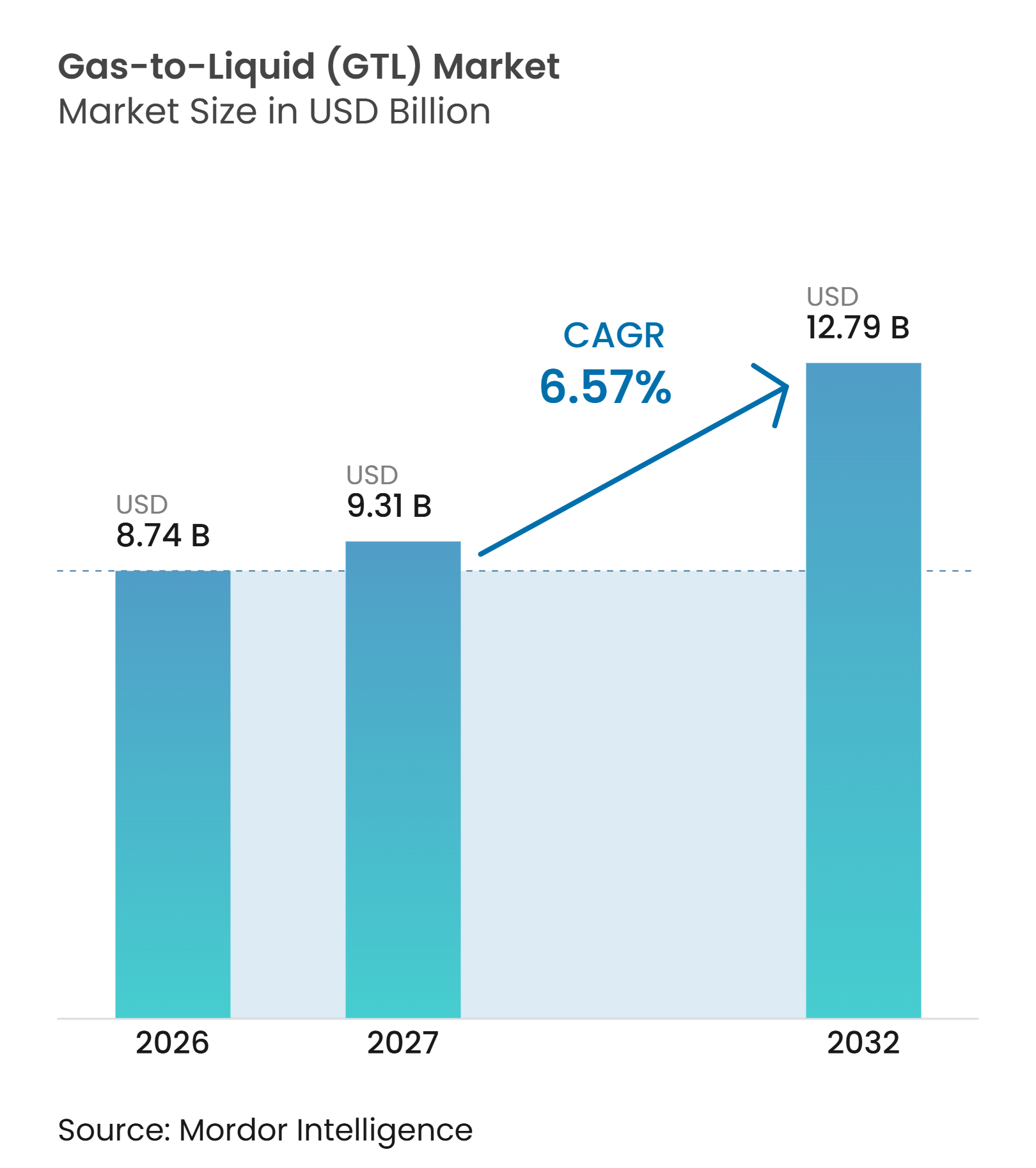
The gas-to-liquid (GTL) market size was valued at USD 8.74 billion in 2026 and is estimated to grow from USD 9.31 billion in 2027 to reach USD 12.79 billion by 2032, at a CAGR of 6.57% during the forecast period (2027-2032). The gas-to-liquid (GTL) market benefits from synthetic diesel and naphtha with very low sulfur content and high cetane quality. These characteristics support use in transport fuels, aviation blending, and petrochemical feedstocks. Rising gas production in China and Saudi Arabia expands the feedstock base, although investment decisions still depend on the spread between gas costs and crude-linked product prices. The gas-to-liquid (GTL) market also faces exposure to concentrated production capacity, methane requirements, and high project costs, which favor operators with secure gas supply and established conversion technology.
Key Report Takeaways
- By product type, GTL diesel held 45.65% of the gas-to-liquid (GTL) market share in 2026, while GTL naphtha is projected to advance at a 7.14% CAGR through 2032.
- By technology, Fischer-Tropsch synthesis held 72.43% of the gas-to-liquid (GTL) market share in 2026, while methanol-to-gasoline is projected to advance at a 7.45% CAGR through 2032.
- By end-user, transportation held 47.12% of the gas-to-liquid (GTL) market share in 2026, while petrochemicals are projected to advance at a 7.71% CAGR through 2032.
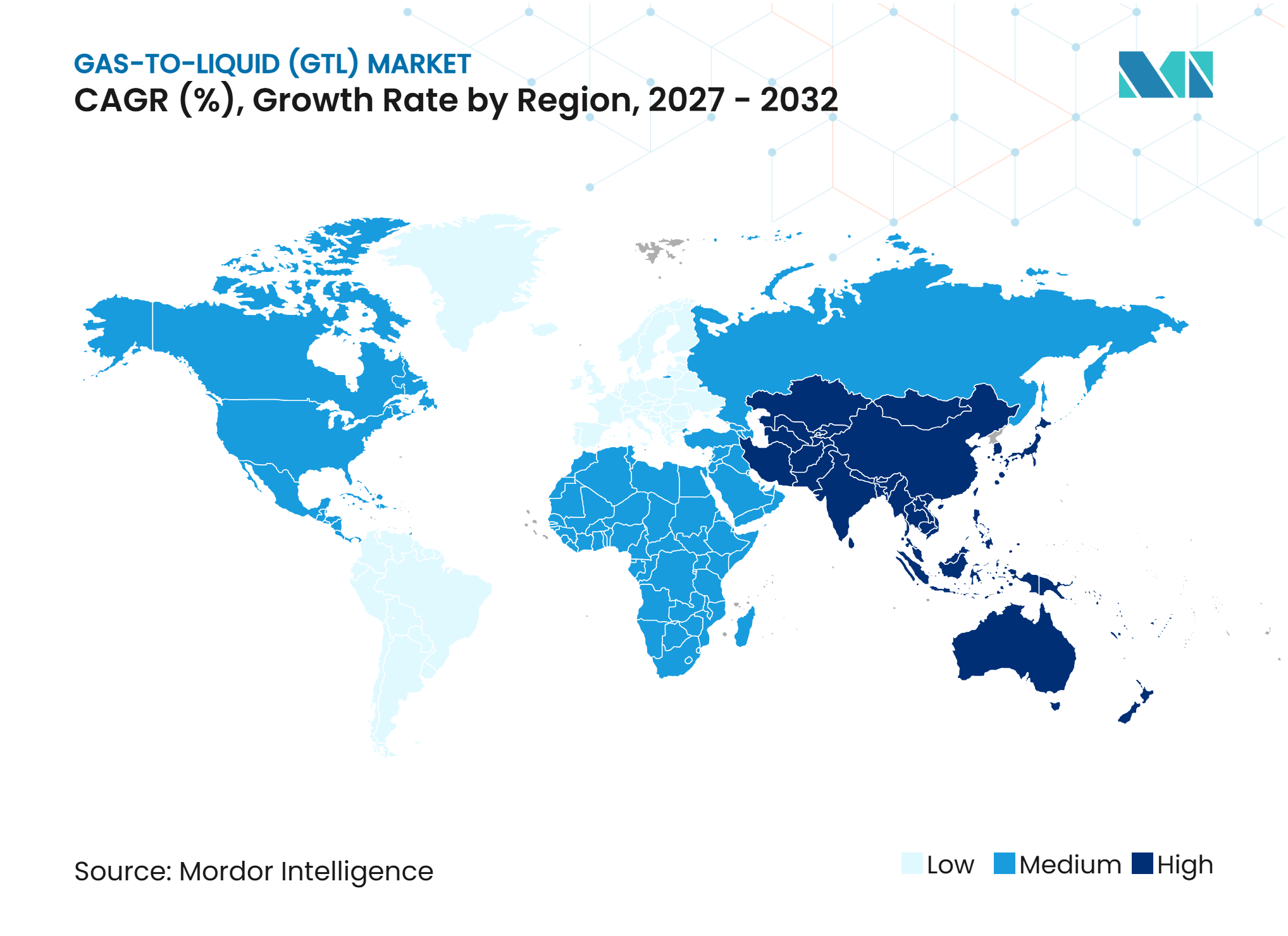
- By geography, the Middle East and Africa held 38.91% of the gas-to-liquid (GTL) market share in 2026, while Asia-Pacific is projected to advance at a 7.66% CAGR through 2032.
Note: Market numbers in this report are based on Mordor Intelligence's proprietary estimation framework, which combines nine months of actuals with Q4 projections for base year 2026.
Market Trends and Insights
Drivers Impact Analysis of Gas-to-Liquid (GTL) Market*
| Driver | (~) % Impact on CAGR Forecast | Geographic Relevance | Impact Timeline |
|---|---|---|---|
| Growth in Natural Gas Production and Feedstock Availability | +1.6% | Global, with concentrated impact in Middle East, Central Asia, and Asia-Pacific | Medium term (2-4 years) |
| Monetization of Stranded, Associated and Flare Gas | +1.4% | APAC core, spillover to MEA and Sub-Saharan Africa | Medium term (2-4 years) |
| Demand for Low-Sulfur and High-Cetane Liquid Fuels | +1.2% | North America and EU, with growing spillover to ASEAN | Short term (<=2 years) |
| Expansion of Petrochemical Demand for GTL Naphtha and Specialty Feedstocks | +1.0% | APAC core (China, India, South Korea), spillover to MEA | Medium term (2-4 years) |
| Modular GTL Deployment for Remote and Mid-Scale Gas Resources | +0.8% | Sub-Saharan Africa, Central Asia, and North America mid-continent | Long term (>=4 years) |
| Source: Mordor Intelligence | |||
Growth in Natural Gas Production and Feedstock Availability
Natural gas supply is expanding in several producing regions faster than pipeline capacity can absorb it. Saudi Arabian Oil Company started Jafurah field production in 2025 and targets an 80% increase in gas production capacity by 2030 from 2021 levels, which could expand feedstock availability for the gas-to-liquid (GTL) market. JSC Uzbekneftegaz completed the 100% performance test at Uzbekistan GTL in 2025, and the plant exceeded its 37,650 barrels per day design capacity under its secure gas supply structure. Gas availability alone does not ensure project development because returns still depend on a durable spread between feedstock costs and liquid product prices. Central Asia and parts of the Middle East remain relevant for the gas-to-liquid (GTL) market where sovereign-backed supply arrangements can support that economic case. This structure favors Gas-to-Liquid (GTL) market projects with long-term gas allocation and defined product offtake.
Monetization of Stranded, Associated and Flare Gas
Gas flaring is both a lost commercial resource and a growing regulatory concern. Nigeria approved 28 firms in December 2025 to capture gas from 49 flare sites in the Niger Delta, with the program targeting USD 2 billion in investment and 250-300 million standard cubic feet per day of gas commercialization. Nigerian National Petroleum Company Limited and Heirs Energies signed agreements for 180 million standard cubic feet per day at OML 17, although the planned uses include power generation, liquefied petroleum gas, and compressed natural gas rather than GTL. This competition makes remote fields with limited pipeline access more important to the gas-to-liquid (GTL) market. Velocys and Tetracore GTL Limited signed a memorandum of understanding in 2025 for a proposed Nigerian project that would convert 55 million standard cubic feet per day into diesel, Jet A-1, and naphtha[1].
Demand for Low-Sulfur and High-Cetane Liquid Fuels
GTL diesel can meet low-sulfur requirements through its synthesis route rather than post-refinery hydrotreating. Euro 7 vehicle requirements and International Maritime Organization fuel sulfur rules support demand for cleaner blendstocks in road and marine uses. Uzbekistan GTL confirmed in its 2025 performance test that its synthetic paraffinic kerosene met American Society for Testing and Materials (ASTM) D7566 requirements for Jet A-1 blending. China, India, and ASEAN markets combine stricter air-quality requirements with a need for consistent fuel quality. These conditions favor gas-to-liquid (GTL) market suppliers that can maintain reliable specifications at scale.
Expansion of Petrochemical Demand for GTL Naphtha and Specialty Feedstocks
GTL naphtha has very low aromatics and sulfur content, which can support its use as a steam-cracker feedstock. Disruptions to Gulf naphtha and liquefied petroleum gas supply in March 2026 forced petrochemical plants to curb polymer output, showing the value of diversified feedstock supply. QatarEnergy is expanding petrochemical capacity through ethane-based crackers in Qatar and the United States, which increases the strategic value of high-purity feedstocks. Greater chemical demand gives the gas-to-liquid (GTL) market a revenue outlet that is less dependent on road-fuel cycles. It also increases the importance of product offtake agreements that include both fuels and chemical feedstocks.
Restraints Impact Analysis of Gas-to-Liquid (GTL) Market*
| Restraint | (~) % Impact on CAGR Forecast | Geographic Relevance | Impact Timeline |
|---|---|---|---|
| High Capital Intensity and Long Project Payback Periods | -0.8% | Global, with concentrated drag in emerging markets | Long term (>=4 years) |
| Exposure to Crude Oil and Natural Gas Price Spreads | -0.6% | Global; most acute in North America and Europe | Short term (<=2 years) |
| Carbon Intensity, Methane Leakage and Energy-Transition Risk | -0.5% | EU and North America; regulatory influence from EU Methane Regulation (EU/2024/1787) and US EPA subpart OOOOb/OOOOc standards | Medium term (2-4 years) |
| Source: Mordor Intelligence | |||
High Capital Intensity and Long Project Payback Periods
Large GTL projects have historically required USD 5-20 billion of capital and extended payback periods. NiQuan Energy LLC was again placed in receivership after failed restarts that consumed more than USD 300 million, and its assets were listed for sale in 2025. The Government of Trinidad and Tobago was owed USD 95 million in unpaid gas invoices. Sasol targeted a USD 50 per barrel breakeven oil price at Secunda by fiscal year 2028 after production challenges in fiscal year 2025, showing the ongoing capital effort needed even at mature assets. Variable carbon-accounting methods across jurisdictions add uncertainty to long-life investment models in the gas-to-liquid (GTL) market. This makes access to sovereign backing or strong balance sheets especially important for Gas-to-Liquid (GTL) market development.
Carbon Intensity, Methane Leakage and Energy-Transition Risk
The European Union Methane Regulation entered into force in August 2024 and sets measurement, reporting, and verification obligations that apply to fossil fuel importers by 2027[2]. This framework raises compliance requirements for exporters of GTL products to Europe. QatarEnergy warned in October 2025 that its supplies could be redirected if European corporate due diligence requirements were not modified for state-owned enterprises. Investors also assess the possibility of shorter operating lives for fossil-based projects, which can raise financing hurdles. Velocys designed microFTL to operate with fossil gas or renewable syngas, offering an option to adjust feedstocks over time. This flexibility may matter as Gas-to-Liquid (GTL) market participants respond to changing carbon requirements.
*Our forecasts treat driver/restraint impacts as directional, not additive. The impact forecasts reflect baseline growth, mix effects, and variable interactions.
Gas-to-Liquid (GTL) Market Segment Analysis
By Product Type:
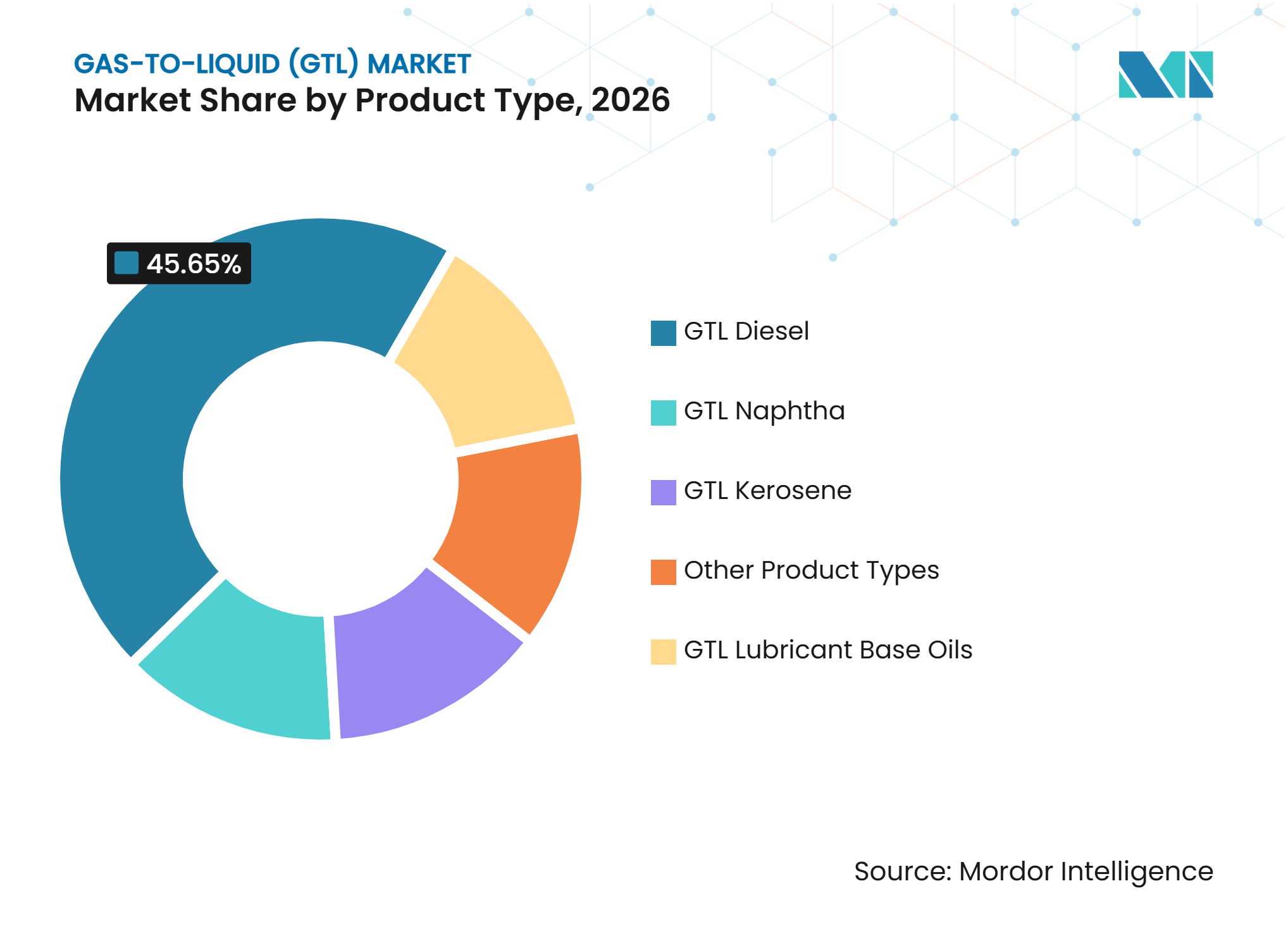
GTL Diesel Retains Scale, While GTL Naphtha Gains ValueGTL diesel held a 45.65% share in 2026, reflecting the long-standing role of transport fuels in large Fischer-Tropsch facilities. Its low sulfur content and high cetane quality support use in existing diesel infrastructure. Road diesel demand remains relevant in Europe, Gulf Cooperation Council countries, and ASEAN markets where fuel specifications are tightening. The gas-to-liquid (GTL) industry has historically been structured around this liquid-fuels demand. Large facilities therefore continue to treat diesel yield, operational reliability, and blendstock quality as core commercial priorities.
GTL naphtha is projected to advance at a 7.14% CAGR through 2032. Demand for GTL naphtha is supported by chemical producers seeking lower-aromatics feedstock for steam cracking. The International Energy Agency expects petrochemical feedstocks to account for more than 60% of oil-demand growth in 2026. GTL kerosene also gained relevance after Uzbekistan GTL confirmed ASTM D7566 compliance for synthetic paraffinic kerosene in 2025. GTL lubricant base oils remain a smaller premium application because their viscosity and thermal characteristics can support automotive and industrial uses.



By Technology:
Fischer-Tropsch Synthesis Leads, While Methanol-to-Gasoline AdvancesFischer-Tropsch synthesis held a 72.43% share in 2026. The technology has decades of operating history and benefits from process expertise held by established licensors. Sasol's slurry phase distillate technology supports ORYX GTL and Uzbekistan GTL, helping operators maintain consistent specifications at commercial scale. This installed base gives Fischer-Tropsch technology a significant role across the gas-to-liquid (GTL) industry. It also creates barriers for entrants that lack proven reactors, catalysts, and operating capabilities.
Methanol-to-gasoline is projected to advance at a 7.45% CAGR through 2032. The pathway can be relevant where methanol assets already exist, or operators favor a smaller conversion footprint. Exxon Mobil Corporation presented its fluid-bed Methanol-to-Gasoline process at the European Refining Technology Conference in 2025 as a route to low-sulfur gasoline. Syngas-to-Gasoline Plus offers feed flexibility across biomass, gas, and coal-derived syngas. A 2025 peer-reviewed review found that intensified low-temperature Fischer-Tropsch reactor designs could make modular units more practical for smaller gas resources.
By End-User:
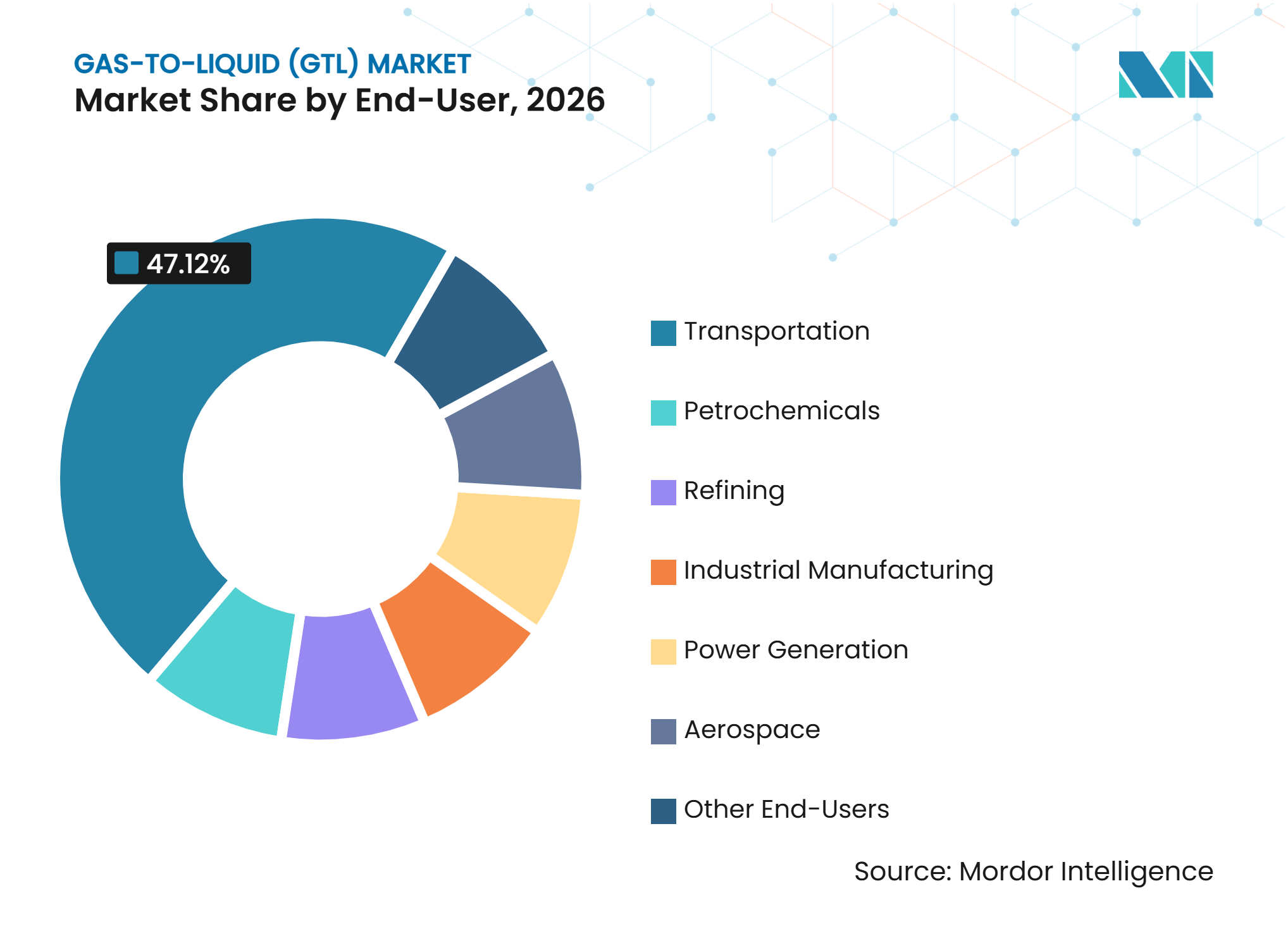
Transportation Holds Demand While Petrochemicals Grow FastestTransportation held a 47.12% share in 2026. Fleet operators value sulfur-free diesel because it can work with established fuel distribution and vehicle systems. This demand base continues to support the utilization of large legacy GTL plants. The segment also includes marine and aviation blending opportunities where low-sulfur and paraffinic products have a quality advantage.
Petrochemicals are projected to advance at a 7.71% CAGR through 2032. Chemical operators use high-purity naphtha to improve cracker feed quality and reduce the processing burden associated with aromatic compounds. Refiners can also use GTL fractions as blendstocks to improve cetane and meet product specifications. Industrial manufacturing uses include solvents, process oils, and specialty fluids. In aerospace, ASTM D7566 qualification supports the use of Fischer-Tropsch kerosene in sustainable aviation fuel blending.

Geography Analysis
Middle East and Africa
The Middle East and Africa held a 38.91% share in 2026. Qatar's Ras Laffan Industrial City hosts Pearl GTL, which converts 1.6 billion cubic feet per day of wellhead gas into 140,000 barrels per day of products, and ORYX GTL, which has a capacity of 34,000 barrels per day. Saudi Arabian Oil Company began Jafurah production in 2025, strengthening regional gas availability for downstream uses. Qatar's North Field expansion targets 126 million metric tons per annum of liquefied natural gas capacity by 2027, reinforcing its wider gas-monetization infrastructure. The concentration of capacity also created risk when attacks in March 2026 stopped production at Pearl GTL and ORYX GTL. Nigeria's flare-gas program offers a pathway for smaller projects where gas transport remains limited.
Asia-Pacific
Asia-Pacific is projected to advance at a 7.66% CAGR through 2032. PetroChina Company Limited reported that its domestic natural gas output rose 6.2% to 261.9 billion cubic meters in 2025. The region has demand for cleaner transport fuels, petrochemical feedstocks, and aviation fuel components. China, India, and ASEAN countries are tightening air-quality standards, which supports lower-sulfur fuel use. Uzbekistan GTL completed its performance test in 2025 above design capacity and targeted a 15%-20% production increase in 2026. Petronas and Petros faced a 2025 gas aggregation dispute that required legal intervention to maintain supply to Shell plc's Bintulu facility, showing how supply rules can affect plant operations.
North America, Europe, and South America
North America has plentiful unconventional gas, but liquefied natural gas exports often offer a more established monetization route than new GTL conversion. Chevron Corporation is contracted to export 7 million metric tons per annum of liquefied natural gas from the United States Gulf Coast starting in 2026. Europe relies largely on imports for GTL products used in low-sulfur blending and aviation applications. The European Union Methane Regulation will reshape the terms for fossil fuel imports from 2027 through its measurement, reporting, and verification requirements. In South America, Petroleo Brasileiro S.A. expanded processing at its Boaventura Natural Gas Processing Unit to 21 million cubic meters per day in May 2025.
Competitive Landscape
Market Concentration
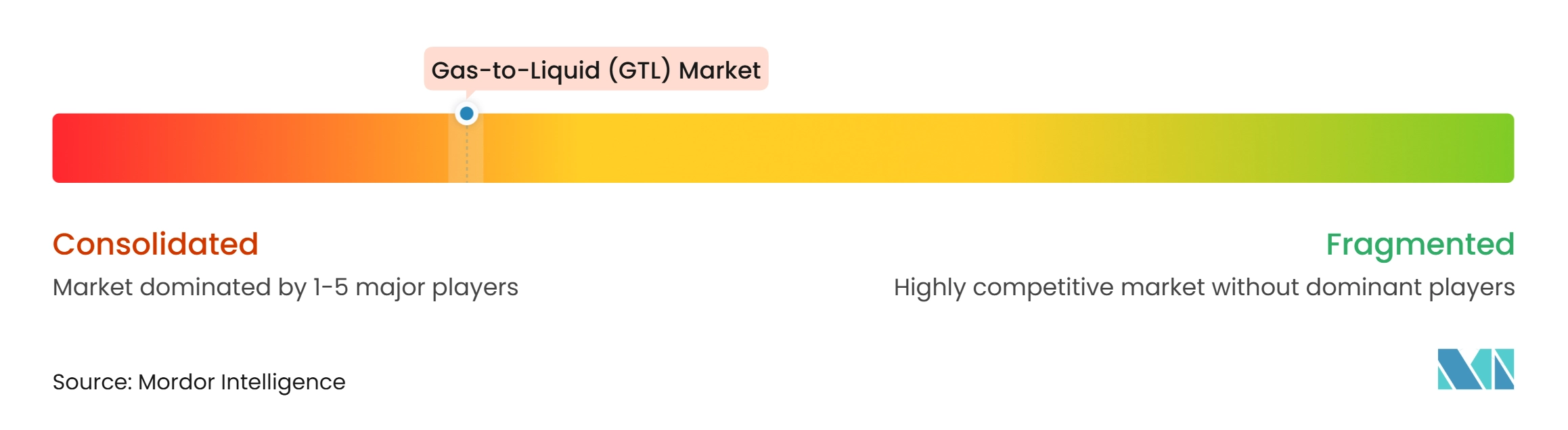
The gas-to-liquid (GTL) market is consolidated, with top players including Shell plc, QatarEnergy, Sasol, Chevron Corporation, and JSC Uzbekneftegaz. Shell plc and QatarEnergy operate at Pearl GTL, while QatarEnergy and Sasol own ORYX GTL through a 51% and 49% arrangement. Sasol also licenses the technology used at Uzbekistan GTL, which completed its 2025 performance test above its design capacity. The gas-to-liquid (GTL) market consequently rewards secure access to gas, proprietary process expertise, and reliable operating performance. These advantages are difficult to replicate at large scale.
Operators are concentrating on performance gains at existing facilities rather than committing immediately to new mega-projects. Pearl GTL joined the World Economic Forum Global Lighthouse Network in September 2025 after implementing more than 45 Fourth Industrial Revolution technologies, including predictive analytics and digital twins. Sasol is pursuing improvements at Secunda to reach a USD 50 per barrel breakeven oil price by fiscal year 2028. Velocys launched microFTL in June 2025 and positioned the package for lower-capital modular conversion projects. The proposed Tetracore project illustrates how smaller units could broaden the gas-to-liquid (GTL) market beyond conventional large plants.
Some participants face unresolved operating and funding barriers. PetroSA's Mossel Bay facility remains non-operational, and the South African National Petroleum Company is considering restart options with private-sector partners. NiQuan Energy LLC's receivership highlights the risk of cost escalation, safety issues, and unstable gas supply for smaller plants. The next competitive changes in the gas-to-liquid (GTL) market are likely to depend on whether modular technologies achieve reliable economics at remote gas resources.
Gas-to-Liquid (GTL) Industry Leaders
-
Shell plc
-
QatarEnergy
-
Sasol
-
Chevron Corporation
-
JSC Uzbekneftegaz
- *Disclaimer: Major Players sorted in no particular order
Gas-to-Liquid (GTL) Market Companies Covered in this Report
- Chevron Corporation
- Exxon Mobil Corporation
- JSC Uzbekneftegaz
- Nigerian National Petroleum Company Limited
- NiQuan Energy LLC
- ORYX GTL
- PetroChina Company Limited
- Petroleo Brasileiro S.A.
- Petronas
- PetroSA
- QatarEnergy
- Sasol
- Saudi Arabian Oil Company
- Shell plc
- Velocys
Recent Industry Developments in Gas-to-Liquid (GTL) Market
- October 2026: Shell plc partially restarted its Pearl gas-to-liquid (GTL) plant in Qatar, six months after the facility sustained damage during the Iran conflict. The restart enabled limited production and the return of some naphtha cargoes to the market, while repairs to the second processing train were expected to continue into the first quarter of 2027.
- June 2026: Cerilon GTL ND Inc. reached definitive technology-licensing agreements with Topsoe A/S and Sasol for its proposed GTL facility in Williams County, North Dakota. The project is designed to convert natural gas into Group III+ base oils, ultra-low-sulfur diesel and naphtha, with the licensing agreements subject to project financing.
Global Gas-to-Liquid (GTL) Market Report Scope
Gas-to-liquid (GTL) technology converts natural gas into liquid hydrocarbon products through chemical conversion processes, producing fuels and specialty products with properties comparable to those of conventional petroleum-based products. The process enables the production of cleaner-burning fuels, synthetic lubricants, and petrochemical feedstocks from natural gas. GTL products are used across transportation, refining, industrial manufacturing, and chemical processing applications.
The Gas-to-Liquid (GTL) Market is segmented by product type, technology, end-user, and geography. By product type, the market is segmented into GTL diesel, GTL naphtha, GTL kerosene, GTL lubricant base oils, and other product types. By technology, the market is segmented into Fischer-Tropsch synthesis, methanol-to-gasoline, Syngas-to-Gasoline Plus, and other technologies. By end-user, the market is segmented into transportation, petrochemicals, refining, industrial manufacturing, power generation, aerospace, and other end-users. The report also covers the market size and forecasts for gas-to-liquid (GTL) in 16 countries across major regions. For each segment, the market sizing and forecasts have been done on the basis of value (USD).
Segmentation Overview
| GTL Diesel |
| GTL Naphtha |
| GTL Kerosene |
| GTL Lubricant Base Oils |
| Other Product Types |
| Fischer-Tropsch Synthesis |
| Methanol-to-Gasoline |
| Syngas-to-Gasoline-Plus |
| Other Technologies |
| Transportation |
| Petrochemicals |
| Refining |
| Industrial Manufacturing |
| Power Generation |
| Aerospace |
| Other End-Users |
| Asia-Pacific | China |
| India | |
| Japan | |
| South Korea | |
| ASEAN Countries | |
| Rest of Asia-Pacific | |
| North America | United States |
| Canada | |
| Mexico | |
| Europe | Germany |
| United Kingdom | |
| France | |
| Italy | |
| NORDIC Countries | |
| Russia | |
| Rest of Europe | |
| South America | Brazil |
| Argentina | |
| Rest of South America | |
| Middle East and Africa | Saudi Arabia |
| South Africa | |
| Rest of Middle East and Africa |
| By Product Type | GTL Diesel | |
| GTL Naphtha | ||
| GTL Kerosene | ||
| GTL Lubricant Base Oils | ||
| Other Product Types | ||
| By Technology | Fischer-Tropsch Synthesis | |
| Methanol-to-Gasoline | ||
| Syngas-to-Gasoline-Plus | ||
| Other Technologies | ||
| By End-User | Transportation | |
| Petrochemicals | ||
| Refining | ||
| Industrial Manufacturing | ||
| Power Generation | ||
| Aerospace | ||
| Other End-Users | ||
| By Geography | Asia-Pacific | China |
| India | ||
| Japan | ||
| South Korea | ||
| ASEAN Countries | ||
| Rest of Asia-Pacific | ||
| North America | United States | |
| Canada | ||
| Mexico | ||
| Europe | Germany | |
| United Kingdom | ||
| France | ||
| Italy | ||
| NORDIC Countries | ||
| Russia | ||
| Rest of Europe | ||
| South America | Brazil | |
| Argentina | ||
| Rest of South America | ||
| Middle East and Africa | Saudi Arabia | |
| South Africa | ||
| Rest of Middle East and Africa | ||
Key Questions Answered in the Report
What is the size of the gas-to-liquid (GTL) market?
The gas-to-liquid (GTL) market size was valued at USD 8.74 billion in 2026 and is estimated to grow from USD 9.31 billion in 2027 to reach USD 12.79 billion by 2032, at a CAGR of 6.57% during the forecast period (2027-2032).
What is driving demand for gas-to-liquid products?
Demand is supported by low-sulfur and high-cetane fuels, chemical feedstocks, and the need to monetize stranded or flare gas.
Which product is projected to advance fastest through 2032?
GTL Naphtha is projected to advance at a 7.14% CAGR through 2032, supported by demand for high-purity petrochemical feedstock.
Which technology held the largest share in 2026?
Fischer-Tropsch synthesis held a 72.43% share in 2026, supported by its established operating base and process expertise.