
Fuel Ethanol Market Size and Share
Market Overview
| Study Period | 2022 - 2032 |
|---|---|
| Market Size (2027) | USD 125.89 Billion |
| Market Size (2032) | USD 162.45 Billion |
| Growth Rate (2027 - 2032) | 5.23 % |
| Fastest Growing Market | Asia-Pacific |
| Largest Market | North America |
| Market Concentration | Low |
Major Players *Disclaimer: Major Players sorted in no particular order Image © Mordor Intelligence. Reuse requires attribution under CC BY 4.0. | |
Fuel Ethanol Market Analysis by Mordor Intelligence
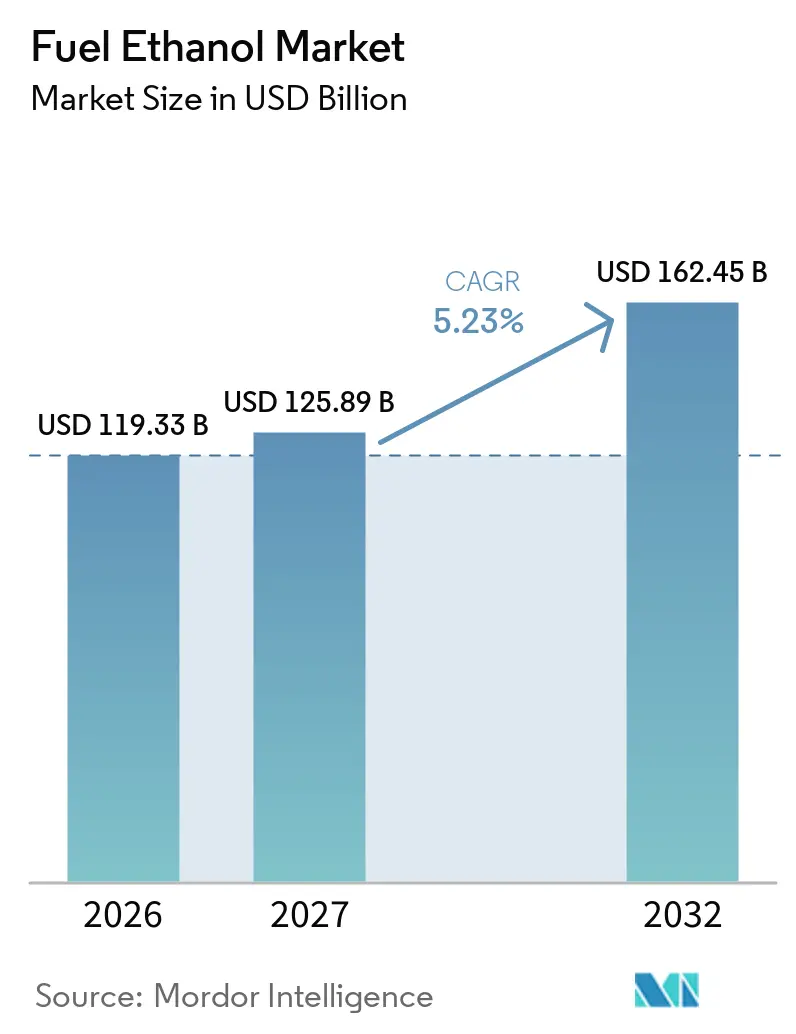
The Fuel Ethanol Market size is expected to increase from USD 119.33 billion in 2026 to USD 125.89 billion in 2027 and reach USD 162.45 billion by 2032, growing at a CAGR of 5.23% over 2027-2032. Mandatory blending rules across more than 60 countries provide a stable base for demand. India reached its E20 target during the current Ethanol Supply Year, while Brazil raised the anhydrous ethanol blend requirement from 27% to 30% from August 1, 2025.[1] The Fuel ethanol market also benefits from ethanol's role as an octane component when refiners reduce aromatic content in gasoline. Carbon-intensity credits and carbon capture are shifting competitive priorities toward lower-emission production routes. Electric vehicle adoption, food security concerns, and limits on retail blending infrastructure remain material constraints on the Fuel ethanol market.
Key Report Takeaways
- By feedstock, corn held 46.3% of the Fuel ethanol market share in 2026, while cellulosic biomass and other feedstocks are forecast to grow at a 5.9% CAGR through 2032.
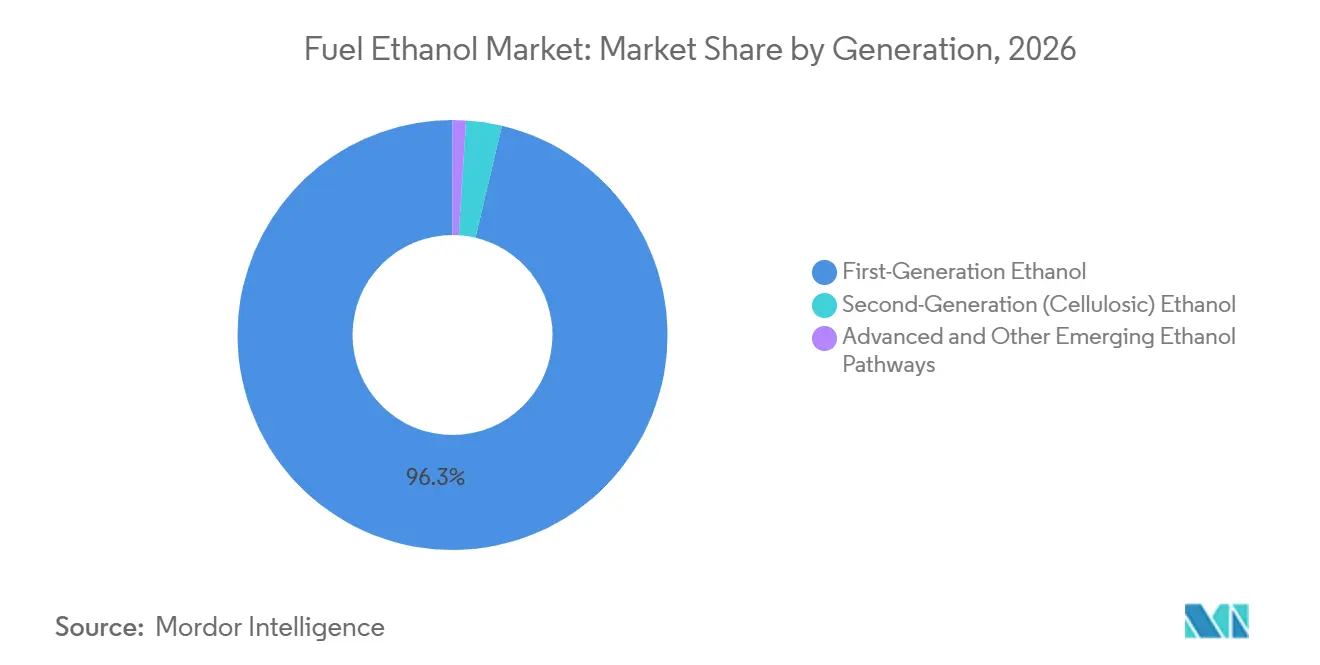
- By generation, first-generation ethanol held 96.3% of the global value in 2026, while second-generation cellulosic ethanol is projected to grow at a 6.2% CAGR through 2032.
- By fuel blend, E10 held 46.7% of the global value in 2026, while E20 is forecast to grow at a 5.8% CAGR through 2032.
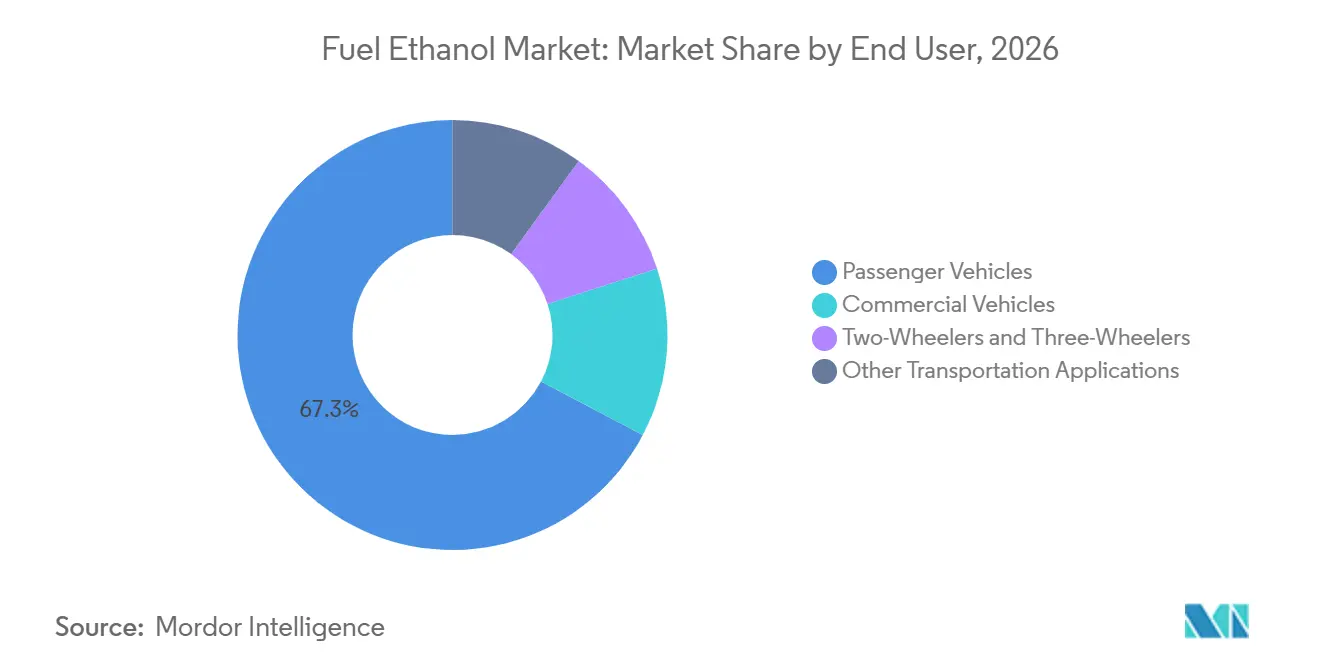
- By end user, passenger vehicles held 67.3% of the global value in 2026, while two-wheelers and three-wheelers are forecast to grow at a 5.5% CAGR through 2032.
- By geography, North America held 47.8% of the global value in 2026, while Asia-Pacific is forecast to grow at a 5.7% CAGR through 2032.
Note: Market numbers in this report are based on Mordor Intelligence's proprietary estimation framework, which combines nine months of actuals with Q4 projections for base year 2026.
Market Trends and Insights
Drivers Impact Analysis of Fuel Ethanol Market*
| Driver | (~) % Impact on CAGR Forecast | Geographic Relevance | Impact Timeline |
|---|---|---|---|
| E10-E20 Blending Mandates and Energy Security Policy | +1.8% | Global, led by South America, South and Southeast Asia | Short term (≤ 2 years) |
| Low-Carbon Fuel Standards and Refinery Decarbonization | +0.9% | North America and Europe | Medium term (2-4 years) |
| Feedstock Cost Advantage and Co-Product Monetization | +0.7% | North America and South America | Short term (≤ 2 years) |
| Rising Octane Demand as Aromatics Are Reduced | +0.6% | North America and Europe | Medium term (2-4 years) |
| Fermentation Carbon Dioxide Capture Creates a Second Revenue Stream | +0.5% | North America, with spillover to Brazil | Medium term (2-4 years) |
| Lower-Carbon Grain Traceability Enables Feedstock Premiums | +0.3% | North America, with early gains in Europe | Long term (≥ 4 years) |
| Source: Mordor Intelligence | |||
E10-E20 Blending Mandates and Energy Security Policy
Sovereign blending mandates remain the strongest demand support for the Fuel ethanol market. India's oil marketing companies reached 19.97% ethanol blending in October 2025 during the current Ethanol Supply Year. The USDA estimated Indian fuel ethanol consumption at 9.7 billion liters in 2025.[2] Brazil activated its E30 requirement on August 1, 2025, which was expected to add more than 1 billion liters of annual demand. Brazil's corn ethanol producers supplied the domestic market when sugarcane mills shifted output toward sugar during 2025. Colombia's E10 policy and Indonesia's expanding E5 program add further demand sources across Latin America and Southeast Asia.[3]
Low-Carbon Standards, Refinery Economics, and Traceable Feedstocks
California's revised Low Carbon Fuel Standard took effect in July 2025 and raised the 2030 carbon-intensity reduction target to 30% from 20% against the 2010 baseline.[4] The revised program also extends benchmarks through 2045, which provides a long planning period for low-carbon fuel investment. ADM and Tallgrass opened a carbon capture facility at ADM's Columbus, Nebraska, complex in November 2025, connected to the Trailblazer pipeline. Aemetis advanced a USD 30 million vapor recompression upgrade at its Keyes plant in October 2025 to lower natural gas use and carbon intensity. Low-carbon grain records can create a premium for documented farm practices, as shown by Landus payments to Iowa farmers under its carbon-intensity supply chain program. Pipeline access and verified feedstock records are therefore becoming practical competitive requirements in the Fuel ethanol market.
Rising Octane Demand and Co-Product Economics
The Fuel ethanol market benefits from tighter gasoline rules that limit the use of aromatic compounds for octane. The EPA's Tier 3 program has limited sulfur in gasoline, while benzene, toluene, and xylene remain air-quality concerns. U.S. premium gasoline sales reached 15% of total gasoline sales in 2024, compared with less than 9% in 2008. A 2025 analysis estimated the cost of ethanol octane at USD 1.4 cents per Anti-Knock Index (AKI)-gallon, compared with USD 6.3 cents for refinery-produced octane. Distillers grains and corn oil also reduce net feedstock costs for corn ethanol producers. These commercial attributes support Fuel ethanol market demand even when a mandate is not the immediate driver.
Fermentation Carbon Dioxide Capture and Credit Monetization
Biogenic carbon dioxide from fermentation is increasingly treated as a co-product rather than a waste stream. Roughly 30% of U.S. dry-mill ethanol biorefineries captured 2.7 million tonnes of biogenic carbon dioxide annually as of 2024. Gevo reported USD 52 million in Section 45Z credit sales from its North Dakota facility during 2025. Connected plants can combine Section 45Z, Section 45Q, California Low Carbon Fuel Standard (LCFS), and carbon dioxide removal credits where program rules allow. Green Plains commissioned carbon capture systems at 3 Nebraska facilities during the fourth quarter of 2025. The remaining capacity without capture connections represents an opportunity, but it also exposes producers to an increasing gap in achievable carbon-intensity value.
Restraints Impact Analysis of Fuel Ethanol Market*
| Restraint | (~) % Impact on CAGR Forecast | Geographic Relevance | Impact Timeline |
|---|---|---|---|
| Light-Duty Vehicle Electrification and Falling Gasoline Demand | -1.4% | China, Europe, the United States, and South Korea | Medium term (2-4 years) |
| Food Versus Fuel and Land-Use Scrutiny | -0.6% | India, Indonesia, and Europe | Long term (≥ 4 years) |
| E10 Blend Wall and Retail Infrastructure Constraints | -0.5% | North America and Europe | Short term (≤ 2 years) |
| Carbon-Intensity Verification and Carbon Dioxide Transport Bottlenecks | -0.3% | North America, with global implications | Medium term (2-4 years) |
| Source: Mordor Intelligence | |||
Vehicle Electrification, Blend Limits, and Infrastructure Constraints
Electric vehicle adoption limits long-term growth in gasoline consumption and can reduce ethanol blending demand. China's fuel ethanol consumption fell an estimated 11% in 2025 as new energy vehicle sales increased 48% year over year in early 2025. The OECD-FAO projected global gasoline demand to decline 0.8% annually through 2034. OECD-FAO Lower gasoline demand in mature markets can increase export supply and place pressure on regional ethanol prices. E15 retail availability also remains limited because of labeling, storage equipment, and fuel-distribution requirements. USDA released USD 537 million for 543 higher-blend infrastructure projects in 29 states during April 2025 to address part of that barrier.
Food Security, Land Use, and Carbon Verification Constraints
Food security and land-use concerns constrain the expansion of crop-based ethanol pathways. Indonesia's proposed sugarcane ethanol expansion drew international concern because it involved clearing a forest area comparable to Belgium. India may require up to 8 million additional hectares of maize cultivation by 2030 to support its E20 program. The European Union maintains a 7% cap on food-crop biofuels that count toward transport targets. Carbon-intensity claims also require verifiable feedstock, production, and transport data. Limited carbon dioxide pipeline capacity can delay access to sequestration credits. These conditions strengthen the case for cellulosic biomass, agricultural residues, and waste-gas routes in the Fuel ethanol market.
*Our forecasts treat driver/restraint impacts as directional, not additive. The impact forecasts reflect baseline growth, mix effects, and variable interactions.
Fuel Ethanol Market Segment Analysis
By Feedstock:
Corn Retains Scale While Cellulosic Pathways Gain GroundCorn held 46.3% of the Fuel ethanol market size by feedstock in 2026. Its position reflects U.S. Corn Belt processing capacity, established commodity markets, and income from distillers’ grains and corn oil. Brazil's growing corn ethanol sector also supported supply when sugarcane mills favored sugar in 2025. Corn has therefore become important in 2 major producing regions with different crop cycles. Sugarcane remains the second-largest feedstock and has a strong position in Brazil and India. Its high energy yield per hectare supports its role where cane supply and mill infrastructure are established. Wheat, cassava, sugar beet, and other grains continue to serve regional production systems in Europe, Southeast Asia, and sub-Saharan Africa. Their use depends on local crop availability, policy incentives, and logistics. The Fuel ethanol market retains these varied feedstock systems because no single crop can meet every regional need across established producing regions and emerging blending programs. This diversity also limits reliance on a single agricultural supply system.
Cellulosic biomass and other feedstocks are projected to expand at a 5.9% CAGR through 2032. These inputs include sugarcane bagasse, agricultural residues, and another non-food biomass. Raízen’s Banco Nacional de Desenvolvimento Econômico e Social (BNDES)-backed Andradina plant is part of a 6-plant program targeting 440 million liters of cellulosic capacity by 2028. A 2025 study found that mature, consolidated bioprocessing of sugarcane bagasse could deliver a minimum ethanol selling price of USD 0.48 per liter at commercial scale. USDA climate-smart crop guidelines also define chain-of-custody expectations for biofuel feedstocks. Non-food inputs can meet those requirements without the same food-price exposure as crop-based pathways. Producers are increasingly directing capital toward these pathways to manage land-use risk. The shift does not displace corn or sugarcane in the near term. It broadens the feedstock base of the Fuel ethanol market.
By Generation:
Established Assets Support a Faster Second-Generation BuildoutFirst-generation ethanol accounted for 96.3% of generation-based value in 2026. This reflects decades of investment in sugar, starch, and grain processing facilities. Mature plants can improve economics through co-products and carbon credits without replacing their core production technology. Valero reported USD 117 million operating income from its ethanol segment in the fourth quarter of 2025, compared with USD 20 million in the fourth quarter of 2024. POET acquired Green Plains' Tennessee facility and announced an expansion at Shelbyville, Indiana. The moves took POET to 35 plants and 3.1 billion gallons of annual capacity. Advanced pathways, including gas fermentation using industrial carbon monoxide and carbon dioxide, remain smaller in volume. Their appeal comes from potentially low or negative carbon-intensity ratings for waste-gas feedstocks. The fuel ethanol industry therefore has a large operating base while newer routes develop around it.
Second-generation cellulosic ethanol is projected to grow at a 6.2% CAGR through 2032. GranBio received a USD 100 million U.S. Department of Energy grant and signed a July 2025 memorandum with RYAM for a cellulosic sustainable aviation fuel project in Georgia. The project uses second-generation ethanol as an intermediate feedstock for sustainable aviation fuel. GranBio also planned a BRL 1.5 billion transformation of its Alagoas facility into the Exygen biorefinery for conventional ethanol, eMethanol, and biomethane from sugarcane residues. New cellulosic projects are often located beside first-generation facilities. This arrangement shares logistics, feedstock handling, utilities, and operating knowledge. It lowers the burden of building separate supply chains. It also links the commercial development of cellulosic production to the assets already serving the Fuel ethanol market.
By Fuel Blend:
E10 Provides Volume While E20 and E15 Expand AvailabilityE10 held 46.7% of the Fuel ethanol market size by fuel blend in 2026. The blend remains anchored by broad U.S. availability and use in 19 European Union member states. E10 is familiar to fuel retailers, vehicle fleets, and fuel-distribution systems. That established use gives it a large base even as higher blends gain policy support. E5 remains important in early-stage markets in Southeast Asia, the Middle East, and Africa. E100 hydrous ethanol continues to be distinctive to Brazil's flex-fuel vehicle system. The International Energy Agency reported that 90% of new passenger cars sold in Brazil can operate on blends ranging from E20 to E100. Fuel blend choices therefore reflect both national regulations and the vehicles already in use. The Fuel ethanol market will continue to contain several blend standards rather than a single global specification.
E20 is forecast to expand at a 5.8% CAGR through 2032. India’s Ministry of Petroleum and Natural Gas required RON 95 E20 gasoline across all states and union territories from April 1, 2026. Brazil's E30 requirement is expected to save up to 700 million liters of gasoline imports annually. E15 is the next major expansion point in North America, though only 3% of U.S. retail stations dispensed it in 2025. The Ethanol for America Act addresses labeling and underground storage tank requirements that have slowed adoption. The higher-blend infrastructure grants announced in 2025 also support retailer conversion. E25-E85 blends are used in flex-fuel vehicle markets in North America and Brazil. Their volumes remain tied to the installed fleet of compatible vehicles. These higher blends give the Fuel ethanol market a route to volume growth where vehicle and retail systems can support them.
By End User:
Passenger Vehicles Lead While Two-Wheelers Add GrowthPassenger vehicles accounted for 67.3% of end-user value in 2026. This reflects the size of the global gasoline vehicle fleet and the role of ethanol in standard road fuels. Passenger vehicle demand is slowing in economies where battery-electric vehicle adoption is high. Commercial vehicles form the second-largest end-user category. They benefit from flex-fuel programs and higher-blend policies in Brazil and India. Other transportation uses remain smaller, but alcohol-to-jet aviation pathways are attracting investment. The European Union Sustainable Aviation Fuel Regulation required a 2% minimum sustainable aviation fuel share from January 2025. The requirement increases to 70% by 2050 under the regulation. These policies create a future pathway for cellulosic ethanol conversion. Fuel ethanol can therefore serve road transport today while developing supply for aviation applications.
Two-wheelers and three-wheelers are projected to grow at a 5.5% CAGR through 2032. India's 280-million-unit two-wheeler fleet provides a large addressable base for E20 fuel. Government information indicates that E20-tuned engines provide better acceleration and 30% lower carbon emissions than E10 in the stated comparison. Higher blends may be more manageable in small-engine fleets than in some passenger vehicle systems. India is discussing E30 with automotive manufacturers after establishing E20 as a national standard. Indonesia, Vietnam, Thailand, and the Philippines are also expanding two-wheeler ethanol programs for energy security. Electric two-wheelers remain less accessible in many lower-income markets. This provides a longer demand window for fuel ethanol-blended fuels in regional motorcycle fleets. The Fuel ethanol market is therefore not limited to passenger-car demand patterns.
Geography Analysis
North America Fuel Ethanol Market
North America held 47.8% of the Fuel ethanol market in 2026. The region's position rests on large corn ethanol capacity, established logistics, and a mature blending system. U.S. ethanol production reached a record 16.4 billion gallons in 2025. POET expanded to 35 plants with 3.1 billion gallons of combined annual capacity after its Tennessee acquisition. ADM identified U.S. biofuel policy clarity as a key factor in its 2026 earnings outlook. Canada's Clean Fuel Regulations cover 12 ethanol facilities producing fuel for domestic use and exports. Mexico's E10 implementation target for 2026 opens incremental demand within the regional trading system. Carbon capture at ADM, Green Plains, and Aemetis sites is becoming a key point of difference in North American Fuel ethanol market production.
South America Fuel Ethanol Market
South America combines a mature ethanol base with active investment in higher blends and cellulosic production. Brazil's E30 requirement has been active since August 2025 and is expected to reduce annual gasoline imports by up to 700 million liters. Copersucar added 9 million tonnes of sugarcane processing capacity through Raízen asset acquisitions in September 2025. Raízen plans 440 million liters of cellulosic capacity by 2028 through its 6-plant second-generation ethanol (E2G) program. Mills operated by Copersucar, Raízen, and bp bioenergy shifted toward ethanol in October 2025 when ethanol became more favorable than sugar. RenovaBio and the Fuels of the Future Law support decarbonization investment. Argentina's E12, Colombia's E10, and Paraguay's E30 requirements add regional demand anchors.
APAC and EMEA Fuel Ethanol Market
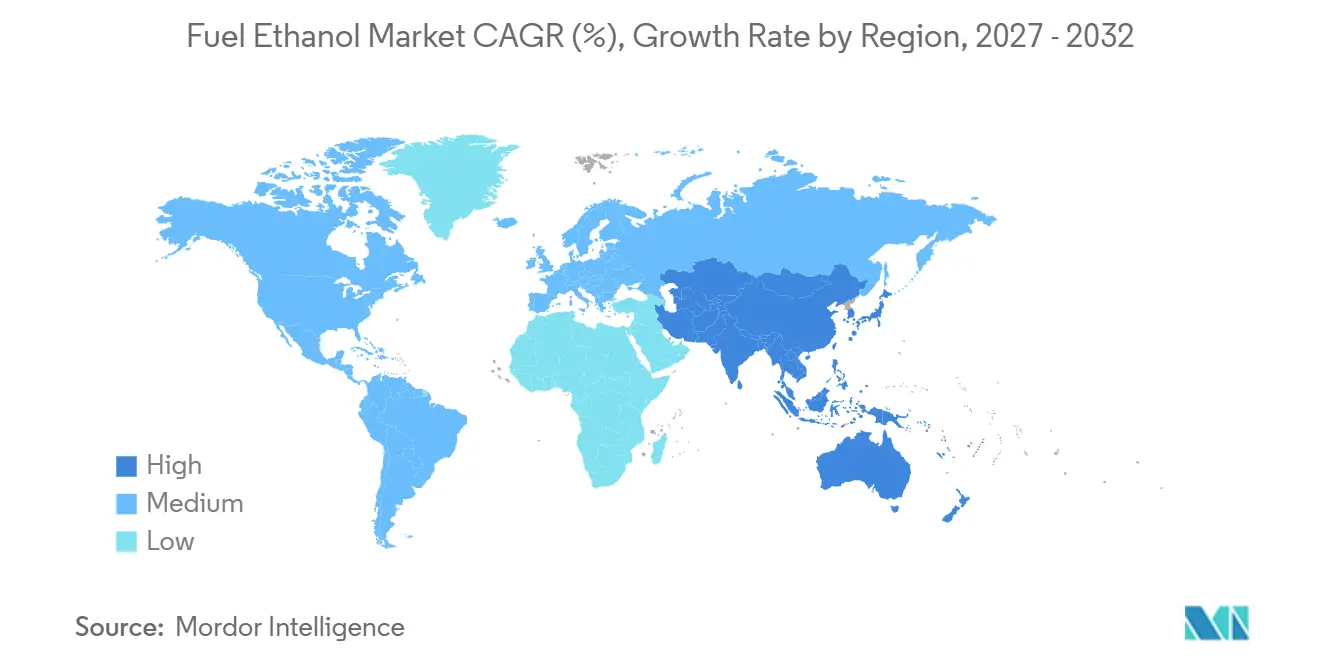
Asia-Pacific is forecast to grow at a 5.7% CAGR through 2032. India's fuel ethanol production reached an estimated 10.5 billion liters in 2025, 46% above the 2024 level, and E20 was available at 18,000 retail outlets. India made RON 95 E20 the national gasoline standard from April 2026. Japan plans E10 by 2030 and E20 by 2040, while Thailand uses E10 with E20 and E85 options. Europe limits food-crop biofuel volumes but supports advanced biofuels, including ethanol-to-jet pathways. Middle East and African programs remain early-stage, with South Africa at E2 and Kenya at E10, while Egypt, Nigeria, and Saudi Arabia have mandates or pilot activity.
Competitive Landscape
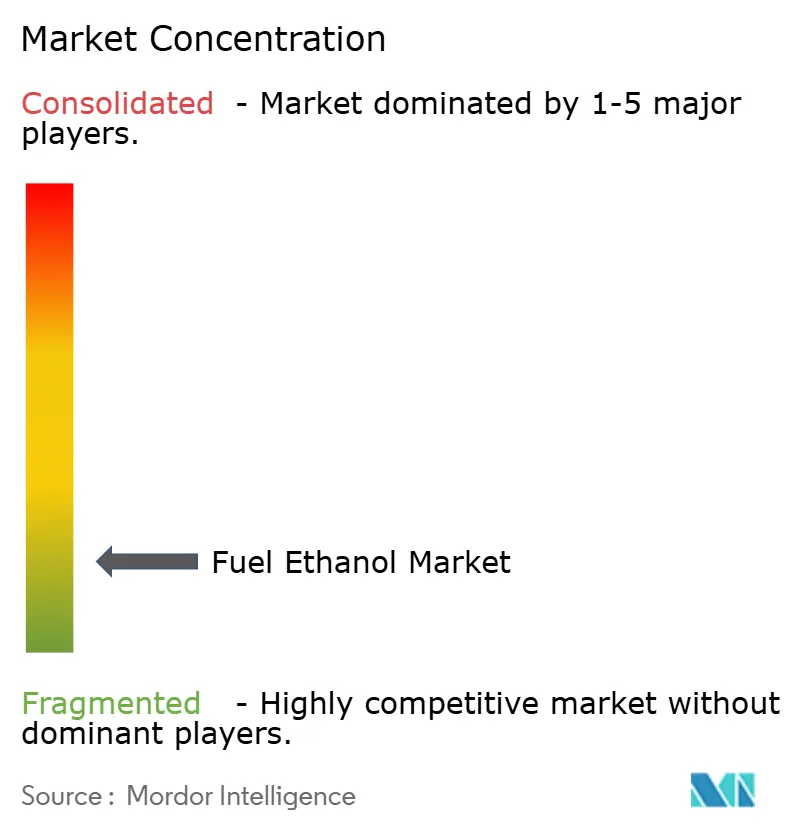
The Fuel ethanol market is fragmented among the largest producers and remains fragmented across smaller facilities. POET and Valero have production scale and logistics networks that smaller producers cannot easily match. Raízen and Copersucar remain important in Brazilian production, trading, and logistics. Green Plains sold its Tennessee plant to POET for USD 190 million during 2025. It used the transaction to remove junior debt and support carbon-capture investment at 3 Nebraska sites. This demonstrates a shift from expanding volume toward improving value per gallon. Gevo's USD 52 million in 2025 Section 45Z credit sales show the potential benefit of on-site sequestration and lower-carbon feedstock sourcing. Valero's reported ethanol operating income increased from USD 20 million in the fourth quarter of 2024 to USD 117 million in the fourth quarter of 2025.
Verified feedstock records are becoming a valuable competitive asset in the Fuel ethanol market. Landus paid USD 420,000 in premiums to more than 40 Iowa farmers during 2024 for documented low-carbon grain. That model connects farm practices with fuel carbon-intensity programs. Data trails must be built across multiple growing seasons, which can make verified supply harder to reproduce quickly. Enzyme suppliers are also seeking a role in lowering cellulosic conversion costs. This increases the importance of process technology for producers moving beyond conventional inputs. LanzaTech's gas-fermentation approach converts industrial carbon monoxide and carbon dioxide into ethanol without agricultural feedstocks. Such routes avoid the land-use and food-security issues attached to crop-based pathways.
Competition is increasingly shaped by access to carbon capture, verified feedstocks, and flexible manufacturing assets. ADM's Columbus facility and the Trailblazer pipeline give participating producers a route to permanent carbon dioxide storage. Aemetis is improving the carbon profile of an existing plant rather than building a new site. Raízen is expanding a cellulosic network beside its established sugarcane operations. These strategies pursue lower carbon intensity, use existing infrastructure, and diversify earnings. No combined market share for the largest firms was supplied, so the record does not support a numerical concentration score based on the required criteria. The Fuel ethanol market remains led by large regional operators while many smaller producers compete below that tier.
Fuel Ethanol Industry Leaders
-
POET LLC
-
Valero Energy Corporation
-
Raízen S.A.
-
Green Plains Inc.
-
Archer Daniels Midland Company (ADM)
- *Disclaimer: Major Players sorted in no particular order
Fuel Ethanol Market Companies Covered in this Report
- Aemetis, Inc.
- Alto Ingredients, Inc.
- Archer Daniels Midland Company (ADM)
- Cargill, Incorporated
- China National Cereals, Oils and Foodstuffs Corporation (COFCO)
- China Petrochemical Corporation (Sinopec)
- Copersucar
- CropEnergies AG
- Gevo, Inc.
- GranBio Investimentos S.A.
- Green Plains Inc.
- LanzaTech Global, Inc.
- Novonesis A/S
- Pannonia Bio Zrt.
- POET LLC
- Praj Industries Limited
- Raízen S.A.
- SEKAB BioFuels and Chemicals AB
- Tereos S.A.
- The Andersons, Inc.
- Valero Energy Corporation
- White Energy Company Limited
Recent Industry Developments in Fuel Ethanol Market
- January 2026: POET announced the doubling of POET Bioprocessing, Shelbyville, Indiana, from 98 million to 193 million gallons of bioethanol annually, also doubling distillers’ grains and corn oil output and adding 20 full-time positions ahead of growing E15 demand.
- November 2025: ADM and Tallgrass opened the world's largest bioethanol carbon capture facility at ADM's Columbus, Nebraska complex, linked to the Trailblazer pipeline repurposed from natural gas, a 400-mile lateral capable of transporting more than 10 million tons of carbon dioxide annually for permanent underground storage.
- October 2025: Aemetis advanced a USD 30 million mechanical vapor recompression upgrade at its Keyes, California ethanol plant using Praj Industries equipment, projected to reduce natural gas consumption by 80%, lower carbon intensity by double digits, and generate USD 32 million in incremental annual cash flow via Low Carbon Fuel Standard (LCFS) credits and 45Z incentives.
- September 2025: Green Plains completed the sale of its Obion, Tennessee plant to POET for USD 190 million, eliminating junior mezzanine debt and strengthening liquidity for carbon-capture investment. POET simultaneously expanded its U.S. footprint to 35 facilities with 3.1 billion gallons of combined capacity.
Global Fuel Ethanol Market Report Scope
The fuel ethanol market refers to the global trade, production, and consumption of ethyl alcohol produced from biomass (such as corn, sugarcane, wheat, and agricultural waste) and blended with motor gasoline to power internal combustion engines.
The global fuel ethanol market is segmented by feedstock, generation, fuel blend, end user, and geography. By feedstock, the market is segmented into corn, sugarcane, sugar beet, wheat and other grains, cassava and other starchy crops, and cellulosic biomass and other feedstocks. By generation, the market is segmented into first-generation ethanol, second-generation (cellulosic) ethanol, and advanced and other emerging ethanol pathways. By fuel blend, the market is segmented into E5, E10, E15, E20, E25–E85, and E100 and other high-ethanol blends. By end user, the market is segmented into passenger vehicles, commercial vehicles, two-wheelers and three-wheelers, and other transportation applications. The report also covers the market size and forecasts for the global fuel ethanol market across 28 countries in key regions. For each segment, the market sizing and forecasts have been provided on the basis of value (USD).
Segmentation Overview
| Corn |
| Sugarcane |
| Sugar Beet |
| Wheat and Other Grains |
| Cassava and Other Starchy Crops |
| Cellulosic Biomass and Other Feedstocks |
| First-Generation Ethanol |
| Second-Generation (Cellulosic) Ethanol |
| Advanced and Other Emerging Ethanol Pathways |
| E5 |
| E10 |
| E15 |
| E20 |
| E25–E85 |
| E100 and Other High-Ethanol Blends |
| Passenger Vehicles |
| Commercial Vehicles |
| Two-Wheelers and Three-Wheelers |
| Other Transportation Applications |
| North America | United States |
| Canada | |
| Mexico | |
| Europe | Germany |
| France | |
| Italy | |
| Spain | |
| United Kingdom | |
| Poland | |
| Netherlands | |
| Russia | |
| Rest of Europe | |
| Asia-Pacific | China |
| India | |
| Japan | |
| South Korea | |
| Australia | |
| Indonesia | |
| Malaysia | |
| Thailand | |
| Philippines | |
| Rest of Asia-Pacific | |
| South America | Brazil |
| Argentina | |
| Colombia | |
| Rest of South America | |
| Middle East and Africa | Saudi Arabia |
| South Africa | |
| Kenya | |
| Egypt | |
| Nigeria | |
| Rest of Middle East and Africa |
| By Feedstock | Corn | |
| Sugarcane | ||
| Sugar Beet | ||
| Wheat and Other Grains | ||
| Cassava and Other Starchy Crops | ||
| Cellulosic Biomass and Other Feedstocks | ||
| By Generation | First-Generation Ethanol | |
| Second-Generation (Cellulosic) Ethanol | ||
| Advanced and Other Emerging Ethanol Pathways | ||
| By Fuel Blend | E5 | |
| E10 | ||
| E15 | ||
| E20 | ||
| E25–E85 | ||
| E100 and Other High-Ethanol Blends | ||
| By End User | Passenger Vehicles | |
| Commercial Vehicles | ||
| Two-Wheelers and Three-Wheelers | ||
| Other Transportation Applications | ||
| By Geography | North America | United States |
| Canada | ||
| Mexico | ||
| Europe | Germany | |
| France | ||
| Italy | ||
| Spain | ||
| United Kingdom | ||
| Poland | ||
| Netherlands | ||
| Russia | ||
| Rest of Europe | ||
| Asia-Pacific | China | |
| India | ||
| Japan | ||
| South Korea | ||
| Australia | ||
| Indonesia | ||
| Malaysia | ||
| Thailand | ||
| Philippines | ||
| Rest of Asia-Pacific | ||
| South America | Brazil | |
| Argentina | ||
| Colombia | ||
| Rest of South America | ||
| Middle East and Africa | Saudi Arabia | |
| South Africa | ||
| Kenya | ||
| Egypt | ||
| Nigeria | ||
| Rest of Middle East and Africa | ||
Key Questions Answered in the Report
What is driving demand for fuel ethanol?
National blending requirements, ethanol's octane value, and low-carbon fuel programs support demand. The global value is forecast to reach USD 162.45 billion by 2032.
Which feedstock leads global ethanol production?
Corn led with 46.3% of feedstock value in 2026, supported by U.S. processing capacity and co-product income.
Why is second-generation ethanol growing faster?
It is forecast to grow at a 6.2% CAGR through 2032 because it uses non-food biomass and can reduce land-use exposure.
Which region is expanding fastest?
Asia-Pacific is forecast to grow at a 5.7% CAGR through 2032, led by India's E20 rollout and broader regional blending programs.
How do carbon credits affect ethanol producers?
Credits can reward low-carbon production, verified feedstocks, and carbon capture, which can improve plant economics.
What are the main risks to ethanol demand?
Electric vehicle adoption, falling gasoline use, food-security concerns, and limited higher-blend retail infrastructure are the main constraints.