
Fuel Cells Marine Vessels Market Size and Share
Market Overview
| Study Period | 2022 - 2032 |
|---|---|
| Market Size (2027) | USD 1.31 Billion |
| Market Size (2032) | USD 2.82 Billion |
| Growth Rate (2027 - 2032) | 16.66 % |
| Fastest Growing Market | Asia-Pacific |
| Largest Market | Europe |
| Market Concentration | Medium |
Major Players *Disclaimer: Major Players sorted in no particular order Image © Mordor Intelligence. Reuse requires attribution under CC BY 4.0. | |
Fuel Cells Marine Vessels Market Analysis by Mordor Intelligence
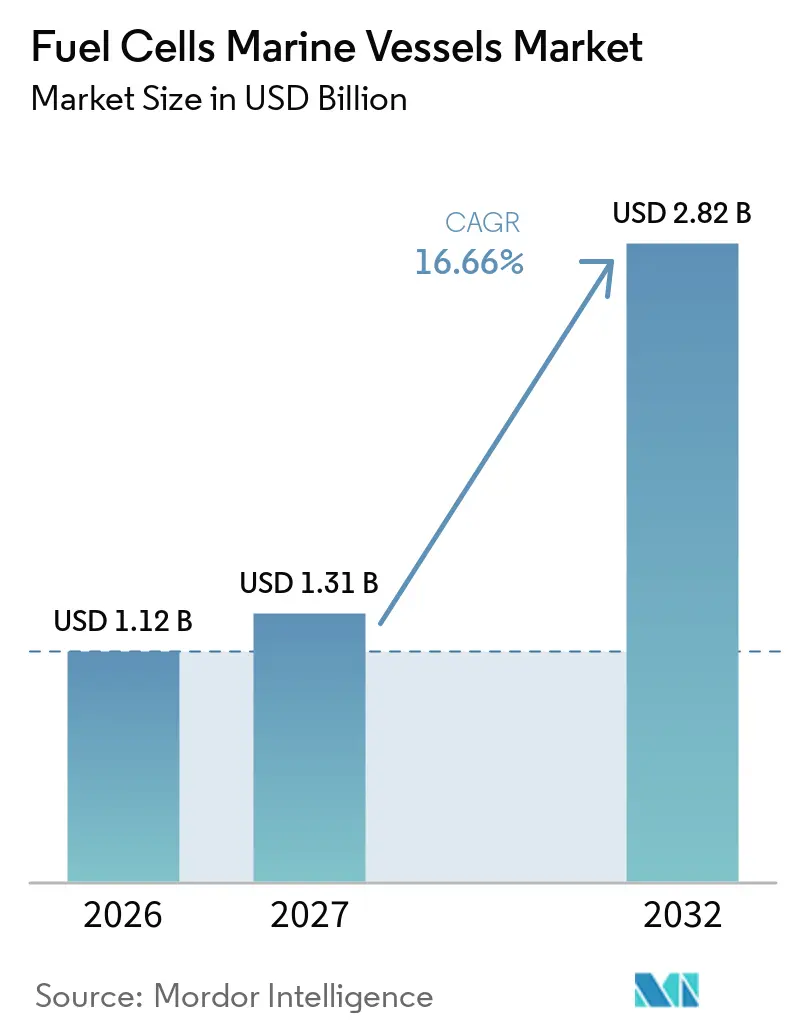
The Fuel Cells Marine Vessels Market size was valued at USD 1.12 billion in 2026 and is estimated to grow from USD 1.31 billion in 2027 to reach USD 2.82 billion by 2032, at a CAGR of 16.66% during the forecast period (2027-2032). Regulatory requirements are making vessel efficiency and fuel-emissions performance central to fleet investment decisions. FuelEU Maritime has applied greenhouse-gas intensity requirements to ships above 5,000 gross tonnage serving European ports since 2025, which gives operators a clear reason to assess hydrogen-based propulsion options. Fuel-cell systems are also moving beyond isolated trials as suppliers, class societies, shipbuilders, and operators build operating records on commercial vessels. The strongest near-term opportunities are on defined routes where fuel supply, port handling, and vessel schedules can be planned together. Competition is shaped by certification, system integration capability, and the ability to supply modules at larger power levels. The fuel cells marine vessels market will remain dependent on the practical availability and verified origin of low-carbon hydrogen.
Key Report Takeaways
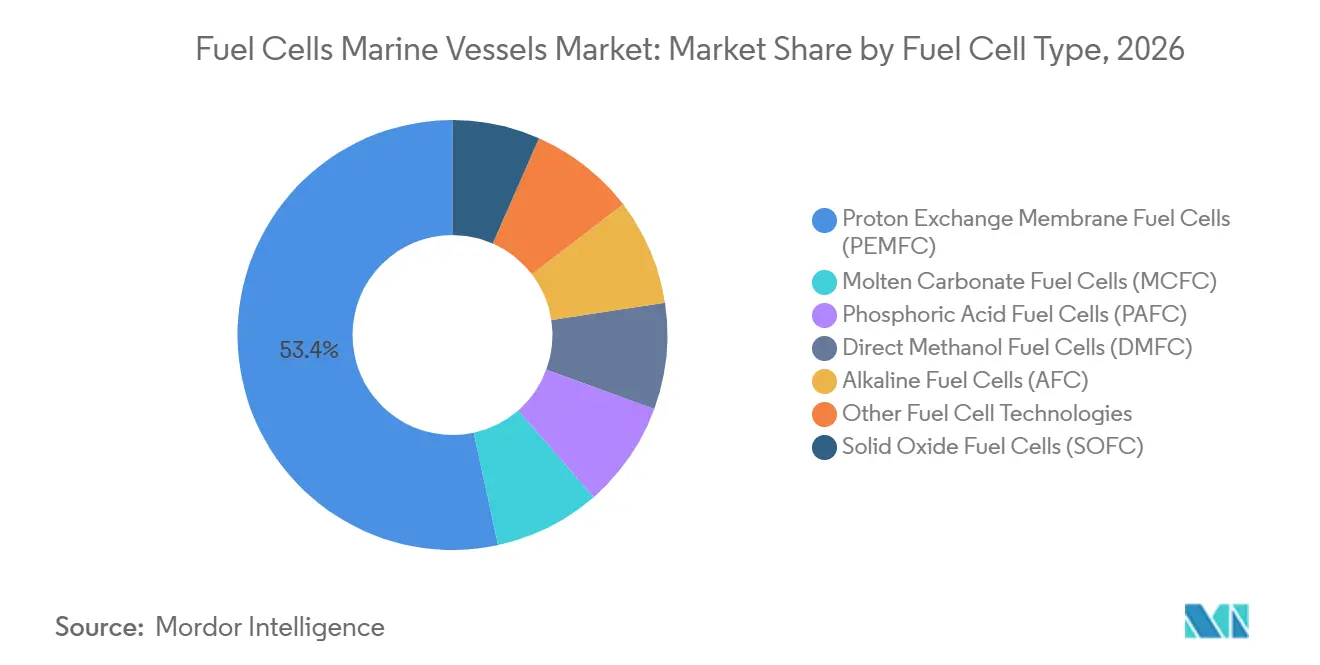
- By fuel cell type, PEMFC held 53.4% share in 2026 and is forecast to grow at a 17.1% CAGR through 2032.
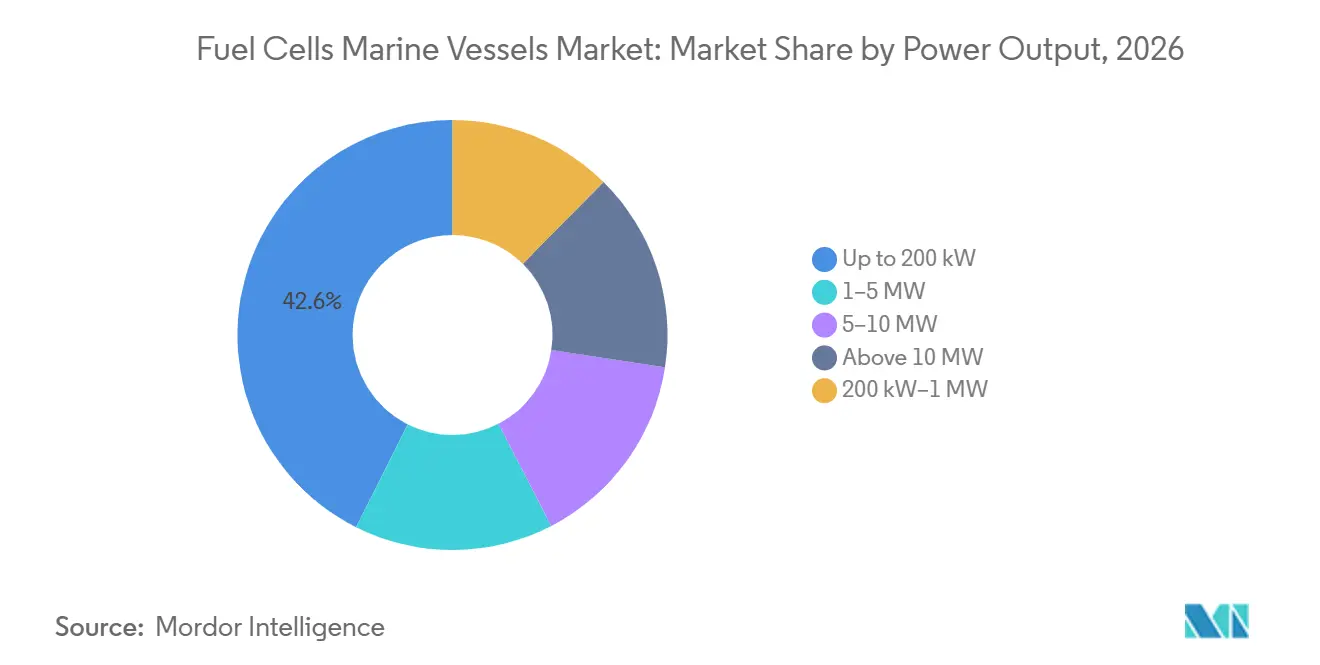
- By power output, up to 200 kW accounted for 42.6% share in 2026, while the 200 kW to 1 MW range is projected to grow at a 16.9% CAGR through 2032.
- By vessel type, passenger ferries held 29.3% share in 2026, while cruise ships are projected to expand at a 17.8% CAGR through 2032.
- By geography, Europe held 44.7% share in 2026, while Asia-Pacific is forecast to grow at a 17.5% CAGR through 2032.
Note: Market numbers in this report are based on Mordor Intelligence's proprietary estimation framework, which combines nine months of actuals with Q4 projections for base year 2026.
Market Trends and Insights
Drivers Impact Analysis of Fuel Cells Marine Vessels Market*
| Driver | (~) % Impact on CAGR Forecast | Geographic Relevance | Impact Timeline |
|---|---|---|---|
| Maritime Decarbonization Mandates and Carbon-Intensity Compliance | +3.5% | Global, with early enforcement in Europe and Norway | Short term (≤ 2 years) |
| Expansion of Hydrogen and Alternative-Fuel Bunkering Corridors | +2.7% | North Sea corridor and Northeast Asia | Medium term (2-4 years) |
| Fuel-Cell and Battery Hybridization for Variable Marine Loads | +2.2% | Global, with early activity in short-sea Europe and East Asia | Medium term (2-4 years) |
| Government Grants, Demonstration Programs and First-Mover Incentives | +1.9% | Europe, Japan, and South Korea | Short term (≤ 2 years) |
| Marine-Certified Modular Systems Reducing Integration Risk | +1.6% | Global classification-society markets | Medium term (2-4 years) |
| Multi-Fuel Reforming and Fuel-Flexible SOFC Deployment | +1.3% | Deep-sea routes, LNG carriers, and cruise vessels | Long term (≥ 4 years) |
| Source: Mordor Intelligence | |||
Maritime Decarbonization Mandates and Carbon-Intensity Compliance
The IMO and regional regulators are making emissions compliance a direct operating issue for commercial fleets. FuelEU Maritime requires annual monitoring and reporting of well-to-wake greenhouse-gas intensity for covered voyages, creating a formal link between fuel choice and compliance cost.[1] This rule matters most for operators that call regularly at European ports and must plan equipment decisions several years in advance. Carbon-intensity rules also make vessel upgrades harder to defer when existing assets approach a renewal decision. Fuel cells offer a route to lower onboard emissions when paired with hydrogen that meets the applicable lifecycle criteria. The fuel cells marine vessels market, therefore, benefits when fleet owners treat propulsion choices as part of long-term compliance planning rather than as small demonstration projects.
The rules do not remove the need for careful project selection. A vessel still needs a dependable fuel supply, crew procedures, safety approval, and a practical route profile before a fuel-cell installation can be justified. Operators with frequent port calls and predictable schedules can use these requirements more effectively than operators on irregular deep-sea services. European financing decisions can also reflect anticipated compliance costs, which increases attention on technologies that can support future operating requirements. This does not mean that every vessel will adopt hydrogen propulsion at the same pace. It means that regulatory exposure has become one of the conditions shaping the fuel cells marine vessels market.
Expansion of Hydrogen and Alternative-Fuel Bunkering Corridors
Hydrogen supply is developing first around corridors with concentrated vessel traffic and committed partners. The Samskip SeaShuttle project on the Rotterdam to Oslo route is using Ballard fuel-cell modules integrated by eCap Marine, providing an operational example for short-sea freight deployment.[2] Such projects help ports, operators, and suppliers understand fuel handling, maintenance, and voyage planning under commercial conditions. They also give prospective users a reference point that is more useful than a laboratory demonstration. The value of a corridor lies in the connection between supply access and a vessel’s recurring operating pattern. The fuel cells marine vessels market can grow more quickly where several ports provide compatible fuel arrangements along the same route.
Japan, South Korea, Singapore, and Northern Europe are positioned to advance these corridor models because they combine port activity with shipbuilding and public-sector support. Infrastructure will not expand evenly across global ports, and that creates different adoption speeds across vessel classes and regions. A port-by-port approach can support early commercial routes, but it may also limit vessels that need flexible global deployment. Operators will consider fuel availability alongside the vessel’s cargo duty, range, and port-call schedule. This makes bunkering infrastructure a route-specific issue rather than a general maritime technology issue. It also explains why the fuel cells marine vessels market is initially concentrated in selected coastal and regional services.
Fuel-Cell and Battery Hybridization for Variable Marine Loads
Fuel cells are best suited to stable output, while batteries can address short peaks in power demand and changing hotel loads. A hybrid configuration allows each system to perform the duty for which it is most suitable. DLR reported that its NAUTILUS solid oxide fuel cell and battery demonstrator reduced carbon dioxide emissions by 30% and non-carbon-dioxide pollutants by 95% against a conventional diesel generator when run on natural gas. This result supports the use of hybrid systems for vessels that cannot yet rely on widespread access to green hydrogen. It also shows why fuel-cell projects are often designed around a complete onboard power system rather than a stand-alone stack. The fuel cells marine vessels market gains from this approach because hybrid designs can match a broader range of marine duty cycles.
The design can reduce abrupt load changes on the fuel-cell stack and support a more stable operating profile. That matters for maintenance planning, equipment life, and onboard redundancy. DLR has continued work on shipboard generator concepts that combine fuel cells and batteries for a low-emission power supply. For short-sea and harbor vessels, batteries can cover maneuvering and port operations while fuel cells support longer, steady runs. For larger vessels, the same principle can be applied through multiple modules and larger energy-storage systems. Hybridization is therefore a practical architecture for the fuel cells marine vessels market, rather than a temporary addition to early vessels.
Government Grants, Demonstration Programs and First-Mover Incentives
Public support continues to move projects from design studies toward commercial demonstrations. Ballard announced a 6.4 MW order for 32 FCwave modules for eCap Marine and Samskip vessels in July 2025, with support from Norway’s Enova program. The order gives the sector a reference installation at a power scale that matters for freight operations. It also creates real operating information for future vessel owners, ports, and classification bodies. Demonstration funding can lower the first project’s commercial risk when the technology, fuel supply, and port facilities must be developed at the same time. The fuel cells marine vessels market benefits because early operational evidence lowers uncertainty for later projects.
European programs are also testing applications beyond ferries and harbor craft. The European Commission’s HELENUS project is developing a solid oxide fuel-cell system for maritime use, reflecting continued interest in higher-efficiency systems for larger vessels. The GAMMA project has been framed around applying hydrogen fuel-cell auxiliary power to a large bulk carrier, which addresses a vessel class with a different operating pattern from regional ferries. These programs do not guarantee broad commercial adoption, but they create technical and operational evidence that suppliers can use in later tenders. Funding also supports the long testing cycles required for safety approval and crew procedures. This support is important for the fuel cells marine vessels market because marine equipment needs proven reliability before it can move into regular service.
Restraints Impact Analysis of Fuel Cells Marine Vessels Market*
| Restraint | (~) % Impact on CAGR Forecast | Geographic Relevance | Impact Timelin |
|---|---|---|---|
| High System, Storage and Bunkering Capital Cost | -2.1% | Global, especially developing economies and low-margin freight routes | Long term (≥ 4 years) |
| Limited Port Hydrogen Availability and Uneven Infrastructure Coverage | -1.5% | Global, especially South America, MEA, and Southeast Asia outside Singapore | Medium term (2-4 years) |
| Well-to-Wake Certification and Fuel-Origin Uncertainty | -0.9% | Global, especially deep-sea and cross-border operators | Medium term (2-4 years) |
| Marine Duty-Cycle Durability, Crew Capability and Maintenance Complexity | -0.7% | Global, especially operators with limited hydrogen experience | Long term (≥ 4 years) |
| Source: Mordor Intelligence | |||
High System, Storage and Bunkering Capital Cost
Fuel-cell propulsion requires more than the fuel-cell stack. Vessel owners must account for storage tanks, fuel handling equipment, ventilation, safety systems, power electronics, integration engineering, and class approval. Compressed hydrogen storage can add weight and occupy volume, while liquid-hydrogen storage requires insulation and management of boil-off. These requirements affect cargo capacity and newbuild design decisions, particularly for ships with thin freight margins. Higher capital cost is therefore one of the main reasons fuel-cell projects are initially concentrated in supported routes and demonstration fleets. The fuel cells marine vessels market must show dependable operating value as well as emissions performance to move beyond these early applications.
Suppliers are focusing on greater output density and simpler installation to improve the cost of marine systems. Larger modules can reduce the number of units and connections needed for a vessel, but they do not eliminate the cost of fuel storage and port systems. The business case is more difficult for long-distance bulk, tanker, and container operations because their energy demand is high and space is commercially valuable. Public funding can reduce the first-project burden, but it cannot replace a credible operating case over the vessel’s life. Cost reduction will depend on repeated installation experience, component scale, and broader fuel availability across the fuel cells marine vessels market.
Limited Port Hydrogen Availability and Uneven Infrastructure Coverage
Commercial marine hydrogen supply remains concentrated in a limited set of ports and projects. This creates a planning problem because shipowners need reliable bunkering before ordering vessels, while ports need firm demand before investing in facilities. The resulting gap can slow projects even when a vessel design and fuel-cell system are technically ready. The most workable early applications are fixed routes with a small number of known ports and repeatable refueling needs. The fuel cells marine vessels market is consequently developing first in Northern Europe and Northeast Asia, where project partners can coordinate the route and the supply chain. Regions with fewer hydrogen facilities will likely take longer to establish comparable operations.
Viking has stated that Viking Libra will use containerized liquid hydrogen, an approach intended to support fuel supply without depending on dedicated dockside bunkering at every port. This approach shows how vessel operators are seeking practical alternatives where permanent infrastructure is not yet available. It may help specific projects, but it does not replace the need for a wider distribution network. South America and the Middle East and Africa have important low-carbon hydrogen ambitions, yet their marine vessel deployments remain less established in the supplied material. Uneven infrastructure will continue to influence which routes can adopt fuel cells first. This constraint will remain central to the fuel cells marine vessels market until more ports can support regular marine demand.
*Our forecasts treat driver/restraint impacts as directional, not additive. The impact forecasts reflect baseline growth, mix effects, and variable interactions.
Fuel Cells Marine Vessels Market Segment Analysis
By Fuel Cell Type:
PEMFC Leads as Larger Vessel Uses DevelopPEMFC held 53.4% of the fuel cells marine vessels market share in 2026 and is projected to grow at a 17.1% CAGR through 2032. Its role in shorter routes reflects fast response, high power density, and a growing set of classification and operating references. Ballard’s FCwave module received DNV type approval and has been selected for the Samskip SeaShuttle project, giving operators a defined module and integration path. These operating references strengthen PEMFC’s position in the fuel cells marine vessels market where operators need quick response and established marine credentials.
The technology is now being considered at power levels that were previously limited to pilot programs. Bureau Veritas granted approval in principle in September 2025 for an ammonia-fueled LR2 tanker concept using a 12 MW PEMFC system and ammonia cracking arrangement. The approval does not establish routine commercial operation, but it shows that larger-vessel designs are being evaluated through formal classification processes. SOFC systems retain a distinct role where efficiency and fuel flexibility are important. Bloom Energy received ABS type approval for its marine power module, while the HELENUS project continues work on a maritime SOFC solution. Other fuel-cell types serve more specialized or lower-power requirements, but their commercial presence remains more limited in the fuel cells marine vessels industry.

By Power Output:
Smaller Systems Lead Installations While Mid-Range Systems AdvanceThe up to 200 kW band accounted for 42.6% of the fuel cells marine vessels market size in 2026. This installed base reflects its fit with ferries, harbor craft, workboats, and auxiliary-power applications that can use one or two modules. Smaller systems are easier to integrate into early deployments because their power requirement and route patterns are more manageable. Japan’s Mahoroba hydrogen fuel-cell catamaran entered public view at Expo 2025 and was planned for Tokyo Bay service from winter 2026, illustrating the regional use of fuel-cell-electric passenger craft. These projects support supplier learning on onboard equipment, crew procedures, and routine vessel operations.
The 200 kW to 1 MW segment is forecast to expand at a 16.9% CAGR through 2032 as projects combine multiple modules for ferries and cargo vessels. Higher-output modules can make hybrid systems more practical for ships that need more than a small auxiliary load. Viking Libra and Viking Astrea each use a planned 6 MW PEM system supplied by Isotta Fraschini Motori, placing cruise ships within the current multi-megawatt reference range. Projects above 10 MW remain less mature because system aggregation, storage volume, reliability, and long operating life remain difficult at that scale. The fuel cells marine vessels market will require successful multi-megawatt operating records before large deep-sea propulsion becomes routine.
By Vessel Type:
Passenger Ferries Provide the Base and Cruise Vessels Build MomentumPassenger ferries held 29.3% of the fuel cells marine vessels market size in 2026. Their fixed routes, predictable schedules, and repeat port calls make them suitable for early hydrogen and fuel-cell deployment. Norway’s Torghatten Nord planned to operate 2 large hydrogen ferries on the Bodø to Lofoten route in 2026, using PowerCell Marine System 200 stacks. Ferry operations also help develop the safety procedures and crew capability needed for wider deployment. This segment remains the practical base of the fuel cells marine vessels market because it can align route operations with fuel supply.
Cruise ships are the fastest-growing vessel category, with a projected 17.8% CAGR through 2032. Viking Libra was scheduled for delivery in November 2026 as an ocean-going cruise ship designed to use liquefied hydrogen, and Viking Astrea was floated out in September 2026 for later delivery. Cargo ships, bulk carriers, and tankers represent the next technical step because they require higher power and longer endurance. Bureau Veritas’ tanker approval in principle provides a formal design reference for that work. Government and harbor vessels can also build public-sector operating experience before broader commercial use.
Geography Analysis
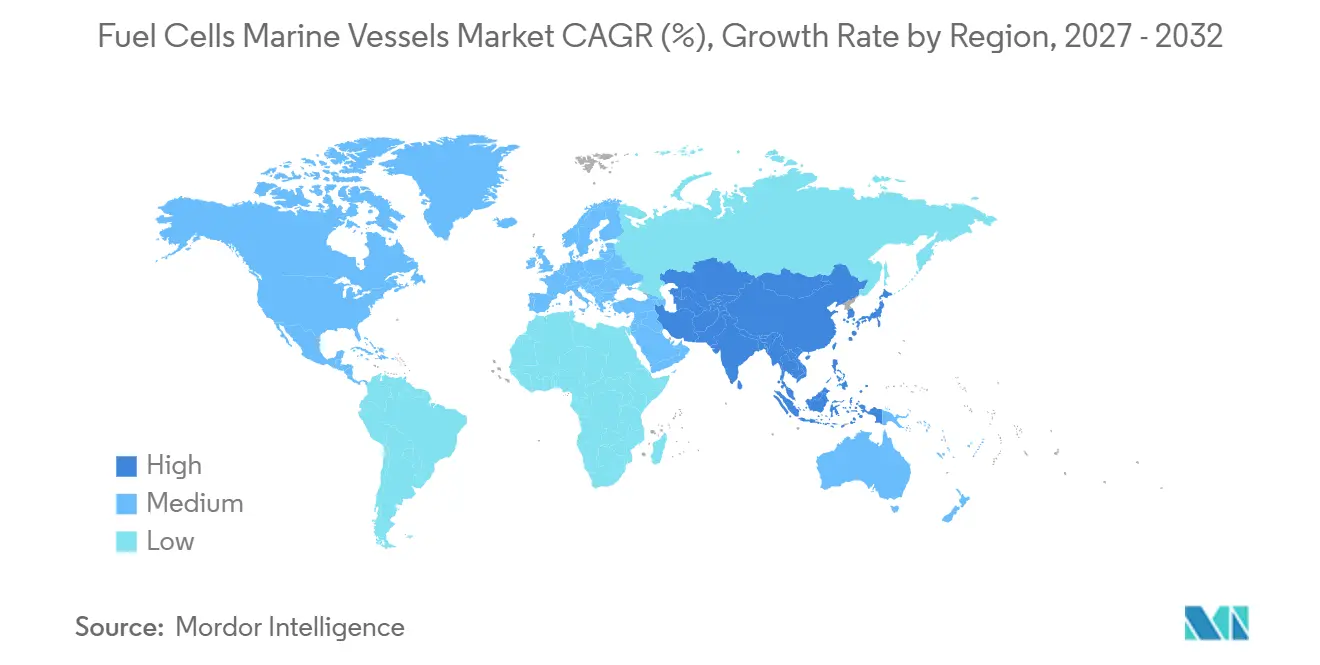
Europe held 44.7% of the fuel cells marine vessels market share in 2026. The region combines direct emissions rules, public funding, suppliers, class-society activity, and short-sea routes that can support planned hydrogen supply. FuelEU Maritime gives vessel operators a formal framework for managing greenhouse-gas intensity on covered voyages. The Rotterdam to Oslo SeaShuttle deployment offers a practical freight reference for the regional corridor model. Europe’s early lead in the fuel cells marine vessels market reflects the interaction of regulation and operating project experience.
European suppliers and research programs are broadening the set of vessel applications under consideration. The HELENUS project supports the development of a high-temperature fuel-cell solution for maritime use. DLR’s work on fuel-cell and battery shipboard generation provides a research base for hybrid onboard power systems. Norway remains important because its ferry operations offer conditions that are well-suited to repeatable fueling and route planning. Italy is also relevant through Fincantieri and Isotta Fraschini Motori, which are linked to Viking’s planned hydrogen cruise vessels. These activities give Europe a broad project base across passenger, freight, and cruise applications.
Asia-Pacific is expected to grow at a 17.5% CAGR through 2032, the highest regional rate in the supplied data. Japan is advancing commercial vessel projects and propulsion tests through companies that span engines, shipping, and energy. Mitsui O.S.K. Lines reported a full-scale land test of a marine hydrogen engine in March 2026 with Japan Engine Corporation and Kawasaki Heavy Industries. Yanmar, NYK, and ENEOS announced a hydrogen fuel-cell system for a Tokyo Bay dining cruise ship planned for 2027. South Korea and Singapore add shipbuilding, system-development, and port capabilities, while India’s FCV Pilot-01 demonstrates widening interest in regional inland-waterway use.
North America has a smaller position in the fuel cells marine vessels market, but holds visible ferry projects. Sea Change completed its first full year of commercial San Francisco Bay service in 2025 and was documented in the International Journal of Hydrogen Energy as a commercial hydrogen fuel-cell ferry. SWITCH Maritime and Incat Crowther are advancing a hydrogen fuel-cell-electric fast ferry design for New York City. South America and the Middle East and Africa remain earlier-stage regions in the supplied material. Their progress is more closely linked to future hydrogen production and port infrastructure than to current vessel deployments.
Competitive Landscape
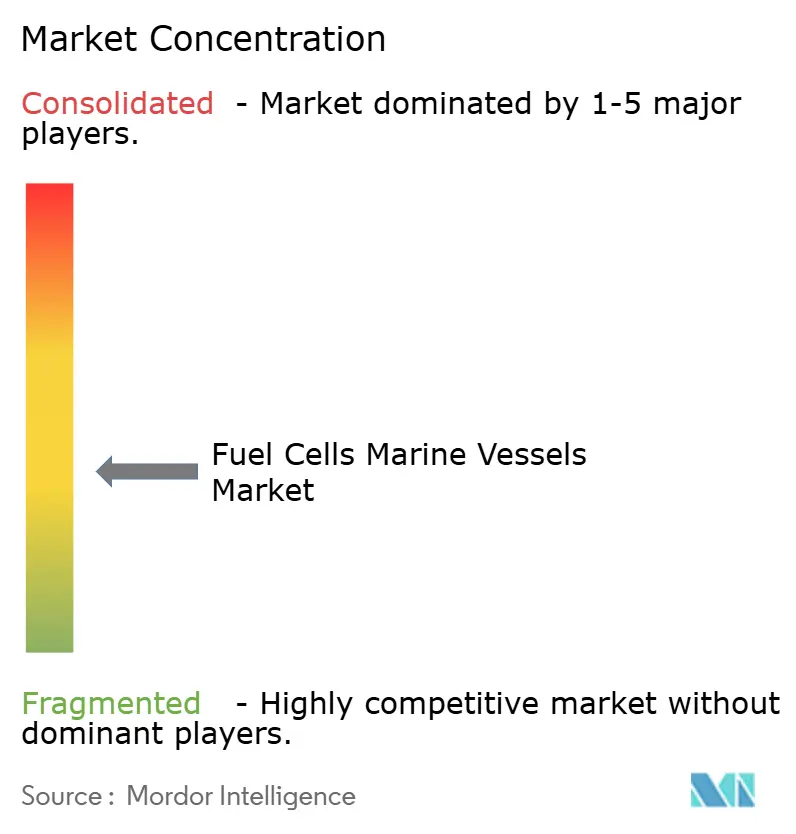
The fuel cells marine vessels market is moderately fragmented. No company in the supplied material is shown to hold a dominant revenue share across marine fuel-cell deliveries. Competition centers on technology performance, system cost, type approval, integration ability, and access to vessel projects. Ballard, PowerCell, Nedstack, VINSSEN, Bloom Energy, and other suppliers are competing across different technology types and power ranges. This structure gives system integrators an important role because a vessel owner needs an approved propulsion solution, not only a fuel-cell stack.
Ballard has a strong reference position through the DNV type-approved FCwave module and its 6.4 MW order for the Samskip project. Bloom Energy holds ABS type approval for its marine solid oxide fuel-cell module, placing it among the recognized suppliers in that technology segment. PowerCell is pursuing marine system scale through its existing product line and the development of larger systems. VINSSEN is associated with the 12 MW PEMFC configuration considered in the approved-in-principle tanker design. These examples show that formal approval and a credible vessel reference can be as important as technical output.
The distinction between stack supplier and system integrator will remain important as projects grow in size. An integrator must combine the stack, power electronics, storage, controls, ventilation, safety systems, and vessel interface into a class-approved design. Suppliers with certified modules can reduce some project uncertainty, while shipyards and integrators still need to adapt the solution to each vessel. The above-10 MW deep-sea segment has not yet established a routine production standard for the supplied material. This leaves room for suppliers that can demonstrate durability, power density, and fuel-system integration at a larger scale.
Fuel Cells Marine Vessels Industry Leaders
-
Ballard Power Systems Inc.
-
PowerCell Sweden AB
-
Bloom Energy Corporation
-
Nedstack Fuel Cell Technology B.V.
-
Cummins Inc.
- *Disclaimer: Major Players sorted in no particular order
Fuel Cells Marine Vessels Market Companies Covered in this Report
- ABB Ltd
- Advent Technologies Holdings, Inc.
- Ballard Power Systems Inc.
- Bloom Energy Corporation
- Cummins Inc.
- Doosan Fuel Cell Co., Ltd.
- GE Vernova Inc.
- Hyundai Heavy Industries Co., Ltd.
- MAN Energy Solutions SE
- Nedstack Fuel Cell Technology B.V.
- Nuvera Fuel Cells, LLC
- Plug Power Inc.
- PowerCell Sweden AB
- Proton Motor Power Systems plc
- SFC Energy AG
- Siemens AG
- Toshiba Energy Systems and Solutions Corporation
- Toyota Motor Europe NV/SA
- Wartsila Corporation
- Yanmar Holdings Co., Ltd.
Recent Industry Developments in Fuel Cells Marine Vessels Market
- September 2026: Viking announced the float-out of Viking Astrea at Fincantieri’s Ancona shipyard, the world’s second hydrogen-powered cruise ship with a 6 MW PEM fuel cell system by Isotta Fraschini Motori. Delivery is scheduled for May 2027, with inaugural Mediterranean and Northern European service thereafter.
- July 2026: Ballard-powered Samskip SeaShuttle was selected as the demonstrator vessel for HyShip, a European innovation project focused on making liquid hydrogen a practical commercial marine fuel on the Rotterdam to Oslo route. The project validates the 6.4 MW Ballard and eCap Marine propulsion system as a European hydrogen short-sea freight reference.
- June 2026: NYK, Yanmar Power Solutions, and ENEOS announced the installation of a hydrogen fuel-cell system on a new 480-ton dining cruise ship entering Tokyo Bay service in 2027. The vessel was confirmed under Japan’s MLIT safety guidelines and marks Yanmar Power Solutions’ fifth commercial maritime hydrogen fuel-cell implementation.
Global Fuel Cells Marine Vessels Market Report Scope
A fuel cell is an electrochemical power generation device that combines a fuel, such as hydrogen, with an oxidizing agent, such as oxygen from the air, to produce electricity and heat. Unlike traditional internal combustion engines that burn fossil fuels, fuel cells generate power silently and cleanly, with water vapor as the primary by-product.
The global fuel cell market is segmented by fuel cell type, power output, vessel type, and geography. By fuel cell type, the market is segmented into proton exchange membrane fuel cells (PEMFC), solid oxide fuel cells (SOFC), molten carbonate fuel cells (MCFC), phosphoric acid fuel cells (PAFC), direct methanol fuel cells (DMFC), alkaline fuel cells (AFC), and other fuel cell technologies. By power output, the market is segmented into up to 200 kW, 200 kW–1 MW, 1–5 MW, 5–10 MW, and above 10 MW. By vessel type, the market is segmented into passenger ferries, cargo ships, container ships, cruise ships, tankers, bulk carriers, offshore support vessels, workboats and service vessels, and other marine vessels. The report also covers the market size and forecasts for the global fuel cell market across 26 countries in the key regions. For each segment, market sizing and forecasts are provided in terms of value (USD).
Segmentation Overview
| Proton Exchange Membrane Fuel Cells (PEMFC) |
| Solid Oxide Fuel Cells (SOFC) |
| Molten Carbonate Fuel Cells (MCFC) |
| Phosphoric Acid Fuel Cells (PAFC) |
| Direct Methanol Fuel Cells (DMFC) |
| Alkaline Fuel Cells (AFC) |
| Other Fuel Cell Technologies |
| Up to 200 kW |
| 200 kW-1 MW |
| 1-5 MW |
| 5-10 MW |
| Above 10 MW |
| Passenger Ferries |
| Cargo Ships |
| Container Ships |
| Cruise Ships |
| Tankers |
| Bulk Carriers |
| Offshore Support Vessels |
| Workboats and Service Vessels |
| Other Marine Vessels |
| North America | United States |
| Canada | |
| Mexico | |
| Europe | Germany |
| France | |
| Italy | |
| Spain | |
| United Kingdom | |
| Norway | |
| Netherlands | |
| Denmark | |
| Russia | |
| Rest of Europe | |
| Asia-Pacific | China |
| India | |
| Japan | |
| South Korea | |
| Singapore | |
| Australia | |
| Rest of Asia-Pacific | |
| South America | Brazil |
| Argentina | |
| Chile | |
| Rest of South America | |
| Middle East and Africa | Saudi Arabia |
| United Arab Emirates | |
| Egypt | |
| South Africa | |
| Morocco | |
| Rest of Middle East and Africa |
| By Fuel Cell Type | Proton Exchange Membrane Fuel Cells (PEMFC) | |
| Solid Oxide Fuel Cells (SOFC) | ||
| Molten Carbonate Fuel Cells (MCFC) | ||
| Phosphoric Acid Fuel Cells (PAFC) | ||
| Direct Methanol Fuel Cells (DMFC) | ||
| Alkaline Fuel Cells (AFC) | ||
| Other Fuel Cell Technologies | ||
| By Power Output | Up to 200 kW | |
| 200 kW-1 MW | ||
| 1-5 MW | ||
| 5-10 MW | ||
| Above 10 MW | ||
| By Vessel Type | Passenger Ferries | |
| Cargo Ships | ||
| Container Ships | ||
| Cruise Ships | ||
| Tankers | ||
| Bulk Carriers | ||
| Offshore Support Vessels | ||
| Workboats and Service Vessels | ||
| Other Marine Vessels | ||
| By Geography | North America | United States |
| Canada | ||
| Mexico | ||
| Europe | Germany | |
| France | ||
| Italy | ||
| Spain | ||
| United Kingdom | ||
| Norway | ||
| Netherlands | ||
| Denmark | ||
| Russia | ||
| Rest of Europe | ||
| Asia-Pacific | China | |
| India | ||
| Japan | ||
| South Korea | ||
| Singapore | ||
| Australia | ||
| Rest of Asia-Pacific | ||
| South America | Brazil | |
| Argentina | ||
| Chile | ||
| Rest of South America | ||
| Middle East and Africa | Saudi Arabia | |
| United Arab Emirates | ||
| Egypt | ||
| South Africa | ||
| Morocco | ||
| Rest of Middle East and Africa | ||
Key Questions Answered in the Report
What is the forecast growth rate for fuel cells in marine vessels?
The Fuel Cells Marine Vessels Market size was valued at USD 1.12 billion in 2026 and is estimated to grow from USD 1.31 billion in 2027 to reach USD 2.82 billion by 2032, at a CAGR of 16.66% during the forecast period (2027-2032).
Which fuel-cell technology leads marine vessel applications?
PEMFC led with 53.4% share in 2026 and is also the fastest-growing fuel-cell type, with a projected 17.1% CAGR through 2032.
Why are passenger ferries early adopters of fuel-cell propulsion?
Passenger ferries held 29.3% share in 2026 because fixed routes and repeat port calls make fueling and operating procedures easier to plan.
Which region has the largest role in fuel-cell marine vessel deployment?
Europe held 44.7% share in 2026, supported by FuelEU Maritime requirements, public programs, suppliers, and defined short-sea routes.
What is the largest barrier to wider use of hydrogen fuel cells at sea?
System, storage, and bunkering costs remain substantial, while limited hydrogen availability at ports restricts vessels to routes with planned supply arrangements.
Which vessel category is expected to grow fastest through 2032?
Cruise ships are expected to record the highest growth rate at 17.8% CAGR, supported by planned hydrogen-capable vessels including Viking Libra and Viking Astrea.