
Friction Stir Welding Market Size and Share
Market Overview
| Study Period | 2021 - 2031 |
|---|---|
| Market Size (2026) | USD 315.60 Million |
| Market Size (2031) | USD 438.11 Million |
| Growth Rate (2026 - 2031) | 6.78 % |
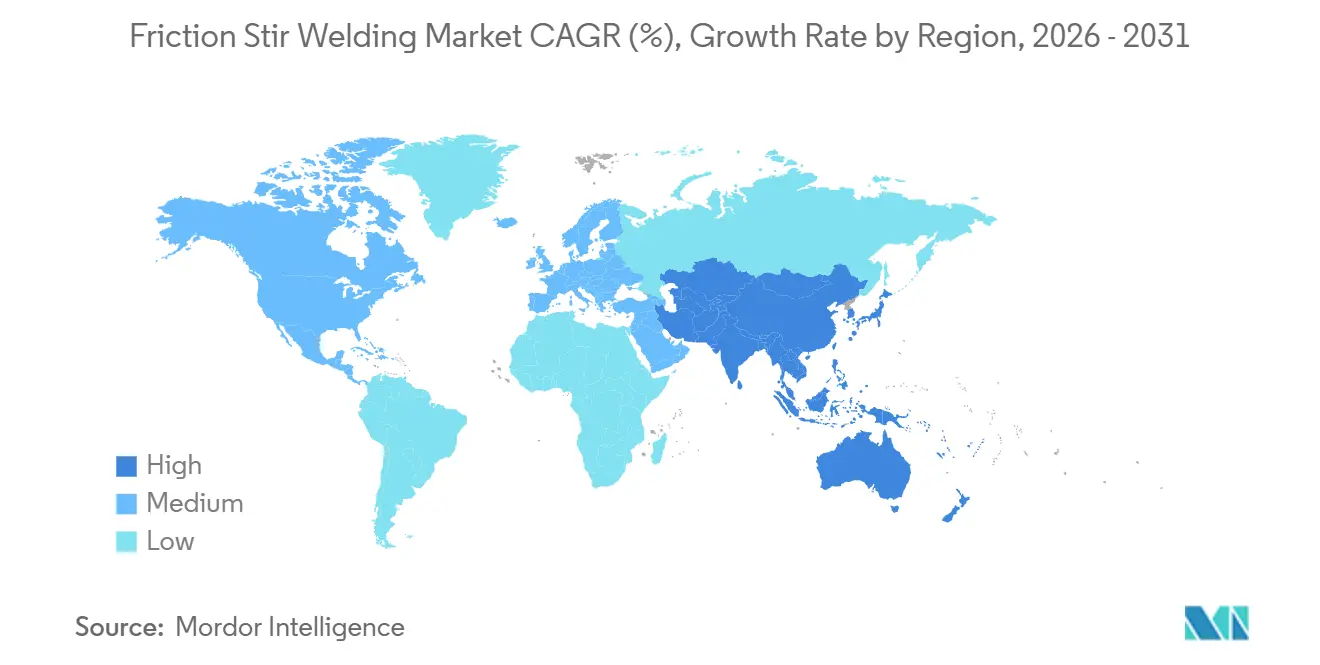
| Fastest Growing Market | Asia-Pacific |
| Largest Market | North America |
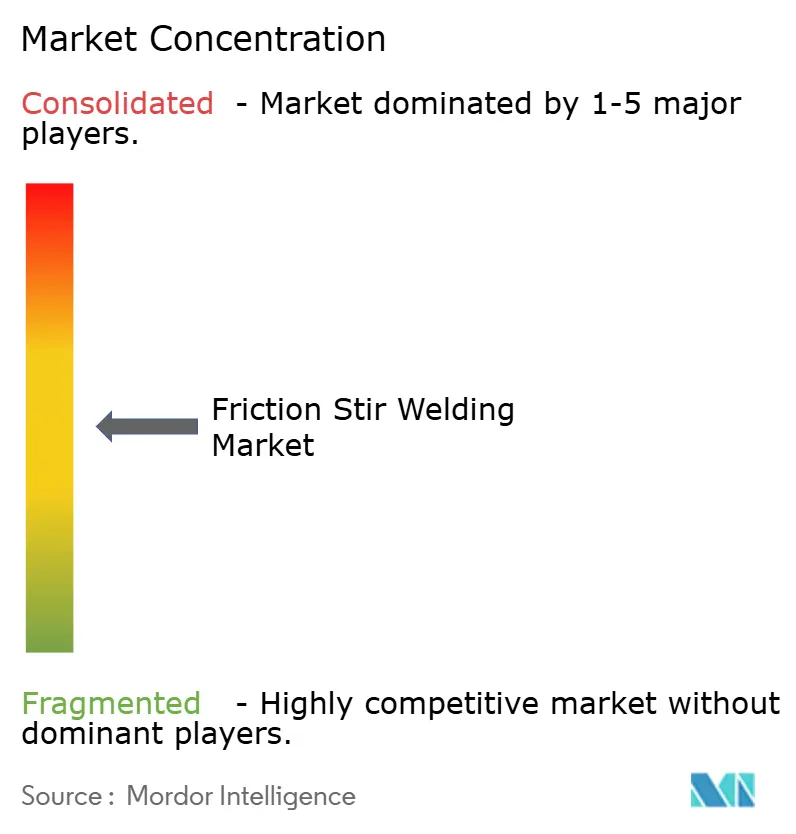
| Market Concentration | Medium |
Major Players *Disclaimer: Major Players sorted in no particular order Image © Mordor Intelligence. Reuse requires attribution under CC BY 4.0. | |
Friction Stir Welding Market Analysis by Mordor Intelligence
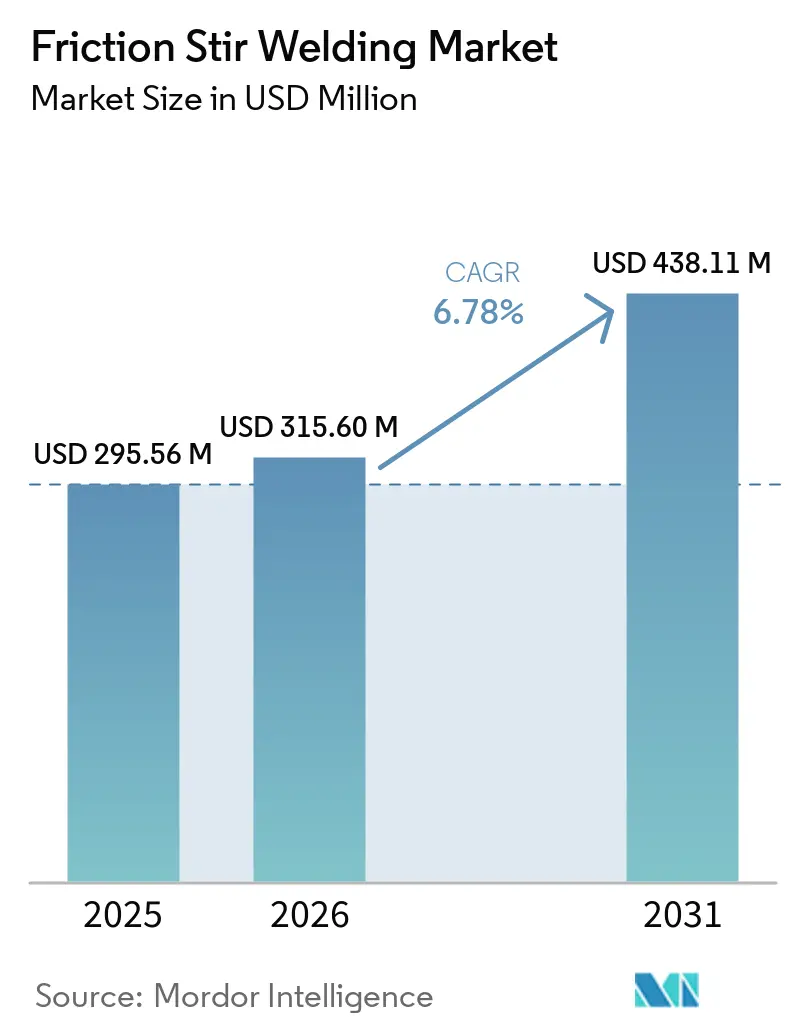
The Friction Stir Welding Market size was valued at USD 295.56 million in 2025 and is estimated to grow from USD 315.60 million in 2026 to reach USD 438.11 million by 2031, at a CAGR of 6.78% during the forecast period (2026-2031). The friction stir welding market is supported by lightweight vehicle programs and the expansion of automated aerospace and launch manufacturing. These applications require solid-state joints without filler material and with limited heat effects near the weld, which can preserve dimensional control where battery sealing, pressure containment, or structural alignment are important. The process also avoids the melting and resolidification cycle associated with conventional fusion welding, helping manufacturers address porosity and residual-stress concerns in demanding aluminum structures. These technical attributes are relevant across battery trays, rail panels, and propellant tanks, although the scale, material grade, and qualification requirements vary by application. New vehicle platforms that specify aluminum battery enclosures can create equipment demand that lasts through the production cycle, since the joining method is tied to the physical design of the battery carrier and cooling system. This relationship can make Friction Stir Welding (FSW) equipment decisions more durable than purchases linked only to short-term production changes. Aerospace and launch programs also support longer equipment procurement cycles than many conventional welding applications. Suppliers are responding through robotic cells, process-force control, and data-led weld inspection, while tool availability, capital costs, and specialized skills remain material constraints. The same factors shape where the friction stir welding market can expand most quickly, since large manufacturers can fund equipment, validation, and workforce development more readily than smaller fabricators. Vendors that combine machine design with application support can address this gap, although customers still need qualified personnel to operate and improve advanced systems.
Key Report Takeaways
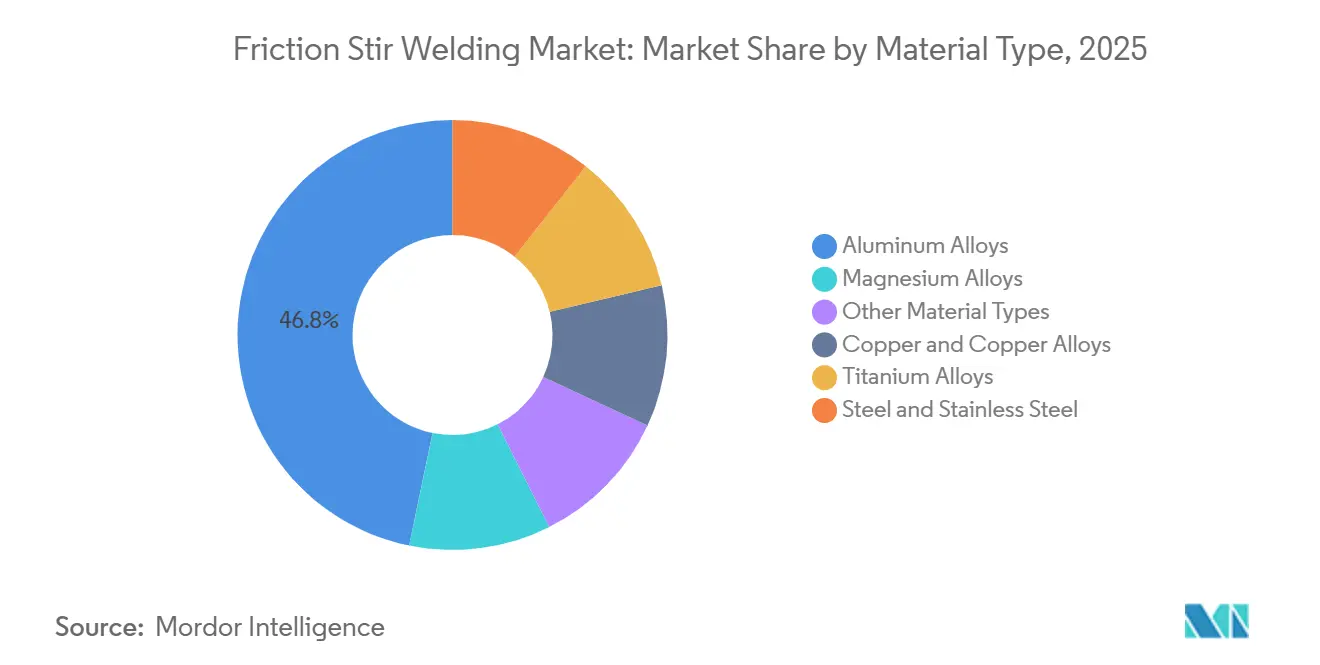
- By material type, aluminum alloys held 46.78% of the friction stir welding market share in 2025, while copper and copper alloys are projected to advance at a 7.13% CAGR through 2031.
- By welding type, linear friction stir welding held 53.64% of the friction stir welding market share in 2025, while refill friction stir spot welding is projected to advance at a 7.65% CAGR through 2031.
- By equipment type, fixed FSW equipment accounted for 40.53% of the friction stir welding market share in 2025, while robotic FSW equipment is projected to advance at a 7.97% CAGR through 2031.
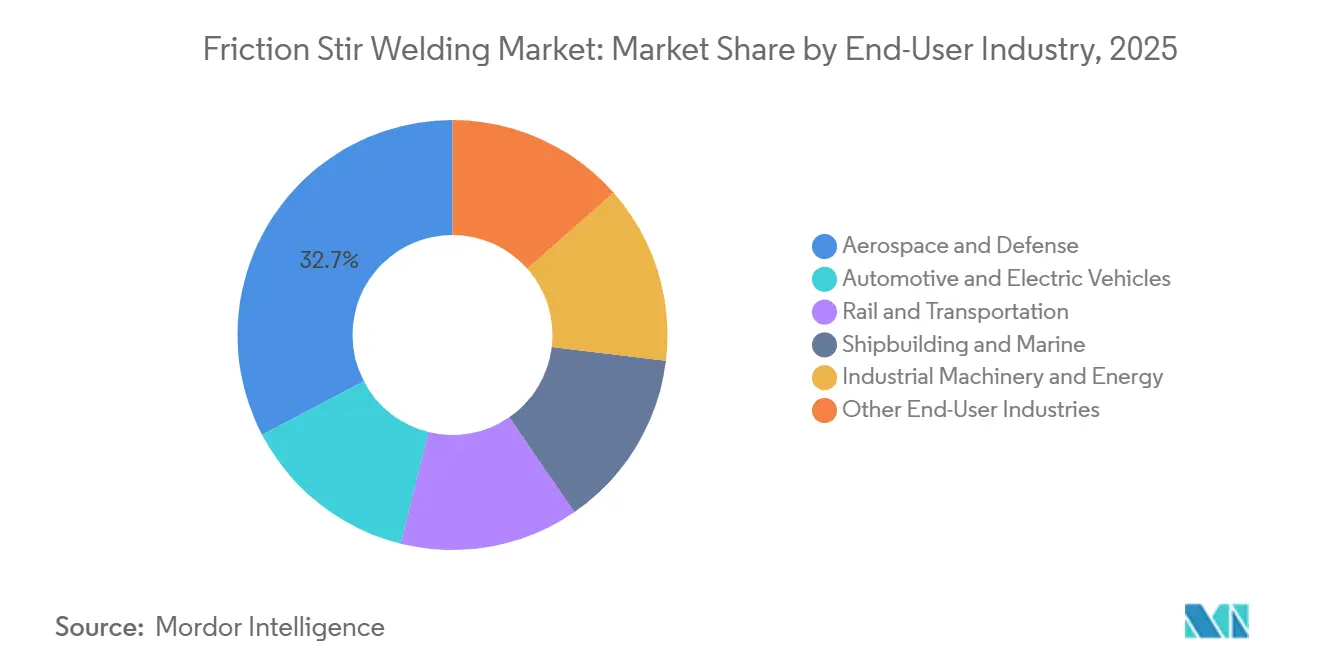
- By end-user industry, aerospace and defense accounted for 32.67% of the friction stir welding market share in 2025, while automotive and electric vehicles are projected to advance at an 8.15% CAGR through 2031.
- By geography, North America accounted for 36.12% of the friction stir welding market share in 2025, while Asia-Pacific is projected to advance at a 7.46% CAGR through 2031.
Note: Market size and forecast figures in this report are generated using Mordor Intelligence’s proprietary estimation framework, updated with the latest available data and insights as of January 2026.
Market Trends and Insights
Drivers Impact Analysis of Friction Stir Welding Market*
| Driver | (~) % Impact on CAGR Forecast | Geographic Relevance | Impact Timeline |
|---|---|---|---|
| Lightweighting of Electric Vehicles and Battery Enclosures | +1.8% | Global, with highest concentration in North America, Europe, and APAC EV manufacturing hubs | Medium term (2–4 years) |
| Growth in Automated Aerospace and Space-Launch Manufacturing | +1.5% | North America and Europe primarily; emerging activity in APAC (China, India) | Long term (≥ 4 years) |
| Expansion of Robotic and Force-Controlled FSW Systems | +1.3% | Global; APAC core, with spillover to North America and Europe | Medium term (2–4 years) |
| Demand for Low-Distortion, Energy-Efficient Solid-State Joining | +1.1% | Global | Medium term (2–4 years) |
| Adaptive FSW Quality Control Using Machine Learning | +0.8% | North America and Europe, with early adoption in APAC aerospace | Long term (≥ 4 years) |
| Source: Mordor Intelligence | |||
Lightweighting of Electric Vehicles and Battery Enclosures
The wider use of aluminum battery enclosures is changing the demand base for the friction stir welding market. KUKA SE & Co. KGaA received a follow-up order for 12 additional FSW cells in 2025 after an initial order for 23 cells from a major U.S. electric vehicle manufacturer. The systems were intended to weld battery carriers and connect cooling plates on production lines serving combustion, hybrid, and electric vehicles, showing how a single installation can support mixed-platform manufacturing rather than a dedicated electric vehicle line alone. This flexibility can be relevant when manufacturers manage changing vehicle volumes across several powertrain types. KUKA SE & Co. KGaA stated that robotic FSW cells can use up to 80% less energy than comparable metal inert gas or laser welding configurations. This operating-cost case matters to procurement teams working toward Scope 2 emissions targets. Pacific Northwest National Laboratory published work in September 2025 on a self-fixturing approach that could extend FSW into assembly-line applications now served by spot welding and adhesives[1]Pacific Northwest National Laboratory, “Breakthrough Could Bring Friction Stir Welding to Assembly Lines,” Pacific Northwest National Laboratory, pnnl.gov. The approach matters because rigid clamping infrastructure can constrain use on production lines. If the technique progresses through laboratory hardening and industrial-partner validation, it could lower a practical barrier to applying FSW in high-volume assembly settings.
Growth in Automated Aerospace and Space-Launch Manufacturing
Aerospace procurement has moved from narrow qualification work toward use across multiple launch programs in the friction stir welding market. Bond Technologies, LLC began construction of its Agilis GG7 gantry system in June 2026 for the National Aeronautics and Space Administration Multipurpose Weld Tool at Marshall Space Flight Center. The system has a 5 m × 5.9 m × 4.9 m working envelope and is intended for rocket bodies and propellant tanks. PAR Systems stated in January 2026 that its i-STIR technology supports core-stage liquid-hydrogen and liquid-oxygen fuel-tank structures for the Artemis II mission. Wuzhong Group delivered a 5-meter tank-bottom FSW system for Chinese civil aerospace in March 2025 and reported joint strengths more than 30% higher than fusion welding on large-diameter aluminum alloy rocket fuel storage tanks. Separate procurement programs in the United States and China broaden the equipment opportunity for suppliers because the demand streams are supported by distinct civil and government launch ecosystems. This reduces reliance on a single national program and creates a wider base for gantry systems, process engineering, and qualified tooling. The opportunity is concentrated in applications that require large working envelopes, strong axial force, and repeatable weld quality. These requirements make aerospace demand particularly relevant to providers of fixed systems, even while robotic solutions take a larger role in complex or flexible production work. The need to join cryogenic propellant tanks also places importance on hermetic seams and verified performance at low temperatures. Refill Friction Stir Spot Welding has been validated for cryogenic aluminum applications, giving the aerospace sector another process option beyond linear seams.
Expansion of Robotic and Force-Controlled FSW Systems
Robotic and force-controlled systems are expanding the applications served by the friction stir welding market. A 2025 study in Metals described a force and position hybrid control strategy for an eight-axis robotic platform. The work used multidimensional force sensors and laser displacement sensing to keep weld-depth and pressure deviations within 5%. It also showed curved aerospace panel welding without crack formation. TWI LTD completed a two-dimensional corner weld in 2026 with a six-axis KUKA KR500 robot under the Aerospace Technology Institute-funded MASTER project. The result enables welding of internal features on liquid-hydrogen storage tanks that had previously been difficult to reach with FSW.
Demand for Low-Distortion, Energy-Efficient Solid-State Joining
The energy and quality case for solid-state joining is becoming important across the friction stir welding market. A 2025 review in the Journal of Materials Research and Technology reported that FSW-based technologies can support resource conservation and recyclability. The review also identified the avoidance of solidification cracking, porosity, and residual stresses that can require secondary work in fusion-welded structures. Battery-tray flatness affects pack sealing, so lower distortion can remove rework from production. ISO 25239 provides a recognized framework for FSW procedure qualification and can reduce the qualification burden for new users.
Restraints Impact Analysis of Friction Stir Welding Market*
| Restraint | (~) % Impact on CAGR Forecast | Geographic Relevance | Impact Timeline |
|---|---|---|---|
| High Capital Cost of Fixed and Robotic FSW Systems | -1.2% | Global; more acute in South America and Middle East and Africa, and among SMEs globally | Short term (≤ 2 years) |
| Limited Availability of Qualified FSW Engineers and Programmers | -0.9% | Global | Medium term (2–4 years) |
| Tool-Material Supply Risk for High-Temperature and Ferrous-Alloy Welding | -0.7% | Global; most acutely felt in North America and Europe for defense and energy programs | Short term (≤ 2 years) |
| Source: Mordor Intelligence | |||
High Capital Cost of Fixed and Robotic FSW Systems
High capital costs can limit adoption in the friction stir welding market, especially among small and medium-sized fabricators. The analysis stated that 40% of smaller fabricators identify upfront cost as their main adoption barrier. A 2025 review in Metals noted that real-time sensing, intelligent analytics, and automated FSW control can be difficult for small and medium-sized enterprises to implement. Custom fixturing and process-parameter development can add 10% to 20% to the initial project cost. Production ramp-up delays of up to 6 months can further weaken early return-on-investment expectations.
Limited Availability of Qualified FSW Engineers and Programmers
The skills constraint reflects a gap between conventional FSW engineering experience and the digital skills now required for robotic systems in the friction stir welding market. Operators need capability in sensor architecture, data preparation, model validation, and systems integration. A 2025 review in Engineering Research Express identified data scarcity, computational complexity, and limited standardized frameworks as challenges for artificial intelligence quality assurance in FSW. Those limits mean that firms cannot deploy machine-learning systems without staff who can support the underlying data and process design, including the selection of useful sensor inputs and the validation of results against weld quality requirements. The need combines metallurgical knowledge with software and systems skills, which can lengthen adoption timelines for smaller organizations. A Springer Nature review published in 2025 found that tool-failure prediction accuracy rose from 87% to 98.1% when models used causative variables rather than raw data. This gap favors manufacturers that can combine welding expertise with digital engineering capability. It also reinforces the importance of workforce planning as sensors, force control, and machine-learning-based inspection become more common. Equipment purchases alone cannot resolve the constraint when organizations lack the staff to interpret process data and translate it into validated changes on the production floor.
*Our forecasts treat driver/restraint impacts as directional, not additive. The impact forecasts reflect baseline growth, mix effects, and variable interactions.
Friction Stir Welding Market Segment Analysis
By Material Type:
Aluminum Alloys’ Dominance Deepens as Copper and Copper Alloys AccelerateAluminum alloys held 46.78% of the friction stir welding market by material type in 2025. This position reflects their extensive use in electric vehicle battery enclosures, aerospace fuel-tank panels, and rail vehicle bodies, where low distortion and reliable sealing are important. Aluminum also has an established record in these structures, allowing manufacturers to build FSW programs around familiar materials and qualified fabrication practices. Platform decisions made in 2024 and 2025 can retain aluminum-intensive designs through model cycles extending beyond 2030. Copper and copper alloys are projected to advance at a 7.13% CAGR through 2031. Demand comes from solid-state joining of copper busbars, charging-system connectors, and motor housings. Fusion welding can introduce porosity and conductivity losses in these applications, making solid-state joining useful where electrical performance and stable contact quality are essential. The resulting opportunity includes busbars, connectors, and motor-related components that require both structural integrity and dependable electrical behavior.
KUKA SE & Co. KGaA presented aluminum-copper busbar FSW as a standard application in its robotic cell portfolio in 2025. This confirms commercial readiness for mixed-material electrical connections. Titanium alloys serve high-value aerospace and defense work, including launch-vehicle structures and airframe fittings, where the value of the component can justify a more specialized process. However, their use does not remove the practical requirement for robust tooling and careful control of process conditions. Magnesium alloys are also relevant to lightweight structural components for automotive and consumer-electronics applications, although limited commercial-scale FSW infrastructure currently restricts wider use. Steel and stainless steel remain specialized materials in FSW because tool wear and tooling costs limit commercial use to applications such as nuclear encapsulation, clad-pipe welding, and selected defense joints. Their throughput is constrained by polycrystalline cubic boron nitride and tungsten-rhenium tooling requirements.



By Welding Type:
Linear Friction Stir Welding Leads Demand, While Refill Friction Stir Spot Welding AcceleratesLinear friction stir welding accounted for 53.64% of the friction stir welding market by welding type in 2025. The process is used for long seams in electric vehicle battery trays and aerospace panels. Its controlled distortion and hermetic sealing support high-volume manufacturing, particularly where long seams must be repeated consistently across large battery or aerospace structures. These characteristics explain why linear FSW remains the standard option for continuous-seam work even as spot and refill variants gain attention. It is particularly suited to components with long, consistent joint paths and established fixturing. Its role in battery trays and aerospace panels means that it remains closely tied to the manufacturing volumes of electric vehicles and space hardware. Refill friction stir spot welding is projected to advance at a 7.65% CAGR through 2031. European Space Agency research validated the process for cryogenic aluminum applications. The work confirmed reliable joint formation at cryogenic temperatures for future launch-vehicle components[2]European Space Agency, “Welding the Future, A New Approach to Building Cryogenic Fuel Tanks,” European Space Agency, esa.int.
Friction stir spot welding serves overlap joints in aluminum-intensive automotive body construction. It competes with resistance spot welding in mixed-material vehicle architectures. Bobbin tool friction stir welding is used for hollow aluminum extrusions in rail vehicles. Its backing-bar-free design can simplify fixturing for enclosed profiles, which is important when access to both sides of the workpiece is limited. This capability gives rail manufacturers a practical route for joining hollow aluminum components without the layout constraints of some conventional systems. A 2025 Springer Nature paper described the Steppwelder FSW gun, which uses a closed-force-flux C-frame compatible with standard industrial robots. This design could support stitch-weld applications in flexible robotic cells. The development suggests a route for FSW to address automotive body-in-white work, where robots and spot-weld concepts are already familiar. It does not displace established processes immediately, but it extends the range of configurations that can be considered for solid-state joining.
By Equipment Type:
Fixed FSW Equipment Anchor Revenue, While Robotic FSW Equipment Grows FastestFixed FSW equipment held 40.53% of the friction stir welding market by equipment type in 2025. Large aerospace tanks, battery-tray lines, and rail panels require the rigidity and axial-force capacity of gantry and bridge systems. Bond Technologies, LLC’s Agilis GG7 illustrates this scale with a 5 m X-axis, a 5.9 m Y-axis, and a 4.9 m Z-axis travel. Robotic FSW equipment is projected to advance at a 7.97% CAGR through 2031. Its growth reflects improving force-control capability for complex weld paths, including curved surfaces and internal features that were less accessible with earlier robotic installations. Robotic cells can also support flexible production layouts when manufacturers work across several component types or platform configurations. KUKA SE & Co. KGaA launched the KR FORTEC ultra MT in spring 2025 with a reach extended to 3,400 mm and up to 20% more process force.
KUKA SE & Co. KGaA stated that laser-tracker calibration can support path accuracy below 0.5 mm. That capability supports more consistent work on complex components. Mobile and portable FSW equipment serves field repair and short-run shipbuilding where fixed-system logistics are less suitable. Portable and adaptive systems are relevant to shipyard applications, where large fixed machines can be difficult to position for repair work or short-run production. This creates a route for suppliers to address field deployments without relying solely on high-throughput factory installations. Portable equipment may be relevant where the workpiece is large, fixed in place, or produced in limited volumes. The opportunity remains more specialized than large automated lines, but it can broaden the customer base for system suppliers and application engineers. It is particularly relevant in shipbuilding and structural repair, where moving a large part to a fixed machine can be impractical. This use case represents a white-space opportunity alongside adaptive control and commercial-scale ferrous-alloy FSW. Such equipment could make FSW more accessible for localized structural work, while fixed platforms continue to support applications where repeatability and high force are essential and robotic systems broaden the addressable work.
By End-User Industry:
Aerospace and Defense Anchor Revenue, While Automotive and Electric Vehicles ExpandAerospace and defense retained 32.67% of the friction stir welding market by end-user industry in 2025. Its position reflects long-standing qualified installations in launch vehicles, commercial space programs, and defense airframes, where FSW has been used for structures that need high joint quality and limited distortion. Qualification history also gives this end-user group a foundation for continued equipment replacement, modernization, and program-specific expansion. Automotive and electric vehicles are projected to advance at an 8.15% CAGR through 2031. KUKA SE & Co. KGaA’s 2025 follow-up order for 12 cells shows the multi-year equipment commitments associated with battery carrier and cooling-plate production. Rail and transportation use FSW for high-speed train bodies and metro vehicle panels. These applications require low-distortion joining of aluminum extrusions, and they use many of the same process strengths that are relevant to battery enclosures and aerospace panels. Rail demand, therefore, adds another established transport application for equipment vendors and process specialists.
Shipbuilding and marine is a developing application area for adaptive FSW processes. Industrial machinery and energy use the process in heat exchangers, cooling systems, and power-conversion equipment. Aluminum-copper hermetic seams can offer service-life benefits over brazed and adhesively bonded alternatives. These applications broaden the friction stir welding industry beyond the vehicle and aerospace sectors. They also link demand to thermal management and power-conversion equipment, where reliable aluminum-copper joints can affect product performance. The diversity of end-uses can help suppliers balance exposure across transportation, energy, industrial equipment, and space programs. It also puts greater emphasis on application engineering because thermal equipment, rail bodies, ship structures, battery trays, and propellant tanks do not use the same materials, joint designs, or production conditions. Suppliers that can provide process development and validation alongside equipment have a broader basis for serving these different requirements. They also increase the value of process control and application-specific tooling.
Geography Analysis
North America Friction Stir Welding Market
North America held 36.12% of the friction stir welding market in 2025. The region is supported by U.S. aerospace and space-launch procurement and the expansion of robotic FSW cells in vehicle manufacturing. Bond Technologies, LLC began construction of the Agilis GG7 system for the National Aeronautics and Space Administration in June 2026. The project signals continued capital commitment to launch-vehicle manufacturing. PAR Systems also confirmed that its i-STIR technology supports structural hardware for the Artemis II mission. These programs provide depth across the regional aerospace supply chain by linking equipment builders, process specialists, and mission hardware manufacturers. The friction stir welding market in the region also benefits from electric vehicle production, where battery carriers and cooling plates require repeatable aluminum joining. The combination of launch and automotive demand supports both large, fixed installations and force-controlled robotic cells in the friction stir welding market. It also creates a regional need for qualified weld procedures, monitoring methods, and skilled engineers who can support production from early equipment installation through sustained operation. This capability supports the continued use of FSW in demanding programs where process consistency is essential. It also reinforces the commercial value of training, technical service, and long-term supplier support after equipment delivery. It also support demand for large-format systems that can handle rocket bodies and propellant tanks rather than only small, fabricated components.
Europe Friction Stir Welding Market
Europe is a major demand center for structured aerospace components and the Ariane 6 supply chain. Germany, France, and the Nordic countries support this activity through established aerospace manufacturing. The European Space Agency and MT Aerospace implemented machine-learning-based FSW inspection for Ariane 6 fuel-tank production in January 2026. The program cut inspection time by 95% versus manual methods. TWI LTD also completed a robotic corner-weld milestone for a liquid-hydrogen storage tank demonstrator in 2026. Aerospace certification requirements, including ISO 25239 and original equipment manufacturer qualification programs, favor established suppliers with verified process capability. They can also lengthen the route to entry for new vendors because equipment, tooling, parameters, and quality controls must meet formal customer requirements. This can support established certified suppliers, but it also creates opportunities for technology providers that help manufacturers qualify new robotic cells, monitoring systems, or specialized welding methods.
APAC, MEA and South America Friction Stir Welding Market
Asia-Pacific is projected to advance at a 7.46% CAGR through 2031 in the friction stir welding market. Civil aerospace, defense shipbuilding, and electric vehicle production are important sources of regional demand, giving Asia-Pacific a varied set of applications rather than dependence on one manufacturing sector. This combination connects equipment demand to launch systems, naval structures, battery components, and associated supply-chain development. Wuzhong Group’s 2025 system delivery represented a commercial entry point for Chinese civil-aerospace FSW. The company reported zero porosity or crack defects in five-meter-diameter aluminum alloy rocket fuel storage tanks. This example highlights the regional relevance of large-diameter aluminum structures in civil aerospace. South Korea’s shipbuilding capability and India’s growing domestic electric vehicle and aerospace manufacturing also point to a wider regional base for FSW equipment and process development. ETA Technology Pvt. Ltd. is contributing to India’s domestic FSW equipment activity, highlighting the importance of process stability, tooling, and quality validation for suppliers serving pressure-containing applications. India’s domestic electric vehicle and aerospace manufacturing scale-up is creating demand for equipment and process capability. South America, the Middle East, and Africa remain early-stage areas, with Brazil’s aerospace activity and Saudi Arabia’s industrial diversification programs identified as near-term adoption corridors.

Competitive Landscape
The friction stir welding market is moderately concentrated, with the top five players including PAR Systems, YAMAZAKI MAZAK CORPORATION, FOOKE GmbH, Manufacturing Technology, Inc., and Grenzebach Group. Large automation companies, including KUKA SE & Co. KGaA, ESAB Corporation, and YAMAZAKI MAZAK CORPORATION, offer FSW within wider manufacturing portfolios. Specialized providers include Bond Technologies, LLC, Stirtec, Stirweld, Manufacturing Technology, Inc., ETA Technology Pvt. Ltd., and Beijing FSW Technology Co., Ltd. They compete through application engineering, process knowledge, and equipment configuration, since FSW performance depends on the match between the machine, tool, material, fixturing, and operating parameters. Specialized firms can therefore compete where customers require tailored equipment or support for difficult joints. TWI LTD has a distinct role as the original FSW patent-holder and provides technology licensing, consulting, qualification support, and research partnerships. This role differs from direct competition in equipment pricing because licensing, consulting, and qualification work are tied to technology knowledge and industry standards. It also places TWI LTD in a position to support equipment vendors and original equipment manufacturers that need research or process-validation assistance.
Manufacturing Technology, Inc. and Stirtec GmbH formed a global partnership in 2025 to expand regional production capacity. Their co-branded approach covered the Americas, India, Australia, and New Zealand, with shared sales activity. MTI was assigned aluminum and bi-metallic machine builds and contract welding in the arrangement. Bond Technologies, LLC’s June 2026 construction of the Agilis GG7 for the National Aeronautics and Space Administration demonstrates investment in large-format aerospace capacity. KUKA SE & Co. KGaA’s KR FORTEC ultra-MT launch in 2025 shows a parallel focus on robotic force capability. These examples show that suppliers are expanding both fixed and robotic offerings.
Portable equipment, field repair, adaptive process control, and commercial-scale ferrous-alloy FSW remain areas for product development. Tool-material availability is a constraint for high-temperature and ferrous-alloy work. The U.S. Geological Survey stated in its 2025 Mineral Commodity Summaries that the United States had no domestic tungsten mine production and depended on imports. This exposure can increase interest in polycrystalline cubic boron nitride variants, tungsten-rhenium recycling, and proprietary tool programs, especially for high-temperature materials where tool wear is a larger commercial issue. The polycrystalline cubic boron nitride tool wear on steel can be 20 to 100 times faster than on aluminum, while individual tool costs can range from USD 2,000 to USD 8,000. Suppliers with distinct tooling capabilities can use this requirement to differentiate their offerings. The friction stir welding market, therefore, rewards both process performance and resilient tooling strategies. Companies must address the weld-quality demands of their customers while managing the availability and cost of tool materials. This issue is most significant for high-temperature and ferrous-alloy welding, where polycrystalline cubic boron nitride and tungsten-based tools are critical inputs. It is also why tool-material supply risk remains a restraint even when demand from electric vehicles and aerospace programs is strong. This makes tool development, recycling programs, and material-specific process knowledge important parts of competitive differentiation, particularly in higher-temperature applications.
Friction Stir Welding Industry Leaders
PAR Systems
YAMAZAKI MAZAK CORPORATION
FOOKE GmbH
Manufacturing Technology, Inc.
Grenzebach Group
- *Disclaimer: Major Players sorted in no particular order
Friction Stir Welding Market Companies Covered in this Report
- Beijing FSW Technology Co., Ltd.
- Bond Technologies, LLC
- ESAB Corporation
- ETA Technology Pvt. Ltd.
- FOOKE GmbH
- Grenzebach Group
- Groupe TRA-C industrie
- KUKA SE & Co. KGaA
- Manufacturing Technology, Inc.
- NITTO SEIKI CO., LTD.
- PAR Systems
- Stirtec
- Stirweld
- TWI LTD
- YAMAZAKI MAZAK CORPORATION

Recent Industry Developments in Friction Stir Welding Market
- June 2026: Bond Technologies, LLC commenced construction of the Agilis (GG7) gantry friction stir welding system for NASA’s Multipurpose Weld Tool, designed for fabricating next-generation launch-vehicle structures. The project strengthened the use of large-scale FSW systems in aerospace manufacturing, particularly for rocket bodies and propellant tanks.
- May 2026: Quantum Space announced a new 25,000–40,000-square-foot manufacturing facility in Tulsa, Oklahoma, equipped for CNC machining, friction stir welding, assembly, fabrication, and testing of spacecraft components. The facility expanded aerospace manufacturing capacity using FSW for large propulsion tanks and precision spacecraft structures.


Global Friction Stir Welding Market Report Scope
Friction stir welding is a solid-state joining process that uses frictional heat and mechanical deformation to join materials without melting them. It produces strong, consistent joints with reduced distortion and is suitable for joining materials that can be challenging to weld using conventional fusion processes.
The Friction Stir Welding Market is segmented by material type, welding type, equipment type, end-user industry, and geography. By material type, the market is segmented into aluminum alloys, copper and copper alloys, titanium alloys, magnesium alloys, steel and stainless steel, and other material types. By welding type, the market is segmented into linear friction stir welding, friction stir spot welding, refill friction stir spot welding, bobbin tool friction stir welding, and other welding types. By equipment type, the market is segmented into fixed FSW equipment, robotic FSW equipment, mobile and portable FSW equipment, and other equipment types. By end-user industry, the market is segmented into aerospace and defense, automotive and electric vehicles, rail and transportation, shipbuilding and marine, industrial machinery and energy, and other end-user industries. The report also covers the market size and forecasts for friction stir welding in 15 countries across major regions. For each segment, the market sizing and forecasts have been done on the basis of value (USD).
| Aluminum Alloys |
| Copper and Copper Alloys |
| Titanium Alloys |
| Magnesium Alloys |
| Steel and Stainless Steel |
| Other Material Types |
| Linear Friction Stir Welding |
| Friction Stir Spot Welding |
| Refill Friction Stir Spot Welding |
| Bobbin Tool Friction Stir Welding |
| Other Welding Types |
| Fixed FSW Equipment |
| Robotic FSW Equipment |
| Mobile and Portable FSW Equipment |
| Other Equipment Types |
| Aerospace and Defense |
| Automotive and Electric Vehicles |
| Rail and Transportation |
| Shipbuilding and Marine |
| Industrial Machinery and Energy |
| Other End-User Industries |
| Asia-Pacific | China |
| India | |
| Japan | |
| South Korea | |
| ASEAN Countries | |
| Rest of Asia-Pacific | |
| North America | United States |
| Canada | |
| Mexico | |
| Europe | Germany |
| United Kingdom | |
| France | |
| Italy | |
| NORDIC Countries | |
| Rest of Europe | |
| South America | Brazil |
| Argentina | |
| Rest of South America | |
| Middle East and Africa | Saudi Arabia |
| South Africa | |
| Rest of Middle East and Africa |
| By Material Type | Aluminum Alloys | |
| Copper and Copper Alloys | ||
| Titanium Alloys | ||
| Magnesium Alloys | ||
| Steel and Stainless Steel | ||
| Other Material Types | ||
| By Welding Type | Linear Friction Stir Welding | |
| Friction Stir Spot Welding | ||
| Refill Friction Stir Spot Welding | ||
| Bobbin Tool Friction Stir Welding | ||
| Other Welding Types | ||
| By Equipment Type | Fixed FSW Equipment | |
| Robotic FSW Equipment | ||
| Mobile and Portable FSW Equipment | ||
| Other Equipment Types | ||
| By End-User Industry | Aerospace and Defense | |
| Automotive and Electric Vehicles | ||
| Rail and Transportation | ||
| Shipbuilding and Marine | ||
| Industrial Machinery and Energy | ||
| Other End-User Industries | ||
| By Geography | Asia-Pacific | China |
| India | ||
| Japan | ||
| South Korea | ||
| ASEAN Countries | ||
| Rest of Asia-Pacific | ||
| North America | United States | |
| Canada | ||
| Mexico | ||
| Europe | Germany | |
| United Kingdom | ||
| France | ||
| Italy | ||
| NORDIC Countries | ||
| Rest of Europe | ||
| South America | Brazil | |
| Argentina | ||
| Rest of South America | ||
| Middle East and Africa | Saudi Arabia | |
| South Africa | ||
| Rest of Middle East and Africa | ||


Key Questions Answered in the Report
What is the size of the friction stir welding market?
The friction stir welding market stands at USD 315.60 million in 2026 and is projected to reach USD 438.11 million by 2031.
What is driving demand for friction stir welding equipment?
Lightweight electric vehicle battery structures and automated aerospace and launch manufacturing are central demand drivers.
Which material type led the market demand in 2025?
Aluminum alloys led the market demand with a 46.78% share in 2025, supported by battery enclosures, aerospace panels, and rail bodies.
Which equipment type is expected to grow fastest through 2031?
Robotic FSW equipment is projected to advance at a 7.97% CAGR through 2031 as force-controlled cells support complex weld paths.
Page last updated on:





