
Market Overview
| Study Period | 2021 - 2031 |
|---|---|
| Forecast Data Period | 2026 - 2031 |
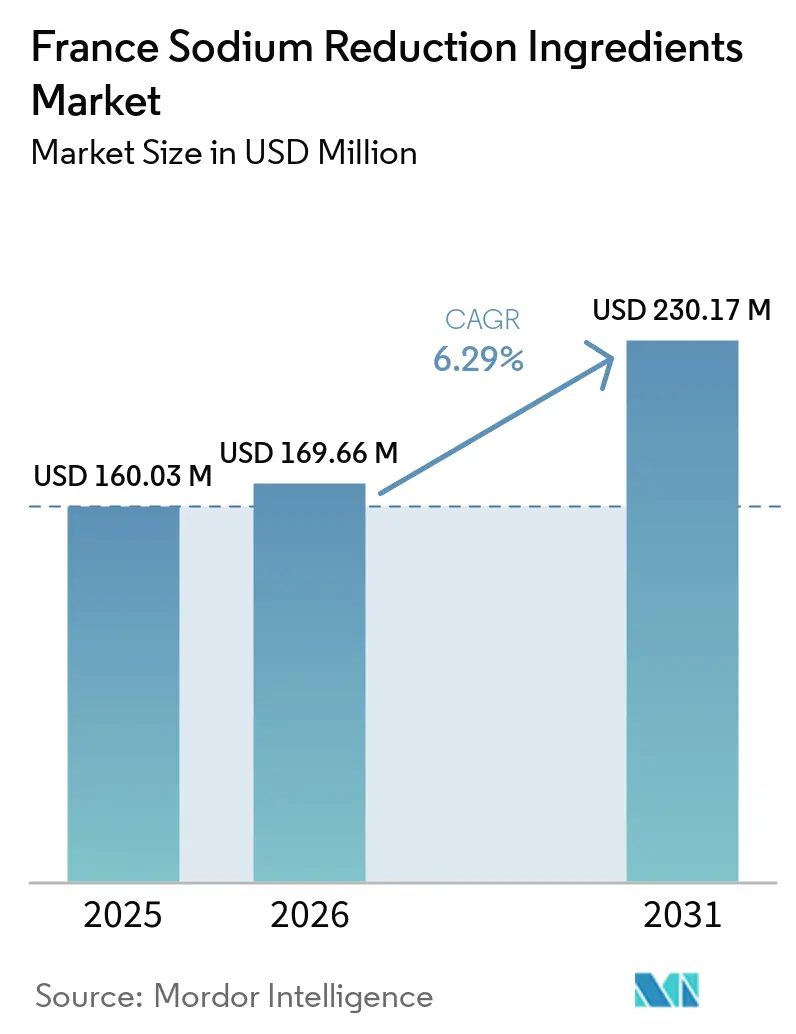
| Base Year Market Size (2025) | USD 160.03 Million |
| Market Size (2026) | USD 169.66 Million |
| Market Size (2031) | USD 230.17 Million |
| Growth Rate (2026 - 2031) | 6.29 % |
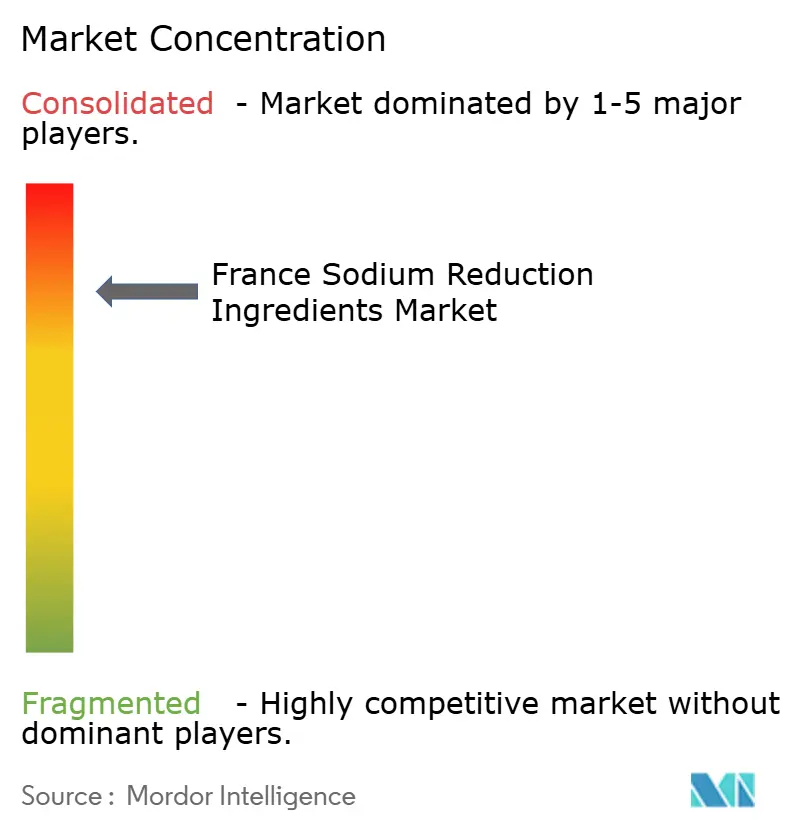
| Market Concentration | High |
Major Players *Disclaimer: Major Players sorted in no particular order Image © Mordor Intelligence. Reuse requires attribution under CC BY 4.0. | |
France Sodium Reduction Ingredients Market Analysis by Mordor Intelligence
The France sodium reduction ingredients market was USD 160.03 million in 2025 and is projected to reach USD 169.66 million by 2026 and USD 230.17 million by 2031, growing at a CAGR of 6.29% over 2026-2031. The France sodium reduction ingredients market is supported by a substantial hypertension burden and persistently high dietary salt intake. Santé publique France reported that 30% of adults in France have hypertension and that more than 80% consume too much salt. The same public health challenge makes reformulation relevant to food manufacturers, public procurement, and institutional meal providers. Suppliers are responding with mineral blends, yeast extracts, and taste-modulation systems that protect flavor while reducing sodium. Competitive advantage increasingly depends on application support, speed of reformulation, and the ability to work with French food categories that have strong taste expectations [1].
Key Report Takeaways
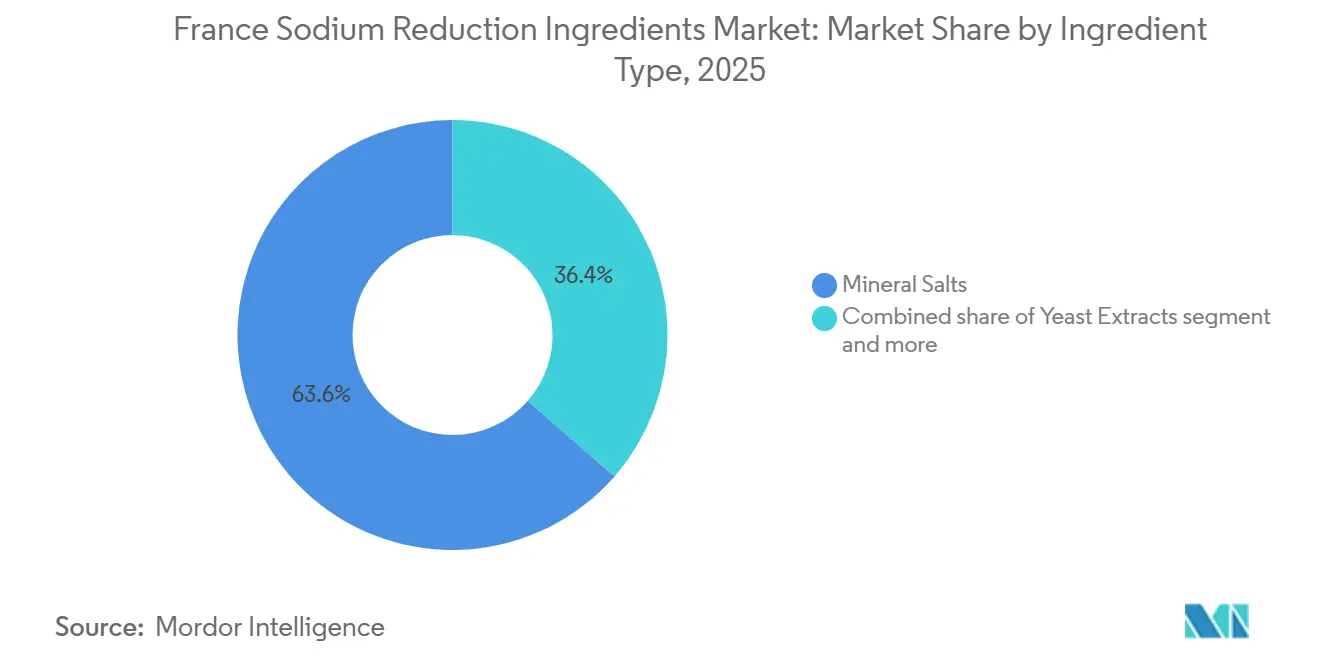
- By ingredient type, mineral salts held a 63.57% revenue share in 2025, while yeast extracts are projected to grow at a 7.21% CAGR through 2031.
- By form, powder/granules held a 62.54% revenue share in 2025, while liquid formats are projected to grow at a 6.74% CAGR through 2031.
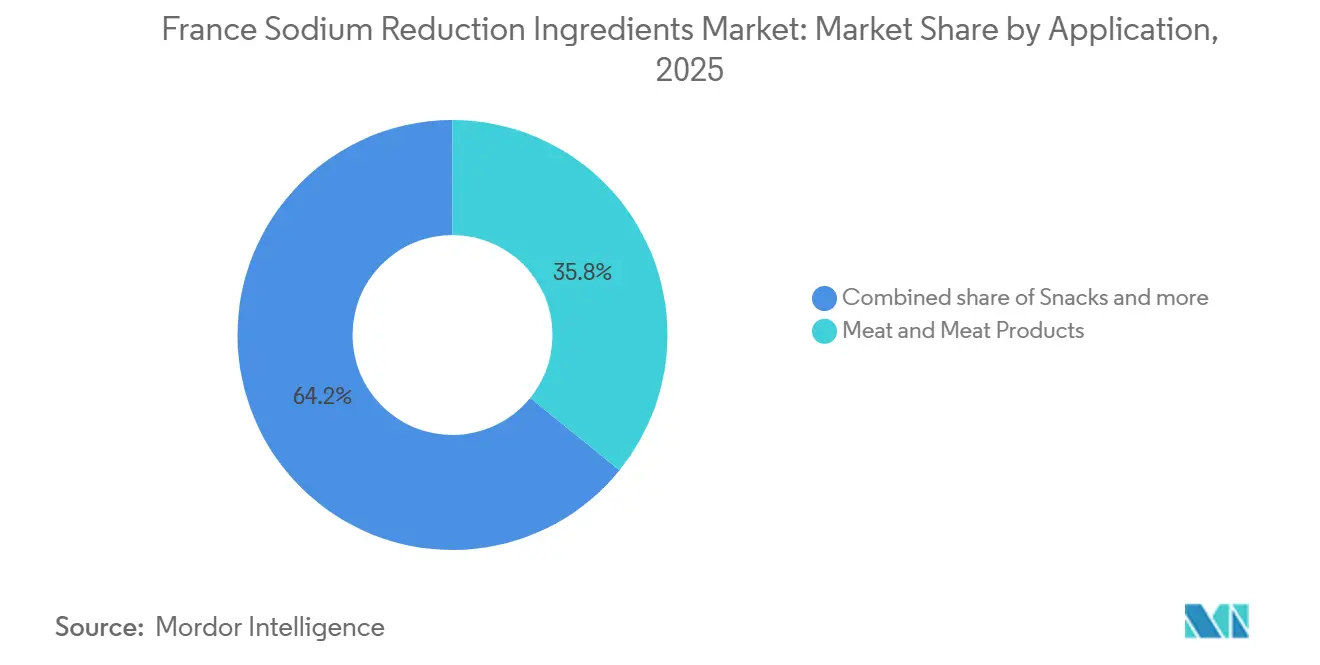
- By application, meat and meat products held a 35.83% revenue share in 2025, while snacks are projected to grow at an 8.02% CAGR through 2031.
Note: Market size and forecast figures in this report are generated using Mordor Intelligence’s proprietary estimation framework, updated with the latest available data and insights as of January 2026.
France Sodium Reduction Ingredients Market Trends and Insights
Drivers Impact Analysis*
| Driver | (~) % Impact on CAGR Forecast | Geographic Relevance | Impact Timeline |
|---|---|---|---|
| Rising Consumer Awareness of Cardiovascular Health | +2.1% | National, with elevated intensity in urban centers (Paris, Lyon, Marseille) | Short term (≤ 2 years) |
| Strengthening Government Initiatives for Dietary Sodium Reduction | +1.8% | National, compliance pressure concentrated among large-scale industrial producers | Medium term (2-4 years) |
| Rising Utilization of Umami-Based Flavor Enhancers | +1.2% | Global supply, demand concentrated in France and broader EU | Medium term (2-4 years) |
| Expanding Innovation in Low-Sodium Snack Seasonings | +0.7% | France and EU, spill-over to export markets served by French manufacturers | Short term (≤ 2 years) |
| Growing Reformulation of Sauces and Condiments | +0.6% | National, regional hubs in Brittany and Pays de la Loire | Medium term (2-4 years) |
| Increasing Demand for Clean-Label Yeast Extracts | +0.8% | Global, driven from France's Lesaffre-anchored fermentation expertise | Long term (≥ 4 years) |
| Source: Mordor Intelligence | |||
Rising Consumer Awareness of Cardiovascular Health
France's cardiovascular disease burden provides a continuing demand base for the France sodium reduction ingredients market. Santé publique France stated that hypertension was linked to more than 55,000 deaths annually and represented 8.5% of all mortality. The agency also reported more than 6.2 million hospital days annually associated with hypertension. Men aged 55 to 74 face a particularly high burden, which supports sustained attention to dietary prevention. A 2025 study estimated that a 40% reduction in salt consumption could reduce average systolic blood pressure by 6.5 mmHg and prevent 19,500 deaths and 140,000 hospitalizations annually. These figures support demand for products that reduce sodium without creating a noticeable change in taste [2].
Strengthening Government Initiatives for Dietary Sodium Reduction
France's 2025 food, nutrition, and climate strategy placed sodium reduction within a broader national food policy agenda. The proposed approach calls for at least a 5% reduction in average salt content by product category against the latest Oqali baseline. The bakery sector had already achieved a 25% reduction in standard bread salt content since 2015. A limit of 1.1 g of salt per 100 g of pain de mie took effect in October 2025. In August 2025, the Directorate-General for Health and the Directorate-General for Food asked ANSES to develop reformulation scenarios for major food categories. The PNNS target of a 25% reduction in population salt intake by 2030 and school meal caps of 1.5 g per meal extend demand beyond branded retail foods [3].
Rising Utilization of Umami-Based Flavor Enhancers
Umami ingredients are shifting sodium reduction from simple salt replacement toward flavor rebuilding in the France sodium reduction ingredients market. Biospringer's Maxarome Prime uses glutamate and nucleotide interactions to strengthen umami perception. This approach can help manufacturers lower sodium while limiting the bitter aftertaste often associated with mineral salt substitutes. Suppliers increasingly differentiate their yeast extract portfolios through the ratio of glutamic acid, peptides, and nucleotides used for different food matrices. The French HUM project showed that plant-derived umami sources could reduce salt in charcuterie while maintaining consumer sensory acceptance. These developments give food producers more options when a basic sodium chloride replacement does not meet flavor requirements.
Expanding Innovation in Low-Sodium Snack Seasonings
Snack reformulation is creating a faster-moving use case for the France sodium reduction ingredients market. Snacks are projected to expand at an 8.02% CAGR through 2031, the fastest rate among the applications provided. European restrictions on smoke flavorings used in BBQ seasonings are prompting manufacturers to redesign seasoning systems. The revised recipes can combine sodium reduction with broader taste and labeling changes during the same development cycle. Oqali data showed that 6 of 18 French savory snack families reduced salt content by 7% to 44% between 2013 and 2021. Kerry reported that a French retail crisp brand achieved a 40% sodium reduction using a mineral salt, Tastesense Salt, and an umami combination.
Restraints Impact Analysis*
| Restraint | (~) % Impact on CAGR Forecast | Geographic Relevance | Impact Timeline |
|---|---|---|---|
| Stringent European Food Ingredient Labeling Requirements | -0.5% | France and EU-wide, most acute for SME manufacturers with limited compliance resources | Medium term (2-4 years) |
| High Costs of Specialized Salt Alternatives | -0.7% | National, disproportionately affecting SME charcutiers and specialty cheese producers | Short term (≤ 2 years) |
| Technical Challenges Maintaining Bakery Dough Functionality | -0.3% | National, concentrated in artisanal and industrial bread and viennoiserie production | Medium term (2-4 years) |
| Volatile Prices of Specialty Mineral Ingredients | -0.4% | EU-wide, France exposed via heavy reliance on imported potassium chloride | Short term (≤ 2 years) |
| Source: Mordor Intelligence | |||
Stringent European Food Ingredient Labeling Requirements
European food information rules require salt content to be declared on pre-packaged food labels. France also applies the Nutri-Score system, whose 2025 revision sharpened sodium-related scoring differentiation. A small sodium reduction may therefore fail to change a product's Nutri-Score grade. That result can limit the commercial return on the ingredient cost and reformulation effort. EFSA's 2025 opinion on magnesium potassium trichloride hexahydrate shows that novel mineral salt ingredients can enter the food system, but they require substantial safety documentation. The France sodium reduction ingredients market therefore has a higher compliance burden for smaller processors with limited regulatory and labeling resources.
High Costs of Specialized Salt Alternatives
Specialized sodium reduction systems can cost more than basic sodium chloride, which affects adoption by smaller food processors. Proprietary yeast extracts, encapsulated salt particles, and peptide-based enhancers can add material costs to an already demanding reformulation project. Larger manufacturers can spread these costs across broader production volumes and work directly with suppliers on application testing. Small charcuterie producers and specialty cheese makers have less scope to absorb the added expense. The cost difference can lead them to use basic mineral blends rather than more advanced multi-ingredient systems. This creates different adoption paths across the France sodium reduction ingredients market, even when the same policy targets apply.
*Our forecasts treat driver/restraint impacts as directional, not additive. The impact forecasts reflect baseline growth, mix effects, and variable interactions.
Segment Analysis
By Ingredient Type: Mineral Salts Anchored, Yeast Extracts Accelerating
Mineral salts held 63.57% of the France sodium reduction ingredients market share in 2025. Their lead reflects established use in processed meats, bakery, and dairy products where safety and regulatory requirements are familiar. Potassium chloride is the largest-volume option for partial sodium chloride replacement, while potassium lactate adds preservation benefits in charcuterie and calcium chloride serves fermented and brined products. K+S introduced NUTRIKS Balance at Fi Europe 2025 in Paris as a ready-mix table salt and potassium chloride blend for mid-size manufacturers without in-house formulation resources. Mineral salts therefore remain the practical option for producers that need familiar processing performance.
Yeast extracts are the fastest-growing ingredient type, with the France sodium reduction ingredients market size for yeast extracts projected to grow at a 7.21% CAGR through 2031. They provide clean-label umami and can mask the bitterness of potassium chloride in lower-sodium recipes. Amino acids and glutamates can add perceived saltiness without added sodium, allowing formulators to combine taste-building approaches. The HUM project, coordinated by ADRIA with LUBEM and CEVA from 2022 to 2025, developed plant-derived umami applications for French charcuterie. This gives domestic manufacturers a reformulation route based on local research when taste quality is central to adoption.

By Form: Powder Leads, Liquid Formats Reflect Category Evolution
Powder/granular formats held a 62.54% revenue share in 2025. Their position reflects dry-blending and batch-processing systems used in bakery, snack seasoning, and meat processing. Powders allow precise dosing of high-potency yeast extracts and help prevent flavor imbalance from overdosing. The format works with existing equipment and avoids the capital modification needed for a new delivery system. It remains practical for mineral blends and products mixed before cooking or extrusion.
Liquid sodium reduction ingredients are projected to grow at a 6.74% CAGR through 2031. Ready-to-eat sauces, soups, and refrigerated condiments need ingredients that disperse evenly in liquid food systems. Liquid yeast extracts and potassium lactate solutions avoid powder dust and support consistent batch-to-batch reduction. Corbion's Purasal and PuraQ Arome systems address sodium reduction and microbial shelf life in the same formulation. Liquid formats therefore grow faster, although powders remain the larger format in the France sodium reduction ingredients market.
By Application: Meat Anchors Demand, Snacks Lead Growth
Meat and meat products held 35.83% of the France sodium reduction ingredients market share in 2025. Charcuterie relies on salt for water activity, protein extraction, microbial management, and curing chemistry. FICT reported that weighted average salt content in processed meats fell 4% between 2013 and 2020, showing prior reformulation progress while further change is needed. Lallemand Bio-Ingredients' Toravita yeast specialties combine potassium chloride with torula yeast properties that can mask off-notes. These systems help processors manage taste and microbial considerations in the same product design.
Snacks have the fastest application growth, with the France sodium reduction ingredients market size for snacks projected to grow at an 8.02% CAGR through 2031. Nutri-Score pressure and the 2025 smoke flavoring restrictions are prompting producers to revisit seasoning recipes. Six of 18 French savory snack families reduced salt content by 7% to 44% from 2013 to 2021. Kerry reported a 40% sodium reduction for a French retail crisp brand using mineral salt, Tastesense Salt, and umami systems. Bakery remains constrained by dough behavior, while sauces and condiments can use multi-modal taste tools that deliver 25% to 30% sodium reduction, according to the European Snacks Association.
Competitive Landscape
The France sodium reduction ingredients market has a high concentration score because a limited group of multinational suppliers and specialists has the capabilities needed for meaningful competition. Kerry, dsm-firmenich, Givaudan, Symrise, and Ajinomoto compete through portfolio breadth and application support. Kerry's Sodium Reduction Simulator and dsm-firmenich's TASTECOMPASS show how digital formulation tools have become part of supplier differentiation. Lesaffre has a local advantage through Biospringer's French manufacturing base and culinary center network. Fermentation know-how, application science, and proprietary taste systems remain significant barriers for smaller entrants.
The France sodium reduction ingredients market has an opportunity in formulation bundles for SME charcutiers and artisanal food producers without dedicated research and development teams. K+S presented NUTRIKS Balance at Fi Europe 2025 as a 1:1 sodium chloride replacement for manufacturers without formulation infrastructure. The product illustrates how pre-formulated mineral blends can lower adoption barriers. MicroSalt's SodiumKind technology aims to provide full salty flavor with 50% less sodium without potassium chloride. Griffith Foods added a service-oriented approach in April 2025 through its Craveable Impact Sodium Solutions initiative.
Supplier competition is moving beyond individual ingredients toward broader reformulation support. Ajinomoto launched Salt Answer and Palate Perfect in June 2025 for application-specific sodium reduction and taste balance. Kerry introduced Smart Taste in September 2025 to help manufacturers improve labels and address regulatory needs. Companies with strong taste science and local technical support have a clearer path to retain food manufacturer accounts.
France Sodium Reduction Ingredients Industry Leaders
-
Cargill, Incorporated
-
Tate & Lyle PLC
-
Kerry Group plc
-
Corbion N.V.
-
Associated British Foods plc
- *Disclaimer: Major Players sorted in no particular order
Recent Industry Developments
- June 2026: K+S acquires Qemetica's salt business in Poland and Germany for EUR 350 million to EUR 380 million. K+S, through its subsidiary ESCO International, agreed to acquire two evaporated salt production sites in Stassfurt, Germany, and Janikowo, Poland, from Qemetica, expanding its European food-grade and specialty salt capacity and reinforcing its position as Europe's largest salt producer. Closing is expected in Q1 2027, subject to competition authority approval.
- September 2025: Kerry launches Smart Taste™ cross-category taste solution range. Kerry Group introduced Smart Taste™ on 30 September 2025, a proprietary range enabling manufacturers to reduce reliance on volatile ingredients, achieve cleaner labels, and meet evolving regulations, expanding its actionable commercial offering beyond the Tastesense Salt platform.
- June 2025: Ajinomoto launches Salt Answer and Palate Perfect platforms for sodium reduction. Ajinomoto Health & Nutrition announced two solution platforms on 23 June 2025. Salt Answer achieves up to 30% sodium reduction across snacks, sauces, and bakery goods through four application-specific SKUs. Palate Perfect targets taste enhancement and flavor balance optimization.
France Sodium Reduction Ingredients Market Report Scope
The France Sodium Reduction Ingredients Market is Segmented by Ingredient Type (Amino Acids and Glutamates, Mineral Salts, Yeast Extracts, Potassium Chloride, Magnesium Sulphate, Potassium Lactate, Calcium Chloride, and Other Ingredient Types), by Form (Powder/Granules and Liquid), and by Application (Bakery and Confectionery, Condiments, Seasonings and Sauces, Dairy and Frozen Foods, Meat and Meat Products, Snacks and Other Applications). The Market Forecasts are Provided in Terms of Value (USD).
By Ingredient Type
| Amino Acids and Glutamates |
| Mineral Salts |
| Potassium Chloride |
| Magnesium Sulphate |
| Potassium Lactate |
| Calcium Chloride |
| Yeast Extracts |
| Other Ingredient Types |
By Form
| Powder/Granules |
| Liquid |
By Application
| Bakery and Confectionery |
| Condiments, Seasonings and Sauces |
| Dairy and Frozen Foods |
| Meat and Meat Products |
| Snacks |
| Other Applications |
| By Ingredient Type | Amino Acids and Glutamates |
| Mineral Salts | |
| Potassium Chloride | |
| Magnesium Sulphate | |
| Potassium Lactate | |
| Calcium Chloride | |
| Yeast Extracts | |
| Other Ingredient Types | |
| By Form | Powder/Granules |
| Liquid | |
| By Application | Bakery and Confectionery |
| Condiments, Seasonings and Sauces | |
| Dairy and Frozen Foods | |
| Meat and Meat Products | |
| Snacks | |
| Other Applications |
Key Questions Answered in the Report
What is driving demand for sodium reduction ingredients in France?
Hypertension prevalence, high dietary salt intake, food policy targets, and Nutri-Score considerations support reformulation demand.
How large is the France sodium reduction ingredients market?
The France sodium reduction ingredients market is expected to increase from USD 160.03 million in 2025 to USD 230.17 million by 2031, at a 6.29% CAGR.
Which ingredient type leads sodium reduction formulations in France?
Mineral salts lead with 63.57% revenue share in 2025, while yeast extracts have the highest projected growth at 7.21% CAGR through 2031.
Which food application is growing fastest for sodium reduction ingredients?
Snacks are projected to grow at an 8.02% CAGR through 2031, supported by seasoning reformulation and Nutri-Score pressure.