
Market Overview
| Study Period | 2020 - 2031 |
|---|---|
| Forecast Data Period | 2026 - 2031 |
| Base Year Market Size (2025) | USD 480.86 Million |
| Market Size (2026) | USD 505.82 Million |
| Market Size (2031) | USD 651.27 Million |
| Growth Rate (2026 - 2031) | 5.19 % |
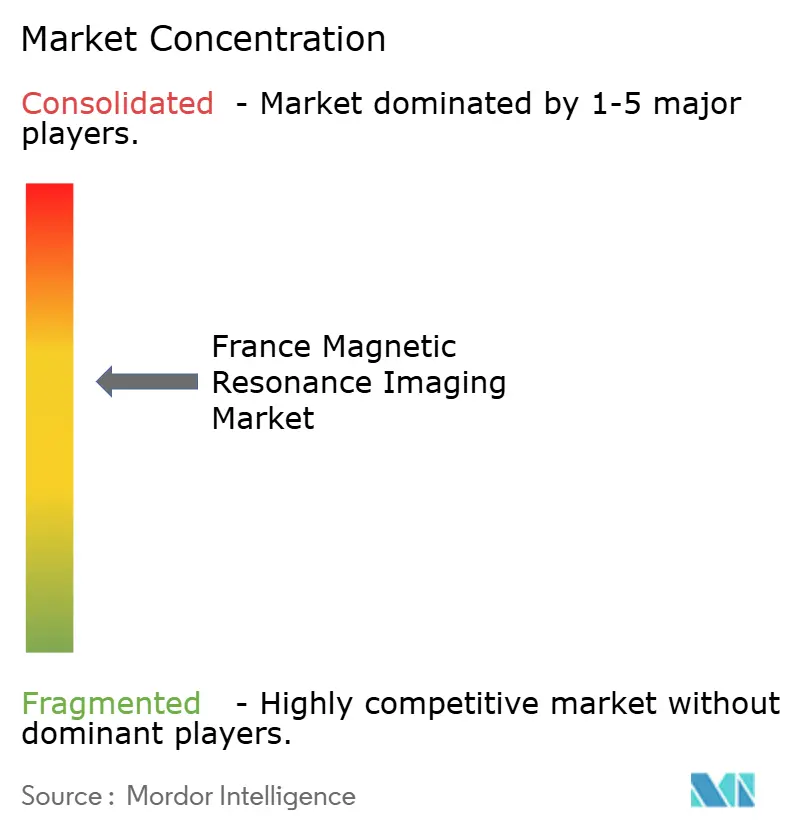
| Market Concentration | Medium |
Major Players *Disclaimer: Major Players sorted in no particular order Image © Mordor Intelligence. Reuse requires attribution under CC BY 4.0. | |
France Magnetic Resonance Imaging Market Analysis by Mordor Intelligence
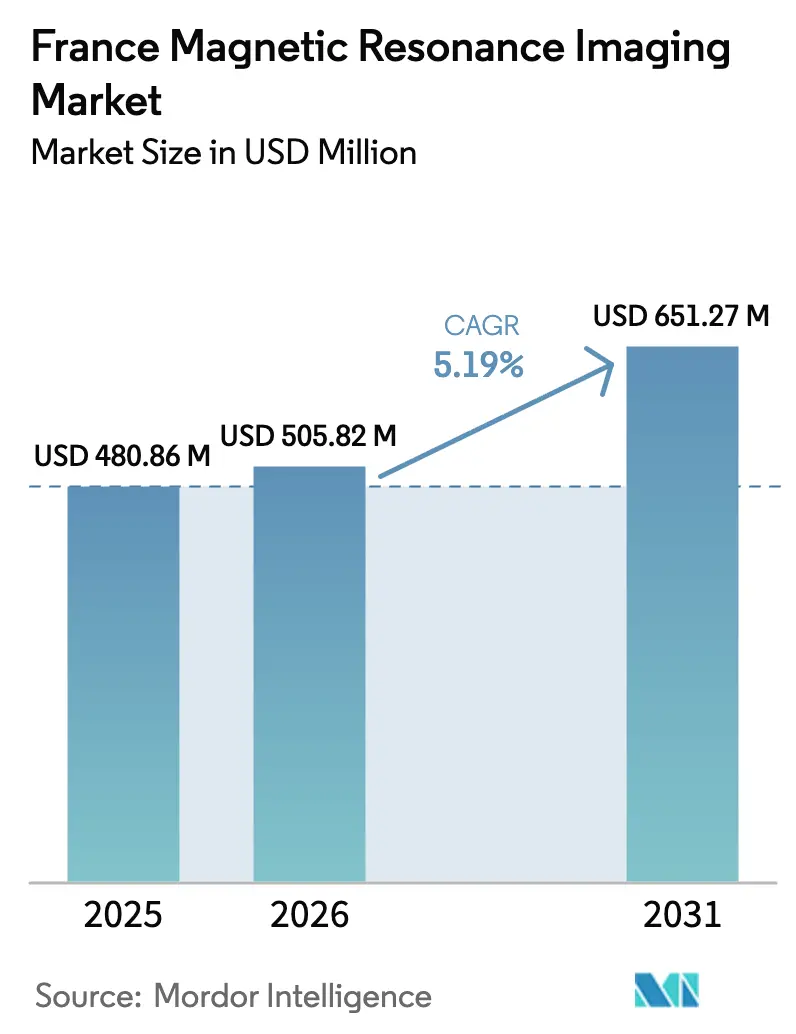
The France magnetic resonance imaging market size is expected to grow from USD 480.86 million in 2025 to USD 505.82 million in 2026 and is forecast to reach USD 651.27 million by 2031 at 5.19% CAGR over 2026-2031. This sustained rise reflects the country’s national commitment to upgrade its installed base of 1,312 scanners, leverage EUR 95 million (USD 104.5 million) in France 2030 imaging funding, and accelerate AI integration in clinical workflows. Rapid deployment of virtually helium-free systems, local production of MRI units at GE’s Buc site, and reforms that mandate outpatient capacity are reshaping procurement cycles and service delivery models. Vendor financing programs, private-equity consolidation of radiology groups, and a robust pipeline of ultra-high-field research platforms further reinforce the growth trajectory of the France magnetic resonance imaging market. Replacement demand is accelerating because France is one of only four European nations now meeting COCIR’s golden-rule age profile, which specifies that at least 60% of scanners be under five years old.
Key Report Takeaways
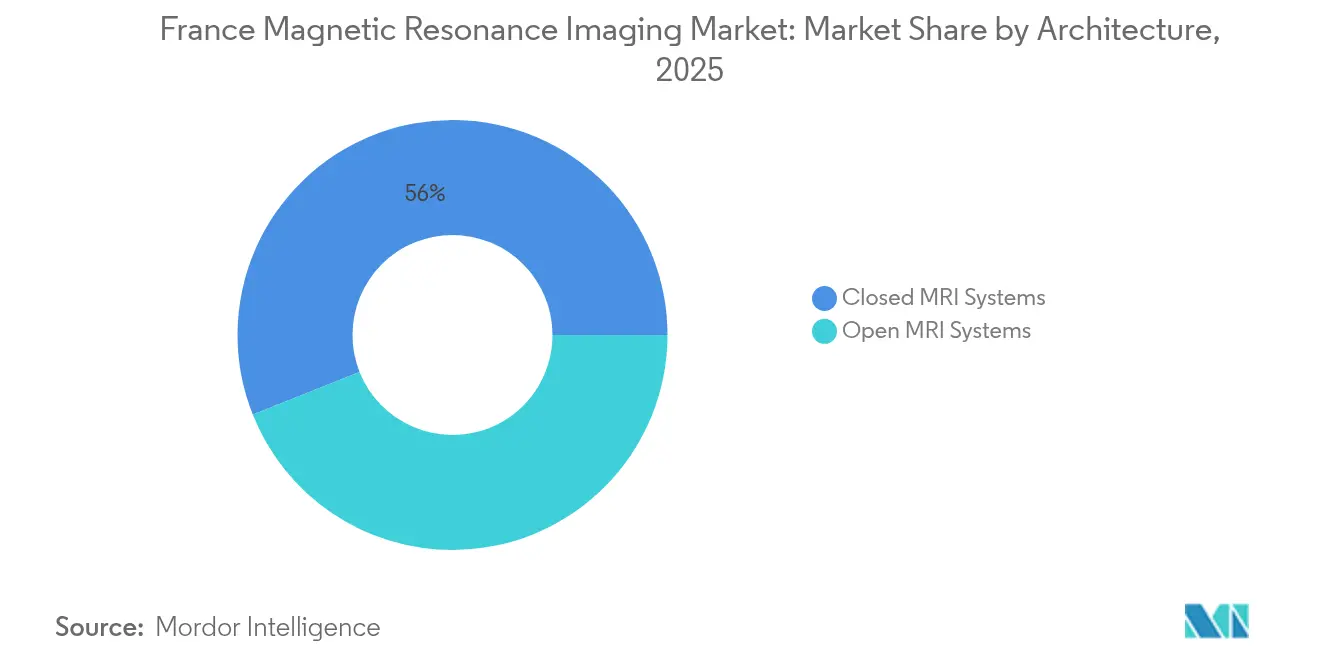
- By architecture, closed systems led with 56.03% France magnetic resonance imaging market share in 2025. Open systems are projected to record the fastest 7.39% CAGR through 2031.
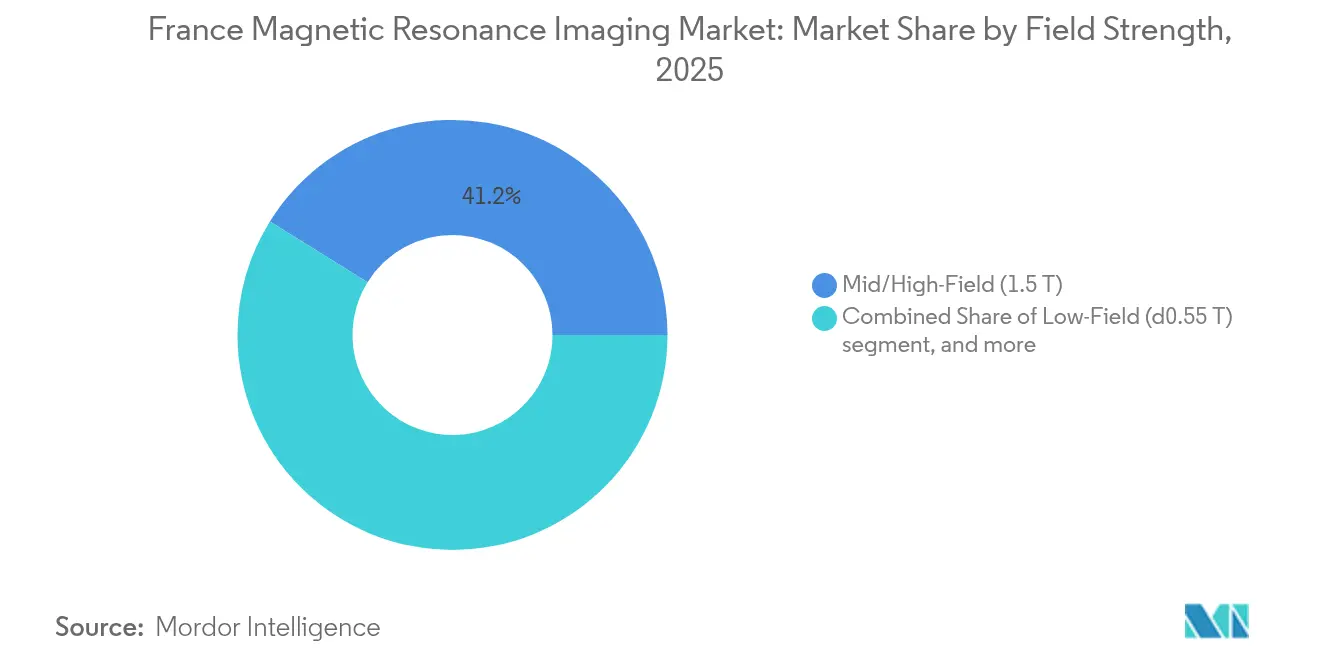
- By field strength, mid/high-field 1.5 T units accounted for 41.15% of the France magnetic resonance imaging market size in 2025. Low-field systems (≤0.55 T) are forecast to advance at a 6.69% CAGR between 2026-2031.
- By application, neurology captured 30.29% of the France magnetic resonance imaging market in 2025. Cardiology is poised for the highest 6.34% CAGR to 2031.
Note: Market size and forecast figures in this report are generated using Mordor Intelligence’s proprietary estimation framework, updated with the latest available data and insights as of 2026.
France Magnetic Resonance Imaging Market Trends and Insights
Drivers Impact Analysis*
| Driver | (~) % Impact on CAGR Forecast | Geographic Relevance | Impact Timeline |
|---|---|---|---|
| Rapid rise in cancer & neuro-degenerative disease burden | +1.2% | Nationwide, aging regions | Long term (≥ 4 years) |
| Growing adoption of 3 T scanners in French university hospitals | +0.8% | CHU networks, major metros | Medium term (2-4 years) |
| National AI-for-imaging strategy under “France 2030” funding | +1.0% | Île-de-France & Rhône-Alpes R&D hubs | Medium term (2-4 years) |
| Expansion of outpatient MRI capacity via 2024 social-security reforms | +0.9% | Underserved territories | Short term (≤ 2 years) |
| Vendor financing programs for private clinics | +0.7% | Regional private sector | Short term (≤ 2 years) |
| Aging installed base reaching end-of-life triggers replacement wave | +1.1% | Nationwide, scanners > 10 years | Medium term (2-4 years) |
| Source: Mordor Intelligence | |||
Rapid Rise in Cancer & Neuro-Degenerative Burden
France’s aging population is escalating clinical demand for high-resolution neurological and oncological imaging. Expanded national screening protocols now rely on MRI for early tumor detection and disease staging. The Iseult 11.7 T platform at CEA produced first-in-human brain scans in 2024, demonstrating sub-millimeter resolution that improves hippocampal atrophy measurement and iron mapping for Parkinson’s diagnostics[1]. University hospitals are therefore scaling MRI slots dedicated to neuro-oncology pathways, integrating diffusion and perfusion sequences that shorten diagnostic timelines. Steady gains in five-year cancer survival rates further elevate longitudinal monitoring volumes. Together, these demographic and clinical pressures intensify scanner utilization and accelerate replacement demand across the France magnetic resonance imaging market.
Growing Adoption of 3 T Scanners in University Hospitals
Academic centers including CHU Reims and CHU Nancy are moving from 1.5 T to 3 T platforms to unlock advanced research protocols. Higher field strength improves signal-to-noise ratios, enabling functional MRI, diffusion tensor imaging, and proton spectroscopy that previously required referral to national research facilities[2]. France 2030 funds earmark capital for this upgrade cycle, while vendor value partnerships bundle equipment, training, and life-cycle servicing to offset upfront costs. Early adopters report sharper vascular delineation in stroke work-ups and reduced slice thickness in musculoskeletal exams, reinforcing the clinical case for 3 T migration. The resulting rise in high-complexity exams widens reimbursement differentials between university hospitals and private clinics, adding momentum to the France magnetic resonance imaging market expansion.
National AI-for-Imaging Strategy Under France 2030 Funding
Public grants are fueling French AI start-ups that automate image reconstruction, lesion detection, and workflow triage. The ImaSpiiR-X consortium secured EUR 18.2 million (USD 20.0 million) to commercialize spectral MRI advances, while Gleamer’s 2025 acquisition of Pixyl and Caerus Medical brings CE-marked neuroinflammatory and lumbar spine algorithms into clinical practice. Philips’ SmartSpeed software, compatible with 97% of sequences, delivers up to 3× faster scans and 65% higher spatial resolution on existing scanners, expanding throughput without new hardware. These innovations speed reporting, cut repeat exams, and free scarce radiologist capacity, directly influencing capital planning at hospital and clinic level.
Expansion of Outpatient MRI Capacity Via 2024 Reforms
Social-security legislation effective January 2024 prescribes new authorizations for ambulatory imaging sites to curb hospital backlog. Streamlined approvals reduced median licensing time from 12 to 6 months according to the Ministry of Health, triggering bids for mobile trailers and modular suites serving medical deserts in the North and Center-West. Networks such as IMADIS Groupe operate 24/7 teleradiology hubs that interpret scans from 300 partner establishments, reinforcing rural deployment feasibility. Accelerated outpatient penetration spreads scan volumes, sustaining the France magnetic resonance imaging market even as procedure tariffs undergo annual downward pressure.
Restraints Impact Analysis*
| Restraint | (~) % Impact on CAGR Forecast | Geographic Relevance | Impact Timeline |
|---|---|---|---|
| Capped public-hospital budgets & DRG-linked tariffs | −0.8% | Nationwide public sector | Long term (≥ 4 years) |
| Lengthy ANSM approval cycle for novel field strengths | −0.4% | National, innovation hubs | Medium term (2-4 years) |
| Persistent shortage of MRI technologists in regional France | −0.5% | Regional & rural areas | Short term (≤ 2 years) |
| High procurement cost vs. CT & ultrasound alternatives | −0.6% | Nationwide | Medium term (2-4 years) |
| Source: Mordor Intelligence | |||
Capped Public-Hospital Budgets & DRG-Linked Tariffs
Public facilities spend only 5% of operating income on capital investment, down from 10% in 2009, limiting MRI fleet renewal. The EUR 1.3 billion technical forfait allotted to MRI exams faces annual cost-containment reviews by Assurance Maladie, squeezing per-scan reimbursement. Hospital CFOs therefore delay purchases or pivot to vendor-financed value partnerships, lengthening procurement cycles. Competitive tension rises because private clinics can recover costs faster under fee-for-service models, siphoning complex cases. These structural funding barriers dampen large volume orders, tempering the France magnetic resonance imaging market CAGR despite robust clinical demand.
Lengthy ANSM Approval Cycle for Novel Field Strengths
Ultra-high-field MRI systems undergo 18-month safety dossiers at ANSM before first-in-patient use. The Iseult 11.7 T project required staged volunteer protocols and granular electromagnetic modeling to satisfy regulator thresholds[3]. Vendors must produce additional biocompatibility data, elevating launch costs and pushing break-even horizons. AI-driven image-post-processing apps also navigate a Class IIb MDR pathway, stretching go-to-market timetables. These prolonged approvals defer revenue from novel platforms and moderate the pace of technology turnover within the France magnetic resonance imaging market.
*Our forecasts treat driver/restraint impacts as directional, not additive. The impact forecasts reflect baseline growth, mix effects, and variable interactions.
Segment Analysis
By Architecture: Diagnostic Precision Sustains Closed-System Leadership
Closed scanners anchored 56.03% of the France magnetic resonance imaging market in 2025 thanks to superior homogeneity and high channel coils that satisfy neurology, oncology, and musculoskeletal protocols. Closed units now incorporate BlueSeal and DryCool helium-free designs, which reduce energy consumption and help mitigate global helium shortages. These sustainability gains influence hospital tenders, which score equipment based on carbon criteria. Open platforms remain niche but gather momentum with a 7.39% CAGR because patient comfort improves completion rates among claustrophobic and pediatric cohorts. Outpatient centers in Provence and Brittany advertise panoramic 0.4 T systems as a differentiator, capturing referrals from general practitioners. The France magnetic resonance imaging market size for open architecture will therefore expand while coexistence persists, reflecting complementary—not substitutive—clinical use-cases.
Second-generation open units deploy AI-based reconstruction that compensates for lower field strength, closing the quality gap with closed systems. Portable intraoperative models further extend open design into hybrid operating rooms, adding functional values rather than siphoning demand from mainstream diagnostic suites. Closed scanners, however, retain the premium tier of France magnetic resonance imaging market share because they support 3 T upgrades, spectroscopy adjuncts, and parallel transmit coils essential for clinical research trials.

By Field Strength: Mid-Field Dominance Meets Low-Field Innovation
Mid/high-field 1.5 T platforms command 41.15% France magnetic resonance imaging market share, offering a balance of cost, throughput, and reimbursements aligned with routine neurology and abdominal imaging. Investment priority remains on refurbishing these workhorses with AI acceleration packages and dual-energy coils, extending asset life and lowering per-exam consumables. Very-high-field 3 T adoption pushes ahead in 15 university hospitals, supporting advanced connectome mapping and tractography studies tied to EU Horizon grants.
Low-field technology is the fastest riser, clocking a 6.69% CAGR, because 0.55 T mobile trailers and hyper-portable 0.05 T bedside units enter emergency workflows. Proof-of-concept deployments in rural Normandy enable stroke triage without patient transfer, meeting reform targets for distance imaging access. Service contracts guarantee remote calibration, mitigating historical maintenance hesitancy among small clinics. Over the forecast horizon, low-field share growth widens the overall France magnetic resonance imaging market size by unlocking new service sites rather than cannibalizing hospital volumes.
By Application: neurology retains lead while cardiology accelerates
Neurology held 30.29% of examinations in 2025, benefiting from structured Alzheimer’s screening pathways that reimburse volumetric hippocampal assessment. High adoption of diffusion tensor and multi-band functional protocols drives repeat scanning and research partnerships with AI start-ups that label white-matter lesions. Oncology remains second, but mix shifts toward whole-body diffusion imaging for metastatic surveillance, shortening CT dependency in treatment cycles. Musculoskeletal exams ride the wave of sports medicine demand, especially in the lead-up to the 2026 Winter Olympics bid, which bolsters private imaging-center footfall.
Cardiology grows fastest at 6.34% CAGR because compressed-sense sequences reduce breath-hold requirements, making MRI accessible for heart-failure patients previously sent to CT. French academic societies now endorse MRI as first-line for arrhythmogenic right ventricular cardiomyopathy, spurring scan referrals. Hepatology units adopt liver-fat quantification protocols, showcasing MRI’s expanding abdominal footprint. Collectively, this diversified application suite sustains rising throughput and strengthens the revenue base of the France magnetic resonance imaging market.
Regulatory Landscape
Magnetic resonance imaging (MRI) systems in France are governed by the EU Medical Device Regulation (EU) 2017/745 (MDR), with the Agence nationale de securite du medicament et des produits de sante (ANSM) serving as the national competent authority for market surveillance, vigilance, and operator/device registration obligations. For innovative MRI platforms and related software, including AI-enabled post-processing, manufacturers need to complete conformity assessment and meet French vigilance expectations, and novel configurations can face longer safety and documentation review timelines before routine clinical deployment.
Market access is also shaped by reimbursement and assessment pathways. The Haute Autorite de Sante (HAS), including CNEDiMTS, evaluates clinical benefit and can assess MRI compatibility of implantable medical devices to support safe use in patient pathways. Pricing for reimbursed devices is set via the interministerial CEPS process, and inclusion on the LPPR is a lever for broader adoption within the national health insurance environment.
Value Chain Analysis
France's MRI value chain runs from upstream magnet, gradient, RF coil, and electronics supply to system integration by global OEMs, followed by siting, shielding, installation, commissioning, and multi-year service contracts. Local and regional industrial footprints support configuration and delivery into France, while domestic medtech participation is reflected by French manufacturers such as DMS Imaging, which integrates software platforms, for example ADAM, across its imaging lines. This points to closer coupling of hardware and workflow software in procurement decisions.
On the demand side, purchasing and contracting routes differ by care setting. Public hospitals and university centers frequently buy through centralized or group purchasing channels such as UGAP, Resah, and UniHA, then pair capital equipment awards with lifecycle maintenance and training. Private imaging centers and radiology networks combine direct OEM contracting with financing and service bundles, while teleradiology hubs and PACS or workflow integrators add an additional layer of software selection and interoperability requirements across multi-site deployments.
Competitive Landscape
Global manufacturers establish their market presence through integrated offerings that combine hardware, AI, and financing. Siemens Healthineers leads through long-horizon value partnerships, securing life-cycle services that ensure uptime and facilitate research collaboration. GE HealthCare’s Buc manufacturing line, inaugurated in 2024, yields an 84% lower delivery carbon footprint to EU buyers and supports agile configuration for site-specific shielding constraints. Koninklijke Philips N.V. scales BlueSeal helium-free magnets and SmartSpeed AI, positioning sustainability and speed as procurement differentiators. Collectively, these three suppliers captured approximately 64% of the French magnetic resonance imaging market share in 2024.
Tier-two vendors pursue niche strategies. Canon Medical advances rapid-sequence cardiac protocols on 1.5T Vantage Orian units, appealing to private clinics seeking cardiology growth. Esaote promotes open 0.4 T systems for veterinary and extremity imaging, tapping non-hospital budgets. Start-ups such as Hyperfine eye CE approval for 0.064 T portable systems, yet long ANSM review cycles defer revenue realization.
AI firms shape competitive parameters. Gleamer’s acquisitions assemble an MRI-centric toolbox that bundles neuro and spine triage algorithms into a single SaaS license. French firm Incepto curates a marketplace of FDA-cleared apps, embedding these in PACS workflows and sharing subscription income with radiology groups. Service differentiators therefore pivot from pure magnet specifications to total-cost-of-ownership propositions, reinforcing integrated model dominance.
France Magnetic Resonance Imaging Industry Leaders
-
GE Healthcare
-
Koninklijke Philips NV
-
Esaote SpA
-
Canon (Canon Medical Systems Corporation)
-
Siemens Healthineers
- *Disclaimer: Major Players sorted in no particular order
Market Opportunities and Future Outlook
The most investable opportunity is where funding programs and modernization mandates expand capacity beyond large hospital sites. In July 2026, France allocated about EUR 384 million of FMIS funding to Regional Health Agencies (ARS) for investment, including hospital digitization and property modernization, which creates a visible financing channel that can support MRI suite upgrades when paired with procurement vehicles used by public providers. This also increases demand for integration services, cybersecurity, and interoperability work as sites connect scanners, PACS, and AI tools.
Innovation-enabled adoption pathways create whitespace for newer MRI configurations and AI applications aimed at improving throughput and patient experience without waiting for immediate full-scale reimbursement permanence. Under the Forfait Innovation mechanism, time-bound reimbursement (2 to 3 years) supports pilots that pair faster acquisition and reconstruction software with workflow triage and specialty coils across neurology, oncology, and cardiology pathways. Industry efforts to manufacture and industrialize imaging solutions in France, including DMS Imaging participation in government-backed industrial projects, further align with sustainability-led procurement criteria and reinforce the service, installation, and lifecycle-support layer around new deployments.
Recent Industry Developments
- May 2026: GE HealthCare announced next-generation 1.5T helium-free MRI technology and Sonic DL AI acceleration at ISMRM 2026. This strengthens GE's position in France through sustainability and workflow optimization features.
- May 2026: Philips announced a partnership with The Walt Disney Company to integrate Disney themed immersive environments into the Philips Ambient Experience for MRI, deployed in French healthcare facilities. The collaboration differentiates Philips in the French market by enhancing patient comfort and experience in MRI workflows.
- February 2026: Philips announced the availability of the InkSpace Imaging Snuggle pediatric body coil for its 3.0T MRI systems. The addition expands pediatric imaging capabilities in France, supporting growth in private clinics and hospitals.
Research Methodology Framework and Report Scope
Market Definition and Coverage
For this study, the market covers the value of MRI systems sold and installed in France, including equipment-related revenue linked to new purchases and replacement cycles across care settings.
Scope exclusions: We exclude imaging services revenue, contrast media, and standalone software-only tools that are not sold as part of an MRI system purchase.
Segmentation Overview
- By Architecture
- Closed MRI Systems
- Open MRI Systems
- By Field Strength
- Low-Field (≤0.55 T)
- Mid/High-Field (1.5 T)
- Very-High-Field (3 T)
- Ultra-High-Field (7 T +)
- By Application
- Neurology
- Oncology
- Musculoskeletal
- Cardiology
- Gastroenterology
- Other Applications
Data Sources, Market Sizing, and Validation
Desk Research
Desk research is used to set the France-specific context and to anchor assumptions on how MRI demand behaves in the country. We reviewed public healthcare statistics and capacity signals, such as French Ministry of Health publications, INSEE health and demographics tables, OECD health data, and Eurostat datasets that can indicate capital spend and hospital activity. We also checked medical-device and radiology sources, including professional association releases and guidance notes, to understand typical equipment refresh cycles and shifts in radiology care pathways.
To translate those signals into a usable market model, we pulled supporting information from company annual reports, investor decks, and reputable press coverage on hospital procurement and private imaging center expansion. We then cross-checked selected inputs using paid subscriptions for company financials and intelligence, and we used patent databases when product cycle timing needed clarification. The sources mentioned above are illustrative, and we also referenced other public and subscription sources for data collection, validation, and research clarification.
Primary Interviews and Surveys
Primary work focused on validating what secondary data cannot show clearly, especially current buying triggers, replacement timing, and typical price bands by scanner class. We spoke with a mix of hospital procurement voices, imaging-center operators, distributors and service partners, and clinical stakeholders who influence modality choice, targeting the main demand pockets across France.
The interview feedback was used to confirm utilization trends, expected funding timing, and the practical split between new site additions versus replacements, before finalizing forecast assumptions.
Distribution of primary research fieldwork respondents
| Company type | Respondent position |
|---|---|
| Top tier: 28% | CXOs: 19% |
| Mid tier: 51% | Functional/Unit leaders: 31% |
| Smaller Players: 21% | Managers: 50% |
Market-Sizing & Forecasting
Sizing starts from a top-down build that reconstructs national MRI equipment demand using France-specific capacity and usage signals, then translates that demand into value using realistic price ladders by field strength and system type. In practice, the model relies on the installed base trend, the expected replacement share (driven by scanner age), procurement cadence in public hospitals, expansion in outpatient imaging networks, and typical service attachment at the time of system sale. Because pricing shifts can change the total quickly, we also monitor factors such as helium management design changes, upgrade intensity, and mix shifts toward higher-field systems.
After the headline value is formed, we corroborate it with selective bottom-up checks, including sampled ASP times estimated unit volumes by class, plus channel conversations that help bound unit shipments for the year. Where the unit picture is uncertain, we use conservative ranges and then tighten them through follow-up validation with interviewees. For forecasting, we run scenarios around funding release timing, replacement urgency, and adoption pace for advanced systems, and we select the final path when expert views align with observed procurement signals.
Data Validation & Update Cycle
Outputs are validated through multiple checkpoints to keep final totals aligned with real-world signals. We test year-to-year changes against independent indicators, such as changes in the installed base, procurement announcements, and broader healthcare investment patterns, and then we investigate outliers before internal sign-off.
A second analyst review is completed to confirm calculations, scope boundaries, and currency handling, and assumptions are revisited if interview feedback or public data points do not fit the draft model. Reports are refreshed annually, with interim updates when material events occur, such as policy shifts or major funding programs. Before delivery, an analyst runs a fresh pass to ensure the latest updated view is reflected in the final results.
Mordor Intelligence's France Magnetic Resonance Imaging Market Sizing Compared With Other Published Estimates
Published market numbers for MRI in France can differ even when they appear to cover the same topic, because the scope boundary is not always consistent and the pricing logic is handled differently. We keep each assumption tied to a traceable demand signal, and we validate it using expert feedback so the estimate does not drift.
The main gap drivers usually come from what is counted as market revenue (systems-only versus systems plus long-term service), how replacement demand is timed, and how ASP changes are modeled across field strengths. Some publications also apply broad growth rates to France without checking local procurement timing, and currency conversion timing can introduce a spread when the reference year is not aligned.
Benchmark comparison
| Source | Market Size | Gaps in Research Methodology |
|---|---|---|
| Mordor Intelligence | USD 480.86 M (2025) | |
| Regional Consultancy A | USD 250.11 M (2026) | The estimate appears to reflect a narrower equipment revenue pool and may undercount replacement-led demand by applying a limited unit base and lower average system prices for the year. |
| Industry Publisher B | USD 422.02 M (2035) | The long-range figure likely relies on steady growth assumptions and simplified ASP progression, with limited visibility on France-specific funding cycles and mix shifts across field strengths. |
Installed base signals, scanner age profile, and procurement timing checks are what keep Mordor Intelligence tied to a realistic replacement-plus-additions demand pool, which then gets priced using system-class mix rather than a single blended ASP. The spread across published figures is mainly explained by scope boundaries and how quickly replacement need is translated into annual purchases, and our steps make those differences easier to trace and repeat.
Key Questions Answered in the Report
How large is the French MRI sector in 2026?
It is valued at USD 505.82 million and is forecast to climb to USD 651.27 million by 2031.
What growth rate is expected for MRI equipment demand in France through 2031?
The segment is projected to expand at a 5.19% CAGR over the 2026-2031 period.
Which clinical use accounts for the highest number of MRI scans in France?
Neurology leads with 30.29% of examinations, driven by nationwide neuro-degenerative screening programs.
Why are low-field portable MRI systems gaining traction across France?
²0.55 T units enable point-of-care imaging in rural areas, meeting reform goals to reduce geographic access gaps while lowering installation costs.
How do 2024 social-security reforms affect outpatient MRI capacity?
Streamlined licensing and funding incentives are fueling new ambulatory imaging centers, easing hospital backlogs and improving appointment times.
Which suppliers hold the largest share of French MRI equipment sales?
Siemens Healthineers, GE HealthCare, and Philips together account for roughly 64% of national scanner installations.