
France Geospatial Analytics Market Size and Share
Market Overview
| Study Period | 2020 - 2031 |
|---|---|
| Forecast Data Period | 2026 - 2031 |
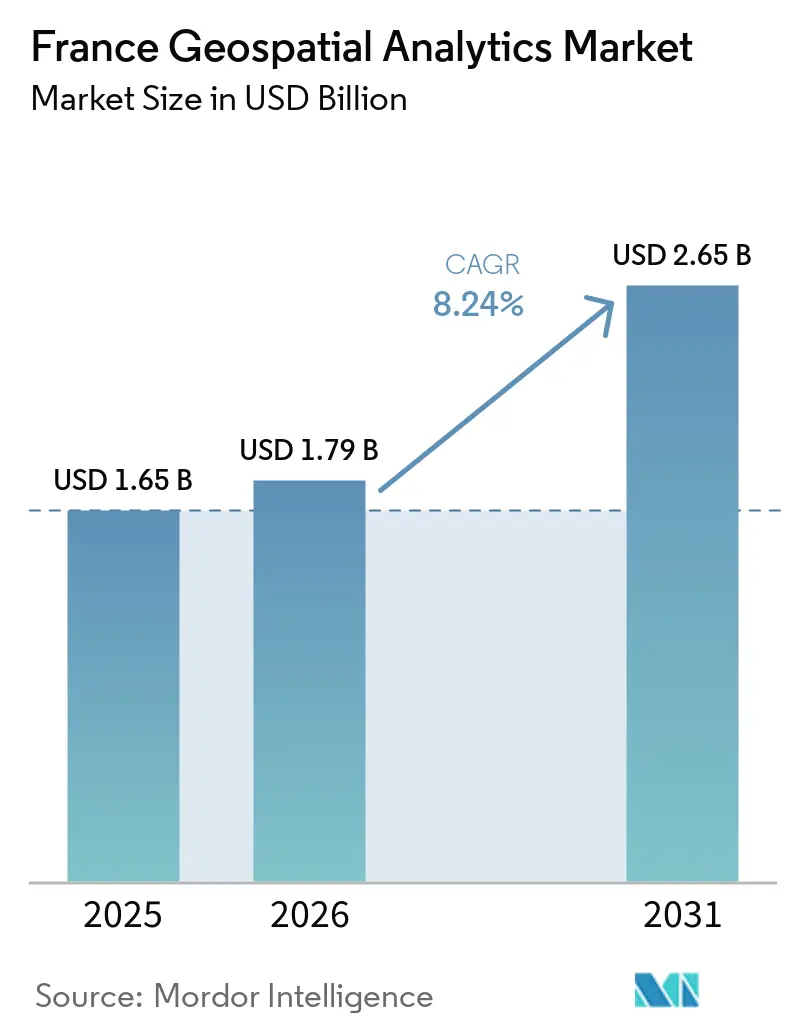
| Base Year Market Size (2025) | USD 1.65 Billion |
| Market Size (2026) | USD 1.79 Billion |
| Market Size (2031) | USD 2.65 Billion |
| Growth Rate (2026 - 2031) | 8.24 % |
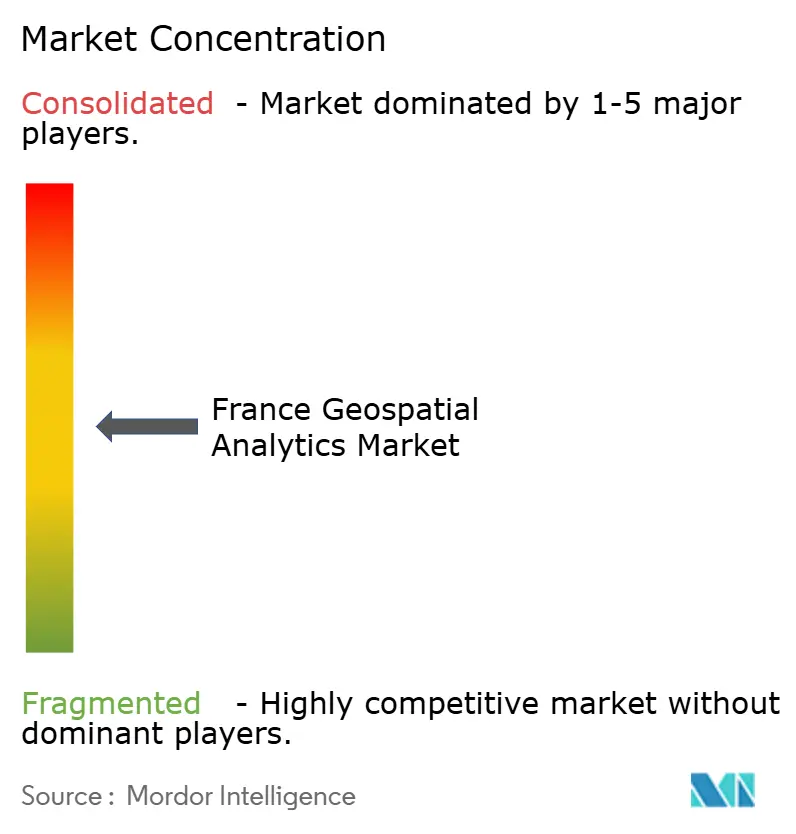
| Market Concentration | Medium |
Major Players *Disclaimer: Major Players sorted in no particular order Image © Mordor Intelligence. Reuse requires attribution under CC BY 4.0. | |
France Geospatial Analytics Market Analysis by Mordor Intelligence
The France Geospatial Analytics Market size is expected to grow from USD 1.65 billion in 2025 to USD 1.79 billion in 2026 and is forecast to reach USD 2.65 billion by 2031 at 8.24% CAGR over 2026-2031.
France benefits from a long-standing space pedigree, deep public funding and strict digital-sovereignty rules that direct spending toward domestic suppliers. The launch of the CSO-3 military observation satellite in March 2025 strengthens national imagery independence while expanding high-resolution data licensing opportunities to European allies.[1]Airbus Communications, “CSO-3 Successfully Enters Orbit,” airbus.comMeanwhile, the EUR 2 billion Fonds vert drives demand for spatial monitoring tools that validate project eligibility, especially in sectors required to file biodiversity impact reports from 2026.[2]Government of France, “Fonds vert Budget Allocation 2025,” gouvernement.fr Rapid 5G rollout under the “Réseaux du Futur” program pushes the France geospatial analytics market toward real-time sensor fusion, and the digital-twin initiative led by IGN and Cerema encourages city governments to embed location intelligence inside every urban-planning workflow. Capital injections and an export-friendly satellite fleet give local vendors an edge as the country positions itself as a continental hub for sovereign spatial intelligence.
Key Report Takeaways
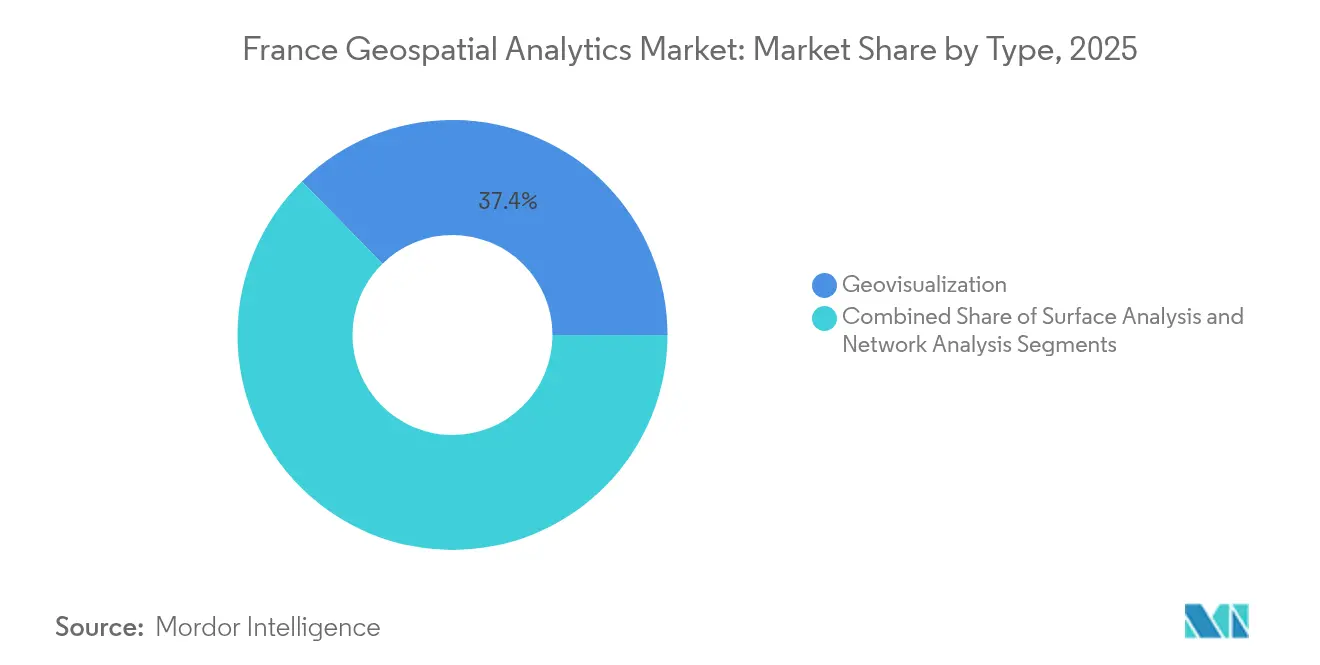
- By type, geovisualization led with 37.35% of France geospatial analytics market share in 2025, while network analysis is projected to grow at a 13.15% CAGR through 2031.
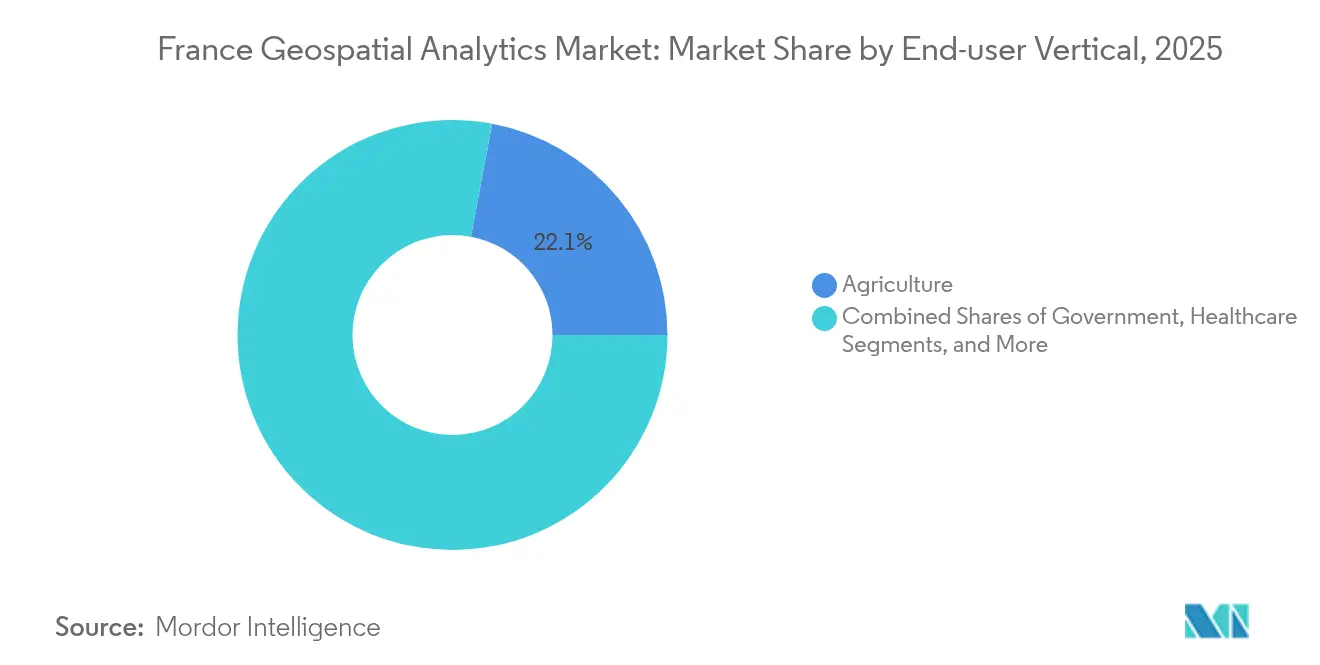
- By end-user vertical, agriculture held 22.05% of France geospatial analytics market share in 2025; automotive and transportation are forecast to expand at a 14.21% CAGR to 2031.
Note: Market size and forecast figures in this report are generated using Mordor Intelligence’s proprietary estimation framework, updated with the latest available data and insights as of 2026.
Projections can easily extend beyond country and regional trends as they are defined by movement across the full international system. Mordor Intelligence's worldwide geospatial analytics market outlook captures this forward trajectory.
France Geospatial Analytics Market Trends and Insights
Drivers Impact Analysis*
| Driver | (~) % Impact on CAGR Forecast | Geographic Relevance | Impact Timeline |
|---|---|---|---|
| Smart city and mobility funding surge | +2.1% | National; early gains in Paris, Lyon, Marseille | Medium term (2-4 years) |
| Defense satellite constellation (CSO-3) demand | +1.8% | National; spillover to EU partners | Long term (≥ 4 years) |
| ESG and Green-Budget compliance mandates | +1.4% | National; industrial regions | Short term (≤ 2 years) |
| 5G-IoT real-time data streams | +1.2% | Urban centers; expanding rural | Medium term (2-4 years) |
| Mandatory biodiversity impact reporting (2026) | +0.9% | National; protected areas | Short term (≤ 2 years) |
| Precision-viticulture platform adoption | +0.7% | Bordeaux, Burgundy, Loire Valley | Medium term (2-4 years) |
| Source: Mordor Intelligence | |||
Smart city and mobility funding surge
France is channeling EUR 475 million into road construction and a further EUR 294 million into road maintenance in 2025.[3]Sénat Budget Office, “Investissements routiers 2025,” senat.fr Municipalities receive these funds only if they can document efficiency gains, which elevates demand for geospatial dashboards that track pavement condition, traffic flow, and carbon footprint in near real time. Istres’ private 5G network demonstrates how geospatial analytics cuts municipal operating costs by 40% while improving emergency-response routing accuracy.[4]Ericsson Press Release, “Private 5G Network Deployed in Istres,” ericsson.com The national digital-twin platform, spearheaded by IGN, Cerema, and Inria, lets cities simulate flood, heat-island, and traffic scenarios, turning spatial data into predictive asset-management tools. France’s commitment to interoperability standards ensures repeatable deployments across 35,000 communes, creating durable revenue streams for vendors whose software supports the new schemas. As volumes of LiDAR, CCTV, and sensor data grow, the France geospatial analytics market will pivot from descriptive mapping to anticipatory decision support.
Defense satellite constellation (CSO-3) demand
The EUR 795 million CSO program supplies 35 cm imagery that meets NATO strategic-intelligence criteria while remaining under French command. Data commercialization clauses permit secure distribution to trusted European partners, generating an export channel that did not exist before. Ukraine’s 2025 contract with a Safran subsidiary to fuse CSO data into its defense-planning platform underscores the constellation’s market potential beyond France. Downstream, insurers, utilities and foresters gain access to a level of spatial precision previously reserved for defense, expanding applications for geospatial imagery analytics. The constellation integrates with the C40S space-domain-awareness system, allowing AI algorithms to flag anomalies and send real-time alerts to both civil and military users. Each new analytic use case expands transaction volume, cementing satellite data as the backbone of the France geospatial analytics market.
ESG and Green-Budget compliance mandates
Environmental rules tighten every year. From 2026, listed companies must report biodiversity impact with georeferenced evidence. Geospatial platforms automate site-level monitoring, overlay protected-species databases and generate auditable compliance reports, cutting manual audit costs by up to 60% for large industrials. The Carb-Chaser constellation, managed by Thales Alenia Space, will deliver certified CO₂ plume measurements that regulators accept as legal proof. France also invested EUR 53 million in BRGM to map strategic minerals, a move that requires high-resolution topographic and subsurface data. These public projects reinforce commercial trust in domestic geospatial infrastructure, accelerating adoption across heavy industry and finance.
5G-IoT real-time data streams
The Réseaux du Futur program sets aside EUR 65 million for 5G-Advanced and 6G testbeds Edge-enabled antennas feed imagery, GNSS readings and sensor outputs to cloud nodes with sub-10 ms latency, letting farmers monitor soil-moisture patches and city officials track bike-lane occupancy. LTE-M deployments already support low-power devices that transmit geolocated measurements for years on a single battery. The combination of high-bandwidth backhaul and energy-efficient edge devices moves the France geospatial analytics market into continuous-monitoring business models where clients pay for streaming situational awareness rather than one-off map layers. Telecom carriers and pure-play analytics firms now partner to embed spatial AI into their service catalogs.
Restraints Impact Analysis*
| Restraint | (~) % Impact on CAGR Forecast | Geographic Relevance | Impact Timeline |
|---|---|---|---|
| High integration and migration cost | −1.6% | National; enterprise sector | Short term (≤ 2 years) |
| Geo-data-science talent shortage | −1.3% | National; Paris and Lyon | Long term (≥ 4 years) |
| Municipal data-standard fragmentation | −0.9% | Regional; varies by level | Medium term (2-4 years) |
| Cloud-sovereignty hosting limits | −0.7% | National; cross-border deals | Medium term (2-4 years) |
| Source: Mordor Intelligence | |||
High integration and migration cost
A full-stack geospatial rollout can exceed EUR 500,000 once data-ingest pipelines, sensor gateways and training programs are factored in. Many small and mid-sized firms delayed projects after construction output fell 8.4% in Q3 2024, showing the sensitivity of spatial-IT budgets to macro conditions. Legacy resource-planning software often lacks spatial fields, forcing companies to purchase middleware and hire specialist integrators. This increases total cost of ownership and makes the payback period less attractive when compared to cloud CRM or ERP investments. Until plug-and-play connectors mature, high entry costs will temper growth in the France geospatial analytics market.
Geo-data-science talent shortage
Demand for analysts who can combine satellite-imagery classifiers with GPU-based inference far outstrips supply. Universities are updating curricula, yet out-flow is limited to a few hundred graduates a year, insufficient to fill open requisitions at Paris-Saclay, Toulouse and Sophia Antipolis tech clusters. Companies like Thales run internal bootcamps, but the ramp-up time delays project launches. Scarcity drives salaries upward and pushes some projects offshore, which conflicts with data-sovereignty mandates. The talent gap therefore subtracts momentum from the France geospatial analytics market until broader STEM initiatives produce larger cohorts.
*Our forecasts treat driver/restraint impacts as directional, not additive. The impact forecasts reflect baseline growth, mix effects, and variable interactions.
Segment Analysis
By Type: Geovisualization Dominates Through Interactive Intelligence
Geovisualization held 37.35% of France geospatial analytics market share in 2025, reflecting public agencies’ need for map-centric dashboards that non-technical staff can interpret quickly. Budget officers use color-coded layers to rank infrastructure risk, while vineyard managers monitor plant stress on a mobile heatmap. The France geospatial analytics market size for geovisualization is projected to grow at 7.12% CAGR as 3D engines and browser-based point-cloud renderers remove workstation limits. Vendors embed accessibility features such as voice navigation and contrast toggles, supported by research from Université Claude Bernard Lyon 1 that demonstrated mobile geovisualization benefits for users with visual impairments.
Network analysis is the fastest-growing sub-segment at a 13.15% CAGR through 2031. This surge aligns with expanded electric-vehicle-charger deployment, where planners evaluate optimal station spacing and grid impact. Surface analysis continues to have steady demand from precision-agriculture and mining clients who require terrain-aware fertilizer plans or blast-risk contours. The combined momentum across sub-segments signals that the France geospatial analytics market will broaden from static map production toward analytical workflows that integrate routing, proximity and elevation parameters inside a single interface.



By End-user Vertical: Agriculture Leads While Automotive Accelerates
Agriculture accounted for 22.05% of France geospatial analytics market size in 2025. Viticulture projects use multi-spectral imagery plus IoT soil probes to fine-tune irrigation, saving water and improving grape quality. Farmers in Bordeaux and Burgundy link plot-level NDVI trends to yield forecasts, then price futures more accurately on commodity exchanges. Aerial spraying firms load prescription maps into autonomous drones, demonstrating how geospatial analytics now influences both upstream crop decisions and downstream trade functions.
The automotive and transportation vertical will experience a 14.21% CAGR between 2026 and 2031. High-definition base maps, centimeter-grade GNSS corrections, and roadside-unit telemetry underpin advanced driver-assistance systems and robotaxi pilots. The France geospatial analytics market size for automotive players benefits from public smart-road budgets and stringent EU safety targets. Utilities, telecom, and defense applications also expand as 5G coverage and the CSO program reduce latency and uplift imagery resolution. As demand disperses across verticals, suppliers diversify SaaS offerings to minimize reliance on any single industry.
Geography Analysis
The France geospatial analytics market is heavily domestic, tapping EUR 2.5 billion in AI and EUR 1.8 billion in quantum allocations under France 2030. Aerospace and defense use cases cluster around Toulouse and Paris, while agri-tech firms anchor in Bordeaux, Dijon and Montpellier. Digital-sovereignty policies require sensitive datasets to reside on SecNumCloud-certified infrastructure, rewarding local providers and complicating joint ventures with non-EU hyperscalers.
At the same time, European integration expands the addressable demand. France spearheads the EU’s destination-Earth digital-twin pilot, exporting methodology and software templates to partner states. CSO-3 imagery sales to allied governments add external revenue while bolstering regional security ties. Ukraine’s 2025 licensing deal illustrates how defense-grade data can enter commercial supply chains under proper export controls.
Beyond Europe, French satellite primes explore Africa and Middle-East markets, offering monitoring packs for pipeline security and desertification watch. They leverage export-credit insurance from Bpifrance to de-risk foreign deals. Domestic sovereign requirements plus selective cross-border alliances place the France geospatial analytics market on a dual-track strategy: protect critical assets at home while monetizing value-added services abroad.
The geospatial analytics market is analyzed by Mordor Intelligence across multiple other geographies, with in-depth regional assessments available for Africa and Middle East. This is complemented by country-specific insights for United Kingdom, Italy, Nigeria, Israel, Canada, United Arab Emirates, and South Korea, reflecting various localized market behavior and policy environments' coverage.
Regulatory Landscape
France’s geospatial analytics ruleset relies on EU interoperability and open-data obligations, particularly the INSPIRE Directive. The Conseil national de l’information géolocalisée (CNIG) provides governance guidance on geographic-data standards and alignment to European high-value datasets.
On sovereign-data distribution, IGN is restructuring national map delivery through cartes.gouv.fr, launched in December 2025 as a sovereign cartographic portal to replace the legacy Géoportail, which is scheduled to close in September 2026. Regional Territorial Data Committees (CTD) were established across multiple regions during 2025, including Pays de la Loire, Hauts-de-France, Grand-Est, and Occitanie, reinforcing multi-level governance and placing more emphasis on consistent schemas and interoperable services for public-sector and regulated-use cases.
Value Chain Analysis
The France geospatial analytics value chain begins with data acquisition and stewardship, including satellite and aerial imagery, LiDAR and surveying, mobile mapping, and authoritative reference datasets. National bodies such as IGN provide foundational data, hosting, and shared platforms that downstream users consume. Data aggregation and curation then feed into integration layers such as ETL, APIs, metadata/catalog, identity and access control, and sovereign hosting requirements for sensitive uses, before moving into analytics and application layers like geovisualization, network analysis, and surface analysis delivered through GIS suites, digital-twin toolchains, and sector-specific solutions.
Downstream demand concentrates among engineering firms, integrators, and software vendors that embed geospatial analytics into design, construction, and asset-management workflows. Contractors such as Egis use Bentley Systems software across major French projects to coordinate models and geospatial context. Public-private collaboration is also visible in national digital-twin initiatives, including a consortium led by 1Spatial France for the digital twin of French territories (JUNN), which connects data providers, platform operators, and application builders to public-sector end users and regulated operators.
Competitive Landscape
The market exhibits moderate fragmentation. Thales Alenia Space and Airbus Defence and Space Intelligence lead high-capex orbital segments, securing multiyear defense contracts and dominating the optical-satellite fleet airbus.com. Software-centric challengers exploit AI and cloud to erode incumbents’ margin in analytics layers. Safran’s EUR 220 million purchase of Preligens in 2024 injected automated object-detection into its offering, illustrating the shift from hardware to AI platforms.
Midsize firms such as Mytraffic and Geoblink combine mobile footfall data with geospatial clustering to guide retail location decisions, signalling growth in B2B SaaS niches. Academic spin-offs commercialize geospatial knowledge graphs, protected by recent patent filings that map spatial entities to semantic triples. Cloud-native architectures win bids where public agencies demand elastic scalability and SecNumCloud certification, pressuring legacy desktop GIS vendors to refactor codebases.
Strategic moves include joint data-distribution portals between Airbus and CNES, 3D point-cloud streaming solutions from Hexagon and digital-twin alliances among IGN, Cerema and Inria. Competitive intensity is expected to rise as telcos bundle geospatial analytics into private-5G offerings, expanding the field from specialists to network operators. The ability to couple sovereign hosting with automated insight generation will determine future share capture in the France geospatial analytics market.
France Geospatial Analytics Industry Leaders
Trimble Geospatial
Bentley Systems, Inc
Esri France
CLS Groupe
Intermap Technologies
- *Disclaimer: Major Players sorted in no particular order

Market Opportunities and Future Outlook
A primary opportunity area is national and local digital-twin deployment tied to public decision-making, climate adaptation, and infrastructure lifecycle management. France 2030 funding includes a EUR 25 million allocation to develop the national digital twin of French territories (JUNN), and IGN and partners are positioning shared components, including data services, 3D/4D modeling, and interoperability patterns, for reuse by cities, departments, and operators. This setup creates room for vendors that package repeatable connectors, quality-control tooling, and auditable analytics for public procurement, particularly where harmonized schemas reduce municipal fragmentation.
Large infrastructure programs are another demand driver for geospatial modeling and collaboration software embedded into engineering delivery. Projects such as the 107 km Seine-Nord Europe Canal and the Grand Paris Express Line 16 (with launching phases cited for late 2026) are already pulling in BIM-geospatial convergence, change tracking, and field-to-office reality capture across multi-stakeholder workflows. In defense-adjacent and sovereign mapping workflows, IGN’s 2026 work to automate military geography and structure industrial collaboration points to demand for secured pipelines and France-hosted processing, favoring providers that combine reality capture, analytics automation, and controlled distribution aligned with sovereign-data practices.
Recent Industry Developments
- April 2026: Trimble released Trimble RealWorks v2026.10, automating workflows for laser scan processing and enhancing data integration within the Trimble geospatial ecosystem. The update improves end-to-end geospatial data processing and reinforces France’s sovereign analytics capabilities.
- March 2026: Bentley Systems opened submissions for the 2026 Year in Infrastructure and YII Awards, with finals scheduled for Oct 6 - 7, 2026, Singapore. The infrastructure-focused geospatial software and digital twin workflows indicate continued vendor activity around digital twin maturation in France/Europe.
- January 2026: Esri France (Esri) Shom adopted the Custom Chart Builder tool for automated production of paper nautical charts. The national scale geospatial charting automation by a public agency supports sovereign maritime geospatial capabilities and automated chart production in France.


Research Methodology Framework and Report Scope
Market Definition and Coverage
For this methodology, the France geospatial analytics market covers software and services used to process location-based data into insights, including spatial modeling, geovisualization outputs, and analytics that sit on top of GIS and remote sensing data streams, as consumed by public and private users in France.
Scope exclusions: We exclude pure hardware sales (such as GNSS devices, drones, and sensors) and raw imagery or base-map data sales when they are not bundled with analytics work.
Segmentation Overview
- By Type
- Surface Analysis
- Network Analysis
- Geovisualization
- By End-user Vertical
- Agriculture
- Utility and Communication
- Defense and Intelligence
- Government
- Mining and Natural Resources
- Automotive and Transportation
- Healthcare
- Real Estate and Construction
- Other End-user Verticals
Data Sources, Market Sizing, and Validation
Desk Research
Desk work started with public datasets that help anchor the demand pool in France, such as INSEE sector indicators, Eurostat digital economy series, and open publications from the European Union Space Program (including Copernicus downstream use signals). We also referenced French public mapping and earth-observation institutions for adoption context and program budgets, alongside procurement portals that show where analytics work is being bought.
To turn those signals into a usable market model, we paired them with supplier-side disclosures, such as annual reports and investor presentations, plus association releases and trusted press coverage on new deployments. Where helpful, paid subscriptions were used for company financials and for scanning patents and tender announcements to confirm product focus and buying cycles. These desk sources are illustrative, and many other references were used to collect, cross-check, and clarify data points during the study.
Primary Interviews and Surveys
Primary work focused on validating what is truly paid for as geospatial analytics in France, and how spending splits between software licenses, cloud usage, and services tied to specific use cases. We spoke with a mix of suppliers, system integrators, public-sector buyers, and enterprise users across common demand pockets, then used follow-up questions to close gaps on pricing, project durations, and deployment pace.
Because reported revenues can be labeled differently across organizations, we checked assumptions with practitioners who see budgets and rollouts firsthand, including respondents covering national and regional activity within France.
Distribution of primary research fieldwork respondents
| Company type | Respondent position |
|---|---|
| Top tier: 37% | CXOs: 18% |
| Mid tier: 44% | Functional/Unit leaders: 38% |
| Smaller Players: 19% | Managers: 44% |
Market-Sizing & Forecasting
Sizing used a top-down approach where national digital and geospatial demand signals were translated into an addressable analytics spend pool for France, and then split into software and services based on how projects are typically contracted. To keep the totals realistic, we corroborated them with selective bottom-up approximations, including sampled supplier revenue splits, channel checks with integrators, and simple ASP x user-volume checks for common deployments.
Key inputs included public program intensity (earth-observation and mapping initiatives), the pace of digital twin and smart-city projects, cloud adoption patterns that affect recurring analytics fees, typical contract lengths for public tenders, and usage growth in sectors like utilities, transport, and defense-related mapping. Forecasting relied mainly on scenario analysis, where base, conservative, and expansion cases were shaped by interview feedback on budget priorities, procurement friction, and the rate at which pilots convert into scaled production systems. When supplier disclosures did not separate analytics from adjacent GIS work, we estimated shares using service descriptions, tender line items, and repeated expert checks before applying them.
Data Validation & Update Cycle
Outputs were validated through triangulation across three angles, which were demand signals, supplier narratives, and independent benchmarks such as tender activity and public program timelines. Variance checks were run for unusual jumps in implied pricing or adoption, and any outliers triggered a second review that revisited the source trail and the conversion assumptions.
Before sign-off, the model and write-up go through multi-step analyst review so that definitions, units, and currency handling stay consistent. Reports are refreshed annually, and interim updates are made when material events shift demand, such as major policy changes, large contract awards, or step-changes in satellite data access. Right before delivery, we do a final pass to ensure the latest available indicators are reflected in the numbers and narrative.
Mordor Intelligence's France Geospatial Analytics Market Sizing Compared With Other Published Estimates
Published market values for France geospatial analytics can look far apart because groups do not always count the same spend, and they also use different base years, currency timing, and rules for what qualifies as analytics versus general mapping software.
The table shows a spread that is mostly explained by scope and revenue treatment, where some estimates blend broader geospatial or location-based services into one total and others include hardware or raw data subscriptions. The benchmark here stays closer to paid analytics outputs by separating stand-alone imagery or base-map data from analytics workloads, and by applying France-only demand checks using procurement cadence and sector adoption signals.
Benchmark comparison
| Source | Market Size | Gaps in Research Methodology |
|---|---|---|
| Mordor Intelligence | USD 1.79 B (2026) | |
| Industry Association A | USD 2.35 B (2026) | Often aligned to a wider geonumerique economy view, which can fold in broader geospatial services and adjacent location-based activities that are not always paid analytics deliverables. |
| Public Sector Briefing B | USD 1.30 B (2025) | Typically anchored to a narrower public-program spend lens and an earlier base year, which can undercount private-sector usage and delay recognition of newer cloud-driven recurring analytics fees. |
In Mordor Intelligence's model, revenues are counted when they are tied to analytics software and services delivered to users in France, which reduces double counting with general GIS tooling and with raw data access lines. Overall, wider definitions push totals higher, while narrower public-only lenses tend to result in lower estimates, and the approach also makes the steps easier to repeat year to year.


Key Questions Answered in the Report
What is the current size of the France geospatial analytics market?
The France geospatial analytics market size stands at USD 1.79 billion in 2026.
How fast will the market grow through 2031?
The market is projected to post an 8.24% CAGR, reaching USD 2.65 billion by 2031.
Which application segment is the largest today?
Agriculture leads with 22.05% of France geospatial analytics market share in 2025 due to widespread precision-farming adoption.
What drives rapid growth in the automotive vertical?
Demand for autonomous-vehicle mapping and smart-road planning propels a 14.21% CAGR in automotive and transportation use cases.
How does CSO-3 benefit commercial users?
The satellite supplies 35 cm imagery that civil sectors can license under controlled agreements, improving urban planning, insurance and environmental-monitoring accuracy.
Why is talent scarcity a restraint?
Universities produce too few graduates skilled in both spatial analytics and AI, delaying project rollouts and raising salary costs for specialized roles.
Page last updated on:





