
Market Overview
| Study Period | 2020 - 2031 |
|---|---|
| Forecast Data Period | 2026 - 2031 |
| Base Year Market Size (2025) | USD 2.12 Billion |
| Market Size (2026) | USD 2.24 Billion |
| Market Size (2031) | USD 2.97 Billion |
| Growth Rate (2026 - 2031) | 5.78 % |
| Market Concentration | Medium |
Major Players *Disclaimer: Major Players sorted in no particular order Image © Mordor Intelligence. Reuse requires attribution under CC BY 4.0. | |
France Diagnostic Imaging Equipment Market Analysis by Mordor Intelligence
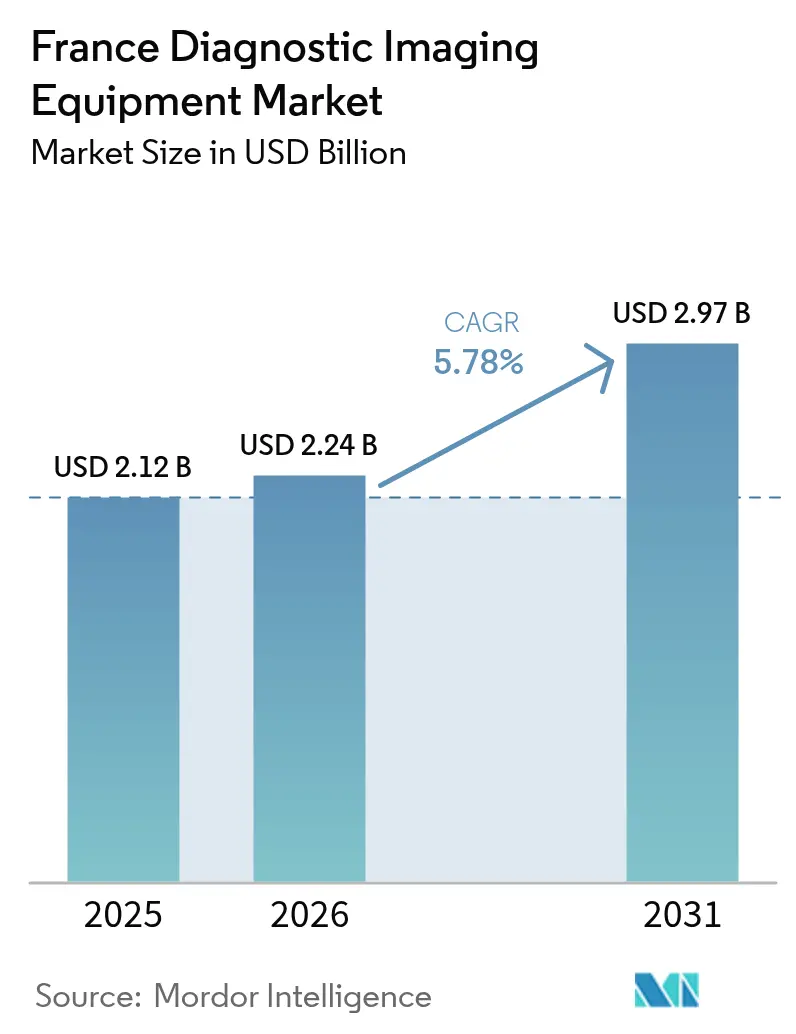
The France diagnostic imaging equipment market size in 2026 is estimated at USD 2.24 billion, growing from 2025 value of USD 2.12 billion with 2031 projections showing USD 2.97 billion, growing at 5.78% CAGR over 2026-2031. This growth is bolstered by government funding, steady growth in healthcare spending, and increasing demand from an aging population. Capital allocation under the national EUR 7 billion health-innovation plan, including EUR 1.5 billion earmarked for artificial intelligence deployment, keeps equipment refresh cycles on track, even as public hospitals face budget deficits.[1] Structural shifts, such as the growth of outpatient care, the adoption of mobile imaging, and the integration of AI-assisted workflows, further strengthen demand signals across modalities, particularly MRI and connected ultrasound. Competitive intensity remains moderate; major multinationals leverage bundled service contracts, while domestic innovators target portable and AI-enabled niches to unlock rural and suburban opportunities
Key Report Takeaways
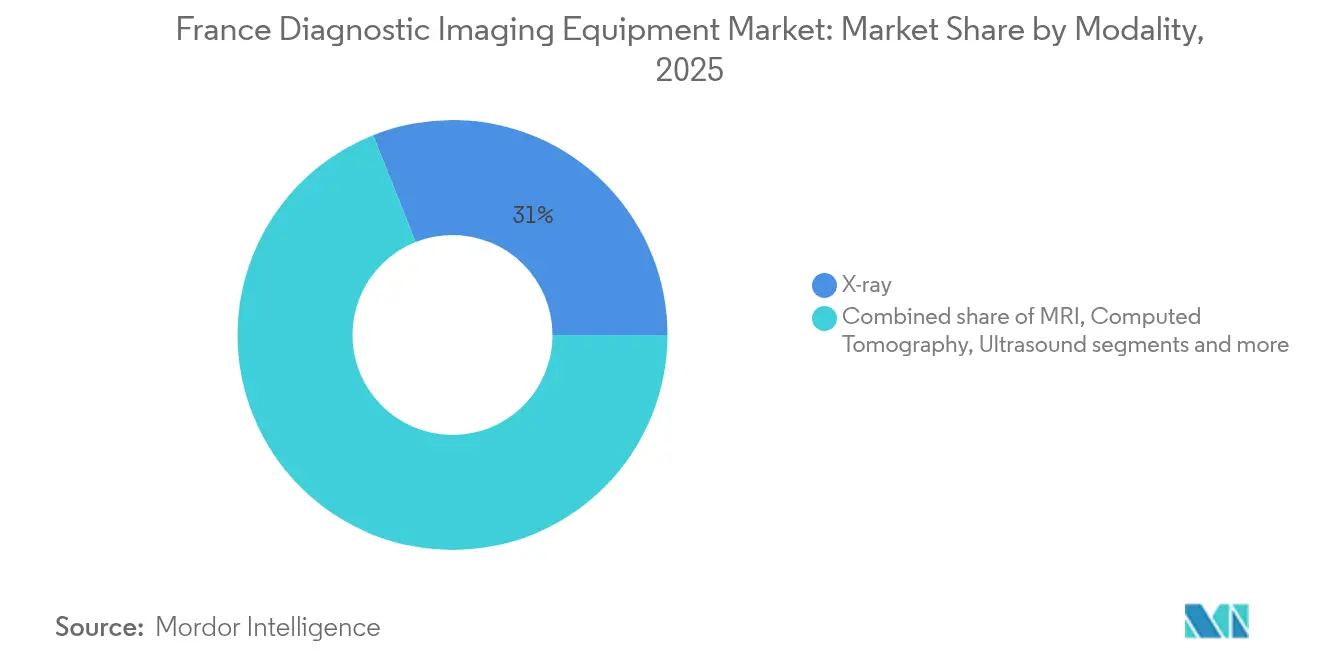
- By modality, X-ray systems led with 31.02% of France diagnostic imaging equipment market share in 2025; MRI is on course for a 6.73% CAGR through 2031.
- By portability, fixed systems accounted for 81.74% of the France diagnostic imaging equipment market size in 2025, whereas mobile/portable systems are forecast to expand at a 7.02% CAGR between 2026-2031.
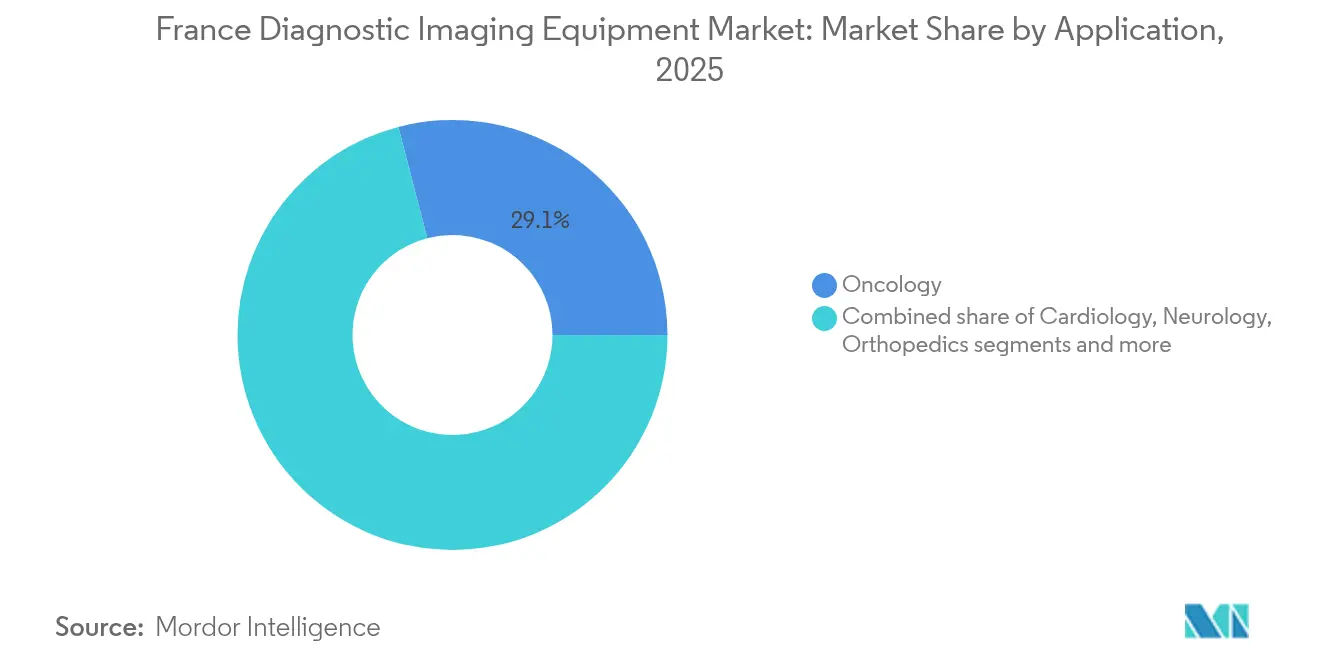
- By application, oncology captured 29.05% of France diagnostic imaging equipment market share in 2025; cardiology shows the highest projected CAGR at 7.18% through 2031.
- By end-user, hospitals held a 67.18% revenue share in 2025; diagnostic centers recorded the fastest growth, at a 6.63% CAGR, from 2026 to 2031.
Note: Market size and forecast figures in this report are generated using Mordor Intelligence’s proprietary estimation framework, updated with the latest available data and insights as of 2026.
France Diagnostic Imaging Equipment Market Trends and Insights
Drivers Impact Analysis*
| Driver | (~) % Impact on CAGR Forecast | Geographic Relevance | Impact Timeline |
|---|---|---|---|
| Rising prevalence of chronic diseases & aging population | +1.8% | National, higher in rural and southern regions | Long term (≥ 4 years) |
| Government investment to modernize hospital imaging capacity | +1.2% | National, prioritizing public hospital networks | Medium term (2-4 years) |
| Steady growth in national healthcare spending and equipment replacement programmes | +0.9% | National, focused on public sector facilities | Medium term (2-4 years) |
| Shift toward outpatient and ambulatory imaging centers boosts system installations outside hospitals | +0.7% | Urban and suburban areas | Short term (≤ 2 years) |
| Emphasis on early, value-based diagnosis increases utilization rates | +0.6% | National, early adoption in academic medical centers | Medium term (2-4 years) |
| Integration of digital health and cloud-based image management drives demand for connected modalities | +0.4% | National, led by Île-de-France and major metropolitan areas | Short term (≤ 2 years) |
| Source: Mordor Intelligence | |||
Rising Prevalence of Chronic Diseases & Aging Population
Chronic disease prevalence continues to rise, pushing imaging volumes across France. Healthcare reimbursements for diabetes, cardiovascular conditions, and cancer reached EUR 167 billion in 2024, making imaging a frontline diagnostic tool. An older demographic intensifies complexity, demanding AI-assisted protocols to detect multiple pathologies in a single scan. Survival gaps tied to travel distance—up to 10% lower five-year cancer survival for patients located farther from referral centers—spotlight the clinical value of locally available scanners. Limited radiologist supply heightens reliance on intelligent image triage, while mobile units help bridge urban–rural access disparities. Collectively, these factors anchor long-term growth in the France diagnostic imaging equipment market.
Government Investment to Modernize Hospital Imaging Capacity
France’s EUR 7 billion health-innovation program identifies diagnostic imaging as a modernization priority. Funds channel toward large-scale equipment renewals, AI pilots, and specialized ventures such as Institut Curie’s EUR 37 million FLASH-radiotherapy platform. The push responds to bottlenecks: annual mechanical-thrombectomy procedures plateaued at 7,500 amid staffing and scanner shortages. Vendor–provider “value partnerships,” like Siemens Healthineers’ EUR 60 million, 12-year contract with University Hospital Nantes, illustrate a new procurement logic that bundles hardware, service, and lifecycle upgrades.[2] Such financing mechanisms accelerate deployments while containing upfront capital strain, underpinning the France diagnostic imaging equipment market expansion.
Steady Growth in National Healthcare Spending and Equipment Replacement Programmes
The 2025 Social-Security Financing Law lifts the national health-expenditure target to EUR 265.9 billion, a 3.4% uptick that safeguards hospital operating budgets. Yet equipment depreciation outpaces new purchases, leaving an investment gap estimated at EUR 5.6 billion. Replacement demand therefore skews toward cost-efficient, energy-saving scanners that promise lower total-ownership costs. Manufacturers respond with helium-free MRI, dose-optimized CT, and service-inclusive contracts, reinforcing steady procurement cycles and propelling the France diagnostic imaging equipment market.
Shift Toward Outpatient and Ambulatory Imaging Centers Boosts System Installations Outside Hospitals
Diagnostic imaging centers grow rapidly as patients seek faster appointments and hospitals redirect routine studies to decongest workloads. The segment’s 6.85% CAGR rests on investor-backed expansion, with private funds now owning 15-20% of imaging practices. Mobile X-ray and robotic ultrasound solutions deliver hospital-grade quality in community settings, validated by studies showing equivalent diagnostic accuracy and reduced time-to-treatment. These trends diversify equipment placements, expand procurement avenues, and stimulate software demand for remote reading, all supportive of the France diagnostic imaging equipment market.
Restraints Impact Analysis*
| Restraint | (~) % Impact on CAGR Forecast | Geographic Relevance | Impact Timeline |
|---|---|---|---|
| Ionizing-radiation safety concerns | −0.8% | National, stricter in densely populated areas | Long term (≥ 4 years) |
| High capital & maintenance cost of advanced systems | −1.1% | National, greater impact on smaller facilities | Medium term (2-4 years) |
| Lengthy CE-mark & reimbursement approval timelines | −0.6% | EU-wide, affects market entry timing | Short term (≤ 2 years) |
| Ongoing shortage of trained radiologists and technologists | −1.3% | National, acute in rural and underserved regions | Long term (≥ 4 years) |
| Source: Mordor Intelligence | |||
Ionizing-Radiation Safety Concerns
The January 2025 creation of the Autorité de sûreté nucléaire et de radioprotection consolidates nuclear-safety oversight and intensifies inspection frequency for 60,000 radiation-emitting devices nationwide. Stricter dose-reference levels prompt facilities to favor low-dose CT, iterative-reconstruction software, or MRI alternatives. Vendors develop visual and acoustic dose-alert systems showcased at AP-HP’s APinnov 2025 event. While safety vigilance limits indiscriminate CT and X-ray growth, it also boosts demand for next-generation scanners with automated exposure control, mitigating, rather than halting, expansion of the France diagnostic imaging equipment market.
Ongoing Shortage of Trained Radiologists and Technologists
France faces persistent personnel deficits; AI modeling indicates automated assistance could cut reading workloads by up to 53%. Rural departments endure the heaviest constraints, fueling mobile-scanner deployments and tele-radiology networks. Nuclear-medicine expansion strains capacity further, as 60% of procedures are expected to involve therapeutic tracers within a decade, yet subspecialty training pipelines remain limited. This human-resource bottleneck tempers volume growth yet simultaneously accelerates AI integration, both a restraint and an innovation engine within the France diagnostic imaging equipment market.
*Our forecasts treat driver/restraint impacts as directional, not additive. The impact forecasts reflect baseline growth, mix effects, and variable interactions.
Segment Analysis
By Modality: X-ray Leads While MRI Gains Momentum
X-ray systems dominated 2025 with 31.02% France diagnostic imaging equipment market share, underscoring their ubiquity in emergency, chest, and musculoskeletal evaluations. The segment’s growth moderates amid radiation-dose scrutiny, but upgrades to digital detectors sustain replacement demand. MRI, propelled by helium-free magnet technology that slashes annual operating costs, exhibits a robust 6.73% CAGR, the fastest in the landscape. The France diagnostic imaging equipment industry benefits from Philips BlueSeal and other zero-boil-off platforms that simplify siting and cut maintenance. CT maintains relevance for trauma and oncology staging, where AI-based image reconstruction reduces dose exposure. Ultrasound innovation—exemplified by Samsung’s acquisition of Sonio—adds deep-learning capabilities for obstetric diagnostics.
In nuclear imaging, theranostic pathways drive SPECT/CT and PET/CT replacements as oncology centers pair diagnostics with targeted radionuclide therapy. Mammography remains vital to national screening programs, though novel magnetic-marker navigation shows promise in lowering re-excision rates for breast-cancer surgery. Overall, modality diversification ensures steady equipment cycles, reinforcing the France diagnostic imaging equipment market’s value trajectory.

By Portability: Fixed Units Anchor Capacity, Mobile Systems Outpace Growth
Fixed scanners retained 81.74% of the 2025 France diagnostic imaging equipment market size, reflecting hospital dependence on high-throughput, full-featured rooms. Widespread picture-archiving integration, power requirements, and advanced technologist workflows continue to favor stationary installations for complex imaging. However, portable systems record 7.02% CAGR, tapping unmet rural and elderly-care needs. Studies verify equal diagnostic accuracy when chest radiographs are performed at bedside, cutting transfer time and potential complications. DMS Group’s Onyx mobile radiology platform exemplifies local manufacturer momentum, lifting company sales 9% to EUR 46.1 million in 2024.
COVID-19 reinforced clinical acceptance of point-of-care scanning, spurring permanent workflow changes. Battery life gains, AI on-device analytics, and 5G connectivity now allow real-time remote consultation, making mobility central to future procurement. These advances shape a two-tier market where fixed rooms handle high-complexity imaging and mobile units ensure proximity care, together enlarging the France diagnostic imaging equipment market.
By Application: Oncology Dominates, Cardiology Accelerates
Oncology retained 29.05% France diagnostic imaging equipment market share in 2025, supported by the National Cancer Institute’s early-detection campaigns and high PET-CT demand for staging. Cardiology charts a 7.18% CAGR as demographic aging lifts cardiovascular case loads; CT angiography and echocardiography gains drive purchases. Precision medicine widens imaging’s clinical scope: approval of 177Lu-PSMA therapy underscores the need for sophisticated nuclear-imaging protocols.
Neurology benefits from ultra-high-field MRI, which enhances cortical-microstructure visualization for neurodegenerative research. Orthopedics orders grow on sports injury screening and aging joint replacements, favoring low-dose 3D systems. Collectively, diversified specialty needs secure a stable pipeline of orders throughout the French diagnostic imaging equipment market.
By End-User: Hospitals Still Rule, Diagnostic Centers Rise
Hospitals accounted for 67.18% of revenue in 2025, operating the broadest modality mix under emergency and inpatient mandates. Budget constraints spur preference for multi-year service contracts that bundle upgrades and training. Diagnostic imaging centers, expanding at 6.63% CAGR, cater to outpatient demand for rapid slots and specialized expertise. Investor-backed networks leverage economies of scale and cloud reading to boost utilization, reshaping competitive dynamics within the France diagnostic imaging equipment market.
Research institutes, veterinary clinics, and mobile providers comprise the remaining share, though their collective volume is trending upward as novel applications—animal oncology imaging, field-based trauma assessment—gain traction. Private clinics posted EUR 362 million in net results for 2024, yet one-third remain loss-making, creating an incentive to adopt workflow-optimizing scanners that improve throughput.
Geography Analysis
Regional disparities define equipment distribution across France. Île-de-France, the nation’s wealth engine, paradoxically reports lower healthcare access indices than certain southern regions as population density exceeds facility capacity. Rural territories confront cardiology wait-times surpassing 42 days, doubling the urban benchmark, highlighting diagnostic inequality. Cancer-survival divergence—up to 10% lower five-year survival for patients distant from reference centers—further validates the need for localized scanners. Government strategies target balanced development. France 2030 funds subsidize equipment in underserved départements, while tele-radiology links extend specialist coverage across multi-site hospital groups. The Loire-Atlantique imaging network, comprising 13 public hospitals, shows regional pooling can maximize utilization. Mobile deployments plug remaining gaps, allowing bedside exams in community nursing homes or emergency triage at local clinics. Such initiatives ensure the France diagnostic imaging equipment market expands beyond metropolitan hubs, reinforcing national goals for equitable care.
Cloud-based enterprise imaging accelerates geographic coverage. Philips’ European launch of HealthSuite Imaging grants radiologists secure access to studies regardless of location, supporting workload sharing among facilities. AI-powered triage funnels complex cases to academic centers while rural technologists handle routine protocols, harmonizing quality standards. Over the forecast horizon, policy, technology, and investment converge to mitigate regional supply-demand mismatches, driving inclusive growth across the France diagnostic imaging equipment market.
Regulatory Landscape
Diagnostic imaging equipment placed on the French market is assessed under the EU Medical Device Regulation, Regulation (EU) 2017/745 (MDR), in force since May 26, 2021, with French legal adaptation via Ordonnance n 2022-582. In France, ANSM operates as the national competent authority for medical devices, covering manufacturer obligations (including national registration where applicable) and post-market surveillance, while market entry continues to depend on CE marking under the MDR framework.
Operational and safety requirements for ionizing imaging systems are covered through radiation-protection rules overseen by the nuclear safety and radiation authority, including equipment quality control provisions referenced in ASN Decision n 2019-DC-0660 (January 15, 2019) for radiodiagnostic installations such as CT. Reimbursement and health technology assessment are handled by HAS, notably CNEDiMTS, which evaluates medical devices for coverage decisions by national health insurance (including clinical benefit and added value) as part of the pathway to listings such as LPPR, influencing uptake beyond regulatory conformity.
Competitive Landscape
Global majors preserve brand recognition and service footprints, yet competitive contours shift toward partnership-driven models. Siemens Healthineers, Philips, and GE HealthCare collectively manage a majority of high-end modalities in tertiary centers; their contracts increasingly bundle uptime guarantees, staff training, and AI upgrades. Philips’ cloud-imaging expansion differentiates through enterprise-wide workflow integration, enabling multi-site reading and fostering customer stickiness. GE HealthCare pursues sustainability upgrades and dose-optimized CT to satisfy emerging regulatory standards GE.
Domestic innovators fill technology gaps. Guerbet SA applies contrast-media leadership to co-develop AI-supported protocols for low-dose liver imaging, enhancing local credibility. Start-ups such as Sonio, now a Samsung subsidiary, add fetal-anomaly detection software to ultrasound consoles, underscoring the strategic importance of AI assets.
Financial investors intensify consolidation among outpatient centers, injecting capital for multi-site expansion and advanced modality purchases. While this boosts equipment demand, it prompts debate over medical governance and cost control. Vendors attuned to this duality—offering flexible financing and regulatory-compliant AI stand to secure long-term market shares within the France diagnostic imaging equipment market.
France Diagnostic Imaging Equipment Industry Leaders
-
FUJIFILM Holdings Corporation
-
Koninklijke Philips N.V.
-
GE HealthCare
-
Siemens Healthineers AG
-
Canon Medical Systems Corporation
- *Disclaimer: Major Players sorted in no particular order

Market Opportunities and Future Outlook
Interoperable image sharing and workflow digitization support a more connected approach to modalities in both hospitals and outpatient imaging centers. Under the Securite and interoperability push in Securite Numérique (vague 2) for imaging, initiatives centered on tools such as DRIMbox and the DRIM-M network for secure national exchange of medical images raise procurement expectations around cybersecurity, connectivity, and standardized exchange, which affects modality refresh decisions beyond scanner specifications.
Regional access programs and high-end capability upgrades also translate into equipment and installation opportunities tied to specific projects and facilities. In April 2026, CHU de Lille inaugurated a 7 Tesla MRI at Hopital Roger Salengro under the ARIANES project with regional and state support, highlighting continued demand for advanced MRI in academic settings alongside broader replacement cycles. Nuclear medicine capacity adds another procurement lane: in January 2026, Hopital Le Creusot started construction of a 1,000 m2 scintigraphy building with Nucléaris, combining facility works with equipment purchases that include two gamma cameras and a digital PET scanner, supporting growth in SPECT/CT and PET/CT ecosystems where oncology pathways increasingly rely on combined diagnostic and therapeutic planning.
Recent Industry Developments
- June 2026: CHU de Poitiers signed a convention with Siemens Healthineers France for the EUR 9.5 million acquisition and installation of a Biograph Vision Quadra PET/CT system. The project expands high-sensitivity PET/CT capacity at a university hospital site and reinforces vendor positioning in premium nuclear imaging platforms tied to oncology and research workflows.
- August 2025: DMS Group finalized a strategic partnership with InnoLux Corporation and InnoCare Optoelectronics Corporation to build a more sovereign European value chain for flat panel X-ray sensors and to integrate AI capabilities. The initiative included a EUR 6.9 million capital increase backed by Bpifrance and NextStage AM, supporting industrial scale-up and supply assurance for digital radiography upgrades.
- May 2024: Samsung Medison announced plans to acquire French AI ultrasound software company Sonio for USD 92.7 million. The acquisition strengthens ultrasound workflow automation in areas such as prenatal imaging and increases competitive pressure to bundle consoles with AI-enabled decision support and quality guidance.
Research Methodology Framework and Report Scope
Market Definition and Coverage
This market covers revenue generated from diagnostic imaging equipment sold and installed in France, including major modalities used to capture internal body images for clinical diagnosis and monitoring. Values are measured at the equipment level and reflected in USD for consistency.
Scope exclusions: We exclude imaging services revenue, contrast media, most consumables, and stand-alone software when it is not sold as part of an equipment deal.
Segmentation Overview
- By Modality
- MRI
- Computed Tomography
- Ultrasound
- X-Ray
- Nuclear Imaging
- Fluoroscopy
- Mammography
- By Portability
- Fixed Systems
- Mobile / Portable Systems
- By Application
- Cardiology
- Oncology
- Neurology
- Orthopedics
- Gastroenterology
- Gynecology
- Other Applications
- By End-User
- Hospitals
- Diagnostic Centers
- Other End-Users
Data Sources, Market Sizing, and Validation
Desk Research
Desk research is used to build the starting structure of the France market and to anchor the model to checks that can be repeated. We relied on public health spending indicators, population and aging statistics, and cancer and chronic disease burden data to understand the direction of imaging demand.
For the quantitative foundation, we referred to sources such as OECD health statistics, Eurostat demographic and healthcare datasets, the World Health Organization, the International Agency for Research on Cancer (GLOBOCAN), and French public health and hospital system publications. Additional context was taken from company annual reports, investor presentations, reputable press coverage, and selected paid subscriptions used mainly for company financials and patent activity tracking. This desk research list is not exhaustive, and we used other sources as well for data collection, validation, and clarification.
Primary Interviews and Surveys
Primary work was used to pressure test the desk assumptions and turn them into practical market inputs, especially around replacement cycles, modality mix, pricing movement, and procurement patterns across hospital and outpatient settings. We spoke with a mix of equipment suppliers, distributor and service-channel participants, and clinical and administrative stakeholders from imaging sites across France.
Where inputs varied by setting, the assumptions were adjusted using what respondents described as typical purchasing triggers, for example system upgrades linked to throughput needs, staff availability, and regulatory or reimbursement expectations. We then cross-checked those adjusted assumptions back to the desk indicators.
Distribution of primary research fieldwork respondents
| Company type | Respondent position |
|---|---|
| Top tier: 37% | CXOs: 18% |
| Mid tier: 44% | Functional/Unit leaders: 38% |
| Smaller Players: 19% | Managers: 44% |
Market-Sizing & Forecasting
Sizing starts with a top-down build that links France diagnostic imaging equipment demand to a realistic installed base and replacement driven purchase pool, then shapes it using modality level utilization signals and public healthcare capacity direction. To keep the totals grounded, we corroborated results with selective bottom-up approximations, such as rolling up supplier and channel revenue signals where available, and validating with sampled average selling price ranges multiplied by plausible unit movement.
A few practical inputs that meaningfully move the model include replacement cycle assumptions by modality, split between hospital and outpatient procurement, average system pricing progression (including inflation and configuration mix), uptake of mobile and compact systems, and procedure intensity patterns tied to aging and oncology screening. When a sub-area lacked clean public data, we used conservative proxy indicators discussed in interviews, then applied sensitivity checks so one assumption could not dominate the final number.
For forecasting, scenario analysis was used so the outlook stays traceable to the drivers that respondents referenced, such as budget timing, backlog clearance, and upgrade waves after major public funding initiatives. We accepted the final growth path only after the driver set produced sensible year-to-year movement for volumes and pricing together, instead of relying on a single headline CAGR.
Data Validation & Update Cycle
Validation is done through repeated variance checks across multiple views of the same market, including modality mix logic, implied unit demand, and price movement reasonableness. If a number looks inconsistent with capacity signals or the expected replacement pool, we rework the assumption and recheck it against interview notes and the desk indicators.
Before sign-off, the model goes through multi-step internal review so calculation errors and soft assumptions get challenged, then corrected where needed. Reports are refreshed annually, and interim updates are made when material events occur that can shift procurement or pricing. Right before delivery, we perform a fresh pass of key inputs so clients receive the most current view that can be defended in a follow-up discussion.
Mordor Intelligence's France Diagnostic Imaging Equipment Market Sizing Compared With Other Published Estimates
Different published market sizes can still be honest, because they often add up slightly different revenue pools and do not always use the same timing for prices and currency conversion. Differences also show up when one estimate leans on equipment shipment momentum, while another leans more on healthcare spending direction, which can move faster or slower than device purchasing.
The main gap comes from whether imaging services and software-only revenues are counted alongside equipment, and how replacement demand is separated from new site additions, where Mordor Intelligence counts only diagnostic imaging equipment revenue and validates pricing and replacement timing through modality level checks.
Benchmark comparison
| Source | Market Size | Gaps in Research Methodology |
|---|---|---|
| Mordor Intelligence | USD 2.12 B (2025) | |
| Global Consultancy A | USD 2.70 B (2024) | Uses a broader spend view that appears to blend equipment with adjacent imaging related revenues and applies a different base year, which can inflate the total when price and mix are carried forward from earlier years. |
| Trade Journal B | USD 1.84 B (2024) | Looks closer to a medical imaging framing with tighter product coverage and a more conservative pricing progression, which can understate high value modalities when configurations and upgrade driven ASP uplift are not fully reflected. |
The table shows that scope and timing choices explain most of the spread, more than any single growth assumption. By keeping the market tied to equipment revenues, using modality fingerprints like replacement cadence and ASP movement, and then checking totals against independent demand signals, the final number stays transparent and repeatable.
Key Questions Answered in the Report
Which imaging modality is most widely used across French hospitals today?
Digital X-ray remains the workhorse in emergency and primary-care settings due to its speed, versatility, and relatively low radiation dose.
What is the biggest technology trend shaping new equipment purchases?
Hospitals and outpatient centers now prioritize scanners with built-in AI for automated triage, dose optimization, and workflow orchestration to counteract staff shortages.
How are government policies influencing vendor strategies in France?
Value-based procurement rules tied to the national health-innovation plan push manufacturers toward long-term service packages that bundle hardware, training, and software upgrades.
Why is mobile imaging attracting growing investor interest?
Portable MRI, CT, and X-ray units allow providers to reach rural communities and long-term-care facilities without building new departments, improving access while keeping capital outlays manageable.
What are providers doing to address radiation-safety concerns?
Facilities are adopting low-dose protocols, iterative-reconstruction software, and visual dose-alert systems to comply with stricter oversight from the new radioprotection authority.
How is financial consolidation affecting independent imaging practices?
Private-equity ownership is introducing stronger capital backing for technology refreshes but also heightens scrutiny over clinical governance and physician autonomy.