
Market Overview
| Study Period | 2020 - 2031 |
|---|---|
| Forecast Data Period | 2026 - 2031 |
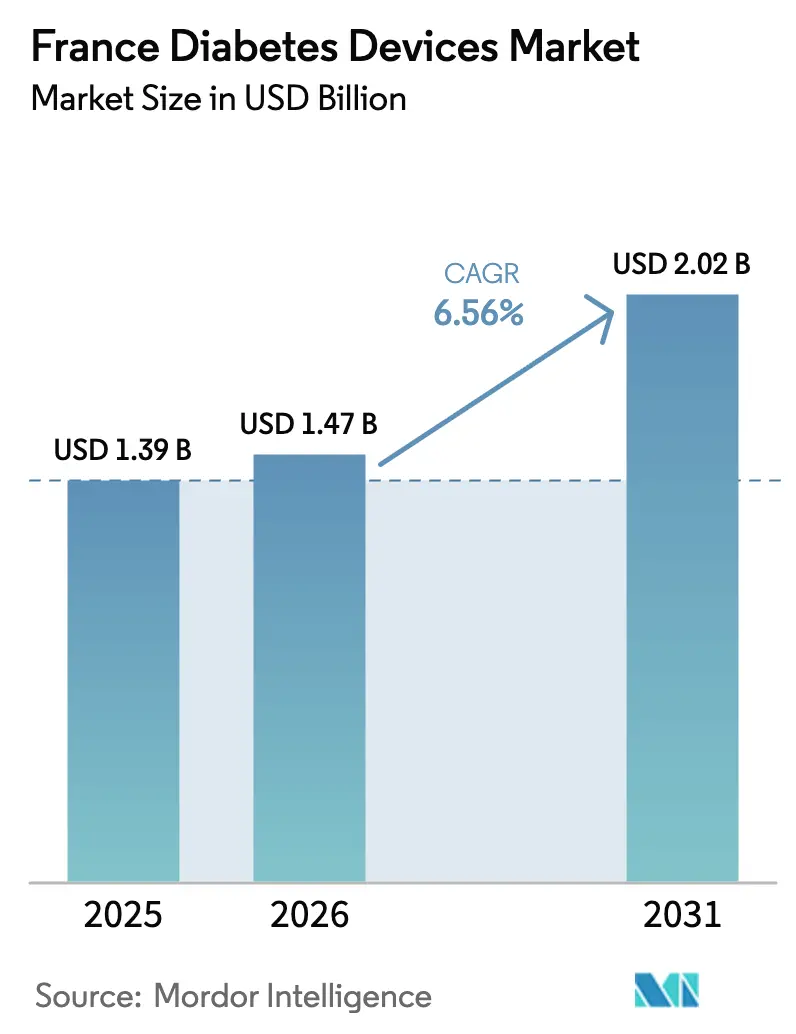
| Base Year Market Size (2025) | USD 1.39 Billion |
| Market Size (2026) | USD 1.47 Billion |
| Market Size (2031) | USD 2.02 Billion |
| Growth Rate (2026 - 2031) | 6.56 % |
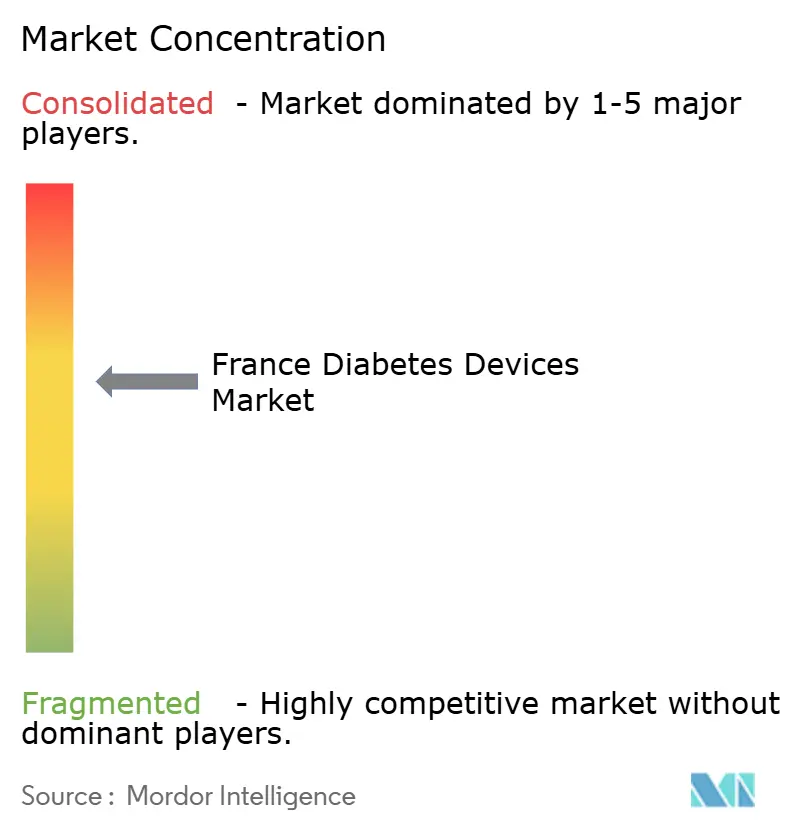
| Market Concentration | Medium |
Major Players *Disclaimer: Major Players sorted in no particular order Image © Mordor Intelligence. Reuse requires attribution under CC BY 4.0. | |
France Diabetes Devices Market Analysis by Mordor Intelligence
The France Diabetes Devices Market size is projected to expand from USD 1.39 billion in 2025 and USD 1.47 billion in 2026 to USD 2.02 billion by 2031, registering a CAGR of 6.56% between 2026 to 2031.
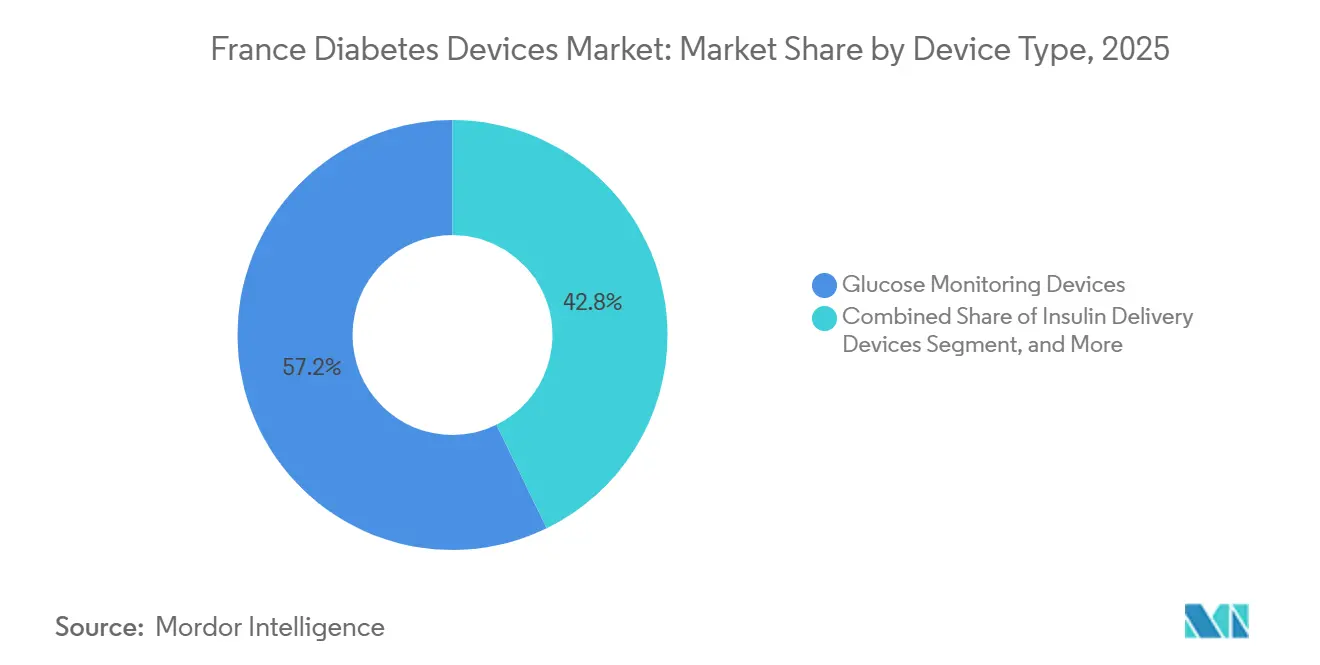
Reimbursement for continuous glucose monitoring (CGM) in basal-insulin Type 2 patients, strong uptake of tubeless patch pumps, and mandatory telemonitoring quotas are shaping near-term demand. CGM commanded 57.23% revenue in 2025, yet insulin delivery devices show faster 7.87% annual growth as automated insulin delivery (AID) systems penetrate pediatric and adult Type 1 segments. Price-volume clauses negotiated by the Comité Économique des Produits de Santé compress sensor margins, while the December 2025 global FreeStyle Libre 3 recall exposes supply-chain fragility. Online channels, expanding at a 12.57% CAGR, are redrawing distribution as patients embrace subscription fulfillment and direct-to-consumer support. The France diabetes devices market remains moderately concentrated, yet domestic innovators such as Diabeloop and Biocorp inject competitive tension through algorithm and connectivity advances.
Key Report Takeaways
- By device category, CGM held 57.23% of France diabetes devices market share in 2025, while insulin delivery devices are forecast to expand at a 7.87% CAGR through 2031.
- By diabetes type, Type 2 products accounted for 83.03% of 2025 revenue, whereas Type 1 devices are projected to register a 10.73% CAGR through 2031.
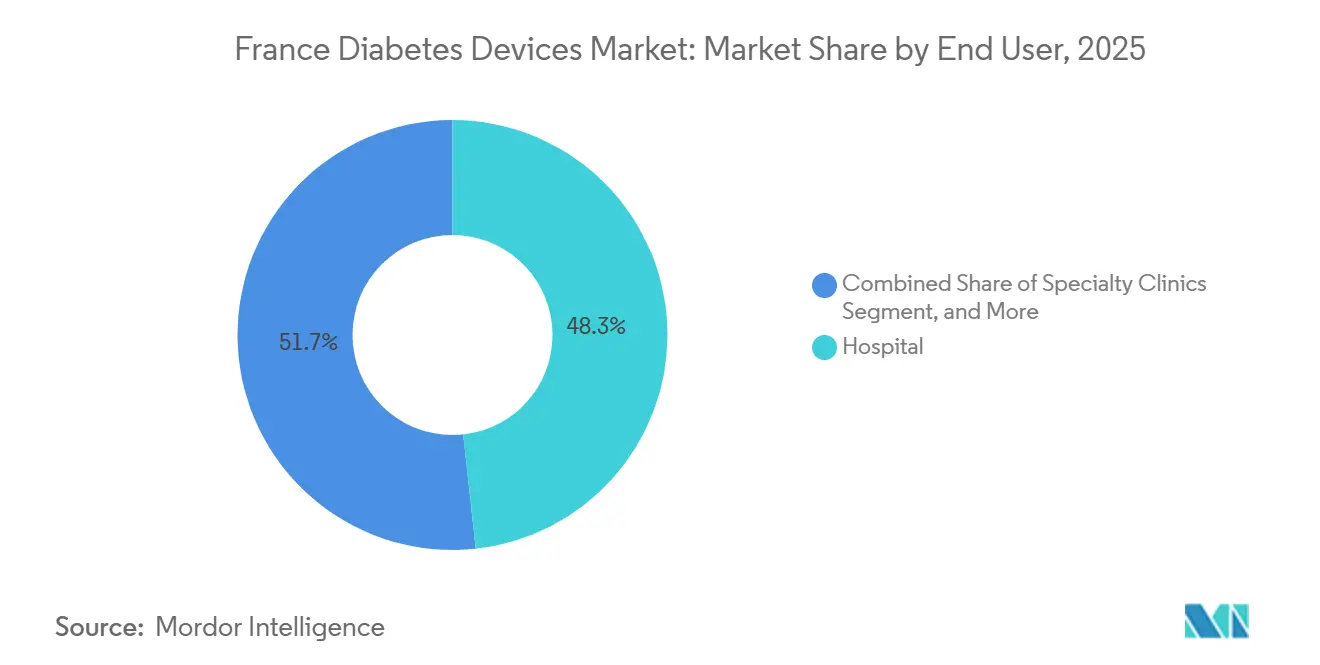
- By end user, hospital led with 48.27% revenue share in 2025, yet home care settings are advancing at a 12.57% CAGR during 2026-2031.
Note: Market size and forecast figures in this report are generated using Mordor Intelligence’s proprietary estimation framework, updated with the latest available data and insights as of January 2026.
France Diabetes Devices Market Trends and Insights
Drivers Impact Analysis*
| Driver | (~) %Impact on CAGR Forecast | Geographic Relevance | Impact Timeline |
|---|---|---|---|
| Mainstream Reimbursement Expansion for CGM Sensors | +1.8% | National metropolitan areas | Medium term (2-4 years) |
| Rapid Uptake of Tubeless and Patch Insulin Pumps | +1.2% | Type 1 cohorts nationwide | Medium term (2-4 years) |
| Smartphone-Integrated SMBG Ecosystems | +0.6% | Urban France | Short term (≤ 2 years) |
| Rapid GLP-1 Adoption Shifting Device Mix | +1.4% | National | Medium term (2-4 years) |
| Primary-Care Telemonitoring Quotas (LATM) | +0.9% | Rural regions | Short term (≤ 2 years) |
| Diabetic-Elderly Fall-Prevention Mandates | +0.5% | Geriatric facilities | Long term (≥ 4 years) |
| Source: Mordor Intelligence | |||
Mainstream Reimbursement Expansion for CGM Sensors
France approved full reimbursement of Dexcom ONE for 100,000 Type 2 patients on basal insulin in June 2024, opening the first European CGM pathway for non-intensive users. Health-economic studies place the incremental cost-effectiveness ratio within national thresholds, reinforcing payer support.[1]Francisco Gomez-Peralta et al., “Cost-utility of real-time continuous glucose monitoring versus self-monitoring of blood glucose in people with insulin-treated Type II diabetes in France,” PMC, PMC.NCBI.NLM.NIH.GOV As volumes rise, price-volume clauses lower per-sensor reimbursement, limiting manufacturer margins. Integrated sensor-transmitter ecosystems help offset this pressure by locking users into subscription refill models. The 2025 revision of the EU Medical Device Regulation (MDR) embeds post-market surveillance requirements, so real-world CGM outcomes feed directly into reimbursement renewal.
Rapid Uptake of Tubeless and Patch Insulin Pumps
Insulet introduced Omnipod 5 in June 2024, meeting the demand for a discreet, adhesive-based therapy among lifestyle-conscious Type 1 patients. Real-world surveys of 14,765 users show satisfaction driven by convenience rather than superior glycemic metrics. Grenoble-based Diabeloop secured EUR 15 million in 2024 to speed DBLG1 adoption and prepare the smartphone-native DBLG2, which gained FDA clearance by January 2026. The MiniMed 780G spin-off announced by Medtronic in June 2025 underscores escalating competition as agile software innovators shorten upgrade cycles. Future pump growth depends on algorithmic personalization, patch-format miniaturization, and bundle offers that pair hardware, sensor, and support.
Smartphone-Integrated SMBG Ecosystems
Pen-cap sensors such as Biocorp’s Mallya, acquired by Novo Nordisk for EUR 154 million in 2023, automatically log insulin doses and transmit data to mobile dashboards. Abbott and Biocorp are aligning FreeStyle Libre data with connected pens, reinforcing platform stickiness. Smartphone-enabled self-monitoring blood glucose (SMBG) meters still serve gestational and early Type 2 cases but face declining volumes as CGM reimbursement widens. Device makers counter commoditization by embedding coaching nudges and predictive analytics into companion apps. National Health Data System analysis links CGM adoption with switches to longer-acting insulins, illustrating how digital data reshapes prescribing behaviors.
Rapid GLP-1 Adoption Shifting Device Mix
Glucagon-like peptide-1 receptor agonists enable down-titration or cessation of basal insulin, shrinking pen and strip demand. Yet CGM placement is still rising because clinicians exploit sensor trends to optimize GLP-1 titration and detect nocturnal lows. Once-weekly basal insulins further trim injection frequency, prompting pen makers to focus on reusable hardware and connectivity. The July 2025 carbon-footprint methodology rates an insulin pen at 0.7 kg CO₂eq, adding environmental scoring to procurement and favoring low-material options.[2]Direction Générale des Entreprises, “Carbon Footprint of Medicines: Assessment Methodology,” ENTREPRISES.GOUV.FR Manufacturers must therefore balance environmental impact with feature differentiation.
Restraints Impact Analysis*
| Restraint | (~) % Impact on CAGR Forecast | Geographic Relevance | Impact Timeline |
|---|---|---|---|
| Price-Volume Clauses Squeezing Margins | -0.9% | National | Medium term (2-4 years) |
| Sensor Cybersecurity and GDPR Compliance Burden | -0.4% | EU aligned | Short term (≤ 2 years) |
| GLP-1-Driven Reduction in Basal-Insulin Users | -0.7% | National | Medium term (2-4 years) |
| CEPS Claw-Backs Linked to Carbon Footprint KPIs | -0.3% | Pilot procurement | Long term (≥ 4 years) |
| Source: Mordor Intelligence | |||
Price-Volume Clauses Squeezing Margins
French price tariffs fall once sales thresholds are crossed, curbing profit despite rising CGM penetration. Dexcom ONE reimbursement illustrates this pinch: higher volumes trigger steeper rebates. Manufacturers introduce premium variants with longer wear or predictive alerts to escape existing caps. The 2025 FreeStyle Libre 3 recall shows how speed-to-market gambits carry quality risk that can magnify financial strain.[3]European Commission, “Guidance on post-market surveillance of medical devices and in vitro diagnostic medical devices: MDCG 2025-10,” HEALTH.EC.EUROPA.EU
Sensor Cybersecurity and GDPR Compliance Burden
Connected pumps and sensors must notify CSIRTs and ENISA of exploited vulnerabilities within 30 days of December 2025, adding audit and patching costs. Data hosting must meet GDPR and ISO 13485 requirements, increasing fixed overhead that smaller firms struggle to cover.
*Our forecasts treat driver/restraint impacts as directional, not additive. The impact forecasts reflect baseline growth, mix effects, and variable interactions.
Segment Analysis
By Device Category: CGM Dominance and Pump Upswing
The French diabetes devices market size remained at 57.23% of the French diabetes devices market share that year. Sensors remain volume leaders, yet their growth trails pumps, as margin pressure from price-volume clauses tempers revenue gains. AID-capable patch pumps underpin the 7.87% CAGR in insulin delivery, helped by Omnipod 5 and DBLG1 rollouts. Self-monitoring glucometers continue to lose ground as CGM reimbursement widens and fingerstick avoidance intensifies.
Second-generation pumps are split between tethered (MiniMed 780G, Tandem Control-IQ) and tubeless (Omnipod 5, Kaleido) designs. Recall-driven sensor shortages can temporarily re-inflate SMBG demand, but a structural shift favors sensors and smart pumps.



By Diabetes Type: Expanding Type 1 AID and Broadening Type 2 CGM
Type 2 products accounted for 83.03% of revenue in 2025, and type 1 diabetes is set to grow faster, with a 10.73% CAGR, as AID becomes standard of care. OB2F registry data indicated MiniMed 780G and Control-IQ each held close to half of installed AID bases, with only 2.8% discontinuation, confirming high persistence. Type 2 devices, despite owning the majority France diabetes devices market share, grow more slowly because GLP-1 usage reduces injection frequency. Pandemic-accelerated telemonitoring, however, lifts sensor adoption among basal-only cohorts, balancing the insulin volume drop.
Gestational and other forms of diabetes remain a niche. Once national CGM thresholds are widened to cover oral-therapy populations, Type 2 sensor revenue should accelerate, though pen volumes may not recover. Carbon-footprint scoring may further tilt purchasing toward reusable pens within the France diabetes devices industry.
By End User: Home-Care Settings Gain Momentum
Hospitals and clinics accounted for 48.27% of revenue in 2025, reflecting the concentration of specialist expertise and peri-operative glucose monitoring. Closed-loop initiation during inpatient stays sustains pump attachment rates, while CEPS procurement channels favor bulk purchases. Yet staff shortages, especially outside metro hubs, press facilities to offload stable patients sooner, indirectly bolstering remote monitoring adoption across the French diabetes devices market.
Home-care settings are recording the fastest growth at a 12.57% CAGR through 2030. Reimbursement introduced in July 2023 allows physicians to bill remote glucose reviews via the PPDP program. Seniors equipped with tablets receive coaching from regional diabetes-nurse networks, reducing travel costs. The France diabetes devices market share for home settings is poised to surpass 30% by 2029 as broadband penetration widens. Pharmacies and ambulatory surgical centers add secondary volumes: pharmacies handle lancets and low-cost glucometers, while day-surgery centers offer sensor insertions and pump starts, creating cross-selling avenues for multinational suppliers focused on the France diabetes devices market.
Geography Analysis
Abbott, Dexcom, Medtronic, Insulet, and Novo Nordisk dominate most revenue streams, but the December 2025 Libre 3 recall allowed Dexcom to capture share amid supply gaps. Novo Nordisk bolstered its connected-device portfolio via the Biocorp purchase, integrating Mallya pen caps into its insulin ecosystem.
Insulet leverages tubeless convenience to woo Type 1 converts, while Diabeloop’s algorithmic expertise targets both hardware-paired (DBLG1) and phone-only (DBLG2) AID niches, reporting 3,500 European users by 2026. Medtronic’s MiniMed spin-off seeks agility to counter rapid software iterations from digital natives.
Sensor and pump makers race to harden cybersecurity, cut carbon footprints, and secure ISO 13485 re-certification ahead of 2028 MDR roll-over deadlines. White-space opportunities include implantable CGM, where Senseonics filed for CE mark of Eversense 365 in February 2026, promising 12-month wear and fewer insertions.
Regulatory Landscape
France regulates diabetes devices under the EU MDR (EU 2017/745) and IVDR (EU 2017/746), with ANSM acting as the competent authority for market surveillance, vigilance, and enforcement. A national legal update was published in the Journal Officiel on April 21, 2026 (Decrees No. 2026-298 and 2026-299), effective April 22, 2026, aligning the French Public Health Code with EU requirements around operator declarations, traceability, and vigilance processes, which increases compliance workload for connected CGM and pump suppliers managing multi-operator distribution chains.
On the reimbursement side, market access is shaped by HAS assessments and LPPR listing, where connected interstitial glucose monitoring systems, insulin pumps, and semi-closed loop systems are evaluated device-by-device and can carry post-registration study requirements for long-term clinical follow-up. HAS updates to nomenclature and prescription frameworks for CGM systems (including those coupled to pumps) influence who can initiate therapy across public and private care settings, while CEPS price-volume clauses and related tariff mechanisms continue to pressure per-unit economics as reimbursed volumes expand.
Competitive Landscape
The France diabetes devices market blends global titans and agile local entrants. Abbott, Dexcom, and Medtronic lead unit sales, jointly accounting for a significant share of 2025 revenue. Medtronic’s August 2024 data-sharing pact with Abbott joins Libre sensors to MiniMed pumps, unifying patient dashboards and clinician portals. Dexcom differentiates with 10-day G7 sensors that warm up in 30 minutes and auto-pair to smartphones, while Abbott counters with 1-hour warm-up Libre 3 at a lower list price, sustaining competitive tension that benefits payers.
Domestic innovators capitalize on France 2030 grants. Grenoble-based Sensorion develops silicon-nitride membranes extending sensor life to 21 days, targeting CE mark by 2026. Paris start-up GlucoSurf integrates haptic alerts for visually impaired users, piloting devices under PECAN fast-track before nationwide roll-out. These firms often license patents to majors, gaining channel access while adding diversity to the French diabetes devices market.
Strategic manufacturing investments amplify local presence. Novo Nordisk expanded a Penfill cartridge plant in Chartres in 2024 to serve European demand. Embecta outsources cannula molding to a Dijon-based contract manufacturer that recently installed EU-MDR-compliant clean rooms, cutting lead times for European deliveries. Competitive differentiation shifts from hardware alone to service layers: remote coaching, A1c predictive analytics, and seamless “Mon Espace Santé” integration. GLP-1 receptor agonists reshape device usage, but CGM enhances titration efficacy; a 2024 study showed A1c declines of 0.5 percentage points when GLP-1 therapy was paired with CGM. Manufacturers therefore position sensors as medication-agnostic companions, sustaining relevance inside the France diabetes devices market.
France Diabetes Devices Industry Leaders
Dexcom
Novo Nordisk
Medtronic
Roche Diabetes Care
Abbott Diabetes Care
- *Disclaimer: Major Players sorted in no particular order

Market Opportunities and Future Outlook
Reimbursement and indication broadening for connected diabetes systems creates whitespace for vendors that can package sensor, pump, and data services into LPPR-listed pathways supported by post-registration evidence. A concrete catalyst is the ministerial decree dated January 22, 2026 adding the Omnipod 5 patch pump coupled with Dexcom G7 to the LPPR, reinforcing France as an access-driven market for semi-closed loop combinations and accelerating competition around interoperable ecosystems and user-friendly patch formats.
Device makers also have room to differentiate through next-generation sensing and risk-detection features that fit payer priorities and clinical workflows. Abbott receiving CE Mark in May 2026 for dual glucose-ketone sensing (Libre Duo) highlights an opportunity to address diabetic ketoacidosis risk management alongside glycemic control, while implantable CGM remains a visible gap with Senseonics filing for CE mark for Eversense 365 in February 2026. At the same time, tighter cybersecurity, traceability, and vigilance expectations under the updated MDR-aligned French framework, plus outcome-driven renewals, elevate demand for robust data governance and real-world evidence generation as part of the commercial offer.
Recent Industry Developments
- May 2026: Abbott secured CE Mark for Libre Duo and Libre Duo 10 Day, enabling continuous glucose and ketone sensing in a single wearable. The addition of ketone monitoring expands the addressable use cases beyond routine glycemic management into early risk detection for diabetic ketoacidosis, raising the bar for feature competition in CGM platforms.
- February 2026: Medtronic began the EMEA commercial launch of the MiniMed Go Smart MDI system paired with the Simplera sensor. Expanding CGM-enabled smart MDI outside pump therapy strengthens competition for insulin-treated patients who want automation and coaching without transitioning to full pump-based AID.
- January 2026: France issued a ministerial decree adding the Omnipod 5 patch pump coupled with Dexcom G7 to the LPPR, widening payer coverage for interoperable patch-pump ecosystems and accelerating access to integrated CGM and patch pump therapy.


Research Methodology Framework and Report Scope
Market Definition and Coverage
This market covers diabetes care devices sold and used in France to monitor glucose and support day to day diabetes management, counted as device and related consumable revenue in value terms.
Scope exclusions: We exclude diabetes drugs, general lab analyzers used for routine chemistry, and non-device services such as coaching apps when they are not bundled with a billable device.
Segmentation Overview
- By Device Category
- Glucose Monitoring Devices
- Self-Monitoring Blood Glucose (SMBG) Devices
- Glucometers
- Test Strips
- Lancets
- Continuous Glucose Monitoring (CGM) Devices
- Sensors
- Durables (Receivers & Transmitters)
- Self-Monitoring Blood Glucose (SMBG) Devices
- Insulin Delivery Devices
- Insulin Pens
- Insulin Pumps
- Insulin Syringes
- Jet Injectors
- Other Diabetes-Care Devices
- Glucose Monitoring Devices
- By Diabetes Type
- Type 1 Diabetes
- Type 2 Diabetes
- Gestational & Others
- By End User
- Hospitals
- Specialty Clinics
- Home Care Settings
- Other End Users
Data Sources, Market Sizing, and Validation
Desk Research
Desk work started by mapping the France pathway for diabetes device adoption and payment, since coverage and reimbursement decisions can change shipment timing and pricing. Public sources were used to anchor the model, such as OECD health statistics, WHO diabetes indicators, Eurostat trade tables, and the French Ministry of Health and related public health portals.
We also reviewed manufacturer filings, investor presentations, product labeling and safety notices, and diabetes association publications to understand device mix changes, sensor replacement patterns, and channel shifts. For cross checks, we used paid subscriptions for company financials and news, plus patent databases to spot technology transitions that typically move average selling prices. The sources listed here are illustrative only, and many other public documents and datasets were also used for collection, validation, and clarification.
Primary Interviews and Surveys
Primary interviews and short surveys targeted device distributors, pharmacy channel stakeholders, clinicians involved in diabetes care, and industry experts who track uptake of monitoring and delivery devices across France. The input helped us confirm which device bundles are commonly reimbursed, how published list prices translate into realized prices over time, and where unit demand differs from what we would otherwise estimate from desk research alone.
Distribution of primary research fieldwork respondents
| Company type | Respondent position |
|---|---|
| Top tier: 34% | CXOs: 22% |
| Mid tier: 44% | Functional/Unit leaders: 32% |
| Smaller Players: 22% | Managers: 46% |
Market-Sizing & Forecasting
Sizing was built mainly through a top-down demand pool reconstruction, where diabetes prevalence in France and treated patient counts were translated into device eligible users, then converted into annual device and consumable value using usage rates and pricing. To keep the totals realistic, we corroborated the output with selective bottom-up checks, including sampling device volumes through channel conversations and applying observed average selling prices to those volumes before adjusting the final totals.
Key inputs used in the model included diabetes prevalence and age mix, uptake of continuous glucose monitoring versus fingerstick testing, replacement cycles for sensors and other consumables, insulin delivery mix (pens versus pumps), and price progression driven by reimbursement revisions and product refreshes. Forecasts were run using scenario analysis, where the base case reflected primary feedback on adoption speed, pricing pressure, and the pace of switching toward newer monitoring formats. When the bottom-up view was incomplete for smaller channels, we used conservative penetration assumptions tied back to the treated cohort, then rechecked them through follow up calls.
Data Validation & Update Cycle
Outputs were checked against independent signals such as reported sales direction from major suppliers, channel inventory commentary, and observable shifts in reimbursement and clinical practice. Variance checks were performed at the device family level, and any outliers triggered a second review of assumptions, followed by re-contact with interviewees when the gap could not be explained by seasonality or mix.
Before sign-off, the model and written insights go through multi step analyst review so that calculation logic, unit to value conversions, and year alignment are consistent. Reports are refreshed annually, and interim updates are made when material events occur, such as reimbursement changes or major product launches. Right before delivery, a final pass is done to reflect the latest public updates available at that time.
Mordor Intelligence's France Diabetes Devices Market Size Compared With Other Published Estimates
Published market values for France diabetes devices often diverge because studies do not always align on the year used for currency conversion, the timing of price updates after reimbursement changes, and how consumable replacement cycles are annualized. Numbers can also shift when some estimates include adjacent diabetes management tools that are not booked as device revenue.
When ASPs are refreshed to match the most recent reimbursement and tender signals, and when unit run rates for sensors and strips are rechecked with channel feedback before the model is finalized, the total tends to land closer to observed demand patterns, which is the validation emphasis applied in Mordor Intelligence.
Benchmark comparison
| Source | Market Size | Gaps in Research Methodology |
|---|---|---|
| Mordor Intelligence | USD 1.39 B (2025) | |
| Industry Publisher A | USD 1.08 B (2025) | Uses a broader channel lens, but pricing appears to be updated less frequently through the year, and consumable run rates can be treated as static, which can pull the total down when adoption shifts toward CGM. |
| Trade Release B | USD 0.95 B (2023) | Different base year and a forward projection that starts earlier, plus likely reliance on headline price points, which can diverge from realized ASPs once reimbursement revisions and mix changes are applied. |
Across the three figures, the spread is mainly explained by year alignment and the way pricing and consumables are carried through the model. With clear device revenue boundaries and repeatable checks on adoption, replacement cycles, and realized pricing, we can trace the number back to practical inputs and update it as conditions change.


Key Questions Answered in the Report
What is the projected value of the France diabetes devices market by 2031?
The market is forecast to reach USD 2.02 billion by 2031 at a 6.56% CAGR.
Which device segment is expanding faster than the overall market?
Insulin delivery devices, propelled by tubeless patch pumps and AID systems, are growing at a 7.87% CAGR.
How did France change CGM reimbursement in 2024?
National coverage was extended to 100,000 basal-insulin Type 2 patients, boosting CGM volumes.
Why are home care settings gaining share by end user?
Home care settings fulfillment drive a 12.57% CAGR during the forecast period.
What regulatory change in 2025 affects connected diabetes devices?
The EU MDR revision introduces mandatory cybersecurity incident reporting within 30 days.
Page last updated on:





