
France Commercial Greenhouse Market Size and Share
Market Overview
| Study Period | 2021 - 2031 |
|---|---|
| Forecast Data Period | 2026 - 2031 |
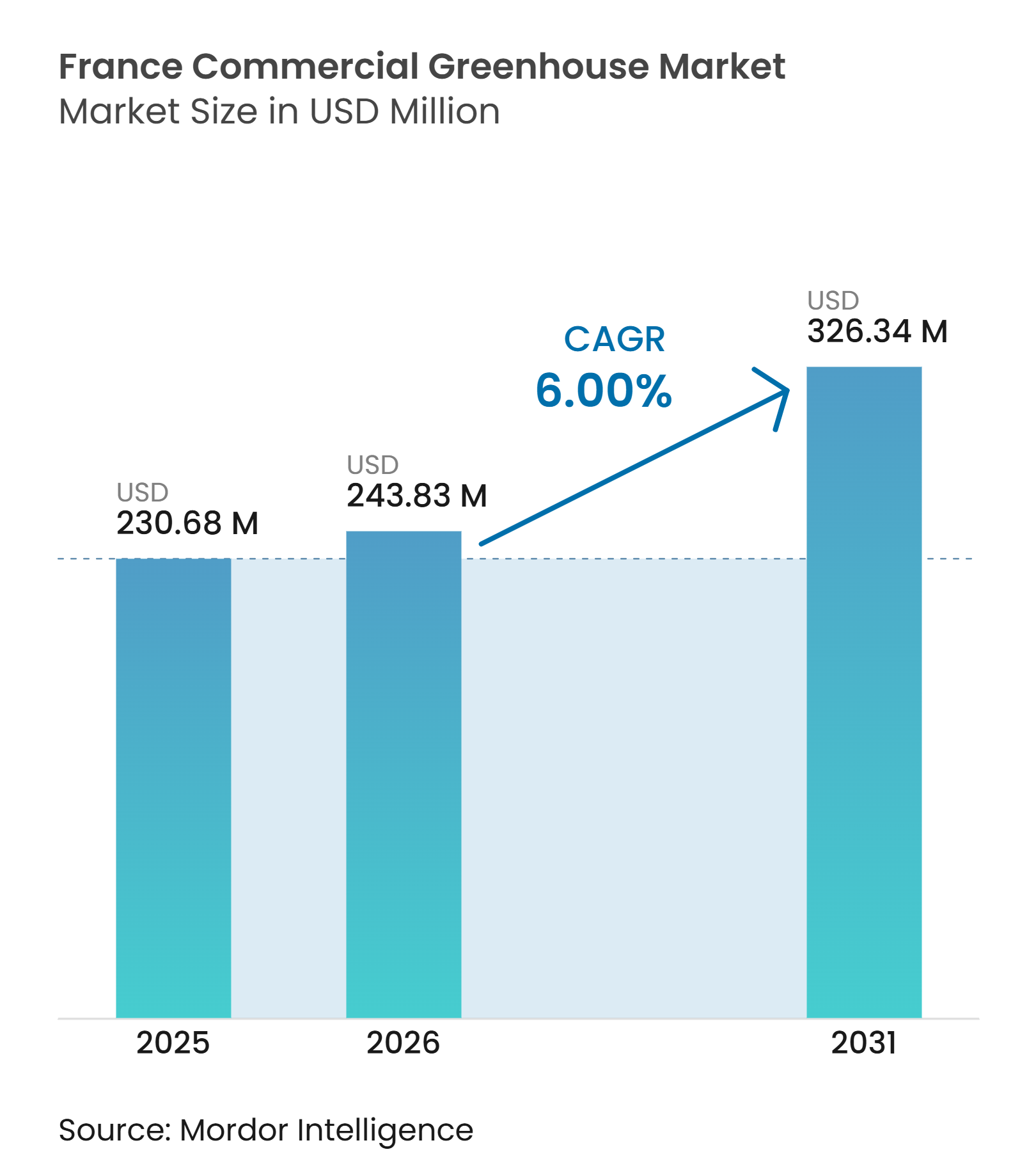
| Base Year Market Size (2025) | USD 230.68 Million |
| Market Size (2026) | USD 243.83 Million |
| Market Size (2031) | USD 326.34 Million |
| Growth Rate (2026 - 2031) | 6.00 % |
| Market Concentration | Medium |
Major Players *Disclaimer: Major Players sorted in no particular order Image © Mordor Intelligence. Reuse requires attribution under CC BY 4.0. | |
France Commercial Greenhouse Market Analysis by Mordor Intelligence
The France commercial greenhouse market size was valued at USD 230.7 million in 2025 and estimated to grow from USD 243.8 million in 2026 to reach USD 326.3 million by 2031, at a CAGR of 6% during the forecast period from 2026 to 2031. The market is shaped by replacement spending as vegetable and ornamental structures near the end of their useful operating lives. Public support directs investment toward projects that meet higher energy and technical standards, which favors complete structures with integrated climate and water systems, so the commercial value lies in a coordinated solution rather than a collection of separate components. Retail demand for traceable French produce supports controlled production models that meet certification and supply requirements. Heat management, water availability, and permit timing determine which technologies are viable at individual sites. Suppliers compete on their ability to combine structural engineering, energy performance, and practical operational support for growers, particularly when a single investment addresses multiple operating constraints simultaneously.
Key Report Takeaways
- By equipment type, Structural Components held 42.3% of the France commercial greenhouse market share in 2025, while Climate Control and Automation Software is projected to grow at an 8.5% CAGR during 2026–2031.
- By crop type, Fruits and Vegetables held 64.4% of the France commercial greenhouse market size in 2025, while the Herbs and Microgreens segment is projected to grow at an 8.7% CAGR during 2026–2031.
- By greenhouse type, Glass Greenhouses held 58.7% of the France commercial greenhouse market share in 2025, while the Hybrid and Semi-closed Greenhouses segment is projected to grow at a 9.5% CAGR during 2026–2031.
- By cultivation technology, Non-hydroponic Soil and Substrate held 61.3% of the France commercial greenhouse market size in 2025, while Hydroponic cultivation is projected to grow at an 8.8% CAGR during 2026–2031.
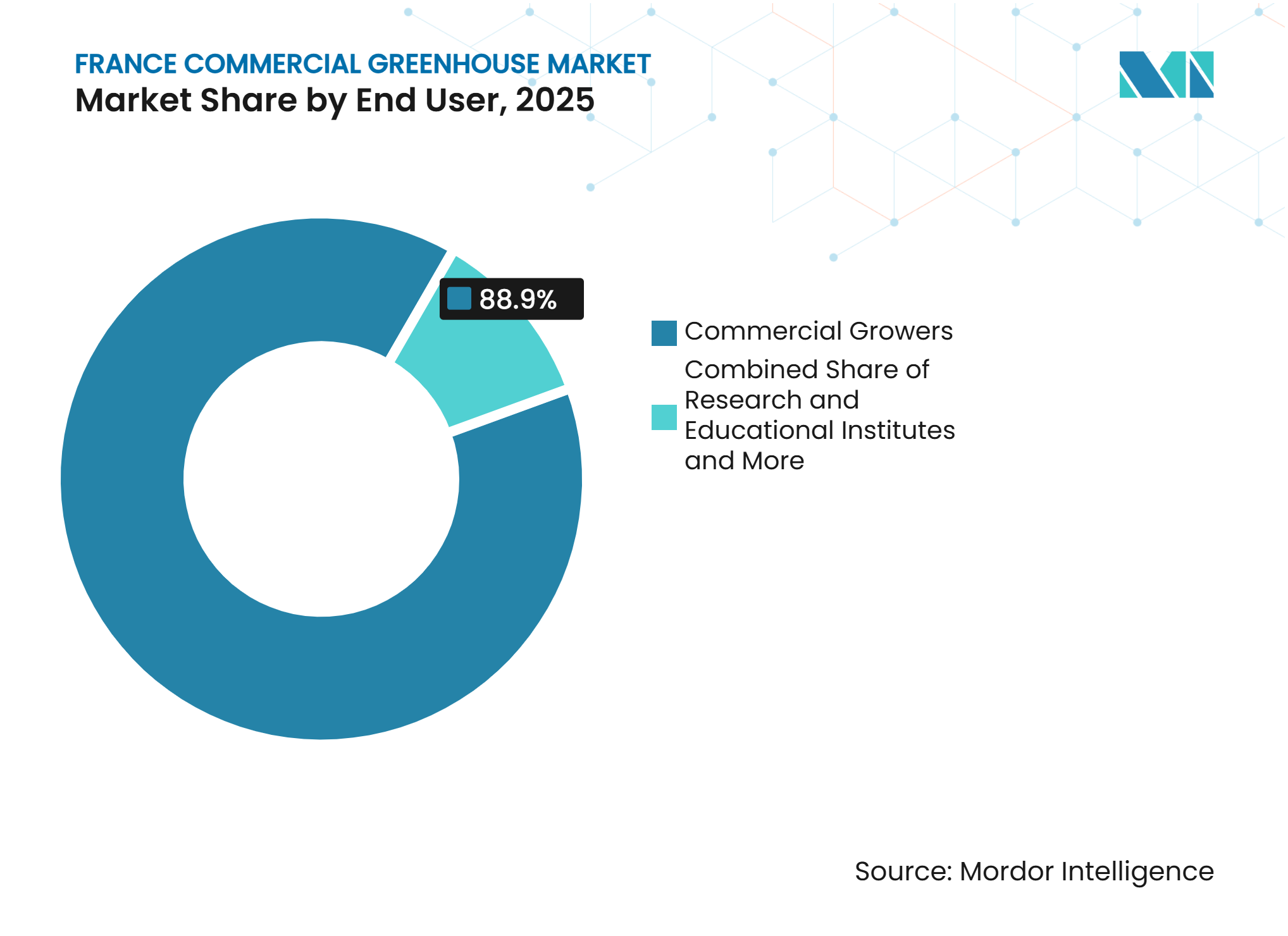
- By end user, Commercial Growers held 88.9% of demand in 2025, while the Research and Educational Institutes segment is projected to grow at an 8.2% CAGR during 2026–2031.
Note: Market size and forecast figures in this report are generated using Mordor Intelligence’s proprietary estimation framework, updated with the latest available data and insights as of January 2026.
Market Trends and Insights
Drivers Impact Analysis of France Commercial Greenhouse Market*
| Public Funding for Greenhouse Decarbonization and Modernization | +1.5% | National, with strong activity in Mediterranean and Atlantic production corridors that contain dense vegetable clusters and aging structures. | Short term (≤ 2 years) |
|---|---|---|---|
| Replacement of Aging Greenhouse Infrastructure | +1.4% | National, with Brittany, the Loire Valley, and Provence-Alpes-Côte d’Azur carrying a substantial stock of older vegetable and ornamental facilities. | Medium term (2-4 years) |
| Consumer and Retail Preference for French-Origin, Certified Produce | +0.8% | National, with demand signals concentrated around retail procurement centers and investment occurring in established production areas. | Long term (≥ 4 years) |
| Waste-Heat, Cogeneration, and Energy-Efficient Greenhouse Economics | +1.1% | Northern and central areas, where industrial activity and greenhouse zones create opportunities for heat recovery. | Medium term (2-4 years) |
| Photovoltaic Greenhouses as a Dual-Revenue Investment Model | +0.7% | Southern regions, where solar conditions support electricity generation alongside horticultural use. | Short term (≤ 2 years) |
| Semi-Closed Climate Control for Heatwaves and Year-Round Production | +0.9% | National, with the strongest operational need in the Mediterranean arc and the southwest during hot periods. | Medium term (2-4 years) |
| Source: Mordor Intelligence | |||
Public Funding for Greenhouse Decarbonization and Modernization
FranceAgriMer’s France 2030 program allocated EUR 35 million (USD 38.5 million) to innovative greenhouse investments and kept the application window open through July 2026[1]. The program covers new construction, extensions, replacement structures, and qualifying equipment within complete commercial projects. Aid rates range from 20% to 40%, which reduces the private funding requirement for eligible growers. The technical conditions place energy performance and eligible equipment at the center of project design. This framework supports suppliers that deliver complete, compliant structures instead of basic replacements. The France commercial greenhouse market gains near-term demand when approved projects move from deferred investment to procurement, reducing the interval between investment approval, technical specification, and supplier selection.
Replacement of Aging Greenhouse Infrastructure
Vegetable facilities average 19 years of age, while ornamental facilities average 21 years of age, creating a replacement cycle independent of new production acreage. The structure of this demand favors solutions that address the building, climate, and energy system in a coordinated project. Rehabilitation requires EUR 100,000 (USD 110,000) to EUR 300,000 (USD 330,000) per hectare at fallow sites in the Var, which separates viable modernization cases from projects requiring demolition. Aging assets also create a preference for suppliers able to define the technical scope before construction begins. The replacement cycle supports demand for higher-value structures, as growers seek a longer operating life, lower resource use, and better compatibility with current retail, certification, and public-funding requirements. It also narrows the viable customer base because smaller operators face a larger financing burden.
Consumer and Retail Preference for French-Origin, Certified Produce
French consumers increasingly select produce carrying zero-residue-of-pesticides claims. The AOPn Tomates et Concombres de France links its Serres d’Avenir charter to traceability, water management, and carbon commitments. The charter holds High Environmental Value level 2 recognition, which places documented production practices within commercial supply arrangements. Controlled structures help growers align seasonal output with retail requirements for domestic origin and product consistency. This strengthens the commercial case for enclosing production rather than relying solely on open-field supply. It also favors investments that support monitoring and verified operating practices.
Waste-Heat, Cogeneration, and Energy-Efficient Greenhouse Economics
The AGRI-TH-116 measure supports the recovery of industrial waste heat for greenhouse heating. Its relevance is strongest where heat-producing industrial sites are located near commercial horticultural operations. Access to recovered heat changes the cost base of year-round production, especially in cooler regions with higher heating needs. Efficient glazing, thermal screens, and heat-recovery connections therefore affect both structural selection and operating expenditure. These systems are most valuable when installed within a complete greenhouse design rather than added after construction, because retrofit limitations often reduce the value of an otherwise efficient technology and complicate commissioning during the critical start-up phase. The French commercial greenhouse market benefits where project economics justify the replacement of older, less efficient structures.
Restraints Impact Analysis of France Commercial Greenhouse Market*
| High Capital, Labor, and Operating Costs | -1.3% | National, with the greatest pressure in high-land-cost peri-urban locations and colder regions with larger heating requirements. | Long term (≥ 4 years) |
|---|---|---|---|
| Water Scarcity and Regional Irrigation Restrictions | -0.8% | Southern and southwestern departments, where drought orders affect major tomato, berry, and ornamental clusters. | Short term (≤ 2 years) |
| Local Opposition and Planning Friction for Large Greenhouses | -0.6% | National, with prominent permitting friction in Normandy and Pas-de-Calais for large glass projects. | Medium term (2-4 years) |
| Strict Eligibility and Compliance Conditions for Investment Aid | -0.5% | National, particularly for smaller operators that lack specialist resources for technical documentation and compliance. | Short term (≤ 2 years) |
| Source: Mordor Intelligence | |||
Water Scarcity and Regional Irrigation Restrictions
Drought restrictions in 2025 covered more than 45 departments, including production areas in Vaucluse, Gironde, and Tarn-et-Garonne. The August 2025 Vaucluse order required glass greenhouse growers seeking a cultural exemption to use an irrigation management tool or cut water use by 20%. These rules make water planning a site-selection and financing issue rather than a routine operating task. Recirculating systems reduce water exposure but increase project complexity and initial costs. Growers without monitoring capability face a higher compliance burden during restricted periods, when timely records and verified operating practices affect access to water. The restraint shifts investment toward designs that manage water and nutrients in closed loops.
Strict Eligibility and Compliance Conditions for Investment Aid
Investment aid requires applicants to satisfy defined technical and documentation conditions. FranceAgriMer used eligibility criteria covering structure type, equipment, and project characteristics[2]. Small and mid-scale operators often lack in-house specialists to prepare energy evidence, technical specifications, and administrative files. This restricts access to support despite a clear need for replacement. Compliance also favors builders that provide documentation alongside their technical offer. The process screens out lower-specification proposals that do not meet program requirements. It slows some orders, while improving the quality threshold for projects that proceed, while reducing the likelihood that public funding supports structures with limited efficiency benefits.
*Our forecasts treat driver/restraint impacts as directional, not additive. The impact forecasts reflect baseline growth, mix effects, and variable interactions.
France Commercial Greenhouse Market Segment Analysis
By Equipment Type:
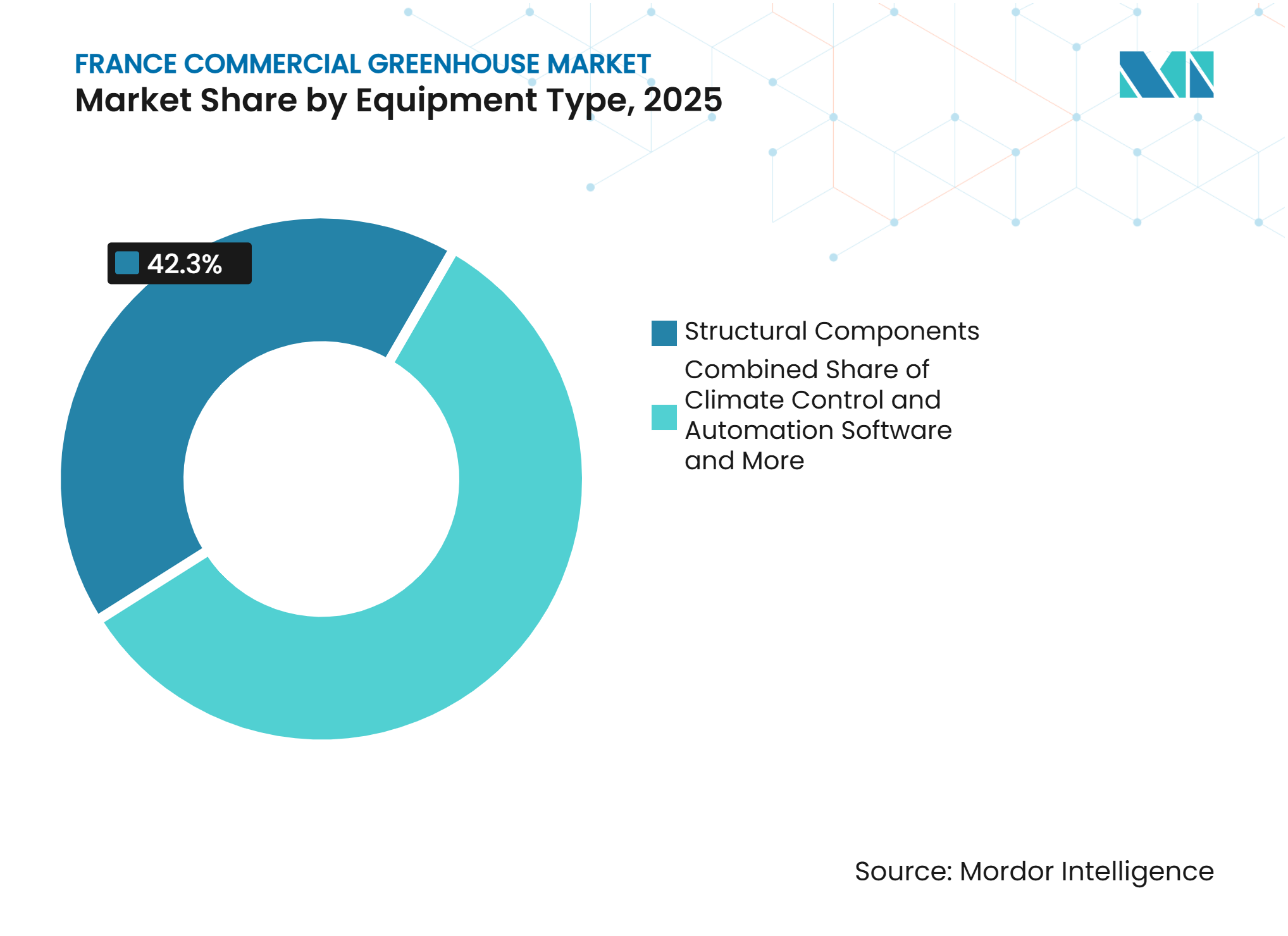
Structural Components Anchor Value While Software AcceleratesStructural Components held 42.3% of 2025 sales, making this the largest equipment category. Glass, frames, and trusses absorb a large share of total project value because they form the operating envelope of the facility and establish the technical base for all subsequent equipment choices. Their selection determines durability, insulation, airflow, and compatibility with heating and ventilation equipment, while also defining the available space, load-bearing capacity, and installation sequence for screens, sensors, piping, and climate-control equipment throughout the construction and commissioning process at the grower’s site. Replacement buyers increasingly assess structure performance alongside initial cost. Heating, Cooling, and Ventilation Systems remain important because climate stability depends on their integration with the building shell, which determines how efficiently each system operates across changing seasons.
Climate Control and Automation Software is projected to grow at an 8.5% CAGR during 2026–2031. High-specification projects require continuous control of temperature, humidity, ventilation, screens, and irrigation schedules across different crop stages and under varying external conditions. Sensor-linked systems reduce reliance on manual adjustments in complex facilities. Screening and Shading Systems are also gaining a larger role where solar generation and crop protection are combined, provided that the structure maintains usable light, workable airflow, and crop access. Irrigation and Fertigation Systems support precise delivery and closed-loop operation when incorporated into complete structure projects.



By Crop Type:
Fruits and Vegetables Retain the Broadest Demand BaseFruits and Vegetables accounted for 64.4% of sales in 2025, making this the largest crop category. Tomatoes, cucumbers, peppers, lettuce, and strawberries support recurring investment because they require consistent quality and scheduling. The AOPn Tomates et Concombres de France’s charter links production practices to retail-facing quality commitments[3]. This creates a direct link between protected production infrastructure and contract-oriented supply programs. Flowers and Ornamentals remain relevant, although their seasonal profile differs from food crops.
The Herbs and Microgreens segment is projected to grow at an 8.7% CAGR during 2026–2031. The category suits controlled production because fresh, pesticide-managed supply is needed across the year, with frequent harvest cycles, limited shelf life, and retailer demand for consistent quality, giving growers a clear reason to manage the production environment closely. Higher production density supports investment in specialized climate and cultivation layouts. Cannabis and Specialty Crops remain distinct because medical applications require controlled facilities that meet licensing requirements, maintain secure environmental conditions, and prevent operational variation unsuitable for controlled specialty production. Seedlings and Propagation Crops also require reliable temperature, humidity, and light management before plants move into commercial production.
By Greenhouse Type:
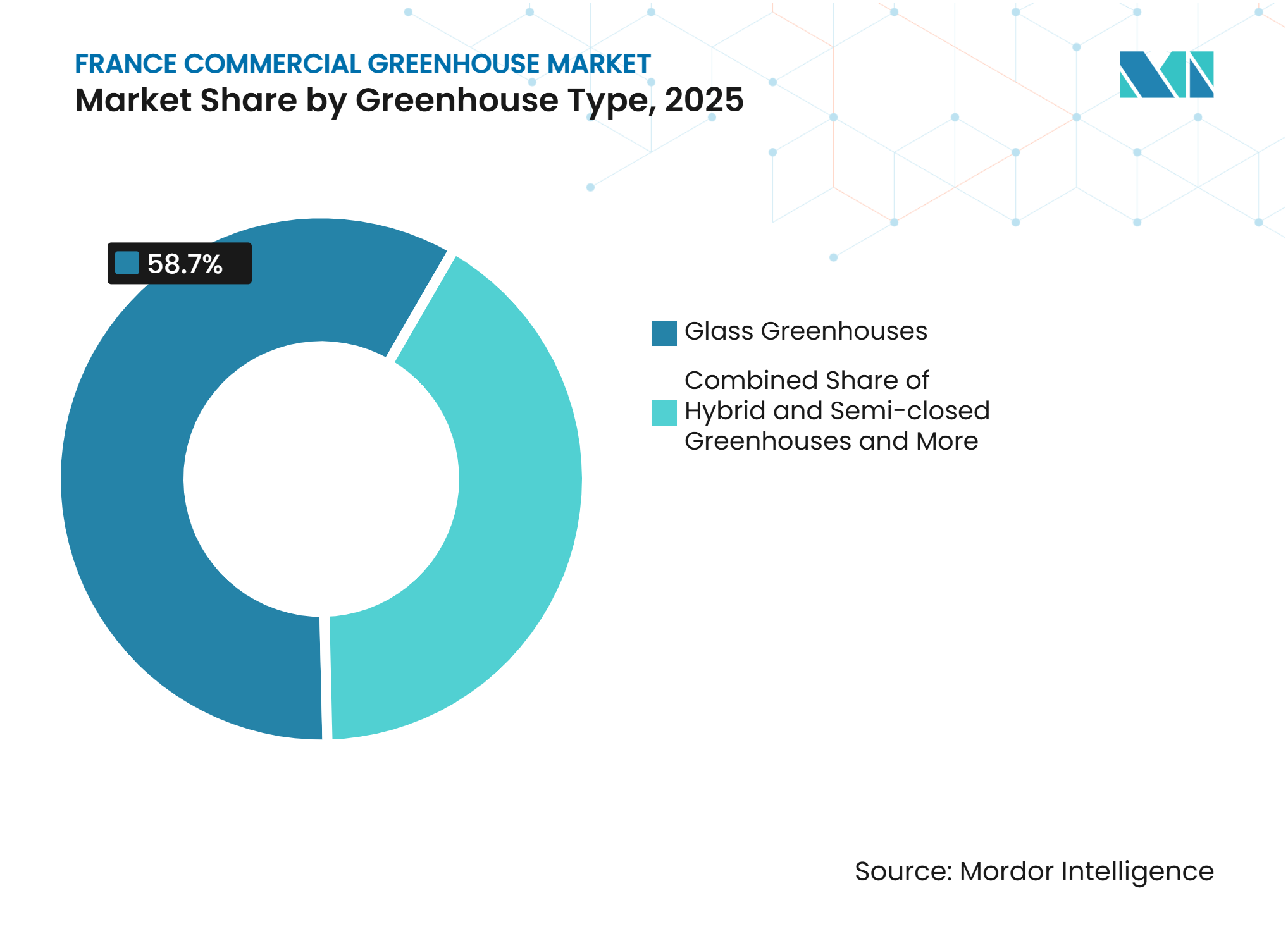
Glass Leads While Semi-Closed Designs Gain GroundGlass Greenhouses held 58.7% of sales in 2025, making them the largest greenhouse-type category. Their role reflects demand for long-life structures that support advanced climate systems and retail-grade crop production. Glass designs are widely used where year-round output and technical integration justify higher capital expenditure through extended service life, lower operating variability, and capacity for integrated systems. Plastic-film Greenhouses remain significant in terms of installed count, particularly in regions with a large tunnel base. Rigid Polycarbonate Greenhouses offer a middle option for growers moving toward greater environmental control.
The Hybrid and Semi-closed Greenhouses segment is projected to grow at a 9.5% CAGR during 2026–2031. These designs combine structural and ventilation choices to manage heat while keeping investment below that of some full-glass facilities. The France commercial greenhouse industry increasingly values these designs for climate control, heat management, and production continuity in areas where intense heat disrupts conventional ventilation strategies. Commercial deployment of semi-closed plastic construction in warm production areas confirms the format’s role in heat management without using a conventional glass envelope. The format gives mid-scale growers a route to higher control without a like-for-like glass investment, especially where heat resilience has become a visible operational concern.

By Cultivation Technology:
Substrate Systems Lead While Hydroponics ExpandsNon-hydroponic Soil and Substrate held 61.3% of sales in 2025, making it the largest cultivation-technology category. Coco coir and rockwool systems retain familiar crop-management practices while separating roots from native soil conditions and allowing a more controlled relationship between irrigation, nutrients, and crop performance. These systems are well-suited to tomato and cucumber operations that require regular nutrient and water control. Their installed base creates continuity in replacement and modernization projects. Soil-based approaches remain relevant where crop practices and existing facility layouts support them.
Hydroponic cultivation is projected to grow at an 8.8% CAGR during 2026–2031. Nutrient Film Technique and Deep Water Culture support leafy greens and herb production, where output per square meter is central. Drip Hydroponics aligns with established tomato and berry irrigation methods. Hybrid and Vertical Integration configurations suit sites where limited floor area, higher land costs, and logistics proximity to consumers justify greater production density. FranceAgriMer also supports innovative irrigation investments under France 2030, reinforcing the business case for closed-circuit designs.
By End User:
Commercial Growers Set Demand While Institutes ExpandCommercial Growers held 88.9% of 2025 demand, making this the largest end-user category. Tomato and cucumber cooperatives in established production regions concentrate purchasing decisions in organizations with defined supply requirements. Their procurement decisions influence preferred structural specifications, supplier qualification, maintenance expectations, and the sequencing of technology adoption. Retail Garden Centers and Nurseries form a smaller, steady customer group for ornamental and bedding-plant production. Their smaller project scale often aligns with plastic-film and polycarbonate formats, where straightforward installation, manageable investment, and seasonal operating patterns guide purchasing decisions.
The Research and Educational Institutes segment is projected to grow at an 8.2% CAGR during 2026–2031. Their projects examine agrivoltaics, controlled-environment production, and resource-efficient crop management. The 2025 CRITT Horticole update reported installation of climate regulation, water management, and energy systems at Peyrat-le-Château, with completion planned for early 2026. These facilities create operating references for equipment integration, crop management, and resource-monitoring practices that commercial projects assess before adoption, including the operational trade-offs between flexible experimentation, data collection, and repeatable crop-production protocols. Their purchasing needs differ from commercial growers because research flexibility has priority over production scale.
Geography Analysis
Brittany and Pays de la Loire have the densest concentration of vegetable greenhouse activity, supported by tomato and cucumber cooperatives. Finistère and Loire-Atlantique concentrate commercial grower demand and experienced suppliers. These regions link production scale with established retail supply channels. Their older vegetable structures also sustain a clear replacement pipeline, reinforced by established service networks, crop knowledge, and retailer relationships. The French commercial greenhouse market benefits from buyers that have both operating experience and a need to upgrade energy performance without disrupting the commercial crop schedules that underpin customer relationships.
The Mediterranean arc, including Provence-Alpes-Côte d’Azur, Languedoc, Occitanie, Drôme, and Ariège, supports ornamentals, high-value fruit, and solar-integrated structures. High solar irradiance strengthens the financial logic for photovoltaic greenhouse designs. A 2025 project in Drôme combined kiwi cultivation with electricity generation under photovoltaic glass greenhouses. These areas also experience hotter conditions that increase the value of shading, ventilation, and semi-closed designs. Water restrictions create a counterweight that rewards recirculation and site-specific water planning.
Normandy and Hauts-de-France support large soilless tomato projects that use year-round production systems, which gives energy supply and thermal performance a larger role than in seasonal facilities. Their cooler climate makes waste heat, cogeneration, and thermal efficiency more central to investment decisions. The Île-de-France belt and urban nodes around Lyon, Bordeaux, and Marseille attract high-intensity herb and leafy-green facilities seeking short distribution routes. Across France, drought risk has made water availability a standard part of project feasibility assessment.
Competitive Landscape
Market Concentration
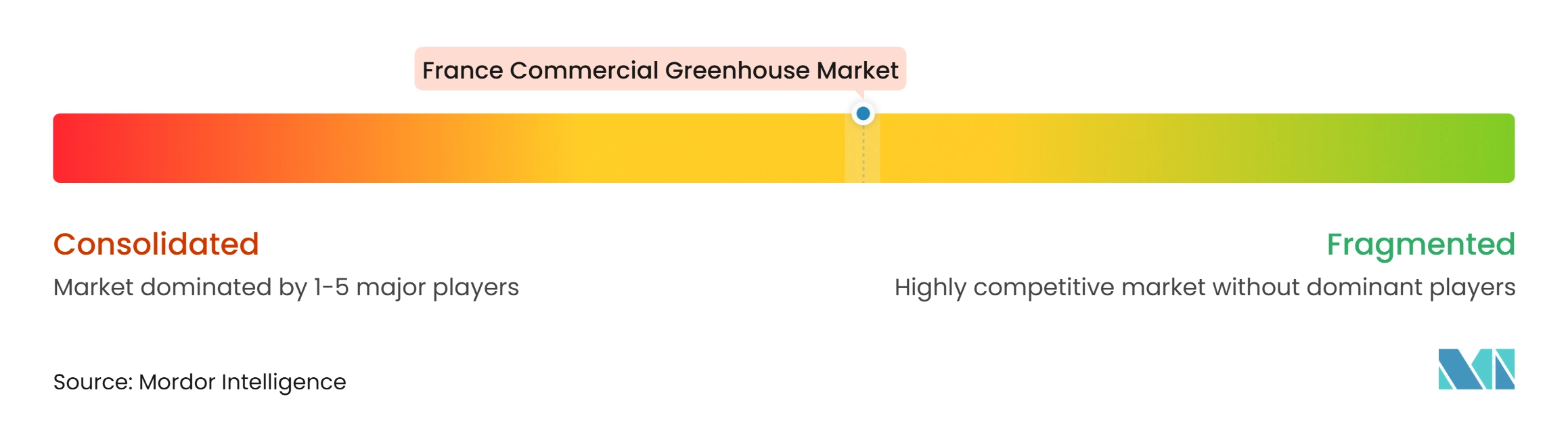
Richel Group operates at a larger scale than many domestic peers and maintains a broad greenhouse portfolio. The approved company group includes CMF Project, JRC Greenhouses, SERRES PRETAMO, Artigianfer France SARL, Havecon Horticultural Projects, Certhon B.V., Prins Group, HORCONEX, Deforche Construction Group (Hedafor), Van der Hoeven Horticultural Projects, SVL Solutions, SARL Galifret, and AM Greenhouses. Rivalry centers on comprehensive greenhouse engineering, portfolio breadth, delivery capability, after-sales coordination, and compliance with grant-linked specifications that influence both funding eligibility and the buyer’s confidence in long-term operational performance under demanding local growing conditions year-round and across varied production conditions. Suppliers with climate-control and energy-performance expertise hold an advantage in higher-value replacement projects.
Richel Group’s July 2026 refinancing strengthened its capital structure for growth. Richel Group also used Project Phénix to position semi-closed plastic structures for growers seeking controlled production at a lower capital threshold than some glass projects. Certhon B.V. completed the Louis Vinet modernization in Nantes during April 2025. The project used a new structure and three-dimensional trellis configuration for cucumber and tomato production. These moves show that local integration and adaptable structure design remain important routes to commercial access, especially when local project delivery requires reliable installation coordination and response during commissioning.
Competitive space remains in projects between 5,000 m² and 20,000 m², where growers require greater performance than basic film structures deliver while still needing to control capital exposure and operational complexity. Suppliers need to balance upfront cost with practical gains in climate control, energy use, and water management. Grant documentation and compliance support have become part of the commercial offer, not just an administrative add-on, because complete and timely evidence affects whether a project qualifies for public support and whether a supplier translates technical rules into a practical, financeable construction specification that aligns with both grower operations and the agency’s review process. Dutch and French providers compete where growers seek turnkey project execution, while local knowledge remains valuable for permitting, installation, crop-specific adaptation, and after-sales coordination. The concentration assessment reflects the scale difference of the leading participants rather than a quantified share calculation.
France Commercial Greenhouse Industry Leaders
-
Richel Group
-
CMF Project
-
JRC Greenhouses
-
SERRES PRETAMO
-
Artigianfer France SARL
- *Disclaimer: Major Players sorted in no particular order
France Commercial Greenhouse Market Companies Covered in this Report
- Richel Group
- CMF Project
- JRC Greenhouses
- SERRES PRETAMO
- Artigianfer France SARL
- Havecon Horticultural Projects
- Certhon B.V.
- Prins Group
- HORCONEX
- Deforche Construction Group (Hedafor)
- Van der Hoeven Horticultural Projects
- SVL Solutions
- SARL Galifret
- AM Greenhouses
- Netafim Ltd. (Orbia Advance Corporation, S.A.B. de C.V.)
Recent Industry Developments in France Commercial Greenhouse Market
- July 2025: Richel Group officially inaugurated Project Phénix at Mauguio, Hérault, a 15,000 m² semi-closed plastic greenhouse for soilless Zero Pesticide Residue tomato production.
- April 2025: Certhon B.V. completed the modernization of Louis Vinet’s greenhouse complex in Nantes, including a new structure with a three-dimensional trellis system for low-wire cucumber and tomato co-cultivation.
- January 2025: FranceAgriMer maintained its EUR 35 million (USD 38.5 million) France 2030 greenhouse innovation investment scheme open through July 2026, with aid rates of 20% to 40% for qualifying new builds, extensions, and high-specification equipment.
France Commercial Greenhouse Market Report Scope
The study counts revenue generated by purpose-built glass or plastic structures where temperature, humidity, light, and fertigation are actively regulated to grow fruits, vegetables, flowers, ornamentals, herbs, and other specialty crops for sale to retailers, food-service buyers, or processors.
Scope exclusion: Backyard hobby houses and purely academic installations below 200 m² are not included.
The France Commercial Greenhouse Market Report is Segmented by Equipment Type (Heating Systems, Cooling and Ventilation Systems, LED Grow Lighting, Irrigation and Fertigation Systems, Climate Control and Automation Software, Screening and Shading Systems, and Structural Components), by Crop Type (Fruits and Vegetables, Flowers and Ornamentals, Herbs and Microgreens, and Cannabis and Specialty Crops), by Greenhouse Type (Glass Greenhouse, Plastic-film Greenhouses, Rigid Polycarbonate Greenhouses, and Hybrid and Semi-closed Greenhouses), by Cultivation Technology (Hydroponic, Non-hydroponic Soil and Substrate, and Hybrid and Vertical Integration), and by End User (Commercial Growers, Research and Educational Institutes and Retail Garden Centers and Nurseries). The Market Forecasts are Provided in Terms of Value (USD).
Segmentation Overview
| Heating Systems | |
| Cooling and Ventilation Systems | |
| LED Grow Lighting | |
| Irrigation and Fertigation Systems | |
| Climate Control and Automation Software | |
| Screening and Shading Systems | |
| Structural Components | Glazing Systems |
| Frames and Trusses |
| Fruits and Vegetables | Tomatoes |
| Cucumbers | |
| Lettuce and Leafy Greens | |
| Peppers | |
| Strawberries and Berries | |
| Flowers and Ornamentals | Cut Flowers |
| Potted Plants and Bedding Plants | |
| Herbs and Microgreens | |
| Cannabis and Specialty Crops | Medical Cannabis |
| Seedlings and Propagation Crops |
| Glass Greenhouses |
| Plastic-film Greenhouses |
| Rigid Polycarbonate Greenhouses |
| Hybrid and Semi-closed Greenhouses |
| Hydroponic | Nutrient Film Technique |
| Deep Water Culture | |
| Drip Hydroponics | |
| Non-hydroponic Soil and Substrate | Soil-based |
| Coco Coir and Rockwool Substrate | |
| Hybrid and Vertical Integration |
| Commercial Growers |
| Research and Educational Institutes |
| Retail Garden Centers and Nurseries |
| By Equipment Type | Heating Systems | |
| Cooling and Ventilation Systems | ||
| LED Grow Lighting | ||
| Irrigation and Fertigation Systems | ||
| Climate Control and Automation Software | ||
| Screening and Shading Systems | ||
| Structural Components | Glazing Systems | |
| Frames and Trusses | ||
| By Crop Type | Fruits and Vegetables | Tomatoes |
| Cucumbers | ||
| Lettuce and Leafy Greens | ||
| Peppers | ||
| Strawberries and Berries | ||
| Flowers and Ornamentals | Cut Flowers | |
| Potted Plants and Bedding Plants | ||
| Herbs and Microgreens | ||
| Cannabis and Specialty Crops | Medical Cannabis | |
| Seedlings and Propagation Crops | ||
| By Greenhouse Type | Glass Greenhouses | |
| Plastic-film Greenhouses | ||
| Rigid Polycarbonate Greenhouses | ||
| Hybrid and Semi-closed Greenhouses | ||
| By Cultivation Technology | Hydroponic | Nutrient Film Technique |
| Deep Water Culture | ||
| Drip Hydroponics | ||
| Non-hydroponic Soil and Substrate | Soil-based | |
| Coco Coir and Rockwool Substrate | ||
| Hybrid and Vertical Integration | ||
| By End User | Commercial Growers | |
| Research and Educational Institutes | ||
| Retail Garden Centers and Nurseries | ||
Key Questions Answered in the Report
What is the value of France’s commercial greenhouse sector in 2026?
France’s commercial greenhouse sector is valued at USD 243.8 million.
Which equipment category leads commercial greenhouse sales in France?
Structural Components led with 42.3% of 2025 sales.
Which crop application has the highest forecast growth through 2031?
The Herbs and Microgreens segment is projected to grow at an 8.7% CAGR during 2026–2031.
What is the main restraint on new commercial greenhouse projects?
High capital, labor, and operating costs are the main restraint to the market