
France Autonomous Agricultural Tractors Market Size and Share
Market Overview
| Study Period | 2021 - 2031 |
|---|---|
| Forecast Data Period | 2026 - 2031 |
| Base Year Market Size (2025) | USD 0.24 Billion |
| Market Size (2026) | USD 0.29 Billion |
| Market Size (2031) | USD 1.02 Billion |
| Growth Rate (2026 - 2031) | 28.60 % |
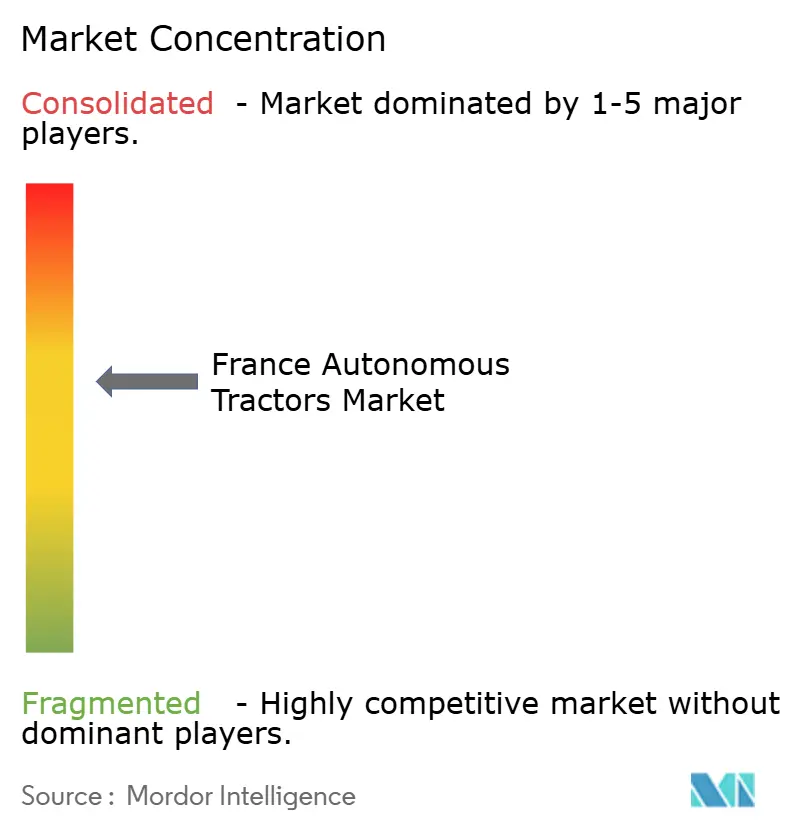
| Market Concentration | Medium |
Major Players *Disclaimer: Major Players sorted in no particular order Image © Mordor Intelligence. Reuse requires attribution under CC BY 4.0. | |
France Autonomous Agricultural Tractors Market Analysis by Mordor Intelligence
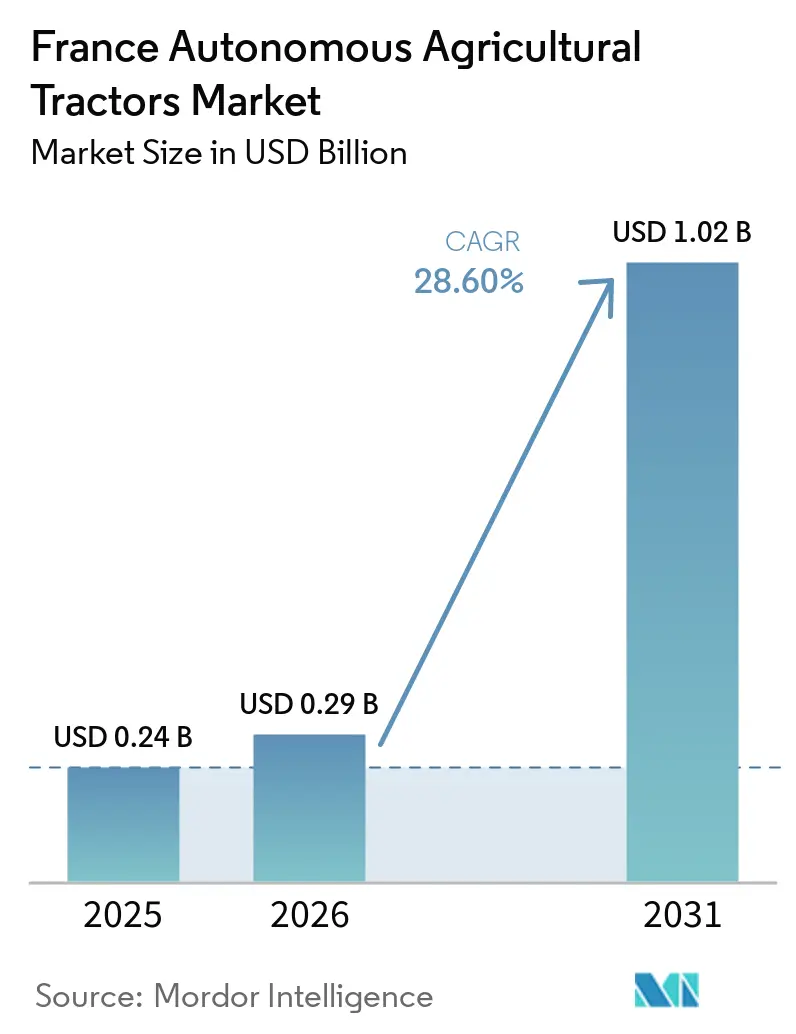
The France autonomous agricultural tractors market size is anticipated to increase from USD 0.24 billion in 2025 to USD 0.29 billion in 2026 and reach USD 1.02 billion by 2031, growing at a CAGR of 28.6% over 2026-2031. The market is expanding in step with a tighter farm labor base, stronger public support for digitized farming, and wider acceptance of automated fieldwork across large arable farms and high-value specialty-crop estates. France agriculture remains a strong setting for this shift because large grain areas, vineyard clusters, orchard belts, and established farm cooperatives create practical conditions for autonomous equipment deployment. The France autonomous agricultural tractors market also benefits from wider access to real-time positioning networks, which reduces a key operating barrier for guidance, path repeatability, and machine supervision in the field. Public equipment aid, research funding, and commercialization activities from global original equipment manufacturers and French robotics firms are helping the France autonomous agricultural tractors market move from pilot use toward broader farm adoption. Adoption is still held back by high upfront system costs and an evolving legal framework for operation, which means growth in France is likely to remain strongest where scale, crop value, or cooperative use improves the payback case.
Key Report Takeaways
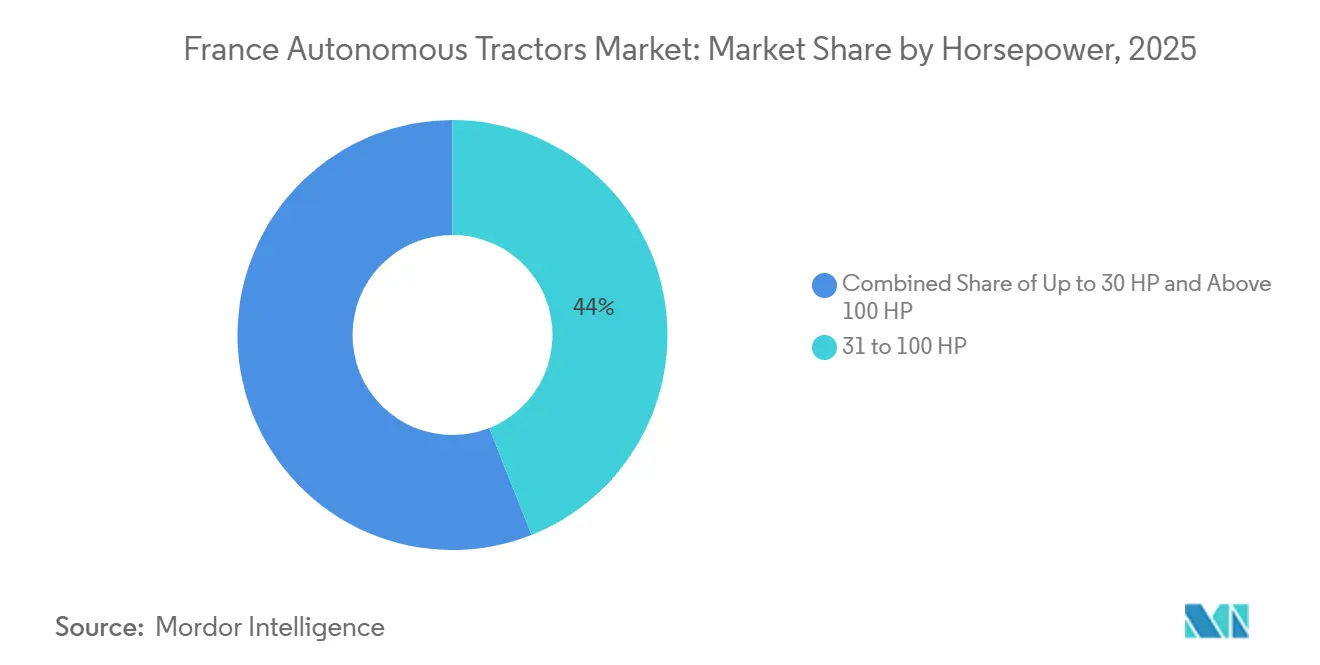
- By horsepower, the 31-100 HP segment held 44.0% of revenue share in 2025, while the above-100 HP segment is forecast to grow at a CAGR of 31.2% from 2026 to 2031.
- By automation level, semi-autonomous systems held 68.0% of the France autonomous agricultural tractors market share in 2025, while fully autonomous systems are forecast to grow at a CAGR of 36.8% from 2026 to 2031.
- By drive type, diesel held a 74.0% of market share in 2025, while battery-electric is forecast to grow at a CAGR of 34.5% from 2026 to 2031.
- By application, orchard and vineyard operations held 39.0% share of the France autonomous agricultural tractors market size in 2025 and are forecast to grow at a CAGR of 32.4% from 2026 to 2031.
- By component, the Global Navigation Satellite System (GNSS) and Global Positioning System (GPS) systems held 31.0% share of the market in 2025, while control and navigation software is forecast to grow at a CAGR of 33.1% from 2026 to 2031.
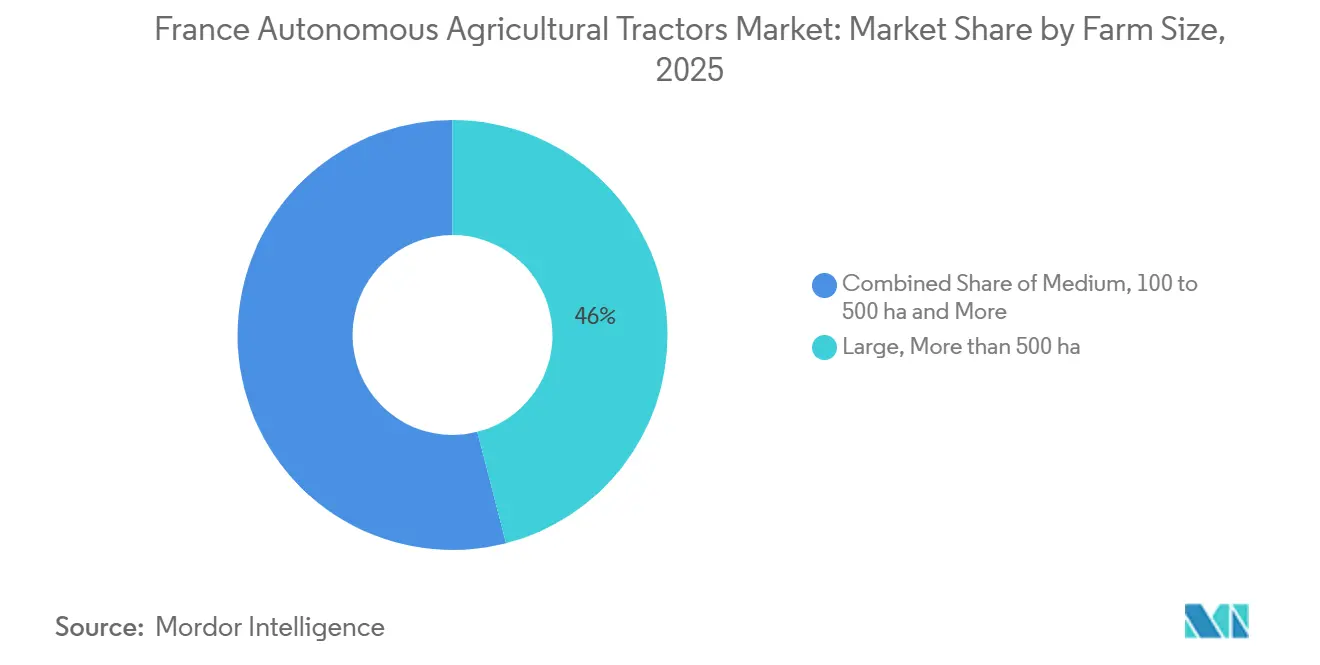
- By farm size, large (more than 500 ha) held 46.0% share in 2025, while medium (100 to 500 ha) is forecast to grow at a CAGR of 29.7% from 2026 to 2031.
Note: Market size and forecast figures in this report are generated using Mordor Intelligence’s proprietary estimation framework, updated with the latest available data and insights as of January 2026.
France Autonomous Agricultural Tractors Market Trends and Insights
Drivers Impact Analysis*
| Driver | (~) % Impact on CAGR Forecast | Geographic Relevance | Impact Timeline |
|---|---|---|---|
| Persistent farm labor shortages in France’s agricultural regions | +5.5% | National, with stronger pressure in vineyard belts and large arable regions | Short term (≤ 2 years) |
| Rising adoption of precision agriculture across large French farms | +4.0% | National, with stronger relevance in northern and central grain regions | Medium term (2-4 years) |
| Strong demand for automation in vineyard and orchard operations in France | +5.0% | Southwest and eastern France, including Bordeaux, Burgundy, Champagne, Loire Valley, and Occitanie | Short term (≤ 2 years) |
| French policy support for agricultural modernization and farm digitization | +3.5% | National | Medium term (2-4 years) |
| Need to improve operating efficiency in labor-intensive French crop production | +4.5% | National, with immediate relevance in mixed farming and cereal areas | Short term (≤ 2 years) |
| Expansion of RTK, GNSS, and connected field infrastructure in France | +3.0% | National, with regional acceleration in Occitanie, Normandy, and Centre-Val de Loire | Medium term (2-4 years) |
| Source: Mordor Intelligence | |||
Persistent Farm Labor Shortages in France’s Agricultural Regions
The France autonomous agricultural tractors market is closely tied to a labor base that continues to narrow across French farming. The International Labor Organization (ILO) data series showed agricultural employment at 2.3% of total French employment in 2025, the lowest point in the series and underscoring how limited the labor pool has become for field work[1]Source: International Labor Organization, “Employment in Agriculture (% of Total Employment),” World Bank Data, data.worldbank.org. Mutualité Sociale Agricole (MSA) reported in its 2025 statistical bulletin that non-salaried farm operators fell by 2.4% from 2023, indicating that the operator base also kept shrinking at the farm ownership level. France Travail reported that 81.5% of agricultural recruitment demand in its 2025 survey was seasonal, indicating that many farms still depend on temporary labor for fieldwork that cannot be easily delayed. This combination supports the market because a machine that can operate with limited human presence helps farms maintain spraying, mowing, tillage, and soil preparation schedules when labor is late. It also makes the market more relevant in vineyards and other labor-intensive crop systems, where a missed field pass can quickly affect crop quality, disease control, and harvesting readiness.
Rising Adoption of Precision Agriculture Across Large French Farms
Precision agriculture is creating a more practical route to autonomy for French farms using digital field tools. France’s National Low-Carbon Strategy, known as Stratégie Nationale Bas-Carbone (SNBC), targeted precision agriculture on an additional 15% of agricultural land by 2030, up from a 5% baseline in the initial stage. Large farms with Global Positioning System (GPS) guidance and Real-Time Kinematic (RTK) auto-steer systems can add autonomous capabilities without replacing their full machinery setup. Adding computer vision and artificial intelligence (AI) tools is less disruptive and less capital-intensive than starting with a new autonomous platform. This supports faster adoption on large farms and makes northern and central arable regions a strong demand base for autonomous upgrade packages.
Strong Demand for Automation in Vineyard and Orchard Operations in France
France’s vineyard and orchard sector provides a strong operating environment for autonomous field systems because these farms manage high-value crops, uneven terrain, and tightly timed field tasks. Repetitive work such as under-vine cultivation, mowing, and spraying can be completed more consistently when autonomous equipment follows planned routes. This is particularly relevant in premium vineyard areas, where labor shortages can delay critical interventions during the growing season. Kubota Corporation introduced its 105.7-horsepower M5 Narrow autonomous tractor platform for vineyard and orchard work in January 2026, showing that major equipment manufacturers are directing product development toward specialty crop operations. These operating needs are making vineyards and orchards an important source of demand for autonomous tractor solutions in France.
French Policy Support for Agricultural Modernization and Farm Digitization
French public policy is providing the France autonomous agricultural tractors market with direct financial and institutional support, rather than merely broad modernization rhetoric. Business France stated that France 2030 committed EUR 2.3 billion (USD 2.5 billion) to agricultural robotics, digital tools, and farm modernization, which signaled sustained public backing for automation-related investment. FranceAgriMer also operates a dedicated EUR 400 million (USD 432 million) fund for innovative agroequipment, with support covering 20% to 30% of equipment costs per farm deployment. In parallel, the France 2030 Priority Research Program on agroecology and digital technology carries EUR 65 million (USD 70 million) in funding and is co-managed by the French National Research Institute for Agriculture, Food and Environment (INRAE) and the French Institute for Research in Computer Science and Automation (Inria), which helps build the technical base for future autonomous field systems. These measures improve the market outlook by reducing part of the cost burden, supporting trials, and providing suppliers with a more predictable commercialization environment. They also help the market widen beyond large private buyers by making cooperative procurement, field validation, and farm-level demonstration more practical.
Restraints Impact Analysis*
| Restraint | (~) % Impact on CAGR Forecast | Geographic Relevance | Impact Timeline |
|---|---|---|---|
| High acquisition cost of autonomous tractor systems for French farms | -4.50% | National, with stronger impact on small and medium farms | Short term (≤ 2 years) |
| Limited economic viability for small and fragmented farm holdings in France | -3.00% | National, with greater pressure in fragmented farming areas | Long term (≥ 4 years) |
| Regulatory and liability uncertainty for unmanned field operations in France | -2.50% | National | Medium term (2-4 years) |
| Connectivity gaps and integration challenges in rural French farming areas | -1.50% | Rural and remote agricultural zones | Medium term (2-4 years) |
| Source: Mordor Intelligence | |||
High Acquisition Cost of Autonomous Tractor Systems for French Farms
High acquisition costs remain a major barrier to the adoption of autonomous agricultural tractors in France, especially for small and medium-sized farms. Fully integrated systems require a level of capital investment that many farm businesses cannot justify without public support or shared ownership arrangements. The financial burden also extends beyond the initial purchase, as farms may need to fund system integration, connectivity, maintenance, training, and software support. France 2030 support can cover 20% to 30% of eligible innovative equipment costs, but the remaining investment still puts pressure on farm cash flows[2]Source: FranceAgriMer, “France 2030,” FranceAgriMer, franceagrimer.fr. This makes financing options, retrofit systems, and cooperative ownership models important for expanding adoption beyond the largest French farms.
Limited Economic Viability for Small and Fragmented Farm Holdings in France
Farm structure is another clear limit on how quickly the France autonomous agricultural tractors market can expand. A study of 469 farms in Brittany found that moving to the next lower quartile of land fragmentation, measured by the number of plots, could increase average farm pre-tax profit by approximately 29%. The finding highlights the broader efficiency implications of operating across fragmented land parcels. This is particularly relevant for autonomous tractors, as geographically dispersed and irregular plots can limit equipment utilization and require additional movement, setup, field mapping, and operational oversight between fields. Small farms also have fewer annual machine hours to spread an expensive autonomy system over, extending the payback period well beyond what many operators consider acceptable. In those conditions, the market is more likely to expand through cooperatives, shared fleets, and retrofit models than through single-farm ownership on every holding. Unless product pricing falls further or service models widen, fragmented land structures will keep adoption concentrated in the upper tier of better-scaled operations.
*Our forecasts treat driver/restraint impacts as directional, not additive. The impact forecasts reflect baseline growth, mix effects, and variable interactions.
Segment Analysis
By Horsepower: Compact Tractors Lead as High-Power Adoption Accelerates
The 31-100 HP range was the largest segment, held 44.0% of the France autonomous agricultural tractor market share in 2025, underscoring how well compact and mid-sized platforms fit current French field conditions. This class aligns well with vineyards, orchards, and specialized crop rows where machine width, turning radius, and lower soil pressure matter as much as raw pulling power. The market still relies on this segment because specialty crop farms constitute the most active commercial base for autonomous fieldwork today. Machines in this range also match repetitive jobs such as inter-row mowing, mechanical weeding, and targeted spray support, which are easier to automate than highly variable, heavy-field tasks. Their practical fit with orchard and vineyard layouts keeps this horsepower band at the center of current deployment volume.
At the same time, the above-100-HP segment is the fastest-growing, forecast to grow at a CAGR of 31.2% from 2026 to 2031. This growth is linked to large cereal and oilseed holdings that can justify autonomous tillage, soil preparation, and broad-acre operations over large parcels. High-horsepower systems become more attractive when farms can spread capital cost across many annual hours and reduce dependence on scarce operators during peak campaign periods. The up-to-30-horsepower category remains smaller, but it is gaining relevance in areas where dense specialty crops require ultra-compact equipment and very precise, low-speed passes. Taken together, the horsepower split shows that the French autonomous agricultural tractor industry is moving on two tracks, with compact units driving current scale and heavy units driving the next wave of arable adoption.



By Automation Level: Semi-Autonomous Systems Dominate, Full Autonomy Surges
Semi-autonomous systems held the largest share of the France autonomous agricultural tractors market in 2025, at 68.0%. This reflected the current comfort levels of farmers, dealers, and insurers, since supervised operations reduce both operational uncertainty and compliance pressure while still cutting labor intensity. Semi-autonomous platforms also fit the installed farm base because they can build on existing guidance habits rather than asking operators to shift immediately into fully unmanned routines. In commercial terms, they offer a middle step that allows users to test performance, supervision processes, and field reliability before making a larger commitment. That is why the France autonomous agricultural tractors market remains anchored in semi-autonomous deployment, even as more advanced systems continue to arrive.
Fully autonomous systems remain the smaller base, but they are forecasted to be the fastest-growing segment, with a 36.8% CAGR from 2026 to 2031. The France autonomous agricultural tractors market size for full autonomy is rising as navigation software, obstacle detection, and safety architecture improve across commercial platforms. The shift will likely stay strongest in structured crop systems first, because fixed rows, repeated routes, and limited operating speeds make validation easier. Over time, as legal clarity improves and more farms gain confidence in remote supervision, the market should see a broader transfer from supervised autonomy to uncrewed operation.
By Drive Type: Diesel Commands Market Share as Battery-Electric Gains Speed
Diesel remained the largest drive type and held 74.0% of the France autonomous agricultural tractors market share in 2025. This reflects the simple fact that the current farm fleet, service network, and refueling routines are still built around diesel-based tractors and retrofit logic. Diesel also remains better suited to long field sessions and heavy-traction needs on large arable farms, where uninterrupted power output still matters. In the market, this makes diesel the practical base for early commercial scale, especially where autonomy is added onto conventional platform thinking. It also explains why many first-generation autonomous deployments still rely on familiar energy systems even when their control architecture is more advanced.
Battery-electric is the fastest-growing drive type, and forecast to grow at a CAGR of 34.5% from 2026 to 2031. This growth aligns with vineyard and orchard operations, where duty cycles are shorter, machine weights are lower, and the appeal of zero tailpipe emissions is stronger. Kubota Corporation and CNH Industrial N.V. (New Holland) both presented specialty crop automation platforms that support the broader movement toward lower-emission, compact, autonomous solutions in horticulture and viticulture. Hybrid systems sit between these two ends and offer a way to balance range, precision control, and longer operating windows where full electrification is not yet ideal. The drive mix shows that the market is not moving through a single energy pathway, because farm use cases differ too much between grain fields and premium specialty crops.
By Application: Vineyards and Orchards Define Market Trajectory
Orchard and vineyard operations were both the largest and fastest-growing application segments, with a 39.0% share in 2025, and are forecast to grow at a 32.4% CAGR from 2026 to 2031. This means the France autonomous agricultural tractors market is being shaped first by field environments where work is repetitive, value per hectare is high, and labor pressure is acute. Repeated passes for mowing, under-vine care, targeted treatment, and narrow-row navigation create a strong technical match for autonomy. This application also benefits from the fact that compact machines can deliver a visible operating result without needing the scale of a large grain enterprise. As a result, orchard and vineyard work give the market its clearest near-term commercial identity.
Tillage remains the next major application, as large cereal farms want to use machines for longer periods during narrow post-harvest and pre-planting windows. Sowing is progressing gradually, with pre-mapped fields and guided task execution helping reduce overlap and improve timeliness, but commercial depth still lags that of vineyard operations. Harvesting remains the least mature autonomous application in this market because it combines tighter safety demands, more crop variability, and greater system complexity. Even so, the application mix suggests that the market will expand outward from specialty crop leadership into broader arable work as performance data and field confidence improve. The current pattern also shows that adoption does not move evenly across tasks, since farms are prioritizing operations where autonomy already fits routine, timing, and machine design constraints.
By Component: Positioning Systems Lead, Software Redefines Value
Global Positioning System (GPS) and Global Navigation Satellite System (GNSS) components led with a 31.0% share in 2025, making them the largest component category in the France autonomous agricultural tractors market. That ranking is logical because positioning remains the base layer for navigation, repeatability, geofencing, and task execution. The market has built much of its early value on reliable correction services and route control before moving into more advanced sensing and decision layers. A strong RTK footprint from the open Centipede network and national commercial coverage from Orphéon support this component leadership[3]Source: French National Research Institute for Agriculture, Food and Environment, “Democratising Precision-Guided Agriculture, Ever-Expanding Centipede-RTK Network,” INRAE, inrae.fr. Positioning hardware, therefore, remains central not only to current machine function but also to the broader adoption path from precision farming to autonomy.
Control and navigation software is the fastest component segment, and the France autonomous agricultural tractors market size for this category is forecast to grow at 33.1% CAGR from 2026 to 2031. That shift matters because value is moving from basic guidance into path planning, machine coordination, obstacle handling, and remote fleet supervision. Bosch Rexroth's focus on machine control ecosystems and cloud-linked autonomy functions shows how suppliers are trying to capture more of that software-led layer. Sensors, camera systems, light detection and ranging (LiDAR), and radar modules will also gain weight as certification and safety expectations rise for unsupervised field use. This means the market is gradually shifting from a hardware-centered proposition to a more integrated stack in which software quality can determine commercial advantage.
By Farm Size: Large Farms Anchor Demand, Mid-Size Closes the Gap
Large farms (more than 500 ha) accounted for 46.0% of the France autonomous agricultural tractor market in 2025, making them the largest buyer group. This outcome reflects the easier payback logic of spreading high capital costs across larger areas, more workdays, and more annual machine hours. Large grain farms can also absorb experimentation more easily because they typically operate larger fleets, manage broader parcels, and place a high value on timeliness during seasonal peaks. In the France autonomous agricultural tractors market, this makes large holdings the first natural destination for high-horsepower autonomous systems and advanced retrofit packages. Their role is likely to remain important because they can validate commercial performance at a scale that smaller farms cannot match on their own balance sheets.
Medium farms (100 to 500 ha) are the fastest-growing group, forecast to grow at a CAGR of 29.7% from 2026 to 2031. The market is becoming more accessible to this segment as retrofit options, subsidies, and cooperative use models improve the affordability of autonomous field work. A Normandy demonstration under the Robots des Champs II project showed how cooperative structures can test autonomous robots across several member farms and build evidence for shared investment decisions. Small farms below 100 hectares remain the weakest adoption tier because field fragmentation, limited machine hours, and residual capital cost still make ownership difficult. This split suggests that the France autonomous agricultural tractors industry will broaden next through pooled access and medium-sized farm adoption rather than through universal single-farm ownership.
Geography Analysis
Northern and central France account for the largest practical deployment base in the France autonomous agricultural tractors market because they combine large grain farms, regular parcel geometry, and strong use of digital field management. These regions support longer autonomous working windows because broad fields reduce turning complexity and allow more continuous machine movement. The market is therefore well suited to Beauce, Picardie, Hauts-de-France, and Center-Val de Loire, where high-horsepower autonomous tillage and soil preparation can be justified by scale. Farms in these areas also tend to have a stronger base of guidance systems and correction services, which makes the shift into higher automation more feasible. Dealer support and service readiness are likely to deepen first in this geography because the conversion case is clearer and the installed customer base is already familiar with precision farming tools.
Normandy and Pays de la Loire form a second important zone in the market, as mixed farming and cooperative use can support adoption among the smaller farm classes. Cooperative testing has already shown how autonomous machines can be shared across member farms rather than bought by a single large operator. This matters because the industry in France depends not only on individual balance-sheet strength but also on whether access models can broaden the user base. These western regions are therefore relevant as proving grounds for pooled ownership, shared service, and structured field demonstrations. If these models work at scale, they can lower the adoption barrier for farms that are too small to justify a dedicated machine but large enough to benefit from autonomous operations during peak windows.
Southwest and eastern France give the market its strongest specialty-crop profile, with Bordeaux, Burgundy, Champagne, the Loire Valley, and other vineyard and orchard regions. These regions combine high-value crop systems with repetitive inter-row tasks, making compact autonomous platforms easier to deploy commercially. Product launches from CNH Industrial N.V. (New Holland) and Kubota Corporation show how suppliers are actively targeting this geography with narrow, specialty-focused automation platforms. The result is a market that is geographically split between large-scale arable adoption in the north and specialty-crop leadership in the south, west, and east.
Competitive Landscape
The France autonomous agricultural tractors market shows moderate concentration, with established global original equipment manufacturers competing alongside French and European specialists in robotics, retrofit autonomy, guidance, and machine control. Deere & Company, CNH Industrial N.V., AGCO Corporation, Kubota Corporation, CLAAS KGaA mbH, and other large platform suppliers bring scale, dealer coverage, and established customer relationships that smaller firms cannot easily match. At the same time, the France autonomous agricultural tractors market remains open enough for value-chain specialists because autonomy depends on software, positioning, sensing, control units, and field integration rather than on the tractor platform alone. That leaves room for companies that do not manufacture full tractors but can supply a key layer of the autonomous operating stack. This structure explains why competition is active but not fully locked down by a small set of firms.
A clear strategic pattern is the integration of platforms by original equipment manufacturers. In April 2026, CLAAS KGaA mbH began series production of the AXION 9 CMATIC at Le Mans with integrated Autonomy Level 2 capability through the AgXeed Vehicle Control Unit, which showed how major brands are moving autonomy into serial production rather than keeping it in pilot form. In January 2026, Kubota Corporation announced the commercialization of an autonomous specialty tractor built on its M5 Narrow platform for vineyard and orchard operations, marking a direct push into specialty crop automation. In November 2025, CNH Industrial N.V. (New Holland) unveiled the R4 autonomous robot series for vineyard and orchard operators, reinforcing the specialty-crop focus already evident in the market. These moves show that competition is shifting from concept statements to commercial product sequencing tied to real-world farm use cases.
Another important feature is the growing role of specialist technology firms and partnerships. Bosch Rexroth is positioning itself as a cross-brand autonomy enabler through machine control and off-road robotic controller systems, which could give it influence beyond any single tractor brand. Agreenculture adds another layer through retrofit autonomy kits for tractor and implement manufacturers, broadening access beyond full machine replacement. The result is a France autonomous agricultural tractors market where large manufacturers still hold an advantage, but where software, retrofit, and control specialists can still shape adoption paths and customer economics.
France Autonomous Agricultural Tractors Industry Leaders
Deere & Company
CNH Industrial N.V.
AGCO Corporation
Kubota Corporation
CLAAS KGaA mbH
- *Disclaimer: Major Players sorted in no particular order

Recent Industry Developments
- March 2026: CLAAS KGaA mbH began series production of the AXION 9 CMATIC large tractors at its Le Mans facility in France, marking the commercial launch of its first tractor line with integrated Autonomy Level 2 capability through the AgXeed Vehicle Control Unit (VCU). The Le Mans plant, described by CLAAS as one of the most modern tractor manufacturing facilities in the world, is currently delivering the award-winning AXION 9.450 TERRA TRAC model to customers across Europe, with the ARION 6.190 CMATIC to follow in May 2026.
- January 2026: Kubota Corporation announced the commercialization of an autonomous specialty tractor built on the 105.7 hp M5 Narrow diesel platform, developed in partnership with a United States-based Artificial Intelligence (AI) startup Agtonomy, at the Consumer Electronics Show (CES) 2026 in Las Vegas. The platform targets vineyard and orchard operations with factory-integrated sensing and AI capabilities for early commercial availability in 2026
- November 2025: CNH Industrial N.V.'s New Holland brand unveiled the R4 autonomous robot series for vineyard and orchard operators at Agritechnica 2025, developed jointly by CNH research teams in Modena, Italy and the New Holland Center of Excellence for Specialty Harvesting in Coëx, France. The R4 series includes two models controlled via GPS, LiDAR, and vision cameras and managed through a mobile application, addressing labor shortages and demand for lower-emission crop production .


France Autonomous Agricultural Tractors Market Report Scope
The France autonomous agricultural tractors market as the revenue generated from new, self-propelled agricultural tractors that can operate with no on-board driver for at least one full field cycle by relying on integrated GPS/GNSS, sensor suites, and decision-support software. The Autonomous Tractors Market Report is Segmented by Horsepower (Up To 30 HP, 31 to 100 HP, and More), by Automation Level (Semi-Autonomous and Fully Autonomous), by Drive Type (Diesel, Hybrid and Battery-Electric), by Application (Tillage, Sowing, and More), by Component (GPS/GNSS, Sensors and Vision Systems, and More), and by Farm Size (Small, Medium, and Large). The Market Forecasts are Provided in Terms of Value (USD).
| Up to 30 HP |
| 31 to 100 HP |
| Above 100 HP |
| Semi-Autonomous |
| Fully Autonomous |
| Diesel |
| Hybrid |
| Battery-Electric |
| Tillage |
| Sowing |
| Harvesting |
| Orchard and Vineyard Operations |
| GPS/GNSS |
| Sensors and Vision Systems |
| LiDAR and Radar Modules |
| Control and Navigation Software |
| Small (Less than 100 ha) |
| Medium (100 to 500 ha) |
| Large (More than 500 ha) |
| By Horsepower | Up to 30 HP |
| 31 to 100 HP | |
| Above 100 HP | |
| By Automation Level | Semi-Autonomous |
| Fully Autonomous | |
| By Drive Type | Diesel |
| Hybrid | |
| Battery-Electric | |
| By Application | Tillage |
| Sowing | |
| Harvesting | |
| Orchard and Vineyard Operations | |
| By Component | GPS/GNSS |
| Sensors and Vision Systems | |
| LiDAR and Radar Modules | |
| Control and Navigation Software | |
| By Farm Size | Small (Less than 100 ha) |
| Medium (100 to 500 ha) | |
| Large (More than 500 ha) |


Key Questions Answered in the Report
Which application leads demand in France?
Orchard and vineyard operations lead current in France.
Why are vineyard and orchard farms adopting autonomous tractors first?
These farms run repetitive low-speed tasks, face labor pressure, and manage high-value crops, which makes the payback case for autonomous operations stronger than in many other field uses.
What is the biggest barrier to adoption in France?
High acquisition cost remains the main barrier, especially for smaller farms, even though FranceAgriMer support can cover 20% to 30% of eligible equipment costs.
Which farm size group is expanding fastest?
Medium farms (100 to 500 ha) expanding fastest among the farm size group in the country.
Page last updated on:





