
Food Binders Market Size and Share
Market Overview
| Study Period | 2027 - 2032 |
|---|---|
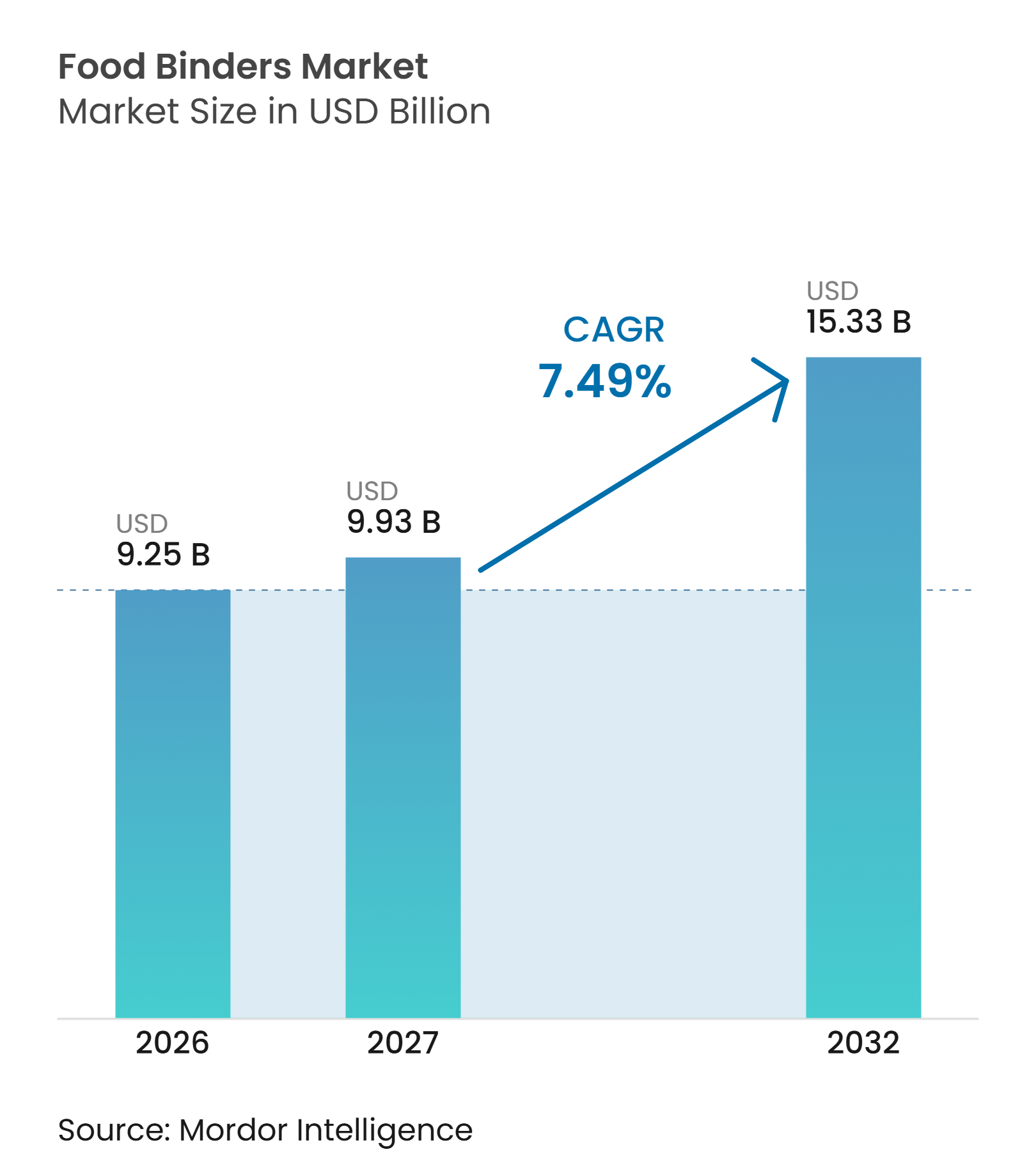
| Market Size (2027) | USD 9.93 Billion |
| Market Size (2032) | USD 15.33 Billion |
| Growth Rate (2027 - 2032) | 7.49 % |
| Fastest Growing Market | Asia-Pacific |
| Largest Market | Asia-Pacific |
| Market Concentration | Medium |
Major Players *Disclaimer: Major Players sorted in no particular order Image © Mordor Intelligence. Reuse requires attribution under CC BY 4.0. | |
Food Binders Market Analysis by Mordor Intelligence
The food binders market size is expected to increase from USD 9.25 billion in 2026 to USD 9.93 billion in 2027 and reach USD 15.33 billion by 2032, growing at a CAGR of 7.49% over 2027–2032. Growth depends on improving food texture, consistency, and product stability while meeting evolving requirements for clean-label and functional ingredients. Rising demand for processed and convenience foods, increasing adoption of plant-based meat and dairy alternatives, and growing use of natural food ingredients support market expansion. Product innovation in plant-based and microbial binding solutions creates opportunities for differentiation, while expanding applications across bakery products, confectionery, meat products, and dairy products strengthen demand. However, raw material price volatility, stringent food safety and regulatory requirements, and sourcing complexities for specialized microbial binders complicate market expansion. Growth therefore favors manufacturers that can develop cost-effective binding formulations, maintain consistent ingredient functionality, and supply versatile solutions across diverse food applications.
Key Report Takeaways
- By source, plant-based binders accounted for the largest share of the food binders market size at 69.29% in 2026, while microbial binders are forecast to grow fastest at a 9.15% CAGR over 2026–2031.
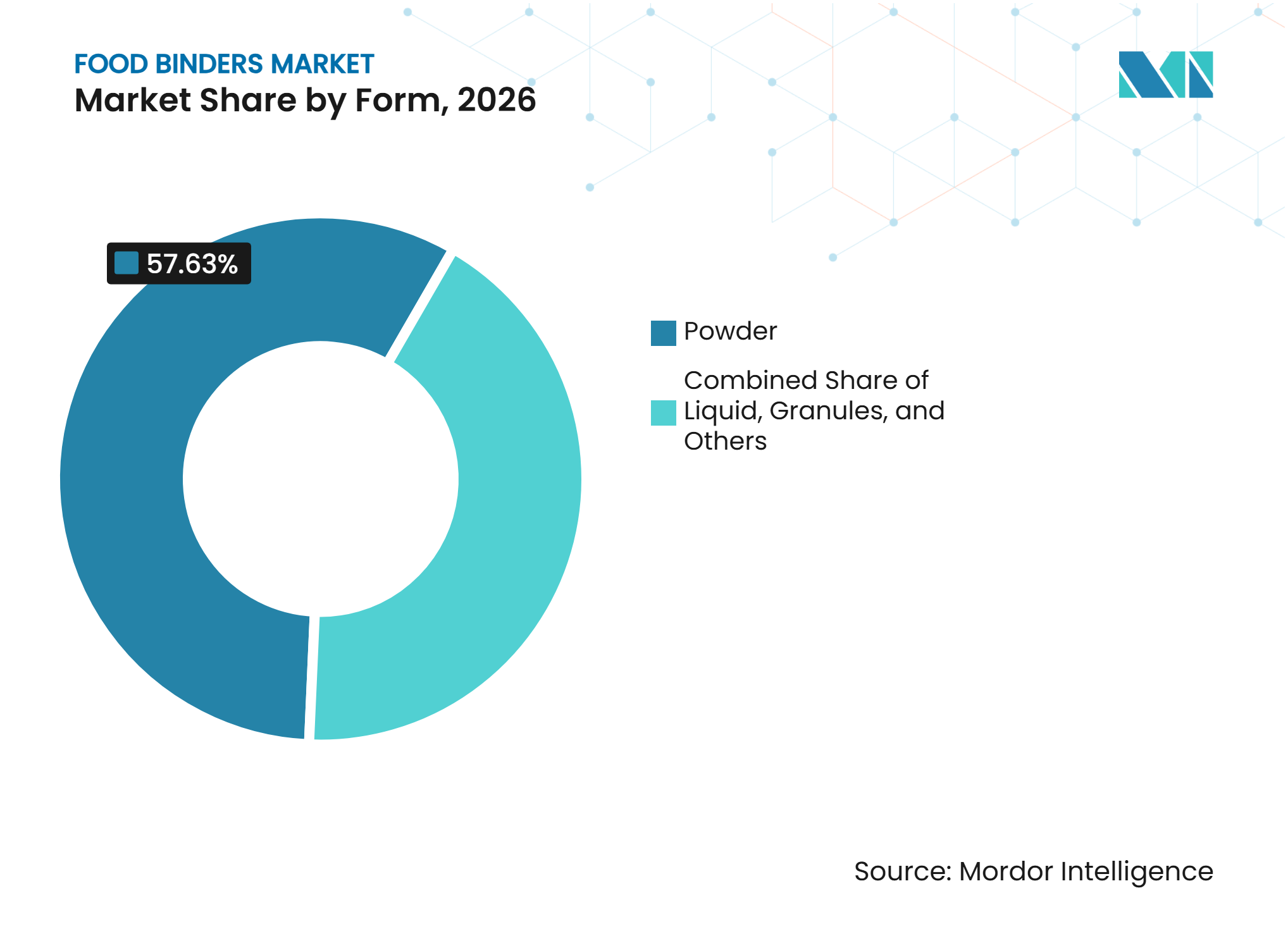
- By form, powder dominated with a 57.63% market share in 2026, while granules are projected to record the fastest growth at an 8.28% CAGR over 2026–2031.
- By application, bakery products accounted for the largest share at 34.46% in 2026, while dairy products are expected to grow fastest at an 8.44% CAGR over 2026–2031.
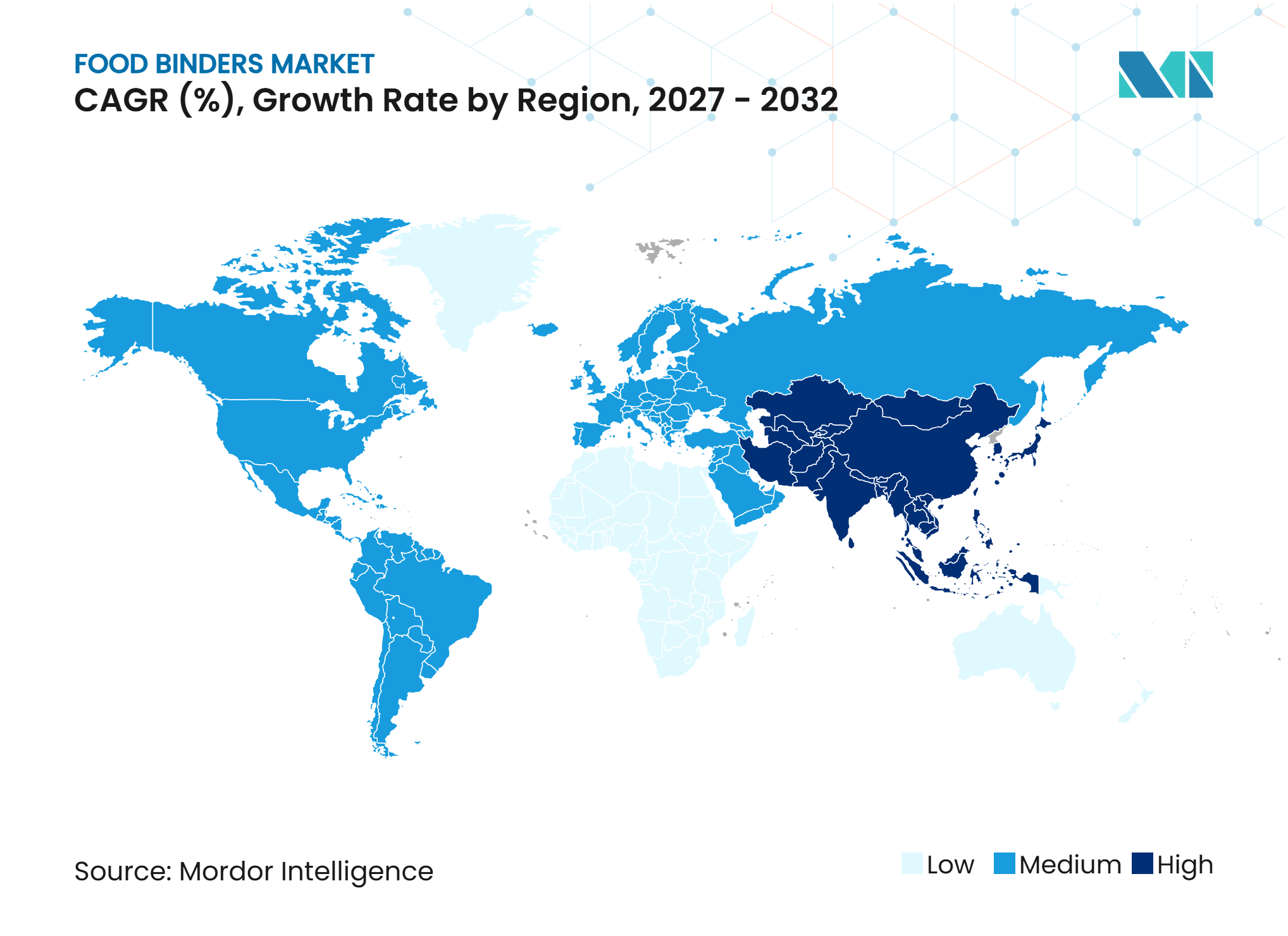
- Among geographies, Asia-Pacific led with a 37.94% share of the food binders market in 2026 and is also forecast to grow fastest at an 8.20% CAGR over 2026–2031.
Note: Market numbers in this report are based on Mordor Intelligence's proprietary estimation framework, which combines nine months of actuals with Q4 projections for base year 2026.
Market Trends and Insights
Drivers Impact Analysis of Food Binders Market*
| Driver | (~) % Impact on CAGR Forecast | Geographic Relevance | Impact Timeline |
|---|---|---|---|
| Rising demand for processed and convenience foods | +1.0% | Global, particularly North America, Europe, and Asia-Pacific, where packaged food consumption and demand for convenient meal solutions are expanding | Short term (Less than 2 years) |
| Growing adoption of plant-based meat and dairy alternatives | +0.9% | Global, particularly North America and Europe, with increasing adoption across Asia-Pacific | Medium term (2–4 years) |
| Increasing demand for clean-label and natural food ingredients | +0.8% | Global, particularly North America and Europe, where manufacturers are reformulating products to meet clean-label preferences | Medium term (2–4 years) |
| Growing demand for binder solutions in sauces, dressings, and ready-to-use preparations | +0.7% | Global, particularly North America, Europe, and Asia-Pacific, supported by expanding processed food and foodservice applications | Medium term (2–4 years) |
| Growing demand for texture improvement and product stability | +0.6% | Global, particularly Europe and North America, where food manufacturers emphasize consistency, shelf stability, and product quality | Medium term (2–4 years) |
| Technological advancements in food ingredient formulations | +0.5% | Global, particularly North America, Europe, and Asia-Pacific, where ingredient manufacturers are developing specialized plant-based and microbial binding solutions | Long term (More than 4 years) |
| Source: Mordor Intelligence | |||
Rising Demand for Processed and Convenience Foods
The growing consumption of processed and convenience foods is creating opportunities for food binder manufacturers as food processors require ingredients that maintain product consistency, texture, and stability during manufacturing, storage, and distribution. The Agricultural and Processed Food Products Export Development Authority (APEDA), under the Ministry of Commerce and Industry, Government of India, identifies convenience foods, nutritional products, and packaged food items as increasingly important consumer preferences, supported by urbanization, higher disposable incomes, and changing dietary patterns [1]. The Ministry of Food Processing Industries (MoFPI) also highlights the expansion of ready-to-eat and ready-to-cook food categories as an important growth area in the organized consumer food industry [2]. These developments increase the need for binding ingredients that improve moisture retention, viscosity, and structural consistency across processed food formulations. Food binders therefore support manufacturers in developing convenient food products with consistent quality and processing performance.
Growing Adoption of Plant-Based Meat and Dairy Alternatives
The increasing development of plant-based meat and dairy alternatives is creating demand for food binders that improve the texture, structure, and functional properties of alternative protein formulations. The Ministry of Food Processing Industries, Government of India, identifies plant-based dairy alternatives, including almond, oat, soy, and coconut-based products, alongside meat alternatives made from jackfruit, soy, and pea protein, as emerging areas within India's plant-based protein sector. These formulations require ingredients that help maintain cohesion, water retention, binding strength, and desirable mouthfeel, particularly in products designed to replicate conventional meat and dairy characteristics. The Government of Canada's Agriculture and Agri-Food department also identifies plant-based dairy alternatives, ready meals, and meat substitutes as established application categories for non-animal-derived protein ingredients [3]. As manufacturers expand their alternative protein portfolios, the need for compatible plant-based binding systems is expected to increase. This creates opportunities for suppliers offering starches, gums, fibers, and other functional ingredients suited to plant-based formulations.
Increasing Demand for Clean-Label and Natural Food Ingredients
The growing emphasis on clean-label formulations and recognizable food ingredients is encouraging manufacturers to explore natural binding solutions as alternatives to certain synthetic or highly processed additives. The United States Department of Agriculture's Economic Research Service (USDA ERS) reports that consumers associate natural food labels with healthier choices and that natural claims are widely used across processed food products. This preference creates opportunities for food binder manufacturers to develop solutions based on plant-derived starches, gums, pectin, cellulose, and other naturally sourced ingredients. Food processors are increasingly required to balance ingredient transparency with functional requirements such as viscosity, moisture retention, emulsification, and product stability. The Ministry of Food Processing Industries, Government of India, also identifies clean-label and natural foods, including the reformulation of products to reduce synthetic additives, as an emerging area of food industry innovation. Consequently, suppliers that can provide naturally sourced binders with reliable functionality and consistent quality are positioned to benefit from the shift toward cleaner food formulations.
Growing Demand for Binder Solutions in Sauces, Dressings, and Ready-to-Use Preparations
The expanding use of sauces, dressings, gravies, spreads, and ready-to-use food preparations is creating opportunities for food binders that improve viscosity, suspension, and formulation stability. The Food and Agriculture Organization of the United Nations (FAO) identifies hydrocolloids as important functional ingredients in sauces, salad dressings, soups, and meat products, where they serve as thickening, gelling, and stabilizing agents [4]. Ingredients such as xanthan gum, guar gum, alginates, and modified starches help manufacturers maintain the desired consistency and prevent ingredient separation during processing and storage. Increasing demand for convenient food preparations also encourages manufacturers to develop formulations that retain their texture and quality across different handling and storage conditions. As food processors expand their ready-to-use product portfolios, the requirement for application-specific binding and stabilization solutions is expected to increase. This supports opportunities for food binder suppliers offering ingredients that can perform across different liquid, semi-solid, and emulsified food systems.
Restraints Impact Analysis of Food Binders Market*
| Restraint | (~) % Impact on CAGR Forecast | Geographic Relevance | Impact Timeline |
|---|---|---|---|
| Volatility in prices of raw materials used in food binder production | −0.8% | Global, particularly Asia-Pacific and South America, where sourcing costs and agricultural commodity price fluctuations can affect ingredient manufacturers | Medium term (2–4 years) |
| Stringent food safety and regulatory requirements | −0.7% | Global, particularly North America and Europe, where food ingredient regulations, safety standards, and compliance requirements increase product development and commercialization costs | Medium term (2–4 years) |
| Complexity of sourcing specialized microbial binders | −0.6% | Global, particularly regions with limited microbial ingredient manufacturing infrastructure and dependence on specialized suppliers | Long term (More than 4 years) |
| Functional limitations of certain natural binding ingredients | −0.5% | Global, particularly North America and Europe, where manufacturers require consistent binding performance across complex processed food formulations | Medium term (2–4 years) |
| Source: Mordor Intelligence | |||
Volatility in Prices of Raw Materials
Food binder production relies on agricultural commodities, plant-derived materials, and specialized microbial inputs, making manufacturers vulnerable to fluctuations in raw material prices. Changes in crop yields, weather conditions, transportation costs, and supplier availability can increase procurement expenses and affect production margins. Smaller manufacturers may face additional challenges in absorbing cost increases while maintaining competitive product pricing. These fluctuations can also complicate long-term sourcing agreements and consistent supply planning.
Stringent Food Safety and Regulatory Requirements
Food binder manufacturers must comply with food safety standards, ingredient approval requirements, purity specifications, and permitted usage levels across different markets. Regulatory differences between countries can increase testing, documentation, and compliance costs, particularly for manufacturers introducing new natural and microbial binding ingredients. These requirements may extend product development and commercialization timelines. Smaller suppliers may face greater challenges in meeting regulatory requirements while maintaining cost competitiveness.
*Our forecasts treat driver/restraint impacts as directional, not additive. The impact forecasts reflect baseline growth, mix effects, and variable interactions.
Food Binders Market Segment Analysis
By Source:
Plant-Based Binders Lead While Microbial Binders Expand FasterIn 2026, plant-based binders accounted for an estimated 69.29% of the Food Binders Market, making them the leading source category. Their position reflects widespread use of starches, gums, fibers, and other botanical ingredients across bakery products, confectionery, meat products, dairy preparations, and processed foods. Plant-derived binders are valued for their ability to improve viscosity, moisture retention, texture, and product stability. Their compatibility with clean-label formulations and growing adoption of plant-based food products further support demand. Meanwhile, microbial binders are projected to record the fastest growth, at an estimated CAGR of 9.15% over 2026–2031. Ingredients such as xanthan gum and other fermentation-derived polysaccharides provide functional properties that support thickening, stabilization, and binding across different food applications.
Animal-based binders serve applications where protein-based binding, gel formation, and structural properties are required, particularly in meat and other processed food products. Other source categories also contribute to the market through specialized functional ingredients used in specific food formulations. However, manufacturers across all source categories need to maintain consistent ingredient quality, functional performance, and cost competitiveness. The ability to provide application-specific binding solutions while meeting evolving food formulation requirements will remain important for market participants.
By Form:
Powder Leads While Granules Expand FasterIn 2026, powder accounted for an estimated 57.63% of the Food Binders Market, making it the leading form. Its position reflects ease of handling, storage, transportation, and incorporation into different food formulations. Powdered binders are widely used across bakery products, confectionery, dairy preparations, meat products, and other processed food applications. Their suitability for dry ingredient blends and controlled formulation processes supports their adoption among commercial food manufacturers. Meanwhile, granules are projected to record the fastest growth, at an estimated CAGR of 8.28% over 2026–2031. Granulated binders offer opportunities for improved handling, controlled dispersion, and convenient ingredient incorporation in selected food processing applications.
Liquid binders serve manufacturers requiring ingredients that can be incorporated directly into liquid and semi-liquid formulations, including sauces, dressings, and dairy preparations. Other forms address specialized processing and formulation requirements across the food industry. However, manufacturers need to consider dissolution characteristics, dispersion, storage stability, and compatibility with different processing conditions when selecting binder formats. Product development that balances handling convenience with functional performance will remain important across form categories.


By Application:
Bakery Products Lead While Dairy Products Expand FasterIn 2026, bakery products accounted for an estimated 34.46% of the Food Binders Market, making them the leading application segment. Their position reflects the widespread use of binding ingredients to improve dough consistency, moisture retention, texture, and structural stability across bread, cakes, pastries, and other baked products. Food binders help manufacturers maintain product quality during mixing, baking, cooling, and storage. Meanwhile, dairy products are projected to record the fastest growth, at an estimated CAGR of 8.44% over 2026–2031. Increasing demand for consistent texture, viscosity, and stability in yogurt, dairy desserts, processed cheese, and other dairy preparations supports the use of functional binding ingredients.
Confectionery applications use binders to support product cohesion, texture, and consistency, while meat products require ingredients that improve binding strength, moisture retention, and structural integrity. Beverages and other food and beverage applications also provide opportunities for specialized binding and stabilizing solutions. However, manufacturers need to select ingredients according to application-specific requirements, including processing temperatures, moisture levels, pH conditions, and interactions with other formulation components. The ability to deliver consistent functionality across diverse food applications will remain important for suppliers.
Geography Analysis
Asia-Pacific Food Binders Market
Asia-Pacific accounted for an estimated 37.94% of the Food Binders Market in 2026, making it the largest regional market. The region is also projected to be the fastest-growing, with an estimated CAGR of 8.20% over 2026–2031. Expanding food processing activities and demand for packaged and convenience foods across China, India, Japan, and Southeast Asian countries support the use of food binders in bakery products, confectionery, meat products, and dairy applications. Growing interest in plant-based food products and functional ingredients also creates opportunities for plant-based and microbial binder manufacturers. Suppliers that offer cost-effective formulations with consistent binding, texture, and stabilization properties are positioned to benefit from regional demand.
North America Food Binders Market
North America represents an established market for food binders, supported by its developed food processing industry and demand for packaged, convenience, and processed food products. The United States, Canada, and Mexico offer applications across bakery products, confectionery, meat products, dairy products, and beverages. Manufacturers use binding ingredients to improve product consistency, moisture retention, texture, and stability across different formulations. Demand for plant-based food alternatives and clean-label ingredients also creates opportunities for suppliers offering natural starches, gums, fibers, and other functional binding solutions.
Europe, South America, and Middle East and Africa
Europe offers opportunities through its established food and beverage processing industries, with demand for food binders across bakery, dairy, confectionery, and processed meat applications. South America benefits from food processing activities in Brazil, Argentina, and other regional markets, supporting demand for ingredients that improve product texture and stability. In the Middle East and Africa, expanding food manufacturing and demand for packaged food products create opportunities for binder applications across different food categories. Across these regions, manufacturers need to address raw-material availability, regulatory requirements, formulation performance, and cost considerations while adapting products to local food processing needs.
Competitive Landscape
Market Concentration
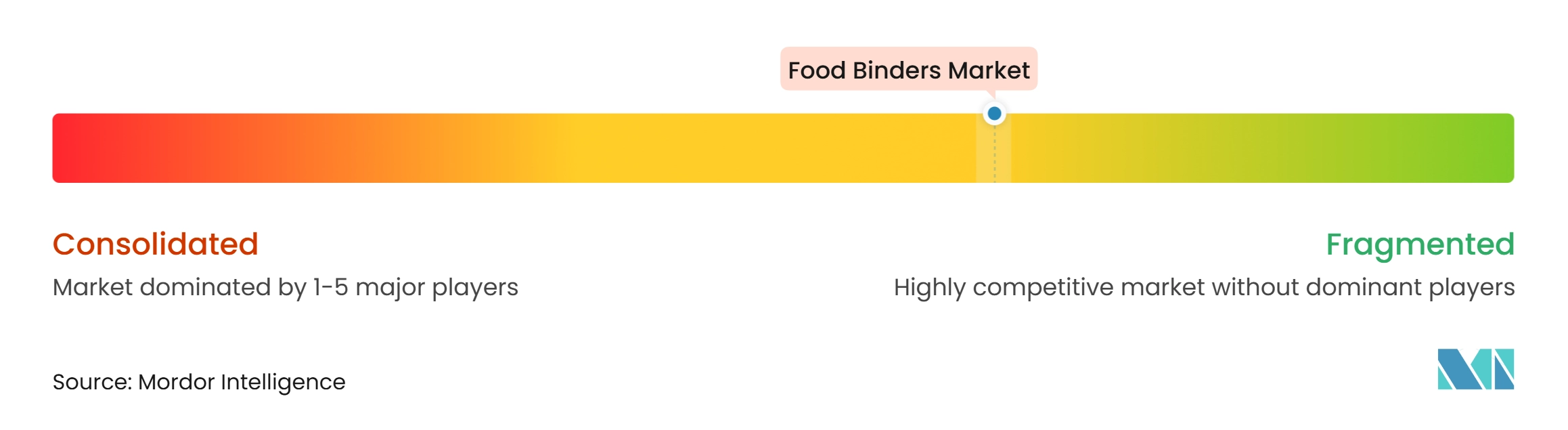
The Food Binders Market includes multinational food ingredient manufacturers, specialty hydrocolloid producers, plant-based ingredient suppliers, animal-derived ingredient manufacturers, and regional ingredient companies competing through product innovation, raw-material sourcing, formulation expertise, and global distribution networks. The companies have varying levels of exposure to food binders through starches, gums, proteins, gelatin, pectin, and other functional ingredients used to improve texture, viscosity, adhesion, moisture retention, and product stability. Large ingredient manufacturers can leverage diversified portfolios and established customer relationships, while specialized producers can differentiate through application-specific binding solutions and expertise in particular ingredient categories.
Competitive strategies in the Food Binders Market focus on expanding plant-based ingredient portfolios, developing specialized binding and texturizing systems, and improving functionality across bakery, confectionery, meat, dairy, and beverage applications. For example, Cargill, Incorporated offers native and modified starches, hydrocolloids, and specialty texturizers for applications such as bakery products, processed meat, confectionery, and dairy. Similarly, Tate & Lyle PLC provides functional starches and hydrocolloids, including pectin, carrageenan, xanthan gum, and gellan gum, which support thickening, gelling, and product stabilization. These offerings reflect the importance of plant-based ingredients, which accounted for 69.29% of the Food Binders Market in 2026. Meanwhile, microbial binders represent a developing growth opportunity, with the segment projected to register the fastest CAGR of 9.15% during 2026–2031.
Product development and application-specific formulation capabilities remain important competitive considerations. Companies such as Ingredion Incorporated, Archer Daniels Midland Company, Kerry Group plc, and DSM-Firmenich AG compete through functional ingredient portfolios, formulation expertise, and customer-focused food solutions. Manufacturers are increasingly focusing on clean-label formulations, plant-derived binding ingredients, and functional systems that improve texture, moisture retention, processing stability, and consistency. Powder-based products accounted for 57.63% of the market in 2026, reflecting their established use in food manufacturing and ease of handling, while granules are projected to record the fastest growth among forms at a CAGR of 8.28% during 2026–2031. Bakery Products represented the largest application segment, with a 34.46% share, while Dairy Products are expected to grow at a CAGR of 8.44% over the same period.
Food Binders Industry Leaders
-
Cargill, Incorporated
-
Archer Daniels Midland Company
-
Ingredion Incorporated
-
Tate & Lyle PLC
- *Disclaimer: Major Players sorted in no particular order
Food Binders Market Companies Covered in this Report
- Cargill, Incorporated
- Archer Daniels Midland Company
- Ingredion Incorporated
- Tate & Lyle PLC
- Kerry Group plc
- International Flavors & Fragrances Inc.
- DSM-Firmenich AG
- Roquette Frères
- BENEO GmbH
- Ashland Inc.
- Jungbunzlauer Suisse AG
- CP Kelco (J.M. Huber Corporation)
- GELITA AG
- Darling Ingredients Inc.
- Nexira SAS
- Ajinomoto Co., Inc.
- Kewpie Corporation
- TIC Gums, Inc. (Ingredion)
- Fiberstar, Inc.
- Alland & Robert
Recent Industry Developments in Food Binders Market
- November 2026: Royal Avebe introduced PuraMYL® 440, a clean-label potato starch designed to provide water binding and texture development during cold processing. The plant-based ingredient supports applications such as meat alternatives, sauces, and dressings without requiring heating, expanding the use of functional starch-based binders in food manufacturing.
- October 2026: Roquette launched WELLENCE™ GF 1229, a cellulosic hydrocolloid designed to improve texture, bread volume, and crumb structure in gluten-free bakery products. The ingredient demonstrated a 23% increase in bread volume compared with a market benchmark and approximately 50% lower instrumental hardness after 21 days, strengthening the availability of specialized binding solutions for bakery applications.
- June 2026: FERM FOOD introduced a fermented gluten-free Bread Binder for industrial bakeries, developed using buckwheat and fava beans fermented with lactic acid bacteria. The plant-based ingredient improves dough structure, moisture retention, sliceability, and softness while reducing the need for multiple additives, expanding fermentation-derived binder applications in bakery products.
Global Food Binders Market Report Scope
For this study, the Food Binders Market is defined as the sales value of commercially produced food-binding ingredients used to improve texture, consistency, adhesion, moisture retention, viscosity, and structural stability in food products. The market covers food binders derived from plant-based, animal-based, microbial, and other sources, segmented by form into powder, liquid, granules, and other forms. By application, the market includes bakery products, confectionery, meat products, dairy products, beverages, and other food and beverage applications. The market is analyzed across North America, Europe, Asia-Pacific, South America, and the Middle East and Africa, with country-level coverage as specified in the report. Market sizing and forecasts are presented in value terms (USD) across the defined segments and geographies.
Segmentation Overview
| Plant-Based |
| Animal-Based |
| Microbial |
| Others |
| Powder |
| Liquid |
| Granules |
| Others |
| Bakery Products |
| Confectionery |
| Meat Products |
| Dairy Products |
| Beverages |
| Other Food and Beverages Segment |
| North America | United States |
| Canada | |
| Mexico | |
| Rest of North America | |
| Europe | United Kingdom |
| Germany | |
| France | |
| Italy | |
| Spain | |
| Sweden | |
| Belgium | |
| Poland | |
| Netherlands | |
| Rest of Europe | |
| Asia-Pacific | China |
| Japan | |
| India | |
| Thailand | |
| Singapore | |
| Indonesia | |
| Korea | |
| Australia | |
| Rest of Asia-Pacific | |
| South America | Brazil |
| Argentina | |
| Colombia | |
| Peru | |
| Chile | |
| Rest of South America | |
| Middle East and Africa | South Africa |
| Saudi Arabia | |
| United Arab Emirates | |
| Nigeria | |
| Egypt | |
| Morocco | |
| Turkey | |
| Rest of Middle East and Africa |
| By Source | Plant-Based | |
| Animal-Based | ||
| Microbial | ||
| Others | ||
| By Form | Powder | |
| Liquid | ||
| Granules | ||
| Others | ||
| By Application | Bakery Products | |
| Confectionery | ||
| Meat Products | ||
| Dairy Products | ||
| Beverages | ||
| Other Food and Beverages Segment | ||
| By Geography | North America | United States |
| Canada | ||
| Mexico | ||
| Rest of North America | ||
| Europe | United Kingdom | |
| Germany | ||
| France | ||
| Italy | ||
| Spain | ||
| Sweden | ||
| Belgium | ||
| Poland | ||
| Netherlands | ||
| Rest of Europe | ||
| Asia-Pacific | China | |
| Japan | ||
| India | ||
| Thailand | ||
| Singapore | ||
| Indonesia | ||
| Korea | ||
| Australia | ||
| Rest of Asia-Pacific | ||
| South America | Brazil | |
| Argentina | ||
| Colombia | ||
| Peru | ||
| Chile | ||
| Rest of South America | ||
| Middle East and Africa | South Africa | |
| Saudi Arabia | ||
| United Arab Emirates | ||
| Nigeria | ||
| Egypt | ||
| Morocco | ||
| Turkey | ||
| Rest of Middle East and Africa | ||
Key Questions Answered in the Report
What is the projected size of the Food Binders Market?
The Food Binders Market is estimated at USD 9.25 billion in 2026 and is projected to reach USD 15.33 billion by 2032.
What is the expected growth rate of the Food Binders Market?
The market is expected to register a CAGR of 7.49% over the forecast period (2027–2032).
Which source segment holds the largest share of the Food Binders Market?
The plant-based segment holds the largest share, accounting for 69.29% of the market in 2026.
Which region dominates the Food Binders Market?
Asia-Pacific holds the largest regional share, accounting for 37.94% of the market in 2026, supported by demand for processed foods and functional food ingredients.