
Food and Beverage Packaging Printing Inks Market Size and Share
Market Overview
| Study Period | 2022 - 2032 |
|---|---|
| Market Size (2027) | USD 5.63 Billion |
| Market Size (2032) | USD 8.31 Billion |
| Growth Rate (2027 - 2032) | 8.12 % |
| Fastest Growing Market | Asia-Pacific |
| Largest Market | Europe |
| Market Concentration | Medium |
Major Players *Disclaimer: Major Players sorted in no particular order Image © Mordor Intelligence. Reuse requires attribution under CC BY 4.0. | |
Food and Beverage Packaging Printing Inks Market Analysis by Mordor Intelligence
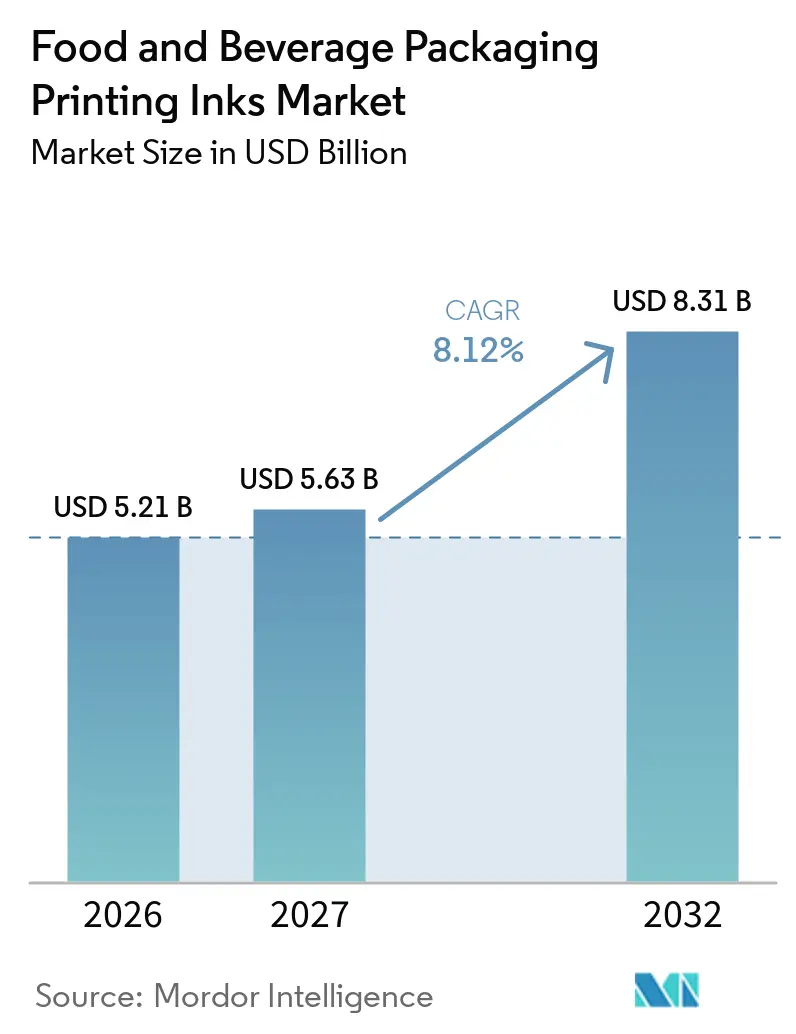
The food and beverage packaging printing inks market size was valued at USD 5.21 billion in 2026 and is estimated to grow from USD 5.63 billion in 2027 to USD 8.31 billion by 2032, at a CAGR of 8.12% during the forecast period (2027-2032). Food-contact regulations, recyclable substrate requirements, and brand-owner emissions targets are shifting ink selection from a price-based decision to a compliance-based one. Suppliers must demonstrate safe migration performance, compatibility with recyclable packaging designs, and reliable performance on high-speed packaging lines. This increases the value of formulation expertise, testing capabilities, and technical support. It also creates opportunities for suppliers to assist converters during material transitions across multiple packaging formats. As a result, the food and beverage packaging printing inks market favors portfolios that combine conventional print performance with food-contact compliance and recyclability requirements.
Key Report Takeaways
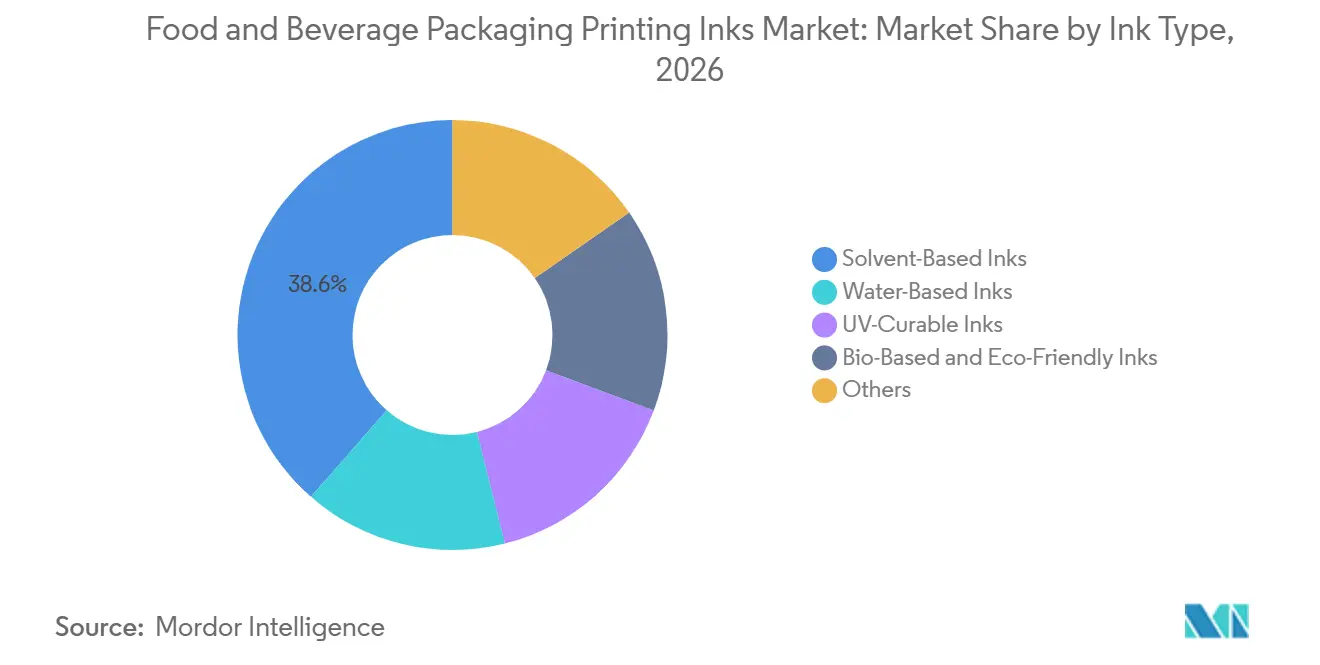
- By ink type, solvent-based inks held 38.56% of the food and beverage packaging printing inks market share in 2026, while bio-based and eco-friendly inks are forecast to grow at an 8.78% CAGR through 2032.
- By printing process, flexography accounted for 51.29% of market share in 2026, while digital printing is forecast to expand at a 9.14% CAGR through 2032.
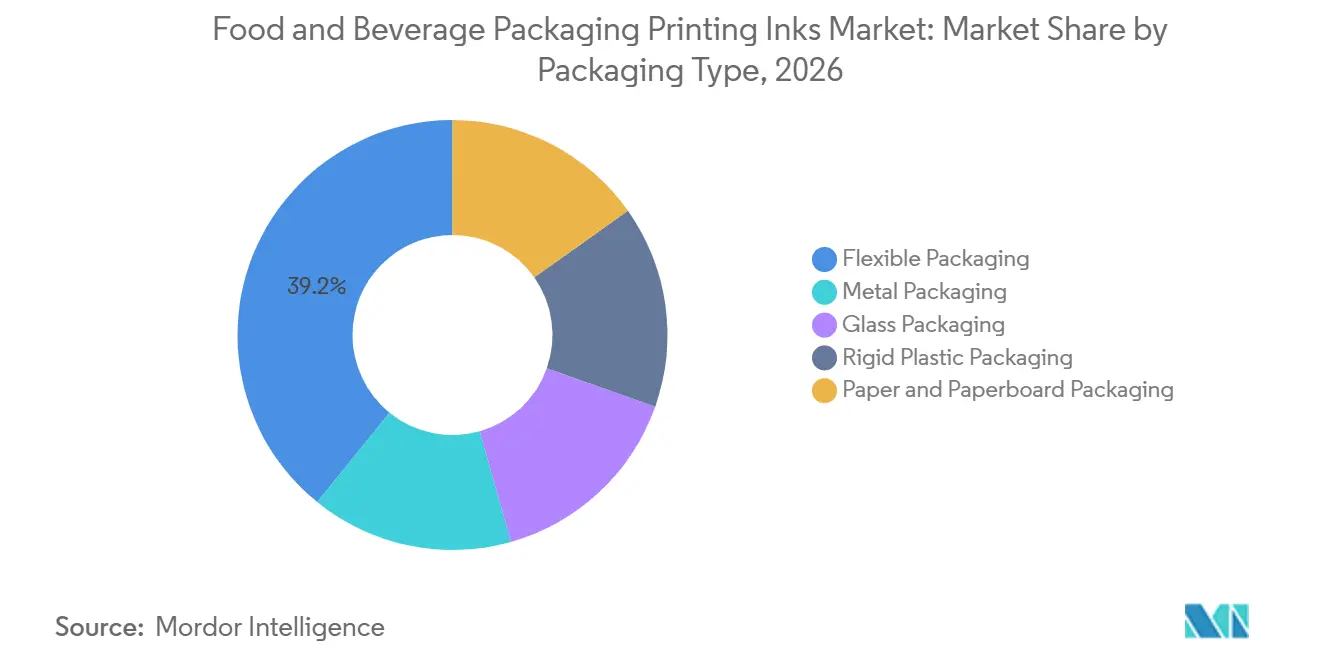
- By packaging type, flexible packaging accounted for 39.17% of market share in 2026 and is forecast to grow at a 10.43% CAGR through 2032.
- By geography, Europe held 33.73% of the market share in 2026, while Asia-Pacific is forecast to grow at a 9.91% CAGR through 2032.
Note: Market numbers in this report are based on Mordor Intelligence's proprietary estimation framework, which combines nine months of actuals with Q4 projections for base year 2026.
Global Food and Beverage Packaging Printing Inks Market Trends and Insights
Drivers Impact Analysis*
| Drivers | (~) % Impact on CAGR Forecast | Geographic Relevance | Impact Timeline |
|---|---|---|---|
| Stricter Food-Contact Migration Controls | +1.5% | Global, the highest intensity in Europe and North America | Short term (≤ 2 years) |
| Recyclable Mono-Material Packaging Conversion | +1.8% | Global, led by Europe, with Asia-Pacific spillover | Medium term (2-4 years) |
| Digital and Hybrid Press Adoption | +1.4% | Global, fastest uptake in Asia-Pacific and North America | Medium term (2-4 years) |
| Ready-to-Eat and Convenience Food Packaging Demand | +2.1% | Global, highest incremental volume in Asia-Pacific and North America | Short term (≤ 2 years) |
| Brand-Owner Solvent-Free and Scope 3 Commitments | +1.6% | Global, with specification pressure originating in Europe | Long term (≥ 4 years) |
| Source: Mordor Intelligence | |||
Stricter Food-Contact Migration Controls
Germany's Printing Ink Ordinance is scheduled to take effect in January 2027 following a transition extension. The ordinance establishes a positive list, specific migration limits for direct food-contact inks, non-detect thresholds for indirect-contact uses, and pigment purity requirements aligned with the Bundesinstitut für Risikobewertung (BfR) IX[1]. These requirements make compliance more demanding for inks used on food packaging surfaces. The European Printing Ink Association (EuPIA) fifth-edition Good Manufacturing Practice guideline took effect in January 2026 and applies globally, reinforcing a common baseline for printing inks used with food-contact materials. Market participants with established testing and documentation systems can respond faster to converter requirements. Flint Group, Toyo Ink Europe, and Siegwerk have presented compliant portfolios that give converters earlier choices when reviewing specifications.
Recyclable Mono-Material Packaging Conversion
The move toward mono-material flexible packaging requires ink systems compatible with recycling designs for polyethylene and polypropylene. RecyClass approved nitrocellulose-free polyurethane-based and polyvinyl-butyral-based inks for surface and reverse printing on polyethylene and polypropylene flexible packaging in 2025. Siegwerk, Borouge, and TPN Food Packaging introduced a recyclable mono-material polyethylene barrier stand-up pouch in September 2025 for oxygen-sensitive dry products. The project used de-inking coating technology to support the production of higher-quality recycled polyethylene feedstock. This transition expands demand beyond standard inks to include coatings, barrier systems, and washable formulations. The food and beverage packaging printing inks market benefits when suppliers can address both print quality and end-of-life packaging performance.
Digital and Hybrid Press Adoption
Growth in seasonal products, regional variants, and personalized packs is increasing the number of active designs that converters must manage. Digital printing supports variable data and shorter runs without the plate replacement costs associated with conventional printing. Digital food-safe inks must still meet migration, adhesion, cure-speed, and film-substrate requirements at commercial line speeds. Canon announced the correPRESS iB17 in October 2025, with an output of up to 8,000 m² per hour using water-based inks for indirect food-contact-compliant corrugated applications. Hybrid flexographic and digital lines create demand for ink management systems that support both print approaches, making digital capability relevant to a broader set of suppliers in the food and beverage packaging printing inks market.
Ready-to-Eat and Convenience Food Packaging Demand
Ready-to-eat foods use stand-up pouches, retort-compatible laminates, flexible trays, and snack liners that require printed surfaces. These formats often require high-speed gravure or flexographic printing and performance under steam or microwave exposure. Food producers also manage frequent artwork changes across snack, beverage, and meal product lines. Each artwork change can require ink qualification for a specific substrate, thermal condition, and packaging format. This increases the work required for print conversion, even when the product formula does not change. The food and beverage packaging printing inks market benefits from the need for qualified inks across a broader range of packaging configurations.
Restraints Impact Analysis*
| Restraints | (~) % Impact on CAGR Forecast | Geographic Relevance | Impact Timeline |
|---|---|---|---|
| Substrate Adhesion and Barrier-Layer Compatibility | -0.9% | Global, most acute for mono-material polyethylene and polypropylene converters in Europe | Medium term (2-4 years) |
| Food-Contact Resin and Photoinitiator Cost Premiums | -1.2% | Global, most severe in cost-sensitive emerging markets | Short term (≤ 2 years) |
| Qualification Delays from Change-Control and Migration Testing | -0.7% | Global, highest in Europe-regulated supply chains | Long term (≥ 4 years) |
| Source: Mordor Intelligence | |||
Substrate Adhesion and Barrier-Layer Compatibility
Polyethylene and polypropylene films have lower surface energy than many traditional multilayer laminates, creating adhesion challenges for sustainable ink systems on substrates used in mono-material packaging. Converters may require modified binders, corona or flame treatment, and primers that also meet food-contact requirements. Each new ink and substrate combination requires adhesion, lamination, migration, and shelf-life testing across multiple processing and storage conditions. The qualification process can take 9-18 months, limiting how quickly converters can adopt new formulations. This remains a practical constraint on growth in the food and beverage packaging printing inks market, even where regulatory or customer requirements are clearly defined.
Food-Contact Resin and Photoinitiator Cost Premiums
Food-contact-compliant inks carry higher input and documentation costs than conventional products. High-purity, low-migration ingredients and validation requirements make it difficult for converters to pass costs on in price-sensitive packaging programs. This is particularly relevant for private-label and commodity food packaging in emerging markets. Premium brands in regulated markets adopt ultraviolet light-emitting diode (UV-LED) and water-based low-migration systems more readily when specifications support the added cost. Mid-market packaging remains dependent on solvent-based formulations. As a result, the food and beverage packaging printing inks market exhibits varying adoption rates depending on brand position, converter capabilities, and local compliance expectations.
*Our forecasts treat driver/restraint impacts as directional, not additive. The impact forecasts reflect baseline growth, mix effects, and variable interactions.
Segment Analysis
By Ink Type: Solvent-Based Leadership and Bio-Based Growth
Solvent-based inks held 38.56% of the food and beverage packaging printing inks market share in 2026, while bio-based and eco-friendly inks are projected to grow at an 8.78% CAGR through 2032. Solvent-based inks remain important because they adhere well to nonporous synthetic films, including oriented polypropylene (OPP), coextruded polyethylene, and polyethylene terephthalate (PET). Their rapid evaporation profile enables high-speed printing on flexible packaging lines. Bio-based and eco-friendly inks are gaining attention as converters respond to customer requirements for solvent-free and emissions-reduced options. DIC Graphics launched Finato BM EX in August 2025 as a toluene-free and methyl ethyl ketone (MEK)-free gravure ink with 10% biomass content. The product is intended for OPP and CPP structures, as well as PET and CPP structures, used for snacks and chilled food packaging.
Water-based inks are the second-largest revenue category and are gaining relevance in European indirect food-contact and paperboard applications. They can support lower-solvent packaging programs where substrate and drying conditions are appropriate. UV-curable inks serve a premium role due to their instant curing and low migration potential. Their selection depends on a converter's ability to manage food-contact documentation, cure performance, and input costs. Electron-beam-curable systems serve selected high-barrier applications that require photoinitiator-free curing chemistry. The food and beverage packaging printing inks market, therefore, retains several ink platforms rather than converging on a single replacement technology. Supplier portfolios need to match substrate requirements, line speeds, food-contact conditions, and the converter's recycling design.

By Printing Process: Flexography Retains Scale as Digital Expands
Flexography accounted for 51.29% of the food and beverage packaging printing inks market size in 2026, while digital printing is forecast to register a 9.14% CAGR through 2032. Flexography remains widely used because it serves high-output flexible packaging production with established plates, color systems, and converter workflows. It also supports LED-UV hybrid configurations that can meet specific packaging requirements. Amcor is committed to a multi-million-euro flexographic line in Hardenberg, the Netherlands, scheduled for April 2026. The line added up to 6,000 metric tons of capacity per year, demonstrating continued investment in flexographic operations. Digital printing is growing due to the need to manage shorter runs, multiple stock-keeping units, and variable information.
Gravure remains relevant for premium long runs, including pasta wraps, high-definition beverage sleeves, and complex food laminates. It is suited to applications that require consistent output at speeds above 300 meters per minute. DIC Corporation began the global rollout of ECOVART in September 2026, a low-solvent gravure ink designed to use less naphtha-derived solvent than conventional alternatives. This offers a pathway for gravure users addressing solvent management in Asian packaging applications. Screen and offset printing continue to serve cartons and specialty labels at lower production runs. The food and beverage packaging printing inks market uses each process for different run lengths, substrate needs, image requirements, and customer specifications.
By Packaging Type: Flexible Packaging Leads Share and Growth
Flexible packaging represented 39.17% of the food and beverage packaging printing inks market size in 2026 and is forecast to advance at a 10.43% CAGR through 2032. The category includes stand-up pouches, retort-compatible laminates, ready-meal packs, and snack liners. These formats are replacing some glass, metal, and rigid plastic packs where lower weight and efficient shelf use are priorities. Flexible structures require inks that provide adhesion, print appearance, migration compliance, and compatibility with lamination systems. The food and beverage packaging printing inks market is directly connected to this packaging shift because each packaging structure requires specialized inks suited to its substrate and use case. Suppliers that support the use of recyclable polyethylene and polypropylene structures can benefit from converter reformulation activities.
Paper and paperboard are the second-largest packaging category. Retail sustainability commitments and improvements in direct food-contact printing are expanding the role of fiber-based formats. Sun Chemical launched SunPak DFC (Direct Food Contact) in September 2026 for direct food-contact sheetfed printing on folding cartons and food trays. Metal and glass packaging serve premium spirits, carbonated beverages, and canned food, for which specialized lacquer-cure ink systems support higher-value applications. Rigid plastic packaging serves food-service and reusable container applications. Extended Producer Responsibility policies can influence ink selection across these categories by increasing interest in designs compatible with recycling.
Geography Analysis
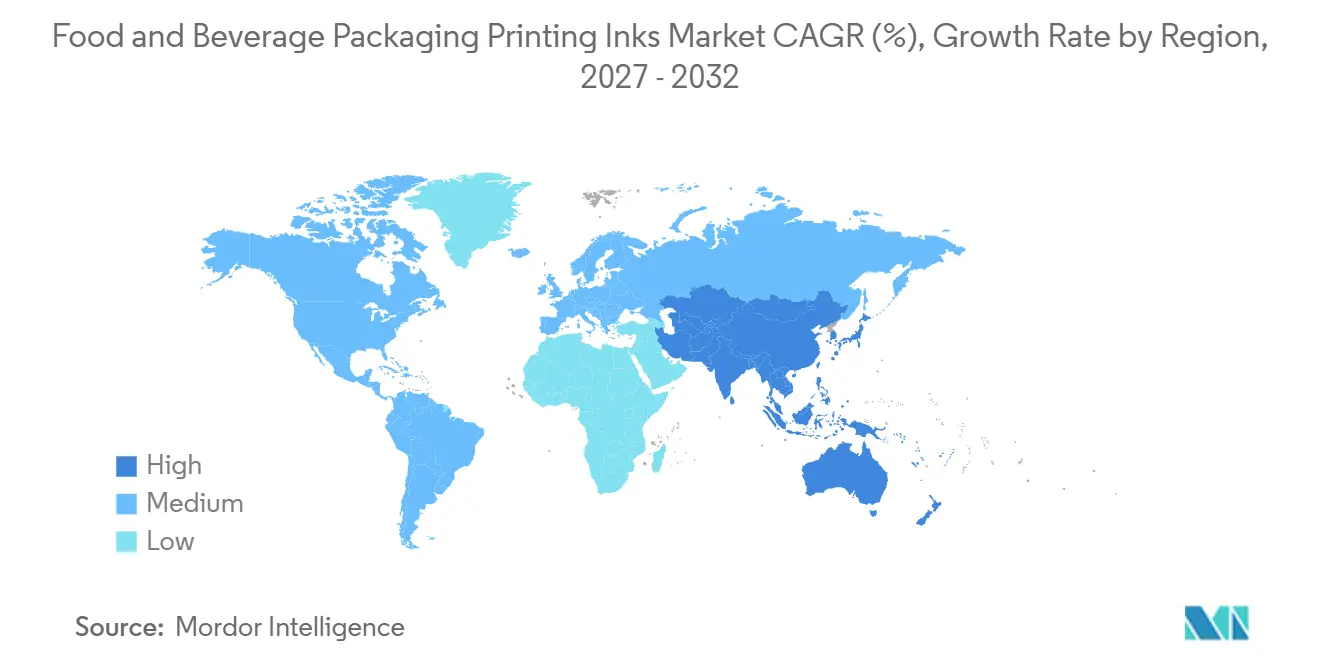
Europe accounted for 33.73% of the food and beverage packaging printing inks market share in 2026. The region has a developed food-contact regulatory framework, which supports demand for low-migration, UV-curable, and nitrocellulose-free systems. The January 2027 enforcement timeline for Germany's Printing Ink Ordinance is encouraging converters to review specifications and complete requalification work. Germany, the United Kingdom, France, Italy, and the Nordic countries show strong demand for food-safe and recycling-compatible formulations. Eastern Europe and Russia continue to rely more heavily on solvent-based systems, as regulatory expectations and converter infrastructure differ across the region.
Asia-Pacific is projected to grow at a 9.91% CAGR through 2032, the fastest regional growth rate in the food and beverage packaging printing inks market. China accounts for 45%-50% of Asia-Pacific packaging ink output, supported by extensive flexible packaging manufacturing. India is a major contributor to regional growth as packaged food production expands. Hubergroup opened India's first direct food-contact ink manufacturing facility in June 2025, indicating that premium food-safe ink production is expanding beyond established European and Japanese locations. Japan and South Korea are mature markets with deep application expertise. DIC Corporation and Artience published a joint film-packaging recyclability evaluation protocol for Japan in October 2026[2]. Vietnam, Indonesia, and Thailand continue to drive packaging demand through investment in food export manufacturing.
North America holds the third-largest regional position, with the United States driving demand for solvent-based and UV-curable inks in snack, beverage, and ready-meal packaging. State Extended Producer Responsibility measures are encouraging converters to evaluate nitrocellulose-free and water-based options before ink-specific requirements are formalized. South America is developing through modern retail expansion and growth in branded packaged food, although reliance on imported raw materials can slow adoption. Brazil and Argentina are the main regional contributors. The Middle East and Africa represent the smallest regional segments. Gulf Cooperation Council countries are expanding food manufacturing, while South Africa provides an entry point for premium food-contact specifications.
Competitive Landscape
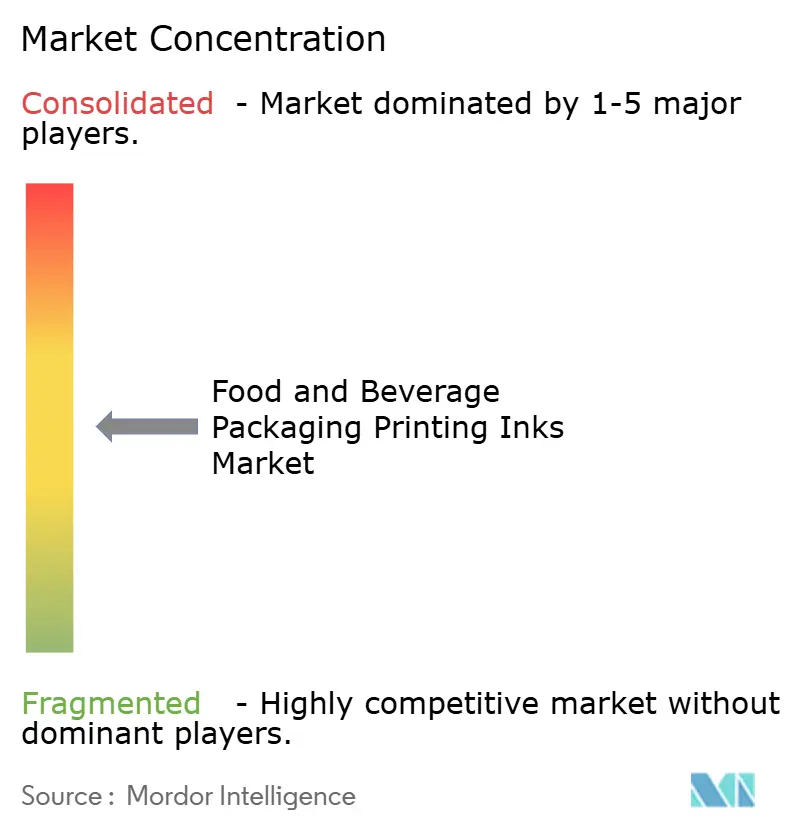
The food and beverage packaging printing inks market is moderately fragmented. Sun Chemical, Siegwerk, Flint Group, DIC Corporation, and Artience are active in premium food-contact-compliant applications. Regional producers compete in solvent-based and conventional water-based categories on price and local service. Global suppliers are expanding beyond core ink formulations into coatings, de-inking systems, and barrier technologies. This broader offering reflects converters' growing consideration of recycling performance alongside color, adhesion, and migration requirements.
Siegwerk acquired Allinova in August 2025, adding water-based polymer dispersions, wax emulsions, and functional additives to its coating capabilities. The acquisition strengthened its position in packaging structures requiring coating and functional-material expertise. Flint Group launched Flexocure LEAP in July 2025, a UV resin system designed to stabilize photoinitiator compounds and reduce the risk of migration on polyethylene substrates. Evonik introduced TEGO Res 1100, a de-inking additive designed to improve the recycling of polyurethane-based inks. These developments indicate that competition increasingly encompasses end-of-life packaging performance, not just print quality.
Opportunities are concentrated in digital food-safe inks, direct food-contact paper and board, and mono-material polyethylene flexible packaging. These applications require products that perform at commercial line speeds while meeting regulatory and recycling requirements. Smaller converters often have limited qualification budgets and may require more focused technical support, creating opportunities for regional specialists in ASEAN and South Asia to develop locally compliant formulations for mid-market food brands. Suppliers are also using color management, in-line measurement, and press simulation to reduce validation time. The market is likely to reward companies that can reduce change-control risk for converters without compromising compliance documentation.
Food and Beverage Packaging Printing Inks Industry Leaders
-
Sun Chemical
-
Siegwerk Druckfarben AG & Co. KGaA
-
Flint Group
-
artience Co., Ltd.
-
SAKATA INX CORPORATION
- *Disclaimer: Major Players sorted in no particular order
Recent Industry Developments
- September 2026: DIC Corporation began the global rollout of ECOVART, a low-solvent-content gravure ink that requires significantly less naphtha-derived solvent than conventional alternatives, reducing volatile organic compound (VOC) emissions and supply chain procurement risk. The initial rollout targets Japan, China, and Southeast Asia.
- September 2026: Sun Chemical launched SunPak DFC in Pace for direct food-contact sheetfed printing on folding cartons and added a new green pigment to its AquaSafe water-based portfolio. These additions enable printed food trays without the co-extrusion of a polyethylene (PE) barrier and expand food-safe design flexibility in Europe.
Global Food and Beverage Packaging Printing Inks Market Report Scope
Food and beverage packaging printing inks are specialized liquid or paste formulations used to print on product containers, wrappers, labels, and boxes, displaying branding, ingredient lists, barcodes, and regulatory information. Unlike standard commercial printing inks, these formulations must be strictly engineered and regulated to ensure they do not contaminate edible contents.
The food and beverage packaging printing inks market is segmented by ink type, printing process, packaging type, and geography. By ink type, the market is segmented into water-based inks, solvent-based inks, UV-curable inks, bio-based and eco-friendly inks, and others. By printing process, the market is segmented into flexography, gravure, digital printing, and others. By packaging type, the market is segmented into flexible packaging, paper and paperboard packaging, metal packaging, glass packaging, and rigid plastic packaging. The report also covers market sizes and forecasts for the global food and beverage packaging printing inks across 16 countries in major regions. The market sizes and forecasts are provided in terms of value (USD).
| Water-Based Inks |
| Solvent-Based Inks |
| UV-Curable Inks |
| Bio-Based and Eco-Friendly Inks |
| Others |
| Flexography |
| Gravure |
| Digital Printing |
| Others |
| Flexible Packaging |
| Paper and Paperboard Packaging |
| Metal Packaging |
| Glass Packaging |
| Rigid Plastic Packaging |
| Asia-Pacific | China |
| India | |
| Japan | |
| South Korea | |
| ASEAN Countries | |
| Rest of Asia-Pacific | |
| North America | United States |
| Canada | |
| Mexico | |
| Europe | Germany |
| United Kingdom | |
| France | |
| Italy | |
| NORDIC Countries | |
| Russia | |
| Rest of Europe | |
| South America | Brazil |
| Argentina | |
| Rest of South America | |
| Middle East and Africa | Saudi Arabia |
| South Africa | |
| Rest of Middle East and Africa |
| By Ink Type | Water-Based Inks | |
| Solvent-Based Inks | ||
| UV-Curable Inks | ||
| Bio-Based and Eco-Friendly Inks | ||
| Others | ||
| By Printing Process | Flexography | |
| Gravure | ||
| Digital Printing | ||
| Others | ||
| By Packaging Type | Flexible Packaging | |
| Paper and Paperboard Packaging | ||
| Metal Packaging | ||
| Glass Packaging | ||
| Rigid Plastic Packaging | ||
| By Geography | Asia-Pacific | China |
| India | ||
| Japan | ||
| South Korea | ||
| ASEAN Countries | ||
| Rest of Asia-Pacific | ||
| North America | United States | |
| Canada | ||
| Mexico | ||
| Europe | Germany | |
| United Kingdom | ||
| France | ||
| Italy | ||
| NORDIC Countries | ||
| Russia | ||
| Rest of Europe | ||
| South America | Brazil | |
| Argentina | ||
| Rest of South America | ||
| Middle East and Africa | Saudi Arabia | |
| South Africa | ||
| Rest of Middle East and Africa | ||
Key Questions Answered in the Report
What is current market size of Food and Beverage Packaging Printing Inks Market?
The food and beverage packaging printing inks market size was valued at USD 5.21 billion in 2026 and is estimated to grow from USD 5.63 billion in 2027 to USD 8.31 billion by 2032, at a CAGR of 8.12% during the forecast period (2027-2032).
Which printing process is growing fastest through 2032?
Digital printing is forecast to grow at a 9.14% CAGR as converters manage more designs, shorter runs, and variable information.
Why is flexible packaging important for printing ink suppliers?
Flexible packaging holds a 39.17% share in 2026 and is forecast to grow at a 10.43% CAGR, thereby raising demand for qualified inks for pouches, liners, and laminates.
Which region is projected to grow fastest?
Asia-Pacific is expected to grow at a 9.91% CAGR through 2032, supported by packaging manufacturing in China and packaged food growth in India.