
Foam Market Size and Share
Market Overview
| Study Period | 2021 - 2031 |
|---|---|
| Market Size (2026) | USD 125.40 Billion |
| Market Size (2031) | USD 166.79 Billion |
| Growth Rate (2026 - 2031) | 5.87 % |
| Fastest Growing Market | Asia-Pacific |
| Largest Market | Asia-Pacific |
| Market Concentration | Medium |
Major Players *Disclaimer: Major Players sorted in no particular order Image © Mordor Intelligence. Reuse requires attribution under CC BY 4.0. | |
Foam Market Analysis by Mordor Intelligence
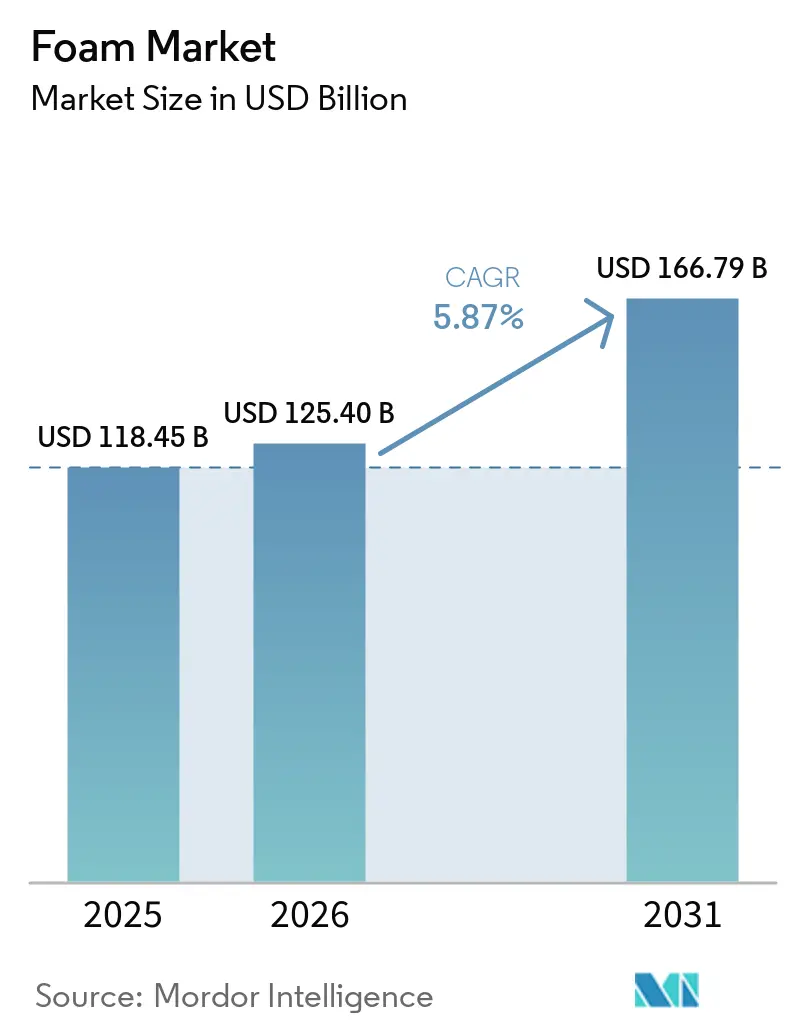
The Foam Market size was valued at USD 118.45 billion in 2025 and is estimated to grow from USD 125.40 billion in 2026 to reach USD 166.79 billion by 2031, at a CAGR of 5.87% during the forecast period (2026-2031). The foam market is supported by building retrofits that require stronger thermal performance and by construction activity in developing economies. Electric vehicle design is also raising demand for materials that manage sound, heat, and weight within constrained vehicle spaces. Higher parcel volumes and more demanding cold-chain shipments are broadening demand for protective foam formats. At the same time, feedstock disruptions and tighter packaging and chemical rules are raising the value of integrated supply, certified formulations, and compliance capabilities. The foam market, therefore, gives producers an incentive to combine scale in core materials with specialized products that meet end-user specifications, especially where customers need verified performance, predictable supply, and clear compliance records.
Key Report Takeaways
- By resin type, polyurethane held 40.43% of the foam market share in 2025 and is projected to advance at a 6.34% CAGR through 2031.
- By foam type, flexible foam held 57.26% of the foam market share in 2025, while rigid foam is projected to advance at a 6.57% CAGR through 2031.
- By end-use industry, building and construction held 35.74% of the foam market share in 2025, while packaging is projected to advance at a 7.05% CAGR through 2031.
- By geography, Asia-Pacific held 40.35% of the foam market share in 2025 and is projected to advance at a 6.89% CAGR through 2031.
Note: Market size and forecast figures in this report are generated using Mordor Intelligence’s proprietary estimation framework, updated with the latest available data and insights as of January 2026.
Global Foam Market Trends and Insights
Drivers Impact Analysis*
| Driver | (~) % Impact on CAGR Forecast | Geographic Relevance | Impact Timeline |
|---|---|---|---|
| Energy-Efficiency Codes and Building Retrofit Demand | +1.8% | Global, concentrated in Europe (EPBD), North America (IECC/ASHRAE), and APAC (China, India) | Long term (≥ 4 years) |
| E-Commerce and Protective Packaging Intensity | +1.3% | Global; APAC core (India, China, Southeast Asia) and North America | Short term (≤ 2 years) |
| Vehicle Lightweighting and EV Acoustic Management | +0.9% | Global; concentrated in APAC (China, South Korea, Japan) and Europe | Medium term (2-4 years) |
| Comfort, Bedding Replacement, and Furniture Demand | +0.6% | Global; strongest in North America and Europe; emerging in Southeast Asia and Middle East | Medium term (2-4 years) |
| Recyclable and Bio-Based Foam Adoption | +0.4% | Europe (regulatory pull), North America (brand commitments), APAC (scale investment) | Long term (≥ 4 years) |
| Source: Mordor Intelligence | |||
Energy-Efficiency Codes and Building Retrofit Demand
Energy-efficiency codes and building retrofit demand create a durable base for insulation applications in the foam market. The International Energy Conservation Code (IECC), American Society of Heating, Refrigerating and Air-Conditioning Engineers Standard 90.1, and the European Union Energy Performance of Buildings Directive set requirements that affect insulation choices in new construction and renovations[1]International Energy Agency, “Buildings,” International Energy Agency, iea.org. Rigid polyurethane and polystyrene products can meet thermal requirements where wall thickness and installation space are limited. Commercial remodeling, electrification projects, and data-center construction can provide demand support when single-family housing activity is weak. These rules make the foam market less dependent on purely discretionary purchases because compliance establishes a minimum performance threshold.
E-Commerce and Protective Packaging Intensity
E-commerce and protective packaging intensity increase demand for protective materials across parcel delivery networks. Online fulfillment requires packaging that can protect goods through repeated handling and variable shipping conditions. Custom-fit foam inserts are relevant for consumer electronics, medical products, and other goods with a high cost of damage. Temperature-controlled pharmaceutical logistics also need materials that help protect shipments during transit. India, China, and Southeast Asian markets provide important opportunities because their manufacturing and digital retail networks are expanding. This part of the foam market depends on product protection, logistics reliability, and material efficiency rather than on retail packaging volume alone, and suppliers need designs that limit damage, fit automated packing operations, and support a consistent customer experience across long delivery routes.
Vehicle Lightweighting and EV Acoustic Management
Vehicle lightweighting and electric vehicle (EV) acoustic management are changing the material requirements of automotive manufacturers. Battery-electric vehicles expose motor, inverter, tire, and heating and cooling noise that combustion engines previously masked. Polyurethane foam can be used in door panels, floor assemblies, firewall systems, and battery enclosures to address these needs. A 2025 Society of Automotive Engineers (SAE) study found that closed-cell polyurethane foam sealing improved total vehicle air leakage by 20% and reduced airborne noise sensitivity by up to 1 dB in battery-electric vehicles. Multi-layer and micro-perforated foam formats can offer acoustic performance while helping vehicle makers manage weight. These needs broaden the foam market beyond seating and interior comfort applications.
Comfort, Bedding Replacement, and Furniture Demand
Comfort, bedding replacement, and furniture demand remain important to flexible foam consumption. Furniture, bedding, and seating applications require compressibility, resilience, and consistent performance over repeated use. Demand in mature economies can respond to housing turnover, replacement decisions, and consumer confidence. Household formation and the growth of modern furniture retail can support a different pattern of demand in Southeast Asia and the Middle East. Producers also need to manage the effect of input costs on upholstered furniture and mattress pricing. The foam market benefits when suppliers can serve both high-volume consumer applications and more specialized comfort requirements, with product design, density control, durability testing, and conversion capability remaining important across several product lines.
Restraints Impact Analysis*
| Restraint | (~) % Impact on CAGR Forecast | Geographic Relevance | Impact Timeline |
|---|---|---|---|
| Petroleum-Derived Feedstock Price Volatility | -1.2% | Global; most acute in North America, Europe, and import-dependent APAC economies | Short term (≤ 2 years) |
| Recycling and End-of-Life Compliance Costs | -0.8% | Europe (PPWR enforcement), North America, APAC (emerging EPR frameworks) | Medium term (2-4 years) |
| Flame-Retardancy and Low-Emission Reformulation Complexity | -0.6% | Europe (REACH, CPR), North America (EPA TSCA, California Prop 65), APAC (EU-alignment trend) | Long term (≥ 4 years) |
| Source: Mordor Intelligence | |||
Petroleum-Derived Feedstock Price Volatility
Petroleum-derived feedstock price volatility can disrupt costs for methylene diphenyl diisocyanate (MDI), toluene diisocyanate (TDI), polyols, and related inputs. Supply interruptions can reduce inventories and make it harder for foam producers to plan procurement and customer pricing. Producers that control feedstocks can be less exposed than formulators that buy materials on spot markets. This difference can affect margins, contract terms, and the ability to maintain supply during disruptions. It can also increase pressure on smaller converters that have less purchasing leverage and a limited ability to hold inventory. The foam market faces a continuing need for flexible sourcing and better supply-chain coordination as feedstock availability changes, because producers must balance the cost of holding material against the risk of delayed deliveries, lost orders, and rapid changes in input prices.
Recycling and End-of-Life Compliance Costs
Recycling and end-of-life compliance costs are particularly relevant to foam used in packaging. The European Union Packaging and Packaging Waste Regulation, Regulation (EU) 2025/40, requires packaging placed on the European Union market to be recyclable and introduces requirements that affect packaging design and waste management[2]European Commission, “Packaging and Packaging Waste,” European Commission, europa.eu. The regulation also limits foam void fill to 50% of package volume, which can change how shippers use protective materials. Producers must prepare for documentation, collection systems, testing, and country-level producer responsibility obligations. These capabilities can impose a heavier burden on smaller converters than on larger suppliers with dedicated compliance teams. The foam market may see more material substitution and investment in collection systems as packaging customers respond to these rules. Product developers will need to consider recyclability during design rather than treat waste management as a separate decision after production.
*Our forecasts treat driver/restraint impacts as directional, not additive. The impact forecasts reflect baseline growth, mix effects, and variable interactions.
Segment Analysis
By Resin Type: Polyurethane Leads Across Core Applications
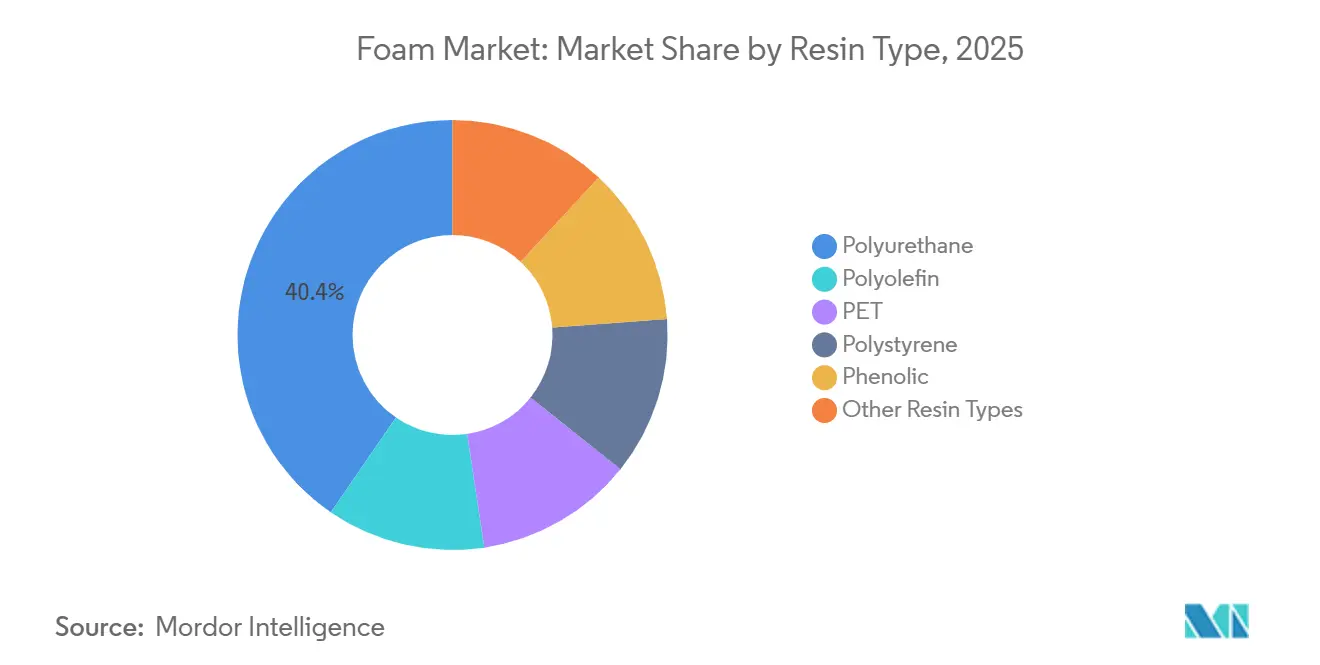
Polyurethane held 40.43% of the foam market share in 2025 and is projected to advance at a 6.34% CAGR through 2031. Its use spans rigid thermal insulation, flexible automotive seating, spray-applied air barriers, and acoustic components. This breadth helps polyurethane serve several demand pools when conditions differ between construction, vehicle, and consumer applications. Polystyrene, including expanded polystyrene and extruded polystyrene, competes in rigid insulation and packaging. Polyolefins such as polyethylene, polypropylene, and ethylene-vinyl acetate are used in footwear, sports products, and lightweight packaging. Phenolic and polyethylene terephthalate foams remain relevant in higher-performance uses such as fire-conscious construction systems and structural composite cores.
The foam market size for polyurethane benefits from the material's role in both rigid and flexible formats. BASF introduced an International Sustainability and Carbon Certification PLUS-certified biomass balance polyether polyol portfolio for North American flexible foam applications in March 2026. The offering provides a path to feedstock substitution while preserving familiar processing conditions for customers. The category's scale also supports investment in product qualification, certification, and technical service. This can help producers respond to customer demands across insulation, seating, packaging, and other applications without changing the underlying resin platform for every use.



By Foam Type: Flexible Foam Leads While Rigid Foam Grows Faster
Flexible foam held 57.26% of the foam market share in 2025 because it is used in furniture, bedding, footwear, automotive seating, and packaging. The material is valued for compressibility, comfort, and elastic recovery. These characteristics allow converters to tailor products for seating, cushioning, support layers, and protective applications with different performance needs. Appliance refrigeration and cold chain uses add demand beyond furniture and bedding. Rigid foam is projected to advance at a 6.57% CAGR through 2031. It is used where thermal performance and thickness efficiency are central to the application.
The foam market size for rigid foam is tied closely to insulation requirements in buildings, cold storage, and appliances. Higher thermal performance standards encourage the use of boards and spray-applied closed-cell systems that can deliver insulation in limited spaces. This gives rigid products a more regulation-linked demand profile than flexible formats sold into consumer products. Covestro AG announced in June 2026 that it planned a new 660,000-metric-ton MDI production train at its Shanghai integrated site. These actions show continuing investment in technically demanding, rigid, and semi-rigid formats. Capacity additions can improve local availability, while application development can help producers tailor density, strength, and thermal performance to specific customer needs.
By End-Use Industry: Building and Construction Leads While Packaging Grows Fastest
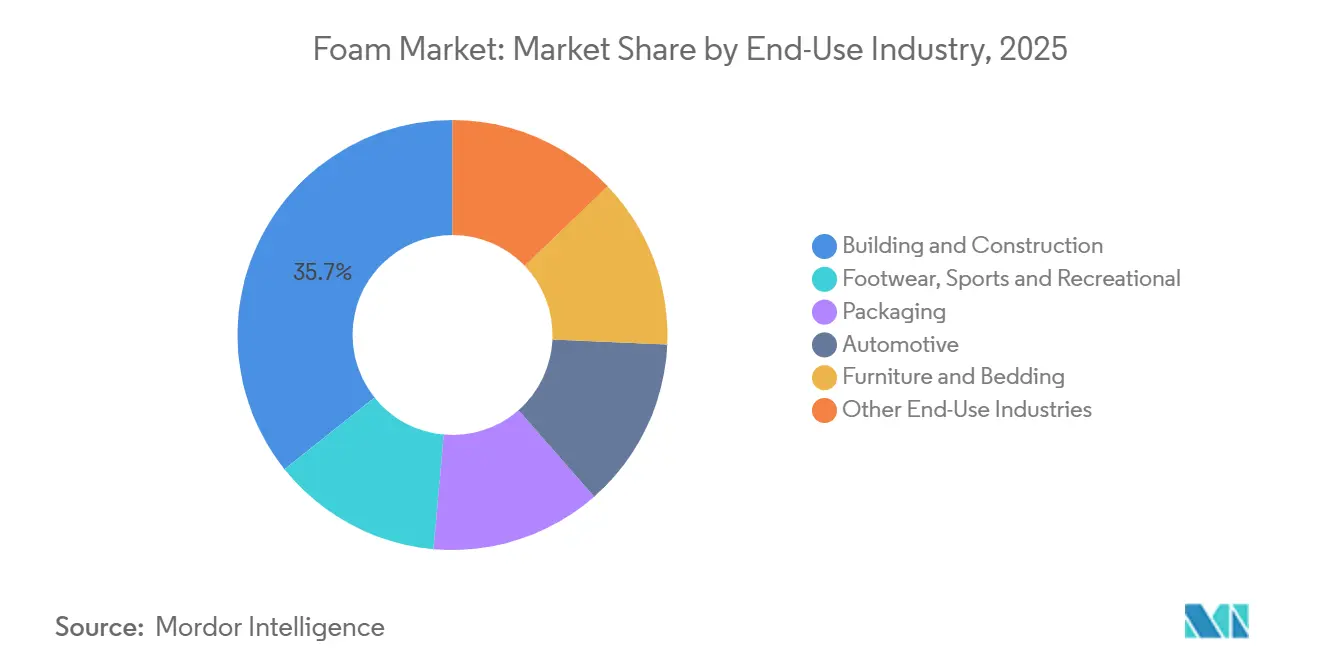
Building and construction held 35.74% of the foam market share in 2025. Rigid polyurethane and expanded or extruded polystyrene boards are used in roofs, walls, cold-storage facilities, and other assemblies where insulation performance matters. The category is supported by energy targets and by the need to manage heating and cooling loads. Packaging is projected to advance at a 7.05% CAGR through 2031. Its growth relates to e-commerce, pharmaceutical cold-chain logistics, and the protection needs of consumer electronics. Automotive, furniture and bedding, footwear, sports, and recreational industries provide further demand for specialized foam materials.
The foam market size for packaging is also shaped by the need to document material performance and environmental characteristics. International Organization for Standardization 14067:2018 and International Sustainability and Carbon Certification PLUS frameworks can help producers substantiate environmental claims. Medical device packaging, marine buoyancy, and aerospace applications form a smaller group of end uses with demanding qualification requirements. These applications can reward suppliers that invest in testing, traceability, and application knowledge. The broader foam market benefits from this mix of large-volume uses and technically specialized requirements. Producers that serve both can balance higher-volume contracts with work that requires more testing, closer customer collaboration, and longer qualification periods.
Geography Analysis
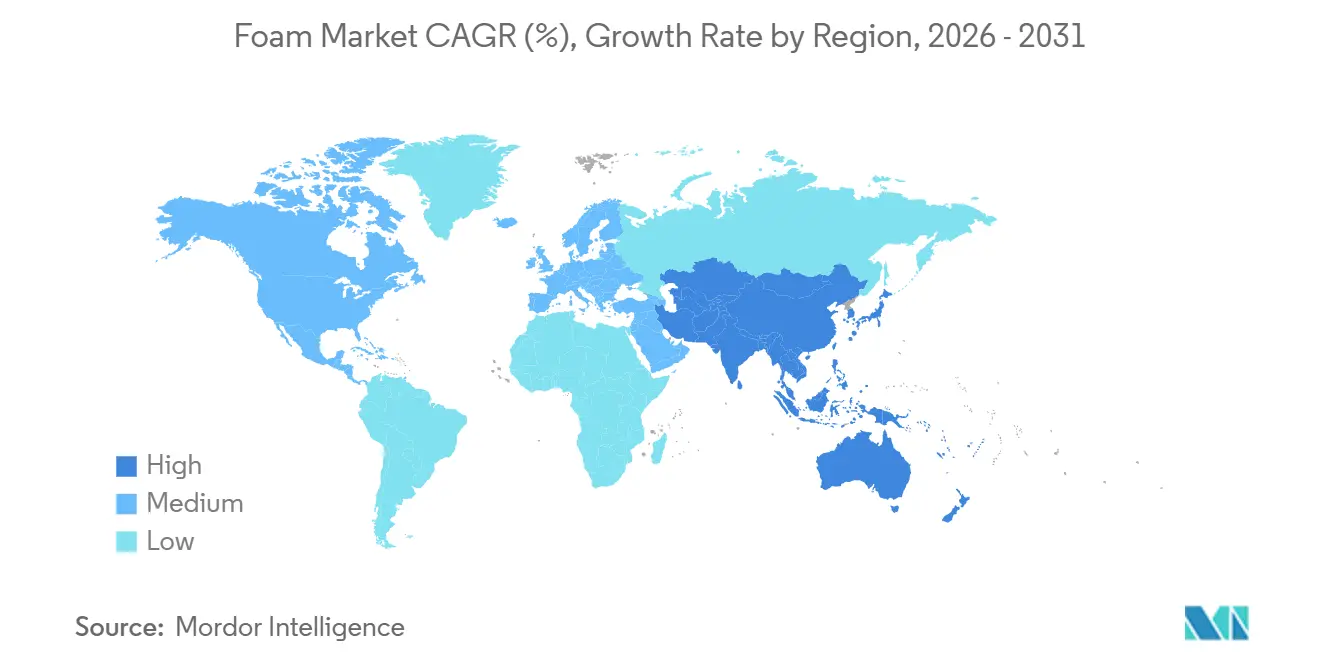
Asia-Pacific held 40.35% of the foam market share in 2025 and is projected to advance at a 6.89% CAGR through 2031. The region combines construction demand, manufacturing growth, e-commerce development, and vehicle production. This variety gives suppliers several routes to growth and reduces reliance on any one customer sector or country. China remains important because of its industrial scale and broad use of foam across insulation, appliances, vehicles, and packaging. India is becoming a secondary demand engine through infrastructure development, electronics production, automotive manufacturing, and digital retail. Southeast Asian economies add demand from cold-chain logistics, construction, and consumer product manufacturing. The foam market in Asia-Pacific also benefits from supply-chain investment that is moving more production closer to regional customers. Local production can shorten delivery times and help suppliers adapt formulations to regional building practices, climate conditions, and end-user preferences.
North America and Europe provide substantial revenue pools with different demand patterns. Construction efficiency rules, commercial remodeling, electrification projects, and data-center development support North American demand. Vehicle manufacturers in the region are also seeking materials that combine acoustic management and thermal performance. Europe is shaped by renovation demand under building policy and by tighter chemical and packaging compliance requirements. Early adoption of lower-global-warming-potential and bio-based products is particularly relevant in Nordic markets with demanding carbon-reporting expectations. The foam market in these regions rewards producers that can combine material performance with robust regulatory documentation. Suppliers need to show that their products meet safety, emissions, recycling, and reporting expectations while maintaining consistent quality across production sites.
South America and Middle East and Africa are smaller revenue pools but include important growth locations. Brazil supports demand through construction activity and furniture production. Argentina has faced macroeconomic conditions that can limit capital investment and affect procurement cycles. Covestro AG initiated a feasibility study in June 2026 for a United Arab Emirates facility with 660,000-metric-ton capacity and cited demand for energy-efficient building insulation, appliance manufacturing, and the food cold chain. Saudi Arabia's construction program and South Africa's role as a distribution hub create further avenues for the foam market. Suppliers serving these locations must account for local building practices, transport conditions, customer specifications, and the availability of regional conversion capacity.

Competitive Landscape
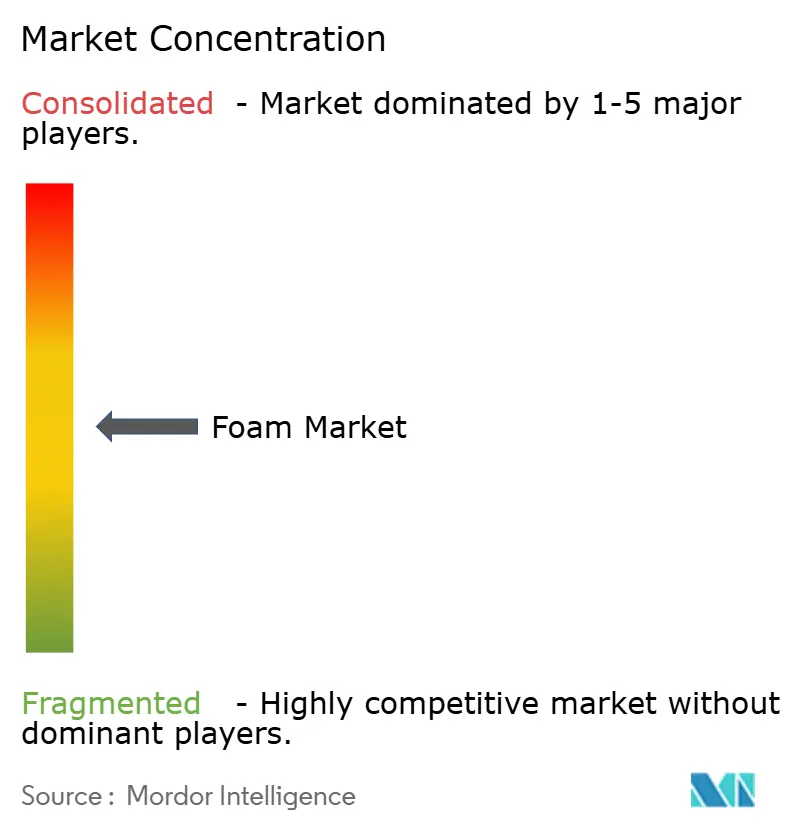
The foam market is moderately concentrated, with the top five players including BASF, Covestro AG, Huntsman International LLC, Carpenter Co., and ARMACELL. These producers compete through feedstock control, mass-balance certification, product development, and global supply capacity. Specialty fabricators such as Zotefoams plc and Rogers Foam Corporation compete through application knowledge, proprietary processes, and customer qualification work. This structure creates pricing pressure in standard grades while maintaining room for differentiated products in demanding applications. It also means that customer service, supply reliability, and converting expertise can be as important as resin capacity in purchasing decisions.
Technology and documentation have become important competitive tools in the foam market. BASF expanded its biomass balance polyol portfolio in March 2026, giving flexible foam customers a documented lower-carbon feedstock option. Covestro AG's planned MDI investment in Shanghai and its United Arab Emirates feasibility study reflect its focus on supply for growth areas in Asia-Pacific and the Middle East. These moves show how capacity, certification, and technical capability are being used together rather than as separate strategies. Smaller producers may find it harder to match these investments across every end market.
Specialized areas such as electric vehicle battery systems and pharmaceutical cold-chain packaging require combinations of thermal management, acoustic performance, and environmental documentation. BASF's certified product offerings and Covestro AG's mass-balance allocations support customers who need traceable claims. SEKISUI CHEMICAL CO., LTD. has developed halogen-free flame-retardant grades for applications that must meet regulatory and product-performance requirements. Zotefoams also expanded its European product range and fabrication capabilities through the acquisition of Overseas Konstellation Company S.A. in November 2025. The foam market continues to favor suppliers that can deliver reliable materials, compliance support, and application-specific engineering. The ability to work with customers from material selection through testing and final qualification can strengthen long-term commercial relationships.
Foam Industry Leaders
BASF
Covestro AG
Huntsman International LLC
Carpenter Co.
ARMACELL
- *Disclaimer: Major Players sorted in no particular order

Recent Industry Developments
- June 2026: Covestro AG announced plans to invest in a new 660,000-metric-ton world-scale MDI production train at its Integrated Site in Shanghai, China. The expansion increases MDI availability, a key raw material for polyurethane foam production, supporting future supply for rigid and flexible foam applications.
- April 2026: Adient plc acquired an automotive seating foam production plant in Romulus, Michigan, expanding its Americas foam manufacturing network to 10 plants and global network to 30. The acquisition strengthens automotive foam production capacity and supports growing demand for polyurethane seating foam across vehicle applications.


Global Foam Market Report Scope
Foams are cellular materials characterized by a network of gas-filled pores within a polymer or other solid matrix, providing low density and tunable physical properties. They are used to provide cushioning, insulation, impact absorption, lightweighting, and protection across a broad range of manufactured products and structures.
The Foam Market is segmented by resin type, foam type, end-use industry, and geography. By resin type, the market is segmented into polyurethane, polystyrene (expanded polystyrene (EPS) and extruded polystyrene (XPS)), polyolefin (polyethylene (PE), polypropylene (PP), and ethylene-vinyl acetate (EVA)), phenolic, polyethylene terephthalate (PET), and other resin types. By foam type, the market is segmented into flexible foam and rigid foam. By end-use industry, the market is segmented into building and construction, packaging, automotive, furniture and bedding, footwear, sports and recreational, and other end-use industries. The report also covers the market size and forecasts for foam in 16 countries across major regions. For each segment, the market sizing and forecasts have been done on the basis of value (USD).
| Polyurethane | |
| Polystyrene | Expanded Polystyrene (EPS) |
| Extruded Polystyrene (XPS) | |
| Polyolefin | Polyethylene (PE) |
| Polypropylene (PP) | |
| Ethylene-Vinyl Acetate (EVA) | |
| Phenolic | |
| Polyethylene Terephthalate (PET) | |
| Other Resin Types |
| Flexible Foam |
| Rigid Foam |
| Building and Construction |
| Packaging |
| Automotive |
| Furniture and Bedding |
| Footwear, Sports and Recreational |
| Other End-Use Industries |
| Asia-Pacific | China |
| India | |
| Japan | |
| South Korea | |
| ASEAN Countries | |
| Rest of Asia-Pacific | |
| North America | United States |
| Canada | |
| Mexico | |
| Europe | Germany |
| United Kingdom | |
| France | |
| Italy | |
| NORDIC Countries | |
| Russia | |
| Rest of Europe | |
| South America | Brazil |
| Argentina | |
| Rest of South America | |
| Middle East and Africa | Saudi Arabia |
| South Africa | |
| Rest of Middle East and Africa |
| By Resin Type | Polyurethane | |
| Polystyrene | Expanded Polystyrene (EPS) | |
| Extruded Polystyrene (XPS) | ||
| Polyolefin | Polyethylene (PE) | |
| Polypropylene (PP) | ||
| Ethylene-Vinyl Acetate (EVA) | ||
| Phenolic | ||
| Polyethylene Terephthalate (PET) | ||
| Other Resin Types | ||
| By Foam Type | Flexible Foam | |
| Rigid Foam | ||
| By End-Use Industry | Building and Construction | |
| Packaging | ||
| Automotive | ||
| Furniture and Bedding | ||
| Footwear, Sports and Recreational | ||
| Other End-Use Industries | ||
| By Geography | Asia-Pacific | China |
| India | ||
| Japan | ||
| South Korea | ||
| ASEAN Countries | ||
| Rest of Asia-Pacific | ||
| North America | United States | |
| Canada | ||
| Mexico | ||
| Europe | Germany | |
| United Kingdom | ||
| France | ||
| Italy | ||
| NORDIC Countries | ||
| Russia | ||
| Rest of Europe | ||
| South America | Brazil | |
| Argentina | ||
| Rest of South America | ||
| Middle East and Africa | Saudi Arabia | |
| South Africa | ||
| Rest of Middle East and Africa | ||


Key Questions Answered in the Report
What is the size of the foam market?
The foam market stands at USD 125.40 billion in 2026 and is projected to reach USD 166.79 billion by 2031.
Which resin type led the market demand in 2025?
Polyurethane led with 40.43% of the foam market share in 2025.
Which foam type is expected to grow fastest through 2031?
Rigid foam is projected to advance at a 6.57% CAGR through 2031, supported by insulation requirements in buildings, cold storage, and appliances.
Which end-use industry led the market demand in 2025?
Building and construction held 35.74% of the foam market share in 2025, supported by insulation use in roofs, walls, and cold-storage facilities.
Page last updated on:





