
FMCW LiDAR Systems Market Size and Share
Market Overview
| Study Period | 2020 - 2031 |
|---|---|
| Market Size (2026) | USD 176.54 Million |
| Market Size (2031) | USD 587.21 Million |
| Growth Rate (2026 - 2031) | 27.17 % |
| Fastest Growing Market | Asia-Pacific |
| Largest Market | North America |
| Market Concentration | Medium |
Major Players *Disclaimer: Major Players sorted in no particular order Image © Mordor Intelligence. Reuse requires attribution under CC BY 4.0. | |
FMCW LiDAR Systems Market Analysis by Mordor Intelligence
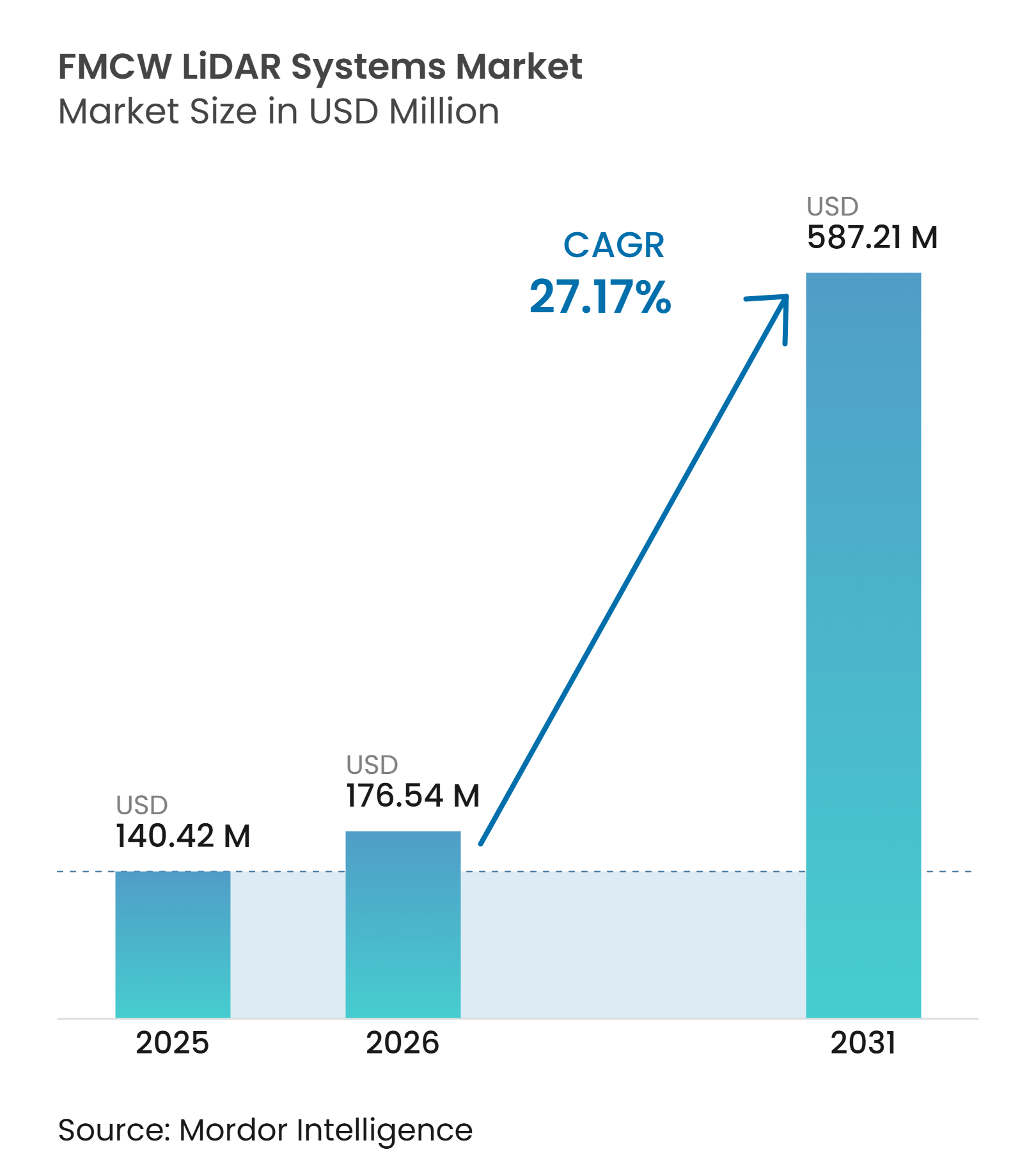
The FMCW LiDAR systems market size is expected to increase from USD 140.42 million in 2025 to USD 176.54 million in 2026 and reach USD 587.21 million by 2031, growing at a CAGR of 27.17% over 2026-2031. FMCW technology measures range and instantaneous radial velocity in a single laser sweep via Doppler-shifted beat frequencies. This capability supports automation systems that must track moving people, vehicles, and equipment in real time. Demand is moving beyond aerospace and premium automotive uses into logistics, manufacturing, and transportation infrastructure. Suppliers are pursuing integrated photonics, software-based perception, and production partnerships to lower system complexity and secure design programs. Supply concentration in specialized photonic components and competition from radar-camera systems will continue to influence purchasing decisions in the FMCW LiDAR systems market.
Key Report Takeaways
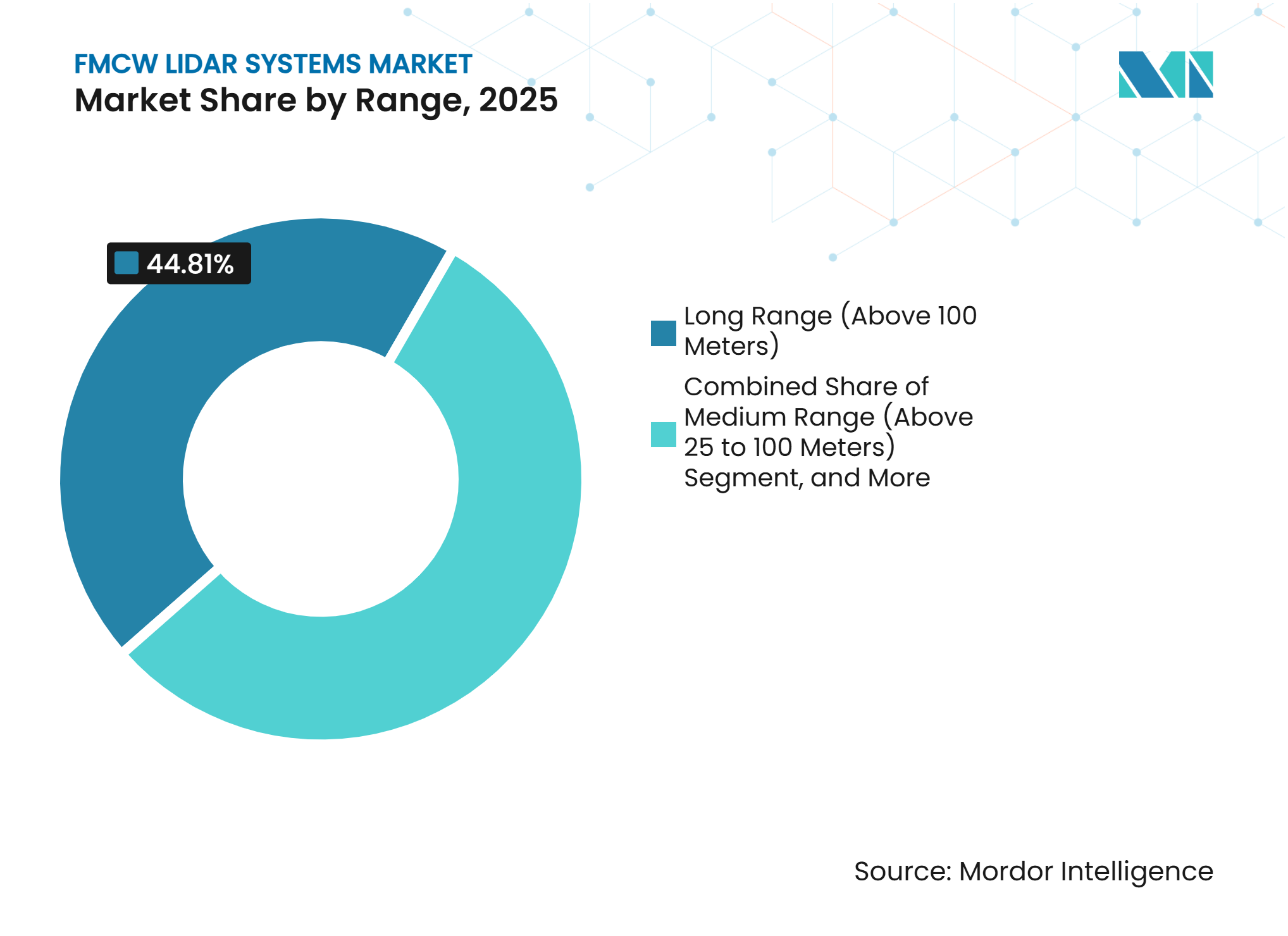
- By range, long-range sensors (above 100 meters) accounted for 44.81% of the FMCW LiDAR systems market share in 2025 and are projected to expand at a 28.47% CAGR through 2031.
- By wavelength, the 1,550-nanometer band is expected to grow at a 28.83% CAGR through 2031.
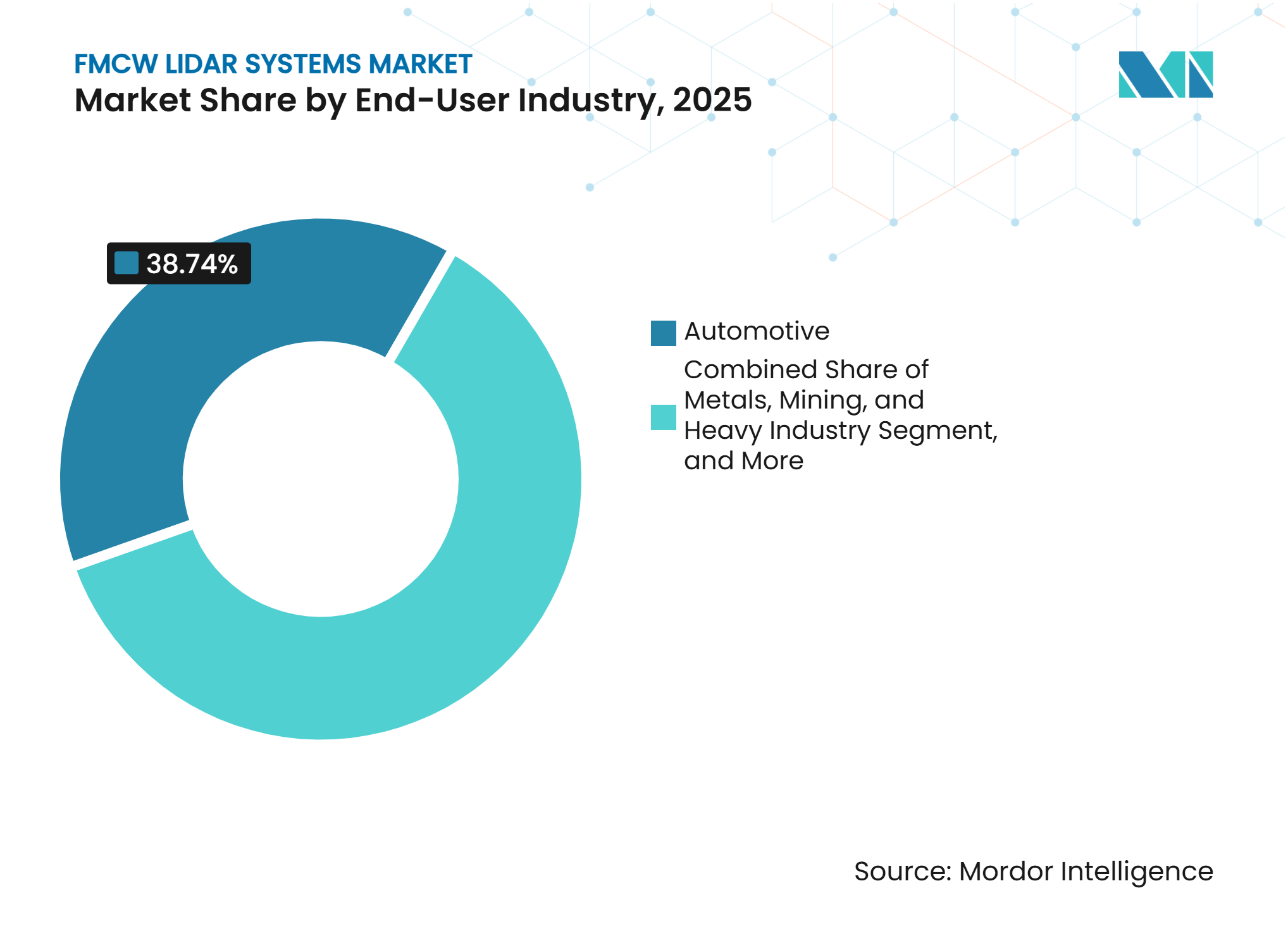
- By end-user industry, automotive accounted for 38.74% of the FMCW LiDAR systems market share in 2025, while third-party logistics and e-commerce fulfillment are projected to grow at a 28.79% CAGR through 2031.
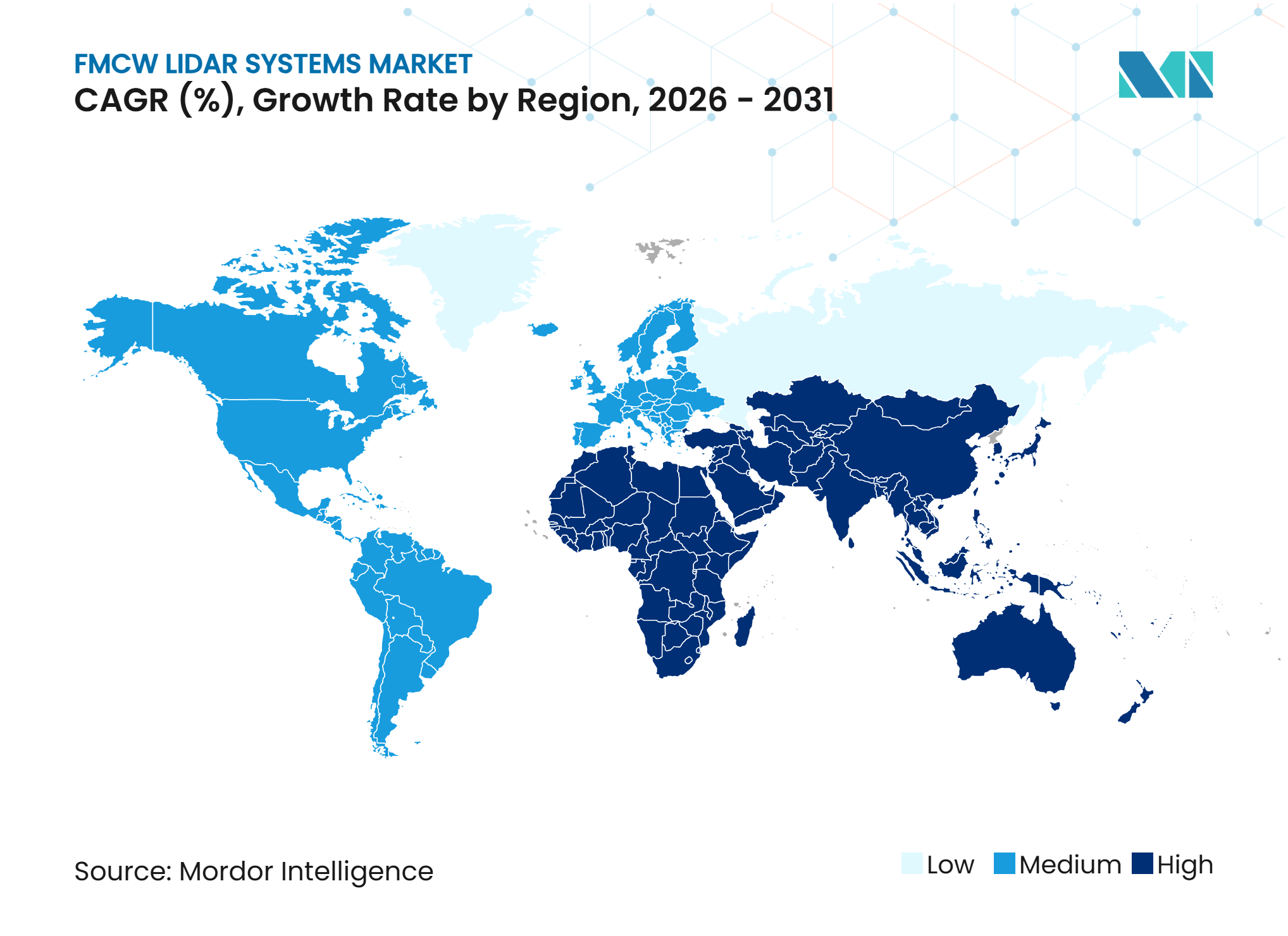
- By geography, North America held 36.42% of the FMCW LiDAR systems market in 2025, while Asia-Pacific is projected to expand at a 29.32% CAGR through 2031.
Note: Market size and forecast figures in this report are generated using Mordor Intelligence’s proprietary estimation framework, updated with the latest available data and insights as of January 2026.
Market Trends and Insights
Drivers Impact Analysis of FMCW LiDAR Systems Market*
| Driver | (~) % Impact on CAGR Forecast | Geographic Relevance | Impact Timeline |
|---|---|---|---|
| Expansion of Autonomous Mobile Robots and Warehouse Automation | +5.2% | Global, with peak intensity in North America, Europe, and East Asia | Short term (≤ 2 years) |
| Industry 4.0 Adoption and Flexible Manufacturing | +4.8% | North America and EU, with secondary gains in South and East Asia | Medium term (2-4 years) |
| Declining Photonic Component Costs and Semiconductor Integration | +4.1% | Global, anchored by CMOS-compatible foundries in Taiwan, South Korea, and the United States | Medium term (2-4 years) |
| Functional-Safety Requirements for Human-Robot Collaboration | +3.5% | North America and EU, with spillover to Asia-Pacific through OEM localization | Medium term (2-4 years) |
| Embedded Perception Reducing System Integration Complexity | +2.9% | Global, with early commercial traction in North America and East Asia | Medium term (2-4 years) |
| Rising Demand for Velocity-Aware Perception in Dynamic Industrial Environments | +2.3% | Global, with concentrated demand in large warehouse and port operations | Long term (≥ 4 years) |
| Source: Mordor Intelligence | |||
Expansion of Autonomous Mobile Robots and Warehouse Automation
Autonomous mobile robots are increasing the demand for sensing systems that can identify both an object’s location and its movement. This requirement is important in fulfillment centers and manufacturing sites where robots work near employees and mobile equipment. FMCW LiDAR combines range and Doppler measurements in a single sweep, which supports this operational need. This demand supports continued adoption in the FMCW LiDAR systems market. Its matched-filter receiver can reduce interference among many LiDAR-equipped robots in the same facility. This can help operators avoid false detections, emergency stops, and related throughput losses. Hesai reported robotics LiDAR shipments of 142,371 units in Q2 2026, up 193.4% year over year, showing that warehouse and embodied AI deployments are creating sensor demand at scale.
Industry 4.0 Adoption and Flexible Manufacturing
Flexible manufacturing cells require frequent spatial updates as layouts change during short production runs. These settings also need reliable detection near reflective metal surfaces, dust, and moving equipment. FMCW LiDAR can provide range and velocity data without relying on fixed mechanical guides. The FMCW LiDAR systems market benefits as flexible cells need this sensing capability. The sensor output can support object classification, motion prediction, and path planning within one perception system. This reduces the need to combine separate radar and camera streams for each cell. A 2026 OFC paper demonstrated simultaneous distance and velocity measurements using an integrated coherent LiDAR platform, supporting the case for compact embedded perception modules.
Declining Photonic Component Costs and Semiconductor Integration
Silicon photonics is moving FMCW LiDAR designs from multi-chip assemblies toward more integrated architectures. Wafer-level production can reduce unit costs for automotive programs that require high volumes and consistent quality. A 2025 research framework identified cost and scalability as central requirements for next-generation integrated FMCW LiDAR sources. Cost reductions can improve access to the FMCW LiDAR systems market for industrial users. It also described the potential of large-scale wafer-level manufacturing for automotive applications. OFC research in 2025 demonstrated a monolithically integrated architecture that placed the optical phased-array transmitter and coherent receiver on a CMOS-compatible chip. These developments could increase replacement risk for designs selected at current pricing as yields improve and new semiconductor-based suppliers enter volume production.
Functional-Safety Requirements for Human-Robot Collaboration
Safety standards are narrowing the choices available to automotive and industrial sensor designers. ISO 26262 establishes functional safety requirements for road vehicle electronic systems. ISO/TS 5083:2025 addresses design, verification, and validation for automated driving systems.[1] FMCW LiDAR provides separate range and velocity outputs, which can support redundant perception approaches. These requirements can favor qualified suppliers in the FMCW LiDAR systems market. ISO 23150-12:2026 also defines logical LiDAR interfaces with data-fusion units for automated driving. Suppliers that complete safety validation can gain an advantage because replacing a qualified sensor can add cost and time to multi-year vehicle programs.
Restraints Impact Analysis of FMCW LiDAR Systems Market*
| Restraint | (~) % Impact on CAGR Forecast | Geographic Relevance | Impact Timeline |
|---|---|---|---|
| Competition From Camera and 4D Radar Perception Systems | -2.8% | Global, most acute in mid-range industrial and entry-level ADAS segments | Medium term (2-4 years) |
| High Integration and Validation Costs for Industrial Deployments | -2.2% | North America, EU, and Asia-Pacific, particularly for non-automotive users with limited systems-integration capability | Medium term (2-4 years) |
| Calibration Drift Across Mixed Indoor and Outdoor Operating Conditions | -1.6% | Global, most disruptive in logistics facilities spanning indoor-outdoor transitions | Long term (≥ 4 years) |
| Photonics Supply Concentration and Export-Control Exposure | -1.4% | North America and EU, sourcing from East Asian photonic component supply chains | Long term (≥ 4 years) |
| Source: Mordor Intelligence | |||
Competition From Camera and 4D Radar Perception Systems
Camera and 4D radar systems are competing with FMCW LiDAR in applications with strict unit-cost limits. Research presented at CVPR 2026 reported that radar-camera cooperative perception improved robustness in fog and rain, where LiDAR point-cloud density can decline. Radar-camera combinations can meet requirements in some mid-range industrial uses where velocity data matters more than high spatial resolution. The input pricing range for FMCW sensors is USD 400-600 per unit, which can make these alternatives attractive. This pressure affects supplier positioning in the FMCW LiDAR systems market. Camera-only systems still face limitations in low visibility and against low-contrast targets. LiDAR-inclusive systems can therefore remain more suitable for safety-sensitive applications that need stronger perception performance.
High Integration and Validation Costs for Industrial Deployments
Industrial buyers must account for integration work in addition to the sensor purchase price. FMCW deployments require calibration of photonic channel gain, chirp linearity, and thermal management. Many non-automotive users lack the required firmware and validation resources in-house. A 1% normalized RMS deviation in chirp nonlinearity can reduce range resolution in the same way as a fivefold increase in laser linewidth. Seasonal temperature changes of 30-40°C can therefore create performance issues that only appear in particular operating conditions. Ongoing engineering costs can delay adoption, where equipment budgets and integration-service budgets are managed separately.
*Our forecasts treat driver/restraint impacts as directional, not additive. The impact forecasts reflect baseline growth, mix effects, and variable interactions.
FMCW LiDAR Systems Market Segment Analysis
By Range:
Long-Range Sensing Dominates, Short-Range Gains Ground in Embedded RoboticsLong-range sensors above 100 meters accounted for 44.81% of the FMCW LiDAR systems market in 2025 and are projected to grow at a 28.47% CAGR through 2031. Demand came from highway ADAS, port and airport crane automation, and robotaxi fleets. These applications need reliable sensing beyond the immediate operating safety buffer. Extended detection distances can improve response time for vehicles and autonomous equipment. Long-range requirements remain important for the FMCW LiDAR systems market. The fact that long range is both the largest and fastest-growing range category reflects demand from production ADAS and autonomous freight platforms. Systems in these applications may need detection beyond 200 meters. OFC research described a coherent LiDAR design that integrated a transmitter and receiver on one CMOS-compatible chip. This approach could lower module costs while preserving long-range performance.
Short-range sensors up to 25 meters serve humanoid robots, collaborative robot arms, and autonomous forklifts operating in shared spaces. These systems often operate at speeds below 10 meters per second and require perception close to the machine. Voyant Photonics has pursued chip-scale sensing for this use case. Hesai stated that its JT128 module was adopted by more than 50 embodied AI companies, including Unitree and Galbot. This showed commercial activity in robotics before broad automotive price parity. Medium range sensors above 25 meters to 100 meters serve mixed industrial environments such as large manufacturing sites and outdoor logistics yards. Their velocity data can support traffic management when reflective surfaces or GPS constraints limit conventional positioning. IEC 60825-1 laser-safety requirements influence transmitted-power choices across all range categories.



By Wavelength:
1,550 nm Architecture Consolidates, 905 nm Defends Volume in Cost-Sensitive SegmentsThe 1,550 nm band is projected to expand at a 28.83% CAGR through 2031. This growth follows technical characteristics of coherent detection rather than a simple commercial preference. The human retina is less sensitive at 1,550 nm than at 905 nm. Under IEC 60825-1 limits, this permits higher transmitted power. Higher power can support a longer range, a greater coherence length, and a larger operating margin in high ambient light. These characteristics are relevant for outdoor yards and airport aprons. Research published in 2026 demonstrated spectral-selective detection at 1,550 nm with tandem colloidal quantum dot photodiodes and a 1.01-nanosecond response time.[2] This points to lower-cost alternatives to InGaAs receivers, which account for a significant share of the FMCW bill of materials.
Aeva’s Atlas Ultra uses a 1,550 nm FMCW system-on-chip designed for ISO 26262 and ISO/SAE 21434 compliance requirements. This example shows how wavelength choice, safety compliance, and vehicle performance can reinforce one another for certified suppliers. Products based on 905 nm retain volume in short- and medium-range industrial applications. Lower required detection distances can reduce the impact of the lower permissible laser power at that wavelength. The 1,310 nm band occupies a narrower position between the other main wavelengths. It offers better eye safety than 905 nm but has lower detector maturity and higher cost than 1,550 nm. Wavelength decisions continue to shape competition in the FMCW LiDAR systems market. Other wavelengths, including mid-infrared variants, remain at the demonstrator stage. Foundries that already manufacture telecom-band components are supporting development for the 1,550 nm category.
By End-User Industry:
Automotive Anchors the Base, 3PL and E-Commerce Fulfillment AcceleratesAutomotive held 38.74% of the FMCW LiDAR systems market in 2025. The sector has established procurement processes for safety-qualified sensors and long design cycles. Those design cycles can lock sensor architectures in place years before production begins. FMCW is gaining relevance in programs for Level 3 and Level 4 driving. Simultaneous velocity measurement can provide useful scene information for hands-off driving functions. Automotive programs provide a stable base for the FMCW LiDAR systems market. ISO/TS 5083:2025 also creates a clear framework for design, verification, and validation of automated driving systems. Electronics and semiconductor users are adopting LiDAR-equipped inspection robots for cleanroom use. FMCW can support contactless spatial measurement for wafer handling and quality-control tasks where reflective surfaces are common.
Third-party logistics and e-commerce fulfillment are projected to grow at a 28.79% CAGR through 2031. High-throughput centers use autonomous mobile robot fleets that require reliable navigation around conveyors and workers. Doppler-based ego-motion estimation can reduce localization drift in feature-poor aisles. This can reduce reliance on external markers and visual simultaneous localization and mapping infrastructure. Consumer goods, food and beverage, and pharmaceutical facilities are adopting FMCW systems gradually for palletizing and automated inspection. Mining and heavy industry can generate higher revenue per installation because autonomous haulage needs long-range sensing across temperatures from -40°C to +85°C. AMLab secured contracts in April 2026 for LiDAR systems on 34 automated rail-mounted gantry cranes at the Port of Rotterdam. GUSS Automation also planned to use Ouster’s Rev8 digital LiDAR in autonomous orchard machines for GPS-denied navigation

Geography Analysis
North America held 36.42% of the FMCW LiDAR systems market in 2025. The region has robotaxi operators moving from pilots toward commercial deployment. Investment in warehouse automation and a deep Tier-1 automotive supply chain also supports demand. Aeva, SiLC Technologies, Voyant Photonics, and AEye form part of the regional base of FMCW-focused companies. These companies focus on silicon photonics integration and production partnerships. North American programs are an important source of demand for the FMCW LiDAR systems market. Aeva was selected in February 2026 by a top-5 global passenger OEM for its Atlas Ultra 4D LiDAR platform. Its July 2025 collaboration with LG Innotek included up to USD 50 million in investment, development funding, and capacity support.
Asia-Pacific is projected to grow at a 29.32% CAGR through 2031. China’s integrated LiDAR supply chain gives the region a manufacturing scale. Japan and South Korea are pursuing automotive and semiconductor co-development programs. Hesai reported 628,275 LiDAR shipments in Q2 2026, up 78.4% year over year. The company also reported a 44% share of China’s long-range ADAS LiDAR category in June 2026, based on Gasgoo data. RoboSense reported 282,600 robotics and other application LiDAR units in H1 2026, up 510.4% year over year. South Korean and Japanese investments in SiLC Technologies show that the regional photonics ecosystem extends beyond Chinese suppliers.
Europe’s growth is shaped by automotive safety requirements and industrial automation spending. Germany, France, and the United Kingdom are central ADAS procurement markets. ISO 26262 requirements support the use of safety-qualified sensor platforms. Hesai confirmed in Q1 2026 that it was a strategic LiDAR partner and supplier for Mercedes-Benz Level 3-enabled models in Europe and China.[3] Its Galileo manufacturing center in Thailand supports this dual-region supply model. The Middle East is also gaining relevance through smart-port projects and sovereign AI programs. Africa has early opportunities in automated mining and port modernization. South America has emerging demand from Brazilian agricultural modernization and Chilean mining automation.
Competitive Landscape
Market Concentration
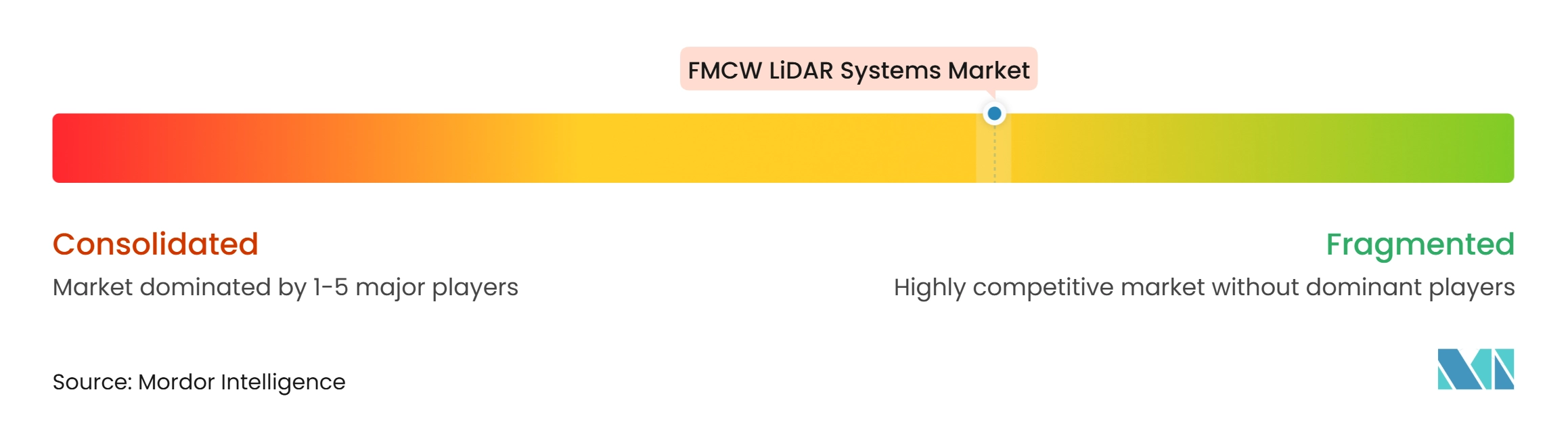
The FMCW LiDAR systems market is moderately fragmented. Hesai Technology and RoboSense operate at volume scale in the automotive and robotics sectors. Aeva, SiLC Technologies, Voyant Photonics, Baraja, and Blickfeld compete through photonic integration, coherent architecture, and application specialization. Chinese manufacturers benefit from cost advantages in high-volume production. Western suppliers focus on chip-scale photonics, perception software, and OEM program certification. Aeva’s selection for a top-5 passenger OEM program in February 2026 illustrates this production-program strategy.
Suppliers are increasingly integrating photonic-chip design, sensor hardware, and perception algorithms. This can reduce the integration layers between sensor silicon and vehicle-control systems. This strategy differentiates suppliers in the FMCW LiDAR systems market. In August 2026, Innoviz announced it was developing a LiDAR-based perception stack with a top-10 automotive OEM, using InnovizTwo and NVIDIA computing hardware.[4] The effort explored a possible future series-production program for driving on the highway operational design domain. Innoviz also announced a USD 30 million registered direct offering in July 2026 to support commercialization of its Perciz defense and security business. In June 2026, it entered a collaboration with Drive Group for intelligent transportation and perimeter-security solutions. These actions show suppliers seeking revenue beyond automotive programs.
Opportunity remains in agriculture, mining, heavy industry, and short-range humanoid robotics. These uses value thermal robustness and velocity measurement, but deployment economics remain sensitive to sensor cost. Port, airport, and smart-road projects also offer a path to larger infrastructure programs. AMLab’s Rotterdam deployment provided a multi-crane example that other terminal operators can assess. Patent activity is increasing around photonic integrated circuits, beam steering, and coherent receiver design. OFC 2025 and OFC 2026 work on integrated transmitter and receiver systems shows the direction of this competition. Seyond, Leishen Intelligent System, and Benewake are also targeting robotics and industrial uses that are not the highest priority for automotive-focused suppliers.
FMCW LiDAR Systems Industry Leaders
-
Hesai Technology Co., Ltd.
-
RoboSense Technology Co., Ltd.
-
Ouster, Inc.
-
Innoviz Technologies Ltd.
-
Aeva Technologies, Inc.
- *Disclaimer: Major Players sorted in no particular order
FMCW LiDAR Systems Market Companies Covered in this Report
- Hesai Technology Co., Ltd.
- RoboSense Technology Co., Ltd.
- Ouster, Inc.
- Innoviz Technologies Ltd.
- Aeva Technologies, Inc.
- Luminar Technologies, Inc.
- Cepton, Inc.
- LeddarTech Inc.
- MicroVision, Inc.
- Blickfeld GmbH
- OPSYS Tech Ltd.
- Voyant Photonics, Inc.
- LuminWave Technology Co., Ltd.
- SSLiDAR Inc.
- Seyond, Inc.
- Leishen Intelligent System Co., Ltd.
- Livox Technology Limited
- Benewake (Beijing) Co., Ltd.
- Baraja Pty Ltd.
- SiLC Technologies, Inc.
- AEye, Inc.
- TetraVue, Inc.
- Hybrid Lidar Systems
Recent Industry Developments in FMCW LiDAR Systems Market
- August 2026: Ouster announced plans for GUSS Automation, a wholly owned John Deere subsidiary, to integrate the Rev8 OS0 native-color digital LiDAR into its next-generation autonomous orchard machine fleet for GPS-denied orchard and vineyard navigation. The Rev8 sensor is built on Ouster’s L4 silicon platform.
- August 2026: Innoviz Technologies announced development of a LiDAR-based perception stack with a top-10 global automotive OEM for highway operational design domain driving. The work integrates the InnovizTwo LiDAR sensor and NVIDIA computing hardware to explore a potential future series-production program.
- June 2026: Drive Group and Innoviz Technologies signed a collaboration agreement to integrate InnovizSMART LiDAR into intelligent transportation and perimeter-security solutions. The joint Barak LightGuard project targeted USD 20 million in sales by the end of 2027.
- February 2026: Hesai Technology announced a cooperation agreement with Grab, appointing Grab as its exclusive LiDAR distributor across 8 Southeast Asian countries and more than 800 cities for robotics, autonomous mobility, and mapping uses.
Global FMCW LiDAR Systems Market Report Scope
The FMCW LiDAR systems market includes systems that use frequency-modulated continuous-wave (FMCW) technology to measure distance, velocity, and direction by analyzing the frequency shift of reflected laser signals. These systems support high-resolution, long-range sensing and are used in applications such as autonomous vehicles, robotics, industrial automation, and security.
The FMCW LiDAR Systems Market Report Market is Segmented by Range (Short Range (Up to 25 Meters), Medium Range (Above 25 to 100 Meters), and Long Range (Above 100 Meters)), Wavelength (905 Nanometers, 1,310 Nanometers, 1,550 Nanometers, and Other Wavelengths), End-User Industry (Automotive, Electronics and Semiconductor, Consumer Goods, Food and Beverage, Pharmaceutical, Metals, Mining, and Heavy Industry, Third-Party Logistics and E-Commerce Fulfillment, Ports, Airports, and Transportation Infrastructure, Agriculture, and Other End-User Industries), and Geography (North America, South America, Europe, Asia-Pacific, Middle East, and Africa). The Market Forecasts are Provided in Terms of Value (USD).
Segmentation Overview
| Short Range (Up to 25 Meters) |
| Medium Range (Above 25 to 100 Meters) |
| Long Range (Above 100 Meters) |
| 905 Nanometers |
| 1,310 Nanometers |
| 1,550 Nanometers |
| Other Wavelengths |
| Automotive |
| Electronics and Semiconductor |
| Consumer Goods |
| Food and Beverage |
| Pharmaceutical |
| Metals, Mining, and Heavy Industry |
| Third-Party Logistics and E-Commerce Fulfillment |
| Ports, Airports, and Transportation Infrastructure |
| Agriculture |
| Other End-User Industries |
| North America | United States |
| Canada | |
| Mexico | |
| South America | Brazil |
| Argentina | |
| Chile | |
| Rest of South America | |
| Europe | Germany |
| United Kingdom | |
| France | |
| Italy | |
| Spain | |
| Rest of Europe | |
| Asia-Pacific | China |
| Japan | |
| India | |
| South Korea | |
| Australia | |
| Rest of Asia-Pacific | |
| Middle East | United Arab Emirates |
| Saudi Arabia | |
| Turkey | |
| Rest of Middle East | |
| Africa | South Africa |
| Egypt | |
| Rest of Africa |
| By Range | Short Range (Up to 25 Meters) | |
| Medium Range (Above 25 to 100 Meters) | ||
| Long Range (Above 100 Meters) | ||
| By Wavelength | 905 Nanometers | |
| 1,310 Nanometers | ||
| 1,550 Nanometers | ||
| Other Wavelengths | ||
| By End-User Industry | Automotive | |
| Electronics and Semiconductor | ||
| Consumer Goods | ||
| Food and Beverage | ||
| Pharmaceutical | ||
| Metals, Mining, and Heavy Industry | ||
| Third-Party Logistics and E-Commerce Fulfillment | ||
| Ports, Airports, and Transportation Infrastructure | ||
| Agriculture | ||
| Other End-User Industries | ||
| By Geography | North America | United States |
| Canada | ||
| Mexico | ||
| South America | Brazil | |
| Argentina | ||
| Chile | ||
| Rest of South America | ||
| Europe | Germany | |
| United Kingdom | ||
| France | ||
| Italy | ||
| Spain | ||
| Rest of Europe | ||
| Asia-Pacific | China | |
| Japan | ||
| India | ||
| South Korea | ||
| Australia | ||
| Rest of Asia-Pacific | ||
| Middle East | United Arab Emirates | |
| Saudi Arabia | ||
| Turkey | ||
| Rest of Middle East | ||
| Africa | South Africa | |
| Egypt | ||
| Rest of Africa | ||
Key Questions Answered in the Report
What is the size of the FMCW LiDAR systems market?
The FMCW LiDAR systems market is expected to increase from USD 176.54 million in 2026 to USD 587.21 million by 2031, at a 27.17% CAGR.
What is driving adoption of FMCW LiDAR systems?
Growth is supported by autonomous mobile robots, flexible manufacturing, photonic integration, and demand for range and velocity data in shared operating spaces.
Why is 1,550 nm used in FMCW LiDAR systems?
The 1,550 nm band can use higher transmitted power under eye-safety limits, supporting longer range and operation in high ambient light.
Which end users are adopting FMCW LiDAR systems fastest?
Third-party logistics and e-commerce fulfillment is projected to grow at a 28.79% CAGR through 2031 as facilities expand autonomous robot fleets.
Which region is expected to grow fastest for FMCW LiDAR systems?
Asia-Pacific is projected to grow at a 29.32% CAGR through 2031, supported by China’s supply chain and wider robotics deployment.