
Floating Storage and Regasification Unit (FSRU) Market Size and Share
Market Overview
| Study Period | 2022 - 2032 |
|---|---|
| Market Size (2027) | USD 3.13 Billion |
| Market Size (2032) | USD 4.56 Billion |
| Growth Rate (2027 - 2032) | 7.83 % |
| Fastest Growing Market | Asia-Pacific |
| Largest Market | Asia-Pacific |
| Market Concentration | High |
Major Players *Disclaimer: Major Players sorted in no particular order Image © Mordor Intelligence. Reuse requires attribution under CC BY 4.0. | |
Floating Storage and Regasification Unit (FSRU) Market Analysis by Mordor Intelligence
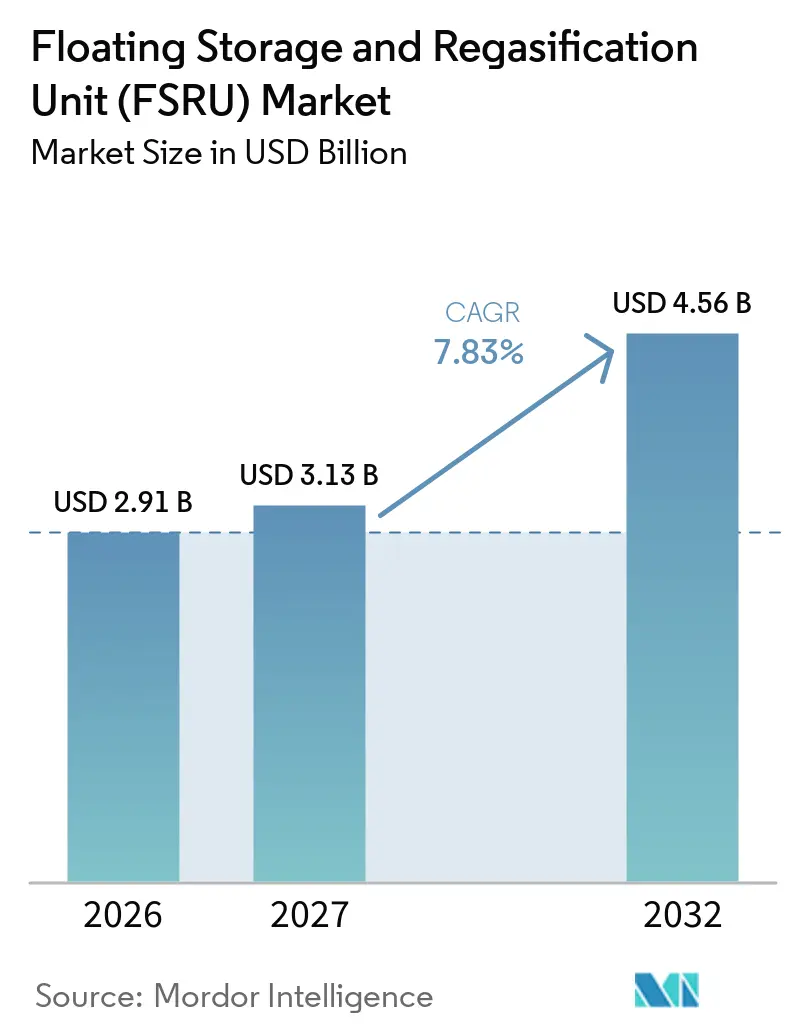
The Floating Storage And Regasification Unit Market size is projected to be USD 2.91 billion in 2026, USD 3.13 billion in 2027, and reach USD 4.56 billion by 2032, growing at a CAGR of 7.83% from 2027 to 2032. The Floating storage and regasification unit (FSRU) market is benefiting from government demand for import infrastructure that can be deployed sooner than a conventional onshore terminal. Long charter periods are shifting FSRUs from emergency supply assets toward permanent parts of national gas systems. Gas-to-power projects are also widening demand because they connect Liquefied Natural Gas (LNG) imports with dispatchable electricity supply in markets with limited domestic gas infrastructure. Vessel availability remains tight because operational units are increasingly committed under long-term contracts, while conversion and newbuild schedules require substantial lead time. The Floating Storage and Regasification Unit (FSRU) market also faces affordability pressure in price-sensitive importing countries, although new liquefaction capacity is expected to improve supply conditions later in the forecast period.
Key Report Takeaways
- By storage capacity, medium-capacity FSRUs held 59.3% of revenue in 2026, while large-capacity FSRUs are projected to grow at an 8.2% CAGR through 2032.
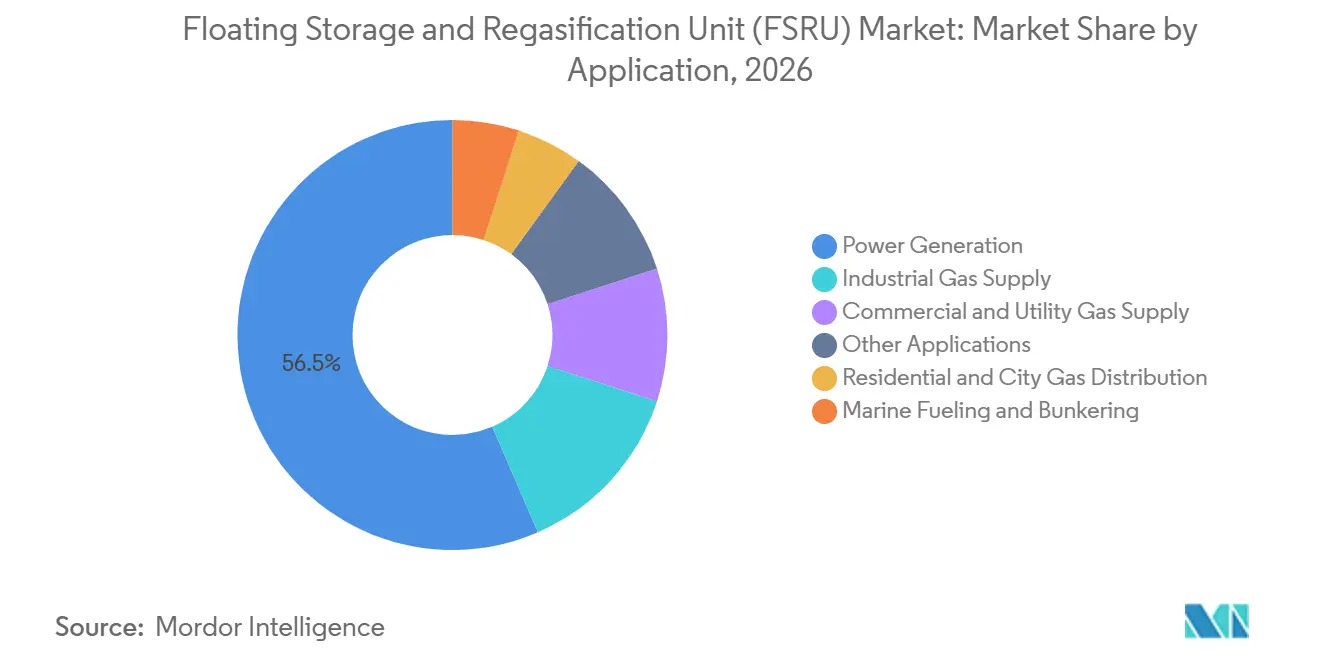
- By application, power generation held 56.5% of revenue in 2026, while residential and city gas distribution is projected to grow at an 8.4% CAGR through 2032.
- By regasification capacity, the medium-scale segment held 53.2% of revenue in 2026, while the large-scale segment is projected to grow at a 9.1% CAGR through 2032.
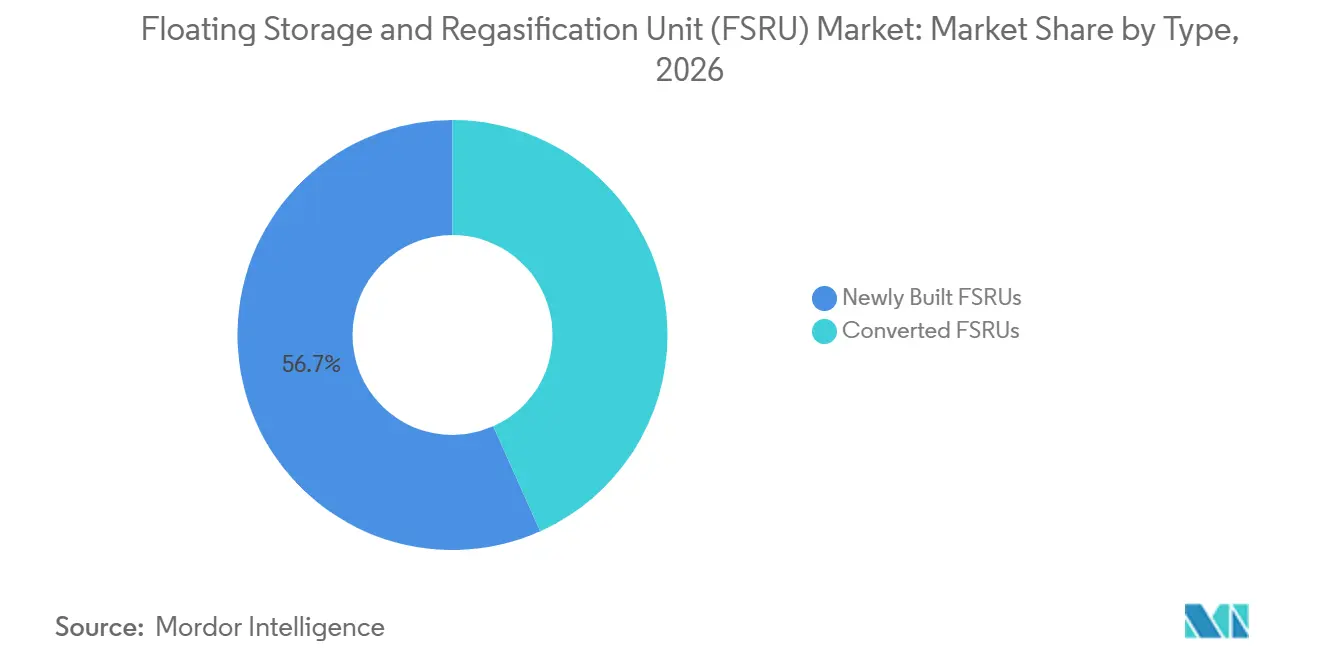
- By type, newly built FSRUs held 56.7% of revenue in 2026, while converted FSRUs are projected to grow at an 8.8% CAGR through 2032.
- By geography, Asia-Pacific held 35.8% of revenue in 2026 and is projected to grow at a 9.3% CAGR through 2032.
Note: Market numbers in this report are based on Mordor Intelligence's proprietary estimation framework, which combines nine months of actuals with Q4 projections for base year 2026.
Global Floating Storage and Regasification Unit (FSRU) Market Trends and Insights
Drivers Impact Analysis*
| Driver | (~) % Impact on CAGR Forecast | Geographic Relevance | Impact Timeline |
|---|---|---|---|
| Rapid Energy-Security Deployment | +2.1% | Global, particularly Europe, Middle East and Africa, South and Southeast Asia | Short term (≤ 2 years) |
| Gas-to-Power Expansion in Supply-Short Markets | +1.8% | Asia-Pacific, Sub-Saharan Africa, Caribbean, Central America | Medium term (2-4 years) |
| Replacement of Russian Pipeline Gas in Europe | +1.5% | Europe, including Germany, Italy, Netherlands, Poland, and Greece | Medium term (2-4 years) |
| LNG Carrier Redeployment and FSRU Conversion | +0.9% | Global, with concentration in Asia-Pacific and Middle East and Africa | Medium term (2-4 years) |
| FSRU Mobility for Demand and Contract Flexibility | +0.7% | South America, ASEAN, and sub-sovereign markets globally | Long term (≥ 4 years) |
| Cold-Energy Recovery and Regasification Efficiency | +0.4% | Asia-Pacific advanced industrial ports and North America | Long term (≥ 4 years) |
| Source: Mordor Intelligence | |||
Rapid Energy-Security Deployment
Governments are selecting FSRUs where energy-security needs cannot wait for onshore terminal development. Egypt moved from no FSRU capacity in 2023 to 5 units in 2026, including units chartered in 2025 and Höegh Evi’s Gandria, which is scheduled for Port of Sumed deployment in Q4 2026 under a 10-year agreement with EGAS. Jordan deployed the Energos Force at Aqaba in August 2025 after its predecessor moved to Egypt. This sequence shows that the availability of a single vessel can affect several national import plans at once. National energy companies are increasingly using FSRUs as permanent grid infrastructure rather than short-term cover. As contracts extend from 3 to 5 years toward 10 and 20 years, more vessels are removed from the available charter pool, which tightens the Floating storage and regasification unit (FSRU) market.[1]
Gas-to-Power Expansion in Supply-Short Markets
The Floating storage and regasification unit (FSRU) market supports gas-to-power projects where electricity systems need dispatchable capacity but lack onshore gas infrastructure. Senegal’s LNG-to-power project began commercial operations in 2025, with the FSRU LNGT Africa supplying gas to Karpowership’s 335 MW fleet. The project showed that floating regasification and generation can be linked in one supply arrangement. ASEAN countries had 37 Metric Tons Per Annum (MTPA) of regasification capacity under development as of April 2025, including projects in the Philippines, Thailand, Vietnam, and Singapore. In Indonesia, a 2025 study found that small-scale LNG supply through FSRUs could reduce fuel costs by 55-60% compared with high-speed diesel.[2] Operating gas-fired plants create longer-term LNG demand, which can support subsequent terminal investment and financing in the Floating storage and regasification unit (FSRU) market.
Replacement of Russian Pipeline Gas in Europe
The end of Russian gas transit through Ukraine on January 1, 2025, strengthened Europe’s need for flexible LNG import capacity.[3] Germany deployed FSRU terminals at Wilhelmshaven 1 and 2, Brunsbüttel, and Lubmin, while a terminal at Stade is scheduled for commissioning by Q2 2026. Europe’s Russian pipeline import reliance fell from 40% in 2021 to 6% by mid-2025, while LNG supplied 48% of EU gas demand during that period. The utilization of German terminals differed sharply by location in 2025, with demand-center access shaping commercial value. This makes vessel mobility important because capacity at lower-use locations can be redirected through sub-charters. The Floating storage and regasification unit (FSRU) market therefore benefits from Europe’s need for both additional capacity and location-specific flexibility.
LNG Carrier Redeployment and FSRU Conversion
Conversion is a major source of future fleet growth for the Floating storage and regasification unit (FSRU) market. Converting a steam-turbine LNG carrier costs USD 200-250 million and takes 27-30 months, compared with USD 320-340 million and 36-40 months for a newbuild. Older LNG carriers face increasing pressure from IMO Carbon Intensity Indicator (CII) and Energy Efficiency Existing Ship Index (EEXI) requirements, which makes conversion a potential alternative to retirement. Seatrium has conversion projects for Höegh Evi, Karpowership, and Excelerate Energy, which shows the concentration of specialist engineering capability. Excelerate’s conversion program includes a vessel with 170,000 m³ storage and reliquefaction capability. Japan Bank for International Cooperation also provided a loan of up to USD 252 million for MOL’s Polish FSRU project, showing that policy-supported financing can support capacity expansion in the Floating storage and regasification unit (FSRU) market.[4]
Restraints Impact Analysis*
| Restraint | (~) % Impact on CAGR Forecast | Geographic Relevance | Impact Timeline |
|---|---|---|---|
| Higher Lifecycle Operating Costs Than Onshore Terminals | -0.8% | Global, most acute in South and Southeast Asia and Sub-Saharan Africa | Medium term (2-4 years) |
| LNG Price Volatility and Importer Affordability | -0.9% | Asia-Pacific price-sensitive importers, South America, and Middle East and Africa | Medium term (2-4 years) |
| Cyclone, Typhoon and Metocean Availability Risk | -0.3% | Asia-Pacific, including the Bay of Bengal and South China Sea, and the Caribbean | Medium term (2-4 years) |
| Vessel Scarcity and Long Shipyard Lead Times | -0.6% | Global, most acute in emerging markets lacking conversion candidates | Short term (≤ 2 years) |
| Source: Mordor Intelligence | |||
LNG Price Volatility and Importer Affordability
Price-sensitive LNG importers often have power tariffs below the delivered cost of imported LNG, making fiscal support central to project viability. Bangladesh’s 2 FSRUs were operating at 95% of their combined 1,100 million cubic feet per day capacity by 2025, but additional capacity remains limited by affordability. Cambodia’s proposed 900 MW LNG-to-power plan faced annual fuel costs of up to USD 722 million, exceeding its 2022 coal import bill. The addition of 210 million tons per annum (MTPA) of global liquefaction capacity between 2026 and 2028 is expected to improve supply conditions. Large import demand from new buyers can still cause price swings, even when global supply expands. The Floating storage and regasification unit (FSRU) market is consequently exposed to the ability of importers to manage both LNG procurement and electricity affordability.
Vessel Scarcity and Long Shipyard Lead Times
Most operational FSRUs are committed under long-term charters through 2030, leaving very limited capacity for immediate redeployment. The global orderbook included only 3 newbuilds in 2025, while shipyards remained focused on conventional LNG carrier orders. Governments that need near-term imports may need to pursue sub-charters or accept delayed gas-to-power projects. There are adequate conversion candidates among older steam-turbine carriers, but specialist conversion-yard capacity is also limited. New operators face an additional barrier because governments and charterers favor companies with demonstrated terminal operating experience. These conditions support charter rates but restrict the pace at which the Floating storage and regasification unit (FSRU) market can add available capacity.
*Our forecasts treat driver/restraint impacts as directional, not additive. The impact forecasts reflect baseline growth, mix effects, and variable interactions.
Segment Analysis
By Storage Capacity: Mid-Size Vessels Anchor Demand While Large-Scale Conversions Accelerate
Medium-capacity FSRUs between 100,000 and 170,000 m³ held 59.3% of the Floating storage and regasification unit (FSRU) market share in 2026. Their position reflects the availability of suitable LNG carrier hulls for both new construction and conversion. They also fit the 2-5 MTPA import needs of Bangladesh, Jordan, Pakistan, and emerging ASEAN buyers. Their draft requirements suit many coastal deepwater ports in developing economies.
Small-capacity units below 100,000 m³ serve archipelagic markets and small-island systems where the FSRU can support domestic distribution. Indonesia has identified Sulawesi and Papua locations where floating terminals below 1 MTPA can replace diesel generation. Large-capacity FSRUs above 170,000 m³ are projected to grow at an 8.2% CAGR through 2032. Excelerate’s Hull 3407 has 170,000 m³ of storage and up to 1,000 million metric standard cubic feet per day (MMSCFD) of regasification capacity for Iraq. Larger vessels can support major national import programs that require extensive pipeline and grid investment. Cold-energy recovery systems may further improve operating efficiency and strengthen the Floating storage and regasification unit (FSRU) market as decarbonization requirements tighten.
By Application: Power Generation Leads While City Gas Emerges as the Next Growth Frontier
Power generation held 56.5% of revenue in 2026. FSRUs allow these countries to introduce gas without first building a large onshore import terminal. Senegal’s operating LNG-to-power project illustrates this integrated approach. The application remains important where domestic gas production cannot meet rising power demand, which supports the Floating storage and regasification unit (FSRU) market.
Residential and city gas distribution is projected to grow at an 8.4% CAGR through 2032. ASEAN countries are building piped distribution networks alongside their first LNG import projects. This allows one floating terminal to serve electricity generation and downstream urban demand, expanding the Floating storage and regasification unit (FSRU) market. PV Gas committed to increase Thi Vai capacity and deploy an FSRU at Vung Tau between 2026 and 2029 for power and downstream gas users. Industrial customers also use imported gas to replace naphtha and fuel oil. Marine fueling, utility supply, and other uses remain smaller applications but can help operators use spare send-out capacity.
By Regasification Capacity: Medium-Scale Segment Holds the Volume, Large-Scale Commands the Value
Medium-scale units with 1-5 MTPA capacity held 53.2% of revenue in 2026. This capacity range aligns with import commitments typically made under existing long-term LNG supply contracts. It is widely deployed across Europe, the Middle East, and South Asia. Their size also suits projects that develop in stages as gas demand becomes established in the Floating storage and regasification unit (FSRU) market.
Large-scale capacity above 5 MTPA is projected to grow at a 9.1% CAGR through 2032. MISC Berhad’s 20-year FSRU contract with Petronas Gas reflects demand for high-capacity supply into Malaysia’s grid. Greece’s Alexandroupolis terminal raised operational regasification throughput during 2025 through optimization of its existing facilities. Small-scale units below 1 MTPA are gaining use in off-grid systems. Indonesia’s multi-depot concept indicated USD 685 million of investment across 50 locations could reduce delivered LNG costs against diesel alternatives. The Floating storage and regasification unit industry therefore serves both large national import hubs and dispersed fuel-switching projects.
By Type: Converted FSRUs Outpace Newbuilds on Speed and Economics
Newly built FSRUs held 56.7% of revenue in 2026. They remain preferred for projects that require long operating life, high redundancy, and 20-year or longer commitments. MISCs planned newbuild for Malaysia and Mitsui O.S.K. Lines (MOL)’s planned unit for Poland show that public backing can support the higher capital requirement. This option remains relevant where the cost of interruption is especially high in the Floating storage and regasification unit (FSRU) market.
Converted FSRUs are projected to grow at an 8.8% CAGR through 2032. Conversion can require USD 200-250 million and 27-30 months, compared with USD 320-340 million and 36-40 months for a new vessel. More than 200 steam-turbine carriers may face commercial constraints under IMO Carbon Intensity Indicator (CII) and Energy Efficiency Existing Ship Index (EEXI) requirements. Conversion provides owners with an alternative use for those ships. Seatrium’s eighth Karpowership conversion is designed for 600 MMSCFD, illustrating the growing scale of the conversion pipeline. The Floating storage and regasification unit industry is therefore drawing on both established vessel assets and purpose-built capacity.
Geography Analysis
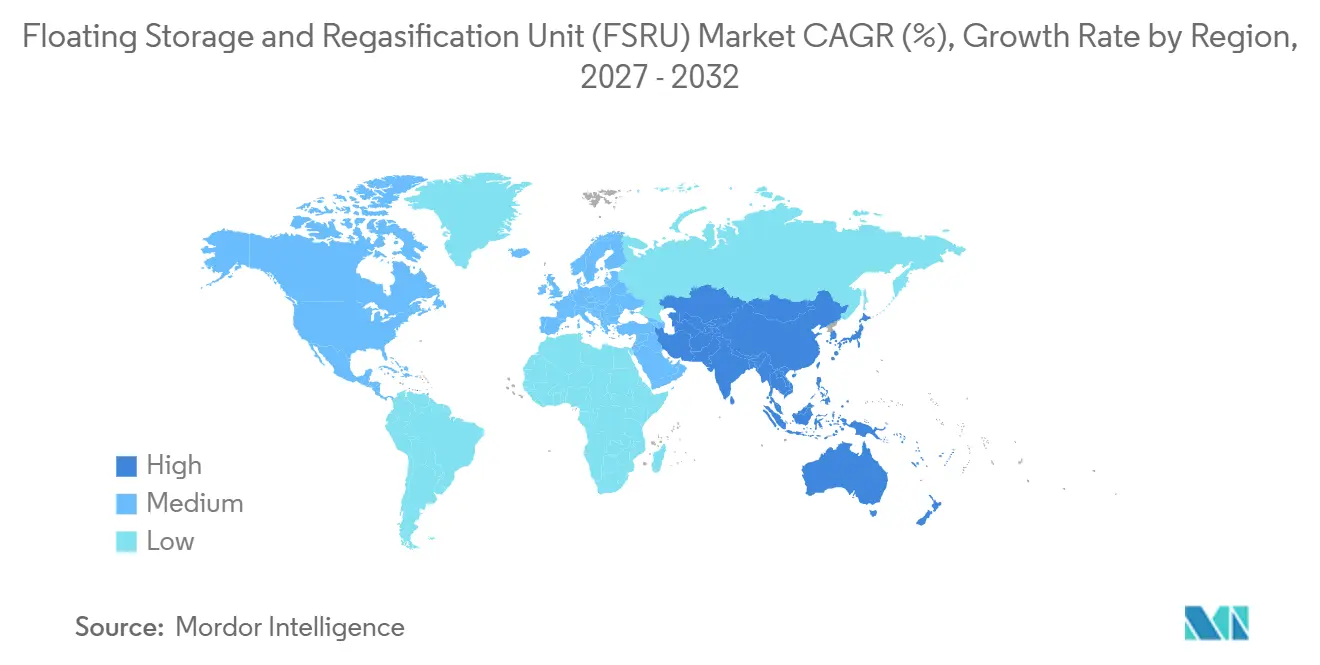
Asia-Pacific held 35.8% of the Floating storage and regasification unit (FSRU) market share in 2026 and is projected to grow at a 9.3% CAGR through 2032. ASEAN countries had 37 Metric Tons Per Annum (MTPA) of regasification capacity under development as of April 2025. FSRUs feature in many projects because they require less capital and can be deployed faster than greenfield onshore terminals. The Philippines granted First Gen a 25-year permit for the Batangas LNG terminal in January 2025, and PetroChina delivered its first cargo in May 2025. Vietnam also plans an FSRU at Vung Tau with 135,000-174,000 m³ storage and up to 14 million Sm³ per day of regasification.
The region continues to expand import capacity in the Floating storage and regasification unit (FSRU) market after the end of Russian pipeline transit through Ukraine. Germany has 4 operational FSRU terminals, with a fifth planned at Stade by Q2 2026. US LNG accounted for 57% of European LNG imports in the first half of 2025. Utilization varied markedly between North Sea and Baltic sites in 2025, showing the importance of berth location and gas-network access. Poland’s floating terminal project, supported by the Japan Bank for International Cooperation (JBIC) loan to MOL, will broaden Eastern European supply options.
Middle East and Africa, together with South America, are important growth areas for the Floating storage and regasification unit (FSRU) market. Egypt moved from LNG exporter to importer as Zohr field output declined between 2021 and 2024. Iraq agreed to a USD 450 million floating import terminal with Excelerate Energy at Khor Al Zubair in October 2025. Brazil expanded LNG import capacity from 2.5 billion cubic feet (Bcf) per day in 2020 to 5.1 Bcf per day by August 2025, with the Suape project adding 0.7 Bcf per day when commissioned.
Competitive Landscape
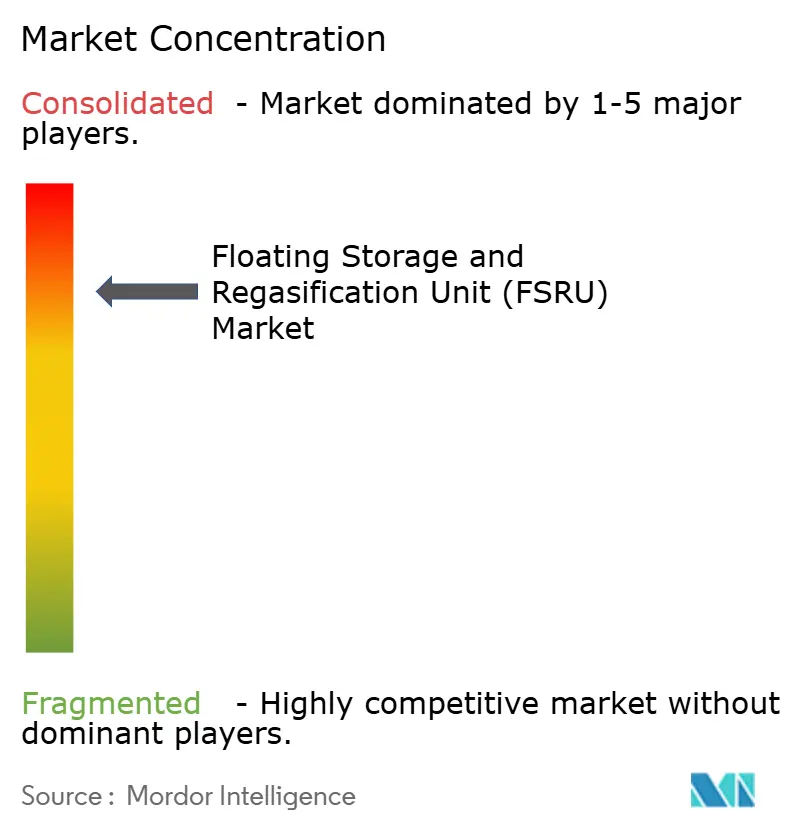
The Floating storage and regasification unit (FSRU) market is highly concentrated among specialist operators and major shipbuilders. Excelerate Energy, Höegh Evi, and Energos Infrastructure are prominent operators with fleets supported by multi-year charters. The global FSRU fleet had 54 units in 2026, and long charter periods limit vessel availability. HD Hyundai Heavy Industries, Samsung Heavy Industries, and Seatrium provide important construction and conversion capacity. Operators are increasingly combining terminal services, LNG supply, and downstream gas sales in single project packages. Excelerate’s Iraq agreement combines terminal construction, vessel supply, and LNG procurement.
Karpowership pairs floating regasification with floating power generation, an approach used in Senegal and other developing markets. Seatrium is expanding its conversion capability through projects for Karpowership, Höegh Evi, and Excelerate Energy. Its October 2026 contract with Excelerate covers an Engineering, Procurement, Construction, Installation and Commissioning (EPCIC) conversion and includes an option for a second unit.
Cold-energy recovery and compliance with vessel-efficiency rules are becoming relevant technical differentiators. A 2025 scientific study found that cryogenic carbon capture integrated with FSRU operations could reduce onboard fuel consumption by 22% while achieving a 100% CO₂ capture rate under the study conditions. IMO Carbon Intensity Indicator (CII) and Energy Efficiency Existing Ship Index (EEXI) requirements also encourage owners to consider converting legacy steam-turbine carriers. The Floating storage and regasification unit (FSRU) market remains constrained by experience, vessel supply, and specialized engineering capacity.
Floating Storage and Regasification Unit (FSRU) Industry Leaders
-
Excelerate Energy, Inc.
-
Höegh Evi AS
-
Energos Infrastructure
-
Karpowership
-
BW Group
- *Disclaimer: Major Players sorted in no particular order
Recent Industry Developments
- October 2026: Seatrium secured an EPCIC FSRU conversion contract from Excelerate Energy, including an option for a second unit, with engineering commencing in Q4 2026 and delivery estimated in 2028. The completed vessel will carry 170,000 m³ storage capacity with reliquefication technology and become the 13th FSRU in Excelerate’s fleet, expanding the company’s downstream LNG infrastructure platform globally.
- August 2026: Dredging work commenced at the Port of Khor Al Zubair for Iraq’s first floating LNG import terminal, with engineering and procurement activities near completion. The USD 450 million project is expected to deliver 500 MMSCFD of regasification capacity, integrating directly into Iraq’s national electricity grid.
- May 2026: MISC Berhad secured a 20-year FSRU contract from Petronas Gas, concurrently entering a shipbuilding contract with Samsung Heavy Industries for a newbuild FSRU valued at KRW 484.8 billion (USD 330 million), with commencement expected in 2029. This marks MISC’s entry into the FSRU segment.
- October 2025: Excelerate signed a definitive 5-year agreement, with extension options, for Iraq’s first LNG import terminal at Khor Al Zubair. The agreement covers a minimum 250 MMSCFD contracted offtake and total investment of USD 450 million, including Hull 3407 under construction at HD Hyundai Heavy Industries.
Global Floating Storage and Regasification Unit (FSRU) Market Report Scope
A Floating Storage and Regasification Unit (FSRU) is a specialized vessel or barge that receives, stores, and regasifies Liquefied Natural Gas (LNG) before delivering natural gas to onshore pipeline networks.
The global floating storage and regasification unit (FSRU) market is segmented by storage capacity, application, regasification capacity, type, and geography. By storage capacity, the market is segmented into small-capacity FSRUs (below 100,000 m³), medium-capacity FSRUs (100,000–170,000 m³), and large-capacity FSRUs (above 170,000 m³). By application, the market is segmented into power generation, industrial gas supply, commercial and utility gas supply, residential and city gas distribution, marine fueling and bunkering, and other applications. By regasification capacity, the market is segmented into small-scale capacity (below 1 MTPA), medium-scale capacity (1–5 MTPA), and large-scale capacity (above 5 MTPA). By type, the market is segmented into newly built FSRUs and converted FSRUs. The report also covers the market size and forecasts for the global floating storage and regasification unit (FSRU) market across 28 countries in key regions. For each segment, the market sizing and forecasts have been provided on the basis of value (USD).
| Small-Capacity FSRUs (Below 100,000 m³) |
| Medium-Capacity FSRUs (100,000–170,000 m³) |
| Large-Capacity FSRUs (Above 170,000 m³) |
| Power Generation |
| Industrial Gas Supply |
| Commercial and Utility Gas Supply |
| Residential and City Gas Distribution |
| Marine Fueling and Bunkering |
| Other Applications |
| Small-Scale Regasification Capacity (Below 1 MTPA) |
| Medium-Scale Regasification Capacity (1–5 MTPA) |
| Large-Scale Regasification Capacity (Above 5 MTPA) |
| Newly Built FSRUs |
| Converted FSRUs |
| North America | United States |
| Canada | |
| Mexico | |
| Europe | Germany |
| France | |
| Italy | |
| Spain | |
| United Kingdom | |
| Poland | |
| Netherlands | |
| Russia | |
| Rest of Europe | |
| Asia-Pacific | China |
| India | |
| Japan | |
| South Korea | |
| Australia | |
| Indonesia | |
| Malaysia | |
| Thailand | |
| Philippines | |
| Rest of Asia-Pacific | |
| South America | Brazil |
| Argentina | |
| Colombia | |
| Rest of South America | |
| Middle East and Africa | Saudi Arabia |
| United Arab Emirates | |
| South Africa | |
| Egypt | |
| Nigeria | |
| Rest of Middle East and Africa |
| By Storage Capacity | Small-Capacity FSRUs (Below 100,000 m³) | |
| Medium-Capacity FSRUs (100,000–170,000 m³) | ||
| Large-Capacity FSRUs (Above 170,000 m³) | ||
| By Application | Power Generation | |
| Industrial Gas Supply | ||
| Commercial and Utility Gas Supply | ||
| Residential and City Gas Distribution | ||
| Marine Fueling and Bunkering | ||
| Other Applications | ||
| By Regasification Capacity | Small-Scale Regasification Capacity (Below 1 MTPA) | |
| Medium-Scale Regasification Capacity (1–5 MTPA) | ||
| Large-Scale Regasification Capacity (Above 5 MTPA) | ||
| By Type | Newly Built FSRUs | |
| Converted FSRUs | ||
| By Geography | North America | United States |
| Canada | ||
| Mexico | ||
| Europe | Germany | |
| France | ||
| Italy | ||
| Spain | ||
| United Kingdom | ||
| Poland | ||
| Netherlands | ||
| Russia | ||
| Rest of Europe | ||
| Asia-Pacific | China | |
| India | ||
| Japan | ||
| South Korea | ||
| Australia | ||
| Indonesia | ||
| Malaysia | ||
| Thailand | ||
| Philippines | ||
| Rest of Asia-Pacific | ||
| South America | Brazil | |
| Argentina | ||
| Colombia | ||
| Rest of South America | ||
| Middle East and Africa | Saudi Arabia | |
| United Arab Emirates | ||
| South Africa | ||
| Egypt | ||
| Nigeria | ||
| Rest of Middle East and Africa | ||
Key Questions Answered in the Report
What is driving demand for FSRUs?
Governments are using FSRUs to secure LNG imports faster than conventional terminals can be developed, especially for power generation and gas supply.
How large is the global FSRU sector?
The Floating storage and regasification unit (FSRU) market is projected to increase from USD 3.13 billion in 2027 to USD 4.56 billion by 2032, at a 7.83% CAGR.
Which region is growing fastest for FSRUs?
Asia-Pacific held 35.8% of revenue in 2026 and is forecast to grow at a 9.3% CAGR through 2032.
Why are converted FSRUs growing faster than newbuilds?
Converted units are projected to grow at 8.8% CAGR because they can cost USD 200-250 million and require 27-30 months, compared with USD 320-340 million and 36-40 months for newbuilds.
What limits faster FSRU deployment?
Vessel scarcity, constrained conversion-yard capacity, long shipyard schedules, and LNG affordability can delay new projects.
What application uses the most FSRU capacity?
Power generation held 56.5% of revenue in 2026, supported by demand for dispatchable electricity in markets with limited gas infrastructure.